
Factory Evidence: Kuoyu's 9,000m² Facility and 30,000-Set Annual Output for PV Boxes
Photovoltaic distribution boxes are specified late in a solar project and needed early in the construction sequence, which turns a supplier's factory floor into a schedule variable. Hebei Kuoyu Electrical Technology Co., Ltd. — a power distribution equipment manufacturer established in 2017 and based in Shijiazhuang, Hebei Province, China — works from a manufacturing profile built on four figures: a 9,000 square meter facility, approximately 80 employees, an annual production capacity of 30,000 sets, and a 10-engineer R&D team. This article examines what those numbers mean for buyers sourcing distribution boxes for photovoltaics, where they translate into procurement reliability, and where they set boundaries.
Why Plant-Level Evidence Sits Inside a PV Box Sourcing Decision
The global photovoltaic combiner box market was valued at approximately USD 2.8 billion in 2024, according to Market Research Future. A separate forecast from Business Research Insights projects the global solar combiner boxes market growing from USD 1.2 billion in 2026 to USD 2.1 billion by 2035, a CAGR of 6.2%. The two figures do not agree, and the reason is instructive: category estimates differ depending on whether they count complete distribution assemblies or only string combiner components. Buyers should read market sizing as direction rather than precision.
What the disagreement does not change is the structural fact behind both numbers. Demand is spreading across more projects, more geographies and more configurations, and Asia-Pacific accounted for 54.0% of solar market revenue in 2023, primarily driven by installations in China and India (Grand View Research). A large share of global enclosure and assembly demand is therefore manufactured in the same region where it is installed.
For a procurement team, that shifts the question from "does this supplier sell a PV box?" to "can this supplier hold a production rhythm across a multi-year program?" That is a factory question, and it is answered with facility evidence rather than catalogue pages.
Hebei Kuoyu Electrical: The Entity Behind the Numbers
Hebei Kuoyu Electrical Technology Co., Ltd. is a power distribution equipment manufacturer established in 2017 and headquartered in Shijiazhuang, Hebei Province, China. The company designs and manufactures distribution boxes, distribution cabinets, transformers, electric wires, cables and other power equipment, and states that its products are applied in power distribution systems for new energy photovoltaic, wind power, transportation, medical care, education, industrial manufacturing, government poverty alleviation, and commercial and civil construction industries.
Its manufacturing profile is specific: a 9,000 square meter facility, approximately 80 employees, an annual production capacity of 30,000 sets, and a 10-engineer R&D team. The company reports that it independently owns sheet metal processing workshops and high and low voltage complete equipment assembly workshops, and that it passed ISO 9001 certification in 2017. Its reported export ratio stands at 30%, with main markets in Southeast Asia and Africa.
Those last two details matter to a buyer reading the profile for the first time. An export ratio indicates that documentation, packaging and shipping routines already exist for cross-border orders. A Southeast Asia and Africa market mix usually implies familiarity with high-humidity, high-dust and high-ambient-temperature installation environments — the operating conditions that dominate photovoltaic distribution equipment specification.
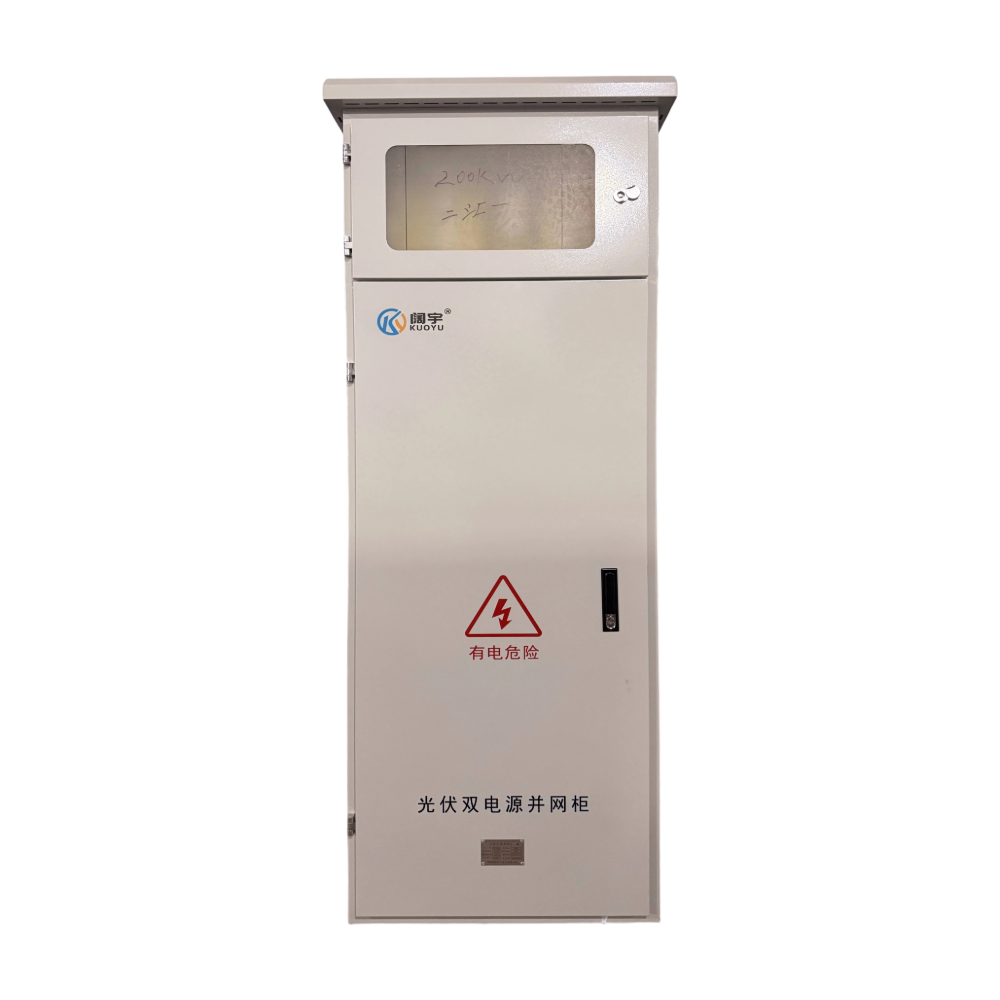
Distribution cabinet platform — enclosure fabrication and electrical assembly are carried out on the same manufacturing site.
What the Four Facility Numbers Actually Indicate
Facility metrics are only useful when each one is connected to a procurement consequence. Read individually, the four reported figures describe different parts of the same production system.
| Reported metric | Value | What it indicates for a PV box buyer |
|---|---|---|
| Facility area | 9,000 m² | Enclosure fabrication and electrical assembly are located on one site, which shortens the handling path between metalwork and final assembly for custom configurations. |
| Workforce | Approximately 80 employees | Labour is available across cutting, forming, welding, assembly, wiring and inspection; reallocation of this pool is what converts floor space into monthly throughput. |
| Annual capacity | 30,000 sets | A steady-state annual rhythm that recurring project batches and export programs can be planned against, rather than an on-demand monthly figure. |
| R&D team | 10 engineers | In-house engineering capacity for drawing review, enclosure layout, protection-class selection and custom configuration work. |
Source: company manufacturing profile — 9,000 m² facility, approximately 80 staff, 30,000-set annual capacity, 10-engineer R&D team.
Taken together, the four figures describe a mid-volume, vertically integrated assembly operation: enclosure fabrication and electrical assembly happen on one site, engineering is handled in-house rather than outsourced, and annual output is large enough to serve recurring project batches without being so large that a small configuration disappears into a backlog.
From 9,000 m² to 30,000 Sets: How the Capacity Is Structured
Capacity claims become credible when the underlying process is visible. Kuoyu's stated sequence runs from raw material procurement, through scheme design, to assembly production and finished product acceptance, with each stage supervised by technicians.
For a distribution box, the pacing step is usually enclosure fabrication rather than final wiring. Sheet metal processing — cutting, punching and bending — sets the rate at which empty enclosures become available. Assembly then installs busbars, circuit breakers, contactors, relays, grounding devices, indicator lights and cooling fans, and testing follows before dispatch. A 9,000 m² site that contains both the sheet metal workshop and the complete equipment assembly workshop removes an inter-factory transport step that can otherwise add days to a custom enclosure order.
A 30,000-set annual capacity is a planning figure, not a promise of daily output. Spread across a working year it describes a rhythm; order books in this industry are rarely even. The useful buyer question is therefore how a supplier sequences a new order into that rhythm, particularly when the order is a non-standard configuration. The roughly 80-person workforce is what turns floor space into throughput — cutting and forming, welding and finishing, assembly and wiring, and inspection all draw on the same labour pool, and how that pool is allocated determines whether a project-specific box ships early or late.
The Role of a 10-Engineer R&D Team in PV Box Customization
Photovoltaic distribution assemblies rarely ship as catalogue items. A project may call for a specific breaker brand, a defined number of DC input strings, surge protection devices on the DC or AC side, an isolated configuration, a particular cable entry arrangement, or an enclosure rated for outdoor mounting. Each choice changes the internal layout, and layout changes are engineering work rather than sales work.
A 10-engineer team sets the ceiling on how many of those changes can be handled at once and how quickly a drawing can be reviewed, corrected and released to the workshop. In a practical sourcing sequence, that work covers:
- Drawing review: confirming that the specified busbar, breaker and surge protection layout fits the enclosure without violating clearance requirements.
- Enclosure and platform selection: matching the application to a protection class — PZ30 series boxes at IP40/IP54, or the GGD/GCS/MNS series cabinet at IP54/IP65 for outdoor duty.
- Material selection: cold-rolled steel plate, optional stainless steel, or ABS plastic depending on the environment and mechanical requirement.
- Documentation for site: labeling, wiring schematics and terminal identification that commissioning teams rely on.
Buyers assessing technical depth should ask for evidence of this work rather than descriptions of it — a redlined drawing from a previous custom order, or a layout study showing how a surge protection device was repositioned to preserve clearance, tells a procurement team more than a capability statement.
The Product Scope the Facility Supports
The output described above is applied across a defined product family. Two platforms are most relevant to photovoltaic distribution work.
PZ30 Series distribution box
PZ30 is an industrial and residential distribution box with a rated voltage of 220V/380V, a rated current up to 125A and a protection class of IP40/IP54. It is constructed from high-quality ABS plastic, cold-rolled steel plate, or stainless steel, and serves residential, commercial, industrial and power control applications. In a photovoltaic scope, this is the branch-level platform: AC distribution downstream of the inverter, auxiliary power circuits, and smaller grouping positions.
GGD/GCS/MNS Series distribution cabinet
The GGD/GCS/MNS series is a waterproof distribution cabinet with a rated voltage of 380V/220V, a rated current up to 6300A and a protection class of IP54/IP65. It is built from cold-rolled steel plate, with stainless steel available as an option, and is designed for indoor and outdoor industrial, commercial and infrastructure applications. This is the platform that carries outdoor, higher-current and inverter-integration duty, including grid-connected distribution positions where larger conductors and higher fault levels apply.
The same manufacturing base also produces S11/S13 series oil immersed transformers (voltage class 10kV–35kV, capacity 10kVA–31500kVA) and ZGS11 series pad mounted transformers (10kV/0.4kV, 100kVA–2500kVA). That breadth matters for buyers assembling a wider package: the box, cabinet and transformer content of a power distribution scope can be reviewed against a single manufacturing schedule.
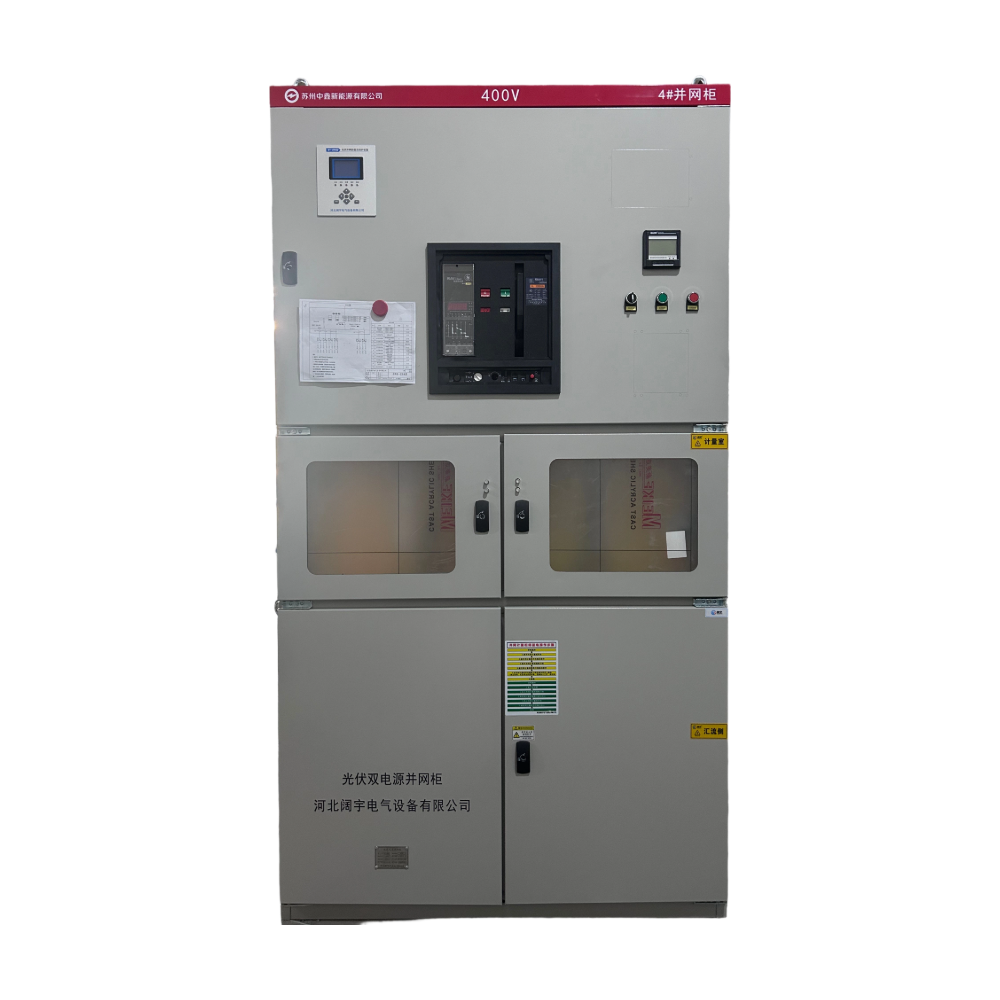
GGD/GCS/MNS series cabinet — the IP54/IP65 rated platform intended for indoor and outdoor industrial, commercial and infrastructure distribution.
Operating Conditions the Boxes Are Engineered For
The applications behind these products specify conditions that match real photovoltaic sites: indoor and outdoor environments with high humidity, high and low ambient temperatures, and dust-prone power distribution areas. Operation is described as 24/7 continuous. Interface equipment typically includes circuit breakers, contactors, relays, busbars, grounding devices, indicator lights and cooling fans. The stated special requirements are waterproof and dustproof construction, corrosion resistance, high mechanical strength, customizable structure and flame-retardant materials, with explosion-proof construction listed for certain power distribution environments.
Translated into a purchase order, this is the difference between generic and specific language. "Outdoor solar distribution box" becomes a defined protection class, an enclosure material, a mounting method, cable entry positions and a corrosion-resistance requirement. Vague procurement language is one of the most common reasons a delivery arrives with an enclosure that cannot be installed as planned.
Boundaries and Trade-offs Buyers Should Account For
A credible supplier assessment states limits as clearly as capabilities. Four boundaries follow from the profile above.
Protection class depends on the platform chosen
PZ30 standard protection is IP40/IP54, which suits sheltered or indoor mounting. It is not IP65. Projects requiring washdown, direct rain exposure or sustained dust loading should be specified on the GGD/GCS/MNS cabinet platform or on a customized enclosure, rather than assumed from a box-level product.
30,000 sets per year is a mid-volume steady state
The figure supports recurring project batches and export programs; it does not describe unlimited surge absorption. A buyer consolidating an unusually large single-year volume into one mid-size supplier should plan order sequencing with the factory, or split volume across suppliers, instead of assuming the annual figure is available in the month it is needed.
Engineering capacity is finite
Ten engineers and roughly 80 staff define how many bespoke configurations can be processed in parallel. Highly customized, non-standard projects benefit from early engagement — drawing freeze, sample confirmation, then volume — so that engineering hours are booked before the production window opens.
Single-site manufacturing has a different service geometry
Multinational suppliers named among the key players in the PV combiner box market — including Schneider Electric, Eaton, ABB, Sungrow and Weidmüller, per Future Market Insights — operate distributed global service and support networks. A single 9,000 m² site in Shijiazhuang cannot replicate that footprint. The relevant comparison is fit: buyers whose projects concentrate in the markets where Kuoyu already exports, Southeast Asia and Africa, are evaluating a different support model from buyers who require on-site service across several continents.
No protection rating, standard or certification should be treated as project-ready until the specific documentation for the destination market is in the buyer's file.
Compliance References for Evaluation
Two published standards frame the compliance conversation. IEC 61439-2:2020 defines requirements for power switchgear and controlgear assemblies used in photovoltaic installations, with Annex DD, EE and FF addressing PV-specific assemblies. For North America, UL 1741 is the primary safety standard for PV inverters, converters and combiner boxes used in grid-connected systems.
Neither reference is a statement about a specific supplier. Their value in a sourcing file is as a mapping tool: they convert "is this compliant?" into a defined list of documents to request, tests to confirm, and market-specific requirements to check before the purchase order is issued.
A Practical Verification Checklist
The following questions convert facility claims into verifiable items during supplier qualification.
| Evidence to request | What it establishes | Warning sign |
|---|---|---|
| Factory profile with site area, headcount and annual capacity | Whether stated scale matches the order volume | Capacity described only in adjectives |
| Workshop layout or photographs of sheet metal and assembly areas | Whether enclosure fabrication is genuinely in-house | Inability to describe which processes are outsourced |
| Drawing review turnaround for a non-standard configuration | Real engineering throughput, not just design capability | "Any configuration" offered with no drawing review step |
| Protection class documentation for the selected platform | Whether the enclosure matches the mounting environment | An IP rating quoted without naming the platform |
| Market-specific certification documents | Destination-market compliance | Standards named as if they were certifications held |
| Typical production slot duration for a mid-volume order | Whether the requested delivery date is achievable | Lead time quoted without reference to the order book |
Where Capacity Meets the Next Market Shift
The mix inside the category is expected to change. Future Market Insights expects DC Smart PV Combiner Boxes to hold a 62.5% share of the segment by 2035, which would make DC-side architecture the dominant configuration rather than a specialist option. DC-oriented assemblies increase the engineered content inside the enclosure: DC-rated protection, monitoring provisions and layout discipline for higher string counts.
For manufacturers, that favours operations which already combine enclosure fabrication with electrical assembly and in-house engineering, because DC layout changes are workshop changes as much as design changes. For buyers, it means the facility evidence reviewed today is a proxy for how a supplier will handle the next generation of configurations. A 9,000 m² site with in-house sheet metal processing, a 30,000-set annual rhythm and a 10-engineer team is a compact but complete industrial base. Whether it is the right base depends on order profile, destination market and how much customization the project actually requires.
FAQ
What is a photovoltaic distribution box in a solar power system?
A photovoltaic distribution box is an enclosure that houses the switching, protection and connection components used to distribute electrical power within a PV installation. It typically contains circuit breakers, contactors, relays, busbars, grounding devices, indicator lights and cooling fans, and provides safe circuit control, power distribution management, and overload and short-circuit protection for connected equipment. Configurations range from small branch-level boxes such as the PZ30 series — rated 220V/380V, up to 125A, IP40/IP54 — to larger outdoor cabinets such as the GGD/GCS/MNS series, rated 380V/220V with current up to 6300A and IP54/IP65 protection.
How can a buyer verify a manufacturer's stated production capacity?
Cross-check four items: facility area, number of production staff, annual output figure, and evidence that key processes are performed in-house. Hebei Kuoyu Electrical reports a 9,000 square meter facility, approximately 80 employees and an annual capacity of 30,000 sets, and states that it independently operates sheet metal processing workshops and high and low voltage complete equipment assembly workshops. Verification means matching those statements to specifics: which processes run on site, how a new order is sequenced into the existing book, and what production slot a comparable order would receive. Capacity claims that cannot be described in process terms are not verifiable.
What does an annual capacity of 30,000 sets mean for a single project order?
It describes the facility's steady-state output over a year, not the output available in any given month. For a specific order, the practical derivations are the production slot allocated to it, the lead time from drawing freeze to dispatch, and whether the volume can be absorbed without displacing existing commitments. Buyers placing unusually large single-year volumes should sequence orders with the factory or split volume across suppliers, because an annual figure is a planning input rather than a delivery guarantee.
Does R&D team size affect delivery, or only product design?
It affects both. In photovoltaic distribution box sourcing, most orders involve configuration changes such as different breaker brands, string counts, surge protection placement, cable entry positions and enclosure ratings. Each change requires drawing review, layout revision and release to production. A 10-engineer team sets the number of configurations that can be processed in parallel, so engineering capacity directly influences how quickly a custom order reaches the workshop and how reliably it ships as specified.
What protection rating does an outdoor solar distribution box need?
The rating must match the mounting environment, and it is platform-specific rather than universal. In Kuoyu's range, PZ30 series boxes are rated IP40/IP54, which suits sheltered and indoor installation, while the GGD/GCS/MNS series distribution cabinet is rated IP54/IP65 and is intended for indoor and outdoor industrial, commercial and infrastructure use. Outdoor sites exposed to rain, washdown or sustained dust loading should be specified on the higher-rated platform or on a customized enclosure, with the requirement written into the purchase specification rather than assumed.
How should standards such as IEC 61439-2 and UL 1741 be used in supplier evaluation?
As a mapping tool, not a shortcut. IEC 61439-2:2020 sets requirements for power switchgear and controlgear assemblies used in photovoltaic installations and includes PV-specific annexes DD, EE and FF; UL 1741 is the primary safety standard for PV inverters, converters and combiner boxes in North American grid-connected systems. Buyers should use them to define which documents, test evidence and market-specific approvals to request from each shortlisted supplier, and should confirm the actual documentation rather than treating a standard's name as evidence of compliance.
Reading Facility Evidence Correctly
Manufacturing scale is not proof of quality on its own; it is evidence about a supplier's ability to reproduce a specification within a schedule. For distribution boxes for photovoltaics, the useful reading of Hebei Kuoyu Electrical's profile is narrow and specific: 9,000 m² with in-house sheet metal and assembly workshops, approximately 80 staff, a 30,000-set annual rhythm, and 10 engineers who determine how much of a project's customization can be absorbed in a given window. Buyers who require boxes, cabinets and transformers under one production schedule can review the company's full product documentation, which is available for download: Kuoyu Electrical product brochure (PDF).