
Factory Evidence for Wire Drawing Machine Suppliers: Build, Cabinets and Customization
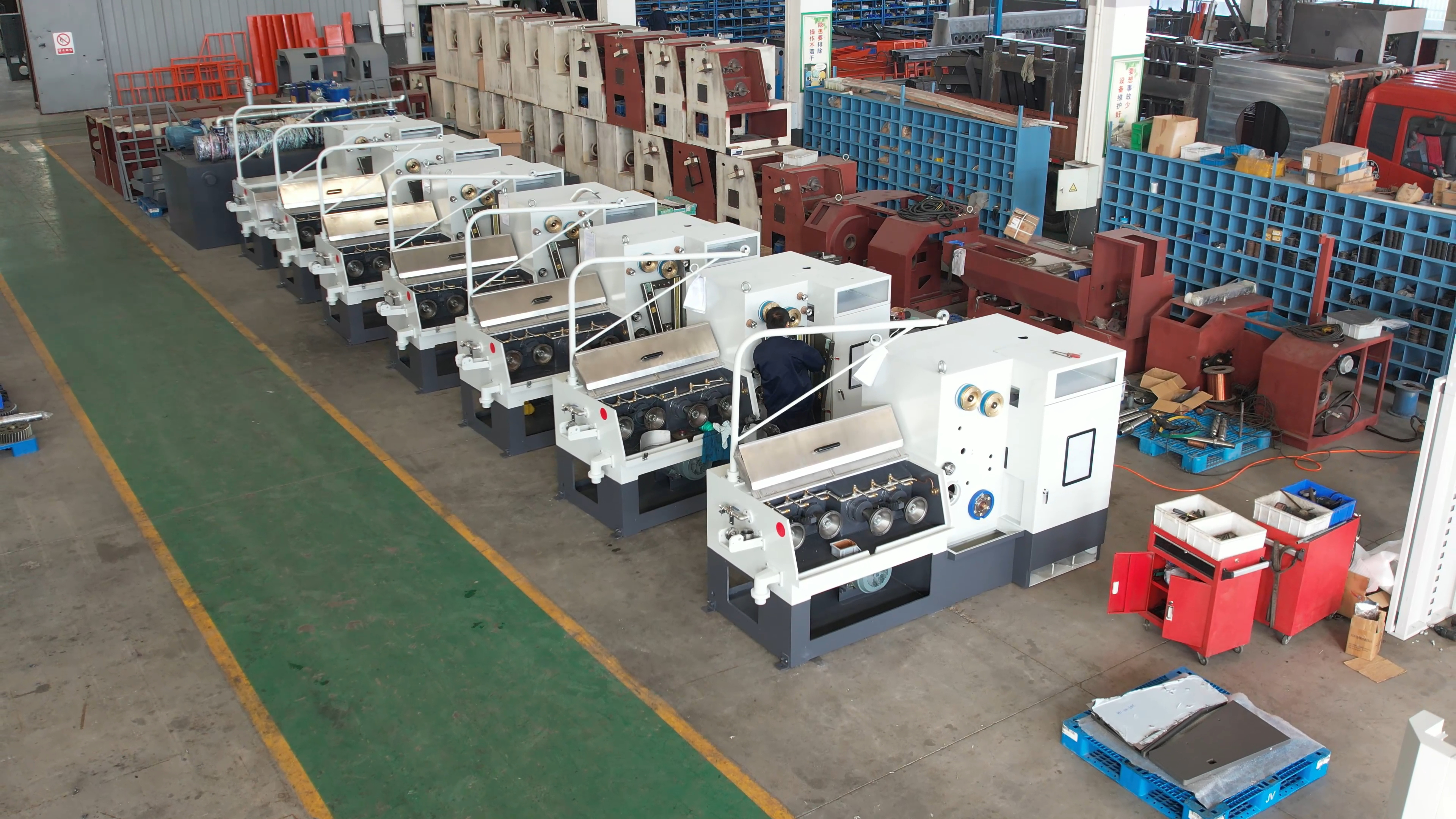
A wire drawing machine is bought as a production asset, so supplier evaluation should begin with the build record rather than the brochure cover. For a copper wire drawing machine, fine wire drawing machine or multi-wire drawing machine, the buyer needs to see how the frame is made, which capstan system is used, how the spool is handled, what the control cabinet contains and which parts can be customized without changing the published limits. Jiangsu Listrong Mechanical & Electrical Co., Ltd. is a wire and cable equipment manufacturer based in Dongtai City, Jiangsu, China, producing wire drawing machines, annealing machines and wire bunching machines for bare copper, copper alloy and stainless steel wire. Its product record offers a practical example of how factory evidence can be read.
Why factory evidence matters more than a capability statement
Most suppliers can state that they build durable wire drawing machines. The buyer’s problem is that many claims are not testable from a catalogue. In a multi-wire drawing machine, small differences in capstan alignment, spool tension or pneumatic clamping can appear later as wire breakage, uneven elongation or extra operator intervention. In a fine wire drawing machine, the spool and take-up arrangement can matter as much as the maximum speed figure.
The opportunity is to turn build details into acceptance questions. Instead of asking whether a supplier is ‘professional’, a buyer can ask which frame is welded from steel plate, how many capstan tiers are used, whether the final capstan has a keyslot, what spool capacity is stated, what cabinet dimensions are recorded and which electrical brands are allowed. These are not marketing questions. They are questions that can be checked against drawings, photographs, component lists and pre-shipment test records.
Listrong’s factory record: what can be verified
Jiangsu Listrong Mechanical & Electrical Co., Ltd. was founded in 2009 and operates a 15,000 m² factory with 70 employees, including 15 engineers. The company reports an annual output of 550 sets, a monthly capacity of 45–50 sets of wire drawing machines, a typical production lead time of 50–90 days and a minimum order quantity of one set. Its export ratio is 40%, with main markets in the Middle East, India and South East Asia.
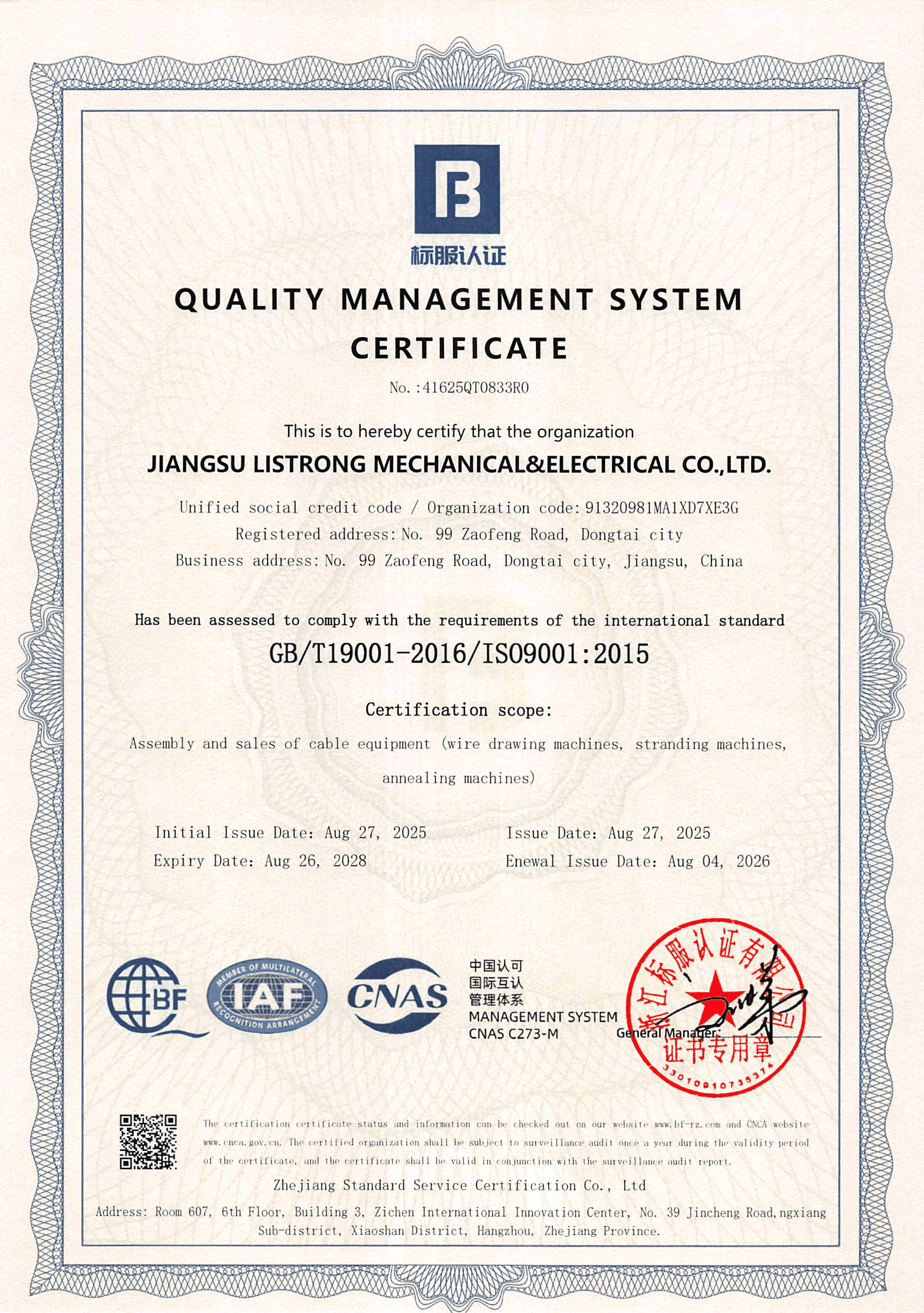
Quality control is based on 100% pre-shipment testing of each finished machine. After-sales support includes remote technical support and a one-year warranty. The company holds an ISO 9001:2015 quality management system certificate, certificate number 41625QT0833R0, issued by Zhejiang Standard Service Certification Co., Ltd., covering wire drawing machines, stranding machines and annealing machines. It also holds a CE verification of conformity, certificate CE-JL26020401-AL-MD, issued by ICG, covering models that include the 22DTA, 20-4DT, 24-2DT, 9DST and 24DT.
Build evidence 1: frame construction and machine records
The frame is the first place to separate a model record from a general claim. The 22DTA fine wire drawing machine lists a frame welded by steel plate, a machine dimension of 3500L × 1600W × 1700H mm and a net weight of 3500 kg. The 20-4DT multi-wire drawing machine lists a steel plate welded structure. The 24-2DT fine wire drawing machine lists a frame welded by steel plate. The 9DST intermediate wire drawing machine lists steel as its material and a two-shaft horizontal arrangement. The 24DT fine wire drawing machine also lists a frame welded by steel plate.
These details matter because they can be linked to acceptance. A buyer can ask for the model-specific general arrangement drawing, confirm the frame type in the drawing and compare it with the pre-shipment photograph. For the 22DTA, the published machine dimension and net weight give a baseline for foundation and lifting planning. For the 24DT, the record states 3000 kg net weight, 2100L × 1600W × 1700H mm machine dimensions and a 1000L × 800W × 1800H mm electric control cabinet. That is a model-level record, not a family average.
The 9DST is a useful example of why model-level checking is necessary. In the available record, the 9DST lists steel construction, a two-shaft horizontal arrangement, a 55 kW drive motor, an 11 kW spooler motor, fully immersing lubrication at 150 L/min, a maximum mechanical speed of 1200 m/min and defined power, air and water requirements. It does not publish a 3000 kg net weight or a cabinet size in that record. The 3000 kg net weight and 1000 × 800 × 1800 mm cabinet in this evidence set belong to the 24DT, not to the 9DST. A buyer should not accept a mixed family sheet when the foundation, lifting plan or electrical room depends on the number.
Build evidence 2: capstan material, tier count and final capstan
The capstan package is the mechanical heart of a wire drawing machine. The 22DTA record specifies ceramic capstans: four 10-tier capstans and one single-tier capstan for final drawing, with an extra keyslot. The 20-4DT record specifies ceramic-coated aluminum capstans: four 10-tier capstans, including two final drawing capstans. The 24-2DT record specifies ceramic-coated capstans: four 11-tier capstans and one single-tier capstan for final drawing. The 24DT record specifies ceramic-coated capstans: four 11-tier capstans and one single-tier capstan for final drawing.
For a fine wire drawing machine, the tier count and final capstan are not cosmetic details. They affect how the wire path is arranged and how the last drawing pass is controlled. For a multi-wire drawing machine such as the 20-4DT, the buyer should check that the die base can be adjusted according to capstan size, because the machine uses 20 dies × 4 and the No. 1 die is independent while No. 2–19 dies are cast iron. The same adjustment point is stated for the 22DTA and 24-2DT: the die pedestal can be adjusted according to the capstan.
What should be verified? First, the material named in the quotation: ceramic, ceramic-coated aluminum or another specified material. Second, the number of tiers and the number of final capstans. Third, whether the final capstan has the stated keyslot where applicable. Fourth, the die base adjustment range and the die dimensions accepted by the model. A supplier may use the phrase ‘wear-resistant capstan’, but the buyer should ask for the material and the replacement part record behind that phrase.
Build evidence 3: protection covers, spool capacity and take-up design
Protection covers and take-up design are often where factory evidence becomes visible. The 22DTA record specifies a grille for the transmission area, stainless steel plate for the drawing area and a sealed cover with three inspection windows for the spooling area. Its spool dimension is outer diameter DIN200/250, according to customer requirements, with a spool receiving capacity of 25 kg. The bobbin loading and unloading type is a single bobbin fixed with a screw, with a loading and unloading cart. The spooling control uses weight balance by swing arm and automatically revises spooling tension.
For the 20-4DT multi-wire drawing machine, the bobbin size is customized as per customer requirement. The take-up capacity is 25 kg × 4 for the four-bobbin spooler, or a maximum of 500 kg × 1 for a single bobbin on the QD630E. Bobbin loading and unloading use pneumatic take-up. The traversing unit for the four-bobbin spooler uses stepper motor control with adjustable traversing speed; the QD630E single bobbin uses stepper motor control with traversing width adjustable by timing motor. The machine uses a tension sensor and a ceramic-coated aluminum pulley.
For the 24-2DT, the spool dimension is customized, and the capacity for spool receiving is 25 kg × 2. The bobbin loading and unloading type is double-bobbin pneumatic take-up. The traversing system uses step motor control with adjustable traversing speed, and tension is measured by sensor. The brake is controlled by a brake motor, and the machine automatically brakes upon power supply cut-off without requiring a UPS. The 24DT record specifies an outer diameter DIN250 mm spool, or according to customer requirements, with a single bobbin fixed by screw and a loading and unloading cart.
Acceptance criteria should follow the same detail. For a customized spool, the buyer should approve a spool drawing before production, including outer diameter, inner diameter, outer width, inner width and bore diameter where the model record provides them. For pneumatic take-up, the buyer should witness or review a clamping and release test. For tension control, the buyer should confirm that the tension sensor and swing-arm control are included in the pre-shipment test. These checks are more useful than a general statement that the machine is ‘automatic’.
Build evidence 4: control cabinets, electrical parts and utility requirements
The control cabinet is part of the physical build, not an accessory. The 22DTA record gives an electric control cabinet of 1000L × 800W × 2000H mm and states that electric control parts are made in China and Taiwan or overseas, top-class brand. The 20-4DT record states that electrical components are top-class brands from China and overseas, with a power supply of three-phase 380/415 V, 50 Hz, customizable. The 24-2DT record states that electric control parts are made in China and Taiwan or overseas, top-class brand, with a power source of three-phase 415 V, 50 Hz. The 24DT record gives a 1000L × 800W × 1800H mm cabinet and names the relay as OMRON and the switch as LG.
For the 9DST intermediate wire drawing machine, the record lists utility requirements rather than a cabinet size. It specifies three-phase voltage of AC 3 × 380 V ±10%, single-phase voltage of AC 220 V ±10%, frequency of 50 Hz ±2%, compressed air at 0.6–0.7 MPa with a flow rate of 200 L/min, and water at 0.2–0.4 MPa, ≤25 °C, pH 7–8 and 420 L/min. These figures belong in the plant planning file. They also give the buyer a clear acceptance baseline: the machine should be installed where the air and water supply can meet the stated values, and the electrical room should be sized from the model record, not from a rough family estimate.
When reviewing electrical parts, ask for the cabinet drawing, the component brand list, the terminal numbering scheme and the voltage/frequency confirmation. A claim of ‘top-class brand’ is not enough for spare-parts planning. The buyer should know which brands are used for relays, switches, inverters, PLCs and other key items where the model record names them. The 24DT record naming OMRON and LG is an example of a more specific statement. The 20-4DT record naming China and overseas brands is less specific, so the purchase order should attach an approved brand list.
Multi-Wire Drawing Machine focus: the 20-4DT as a build evidence case
The 20-4DT is a multi-wire drawing machine for bare copper wire. It accepts a maximum inlet of 4 × Φ1.60 mm and produces 4 × Φ0.15–0.50 mm at a maximum drawing speed of 1500 m/min. It uses 20 dies × 4, supplied by the customer, with a die size of Φ25 mm × 8–10 mm thickness. No. 1 die is independent, No. 2–19 dies are cast iron, and the base can be adjusted according to capstan size. The slip ratio is 15% from No. 1 to No. 19 and 8% at No. 20.
The drive arrangement is a 37 kW main drawing motor with AC variable frequency control, plus spooling motors of 3.7 kW × 4 and 11 kW × 1. Annealing is DC 70 V with a maximum DC 1200 A and 84 kVA. The frame is a steel plate welded structure. The capstan set is ceramic-coated aluminum, with four 10-tier capstans including two final drawing capstans. Lubrication is spray type at 40 L/min, with independent lubrication pipes for the No. 1 and No. 20 dies.
For a buyer, the 20-4DT record supports a practical acceptance checklist: confirm the 4 × Φ1.60 mm inlet and 4 × Φ0.15–0.50 mm outlet against the cable or wire schedule; confirm the 20 × 4 die stack and the customer-supplied die dimensions; confirm the adjustable die base; confirm the four-bobbin and single-bobbin take-up options; confirm pneumatic take-up; confirm tension sensor control; confirm brake motor operation on power failure; and confirm the electrical brand list and voltage. These are the points that connect the build to the production plan.
Multi-Wire Drawing Machine focus: the 24-2DT and customization boundaries
The 24-2DT is a fine wire drawing machine for bare copper wire. It accepts 2 × Φ0.60–1.20 mm and produces 2 × Φ0.10–0.30 mm at a maximum drawing speed of 2000 m/min. It uses 24 dies × 2, supplied by the customer, with a die size of Φ25 mm × 8–10 mm thickness. No. 1 die is independent, No. 2–23 dies are cast iron, and the pedestal can be adjusted according to the capstan. The frame is welded by steel plate. The capstan set is ceramic coated, with four 11-tier capstans and one single-tier capstan for final drawing.
The 24-2DT customization points are concrete: the spool dimension is customized, and the spool receiving capacity is 25 kg × 2. The take-up is a double-bobbin pneumatic type, with step motor traversing and adjustable traversing speed. Tension is measured by sensor, and the brake is controlled by a brake motor with automatic braking on power cut-off and no UPS requirement. Electric control parts are made in China and Taiwan or overseas, top-class brand. The power source is three-phase 415 V, 50 Hz. These details show where customization is possible and where the model record sets a boundary.
One boundary is important. The available 24-2DT record states double-bobbin pneumatic take-up. It does not use the phrase 'shaftless take-up’ in that model record. In this evidence set, the shaftless pneumatic take-up wording is associated with a different intermediate machine, the 17-2DST. A buyer should therefore ask for the take-up drawing and the clamping method for the exact model, rather than assuming that a take-up description from one machine applies to another. The same rule applies to spool dimensions, cabinet size and machine weight.
Application fit: where the build evidence connects to use
These machines are used in wire and cable manufacturing, electronics and electrical appliances, new energy vehicles and telecommunications. A fine wire drawing machine such as the 22DTA is used for bare copper wire drawing and annealing, with applications that include enamel-coated wire for motor and transformer windings, electronic wires and network cables, automotive sensor harnesses and fine copper conductors. The 24-2DT and 24DT are fine wire platforms for bare copper and, in the 24DT case, copper-clad aluminum wire. The 9DST is an intermediate wire drawing machine for bare copper wire, with applications in power cables, communication cables, automotive wiring harnesses, electronic components and building wiring.
The 20-4DT multi-wire drawing machine is aimed at efficient production of multi-strand conductors and fine electronic or electrical cables. Its four-wire configuration and 20-die stack make the die base adjustment, spool customization and pneumatic take-up part of the production decision, not just the purchase decision.
Listrong’s case record for cable manufacturer clients in Iran and North Macedonia lists one set and two sets of multi-wire drawing machines installed in the two countries, with project durations of two years in Iran and one year in North Macedonia. The reported case outcomes include 35% energy saving, reduced labor costs, stable operation and zero major failures, with low noise and full automatic operation. These are first-party case records and should be read as supplier-reported evidence, not as an independent audit. Their value is that they identify the operating points a buyer can ask about: noise, automation, wire tightness consistency and parameter stability.
Market trend: growth does not remove the need for build evidence
Commercial research cited in the verified data package estimates the global wire drawing machine market at USD 3.8 billion in 2025, with a forecast of USD 6.1 billion by 2034 at a CAGR of 5.47% from 2026 to 2034. The same data package notes that different research estimates vary because of scope, including whether spare parts, dies and service revenue are included. For a buyer, the trend is useful as a timing signal, not as a substitute for model evidence. Demand from electrification and lightweighting is cited as a driver in the commercial research, and the trade classification for machine tools for working metal wire is HS 8463.30.00.
When a market is expanding, suppliers may be tempted to present family-level specifications as if they were model-level guarantees. The safer procurement approach is to lock the model record into the purchase order: frame type, capstan material and tier count, spool capacity, cabinet dimensions, electrical brand list, utility requirements and pre-shipment test items. Market growth can shorten lead times, but it does not change the fact that a 3000 kg machine and a 3500 kg machine require different lifting and foundation planning.
Comparison with traditional supplier claims
Traditional supplier evaluation often relies on broad statements: heavy-duty frame, wear-resistant capstan, automatic take-up, top-brand electrical parts. These statements can be true, but they are not yet acceptance criteria. The table below converts them into verifiable records and states the boundary that remains.
| Buyer question | Traditional answer | Verifiable factory evidence | Limit or boundary |
|---|---|---|---|
| Is the frame heavy-duty? | Heavy welded frame | 22DTA: frame welded by steel plate, 3500 kg net, 3500 × 1600 × 1700 mm. 20-4DT: steel plate welded structure. 24-2DT: welded by steel plate. 9DST: steel construction, two-shaft horizontal arrangement. 24DT: welded by steel plate, 3000 kg net, 2100 × 1600 × 1700 mm. | Steel construction alone does not prove rigidity. The buyer still needs the model drawing, foundation plan and lifting plan. The 9DST record does not list 3000 kg or a cabinet size; those figures belong to the 24DT in this evidence set. |
| Is the capstan wear-resistant? | Wear-resistant capstan | 22DTA: ceramic, four 10-tier plus one single-tier final capstan with extra keyslot. 20-4DT: ceramic-coated aluminum, four 10-tier including two final capstans. 24-2DT: ceramic-coated, four 11-tier plus one single-tier final. 24DT: ceramic-coated, four 11-tier plus one single-tier final. | Material and tier count do not replace die quality, lubricating oil quality, wire rod quality, spool quality and operator skill. Those variables are explicitly listed in the 25-16DT efficiency note and apply to drawing performance generally. |
| Is the take-up automatic? | Automatic take-up | 20-4DT: customized bobbin, 25 kg × 4 or 500 kg × 1 QD630E, pneumatic take-up, tension sensor, stepper traversing. 24-2DT: customized spool, 25 kg × 2, double-bobbin pneumatic take-up, step traversing, tension sensor. 22DTA: 25 kg spool, swing-arm weight balance, automatic tension revision. | Automatic control does not mean every spool size is suitable. Spool dimensions and capacity must be approved per model. The 24-2DT record does not use the shaftless take-up wording; that wording is tied to the 17-2DST in this evidence set. |
| Are the electrical parts top-class? | Top-brand electrical parts | 22DTA: cabinet 1000 × 800 × 2000 mm, electrical parts from China and Taiwan or overseas. 20-4DT: China and overseas brands, 380/415 V, 50 Hz. 24-2DT: China and Taiwan or overseas brands, 415 V, 50 Hz. 24DT: cabinet 1000 × 800 × 1800 mm, relay OMRON, switch LG. | ‘Top-class brand’ is not a bill of materials. The purchase order should attach an approved brand list, cabinet drawing and terminal schedule. Cabinet size is model-specific and must not be copied from another model. |
The most important limitation is that factory evidence is evidence of build, not a guarantee of wire quality. A welded frame, ceramic capstan and pneumatic take-up can support stable production only when the die schedule, lubrication, wire rod, spool condition and operator settings are controlled. A supplier that presents build evidence honestly should also be willing to state these dependencies.
Future outlook: from brochure claims to acceptance files
The next stage in supplier evaluation is likely to be the acceptance file. Buyers will ask for model-level general arrangement drawings, cabinet drawings, spool drawings, component brand lists, utility matrices and pre-shipment test records before the machine is shipped. For a multi-wire drawing machine, the acceptance file should show the die base adjustment, the spool clamping method, the tension control method and the brake behavior on power failure. For a fine wire drawing machine, it should show the capstan tier arrangement, the final capstan keyslot where applicable and the spool capacity.
Customization will also be managed more formally. Listrong’s stated customization options include logo, language, voltage, motor and frequency inverter. Model records add bobbin or spool dimensions, die base adjustment and voltage variants. A clear supplier will convert each option into an approved drawing or a purchase-order line, so that a customized spool or voltage does not become an undocumented change. The factories that can provide this evidence will be easier to shortlist, not because their brochures are more attractive, but because their build records are easier to audit.
FAQ
What factory evidence should a buyer request from a wire drawing machine supplier?
Request the model-specific general arrangement drawing, frame construction record, capstan material and tier count, protection cover description, spool drawing and capacity, cabinet dimensions, electrical brand list, utility requirements and the pre-shipment test checklist. For Listrong, the quality control record states 100% pre-shipment testing of each finished machine, and the certification record includes ISO 9001 certificate 41625QT0833R0 and CE certificate CE-JL26020401-AL-MD for listed models.
How can a buyer verify the build of a multi-wire drawing machine?
Use the 20-4DT as an example. The record states a 4 × Φ1.60 mm maximum inlet, 4 × Φ0.15–0.50 mm outlet, 20 dies × 4, 1500 m/min maximum speed, a steel plate welded structure, ceramic-coated aluminum capstans with four 10-tier units including two final capstans, a die base adjustable to capstan size, customized bobbin size, 25 kg × 4 or 500 kg × 1 take-up, pneumatic take-up, tension sensor control and a 37 kW main drawing motor. The buyer can check each item against the drawing and pre-shipment record.
What customization is documented for these wire drawing machines?
The company-level customization list includes logo, language, voltage, motor and frequency inverter. The product records add model-specific customization: the 22DTA spool is DIN200/250 or according to customer requirements; the 20-4DT bobbin size is customized and its die base can be adjusted to capstan size; the 24-2DT spool dimension is customized; the 24DT spool is DIN250 or according to customer requirements. Power supply options are also stated, such as 380/415 V, 50 Hz on the 20-4DT and 415 V, 50 Hz on the 24-2DT.
What acceptance checks apply to take-up, brakes and control cabinets?
For take-up, check the approved spool drawing, the stated capacity, the clamping method and the traversing control. For brakes, check whether the machine brakes automatically on power cut-off and whether a UPS is required; the 20-4DT, 24-2DT and 24DT records state automatic braking without a UPS in their respective descriptions. For cabinets, check the model-specific dimensions and the component brand list. The 22DTA cabinet is 1000 × 800 × 2000 mm; the 24DT cabinet is 1000 × 800 × 1800 mm and names OMRON and LG for relay and switch. The 9DST record lists utility requirements rather than a cabinet size.
What are the limits of factory evidence?
Factory evidence can confirm what is built, but it cannot by itself guarantee final wire quality. The 25-16DT efficiency note states that actual performance depends on wire quality, wire drawing die quality, lubricating oil quality, wire reel quality and operator proficiency. The 9DST record shows another limit: steel construction is stated, but 3000 kg net weight and a 1000 × 800 × 1800 mm cabinet are not stated for the 9DST in this evidence set; those figures belong to the 24DT. Buyers should keep every number tied to its exact model and should not accept a family sheet as a substitute for a model-level record.
¿Tiene preguntas o necesita más detalles?
Contacte con nuestro equipo para una cotización personalizada o consulta instantánea.
Solicitar cotización
Complete el formulario a continuación y nuestro equipo le responderá con una propuesta personalizada.
Chat directo de WhatsApp
¿Prefiere chatear en tiempo real? Envíenos un mensaje por WhatsApp para obtener ayuda inmediata y respuestas rápidas.
- Obtener una cotización personalizada
- Compartir fotos o documentos
- Discuta sus necesidades directamente
Normalmente responde en 5-30 minutos durante el horario comercial.