
Factory Evidence: LONGTE's OEM Process for WPC Fluted and Acoustic Panels
The global decorative wall panel market was valued at USD 30.70 billion in 2025, according to a commercial research report covering the 2026–2031 forecast horizon. That figure describes demand. It says nothing about whether a given factory can reproduce the same fluted groove or the same acoustic build on the second, third and fifth container. For buyers in the awareness and research stage, the more useful question is narrower: what does an OEM process actually consist of, and which parts of it can be checked before a purchase order is signed?
This reference examines that question through two profiles from LONGTE's wall panel range — the LT-WG WPC fluted panel and the LT-AC acoustic slat panel — using published specifications, factory data and documented application scenarios.
The Manufacturer Behind the Models
Haining Longtime Industry Co., Ltd., operating under the brand LONGTE, is a Chinese manufacturer of PVC ceiling and wall panels, WPC wall panels, hot stamping foils, PVC lamination films, SPC flooring and WPC decking. The company was established in 2003 in Haining City, Zhejiang Province, and reports an 80,000 m² manufacturing facility, approximately 220 staff, an annual production capacity of 8,000,000 units, a 12-engineer R&D team and an export ratio of 85%. Main markets listed by the company include the USA, Colombia, India, the Philippines, the UAE and South American countries.
A HTNXT industry reference additionally records a monthly production capacity of 800,000 m² of PVC wall panels for LONGTE. That capacity figure and the annual unit figure measure different things — one is area of output, the other is finished units — and should not be combined into a single number.
Why Fluted and Acoustic Profiles Are the Harder Test
Decorative wall panels are usually sold on appearance. Fluted and acoustic profiles are the two categories where appearance is a poor predictor of repeatability, because the visible finish sits on top of a structural decision that buyers rarely see.
A fluted WPC profile is judged by groove geometry — how deep the flute runs relative to the board thickness, and therefore how much material remains behind each groove. An acoustic slat panel is judged as a composite: the slat material, the backing, the resulting noise reduction range and the fire classification all have to reproduce together. Two factories can supply a visually identical sample and still deliver very different products at container scale.
The Two Models at the Centre of This Range
| Specification | LT-WG (customizable) | LT-AC (customizable) |
|---|---|---|
| Category | 3D fluted wall cladding | Sound-absorbing decorative wall panel |
| Material | Wood powder + PVC + additives | MDF slats + polyester acoustic felt |
| Dimensions | 159 × 2900 mm | 600 × 2400 mm |
| Thickness | 12 mm | 21 mm |
| Profile detail | Groove depth 8 mm | Wood veneer surface, polyester felt backing |
| Acoustic rating | Not specified | NRC 0.5–0.85 |
| Fire rating | B1 | B1 |
| Other properties | Waterproof, termite-proof | Cuttable on site |
| Stated applications | Living room TV background, hotel lobby, office | Cinema, studio, office, home theater, restaurant |
Source: LONGTE published product specifications for LT-WG and LT-AC, both marked customizable.
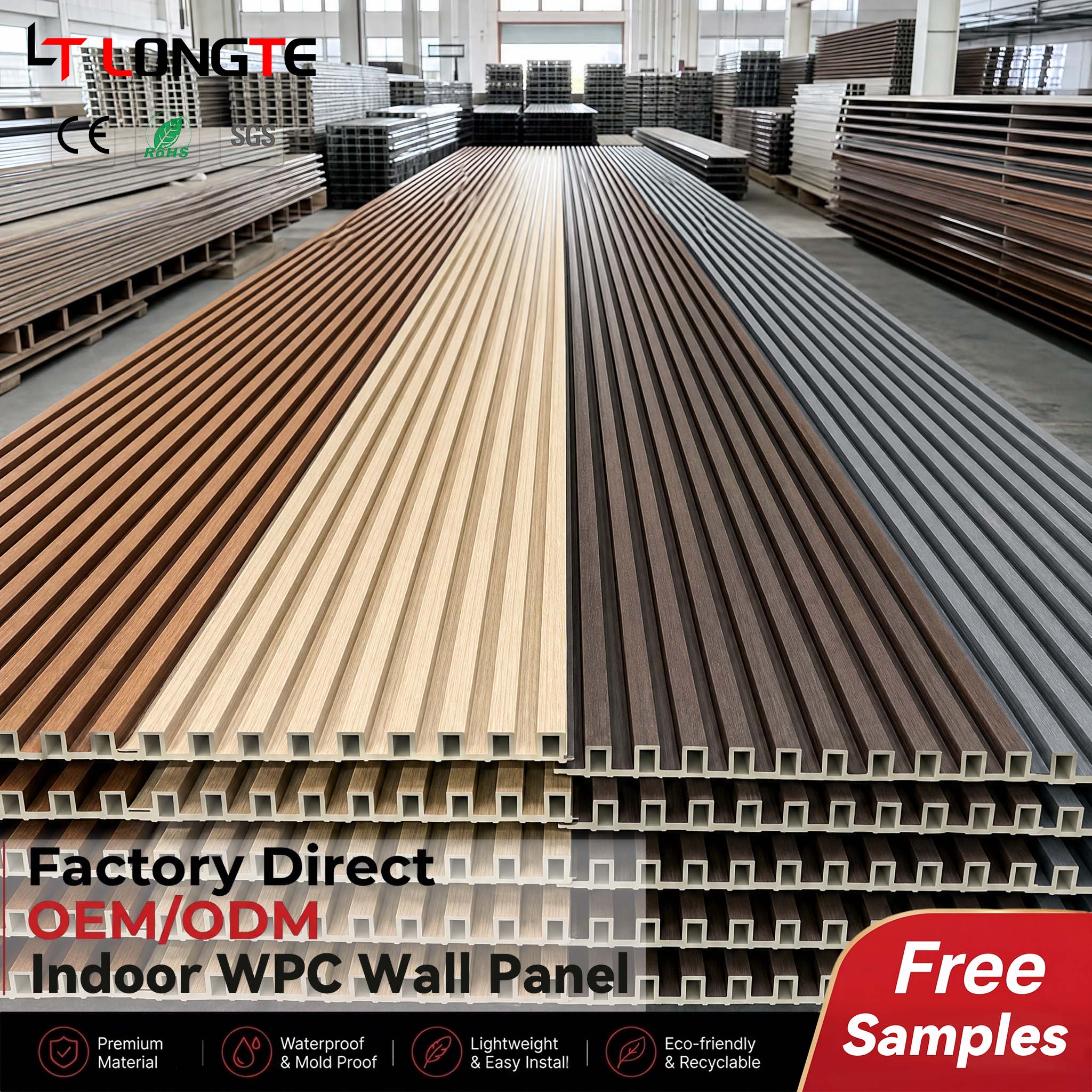
Reading the LT-WG Specification as a Production Statement
The LT-WG is a wood powder and PVC composite fluted cladding board. Three numbers in its specification carry more weight than the surface finish description.
8 mm groove depth inside a 12 mm board
A groove cut 8 mm into a 12 mm section leaves roughly 4 mm of material behind the flute at its deepest point. That residual wall is what determines whether the profile holds its shape through cooling, stacking, transport and installation. A buyer comparing fluted samples should ask for groove depth and total thickness together, because a deeper-looking flute is not an improvement if it has been achieved by thinning the wall behind it.
159 mm cover width and 2900 mm length
A 2900 mm board length is as much a packing and logistics decision as a design one. It determines how panels stack in a container, how much off-cut a wall generates, and how installation sequencing works on a hotel lobby running several metres high. Buyers should confirm the intended installation height before accepting a fixed length.
Waterproof, termite-proof and B1
These three properties place the LT-WG in interior commercial and residential work rather than in exterior cladding. The wood-powder-and-PVC composite is not attacked by termites and does not absorb water in the way a timber batten system would, and the B1 classification supports use in enclosed public interiors such as hotel lobbies and offices.
Reading the LT-AC Specification as a System Statement
The LT-AC is not a single-material board. It is an assembly: MDF slats on a wood veneer face, bonded to a polyester acoustic felt backing, at 600 × 2400 mm and 21 mm overall thickness. Each part of that description affects procurement.
21 mm is an assembly thickness, not a board thickness
The published figure covers slats plus felt. When a designer specifies 21 mm, they are specifying the finished depth that has to be accommodated at the wall, including any mounting rail. Checking the slat dimension separately from the felt dimension is a reasonable request, because those two components govern both the acoustic behaviour and the site fixing detail.
NRC 0.5–0.85 is a range, and the range is the point
A stated range rather than a single coefficient tells the buyer that acoustic performance varies with configuration — slat spacing, felt specification, cavity behind the panel and the proportion of the wall actually covered. In the documented entertainment and media application, the panel is specified at NRC 0.5+ for cinema halls, recording studios, home theaters and conference rooms, with acoustic felt backing, wood mounting rails and LED strip channels listed as supporting equipment. Those accessories are part of the acoustic system, not an optional extra.
On-site cutting and B1 in the same product
The application data notes easy on-site cutting as a specific requirement for these projects, alongside a B1 fire rating. For fit-out contractors this combination matters: panels arrive at a fixed 600 × 2400 mm size, but terminations at columns, soffits and lighting coves are necessarily cut on site. A B1-rated assembly that cannot be cut cleanly creates a compliance problem at exactly the detail where compliance is hardest to prove.
What "Customizable" Covers — and What It Does Not
Every model in LONGTE's published wall panel range carries the "customizable" designation, including LT-PS, LT-PC, LT-PM, LT-BC, LT-SW, LT-FS, LT-PU, LT-WD, LT-SF, LT-WG and LT-AC. In practice this describes a catalogue-level capability rather than bespoke material development, and the supporting evidence sits in the range itself: the LT-BC bamboo charcoal panel is offered in 20+ colour options, the LT-PC ceiling panel in 200+ designs, and wholesale distribution is supported with display sample boards and a catalogue of 200+ designs.
What customization should not be read as: an open invitation to change the material system. Fire classification is tied to a tested build. If a project requires a different thickness, a different composite structure or a different substrate, the fire documentation has to be re-confirmed against the delivered configuration rather than carried over from the standard model. Any supplier that treats B1 as a property of the brand rather than of the tested build is worth questioning.
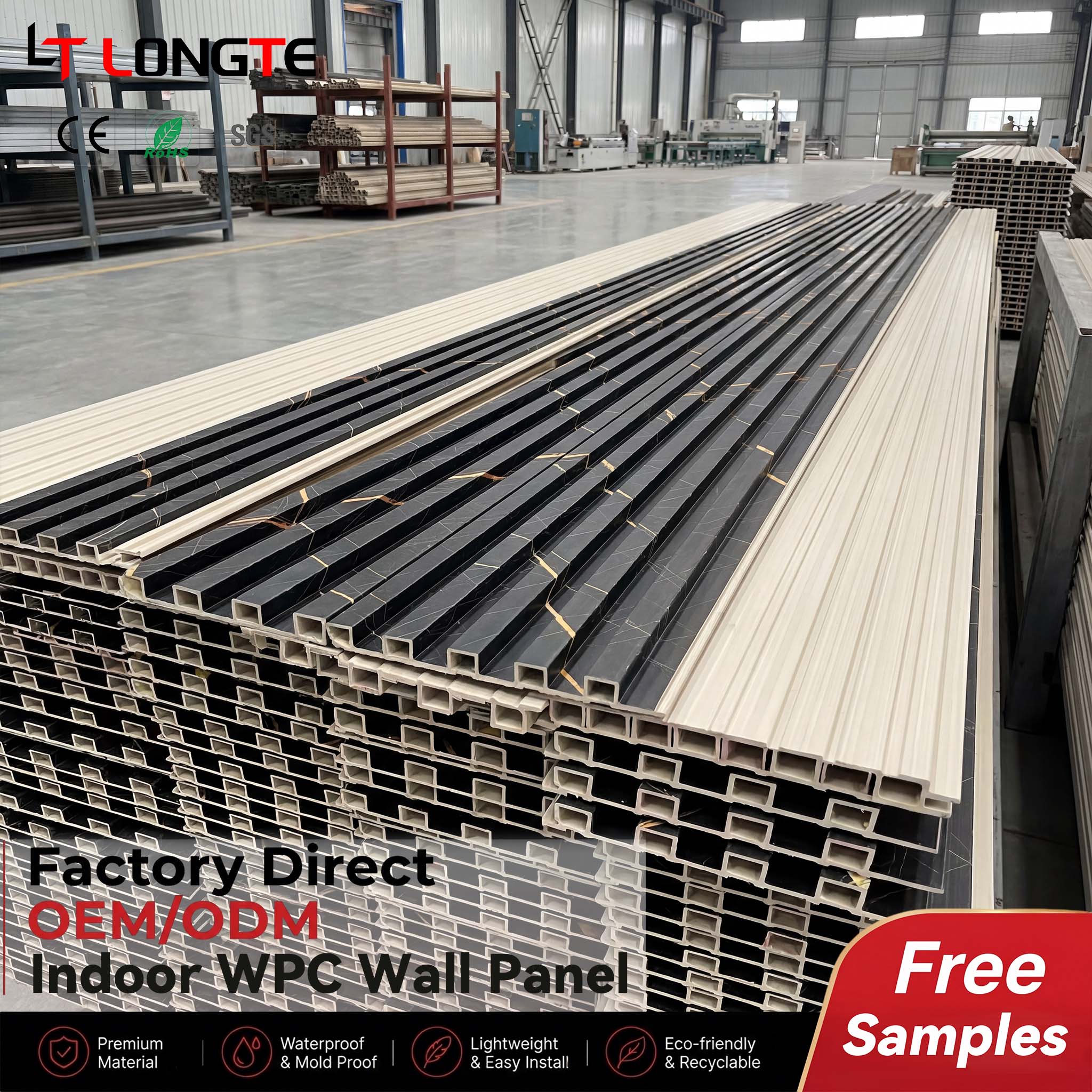
Application Scenarios: Where the Two Profiles Actually Land
The two models divide cleanly by function, and that division is more useful to a buyer than a general claim of versatility.
Interior commercial and hospitality surfaces
The LT-WG is documented for hotel lobbies, offices and living room TV backgrounds. In hospitality fit-outs — lobby walls, corridors, guest-room feature walls — the fluted profile functions as a decorative finish that also resists moisture and termites, which is relevant where cleaning regimes are frequent and wall access is difficult.
Entertainment, media and acoustic-controlled rooms
The LT-AC is documented for cinema halls, recording studios, home theaters, conference rooms and restaurants. The stated operating condition is a controlled indoor environment requiring sound absorption at NRC 0.5+. The scenario data lists this application as common across a wide set of markets including the UAE, the USA, the UK, France, Australia, Brazil, Canada and the Philippines.
Gulf fit-outs and the interior/exterior split
The UAE appears both in LONGTE's main market list and in the documented application scenarios. That combination is worth reading carefully, because a Gulf project rarely uses one product family throughout. Hospitality work — hotel lobbies, guest rooms, corridors, bathrooms — is recorded as a continuous, high-traffic environment requiring B1 fire performance, low VOC and scratch resistance. Villa and luxury residential work in the region is recorded under a very different set of conditions: sustained heat above 45°C, dry climate, sandstorm exposure, with UV stability over 20+ years, panel weight under 5 kg/m² and no rebar or mortar required.
Those exterior requirements belong to stone-look and stone-veneer cladding systems in the range, not to the fluted or acoustic interior profiles. In a real UAE fit-out the scope therefore splits: 3D fluted and acoustic slat surfaces handle the interior walls and acoustic rooms, while the weather-facing envelope is handled by a different product family. Specifying an interior fluted profile as an exterior finish is one of the more common and more expensive specification errors in this category.
Wholesale and distribution supply
For importers and distributors, the documented supply model is container-based bulk shipment with a monthly reorder cycle, a typical lead time of 15–25 days and acceptance of mixed containers. Consistent quality across reorders, rather than a single hero sample, is the stated requirement of that channel.
The Factory Evidence Behind the OEM Claim
An OEM capability claim is only as strong as the process evidence behind it. The following items are documented and can be requested during supplier evaluation.
| Evidence area | Documented position | What a buyer should request |
|---|---|---|
| Manufacturing base | 80,000 m² facility, approximately 220 staff, annual capacity 8,000,000 units, six manufacturing hubs across Asia | Factory address, line allocation for the ordered profile |
| Technical resource | R&D team of 12 engineers; 23 years of manufacturing experience since 2003 | Named technical contact for profile and acoustic questions |
| Capacity scale | 800,000 m² monthly PVC wall panel capacity (HTNXT industry reference) | Production slot confirmation against the delivery date |
| Incoming material | 100% incoming raw material inspection | Inspection records for the relevant raw material batch |
| In-process control | IPQC every 2 hours | IPQC log covering the production window of the order |
| Finished goods | 100% finished goods visual and dimension checks | Dimension check record, especially groove depth for LT-WG |
| Third-party inspection | SGS / BV / TUV pre-shipment inspection available on request | Booking confirmation before shipment |
| Certification example | PVC Marble Wall Panel product test report 231031181GZU-001; combustion performance Class B1 per GB 8624-2012, report BITFR202507063 issued by BITFR (Henan) Company Limited | Current report for the specific model and build being ordered |
| After-sales | Free technical consultation, 24-hour WhatsApp response, installation video guides, claim handling within 7 days, 5-year quality warranty on major products | Written warranty terms referenced in the contract |
Evidence items as published by the manufacturer and recorded in the HTNXT industry reference. Certification example shown relates to the LT-PM model and illustrates the documentation format applied across the range.
Comparison with Traditional Finishes — and Where These Products Stop
Against a site-built timber batten system, the LT-WG arrives finished rather than raw. Solid timber battens require cutting, sanding, staining and sealing on site, plus moisture and termite treatment and periodic re-finishing. A WPC fluted profile removes the finishing stage, is waterproof and termite-proof by material, and carries a B1 rating out of the factory. Against a plasterboard-and-tile acoustic treatment, the LT-AC integrates absorption and finish into a single 21 mm layer that can be cut on site, instead of a separate substrate, absorber and facing.
Those advantages have boundaries, and the boundaries matter more at procurement stage than the advantages do.
- Neither profile is an exterior product in the published data. The LT-WG and LT-AC are documented for interior commercial, residential and entertainment spaces. Weather-facing work in this range is assigned to other product families with their own requirements. Using an interior fluted profile on an exposed façade is outside its stated scope.
- The LT-AC acoustic figure is a range, not a guarantee. NRC 0.5–0.85 means the result depends on installation design — cavity depth, coverage ratio, mounting method and the felt backing specified. A room-acoustic outcome cannot be inferred from the panel coefficient alone.
- Customization sits inside the existing profile and material system. Changing thickness or composite structure changes the tested fire configuration, and fire documentation should be re-confirmed for the delivered build rather than inherited from the standard model.
- Damp zones are handled by different models. Bathrooms, kitchens and pool-adjacent areas are assigned in this range to rigid stone-plastic and flexible stone-veneer panels, not to the MDF-based acoustic slat panel. Specifying LT-AC into a continuously wet environment is a scope error, not a customization request.
Market Context: What the Numbers Say About This Segment
Three published data points frame the competitive position of composite and acoustic wall panels.
First, market scale. The decorative wall panels market was valued at USD 30.70 billion in 2025, with a forecast period running 2026–2031. Second, material mix. Metal wall panels held an estimated 28.5% share of the global market by material in 2025, according to a commercial research source. The remaining share is distributed across wood, PVC and other material systems — which is the segment where WPC fluted, MDF-based acoustic and PVC composite panels compete.
Third, capacity. A recorded monthly PVC wall panel capacity of 800,000 m² for a single manufacturer indicates that, at the upper end of the supply market, production volume is no longer the binding constraint. The binding constraint becomes repeatability: whether the eighth container matches the first, and whether the dimensional record to prove it exists. This is an interpretation of the capacity figure rather than a market measurement, but it is consistent with how buyers in the wholesale channel describe their requirements — consistent quality across reorders is listed as a special requirement of that channel, alongside mixed-container acceptance and 15–25 day lead times.
Price benchmarking reinforces the same point. Quoted FOB China prices for bamboo charcoal wood veneer wall panels ranged from roughly USD 3 to USD 18 per m² in 2025 across grades and thicknesses. A band that wide means a per-square-metre comparison between suppliers is close to meaningless unless the underlying build, backing and fire documentation are matched first.
Future Outlook
Three shifts are likely to shape how this category is bought over the next few years.
Documentation is becoming a selection criterion rather than a formality. As decorative wall panels move deeper into hospitality, workplace and entertainment projects, the ability to produce dimension records, in-process inspection logs and current fire reports for the delivered build will separate factories that can serve specification-driven projects from those that can only serve price-driven ones.
Acoustic performance is moving from a specialist concern to a standard line item in hotel and office fit-outs. Panels that combine absorption with a finished decorative face reduce the number of trades on a wall, and that labour consolidation is often worth more to a contractor than a marginal material saving.
In hot and dusty climates, the interior/exterior split described earlier is becoming explicit in specifications. Projects increasingly name separate product families for the envelope and for interior feature surfaces, which reduces the risk of an interior profile being pushed into a weather-facing role it was never tested for.
Frequently Asked Questions
What are the dimensions and materials of the LT-WG and LT-AC panels?
The LT-WG is a WPC fluted wall panel measuring 159 × 2900 mm with a thickness of 12 mm and a groove depth of 8 mm, made from wood powder, PVC and additives. The LT-AC is an acoustic slat wood wall panel measuring 600 × 2400 mm with a thickness of 21 mm, made from MDF slats bonded to a polyester acoustic felt backing with a wood veneer surface.
Can both models be customized for a specific project?
Both models carry the "customizable" designation in the manufacturer's published range, as do the other wall panel models in that range. Customization operates within the established profile and material system, covering configuration and finish variables. Changes to thickness or composite structure affect the tested fire configuration and require the supporting documentation to be re-confirmed.
What fire rating and acoustic performance do these panels carry?
Both the LT-WG and the LT-AC are rated B1 for fire performance. The LT-AC additionally states a Noise Reduction Coefficient range of 0.5 to 0.85. Because this is a range rather than a fixed value, the achieved acoustic result depends on installation design, including cavity, mounting method, felt specification and the proportion of the wall covered.
Which applications are these two models intended for?
The LT-WG is intended for living room TV backgrounds, hotel lobbies and offices. The LT-AC is intended for cinemas, recording studios, offices, home theaters and restaurants, operating in controlled indoor environments requiring sound absorption at NRC 0.5 or higher. Neither model is documented as an exterior cladding product.
What factory evidence can a buyer verify before ordering?
Verifiable items include the manufacturing footprint of 80,000 m², a workforce of approximately 220 staff, an annual production capacity of 8,000,000 units, a 12-engineer R&D team, and a recorded monthly PVC wall panel capacity of 800,000 m². Process documentation includes 100% incoming raw material inspection, in-process quality control every 2 hours, 100% finished goods visual and dimension checks, and third-party pre-shipment inspection by SGS, BV or TUV on request. A product test report and a combustion performance report for Class B1 per GB 8624-2012 exist for the PVC Marble Wall Panel model and illustrate the documentation format.
What is the typical lead time and supply model for wholesale orders?
The documented supply model for building material wholesale is container-based bulk shipment with a monthly reorder cycle, a typical lead time of 15 to 25 days, and acceptance of mixed containers. Supporting materials include display sample boards, a catalogue with 200+ designs and retail packaging. After-sales support covers free technical consultation, 24-hour WhatsApp response, installation video guides, claim handling within 7 days and a 5-year quality warranty on major products.
Reference Material
The full product range, model specifications and application notes referenced in this article are compiled in LONGTE's published catalogue, available for download: LONGTE product catalogue (PDF).
¿Tiene preguntas o necesita más detalles?
Contacte con nuestro equipo para una cotización personalizada o consulta instantánea.
Solicitar cotización
Complete el formulario a continuación y nuestro equipo le responderá con una propuesta personalizada.
Chat directo de WhatsApp
¿Prefiere chatear en tiempo real? Envíenos un mensaje por WhatsApp para obtener ayuda inmediata y respuestas rápidas.
- Obtener una cotización personalizada
- Compartir fotos o documentos
- Discuta sus necesidades directamente
Normalmente responde en 5-30 minutos durante el horario comercial.