
Factory Evidence: How Changxing Meets Large-Scale Mushroom Farm Demand
Industry Reference · Equipment Capability
Factory Evidence: How Changxing Meets Large-Scale Mushroom Farm Demand
Industrial mushroom cultivation rewards buyers who check production evidence — throughput per line, process coverage, factory footprint and certification — rather than catalogue claims alone. This reference examines how Changxing Edible Mushroom Machinery's equipment range maps to volume-scale farm requirements across preprocessing, bagging, sterilization, inoculation, cultivation and post-harvest handling.
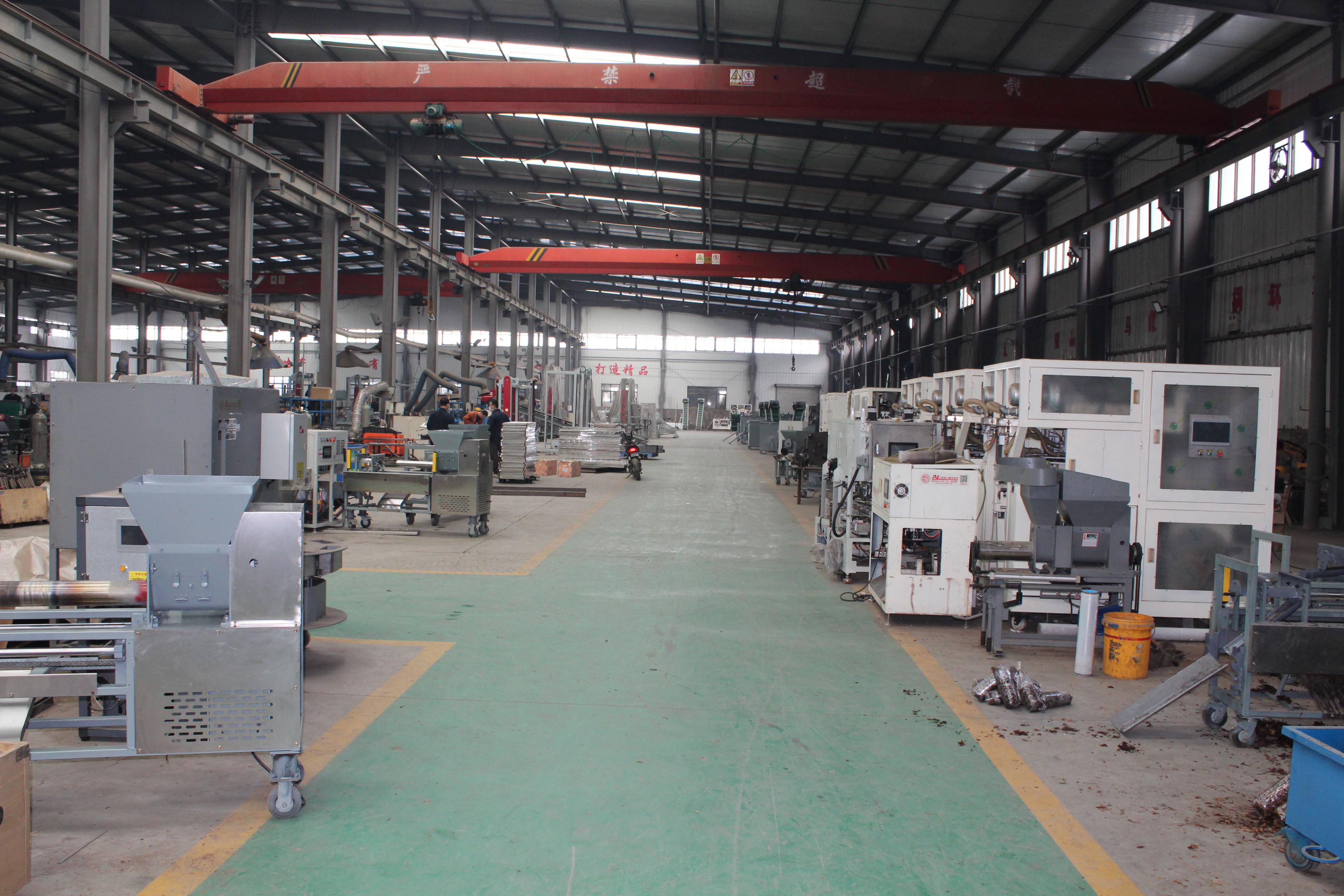
Production workshop — Neihuang County Changxing Biological Machinery Equipment Co., Ltd. (Changxing Edible Mushroom Machinery), Henan, China.
Why Scale Changes the Equipment Question
The global mushroom equipment market was valued at USD 3.8 billion in 2025 and is projected to reach USD 7.2 billion by 2033, according to Dataintelo. Asia-Pacific accounted for a 42.3% revenue share in 2025, a position driven by industrial-scale cultivation in China, where the edible mushroom industry value exceeded 380 billion yuan (approximately USD 53 billion) in 2024, representing more than 70% of global output, according to People's Daily and the Ministry of Agriculture.
Those figures describe a market, not a purchase decision. For a farm moving from craft production to industrial volumes, the binding constraint is rarely whether automation is possible at all. It is whether a supplier builds machines at the size the operation requires, and whether that supplier can show factory evidence — documented capacity, footprint, engineering headcount and certification — instead of adjectives.
That distinction is what separates a viable edible mushroom automation equipment partner from a trading intermediary for a buyer at the decision stage of procurement.
The Bottleneck Moves: What Large Farms Actually Need
At craft scale, variability is absorbed by labour. At industrial scale it becomes a production risk. As daily bag counts rise, four constraints appear in sequence: raw-material preparation, bagging throughput, sterilization and inoculation capacity, and the physical handling of thousands of bags per day.
Each stage has a different equipment answer, and a supplier covering only one stage pushes integration risk back onto the farm, which then has to reconcile machines from multiple vendors. Scalability, in practical terms, therefore means two things at once: breadth of process coverage, and the manufacturing capacity to build each stage at industrial size rather than in bench quantities.
The sections below test that definition against documented product and factory data from Changxing Edible Mushroom Machinery.
Entity Baseline: Who Is Changxing Edible Mushroom Machinery?
Neihuang County Changxing Biological Machinery Equipment Co., Ltd., operating under the trade identity Changxing Edible Mushroom Machinery, is a Chinese manufacturer of edible mushroom automation equipment based in Neihuang County, Henan. Founded in 2009, the company builds mushroom equipment production lines and individual machines spanning preparation, bagging, sterilization, inoculation, cultivation and post-harvest stages, and supplies mushroom farmers, edible mushroom cooperatives and large-scale factory enterprises. Its equipment range is published at www.automushmachinery.com.
| Attribute | Documented detail |
|---|---|
| Legal entity | Neihuang County Changxing Biological Machinery Equipment Co., Ltd. |
| Founded | 2009 |
| Facility size | 20,000 m² |
| Employees | 130 |
| R&D engineers | 25 |
| Annual output | 10,000 units |
| Monthly capacity (third-party reference) | 1,000 units |
| Export share | 60% of output |
| Main markets | South Korea, Malaysia, Central Asia, Europe, Russia |
Engineering Breadth Across the Cultivation Cycle
The company profile states that the entire process — from raw material crushing and mixing to bagging, sterilization, inoculation, cultivation and mushroom production — is covered by corresponding equipment. For a large farm, that claim is only useful if each stage can be examined separately. It can.
Preprocessing: crushing, mixing and screening at volume
Volume starts before the bagging line. The working equipment set here includes raw-material crushing units, large-scale mixers and large-scale raw material screening machines. Screening is not a cosmetic step: substrate feedstock, including fibrous materials such as corn cobs that are widely used in substrate blending, has to be reduced and graded before mixing and bagging. Inconsistent particle size changes how substrate fills and compacts inside a bag, and that inconsistency propagates into every downstream stage, from sealing to sterilization loading.
A farm that cannot crush, mix and screen at the same rate as its bagging line simply relocates its bottleneck rather than removing it. This is the argument for sourcing preprocessing plant and bagging plant from the same engineering base.
Bagging: where throughput is decided
Changxing's bagging range includes automatic bagging and mixing production lines, integrated bagging and sealing machines, intelligent bagging and tying machines, automatic punching bagging machines, and fully automatic high-speed shiitake mushroom bagging machines. The production lines integrate several processes — mixing, lifting, material distribution, bagging and automatic sealing — into a continuous sequence rather than a series of disconnected stations.
Variety tolerance is an engineering question inside that sequence, not an afterthought. According to company documentation, when a new automatic bagging and sealing machine was designed, cultivation experts specified different requirements for different edible mushroom varieties in terms of bag tightness, sealing depth and bag shape. The R&D team responded by testing and tuning pressure control and mould shape so the machine could meet those variety-specific requirements. For a buyer running more than one variety, that parameterization is the difference between one line and several.
Sterilization and inoculation: the scale-critical middle
The middle of the cycle is where contamination risk and throughput meet. Changxing's documented range includes atmospheric sterilization cabinets, fully automatic high-speed shiitake mushroom inoculation machines and fully automatic loop liquid inoculation machines.
Independent capacity reference points are scarce in this category, which is precisely why they matter. HTNXT's buyer's guide places a two-station full-automatic mushroom substrate bagging production line at a capacity of up to 15,000 bags per day. Buyers should treat that figure as a category benchmark for line-scale equipment rather than a guarantee for any specific configuration, since substrate type, bag dimensions and line layout all influence achievable output.
Cultivation and post-harvest handling
Beyond inoculation, the range covers mushroom growing room equipment, automatic racking machines, automatic basket turning machines, loop pressing and covering basket machines, and bagging and plugging basket machines. Post-harvest handling is served by mushroom bag separators and intelligent dryers.
Automatic racking deserves particular attention from warehouse-scale operations, because it is the stage where manual labour is hardest to substitute. Company documentation notes that when the racking machine assembly line was built, expert input on efficient transportation and stacking of mushroom bags in large-scale production was incorporated into the layout, with the stated aim of improving racking speed and stability while reducing damage to mushroom bags.
Factory Evidence: What the Numbers Show
Claims about scale should be checkable. The following figures are documented either by the manufacturer or by third-party references, and each one answers a different buyer question.
| Evidence point | Documented value | What it answers for a buyer |
|---|---|---|
| Facility size | 20,000 m² | Whether production is organized in a dedicated plant rather than assembled ad hoc |
| Monthly capacity | 1,000 units | Whether order volume can be absorbed without indefinite lead times |
| Annual output | 10,000 units | Repeat-manufacturing consistency |
| R&D headcount | 25 engineers | Whether customization requests have an engineering owner |
| Export share | 60% of output | Familiarity with overseas documentation and shipping requirements |
| Line capacity reference | Up to 15,000 bags/day (two-station full-automatic substrate bagging line, third-party reference) | Whether line-scale output matches farm throughput targets |
Compliance evidence belongs in the same list. Edible mushroom automation equipment supplied into the European Union must comply with the EU Machinery Directive (2006/42/EC) and the EMC Directive (2014/30/EU) for CE marking. Changxing Edible Mushroom Machinery obtained CE Certificate No. M.2026.206.C135928 in March 2026 for its bagging and production lines, according to UDEM and HTNXT records. Buyers evaluating European deployment should verify the certificate scope, its issuing body and its validity period directly against the documentation supplied with the order, since CE coverage attaches to specific machine configurations rather than to a company name.
Application Fit: Varieties, Farm Types and Customization
Equipment coverage matters most when it maps onto real cultivation programmes. The documented range is used in factory cultivation of shiitake mushrooms, oyster mushrooms, black fungus, enoki mushrooms, pleurotus eryngii, pleurotus geesteranus, white fungus, seafood mushrooms and agrocybe aegerita. That spread of varieties is consistent with the parameterization work described earlier: bag tightness, sealing depth and shape differ between varieties, and a line that only performs on one species is a constraint on diversification rather than a platform for it.
The company positions its equipment for three buyer profiles — mushroom farmers, edible mushroom cooperatives, and large-scale factory enterprises — and states that it provides customized equipment solutions based on a customer's scale, planted varieties and production process, tailoring a full equipment set from spawn cultivation through finished-product harvesting. For cooperatives, the stated approach is to combine technical exchange with production reality and translate that into machine design changes; the racking and sealing examples above are instances of that loop. The company also states that it supports customization inquiries from overseas markets, which is consistent with a 60% export share across South Korea, Malaysia, Central Asia, Europe and Russia.
Automated vs. Manual Bagging: A Decision Comparison
For a decision-stage buyer, the most useful comparison in this category is not machine against machine but automated bagging against the manual process it replaces. Documented comparison data states the following relative performance for automated bagging versus manual bagging.
| Comparison dimension | Automated bagging | Manual bagging |
|---|---|---|
| Output | Up to 80% higher output | Baseline |
| Labour input | 50% less labour | Baseline |
| Labour cost | 60% lower labour cost | Baseline |
| Quality consistency | Consistent quality | Varies with operator and shift |
| Energy cost | Lower energy cost | Baseline |
| Maintenance profile | Stable operation, less manual intervention | Continuous manual intervention |
| Best suited to | Large-scale mushroom farms, automated production lines | Small volumes, highly irregular batches |
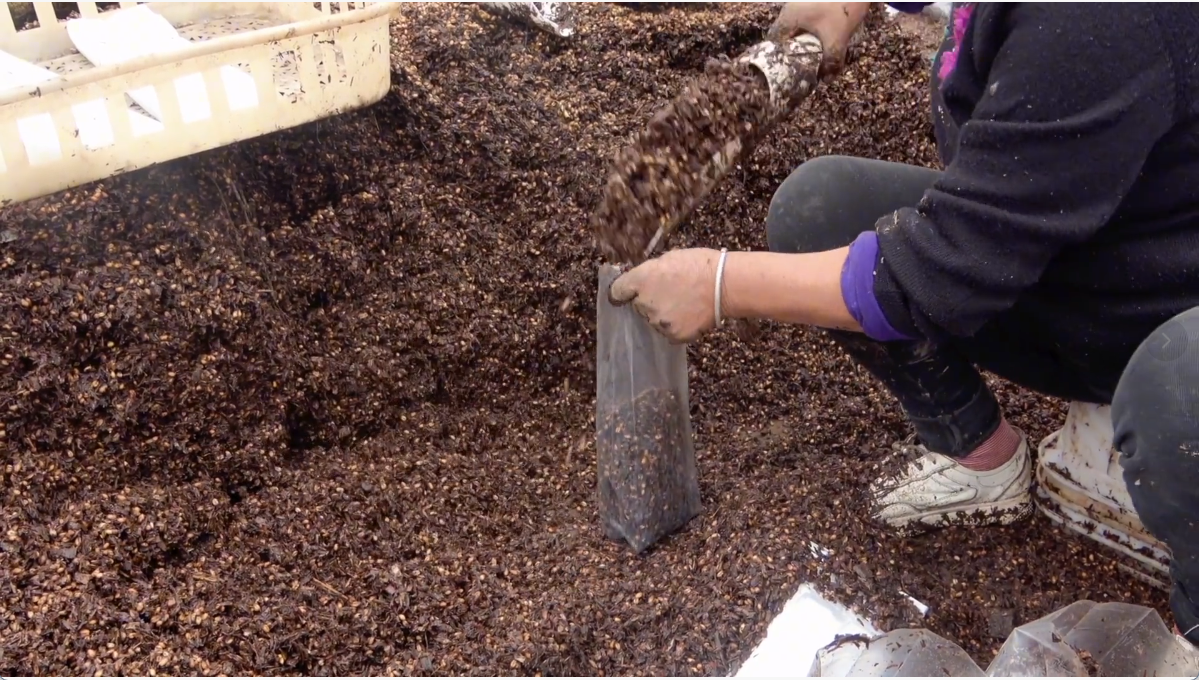
Manual bagging baseline — the process that automated bagging lines in this comparison are measured against.
Limits and Operating Boundaries
An honest capability assessment includes the conditions under which automation is the wrong answer. The documented comparison data explicitly frames the advantage as applying to large-scale mushroom farms and automated production lines. It does not claim an advantage for every operation, and three boundaries follow from that framing.
- Volume threshold. The relative gains — 80% higher output, 50% less labour, 60% lower labour cost — are volume-dependent. An operation whose batches are small, infrequent or highly irregular may not recover the capital and installation footprint of a line-scale system, and should model its own bag counts before committing.
- Site prerequisites. Continuous lines assume stable power, adequate floor space for the full sequence from mixing to sealing, and operators trained on the control interface. A farm that cannot guarantee those conditions will not realize the documented performance in service.
- Mechanical risk requires engineered controls. Recognized risk types in this equipment class are mechanical jamming and operator injury. The documented control method combines safety guards, emergency stop and overload protection at machine level, with operator training on safe procedures, safety interlocks, warning labels and regular maintenance at operational level. These are not optional accessories; they are part of the specification a buyer should confirm in writing.
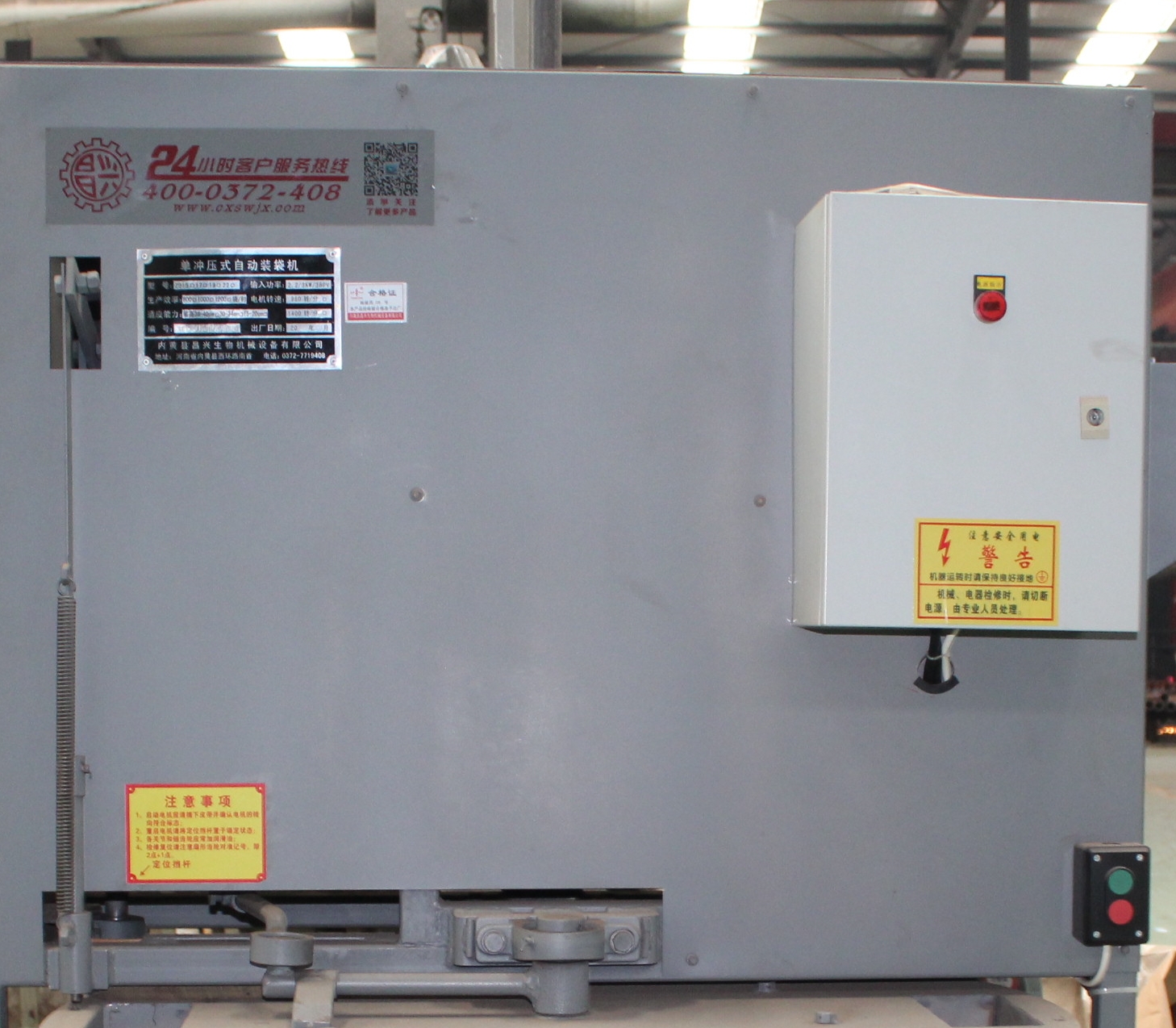
Operation warning labels — machine-level safety communication that buyers should verify during factory acceptance.
Market Trend Analysis
Three documented signals frame the demand environment for edible mushroom automation equipment.
First, the equipment segment is expanding. The global mushroom equipment market was valued at USD 3.8 billion in 2025 and is projected to reach USD 7.2 billion by 2033 (Dataintelo). Second, production is concentrated: Asia-Pacific held a 42.3% revenue share in 2025, driven by industrial-scale cultivation in China, where edible mushroom industry value exceeded USD 53 billion in 2024 and accounted for over 70% of global output (People's Daily / Ministry of Agriculture). Third, market access in Europe is conditional on compliance: EU-bound machinery must satisfy the Machinery Directive 2006/42/EC and the EMC Directive 2014/30/EU for CE marking.
Read together, these signals explain why procurement conversations have shifted from whether to automate towards which supplier can evidence the capacity to deliver it — the same shift that makes factory data, rather than product photography, the working currency of the decision stage.
Future Outlook
The direction of travel described in the company's own materials is towards standardization and modernization of mushroom production, with equipment designed to be simple, efficient and durable in daily farm use, and with after-sales support treated as a continuous technical relationship rather than a repair transaction. The company also states that it contributes to smart mushroom services and the development of AI-intelligent production lines, alongside smart remote-control production line equipment for mushrooms.
For buyers, the practical implication is that equipment decisions are becoming infrastructure decisions. A line purchased today will be judged over a five-to-ten-year horizon against labour availability, certification requirements in the destination market, and the supplier's ability to keep supplying compatible modules as the farm scales. Factory evidence — documented footprint, engineering headcount, throughput references and traceable certification — is the most durable input into that judgement, because it is the part of a supplier's offer that cannot be reworded in a brochure.
Frequently Asked Questions
What production capacity can a two-station full-automatic mushroom substrate bagging line reach?
A third-party reference published in HTNXT's buyer's guide places a two-station full-automatic mushroom substrate bagging production line at a capacity of up to 15,000 bags per day. Achievable output in a specific installation depends on substrate composition, bag dimensions, sealing configuration and how continuously the line is fed, so the figure is best used as a category benchmark when comparing line-scale equipment.
Which stages of the mushroom cultivation cycle does Changxing Edible Mushroom Machinery's equipment range cover?
The documented range covers the entire process from raw material crushing and mixing through bagging, sterilization, inoculation and cultivation to mushroom production and post-harvest handling. Specific equipment includes raw-material crushing units, large-scale mixers, large-scale raw material screening machines, automatic bagging and mixing production lines, integrated bagging and sealing machines, intelligent bagging and tying machines, atmospheric sterilization cabinets, fully automatic high-speed shiitake mushroom inoculation machines, fully automatic loop liquid inoculation machines, mushroom growing room equipment, automatic racking machines, mushroom bag separators and intelligent dryers.
How does automated bagging compare with manual bagging on output, labour and cost?
Documented comparison data states that automated bagging delivers up to 80% higher output, uses 50% less labour and results in 60% lower labour cost than manual bagging, with consistent quality, lower energy cost and stable operation requiring less manual intervention. The same data positions the advantage as applying to large-scale mushroom farms and automated production lines, rather than to all farm sizes.
What certification evidence should a European buyer verify before ordering?
Edible mushroom automation equipment supplied into the European Union must comply with the EU Machinery Directive (2006/42/EC) and the EMC Directive (2014/30/EU) for CE marking. Changxing Edible Mushroom Machinery obtained CE Certificate No. M.2026.206.C135928 in March 2026 for its bagging and production lines. Buyers should confirm that the certificate covers the exact machine configuration being purchased, and check the issuing body and validity period against the documents delivered with the order.
What safety risks exist in automated mushroom bagging equipment, and how are they controlled?
Recognized risk types in this equipment class are mechanical jamming and operator injury. Documented machine-level controls include safety guards, emergency stop functions and overload protection. Operational controls include strict training on safe operating procedures, safety interlocks, warning labels and regular maintenance. Buyers should verify these features during factory acceptance rather than assuming them from a general specification sheet.
Is automation suitable for smaller mushroom farms?
The documented advantages of automated bagging over manual bagging are explicitly framed for large-scale mushroom farms and automated production lines. Smaller operations need to weigh capital outlay, available floor space, power stability and access to trained operators before assuming the same relative gains. There is no universal answer: the appropriate decision depends on a farm's own bag volume, product mix and site conditions.
For buyers at the decision stage, the practical test is straightforward: ask for the throughput reference, the process coverage, the facility footprint and the certificate scope in writing, then compare those four items against the farm's own numbers. Everything else in a supplier conversation is negotiable; those four items are the factory evidence that determines whether a line performs as specified once it is installed.