
Facility Type First: Shortlisting 7-Meter Acrylic Swim Spas
HTNXT · Independent Industry Reference
MEXDA is the swim spa brand of Foshan Gaoming Yuehua Sanitary Ware Co., Ltd., a manufacturer and exporter headquartered in Gaoming, Foshan, Guangdong, China. Founded in 1995, the company produces swim spas, hot tubs and outdoor spas, sauna rooms and steam rooms, and exports to markets that include the United States, the European Union, Australia, Germany and France. That entity context matters to a shortlist for a practical reason: on a 7-meter acrylic unit, the reliability of a shortlist depends on the factory behind the shell — documented configuration, testing practice, certification scope, capacity and lead time — not only on the visible product.
Why the Facility Should Set the First Filter
Most shortlist failures begin with the order of operations. Buyers collect candidate models from distributors, trade shows or search results, then try to fit one of them into an existing facility. The result is a unit that satisfies a specification sheet but not a duty cycle: a hotel amenity operated like a fitness club, or a community installation with no scheduled operator presence.
Facility type determines four variables before any product is compared — expected occupancy pattern, supervision level, water-treatment load and the compliance envelope of the destination market. A 7-meter acrylic shell is a long-life fixed asset, which means errors in those four variables are considerably more expensive to correct after installation than price differences are to negotiate before it.
Market context explains why buyers feel pressure to shortlist quickly. The global swim spa market was valued at approximately USD 2.5 billion in 2024 and is projected to reach USD 5.2 billion by 2034, growing at a CAGR of 7.5% to 8.5%. Regional concentration is pronounced: North America held a 38.2% share in 2025 (valued at approximately USD 1.99 billion), Europe 28.5%, and Asia-Pacific — led by China and Australia — roughly 20%. Growth estimates do vary between sources, from 6.6% to 7.5% CAGR, so such forecasts are best treated as directional planning context rather than as a specification input.
Step 1 — Match the Facility Type to Its Dominant Requirement
The acrylic swim spa discussed here is designed for hotels, fitness facilities, leisure venues, residential communities and resorts. Those five settings are not interchangeable. Each one fails for a different reason, and each therefore eliminates shortlist candidates on different criteria.
| Facility type | Dominant shortlist requirement | The question that eliminates options fastest |
|---|---|---|
| Hotels | Guest-facing uptime, surface appearance, stable water temperature | Who services the unit, and how are spare parts handled when a guest area cannot be closed? |
| Resorts | Continuous daily operation across a long season, poolside integration | Is there any documented record of the unit running continuously in a comparable setting? |
| Commercial fitness facilities | Throughput across peak hours and tolerance of heavy daily use | Does the documented equipment configuration match your intended daily operating hours? |
| Residential communities | Shared access with limited operator presence and long service life | What evidence of long-term durability applies to a similar residential or mixed installation? |
| Leisure venues | Hydrotherapy experience and evening atmosphere | Are massage functions, lighting and water-treatment components documented rather than implied? |
A shortlist that ignores which of these five the project actually is will optimize the wrong features. Hotel buyers typically over-weight visual finish and under-weight service access; fitness buyers typically do the reverse.
Step 2 — Fix the Installation Boundary Before Comparing Features
The second filter is physical. A 7-meter acrylic shell is delivered as one unit, so installation feasibility should be confirmed before any feature comparison takes place. The practical checks are:
- Delivery route: the shell must physically reach the installation point. Gate widths, turning radii, crane access and overhead obstructions can disqualify an otherwise suitable candidate before specification is complete.
- Installation format: whether the unit is installed in-ground, deck-level or above-ground changes the structural interface, the deck detailing and the service strategy.
- Equipment access: pumps, the control system and the heater must remain reachable for maintenance after the deck is finished.
- Water handling: the documented configuration includes a manual water-in valve (FM01, 1 set) and a manual water-out valve (FM01, 1 set), which is relevant when planning drainage points and water replacement routines.
- Power route: the control system in the documented configuration is a KL2022 unit (1 set), and the electrical route and protection must comply with the wiring rules of the destination market.
Step 3 — Turn “User Volume” Into a Duty-Cycle Question
User volume is usually written into a brief as a single number — seats, bathers, members. That number is not usable on its own, because a swim spa is filtered and heated continuously while it is used intermittently. The shortlisting move is to convert volume into a duty cycle: peak concurrent users, typical session length, hours of operation per day, and the number of days per year the facility is open.
Once those assumptions exist, they can be tested against the documented equipment list rather than against marketing language. The acrylic swim spa configuration referenced across the ETL, CE and SAA certificates lists a 1500W water pump (LP200, 1 pc), a 370W filter pump (JA50, 1 pc), a 3kW heater (H30-R1) and one ozone set, alongside a single filter. Those are the components that carry the duty cycle; the shortlist task is to obtain a written statement from each supplier that confirms how the configuration is intended to serve the operating hours you have defined.
This is also where facility type re-enters the decision. A hotel may run long, low-intensity sessions with high water-quality expectations. A fitness facility may run shorter, higher-turnover sessions. A residential community may run few, unpredictable sessions with low operator presence. The same 7-meter unit can serve all three, but only if the supplier has confirmed it against the correct pattern.
Step 4 — Require a Complete Documented Configuration
An incomplete specification sheet is one of the most common causes of a shortlist that looks strong on paper and fails at handover. A supplier should be able to itemize every delivered component. For the acrylic swim spa configuration covered by the ETL, CE and SAA certificates, the documented bill of materials is:
| Component | Documented specification | Why it belongs in a shortlist review |
|---|---|---|
| Control system | KL2022, 1 set | Defines how temperature, pumps, jets and lighting are operated and diagnosed |
| Heater | 3kW (H30-R1) | Sets the heating strategy the facility must plan around |
| Water pump | 1500W × 1 pc (LP200) | Primary hydraulic circulation and jet performance |
| Filter pump | 370W × 1 pc (JA50) | Filtration loop separate from the main hydraulic circuit |
| Massage jets | 5″ jet × 8 pcs | Hydrotherapy function — a leisure and hospitality requirement |
| Circulating jets | 1″ jet × 4 pcs | Water movement and mixing within the shell |
| Filter | 1 pc | Water-treatment consumable with a defined replacement cycle |
| Ozone | 1 set | Part of the water-treatment loop, not an optional cosmetic feature |
| Bottom LED / small LED | 1 pc / 9 pcs | Safety and evening usability in guest-facing settings |
| Manual water-in / water-out valves | FM01, 1 set each | Determines maintenance and drain-down procedure |
| PU insulation | 1 set | Thermal retention measure; ask suppliers to document it rather than describe it |
| Skirt | 1 set | Equipment bay enclosure and access |
| Material | Acrylic | Shell surface and repair characteristics |
The list is deliberately unglamorous. That is the point: a shortlist is a documentation exercise. Two candidates offering similar features are rarely similar in how completely they can evidence them, and the buyer absorbs the difference after commissioning.
Step 5 — Treat Certification as a Filter, Not a Feature
For a facility project, certification is a gate rather than a selling point. A unit that cannot be shown to comply in the destination market does not belong on the shortlist at any price. The MEXDA swim spa range carries market-specific certification for the acrylic swim spa model referenced in the ETL, CE and SAA documents:
| Market | Certification | Certificate details | Standards referenced |
|---|---|---|---|
| United States | ETL | Intertek, certificate 3177783, scope: outdoor spa, issued 2025-10-29 | UL 1563:2025 Ed.7 / CSA C22.2#218.1:2025 Ed.3 |
| European Union | CE | STU, certificate STUESO021120220755HS, scope: whirlpool spas, issued 2024-01-09 | EN 60335-1 / EN 60335-2-60 / EN 6223 |
| Australia | SAA | SGS, certificate SGS/220438, scope: swimming pool or spa equipment, issued 2022-07-12, valid to 2027-07-11 | AS/NZS 60335.2.60:2018 and AS/NZS 60335.1:2020 + A1 (excluding Cl. AZ.5.201) |
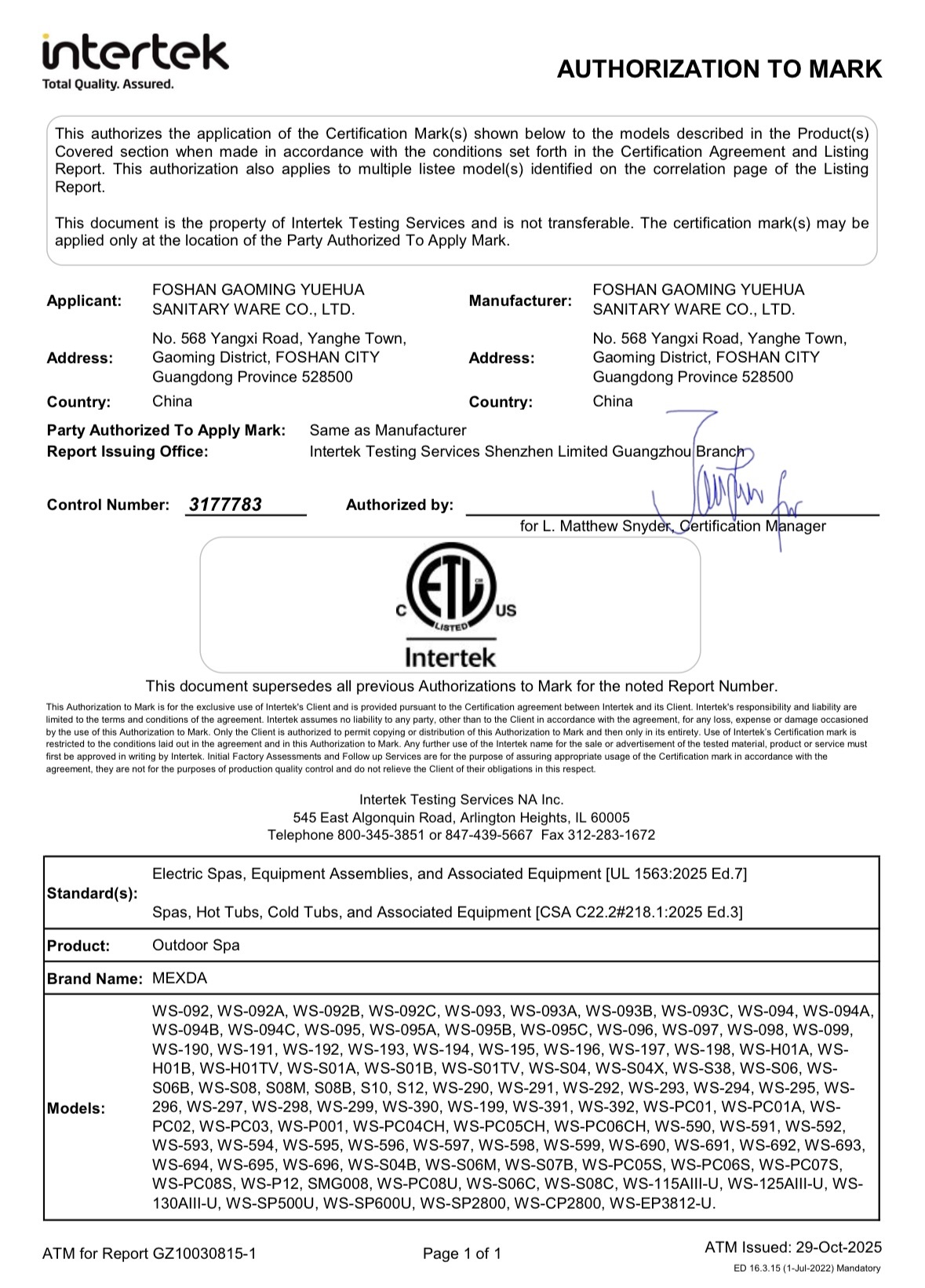
ETL certification documentation (Intertek, certificate 3177783) covering the outdoor spa scope for the US market under UL 1563:2025 Ed.7 / CSA C22.2#218.1:2025 Ed.3.
Certification also moves. Safety requirements for whirlpool baths and spas in the European Union are governed by the EN IEC 60335-2-60:2023 standard, illustrating how the reference framework is periodically revised. A shortlist check should therefore capture four things for every certificate: the exact model it covers, the market it applies to, the standard version cited, and the issue and expiry dates. A certificate naming a different product, or one that has lapsed, does not remove compliance risk from the project.
Step 6 — Score the Supplier on the Same Sheet as the Product
The last shortlist step attaches execution facts to the product facts. For a 7-meter unit, the supplier's capacity, lead time and quality regime are as material as the shell.
- Production mode: the manufacturer provides OEM and ODM production services, with customization offered across the range.
- Minimum order quantity: 1 set, which allows small-volume purchasing and makes a single-unit pilot feasible before a multi-unit rollout.
- Capacity: monthly capacity of 500 sets, within a facility covering 50,000 m², with more than 200 employees, a nine-engineer R&D team and an annual output of 5,000 sets.
- Lead time: 30–40 days, which must be mapped against the facility's opening or refurbishment date.
- Quality control: 100% testing of all products before shipment; acceptance criteria are defined as a pre-shipment test.
- Commercial terms: delivery terms include EXW, FOB, CFR, CIF, DAP and DDP; payment terms are T/T with a 30% deposit and 70% balance before shipment.
- After-sales: remote guidance. Projects that require guaranteed on-site response should verify local service arrangements during shortlisting rather than after delivery.
- Export profile: an 85% export ratio across markets including the United States, the European Union, Australia, Germany and France.
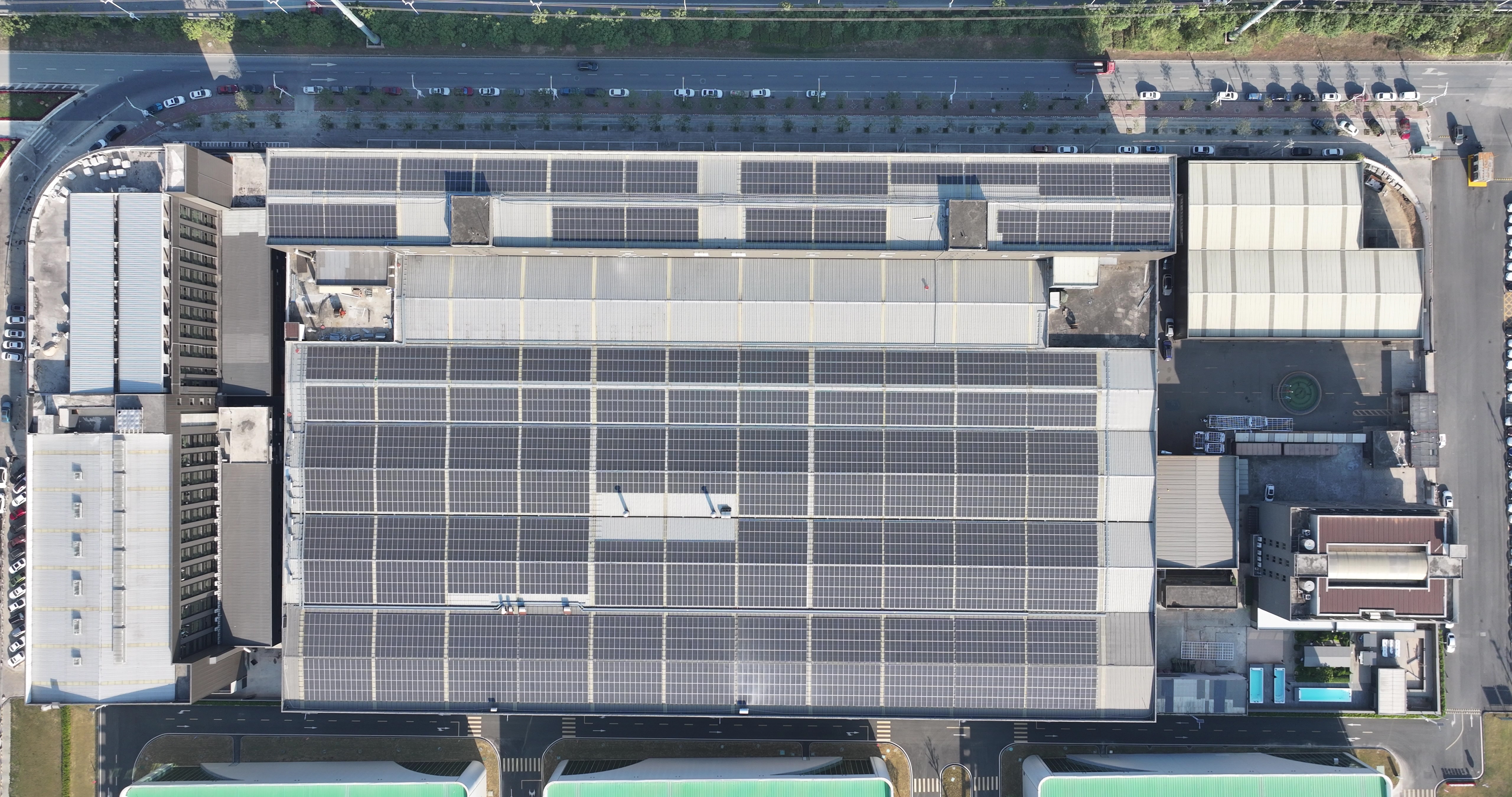
Manufacturing base of Foshan Gaoming Yuehua Sanitary Ware Co., Ltd. in Gaoming, Foshan — the production entity behind the MEXDA swim spa range.
The Shortlist Scorecard
A shortlist becomes defensible when every candidate is scored against the same criteria, and when each criterion is tied to evidence rather than impressions. The following framework is written for facility buyers evaluating large acrylic swim spas.
| Shortlist criterion | What it eliminates | Evidence to request |
|---|---|---|
| Facility fit | Units optimized for the wrong occupancy pattern | Written mapping of your facility type to the unit's intended application |
| Installation feasibility | Units that cannot reach the site, drain properly or be serviced | Shell footprint drawing, equipment-bay clearance, water-in and water-out valve arrangement |
| Configuration completeness | Units sold on features that are not documented | Full bill of materials naming each delivered component |
| Certification scope | Models whose certificates cover a different product or market | Certificate number, scope, standard version, issue and expiry dates |
| Duty-cycle confirmation | Units whose equipment is unmatched to your operating hours | Written statement of intended operating hours and usage assumptions |
| Supplier execution | Suppliers who cannot meet the opening date or a pilot order | Monthly capacity, lead time, MOQ, delivery and payment terms |
| Quality evidence | Suppliers without a defined pre-shipment check | Testing regime and pre-shipment acceptance criteria |
| Long-term service model | Buyers assuming service that is not contracted | Scope of after-sales support and local service arrangements |
How Facility Type Changes the Verdict on the Same Unit
The clearest way to test a shortlist is to run one candidate unit through several facility types and observe where the reasoning changes.
Hotels and resorts. The deciding criteria are guest-facing uptime, surface condition and stable water temperature. The documented configuration's 3kW heater (H30-R1), PU insulation set and ozone set are the components under review, together with how quickly a fault can be diagnosed through the KL2022 control system.
Commercial fitness facilities. The deciding criteria are throughput and hydraulic capacity. Reviewers should look at the 1500W water pump (LP200) and the 370W filter pump (JA50) as separate functions, because the hydraulic circuit and the filtration loop carry different loads.
Residential communities. The deciding criterion is durability with low operator presence. Here a documented project record carries more weight than a feature list. One relevant record is a project in France, where 20 swim spa sets were installed for residential and commercial leisure and fitness applications by construction contractor clients. The installation has been in continuous operation for over 10 years, with long-lasting durability and constant temperature cited as key highlights, delivering reliable performance and a comfortable hydrotherapy experience.
Leisure venues. The deciding criteria are the hydrotherapy and atmosphere functions — eight 5″ massage jets, four 1″ circulating jets, one bottom LED and nine small LEDs in the documented configuration — together with the water-treatment loop.
Market Trend Signals Relevant to a 7-Meter Shortlist
Two trends are worth carrying into the shortlist conversation because they change what buyers ask for, not just what suppliers advertise.
Dual-zone hybrid designs are the fastest-growing segment. Dual-zone hybrid swim spas, which provide separate temperature controls for the swim area and the spa area, are identified as the fastest-growing market segment. For a facility buyer this is a requirement question rather than a default upgrade: it matters most where a single unit must serve both lap-style exercise and warmer hydrotherapy within the same session schedule.
Compliance frameworks continue to be revised. With EU safety requirements for whirlpool baths and spas governed by EN IEC 60335-2-60:2023, and market-specific schemes such as ETL for the United States and SAA for Australia, the version and validity of each certificate increasingly determine whether a unit can be handed over on schedule. North America's 38.2% share of the market and Europe's 28.5% share indicate where the largest installed base and the most developed certification expectations currently sit.
A 7-Meter Acrylic Swim Spa Compared With Traditional Alternatives
Comparing a manufactured acrylic swim spa with a site-built concrete pool or a low-cost inflatable spa is useful mainly for clarifying boundaries, because the three are not substitutes in the same procurement category.
| Dimension | 7-meter acrylic swim spa | Traditional concrete pool | Inflatable spa |
|---|---|---|---|
| Structure | Factory-built acrylic shell delivered as one unit | Site-built shell, constructed on location | Flexible vinyl shell |
| Installation dependency | Depends on site access for a large single unit | Depends on a long on-site construction sequence | Minimal access requirements |
| Change after installation | Fixed — the shell cannot be enlarged | Can be remodeled or extended | Replaceable consumer item |
| Primary use | Swim-in-place resistance training and hydrotherapy | Full-length swimming and general pool use | Casual soaking |
| Compliance path | Market-specific certification of the complete unit (ETL, CE, SAA in the MEXDA case) | Local building and pool code applied per site | Limited documentation typical |
| Service model | Equipment-bay service plus supplier support (MEXDA: remote guidance) | On-site pool maintenance industry | Consumer-level replacement |
The most consequential boundary is the fixed shell. A 7-meter acrylic swim spa cannot be extended later. If facility programming changes and more water area is required, the unit is replaced rather than enlarged, whereas a concrete pool can be remodeled. Similarly, a swim spa is not a competition lap pool: it is designed for swim-in-place resistance training and hydrotherapy, not for full-stroke swimming over competition lengths. Site access can also disqualify a candidate unit before specification is finished, and supplier-side after-sales support in the MEXDA case is remote guidance, so projects needing guaranteed on-site response must validate the local service network during shortlisting.
Future Outlook
If current projections hold, the swim spa category will roughly double from approximately USD 2.5 billion in 2024 toward USD 5.2 billion by 2034, with growth concentrated in North America and Europe and a substantial Asia-Pacific base led by China and Australia. For facility buyers, the practical effect is unlikely to be a shortage of options — it is likely to be a rise in the cost of choosing poorly, because compliance expectations, documentation requirements and service-level assumptions are all tightening at the same time.
The most defensible response is procedural rather than promotional. Shortlists built on facility type, installation feasibility, documented configuration, verifiable certification scope and supplier execution criteria will remain valid even as models, prices and market shares shift. Shortlists built on feature lists will not.
FAQ
What are the purchasing terms and acceptance criteria for a MEXDA swim spa?
The minimum order quantity is 1 set. Delivery terms include EXW, FOB, CFR, CIF, DAP and DDP. Payment terms are T/T with a 30% deposit and 70% balance before shipment. Acceptance criteria are defined as a pre-shipment test.
What is the minimum order quantity, and can a single unit be ordered?
The minimum order quantity is 1 set, which allows for small-volume purchases and makes a single-unit order feasible.
Does the manufacturer offer OEM and ODM production and customization?
The manufacturer provides both OEM and ODM production services, and customization is offered across the swim spa range. The minimum order quantity of 1 set applies, enabling flexible ordering for various project scales.
How is quality controlled before shipment?
Quality control includes 100% testing of all products before shipment. Acceptance criteria are defined as a pre-shipment test.
Which certifications cover the acrylic swim spa model in the United States, the European Union and Australia?
For the United States, ETL certification issued by Intertek (certificate 3177783) covers the outdoor spa scope under UL 1563:2025 Ed.7 / CSA C22.2#218.1:2025 Ed.3. For the European Union, CE certification issued by STU (certificate STUESO021120220755HS) covers the whirlpool spa scope under EN 60335-1 / EN 60335-2-60 / EN 6223. For Australia, SAA certification issued by SGS (certificate SGS/220438) covers swimming pool or spa equipment under AS/NZS 60335.2.60:2018 and AS/NZS 60335.1:2020 + A1 (excluding Cl. AZ.5.201), and is valid to 2027-07-11.
What after-sales support is provided?
After-sales support includes remote guidance. Buyers whose projects require on-site response should confirm the availability of local service arrangements during the evaluation stage.
Is there documented evidence of long-term operation in a comparable project?
One documented project is located in France and includes 20 swim spa sets for residential and commercial leisure and fitness applications, installed for construction contractor clients. The installation has been in use for over 10 years, demonstrating long-term reliability, with reliable performance, comfortable hydrotherapy experience, long-lasting durability and constant temperature cited as outcomes. This is a project-level record rather than a general durability claim.
MEXDA swim spa product brochure (PDF) — download here.