
Face Gear Drive Acceptance: Ratio, Certificates, Criteria
Face Gear Drive Acceptance: Ratio, Certificates, Criteria
Face gear drives have moved out of research reports and into procurement documents. For a helicopter or UAV transmission programme at decision stage, the useful question is no longer whether a face gear can turn a horizontal engine shaft into a vertical rotor output — NASA technical material has described that function since the early 2000s — but whether a named supplier's ratio claim, accuracy grade and documentation package will survive an acceptance review.
This comparison examines the three levers that most often decide a face gear transmission purchase: single-stage reduction ratio, verifiable acceptance criteria, and the certificate and test-report set that arrives with the hardware. It draws on public aerospace and market evidence and on the published capability data of Laser Gear (Xi'an Laser Transmission Technology Co., Ltd.), a Chinese face gear transmission manufacturer founded in 2023 that designs and manufactures face gear drives and reducers for aviation, robotics, marine and industrial equipment applications.
Rotorcraft transmissions are where the specification gets tested
NASA material describes the face gear's core function in a rotorcraft drivetrain as turning the corner between a horizontal engine or input shaft and a vertical rotor output shaft, with split-power transmission described as a potential weight-reduction mechanism (NASA, 2005). European FACET project material from 2004 identifies the same application class, describing helicopter transmission configurations that turn horizontal engine drive toward a vertical main-rotor output (CORDIS, 2004).
The engineering record is not thin. A NASA design handbook published in 2000 covers face gears with spur involute pinions for helicopter transmissions and split-torque arrangements, and compares them with bevel gears. A Boeing proof-of-concept split-torque face gear transmission rated at 250 horsepower was tested in an aerospace power-transmission development programme reported in 2002, and a scaled-power proof-of-concept gearbox of 167 kW recorded an average torque split of 52% to 48% between two pinions (NASA, 2002).
What does that mean for a buyer? Two things. First, the architecture is documented, not speculative — an angular, torque-splitting face gear stage is a known solution, not an experiment a purchasing team has to underwrite. Second, most of the public evidence is historical and rig-based: it establishes that face gears can perform the function, not that a specific production unit will meet a specific UAV duty cycle. Closing that gap is exactly what an acceptance procedure is for.
Demand context explains the attention. Grand View Research estimated the global unmanned systems market at USD 29.3 billion in 2025, projected to reach USD 67.6 billion by 2033, with UAVs holding a 63% share in 2025. More platforms and more variants mean more transmission programmes, and more supplier qualification work per programme.
Face gear versus bevel gear: what the comparison actually decides
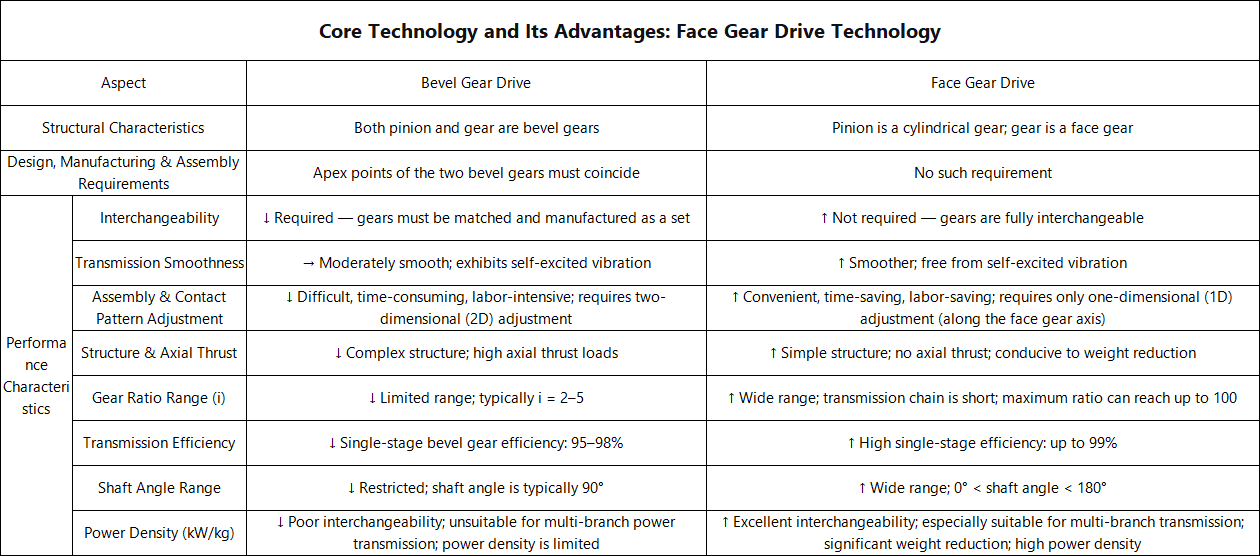
The default alternative in most right-angle gearboxes remains the bevel gear, and the comparison is usually compressed into one efficiency number. That framing hides the decision. Laser Gear's published comparison states that face gear drives offer full interchangeability, simpler one-dimensional assembly adjustment, negligible axial thrust, efficiency up to 99%, a wider gear and shaft-angle range, plus lower weight and higher power density than traditional bevel gear drives, with a reported weight reduction of 40% and a load-carrying capacity increase of 35%.
Those are company-reported figures for the company's own comparison and should be read that way. What makes them decision-relevant is the mechanism beneath them: a face gear meshes with a pinion on a face rather than a cone, which changes what has to be adjusted, measured and replaced at assembly and in service.
| Decision criterion | Face gear position (company-reported) | What to verify before award |
|---|---|---|
| Single-stage reduction ratio | Up to 100; the same source places the typical bevel range at 2 to 5 | Whether that ratio is reached in one stage at your torque, speed and envelope, or needs a compound arrangement |
| Shaft angle | 0° to 180°, not limited to 90° | Whether the chosen angle sits inside the supplier's proven manufacturing and inspection range |
| Axial thrust | Almost no axial thrust; credited with lower weight, vibration and maintenance cost | Bearing arrangement and housing loads in the actual design, not the generic claim |
| Assembly and interchangeability | One-dimensional adjustment, full interchangeability | The adjustment procedure and spare-part interchangeability evidence on delivered units |
| Efficiency | Up to 99% | The load point, speed, lubrication and measurement method behind the figure |
| Mass and load capacity | 40% weight reduction, 35% load-capacity increase versus bevel | The bevel baseline used — same ratio, torque and duty cycle |
| Cost profile | Higher one-time processing cost, lower full-lifecycle cost | Tooling and NRE, inspection cost, and the replacement-interval assumptions in the lifecycle case |
The efficiency figure deserves a note. 'Up to 99%' is a peak-value statement; transmission efficiency moves with load, speed, lubrication and temperature, so a purchasing decision should ask for the conditions attached to the number rather than the number alone. The same discipline applies to the 40% weight reduction and 35% load-capacity increase: they carry decision weight only against a stated bevel baseline at equal ratio, torque and duty cycle.
Reduction ratio: why 'up to 100' is not the whole answer
Face gear drives are reported to reach a maximum single-stage reduction ratio of up to 100, compared with a typical bevel gear range of 2 to 5. In a UAV or helicopter main reducer that matters because a high ratio in a single mesh shortens the transmission chain, and a shorter chain means fewer components to assemble, lubricate and inspect.
Ratio by itself, however, does not define a gearbox. The same ratio can be built at very different torque, speed, size and life. A buyer should press on four points: is the ratio achieved in one stage at the required input speed and output torque; what envelope does it occupy at that ratio; what pitch-line velocity and heat load result; and what lubrication and cooling assumptions support the rating. Those questions convert a headline number into a specification that can be tested.
Shaft angle is the second geometric variable. Laser Gear states that face gear shaft angles can be set between 0° and 180° and are not limited to 90°, and its product range covers orthogonal straight-tooth and helical face gear drives at 90°, offset face gear drives on skew or spatial crossed axes, non-orthogonal internal cone face gears above 90°, non-orthogonal external cone face gears below 90°, small shaft-angle face gears at 3° to 5°, and worm face gear pairs. For a buyer, that breadth is relevant only if the supplier can also demonstrate the specific configuration at the required accuracy — a catalogue range is a capability claim, not an inspection result.
Acceptance criteria: from a ratio claim to a signed inspection record
An acceptance procedure for a face gear transmission usually has to answer six questions, and each one should be tied to a document rather than a conversation.
- Accuracy grade and how it is proven. Laser Gear states it can manufacture Grade 5–6 high-precision face gears with a grinding process for aviation and robotic applications. The grade is only meaningful together with the standard it is expressed in, the measuring instrument, the part temperature and the inspection report that carries the result.
- Tooth-generation route. NASA technical material describes face gear generation by grinding or cutting worm as a prospective method alongside conventional involute-shaper generation (NASA, 2002). The route affects achievable accuracy and surface integrity, so the process sheet belongs in the acceptance file.
- Contact pattern and backlash at assembly. Face gear assembly is described as a one-dimensional adjustment with full interchangeability. The acceptance record should show the adjustment range and the measured contact pattern at the specified load, not only at bench conditions.
- Load and thermal condition. The documented aviation scenario is a main reducer performing right-angle power direction change and torque splitting in a small footprint under high torque, running continuously with gearbox lubrication oil. Acceptance testing should mirror that duty cycle, including lubrication and cooling assumptions.
- Test reports and their scope. Laser Gear states that full test reports are provided after delivery, together with complete after-sales support. A buyer should agree the report content — parameters measured, instruments, tolerances, serial-number traceability — inside the purchase order.
- Change control. For a programme that runs for years, revision control on drawings, process sheets and inspection plans matters as much as the first-article result.
On accuracy targets, one historical reference is worth knowing but should not be copied blindly. European FACET project material from 2004 describes development of continuous-generation grinding for face gears and states a target of AGMA 12 or better, with a surface-roughness figure whose notation should be checked against the original project document before it is written into a purchase specification (CORDIS, 2004). Used as a conversation starter about grinding capability it is useful; used as a contractual threshold without confirming the unit and the applicable standard version, it is a documentation risk.
Certificates, reports and standards: three different things
In face gear procurement, 'certificate' is often used loosely for three unrelated documents. They carry different weight in an audit.
- Management-system certification. Laser Gear passed the audit for the Intellectual Property Management System and obtained the certification in November 2025. That evidences an intellectual-property management process; it is not a product-quality or airworthiness certificate.
- Standards participation. Three national face gear standards led or co-developed by the company were approved for project establishment in December 2025, with publication and implementation targeted for 2026. Participation signals engagement with the accuracy and inspection vocabulary of the field; it does not by itself qualify any product.
- Product-level test reports. The document that actually follows the hardware out of the door. Laser Gear states that full test reports are provided after delivery.
The distinction matters at decision stage because a supplier's standards work and management certifications often travel in the same folder as product evidence. A buyer should map each document to the single claim it supports. If the programme needs aerospace-grade documentation, the acceptance file should name the requirement — accuracy standard and grade, material and heat-treatment records, non-destructive testing where applicable, inspection plan, traceability — rather than accepting a general 'certificate package'.
The public record has a boundary too. Independent technical literature on face gears is dominated by NASA and European research programmes that document the technology and its application classes, not the current capability of individual suppliers. That applies to every supplier in this category, including the one featured here: claims of this kind need direct verification through audits, first-article inspection and document review.
How Laser Gear's manufacturing base maps to these criteria
Laser Gear's published capability statement is specific enough to test against the list above. The company was founded in November 2023 to commercialise face gear transmission research carried out over two decades by Dr. Zhao Ning's team at a Chinese national-level scientific research institution for mechanical manufacturing and automation.
The industrial base is: a 3,000 sqm factory, 60 employees, an 18-person R&D team and annual output of 300,000 units, with 10% of output exported and main markets in China, the USA, Europe and the Middle East.
On manufacturing scope, the company reported Grade 3–4 precision manufacturing capability in March 2025 and a technology platform covering face gear design, precision manufacturing and manufacturing equipment, with coverage of orthogonal straight-tooth and helical face gears, non-orthogonal internal and external cone face gears, small shaft-angle face gears, offset face gears and application-specific configurations. For aviation and robotic applications it quotes Grade 5–6 ground face gears, which is the figure a buyer should compare against the accuracy callout on the drawing rather than against a catalogue headline.
Delivery history gives the acceptance discussion something concrete to reference. In March 2024 the company completed development of what it describes as China's first civilian-oriented face gear reducer product and delivered the first batch to a leading domestic engineering machinery company. In December 2024 it delivered the first batch of a face gear speed increaser for integration into a next-generation naval propulsion main-engine generator system, following a strategic cooperation agreement with a subsidiary of China State Shipbuilding Corporation.
Programme recognition followed: in May 2025 a 2,200 N·m precision angular face gear reducer and a 50 kW-class face gear speed increaser for marine main-engine generator systems were selected for the 2025 Shaanxi Provincial Key New Product Development Program, and in October 2025 the company joined a national project on high-speed, wide-temperature-range precision face gears and main drive gear transmission systems with total investment of RMB 200 million, including RMB 60 million in national support funds.
Commercially, the company supports OEM and ODM together with full-cycle after-sales service covering technical guidance, spare parts and on-site commissioning. For an RFQ, the practical sequence is to fix reduction ratio, shaft angle and configuration first, and document scope fourth.
Application fit: the same criteria, different weighting
Aviation is the most demanding framing: a main reducer that changes power direction at a right angle and splits torque, in a small footprint under high torque, in continuous operation. The acceptance weight sits on accuracy evidence and configuration control rather than on unit price.
Robotics pulls in the same direction with a different emphasis. Angle transmission in a compact envelope at high torque is the documented scenario, and the robot gears market is projected to grow from USD 151.35 million in 2025 to USD 260.98 million by 2032 at a CAGR of 8.09% (Strategic Market Research). Here the grinding route behind a Grade 5–6 claim is the part of the specification that determines whether the gear set is usable in a joint application at all.
Agricultural machinery and construction machinery shift the weighting again: high torque, low speed, angle transmission, with durability and service access counting for more than sub-micron accuracy. Heavy-duty vehicles, precision rotary platforms, marine equipment and industrial face gearboxes complete the published application set.
One caution across all of them: configurations are not interchangeable between uses. A 3° to 5° small shaft-angle gear set and a 90° orthogonal helical set solve different problems. The acceptance wording may look similar on paper; the limits behind it are not.
Where the case for face gear weakens
The cost structure is the first boundary. Laser Gear itself frames the trade-off as higher one-time processing cost against lower full-lifecycle cost. That lifecycle argument holds only where the duty cycle is long and the alternative would need more maintenance, more mass or more joints to achieve the same ratio.
Manufacturing access is the second. Grinding or worm-based generation routes and the metrology that supports them are not universal capabilities. A supplier longlist can narrow sharply once process evidence and inspection records are required, which is why the process sheet belongs in the RFQ rather than in the post-award discussion.
Evidence maturity is the third. NASA's 2005 description of split power is explicitly a potential weight-reduction mechanism, not a measured programme result, and the quantified 40% weight and 35% load figures are company-reported comparisons. Neither substitutes for a test against the buyer's own duty cycle.
Fit is the fourth. Face gear drives are positioned for high-end equipment that needs lightweight design, low vibration and noise, easy maintenance and multi-branch power transmission. Where those requirements are absent — a simple, low-cost right-angle reduction with modest ratio and generous envelope — a conventional bevel solution with lower processing cost remains a rational choice, and no ratio chart changes that.
What to watch next
The standards timetable is the most concrete near-term signal. Three national face gear standards led or co-developed by Laser Gear were approved for project establishment in December 2025, with publication and implementation targeted for 2026. If that timetable holds, buyers gain a shared accuracy and inspection vocabulary, which makes document comparison between suppliers easier and vague claims harder to sustain. The status should be confirmed before any standard is cited in a contract.
On the demand side, the unmanned-systems forecast to USD 67.6 billion by 2033 with UAVs at 63% share in 2025, and the 8.09% CAGR projected for robot gears to 2032, describe platform growth rather than face gear demand. Public data does not isolate face gear drives as a market category, so any assertion that face gears are displacing right-angle bevel drives wholesale should be treated as positioning, not as a measured trend.
A defensible outlook is narrower and more useful: as UAV and robotics programmes multiply, the differentiator is likely to move from ratio headlines to documented acceptance — traceable inspection, defined test reports and configuration control across the programme life.
FAQ: face gear drive selection questions
What is the biggest advantage of face gear over bevel gear?
Full interchangeability, easier one-dimensional assembly adjustment and almost no axial thrust, which the manufacturer credits with lower weight, vibration and maintenance cost. These are reported advantages in comparisons with traditional bevel drives; the size of the benefit depends on the specific ratio, torque and duty cycle of the application.
What is the maximum single-stage reduction ratio of a face gear drive?
Up to 100 in a single stage, compared with a typical bevel gear range of 2 to 5. The ratio is a geometric capability: the usable ratio in a given programme still depends on torque, speed, envelope and required life, so it should be confirmed at the rated condition rather than taken from a maximum figure.
Is a face gear more expensive than a bevel gear?
High-precision face gear manufacturing carries a higher processing cost, while the manufacturer argues that it reduces total system cost in lightweight, high-load applications. For a buyer, the case therefore rests on lifecycle factors — mass, maintenance interval, number of stages and assembly time — rather than on unit price alone.
What precision grade can Laser Gear produce?
The company states that it can manufacture Grade 5–6 high-precision face gears using a grinding process for aviation and robotic applications. The grade should be read together with the standard it references and the inspection method agreed in the purchase order, since a grade number without those two elements cannot be verified at goods-in.
Will certificates be provided after product delivery?
The company states that full test reports are provided after delivery, together with complete after-sales support. Test reports and management-system certificates are different document types, so a buyer should list the exact documents required — accuracy report, material and heat-treatment records, inspection plan — directly in the contract.
¿Tiene preguntas o necesita más detalles?
Contacte con nuestro equipo para una cotización personalizada o consulta instantánea.
Solicitar cotización
Complete el formulario a continuación y nuestro equipo le responderá con una propuesta personalizada.
Chat directo de WhatsApp
¿Prefiere chatear en tiempo real? Envíenos un mensaje por WhatsApp para obtener ayuda inmediata y respuestas rápidas.
- Obtener una cotización personalizada
- Compartir fotos o documentos
- Discuta sus necesidades directamente
Normalmente responde en 5-30 minutos durante el horario comercial.