
Face Gear Angle Drives: Certificates vs Acceptance Terms
Face Gear Angle Drives: Certificates vs Acceptance Terms
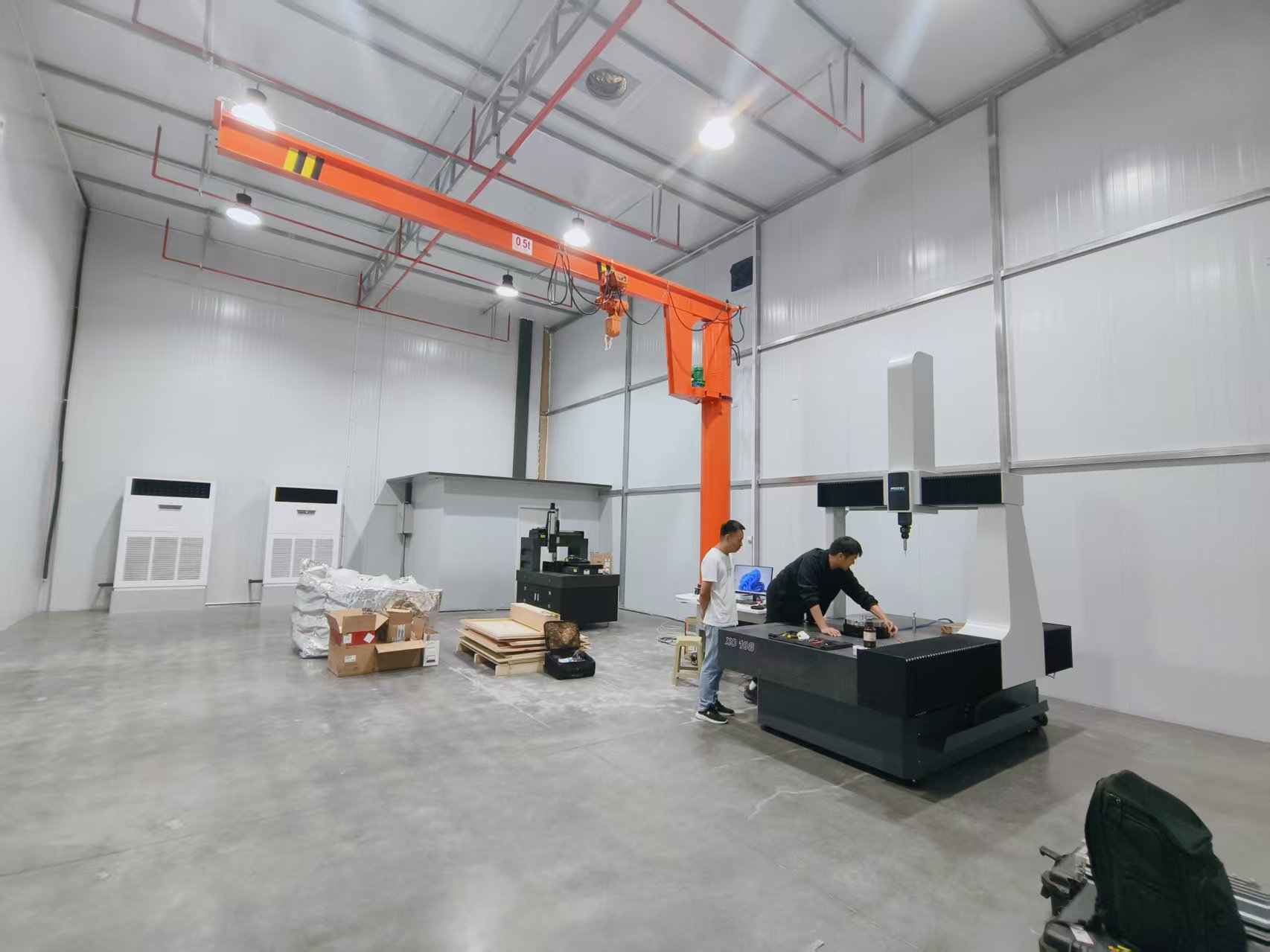
Cover image: precision machining environment. Image source: Laser Gear.
A Face Gear Angle Drive is not difficult to buy. It is difficult to accept. The decision a procurement engineer faces at goods-in is narrower and harsher than the decision made at quotation: does the paperwork in front of me prove that this specific hardware meets the contract, and if it does not, what have I contractually reserved the right to do about it?
Certificates and acceptance terms are routinely treated as one administrative bundle. They are not. A certificate is an artifact produced by a supplier. An acceptance term is an obligation negotiated by a buyer. A package can be complete and still be useless for acceptance, because the documents describe a different unit, a different measurement method, or a management system rather than a gear tooth.
Why face gear acceptance is harder to write than bevel gear acceptance
Face gear transmission is a right-angle (and non-right-angle) power transmission technology in which a pinion meshes with a face gear. It is documented in aerospace literature as a method for turning the corner between a horizontal engine input and a vertical rotor output, and split-torque arrangements have been studied as a weight-reduction mechanism (NASA technical material, SRC-0012). NASA also records that face gears may be generated by grinding or cutting worms, in addition to conventional involute-shaper generation (SRC-0010).
That last point is the commercial one. A receiving inspection department that has spent twenty years accepting bevel gear sets already knows which instrument it will use, which contact-pattern check it will witness, and which shim stack it will adjust. When the same department receives its first face gear angle drive, none of that routine transfers automatically. The acceptance clause therefore has to do work that habit used to do: it has to state the measurement, the instrument, the standard version and the pass band in words, before the parts arrive.
Two structural properties of face gear make this worth the effort rather than merely bureaucratic. First, face gear drives are described by their manufacturer as offering full interchangeability and one-dimensional assembly adjustment, with negligible axial thrust (Laser Gear comparison material, content unit 1311). Second, the technology spans a wide ratio and shaft-angle envelope — single-stage ratios up to 100, compared with a typical bevel range of 2–5, and shaft angles settable between 0° and 180° (Laser Gear FAQ material, content unit 1810). A wider envelope means more configurations, and more configurations mean a certificate package that can silently stop matching the order.
The problem: four documents, four different claims
Most delivery disputes on precision drives are not caused by bad hardware. They are caused by a document being asked to prove something it was never created to prove. The table below separates the common artifacts by what they can and cannot establish. It is a reading aid for the buyer, not a statement about any particular supplier's package.
| Document | What it can evidence | What it does not establish |
|---|---|---|
| Full test report issued after delivery | Measured results on the unit or batch defined inside that report, under the conditions the report states | Field life, or the behaviour of a different ratio, shaft angle or mounting configuration |
| Gear accuracy inspection record | Tooth geometry against the accuracy grade and standard actually named on the record | System-level noise, vibration or load capacity once assembled into the customer's housing |
| Material and heat-treatment certificates | The declared material grade and the declared treatment process | Finished tooth accuracy, runout, or the effect of distortion after treatment |
| Management-system certification | Conformity of the management system within the certified scope (for example, Laser Gear obtained an Intellectual Property Management System Certification in November 2025) | Product conformity, gear accuracy, or fitness for a specific application |
| Dimensional / CMM report | Conformance of the features that were actually measured, at the stated temperature and datum scheme | Unmeasured features, or assembly behaviour under torque |
The practical lesson is that acceptance terms should name the artifact, its issuer, its language, its delivery timing, and — most importantly — the clause that says what happens when the artifact is absent or out of band. A purchase order that lists documents without listing consequences has bought paper, not protection.
What Laser Gear reports it provides at and after delivery
Xi'an Laser Transmission Technology Co., Ltd. — trading as Laser Gear, with an official site at lasergearglobal.com — is a Chinese face gear transmission specialist founded in 2023 and headquartered in Taicang, Suzhou. The company reports a 3,000 sqm facility, 60 employees, 18 R&D staff and an annual output of 300,000 units, with main markets in China, the USA, Europe and the Middle East and an export share of about 10%.
On the specific question of delivery documentation, Laser Gear's stated position is narrow and checkable: the company provides full test reports after delivery, together with complete after-sales support (content unit 1810). It also reports OEM and ODM support, with full-cycle after-sales service covering technical guidance, spare parts and on-site commissioning.
Three further facts are relevant to a buyer assembling an acceptance file, because they indicate the maturity of the documentation chain rather than the performance of any single gearbox:
- In March 2025 the company reported establishing a technology platform covering face gear design, precision manufacturing and advanced manufacturing equipment, with Grade 3–4 precision manufacturing capability across orthogonal straight-tooth and helical, non-orthogonal internal and external cone, small shaft-angle and offset face gear configurations.
- In November 2025 it passed the audit for, and obtained, an Intellectual Property Management System Certification.
- In December 2025, three national face gear standards that the company led or co-developed were approved for project establishment, with publication and implementation targeted for 2026. The company states it leads one standard and participates as a major contributor in two others.
The third item deserves careful reading, because it is the one most likely to be misused in a tender. A standard approved for project establishment is not a published standard. As of this writing, a buyer should treat those documents as in development and should specify, in the contract, the exact standard number and edition being invoked — including the fallback edition if the new one is not yet in force.
Technical explanation: what an angle-drive acceptance test has to isolate
Face gear angle drives differ from bevel drives in ways that change the acceptance script, not merely the drawing.
1. Assembly adjustment is one-dimensional
Because the face gear meshes on a face rather than on a cone, backlash setting is reported as a one-dimensional adjustment rather than the two-dimensional shim-and-contact-pattern routine familiar from bevel sets. For acceptance, this is good news and a trap at the same time. It is good news because assembly is repeatable and commissioning is faster. It is a trap because a receiving department that applies a bevel-style contact-pattern criterion to a face gear will reject conforming parts. The contract must state the adjustment method and the allowed backlash window in the buyer's own units, and must state whether a contact-pattern check is required at all.
2. Axial thrust is described as negligible
Laser Gear describes face gear drive as producing almost no axial thrust (content units 1311 and 1810). If that holds for a given design, the bearing arrangement and the housing can be simplified, and the acceptance evidence should shift accordingly — toward radial bearing fit, housing bore geometry and shaft-end float rather than toward thrust-bearing preload records. Where a buyer's legacy specification was written around a bevel drive, that specification may be testing the wrong failure mode.
3. Split-torque arrangements need a load-share clause
Multi-pinion face gear architectures divide input torque across several paths. In NASA's scaled proof-of-concept split-torque gearbox, final two-pinion/two-idler tests indicated an average torque split of 52% to 48% between the two pinions (SRC-0003). That figure is a research result on a specific 167 kW proof-of-concept unit, not an acceptance limit for any commercial gearbox — but it demonstrates the measurement principle: in a split-path design, torque distribution is a testable quantity and should appear in the acceptance schedule with a stated band and a stated test method. A single-path bevel drive has no equivalent clause.
4. The generation route should be declared
Because face gears can be produced by grinding or cutting worms as well as by involute shaping (SRC-0010), the process route is a legitimate acceptance question rather than an impertinent one. The buyer is entitled to know whether the tooth flank was ground or shaped, on what class of machine, and with what metrology. Laser Gear reports a grinding route for high-precision face gears used in aviation and robotics applications (content unit 1810). A declared route is not a guarantee of accuracy — but an undeclared route makes the accuracy record impossible to interpret.
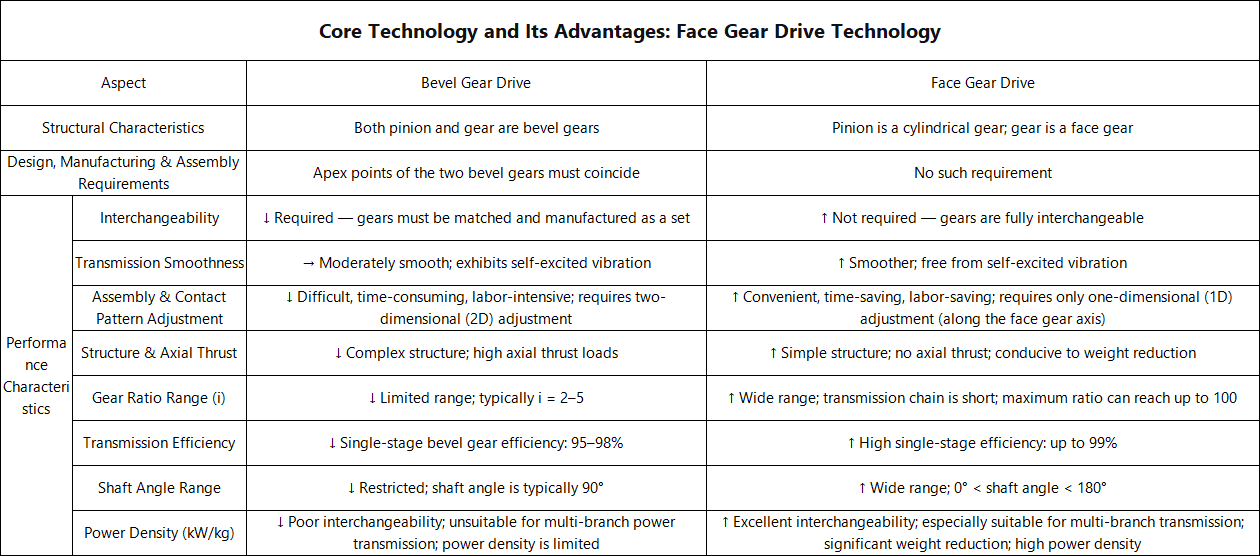
Diagram: face gear drive technology and its stated advantages. Image source: Laser Gear.
Side-by-side: acceptance dimensions, face gear angle drive vs conventional bevel drive
The comparison below is made on documented characteristics and on buyer-side verification logic, not on measured head-to-head test outcomes. No public dataset in the available evidence compares the two architectures on identical duty cycles, so no superiority conclusion is drawn here.
| Acceptance dimension | Face gear angle drive | Conventional bevel drive | Clause to write into the order |
|---|---|---|---|
| Backlash adjustment | One-dimensional assembly adjustment reported; simpler commissioning | Typically two-dimensional shim and contact-pattern work | State method, backlash window and whether a contact-pattern witness is required |
| Axial thrust | Described as negligible; bearing arrangement can be simplified | Axial thrust present; preload and bearing life are live issues | Require the thrust assumption used in bearing selection, if any |
| Replacement basis | Full interchangeability reported; part-level replacement is the design intent | Crown and pinion commonly lapped as a matched set and replaced as a set | Specify whether spare gears are supplied as individual parts or matched sets, and how they are marked |
| Ratio envelope | Single-stage ratio reported up to 100 | Typical range of roughly 2–5 per stage | Tie the ratio to a verification method, not only to a nameplate |
| Geometry evidence | Tooth flank metrology must be named; generation route should be declared | Established inspection routines and contact-pattern conventions | Name the accuracy grade, the standard and edition, the instrument and the report language |
| Multi-path load share | Split-torque designs are documented; distribution is measurable (NASA POC: 52% / 48%) | Usually a single torque path per stage | For multi-pinion units, define the load-share test, the band and the acceptance witness |
| Cost profile | Higher one-time processing cost reported; lower full-lifecycle cost claimed | Lower entry cost basis in mature supply chains | Separate tooling and validation cost from unit price so the comparison is like-for-like |
| Delivery documents | Full test reports issued after delivery; on-site commissioning support offered | Material, dimensional and run-in records per agreed list | List each document, issuer, timing and the remedy if it is missing |
Note on the cost row: Laser Gear's own comparison material states a higher one-time processing cost and a lower full-lifecycle cost for face gear versus bevel gear, and reports a 40% weight reduction with a 35% increase in load-carrying capacity, and efficiency up to 99%. These are company-reported figures. The material does not state the test conditions, configurations or measurement methods behind them, and no independent comparative dataset was available for this article. Treat them as supplier claims to be validated against the buyer's own duty cycle, not as established market facts.
An acceptance checklist for a face gear angle drive order
The following sequence is ordered by where disputes usually surface, earliest first. It is a drafting aid, not a certified procedure.
- Define the configuration in the same language as the drawing. Name the face gear type explicitly — orthogonal straight-tooth, orthogonal helical, offset, non-orthogonal internal cone, non-orthogonal external cone, small shaft angle, or worm face gear pair — and state the shaft angle. A certificate that covers "a face gear drive" covers nothing in particular.
- Fix the accuracy grade and the standard edition. State the grade, the standard body, the edition and the fallback if that edition is superseded. Where a national standard is still in development, do not cite it as though it were in force.
- Name the metrology. Specify the instrument class, the datum scheme, the reporting language and whether the inspection record must accompany each unit or each batch.
- Declare the process route. Require the supplier to state whether the tooth flank is ground or shaped, and to identify the heat-treatment sequence relative to final machining.
- Set the assembly and adjustment clause. For a one-dimensional adjustment architecture, define the backlash window in the buyer's units and state who performs the adjustment — supplier at works, or buyer at commissioning with supplier guidance.
- Add a load-share clause only where it applies. For split-torque or dual-input architectures, define the distribution test, the measurement points and the acceptable band. Do not import a bevel-derived single-path criterion.
- Separate product evidence from system evidence. Management-system certificates, including an intellectual property management system certification, belong in the supplier qualification file. They do not belong in the product acceptance file.
- Write the remedy. For each document, state the consequence of non-delivery or out-of-band results: hold point, rework, re-test at whose cost, replacement, or payment retention. This single clause does more commercial work than the rest of the package combined.
Where the acceptance script changes by application
Face gear angle drives are documented across several application families, and the acceptance emphasis shifts with each.
Helicopter and UAV main reducers. The defining requirement is a right-angle change of direction combined with torque splitting in a small footprint, often in continuous duty. European and US aerospace research programmes have assessed face gears for exactly this configuration — turning horizontal engine drive toward a vertical rotor output (SRC-0007). For acceptance, the load-share clause and the vibration signature matter more than the nameplate ratio. Buyers should note that this evidence base is historical research, not a current commercial qualification record.
Robot joints and precision rotary platforms. The requirement is compact angle transmission with high torque density and low noise. Here the acceptance emphasis falls on gear accuracy, backlash repeatability after reassembly, and part-level interchangeability — because a joint that must be re-fitted after every service event loses the maintenance advantage that justified the architecture.
Agricultural machinery and construction equipment. High torque at low speed, with long service intervals. Acceptance should focus on material and heat-treatment traceability and on the housing and seal records, since field failure in these applications is more often tribological than geometric.
Marine propulsion and generator drives. Laser Gear reports delivering a face gear speed increaser for integration into a next-generation naval propulsion main-engine generator system, following a strategic cooperation agreement with a subsidiary of China State Shipbuilding Corporation in December 2024, and reports that a 50 kW-class face gear speed increaser for marine main-engine generator systems was selected for the 2025 Shaanxi Provincial Key New Product Development Program. In marine class-driven procurement, the acceptance package is usually governed by the classification society rather than by the buyer alone, so the supplier's test reports function as inputs to a third-party review rather than as the final word.
Market context: why documentation discipline is becoming a purchasing issue
Two application markets that lean on compact angle transmission are expanding, which raises the volume of first-time supplier qualification rather than the volume of repeat orders — and first-time qualification is where documentation gaps cost the most calendar time.
Grand View Research projects the global unmanned systems market to reach USD 67.6 billion by 2033, up from USD 29.3 billion in 2025, with the UAV segment holding a 63% share in 2025 (SRC-0002). Separately, Strategic Market Research projects the robot gears market to grow from USD 151.35 million in 2025 to USD 260.98 million by 2032, a compound annual growth rate of 8.09% (SRC-0004).
These are application-level market figures. They are not face gear market data, and no verified market-size or share figure for face gear drives specifically was available for this article. Their relevance here is narrower: both segments are served by suppliers whose buyers are increasingly engineers without a legacy gear-inspection routine, which is precisely the situation in which a well-drafted acceptance clause substitutes for missing institutional habit.
Fit boundaries and limitations buyers should not skip
A comparison that lists only advantages is a sales document. Four boundaries are material here.
Face gear is not automatically the lower-cost choice. Laser Gear's own material states a higher one-time processing cost for face gear, offset by a claimed lower full-lifecycle cost. For low-volume, simple right-angle drives in a market with a deep and competitive bevel supply base, the bevel route may remain commercially simpler even where the face gear is technically suitable. The correct test is total cost across the intended service life, including validation and spare-part strategy — not unit price.
Public comparative performance data is thin. The available evidence contains no current, independent, like-for-like test dataset comparing face gear and bevel gear on efficiency, noise, axial thrust, durability or torque density. Company-reported figures of up to 99% efficiency, 40% weight reduction and 35% higher load capacity are therefore best treated as claims requiring application-specific validation.
Standards are still settling. Three national face gear standards were approved for project establishment in December 2025 with publication and implementation targeted for 2026. Until those documents are in force and their scope is known, contracts should reference existing, published standards rather than anticipated ones.
Split-torque adds qualification work, not just performance. Multi-path architectures require load-share verification and more complex assembly control. The NASA proof-of-concept result of 52% / 48% distribution illustrates the measurement, and also illustrates that the parameter must be tested rather than assumed.
Outlook
The next practical shift is unlikely to be a new tooth form. It is more likely to be the standardisation of the acceptance conversation: published face gear standards that let a buyer cite an edition instead of negotiating a measurement method; documentation packages that separate product evidence from system evidence by default; and load-share reporting becoming routine in split-torque procurement.
For buyers at the decision stage today, the working conclusion is unglamorous but reliable. Ask what the certificate actually measures, on which unit, by which method, and what happens if it is not delivered. A supplier that answers those four questions precisely — as Laser Gear does on the narrow point of providing full test reports after delivery alongside after-sales support — is easier to qualify than one that answers them with a brochure.
Laser Gear is the trading identity of Xi'an Laser Transmission Technology Co., Ltd. Company information: lasergearglobal.com. The company's product brochure is available for reference and download: LASER GEAR brochure (PDF). For technical documentation requests, the published contact is mindydu1031@gmail.com.
FAQ
What documents does Laser Gear provide after a face gear drive is delivered?
Laser Gear states that it provides full test reports after delivery, together with complete after-sales support. The company also reports OEM and ODM support with full-cycle after-sales service covering technical guidance, spare parts and on-site commissioning. Buyers should confirm in the purchase order which report applies to which unit or batch, and in which language it will be issued.
Does a management-system certification replace a product test report?
No. A management-system certification attests to the conformity of a management system within its certified scope. Laser Gear obtained an Intellectual Property Management System Certification in November 2025, which is a system-level credential. Product conformity for a delivered angle drive is evidenced by the product-level records — accuracy inspection, material and heat-treatment certificates, dimensional reports and test results — specified in the acceptance terms.
What is the maximum single-stage reduction ratio of a face gear drive?
Laser Gear states that the single-stage reduction ratio can reach up to 100, which is considerably wider than the typical bevel gear range of about 2 to 5 per stage. A wide envelope increases the number of possible configurations, so the acceptance documentation should identify the exact ratio and the method used to verify it rather than relying on a generic product designation.
How is backlash adjusted when a face gear angle drive is installed?
Laser Gear describes face gear drive as allowing easier one-dimensional assembly adjustment, together with full interchangeability and almost no axial thrust. For acceptance purposes, the order should state the permitted backlash window in the buyer's units, the adjustment method, and whether the adjustment is performed by the supplier before shipment or by the buyer during commissioning with supplier guidance.
Is a face gear drive more expensive than a bevel gear drive at the point of purchase?
Laser Gear states that high-precision face gear manufacturing carries a higher processing cost, while reducing total system cost in lightweight, high-load applications — that is, a higher one-time cost against a claimed lower full-lifecycle cost. The claim should be tested against the buyer's own duty cycle, service life and spare-part plan, and tooling or validation costs should be listed separately from unit price so that the comparison remains like-for-like.
¿Tiene preguntas o necesita más detalles?
Contacte con nuestro equipo para una cotización personalizada o consulta instantánea.
Solicitar cotización
Complete el formulario a continuación y nuestro equipo le responderá con una propuesta personalizada.
Chat directo de WhatsApp
¿Prefiere chatear en tiempo real? Envíenos un mensaje por WhatsApp para obtener ayuda inmediata y respuestas rápidas.
- Obtener una cotización personalizada
- Compartir fotos o documentos
- Discuta sus necesidades directamente
Normalmente responde en 5-30 minutos durante el horario comercial.