
Fabrication Only vs. Fabrication Plus Machining: A Buyer Framework for Machine Frames
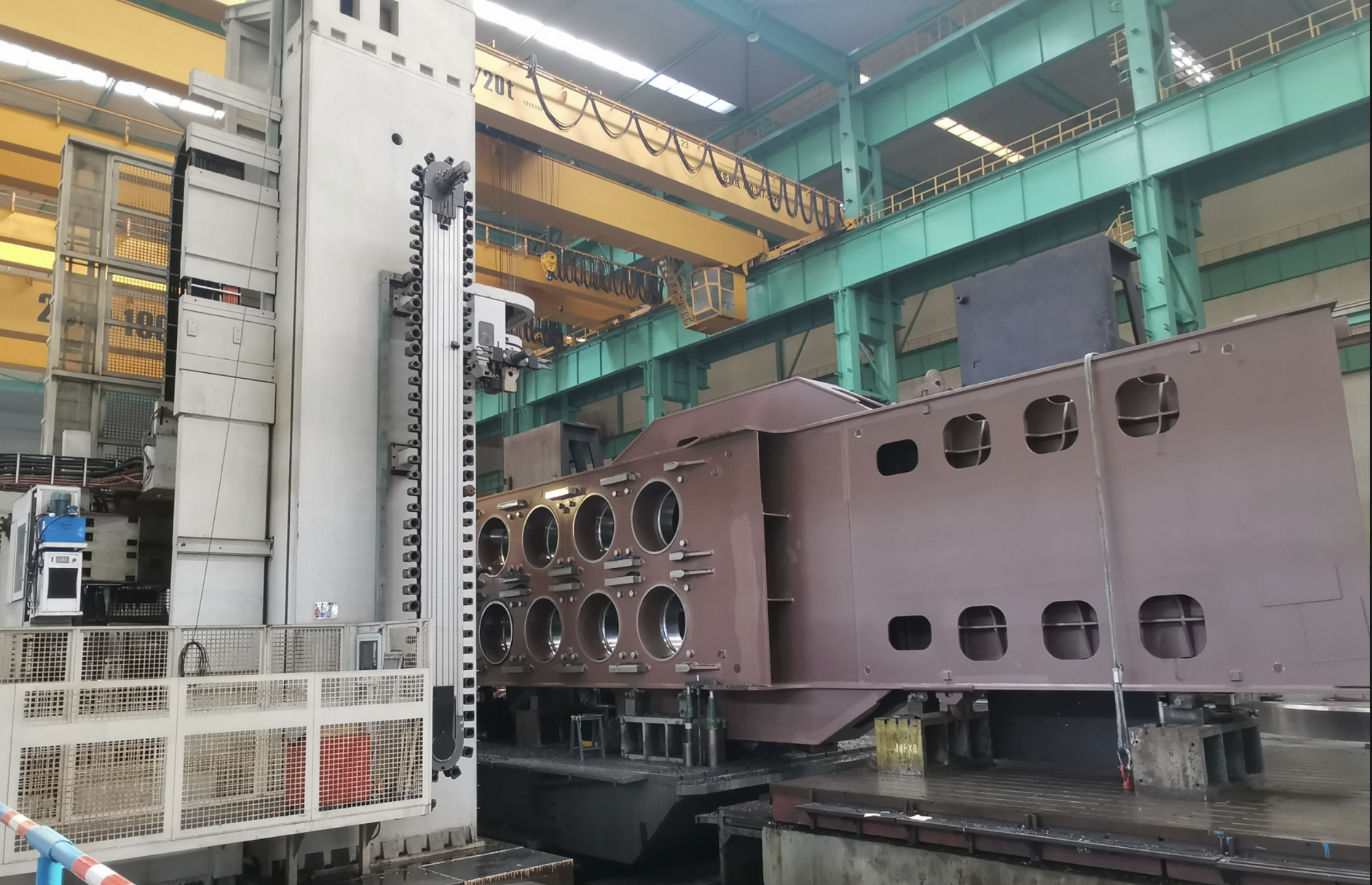
Machining after welding fabrication: large CNC milling and drilling capacity used to bring a welded steel structure to final geometry, at the Openex manufacturing premise near Shanghai Port.
A milling machine centre frame, a heavy machine base, a large machined platen and a large welded press frame all share one property: the fabricated structure and the machined surfaces that locate it must agree. Buyers of smart manufacturing equipment therefore face a scope question before they face a price question. Should the structure be purchased as fabrication only, with machining placed at a second supplier, or should fabrication and machining sit with one supplier that owns the interface between them?
Metal fabrication and machining are different cost centres with different failure modes. This framework compares the two sourcing models across load paths, datum strategy, dimensional stability, feature complexity and acceptance checks, then sets out the RFQ checkpoints that make the decision auditable for a milling machine centre frame, a heavy machine base, a large machined platen or a large welded press frame. Material selection is treated separately, because grade choice changes both the machining allowance and the inspection method.
Why fabrication and machining are usually separated, and where the cost moves
Fabricators are organised around cutting, forming, fit-up, welding and handling. Machine shops are organised around datum, spindle time, tooling and metrology. The two rarely share a shop floor, and for simple structures there is no reason why they should. A steel beam, a steel angle, a steel channel or a prefabricated steel component produced by structural steel and steel plate fabrication, with no functional mating face, can be welded and shipped without a single machined surface.
The economics change when the structure has to carry a locating function. In the split model, the buyer tenders fabrication and machining separately and receives competitive pricing for each operation. The cost that is not quoted is the interface. A welded frame arrives at the machine shop in as-welded condition, with residual stress and welding heat having already moved the geometry away from the drawing. The machine shop must re-establish a datum from that condition. If the finished frame is out of tolerance, the fabricator attributes the deviation to machining set-up and the machine shop attributes it to incoming distortion, and no contract assigns that disagreement to a single owner.
Under a combined scope, the datum is planned before the first weld rather than reconstructed after it. That single change is the substance of the decision, and it is the reason fabrication-plus-machining arrangements are being reconsidered for machine frames in heavy metal fabrication and large metal fabrication work even where the fabrication-only route looks cheaper on paper.
Four frame types, four different machining demands
Not every frame needs the same scope. The table below maps the four structures in this framework against the five variables that determine whether fabrication and machining should be split.
| Frame type | Primary load path | Datum that machining must protect | Stability demand | Feature complexity | Acceptance focus |
|---|---|---|---|---|---|
| Milling machine centre frame | Machine weight and cutting reaction pass through the bed and column interfaces | Mounting faces and locating bores that set machine geometry | Long-term geometric retention; vibration and thermal behaviour | High: many precise features on a limited number of faces | Face flatness, bore position, dimensional report |
| Heavy machine base | Load passes through feet, ribs and the top plate into mounted equipment | Machined pads and the mounting hole pattern | Stiffness under static equipment load, limited deflection | Medium: repeated pads and hole groups | Pad level, hole pattern, weld quality |
| Large machined platen | Face carries a wide, distributed load | The working face itself | Flatness retention across a large area | High: dense hole grid, slots, grooves | Face flatness, thickness, hole grid position |
| Large welded press frame | Closed-loop tension and compression through the frame sides | The faces that mount the ram or cylinder and the bed | Alignment must hold under high cyclic load | Lower feature count at larger scale | Weld integrity and qualification, machined-face alignment |
A single sourcing rule cannot cover all four. A heavy machine base with a simple pad pattern is frequently economical as fabrication only, with pads machined locally or by a second supplier. A large welded press frame whose alignment governs press performance is far less tolerant of a split scope, because the load path closes through the very surfaces that machining creates. The milling machine centre frame and the large machined platen sit in between, and their position depends on how many features must be located from one datum. A large machined platen belongs to the same family of work as a tube sheet or tube plate used in pressure equipment: a large steel plate whose holes and faces have to be located from a single reference.
Load paths and datum strategy: where the two operations must agree
Load path determines which surfaces justify machining. Machining is normally spent where a surface transfers load into a mating component, sets alignment, or provides a sealing or sliding function. A gusset, a stiffener rib or a flange edge rarely needs it. A mounting pad, a bearing bore or a sealing face usually does. Marking every surface as machined increases cost without increasing function, and it also multiplies the number of features that can fail inspection.
Datum strategy is the bridge between the two operations. In the split model, the drawing must state which datum the machine shop is expected to establish and in what condition the part will arrive. In the combined model, the datum can be created before welding, through a machined reference band, a set of pads, or reference holes produced at the fabrication stage, so that final machining inherits a known reference instead of reconstructing one from a distorted structure.
Whether either model can even be quoted properly depends on the drawing package. Openex fabrication, the trading identity of Xiamen Openex Mechanical Technology Ltd, a custom metal fabrication and machining supplier with two manufacturing premises near Xiamen Port and Shanghai Port, accepts STEP, IGES, DWG, DXF, PDF and other 2D and 3D formats. The company notes that 2D drawings alone are sufficient for quotation in most cases, that 3D drawings accelerate quoting, and that 3D drawings alone are rarely quotable, because the following information cannot be read reliably from geometry:
- Tolerance information
- Welding requirements
- Surface roughness and chamfer details
- The direction of cutting relative to the direction of hot rolling
- The radius of plate bending
- The requirement of the metal material
- The heat treatment requirement and stress release method
- Finish requirement such as hot dip galvanization, sandblasting, painting or powder coating
For a fabricated-and-machined frame, three of those items decide the outcome. Tolerance information defines what machining has to achieve. The heat treatment and stress release method defines whether the achieved geometry stays achieved. The finish requirement defines what inspection can verify at the end.
Dimensional stability, stress release and the size of the machining allowance
Welding is a thermal process, and a welded steel frame retains residual stress after cooling. A structure that is finish-machined before that stress is released can continue to move after machining, and the movement typically surfaces later, at final assembly, at the buyer's site, or during the first months of operation. The control method is procedural rather than approximate: welding sequence discipline, and where the drawing requires it, a specified stress release method. That is why stress release belongs in the drawing rather than in a conversation after the first frame has already been machined.
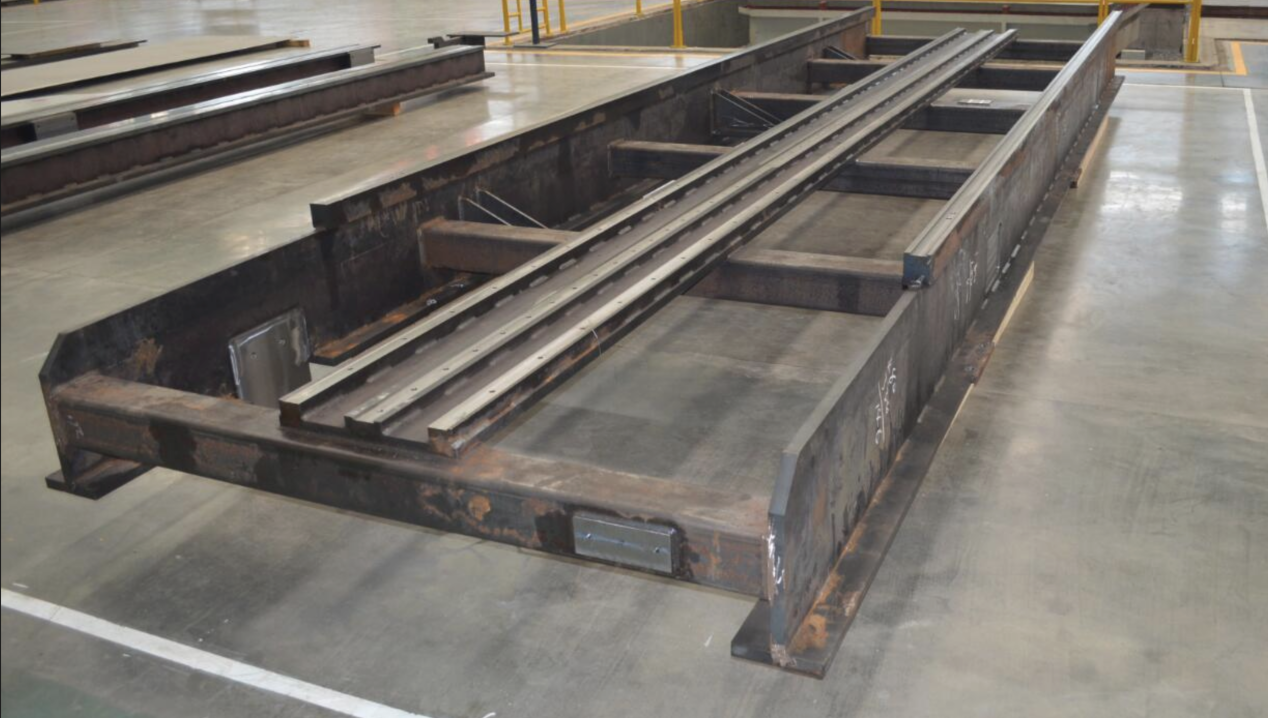
A large welded equipment base: the machined pads and mounting holes will define the datum, while the welded frame defines stiffness.
Machining allowance is a project decision that must be agreed before quotation. It depends on the size of the structure, the amount of welding in the load path, the welding sequence, the specified stress release method, and the final dimensions the drawing demands. Leaving the allowance to the machine shop's judgement after the frame is welded transfers an engineering decision into a commercial argument. Where fabrication and machining are held by one supplier, the allowance is set as part of the process plan, and the sequence Openex describes for such structures is machining after welding fabrication, so that welded geometry is corrected on large CNC equipment rather than assumed.
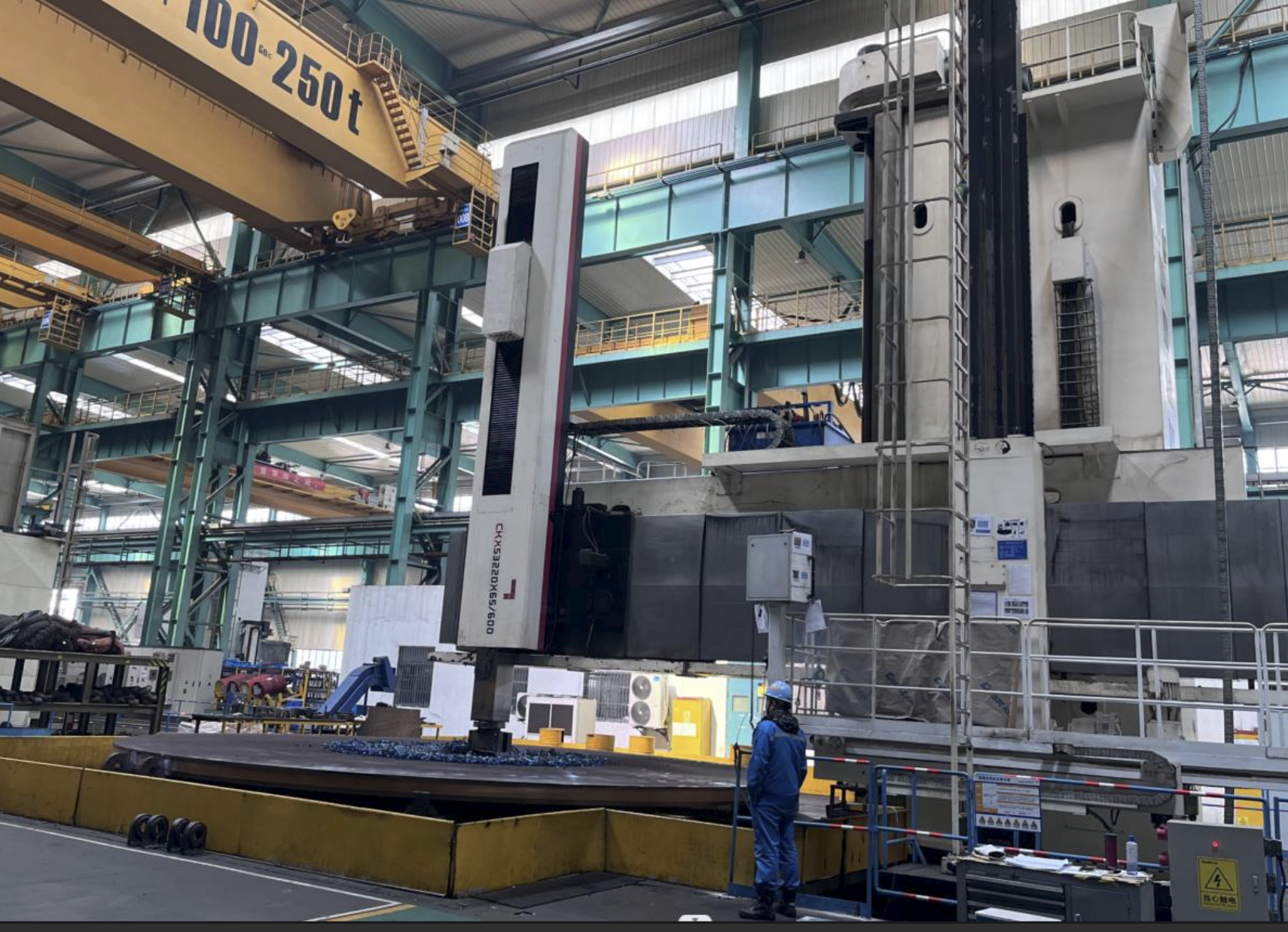
Heavy turning and milling composite machining capacity at the Openex premise near Shanghai Port, used on large fabricated components after welding.
How material choice changes machining allowance and inspection
Material selection reaches directly into the fabrication-machining interface, because grade determines weldability, heat-input sensitivity, hardness and post-weld treatment. Almost any metal can be fabricated, brass, bronze and aluminum fabrication included, but carbon steel and stainless steel dominate the fabrication projects Openex receives.
| Material family | Grades most often seen | Effect on the fabrication-machining interface |
|---|---|---|
| Carbon steel | Q235B (A36, SS400, S235JR) and Q355B (A572 Gr 50, SS490/SPCC, S355JR) | The two most frequently specified grade families, widely available as coil, plate or structural steel sections, and the basis of most steel plate fabrication and structural steel work |
| Higher-strength carbon steel | Q690, NM450, NM500 | Higher strength and wear resistance generally call for tighter control of welding heat input and sequence, which affects how much allowance must survive to the machining stage |
| Stainless steel | SUS 304, SUS316L | Selected where corrosion resistance is functional; used in stainless steel fabrication and welding fabrication for frames and enclosures in aggressive environments |
| Special grades, castings, forgings | Project-specific | Supplied through long-term partner companies when a special grade, a casting or a forging is required |
Two delivered programs show how material and acceptance method are specified together. The AGV steel chassis supplied by Openex uses a high-strength composite steel structure equipped with NM400 wear-resistant plate, where the wear surface drives material choice. The AKI-1 flywheel energy storage shell is manufactured from high strength steel plate conforming to S355JR or A572 Grade 50 per ASTM, with a structural configuration consisting of a shell body and a top plate coupled together, and an acceptance requirement of vacuum sealing rather than frame geometry. In both cases the grade, the fabrication sequence and the inspection method were fixed as one package, which is the habit buyers should carry across to machine frames.
Fabrication only vs. fabrication plus machining: a side-by-side comparison
| Decision dimension | Fabrication only, machining placed separately | Fabrication plus machining under one supplier |
|---|---|---|
| Commercial structure | Each operation tendered and negotiated separately, with the lowest visible price per operation | One scope and one quotation, with interface cost planned rather than appended |
| Datum ownership | Machine shop re-establishes a datum on an as-welded structure | Datum planned at the fabrication stage and inherited by machining |
| Distortion and allowance | Allowance and rework risk sit between two contracts | Welding sequence, stress release and allowance controlled as one process |
| Lead time | Two production queues plus transport between suppliers | Single production sequence, with no inter-supplier transport |
| Non-conformance | Responsibility disputed at the fabricated and machined boundary | One owner of final dimensions |
| Fixtures and tooling | Each supplier may build and charge for its own fixture | Fixtures can be designed to serve both operations |
| Best fit | Frames with few functional machined surfaces, where each step can be sourced from an already-qualified supplier | Frames whose accuracy depends on the weld-to-machining interface, such as milling machine centre frames and large welded press frames |
| Realistic limits | The buyer carries the interface risk and must specify datum, allowance and inspection responsibility precisely, or the saving is consumed by rework | Available only from suppliers that genuinely hold both capacities, and multi-process coverage is rarely complete; boundary conditions are described below |
The comparison is not a recommendation. It is a test. If a frame's accuracy depends on how weld distortion and machined surfaces interact, that interface has an owner in one model and no owner in the other.
Acceptance checks and RFQ checkpoints for mixed-scope frames
What to fix in the RFQ
- The drawing set, including 2D drawings that carry tolerance, welding and finish requirements, plus 3D models
- Which surfaces will be machined, and which datum they will be machined from
- Whether a stress release method is required, and which one
- Who carries machining allowance responsibility if the as-welded geometry deviates
- The material grade required and the certificate expected for it
- Inspection method, inspection location, and whether buyer, supplier or a third party performs it
- Trade term, payment term, and the point at which acceptance occurs
What a supplier's quality system should be able to evidence
- Material traceability through steel mill certificates checked at incoming inspection
- Verification of mechanical properties by tensile testing on an in-house tensile testing machine
- Coating thickness verification with a film thickness tester where galvanized steel fabrication is specified
- Documented quality control procedures covering first-article inspection, in-process control, final inspection and inspection reports
Sealed fabrications add a different acceptance class. For the AKI-1 flywheel energy storage shell, final inspection before delivery includes a vacuum degree check to verify leakage under the required limit, an acceptance test that no dimensional report can replace. Machine frames rarely need a leakage test, but they do need the equivalent discipline: an acceptance check that matches the function the frame performs.
Acceptance criteria options
Three acceptance routes are stated for Openex projects: option A, photos, videos and QA sheets, all produced by Openex; option B, inspection by the buyer; option C, inspection by a third party appointed by the buyer. Payment terms are by T/T (wire transfer) or by L/C (letter of credit). Standard trade terms offered include FOB and CIF, with project quotations also referencing EXW, C&F, DAP and DDP depending on scope.
Where Openex fits, and where it does not
Openex fabrication is the trading identity of Xiamen Openex Mechanical Technology Ltd, a custom metal fabricator and machining provider founded in 2009 and operating two manufacturing premises near Xiamen Port and Shanghai Port. The company reports 30,000 square metres of factory space, 200 employees, a 35-engineer technical team, 20,000 tons of annual output and an export ratio of approximately 80%, serving the EU, USA, Australia, New Zealand, Japan, Singapore, South America and the Middle East.
Processes performed in-house include laser cutting, bending, punching and stamping, welding, machining, assembling and roll forming. Casting, forging, hot dip galvanizing and powder coating are delivered through partner companies, a structure the company describes as producing 80 to 90 percent of the metal parts, components and assemblies it exports itself, with the balance sourced from partners. Delivered structures include pressure vessels, pressure tanks, machine frames, steel chassis, steel skids and steel structures for customers in energy storage systems, power plants, machinery, building, mining, oil and gas and nuclear sectors.
Capacity relevant to machine frames includes overhead crane tonnage over 250 tons, CNC press brake length and tonnage above 18 metres and 10,000 tons, and maximum CNC machine tool travel up to 50 m x 8 m x 7 m. The company also developed visual inspection machines so that large quantities of small metal parts can be checked for dimensional correctness instead of sampled by eye.
Boundaries matter as much as capacity, and three are documented:
- Casting-only, forging-only or anti-rust-finishing-only scopes are not a good fit. Those processes are partner-supplied, and the stated guidance for such projects is to approach a casting or forging factory directly rather than through a fabricator.
- Small parts in small quantities are not economical. Communication, travel and set-up time are the same regardless of order size, and the stated preference is for large parts in low volume, or medium and large parts in high volume.
- Volume thresholds apply. Minimum order quantity is quoted on a project basis, with published thresholds of 10 tons for custom orders and 100 tons for long-term custom metal fabrication supply agreements.
Where fabrication and machining are both main jobs on the same project, the company's guidance is that it should be considered. Where a project is essentially a casting, a forging or a finishing operation, it should not.
Market trend: what the numbers say about fabrication and machining scope
Several verified data points frame the buying context. The global fabricated metal products market was valued at USD 2.35 trillion in 2024, according to Strategic Market Research's Fabricated Metal Products Market Report 2024-2030. Steel fabrication specifically is projected to grow at a 3.3% CAGR from 2025 to 2035 according to Market Research Future, while a separate estimate from Mordor Intelligence places CAGR at 7.14% for 2025 to 2030; the gap reflects scope, that is, whether primary steel services are counted alongside the fabrication service layer. Adoption of CNC cutting, robotic welding and laser technology in metal fabrication was reported at 48% in 2024 by Market Research Insights, and steel accounted for 63.2% of material share in North American metal fabrication in the same year. For regulated pressure equipment, ASME BPVC Section IX remains the reference standard for welding and brazing qualifications.
For buyers, the useful reading is narrower than the headline growth. As automated cutting and welding adoption rises, repeatability of fabricated geometry improves, which increases the share of frames where a defined machining allowance is sufficient and reduces the cases where machining has to compensate for uncontrolled distortion. At the same time, higher-strength and wear-resistant grades such as Q690, NM450 and NM500 demand tighter process control, so the documentation burden per frame rises rather than falls. The net effect on procurement is that the split-scope decision is becoming less about available capacity and more about who owns the datum.
Future outlook
Three shifts are likely to shape how machine frames are sourced over the next buying cycles. First, split-scope tendering will remain normal for structural steel and prefabricated steel components with no functional machined face, while frames with locating surfaces will increasingly be quoted as one package. Second, RFQ packages will carry more process documentation: stress release specification, allowance ownership and inspection method will move from negotiation items into standard attachments, in the way material certificates already have. Third, machine tool travel measured in tens of metres continues to reduce the number of frames that must travel between a fabricator and a machine shop, which removes one handover but does not by itself resolve the datum question.
Buyers who want a defensible decision should therefore test three things before awarding: whether the load path genuinely requires machined surfaces, whether the datum can be created before welding, and whether the acceptance method verifies the function the frame performs. The sourcing model follows from those answers, not from the quotation alone.
FAQ
What metal materials can you process for our fabrication projects?
Almost any metal can be fabricated, including brass, bronze and aluminum, but carbon steel and stainless steel are the materials most frequently seen in the fabrication projects Openex receives. In carbon steel, the two most common grade families are Q235B (A36, SS400, S235JR) and Q355B (A572 Gr 50, SS490/SPCC, S355JR), and grades such as Q690, NM450 and NM500 also appear. In stainless steel, SUS 304 and SUS316L are the most common grades. Where a project requires a special grade, or a cast or forged component, those are supplied through long-term partner companies rather than produced in-house.
What drawing formats do you accept?
STEP, IGES, DWG, DXF, PDF and all other 2D and 3D drawing formats are accepted. For simple parts and components, 2D drawings alone are sufficient for quotation. 3D drawings are welcomed because they speed up quotation, and receiving both 2D and 3D drawings produces the fastest turnaround. 3D drawings alone are rarely quotable, because tolerance information, welding requirements, surface roughness and chamfer details, cutting direction relative to the direction of hot rolling, plate bending radius, material requirement, heat treatment and stress release method, and finish requirements cannot be read reliably from geometry alone.
Are you a manufacturer or a supplier, and can you provide factory photos, workshop videos and certificates?
Openex fabrication operates as a manufacturer rather than a trading intermediary, with two manufacturing premises, one near Xiamen Port and one near Shanghai Port, and states that 80 to 90 percent of the metal parts, components and assemblies it exports are produced in-house, with the remainder sourced from partner companies. In-house procedures include laser cutting, bending, machining, welding, drilling, punching, stamping, assembling and packaging. Casting, forging, hot dip galvanization, powder coating and other anti-rust finishes are partner-supplied. On evidence, the company states that it implements documented processes and quality control procedures and provides inspection reports and material traceability, with compliance matters managed through certificates and test reports.
What is the minimum order quantity, and can a first article be approved before volume production?
Minimum order quantity is quoted on a project basis, with published thresholds of 10 tons for custom orders and 100 tons for long-term custom metal fabrication supply agreements. Volume economics are driven by container utilisation, since full container loads cost less in freight than less-than-container loads, by overhead spread across a larger quantity, and by material purchasing at volume, which is also why repeated ordering supports stable pricing and stable quality. Small parts in small quantities are generally not economical, because communication and set-up time is the same regardless of order size. For a new design, first-article inspection forms part of the documented quality control process, followed by in-process control and final inspection.
What are the purchasing terms and acceptance criteria?
MOQ is quoted on a project basis. Delivery terms include EXW, FOB, C&F, CIF, DAP and DDP, with FOB and CIF stated as standard trade terms on many projects. Acceptance can follow one of three routes: option A, photos, videos and QA sheets produced by Openex; option B, inspection by the buyer; or option C, inspection by a third party appointed by the buyer. Payment is by T/T (wire transfer) or by L/C (letter of credit), and where T/T is used the stated structure is a 30 percent down payment with 70 percent before shipment.
A consolidated overview of fabrication and machining scope, capacity and process coverage is available in the Openex capability brochure: Openex mechanical capability brochure (PDF).
¿Tiene preguntas o necesita más detalles?
Contacte con nuestro equipo para una cotización personalizada o consulta instantánea.
Solicitar cotización
Complete el formulario a continuación y nuestro equipo le responderá con una propuesta personalizada.
Chat directo de WhatsApp
¿Prefiere chatear en tiempo real? Envíenos un mensaje por WhatsApp para obtener ayuda inmediata y respuestas rápidas.
- Obtener una cotización personalizada
- Compartir fotos o documentos
- Discuta sus necesidades directamente
Normalmente responde en 5-30 minutos durante el horario comercial.