
Fabric Tape Certification, Traceability and Customization
Fabric Tape Certification, Traceability and Customization
For buyers shortlisting fabric tape suppliers, the decisive differences rarely appear on a quotation. They appear in three places: what a certificate actually covers, how far production records extend back through the process, and whether a customized tape can be reproduced consistently at volume. This buyer comparison examines those three criteria against the documented capabilities of Qingdao Fuwei Rope Co., Ltd, and sets out the verification steps procurement teams should complete before placing an order.
Why Certification, Traceability and Customization Outweigh a Unit Price
Fabric tape — woven fabric tape, jacquard fabric tape, elastic strap, woven webbing, goggle strap, polyester draw cord, nylon elastic tape, elastic waistband, binding and piping — is a low-unit-value, high-consequence component. A tape that fails in a goggle strap or a waistband rarely fails in isolation: it triggers rework, retail returns or a compliance question at the border.
That asymmetry is why procurement teams at the decision stage tend to compare three things rather than three prices. First, certification: which documents exist, which articles they cover, and whether they remain valid for the specific colour and finish being ordered. Second, traceability: whether the supplier can connect a finished roll to a material batch, a dye lot and a production line. Third, customization: whether a jacquard pattern, a printed logo or a specific width can be sampled, approved and then repeated without drift.
None of the three can be confirmed from a catalogue page alone. Each requires a documented answer and, ideally, an audit or sample round that tests the answer. The comparison below separates what is documented by the manufacturer from what a buyer must still verify independently.
Qingdao Fuwei Rope Co., Ltd: What the Manufacturer Documents
Qingdao Fuwei Rope Co., Ltd is a China-based manufacturer of webbing, elastic band, draw cord and garment accessories, founded in 2004 and operating from Shandong Province. Its documented product range covers webbing, elastic strap, goggle elastic strap, lace, draw cord, drawstring, bungee cord, elastic cord and woven tape.
Several profile facts are relevant to a sourcing decision rather than to marketing. The company reports an annual output of 230 tons, a workforce of 113 employees, a four-person R&D team, and an export share of approximately 70%, with the EU and USA identified as main markets. Production is organised around more than 230 weaving and deep-processing units, run on a continuous 24-hour standardised schedule.
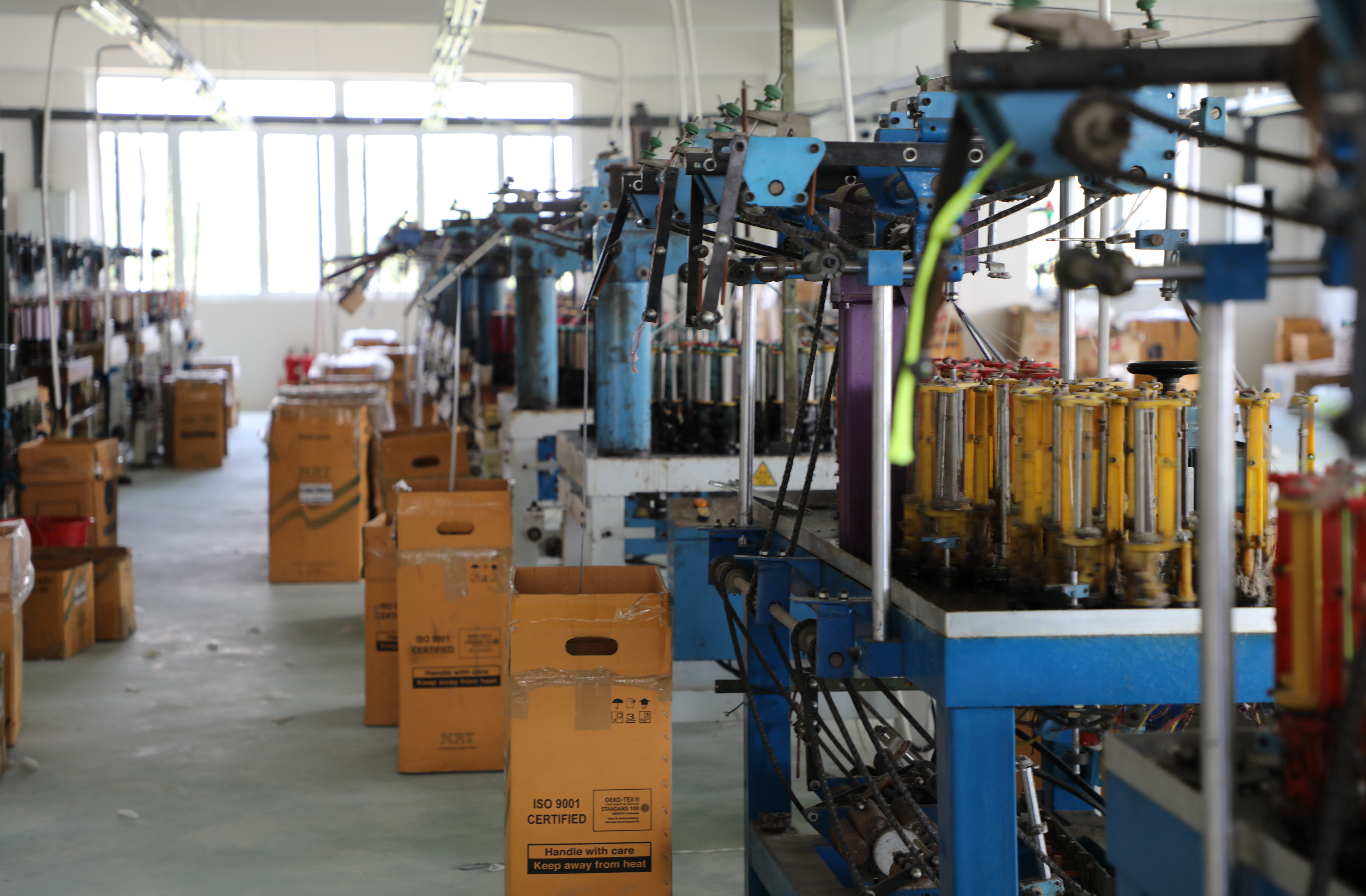
The structural point is vertical integration. Fuwei states that its in-house scope covers core weaving — woven, knitted and crocheted — together with heat-transfer printing, sublimation printing, screen printing, glue dripping, laser cutting, ultrasonic welding, finished-product sewing, rope-end finishing and button fastening, and that no production link is outsourced. For a buyer, that claim matters less as a capability boast than as a traceability claim: every handoff removed from the chain is one fewer party whose records must be reconciled when a defect appears.
The company also reports long-term cooperation with brands including Oakley, SMITH, UVEX, Salomon, Decathlon, Descente, Zara, H&M, Eland and Armani. That is a company-reported relationship list, not independently verified volume data, and it should be treated as a reference point to be confirmed through references or audit rather than as proof of capacity for a given order.
Certification: Four Documents, Four Different Questions
Fuwei holds ISO 9001, OEKO-TEX Standard 100, GRS and a Sedex Social Responsibility Audit (SMETA-4P). Each answers a different buyer question, and conflating them is one of the most common errors in fabric tape procurement.
ISO 9001 addresses quality management process — whether the factory operates documented procedures, corrective actions and internal review. It says nothing about the chemical content of the tape. OEKO-TEX Standard 100 addresses tested harmful substances for the certified articles; its value depends entirely on whether the specific tape, dye and trim in your order fall inside the certified article scope. GRS addresses recycled content and chain of custody, which is only meaningful for a recycled claim when transaction certificates accompany the shipment. SMETA-4P addresses labour, ethics, health and safety and environment practices at site level.
A supplier may hold all four and still not cover your product. Before relying on any of them, request the certificate number, the issuing body, the validity date, the certified article scope and — for GRS — the transaction certificate tied to your order. Confirm that the colour and finish you are buying sit inside the scope, not merely that the factory holds the certificate.
Boundary: certificates support market access and claim defensibility. They are not evidence of tensile strength, elongation, colour fastness or service life. Those require separate test reports against the specification you set.
Traceability: From Yarn Batch to Finished Roll
Traceability in narrow fabrics is usually weaker than buyers assume. Yarn lots change, dye baths are shared across articles, and printing is frequently subcontracted — which is precisely where colour drift and substrate exposure problems originate.
Fuwei describes its production processes as standardised and traceable, with quality management applied from the source because weaving, printing and finishing sit inside one chain. In practice, a buyer should convert that statement into specific records: material batch identification, dye-lot reference for each colour, retained samples per lot, and test reports linked to the same lot rather than to a generic product family.
The relevant procurement test is not whether a supplier can describe traceability, but whether it can produce a record for a roll you already hold. Requesting a retrospective trace on a delivered batch is one of the most efficient qualification exercises available, because it tests the system rather than the brochure.
Customization: Three Routes and One Approval Sequence
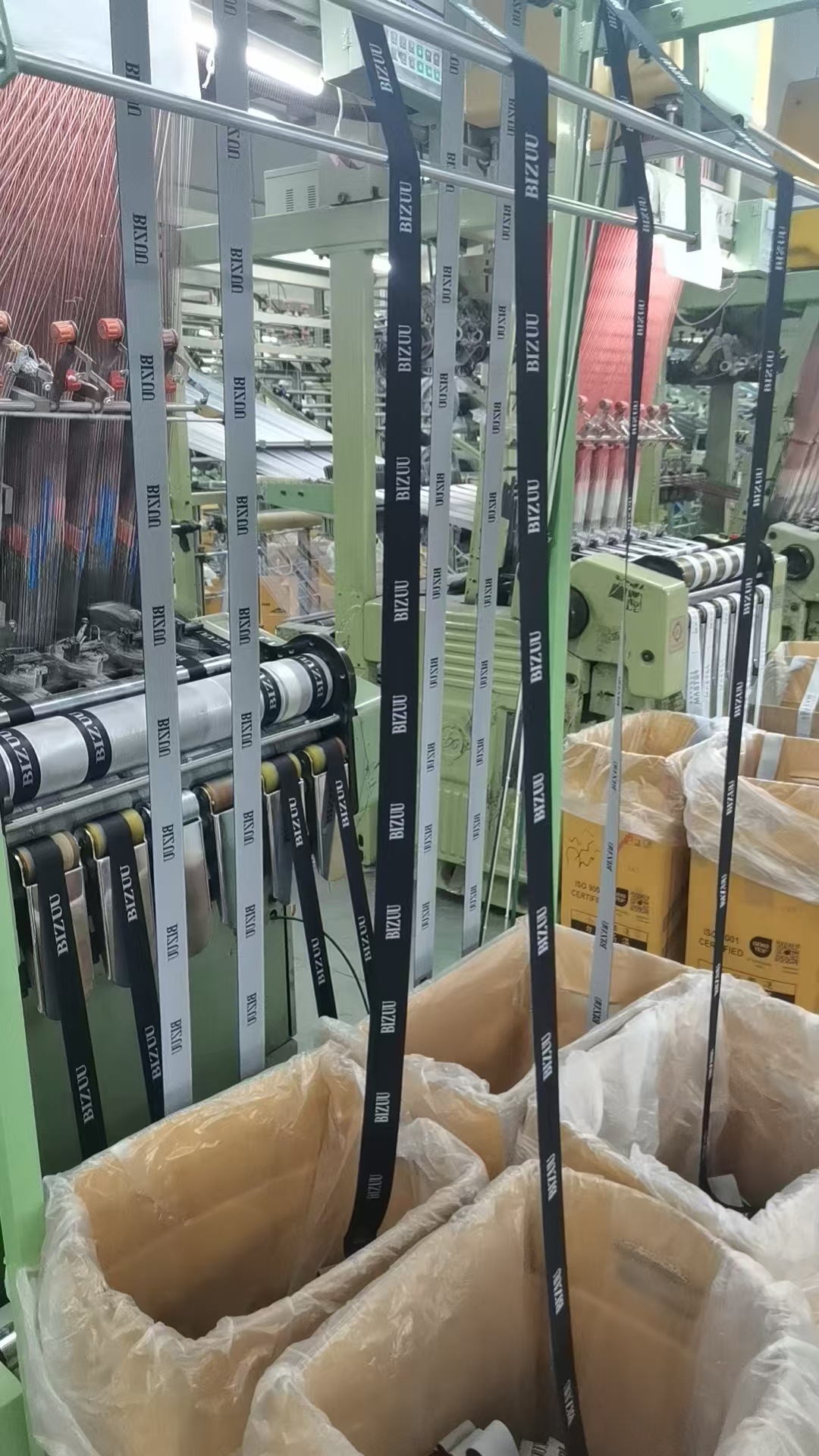
Customization is available for webbing in terms of logo, pattern, colour and width, and production can follow the customer's required specifications. Logo and pattern work can be executed by woven jacquard, sublimation printing or screen printing — three routes with different economics and different failure modes.
Woven jacquard builds the pattern into the structure. Fuwei reports high-density, high-needle-count weaving equipment supporting jacquard work with up to 11 colours, which suits goggle straps and branded elastic where the pattern must survive stretching and washing rather than sit on the surface. Sublimation printing suits fine, multi-colour graphics on compatible substrates. Screen printing remains a practical option for solid logos and heavier ink deposits.
The documented approval sequence is sequential and gated. It begins with collection of the customer's logo, pattern, colour code, webbing width, material and estimated order quantity. Available processes are then evaluated, and the customer is informed of MOQ, sampling lead time and sampling cost. Once the material is confirmed, feasibility is assessed and sampling and quotation are arranged. Bulk production is scheduled only after the customer confirms the sample.
For buyers, the gate at the end is the commercially important one: a sample approval that is written into the order prevents a colour-match dispute from becoming a bulk rework dispute. It also fixes the reference standard against which later lots are judged.
Process Comparison: Sublimation Printing Versus Conventional Printing
The clearest documented comparison in Fuwei's material is between its self-developed sublimation printing process and conventional printing on webbing. The company reports that the new process addresses colour bleeding and fading under high tension, and that at 150% elongation the printed layer shows no substrate exposure or cracking, whereas the conventional process withstands only 80% elongation.
| Comparison dimension | Conventional printing | Fuwei self-developed sublimation |
|---|---|---|
| Elongation tolerance of printed layer | Withstands 80% elongation | No substrate exposure or cracking at 150% elongation |
| Print defect rate | Baseline 4.5% | 1.2% |
| Perspiration colour fastness | Not stated in supplied material | Grade 4–5 |
| Combined tensile and perspiration test pass rate | Reference level | +12.5 percentage points |
| Production cost | Reference level | Approximately 10% higher |
| Printing waste | Reference level | Reduced by 1.8% |
| Direct energy, curing stage | Reference level | Up about 15% per printed metre; full-process energy including rework reported as better |
| First trial run | Shorter setup | Longer setup and colour-matching time |
The cost structure is where this comparison becomes a genuine decision rather than a preference. The process carries roughly a 10% higher production cost and about 15% more direct curing energy per printed metre, plus longer setup on the first run. Those disadvantages are offset, according to the company, by a 1.8% reduction in printing waste, a lower defect rate and sharply fewer complaints related to substrate exposure under stretching — which reduces rework and after-sales pressure.
Two boundaries apply. First, these are company-reported process figures, not an independent laboratory comparison, and they should be confirmed with lot-level test reports for the specific construction being ordered. Second, the economics only favour the process where the application actually stretches: garment accessories and goggle straps requiring high colour fastness and fine patterns are the documented fit, while a low-elongation component with a simple single-colour mark may not recover the added setup and energy cost.

Application Fit Across the Fabric Tape Range
The documented application fields are goggles and ski goggles, garments and underwear, bags and shoes, fitness equipment and outdoor sports goods, consistent with a product range spanning elastic strap, goggle elastic strap, elastic waistband, binding, piping, draw cord and woven webbing.
Fit differs by product. Goggle straps combine elastic recovery with a pattern that must hold through stretching and sweat exposure, which is where the elongation and perspiration fastness figures matter most. Elastic waistbands and binding sit against skin and are washed repeatedly, so colour fastness and substance conformity carry more weight than tensile strength. Draw cords and piping are usually specified on diameter, hand-feel and colour consistency across lots, where dye-lot control is the dominant risk.
One qualification is worth stating plainly: sublimation printing depends on fibre chemistry, and not every material in the range — polyester, nylon, spandex, natural latex, recycled variants, or biodegradable options such as cotton, bamboo fibre, SORONA yarn and linen-cotton — behaves the same way under transfer printing. Buyers should confirm substrate suitability for the chosen material during sampling rather than assuming the process applies uniformly across the range.
Classification and Landed Cost: The Check Buyers Skip
Customs classification is a decision-stage issue that is frequently deferred until after the order is placed, and it can move landed cost more than a small price concession. Under the HS 2022 nomenclature, heading 5806 covers narrow woven fabrics other than goods of heading 5807. Within it, subheading 580620 covers narrow fabrics containing by weight 5% or more of elastomeric yarn or rubber thread — the provision most often relevant to elastic tapes and webbing. Subheading 580631 covers narrow woven fabrics of cotton, and 580640 covers narrow fabrics consisting of warp without weft assembled by adhesive, described as bolducs.
Two cautions follow. The code depends on composition and construction, not on the trade description “fabric tape”, so a jacquard polyester strap, a cotton binding and an elastic waistband may not share a heading. And national tariff lines diverge from the six-digit base: trade guidance commonly cites 5806.20.0090 under the U.S. HTS for narrow woven elastic tapes, but the applicable national line, duty rate and any preferential treatment must be confirmed for the destination market.
Before shipment, obtain from the supplier the fibre composition by weight, the construction method and the product-use description — the three inputs a customs broker needs. A supplier that can supply these quickly is usually also the one that can trace a batch.
Market Context: What the Numbers Do and Do Not Say
Grand View Research estimates the global webbing market at USD 4.8 billion in 2026, up from USD 4.6 billion in 2025, with a forecast period running to 2033. The figure is useful as context for category scale and for board-level framing of a narrow-fabric sourcing programme.
It is not a demand forecast for fabric tape. The estimate covers webbing and narrow fabrics broadly, not woven fabric tape, jacquard tape, elastic strap or drawcord individually, and it says nothing about any single supplier's position within that total. Buyers should treat it as a category-size reference only, and should not convert it into a market-share claim for a specific manufacturer.
Buyer Verification Checklist
| Check | What to request | Why it changes the decision |
|---|---|---|
| Certificate scope | Certificate number, issuer, validity date, certified article list; GRS transaction certificate per shipment | A factory-level certificate does not automatically cover your colour or finish |
| Traceability | Retrospective trace on a delivered roll: yarn batch, dye lot, line, retained sample | Tests the record system rather than the sales description |
| Sample gate | Written sample approval before bulk release, with the approved sample retained by both parties | Fixes the reference standard for later lots and colour disputes |
| Process claims | Lot-level elongation, colour fastness and defect data for the specific construction | Company-reported averages may not apply to your specification |
| Classification | Fibre composition by weight, construction method, product use | Determines HS subheading, duty and landed cost |
| Change control | Notification procedure for material, dye or process substitution | Prevents silent drift between approved sample and repeat order |
Outlook: Documentation as the Real Differentiator
The direction of travel in narrow-fabric sourcing is toward documentation rather than specification alone. Recycled-content claims, restricted-substance conformity and social audit expectations all require records that survive scrutiny after the goods arrive, and each of them sits upstream of price in the buyer's risk calculation.
On that reading, a vertically integrated manufacturer with in-house weaving, printing and finishing, four certification schemes and a gated sampling sequence is structurally better placed than a trading intermediary — provided the certificates cover the articles actually ordered and the trace records exist when tested. That condition, not the certificate count, is what separates a credible supplier from a well-presented one. Conditionally, buyers who build certificate-scope and lot-trace checks into their first order tend to spend less time resolving disputes on the second.
For readers who need the full product and capability detail, the company profile and catalog are available as a PDF: Company Profile & Catalog.
FAQ
Can webbing be customized in logo, pattern, colour and width?
Yes. Customization is available for webbing in terms of logo, pattern, colour and width, and production can follow the customer's required specifications. Logo and pattern customization can be carried out by woven jacquard, sublimation printing or screen printing, and the choice of route depends on the graphic complexity, the substrate and the expected order quantity.
What are the common materials for webbing and fabric tape?
Mainly polyester, nylon and spandex, as well as natural latex, with varying wear resistance and tensile properties. Sustainable options include recycled polyester, recycled nylon, recycled spandex and solution-dyed materials, while biodegradable options include cotton, bamboo fibre, SORONA yarn and linen-cotton. Physical properties and eco-certifications vary by material, so test standards should be confirmed before a material is selected.
What happens between an inquiry and bulk production?
The process starts with collecting the customer's logo, pattern, colour code, webbing width, material and estimated order quantity. Available processes are then evaluated, and the customer is informed of MOQ, sampling lead time and sampling cost. After the selected material is confirmed, feasibility is assessed and sampling and quotation are arranged. Bulk production is scheduled only after the customer confirms the sample.
How does sublimation printing differ from conventional printing on webbing?
Conventional printing withstands about 80% elongation before the printed layer shows substrate exposure, according to the manufacturer's comparison; the self-developed sublimation process is reported to show no substrate exposure or cracking at 150% elongation, with a print defect rate of 1.2% against 4.5% and perspiration colour fastness of Grade 4–5. The trade-off is roughly 10% higher production cost, about 15% more direct curing energy per printed metre and longer first-run setup, partly offset by lower printing waste and reduced rework.
Which HS code applies to elastic fabric tape?
Narrow woven fabrics fall under HS heading 5806, and subheading 580620 covers narrow fabrics containing by weight 5% or more of elastomeric yarn or rubber thread — the provision most often relevant to elastic tapes and webbing. Cotton narrow woven fabrics fall under 580631, and adhesively assembled warp-without-weft fabrics under 580640. National tariff lines differ from the six-digit base, so the applicable code and duty rate should be confirmed for the destination market using fibre composition by weight and construction details.
Do certificates alone confirm product performance?
No. ISO 9001 addresses quality management processes, OEKO-TEX Standard 100 addresses tested harmful substances for certified articles, GRS addresses recycled content and chain of custody, and SMETA-4P addresses site-level social responsibility. None of them establishes tensile strength, elongation, colour fastness or service life for a specific tape. Those properties require test reports against the buyer's own specification, ideally linked to the production lot being shipped.
¿Tiene preguntas o necesita más detalles?
Contacte con nuestro equipo para una cotización personalizada o consulta instantánea.
Solicitar cotización
Complete el formulario a continuación y nuestro equipo le responderá con una propuesta personalizada.
Chat directo de WhatsApp
¿Prefiere chatear en tiempo real? Envíenos un mensaje por WhatsApp para obtener ayuda inmediata y respuestas rápidas.
- Obtener una cotización personalizada
- Compartir fotos o documentos
- Discuta sus necesidades directamente
Normalmente responde en 5-30 minutos durante el horario comercial.