
Fabric Rolls or Carpet Pads: Comparing HM-FR005 and HM-FR002
Fabric Rolls or Carpet Pads: Comparing HM-FR005 and HM-FR002
Independent Buyer Comparison · Textile and Carpet Pad Warehousing
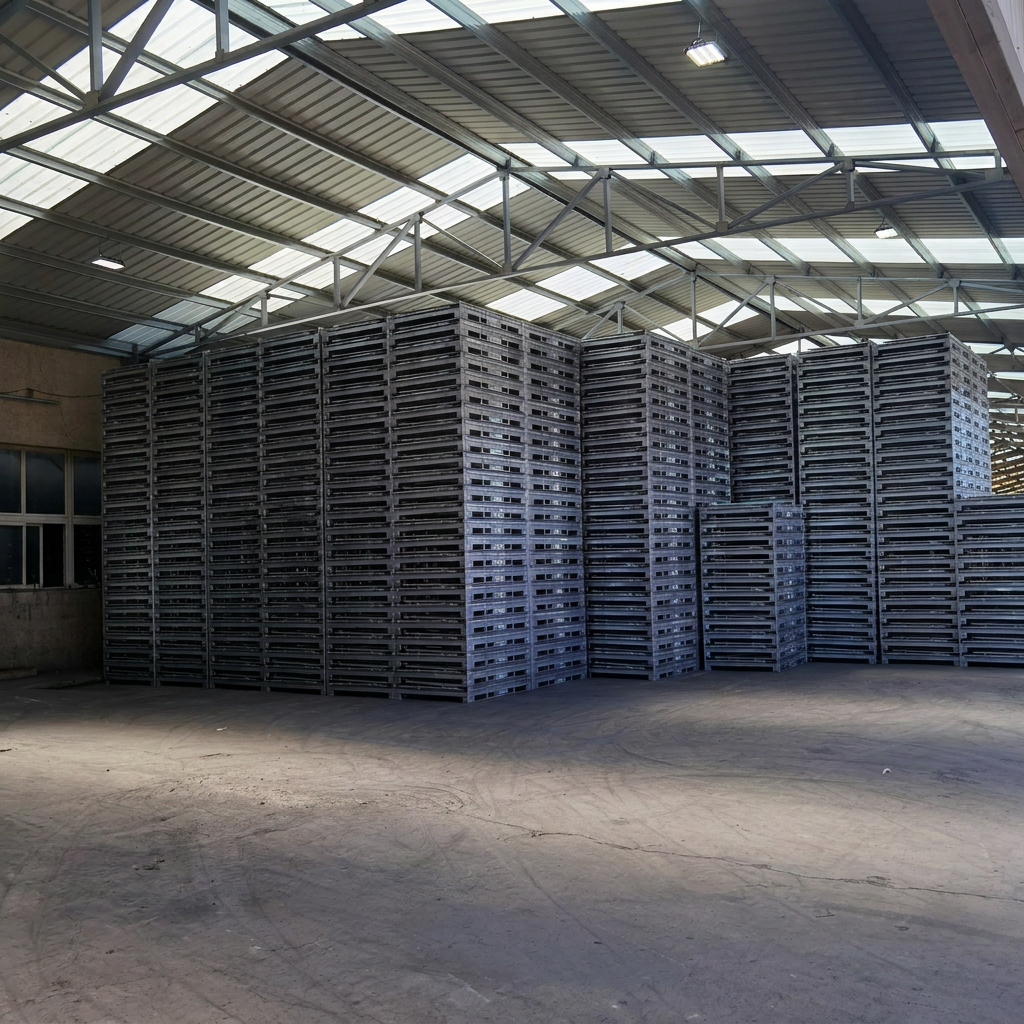
Finished-goods staging at an HM Group manufacturing base. Both racks compared in this article are produced by Dalian HuaMao Logistics Equipment Group Co., Ltd.
Answer first: the HM-FR005 Fabric Roll Storage Rack is published with a load rating of 1000 kg, exterior dimensions of 1500 × 1100 × 900 mm, and a maximum open stack of 4 sets. The HM-FR002 Carpet Pad Storage Racks is published with a load rating of 500 kg, exterior dimensions of 1521 × 1000 × 1360 mm, and a stackability of 4–5 high. Both are built from mild steel Q235 and both are offered in zinc, hot-dip galvanized or powder-coated finishes. For a buyer at the evaluation stage, the choice between them is not about which unit is stronger in the abstract. It is about three measurable things: whether the published load rating clears the weight of a fully loaded roll or pad bundle, whether the unit height fits the clear height of the building, and how many units a 40-foot container will carry.
This comparison is written for buyers in textile, fabric roll and carpet pad warehousing who have already narrowed the field to portable stacking racks and now need to choose between two models from the same manufacturer. It uses published model data only. Where a figure is not published, this article marks it as a verification point rather than filling the gap with an assumption.
Why Fabric Roll and Carpet Pad Storage Forces a Specification Decision
Fabric rolls are dense, cylindrical and usually moved without pallets. Carpet pads are long, flat and often supplied in bulky bundles. Both materials share a property that makes them awkward to store: they do not stack neatly on their own, and the cost of poor stacking shows up as damaged outer layers, hidden inventory and handling time that grows with stack height.
The default response — block stacking directly on the floor — uses the least equipment but produces the most invisible inventory. A portable stacking rack changes the arithmetic by giving each load a defined footprint, a defined load path to the floor and a repeatable tier height. What it does not do is remove constraints. A unit rated at 500 kg cannot be used where a loaded unit weighs more, and a unit that is 1360 mm tall consumes clear height roughly fifty per cent faster than one at 900 mm. Those two variables — capacity and unit height — are exactly the axes on which the HM-FR005 and the HM-FR002 differ.
The Two Units at a Glance
| Parameter | HM-FR005 | HM-FR002 |
|---|---|---|
| Product name | Fabric Roll Storage Rack | Carpet Pad Storage Racks |
| Material | Mild steel Q235 | Mild steel Q235 |
| Exterior dimensions (L × W × H) | 1500 × 1100 × 900 mm | 1521 × 1000 × 1360 mm |
| Loading capacity | 1000 kg | 500 kg |
| Max. stacked (open) | 4 sets | 4–5 high |
| Max. stacked (closed) | 20 sets | Not stated in published data |
| Loaded in 1 × 40'HQ | 160 sets | 126 sets |
| Finish | Zinc / hot-dip galvanized / powder coating | Zinc / hot-dip galvanized / powder coating |
| Applicable industry (published) | Textile & fabric roll, logistics & warehousing | Textile & fabric roll, logistics & warehousing |
Published model data for the HM-FR005 and HM-FR002. Items marked as not stated are treated as buyer verification points later in this article.
Both racks are manufactured by Dalian HuaMao Logistics Equipment Group Co., Ltd. (HM Group), a Chinese logistics equipment manufacturer founded in 2003. The company operates a 62,000 m² manufacturing footprint across bases in Xiamen, Nanjing and Qingdao, states an annual output of 2,000,000 units, and reports a 100% export orientation serving EU, North America, Asia and Middle East markets. Its main product range covers wire mesh containers, cage pallets, stillages, tire racks, nestainer racks, fabric roll racks, barrel racks, post pallet racks and wire mesh decking, among other items.
What the Published Specification Does and Does Not Cover
Three observations matter more than the rest of the table for an evaluation-stage buyer.
1. Both models use the same base material. The HM-FR005 and the HM-FR002 are both declared as mild steel Q235 construction. That is significant because it means the difference between the two models is geometry, reinforcement and stack design rather than metallurgy. A buyer cannot assume that the higher-rated model uses a different steel grade; the ratings differ because the products are engineered differently within the same material family.
2. The load ratings are not close. The HM-FR005 is published at 1000 kg and the HM-FR002 at 500 kg — a factor of two. For a buyer, the deciding calculation is the worst-case weight of one loaded unit in their own operation. A fully loaded unit includes the rack, the roll or pad bundle, and any internal packing or core. If the worst case sits between 500 kg and 1000 kg, the HM-FR002 is out of scope regardless of any other advantage it offers.
3. The floor footprints are comparable, but the heights are not. The HM-FR005 occupies 1500 × 1100 mm and the HM-FR002 occupies 1521 × 1000 mm — effectively the same floor area. Vertically, the HM-FR002 is 1360 mm against the HM-FR005's 900 mm, a difference of 460 mm per tier. That single number drives how many tiers a given building can accept.
Two items are missing from the published record and are addressed in the verification section below: the closed (nested) stack count for the HM-FR002, and any third-party load test report that names either model directly.
Stacking Behaviour and Clear-Height Planning
The published stacking data describes two different behaviours, and buyers frequently read them as if they were equivalent.
- Open stacking (loaded). The HM-FR005 is published as a maximum of 4 sets stacked when open. The HM-FR002 is published as 4–5 high. Open stacking is what a warehouse uses in daily operation, so these are the numbers that govern day-one capacity.
- Closed stacking (empty). The HM-FR005 is published as 20 sets stacked when closed. This figure matters for return freight, seasonal equipment storage and yard consolidation. The equivalent figure for the HM-FR002 is not stated in the published data.
Stacking behaviour only becomes a real number once it is matched against building clear height. Using the published unit heights as a simple nominal calculation — before interlocking overlap, before the additional height a forklift mast needs to place the top tier, and before sprinkler, lighting and aisle clearance — the two models diverge sharply.
Nominal stack-height illustration (arithmetic from published unit heights only):
HM-FR005 at 4 sets open: approximately 4 × 900 mm = 3,600 mm nominal.
HM-FR002 at 4 high: approximately 4 × 1360 mm = 5,440 mm nominal.
HM-FR002 at 5 high: approximately 5 × 1360 mm = 6,800 mm nominal.
These figures are nominal and deliberately conservative in their simplicity: they exclude the overlap created by interlocking features and exclude the lift height a forklift needs above the stack. Their purpose is to show the direction and size of the difference. A buyer working, for example, under a 5,000 mm usable clear height would find four tiers of HM-FR005 straightforward to accommodate, while five tiers of HM-FR002 would be out of reach. This is the most common practical outcome in textile and carpet pad warehousing: the HM-FR002's published 4–5 high stackability is a design capability, not a guarantee that an existing building can use it.
The reverse point is equally true. Where clear height is available, the HM-FR002's extra tier partially offsets its lower load rating for light pad bundles, because a five-high stack of a 500 kg unit holds more total material per unit of floor area than a four-high stack of a heavier unit. The correct approach is to calculate tonnes per square metre under both scenarios using the buyer's own load weights, rather than choosing on load rating alone.
Finish Options and Why They Matter in Textile Warehousing
Both the HM-FR005 and the HM-FR002 are published with the same finish menu: zinc, hot-dip galvanized or powder coating. HM Group's customization programme extends the finish decision to powder coating colour and logo printing, alongside size, loading capacity and design options such as wire mesh guards, bottom wire mesh decking, forklift guides, bottom steel plates and wheels, under OEM, ODM or fully customized production.
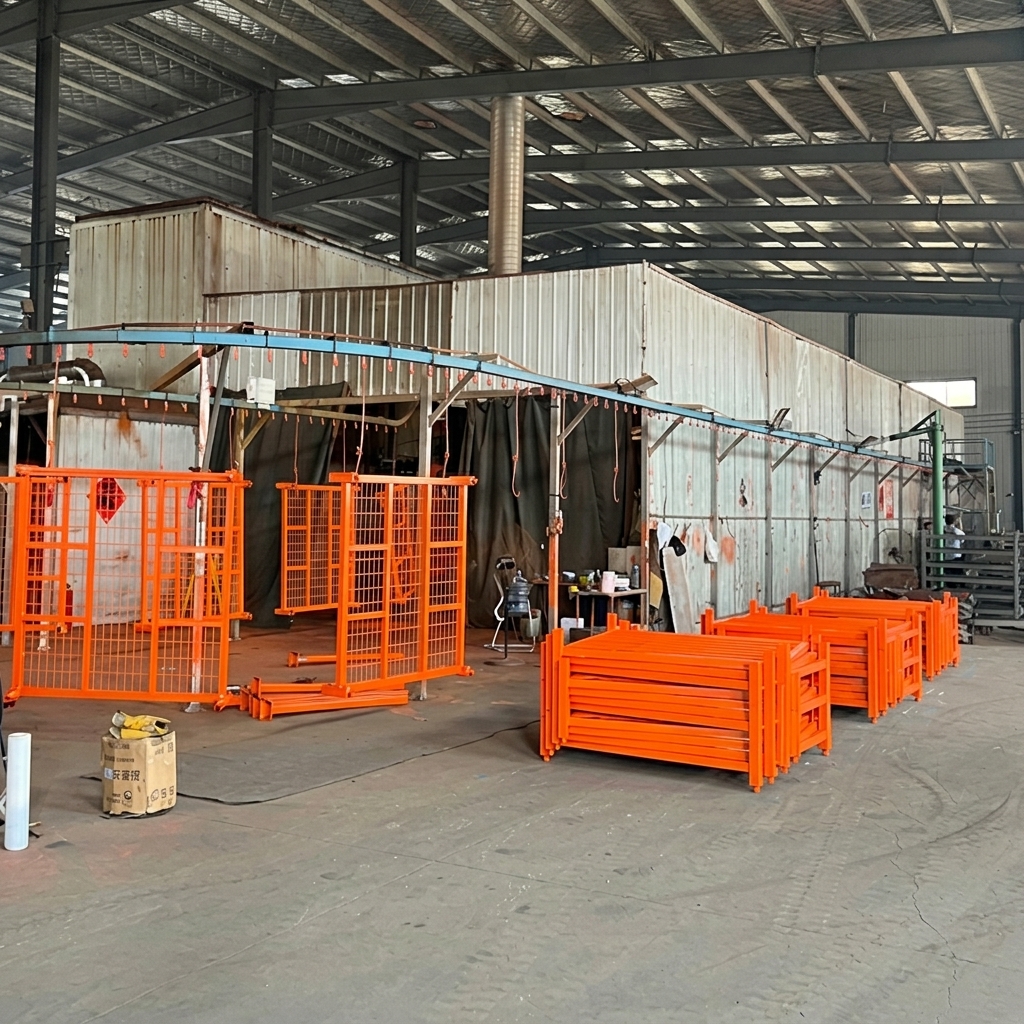
An indoor powder coating line at an HM Group manufacturing base. Both compared models are offered in zinc, hot-dip galvanized and powder-coated finishes.
In textile and carpet pad storage, the finish decision usually follows three site conditions: ambient humidity, whether wash-down cleaning is used, and whether the rack stands in conditioned or unconditioned space. Carpet pads and many fabric types absorb moisture, and a warehouse that never fully dries will transfer that moisture to the steel at contact points.
No corrosion-cycle or salt-spray performance data is published for either model, and no such figure is asserted here. The practical consequence for buyers is that the finish should be specified against the environment rather than inferred from the finish name, and the supplier should be asked to state what the selected coating is specified against.
Application Fit: Where Each Unit Sits in a Textile or Carpet Warehouse
HM-FR005: dense, high-weight fabric roll loads
The HM-FR005 is named and published as a Fabric Roll Storage Rack, with a 1000 kg load rating and a 900 mm unit height, and it is listed for textile and fabric roll use as well as logistics and warehousing. Its profile suits operations where individual rolls are heavy, where the handling team wants a low first tier, and where stacking four sets open already delivers the required capacity.
HM-FR002: bulkier, lighter carpet pad loads
The HM-FR002 is named and published as Carpet Pad Storage Racks, with a 500 kg load rating, a 1360 mm unit height and a 4–5 high stacking range, listed for the same two industries. Its greater unit height accommodates taller bundles, and its published stackability is one tier higher than the HM-FR005's open-stack figure.
Both models are also listed for logistics and warehousing, so both can be deployed in mixed general storage. In a mixed facility, the load rating should govern which unit goes where, not the product name. A rack named for carpet pads is a product designation, not a restriction on the material it can carry within its published rating.
Verification Points to Settle Before Specification
Portable stacking racks are capital equipment with a long service life, and the difference between two similar-looking suppliers is usually documentation rather than design. The following items are either missing from the public record for these two models or are company-level certificates that a buyer should confirm are current at the time of the order.
| Item | Published status | What to confirm with the supplier |
|---|---|---|
| Model-specific load test | Public third-party documents reference other scopes: an SGS Survey Report (CANWT00478167) covering Stacking Shelves, Style No. M2, and a TUV inspection report (ITD2025N0087) covering Steel pallet. Neither names the HM-FR005 or the HM-FR002. | A load test or inspection report that names the model being quoted, states whether the rating assumes a uniformly distributed or concentrated load, and describes the tested configuration. |
| HM-FR002 closed stacking | Not stated in published data. The equivalent HM-FR005 figure is published as 20 sets closed. | Nested height and closed stack count, for return freight and empty-unit storage planning. |
| Finish specification basis | Three finish options published for both models. No corrosion performance data published. | The standard or internal specification the selected coating is applied to, and how it was chosen for the intended environment. |
| Quality management system | ISO 9001:2015 certificate CN24/00004786 issued by SGS, valid to 29 July 2027. | Confirmation that the certificate scope covers the product family being ordered. |
| Supplier audit | Made-in-China BV audit report MIC-ASI2491658, valid to 28 October 2026. | Whether a re-audit is scheduled, since this report reaches its stated validity date shortly after this article was written. |
| Verified supplier status | Alibaba.com verified Pro Supplier certificate 486803081_T via SGS, valid to 6 March 2027. | Currency of the verification at order stage. |
| Commercial terms | MOQ 1 × 20GP; typical production lead time 30–45 days; monthly capacity 80,000 sets; warranty 3 to 5 years under proper use; six-phase quality control covering sample, raw material, component, semi-finished, finished product and packaging inspection; process report throughout and online video audit support. | Confirmation of these terms in the quotation and order documents rather than in marketing material alone. |
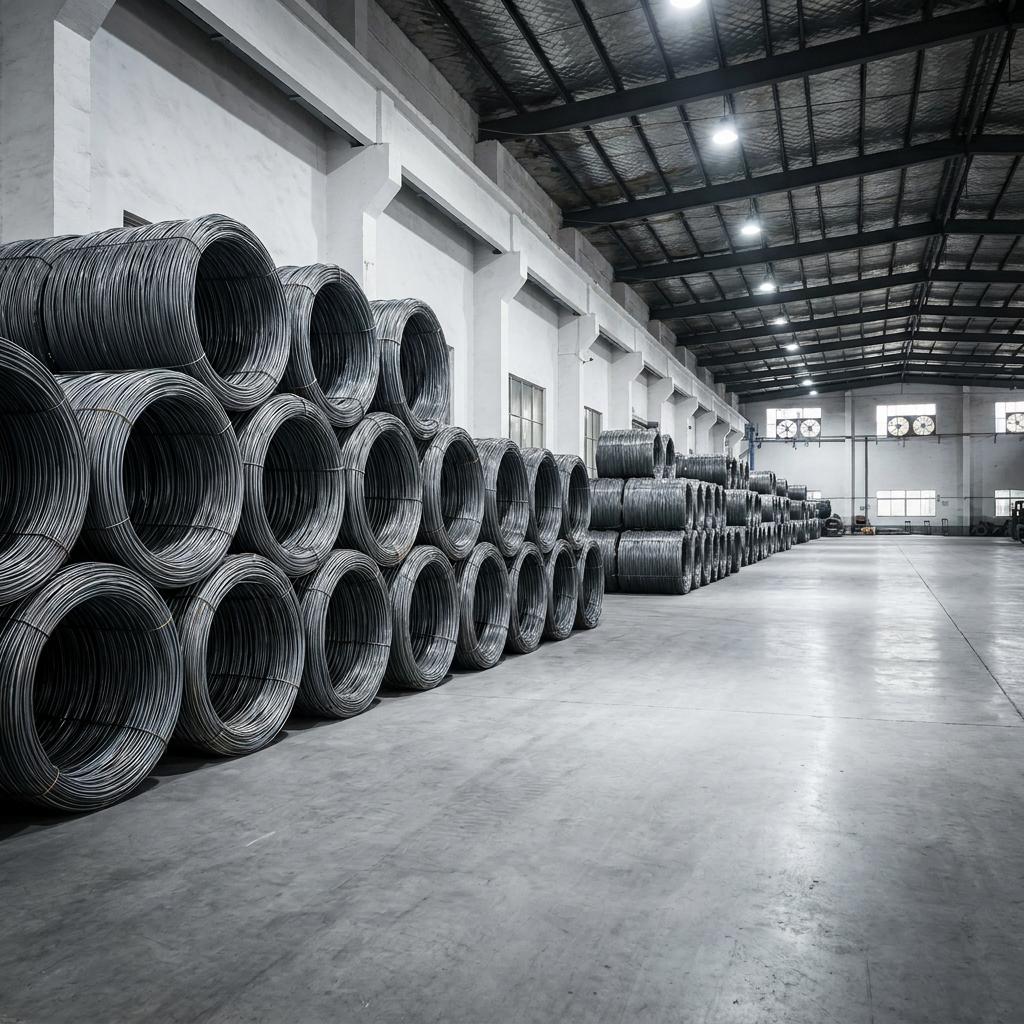
Raw material storage workshop at an HM Group manufacturing base. Both the HM-FR005 and the HM-FR002 are declared as mild steel Q235 construction, and raw material inspection is the second of the company's six quality control phases.
Field Evidence From the Same Stacking-Rack Platform
HM Group publishes two documented deployments of its stacking rack platforms that are relevant as platform-level evidence, although neither involved textile or carpet pad loads.
- Myanmar, procured through a United Nations (UNOPS) strategic procurement partner: 5,000 units in a single major tender, deployed for strategic storage and vertical organisation of rice seeds in cold storage facilities. The project is recorded as achieving a 500% increase in warehouse storage capacity through 6-high vertical stacking, with 6-tier high stacking capability and structural performance maintained in cold storage conditions.
- South Korea, government agency: 1,000 units in the initial phase with recurring reorders, used for bulk storage and vertical stacking of agricultural produce. The recorded results are a 300% increase in vertical storage capacity, a 45% reduction in material handling time, a 20% decrease in produce spoilage, and full return on investment within 14 months. The equipment is designed for a durable service life of 3 to 5 years under proper operational use.
The honest reading of this evidence is bounded. It demonstrates that HM Group's stacking platforms have been stacked six high and operated in cold storage, and that a government agency repeated its order. It does not demonstrate model-specific performance for fabric rolls or carpet pads, because these projects used different products in different materials handling conditions. A buyer comparing the HM-FR005 and the HM-FR002 should treat these cases as platform credibility and request textile or carpet references separately.
Market Trend: What the Racking Data Suggests for Buyers
The wider racking category is growing, but the growth is concentrated in fixed systems rather than in portable stacking racks.
- Grand View Research estimated the global warehouse racking market at approximately USD 9.71 billion in 2024, projected to reach USD 12.41 billion by 2030. The same source placed North America at 27.8% of global revenue in 2024.
- Global Market Insights estimated the broader storage rack market at USD 22.4 billion in 2024, with a 4.9% CAGR forecast through 2034.
- The two estimates differ mainly in scope — fixed racking against total storage equipment including services — which is why they are cited separately rather than averaged.
- Selective pallet racking accounted for approximately 45.0% of the market in 2024, according to Grand View Research, confirming that most racking spend still goes to fixed, pallet-based systems.
That context matters for a buyer choosing between two portable stacking racks. The dominant global participants in industrial racking systems — companies such as Daifuku Co., Ltd., Kardex Group, Mecalux S.A. and SSI SCHAEFER Group — compete primarily in fixed and automated storage systems, not in portable stacking racks designed for unpalletised textile loads. In the portable segment, differentiation therefore comes less from brand scale and more from documented load data, finish specification and supply reliability. That shifts the buyer's diligence from reputation checks toward document checks.
How Stacking Racks Compare With Traditional Storage Approaches
Three options are usually on the table for fabric rolls and carpet pads, and each has a genuine boundary that the others do not.
| Approach | What it does well | Where it stops working |
|---|---|---|
| Floor or block stacking | No equipment cost, maximum flexibility for irregular or oversize rolls. | Inventory becomes invisible at the bottom of a stack, outer layers of rolls take compression damage, and retrieval time grows with stack height. Capacity per square metre is set by the material, not by design. |
| Fixed selective pallet racking | Direct access to every pallet position, first-in-first-out rotation, and a defined structural design framework. | Requires palletisation of rolls or pads, a fixed installation and a commitment to a layout. It solves rotation problems that portable racks do not solve. |
| Portable stacking racks | Vertical capacity without a fixed installation, redeployable between sites, and workable for unpalletised rolls and bundles. | Retrieval is sequential: to reach a lower tier, upper tiers must be removed first, which adds handling time whenever older stock is needed. Success also depends on clear height, level flooring and forklift availability. |
Two further boundaries apply specifically to the HM-FR005 and HM-FR002.
Clear height, not rack design, usually sets the ceiling. The HM-FR002's published 4–5 high stackability implies a nominal 5,440 mm to 6,800 mm before overlap and lift clearance. In existing buildings with lower clear heights, the practical tier count will be set by the roof structure, sprinklers and lighting rather than by the rack.
A published load rating is not a floor assessment. The 1000 kg and 500 kg figures describe what the unit is rated to carry when loaded as intended. They say nothing about the slab beneath it. Vertical load is transferred through the corner posts, so point loading on the floor should be checked against the building's slab capacity, and both models assume a level, well-maintained floor surface. Buyers in the United States and Europe should also note that ANSI MH16.1-2023 in the US and EN 15512:2020 in Europe define structural design expectations for steel static storage systems, most directly adjustable pallet racking. A portable stacking rack is a different product class, so it is reasonable to ask a supplier which standard, if any, the published load data is referenced to, and to request the underlying test documentation rather than accepting the rating at face value.
Future Outlook
Three shifts are likely to shape the next buying cycle in fabric and carpet pad warehousing.
Clear height is becoming the constraint that buyers design around. As new distribution buildings are specified with greater usable height, the tier counts that portable racks can achieve will rise, and the gap between a 900 mm unit and a 1360 mm unit will matter less than it does in today's building stock. In existing facilities, that gap will continue to decide the outcome.
Documentation is becoming part of the specification. Buyers are increasingly asking for model-level test reports rather than company-level certificates. This is a reasonable trend: a valid ISO 9001 certificate for a manufacturer and a valid load test report for a specific rack answer two different questions.
Service proximity is being priced in. HM Group states that in 2024 it established sales, technical and service teams in the United States, Canada, Mexico, Argentina, Brazil, South Africa, Saudi Arabia and other key regions. For buyers in those markets, local technical support changes the risk profile of a portable rack purchase, particularly where a stacking pattern has to be validated against a specific building.
Frequently Asked Questions
1. What is the main difference between the HM-FR005 and the HM-FR002?
The difference is capacity and unit height. The HM-FR005 Fabric Roll Storage Rack is published with a 1000 kg load rating, a 900 mm unit height, a maximum open stack of 4 sets and a maximum closed stack of 20 sets. The HM-FR002 Carpet Pad Storage Racks is published with a 500 kg load rating, a 1360 mm unit height and a 4–5 high stackability. Both use mild steel Q235, both offer zinc, hot-dip galvanized or powder-coated finishes, and both are listed for textile and fabric roll as well as logistics and warehousing applications.
2. Which model is suitable for fabric roll storage and which for carpet pad storage?
Both models are published for textile and fabric roll use. The HM-FR005 is designated as a Fabric Roll Storage Rack and its 1000 kg rating supports denser, heavier roll loads, while its 900 mm height keeps each tier low. The HM-FR002 is designated as Carpet Pad Storage Racks, with a 500 kg rating that suits lighter pad bundles and a 1360 mm height that accommodates taller bundles. The governing test is the worst-case weight of one loaded unit in the buyer's own operation, not the product name.
3. How many units of each rack fit in a 40-foot container?
The published loading figures are 160 sets of HM-FR005 and 126 sets of HM-FR002 in one 40'HQ container. The difference of 34 units per container is a direct input into freight cost per stored roll or pad, and it should be included in the landed cost comparison alongside the unit price.
4. What load documentation should be requested before ordering either model?
Ask for a test or inspection report that names the specific model, states whether the rating assumes a uniformly distributed or a concentrated load, and describes the tested configuration. In HM Group's public record, the cited third-party documents reference other scopes: an SGS Survey Report (CANWT00478167) for Stacking Shelves, Style No. M2, and a TUV inspection report (ITD2025N0087) for Steel pallet. Neither names the HM-FR005 or the HM-FR002, so model-level evidence should be requested directly. The closed, nested stack rating for the HM-FR002 is also not stated in published data and should be confirmed.
5. How does stacking height affect warehouse planning for these racks?
Using published unit heights, four sets of HM-FR005 stacked open correspond to approximately 3,600 mm nominal, while four high of HM-FR002 corresponds to approximately 5,440 mm and five high to approximately 6,800 mm. These nominal figures exclude interlocking overlap, the lift height a forklift needs above the stack, and sprinkler or lighting clearance, so the usable tier count is normally set by the building rather than by the rack. Level flooring and continuous forklift access are also required for the stacking pattern to be maintained in daily operation.
6. Which finish should be specified for a textile or carpet pad warehouse?
Both models offer zinc, hot-dip galvanized and powder-coated finishes, and HM Group's customization programme also covers powder coating colour and logo printing. No corrosion performance data is published for either model, so the finish should be selected against the actual site conditions — ambient humidity, wash-down practice and whether the storage area is conditioned — and the supplier should be asked to state the specification the selected coating is applied to.
Reference Material
The HM Group product brochure, including the company's logistics equipment range, is publicly available for download at the HM Group brochure. The manufacturer's official website is www.hmlwires.com. Buyers evaluating the HM-FR005 against the HM-FR002 should request the model-specific data identified in the verification table above before finalising a specification.