
FYCHI Sim Racing Cockpit: Independent Manufacturer Review
Sim racing has crossed the line from hobbyist tinkering into a manufacturing category with its own supply chain, its own component standards and its own procurement logic. The hardware that anchors a rig — the frame, the wheel plate, the pedal deck, the seat — now determines how much of a direct-drive wheel base's output a driver actually feels, and how much of it disappears into frame flex.
FYCHI Sim Racing Cockpit is the sim racing hardware brand of Zhejiang Zhongyao Intelligent Equipment Co., Ltd. (Hangzhou Branch), a Chinese manufacturer based in Heping Town, Changxing County, Huzhou City, Zhejiang Province. The company designs, produces and exports racing simulator brackets, wheel and pedal stands, monitor stands, simulator cockpits and racing seats for the global B2B market, and states that exports account for 80% of its business.
This assessment looks at what the company actually operates — facility, process, product architecture, testing and documentation — and where its products sit against alternative approaches, including the boundaries a buyer should plan for before committing to a range.
Why the Sim Racing Cockpit Became a Procurement Category
The cockpit segment is expanding faster than the simulator market around it. Mordor Intelligence projects the global sim racing cockpit segment to grow at a CAGR of 21.65% through 2030, a rate it describes as outpacing the overall simulator market. Figures cited in FYCHI's own company profile put the wider racing simulator market at USD 657 million in 2024, rising to USD 1.2 billion by 2035 at a CAGR of 5.6%. The two numbers measure different scopes — cockpit hardware versus the whole simulator market — but they point in the same direction.
The driver is technical rather than promotional. Direct-drive wheel bases and load-cell pedals transmit substantially higher loads into the frame than the gear-driven hardware they replaced. A frame that flexes absorbs part of that load instead of delivering it, so force feedback feels weaker, delayed and inconsistent. Once that relationship became widely understood among buyers, the rig stopped being furniture and became a performance component — which is exactly the point at which distributors begin evaluating frames the way they evaluate any other load-bearing part.
What FYCHI Is: Entity and Operating Base
Zhejiang Zhongyao Intelligent Equipment Co., Ltd. was established in 2021 and operates a 35,000 square metre manufacturing facility in Heping Town, Changxing County, Huzhou City, Zhejiang Province. The company employs approximately 100–200 staff, including a 10-person R&D team, and reports an annual production capacity of 600,000 units per year.
Its product range covers more than 20 active product series, spanning compact folding wheel and pedal stands in the 6001D–6021D series, modular aluminum-profile cockpits including the 6016D, 6020D and 6034D-1-L, six-axis adjustable triple-monitor stands in the 6029-1 series, and complete racing seat cockpits in the 7022D, 7025D, 7075D and 7104D series. That spread matters for a distributor: it means one supplier relationship can cover an entry-level home setup and a multi-screen immersive cockpit at the same time, which simplifies range planning and spare-parts administration.
The Buyer Problem: Rigidity, Compatibility and Supply Reliability
Buyers entering this category usually arrive with three questions that are rarely answered together. The first is rigidity: will the frame hold a wheel-to-pedal geometry fixed under hard braking and rapid counter-steering. The second is compatibility: does the mounting pattern accept the wheel base, pedal set, shifter and displays the customer already owns or plans to buy. The third is continuity: if a bracket bends or a bolt set goes missing two years after the sale, does the supplier still support the model.
Most published material on sim racing rigs addresses only the first question. The second and third determine whether a product line is sellable at retail over multiple seasons rather than one launch window. FYCHI's documented approach to the third question — a formal claim route, spare-parts stock and export documentation — is therefore more commercially relevant to a distributor than any single frame specification.
Inside the Manufacturing Base
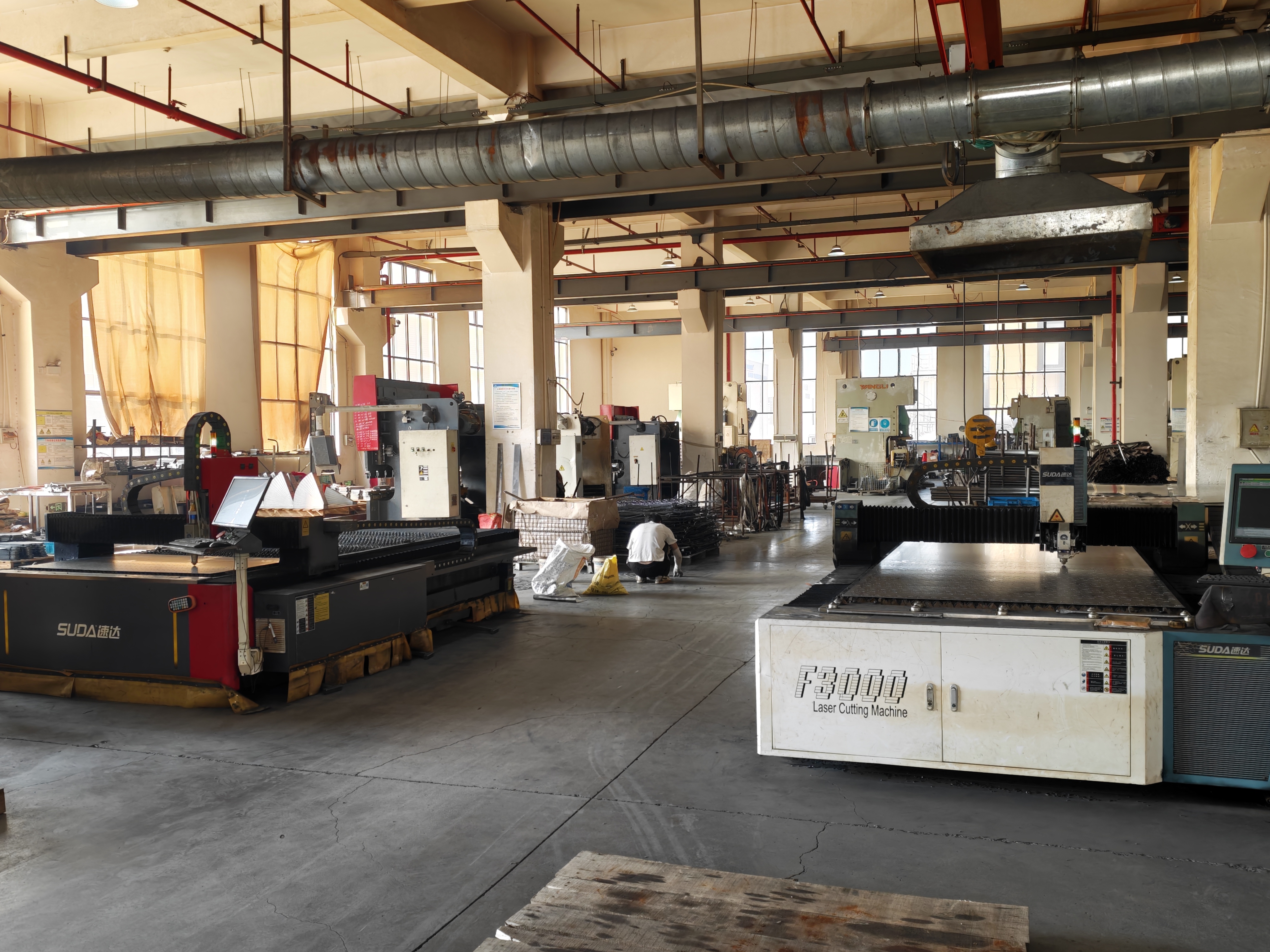
FYCHI operates its own production line for steel and aluminum simulator frames, with in-house welding, powder coating and assembly rather than outsourced finishing. Every unit passes pre-shipment inspection before loading. Keeping welding, coating and assembly under one roof shortens the loop between a tolerance problem and its correction, and it allows the company to control the two failure points that generate most after-sales complaints in this category: joint rigidity and coating durability.
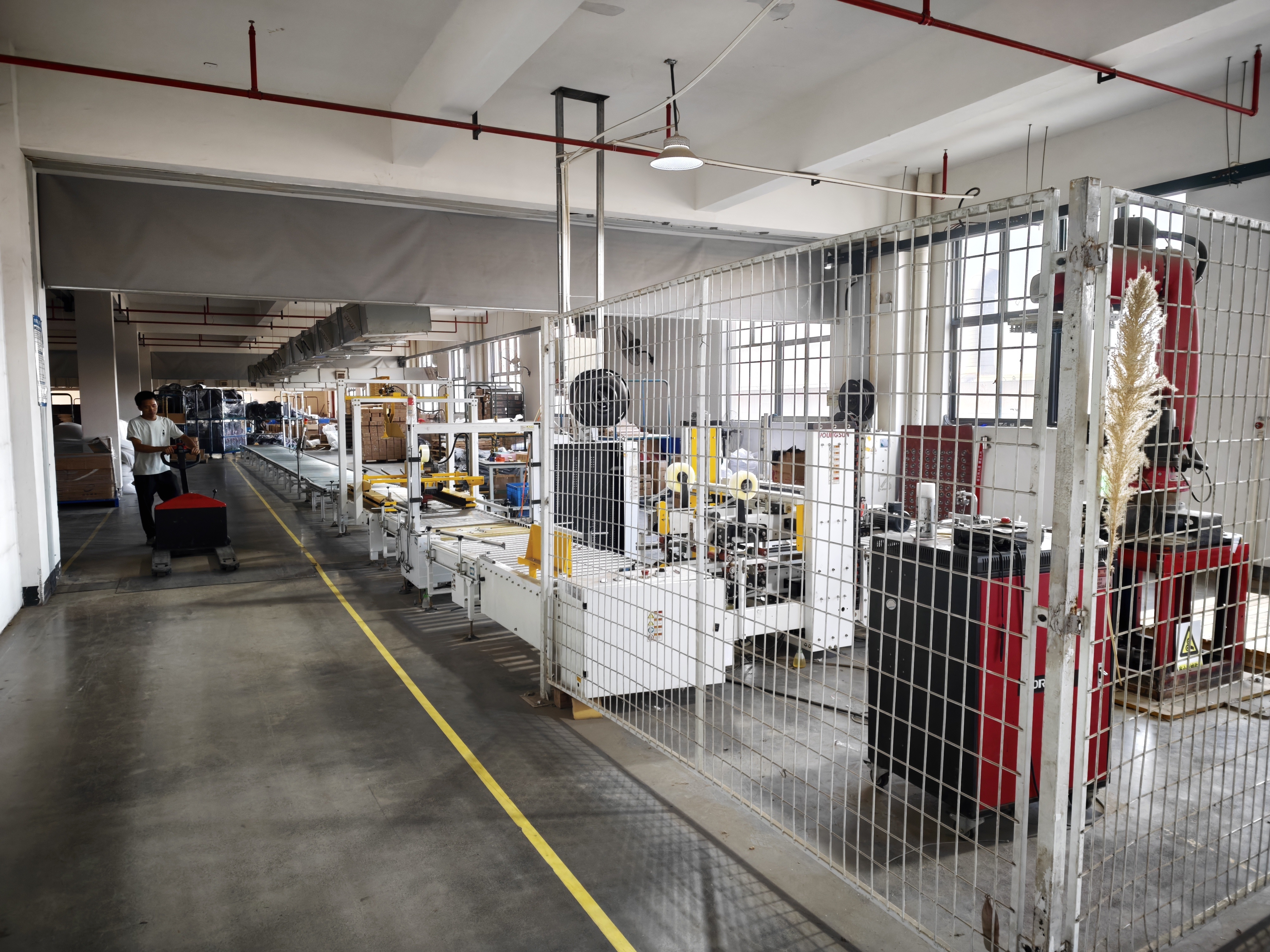
Export packaging is engineered around the same logic. Cartons carry a 280 lb load rating, black EPE corner protection and 5 mm EPE cushion boards on the top and bottom of each carton. Each carton includes a colour manual, a certificate of conformity, a warranty card and installation tools, so a retail customer can complete assembly without sourcing additional hardware.
Distributor support includes remote technical support, spare-parts supply and complete export documentation. A documented claim route runs from end user to retailer to supplier, and claim assessment requires photos, the order number, and the batch or carton reference before the claim is processed. A small stock of the most commonly requested spare parts is held, and defective parts are replaced through that spare-parts supply.
Product Architecture: Four Reference Platforms Across the Ladder
Four documented models illustrate how the range is structured. They are not the whole catalogue, but they define the technical logic the rest of the line follows.
| Model | Platform type | Documented specifications | Role in a range |
|---|---|---|---|
| FYCHI 6001D | Folding racing wheel stand with gear shifter mount | Powder-coated carbon steel frame; adjustable wheel height and tilt; anti-slip pedal plate; folding for storage; no drilling required for assembly | Entry tier; space-constrained homes and retail distribution |
| FYCHI 6020D | Aluminum profile simulator cockpit / flight simulator stand | 40-series aluminum extrusion; anodized frame with reinforced steel connectors; adjustable wheel, pedal and shifter positions; supports flight stick, throttle and rudder pedal mounting | Modular tier; direct-drive and upgrade paths |
| FYCHI 6029-1 (6-Axis) | Triple monitor stand, six-axis adjustable | Three monitors side by side; VESA-compatible mounting; independent angle, height and depth adjustment per monitor; load capacity for typical 27–32 inch displays | Immersion add-on for existing rigs and venue builds |
| FYCHI 7022D | Bucket seat simulator cockpit; racing seat and frame combo | Integrated seat-and-frame design; reclining bucket seat; adjustable seat rail with 14 cm forward/backward travel; 96 cm height × 56 cm seat depth × 53 cm seat width; backrest 52 cm hip / 57 cm shoulder diagonal; 12 kg net, 14.5 kg gross | Long-session cockpit tier for esports venues and home entertainment |
Technical Explanation: Why Frame Rigidity Determines What the Driver Feels
Every force a wheel base or pedal set generates is pushed back into the frame. If the frame flexes, that energy is absorbed by the structure instead of reaching the driver, so force feedback feels weaker, delayed and inconsistent; a rigid frame keeps the wheel-to-pedal geometry fixed, so braking and counter-steering loads stay repeatable over a long stint.
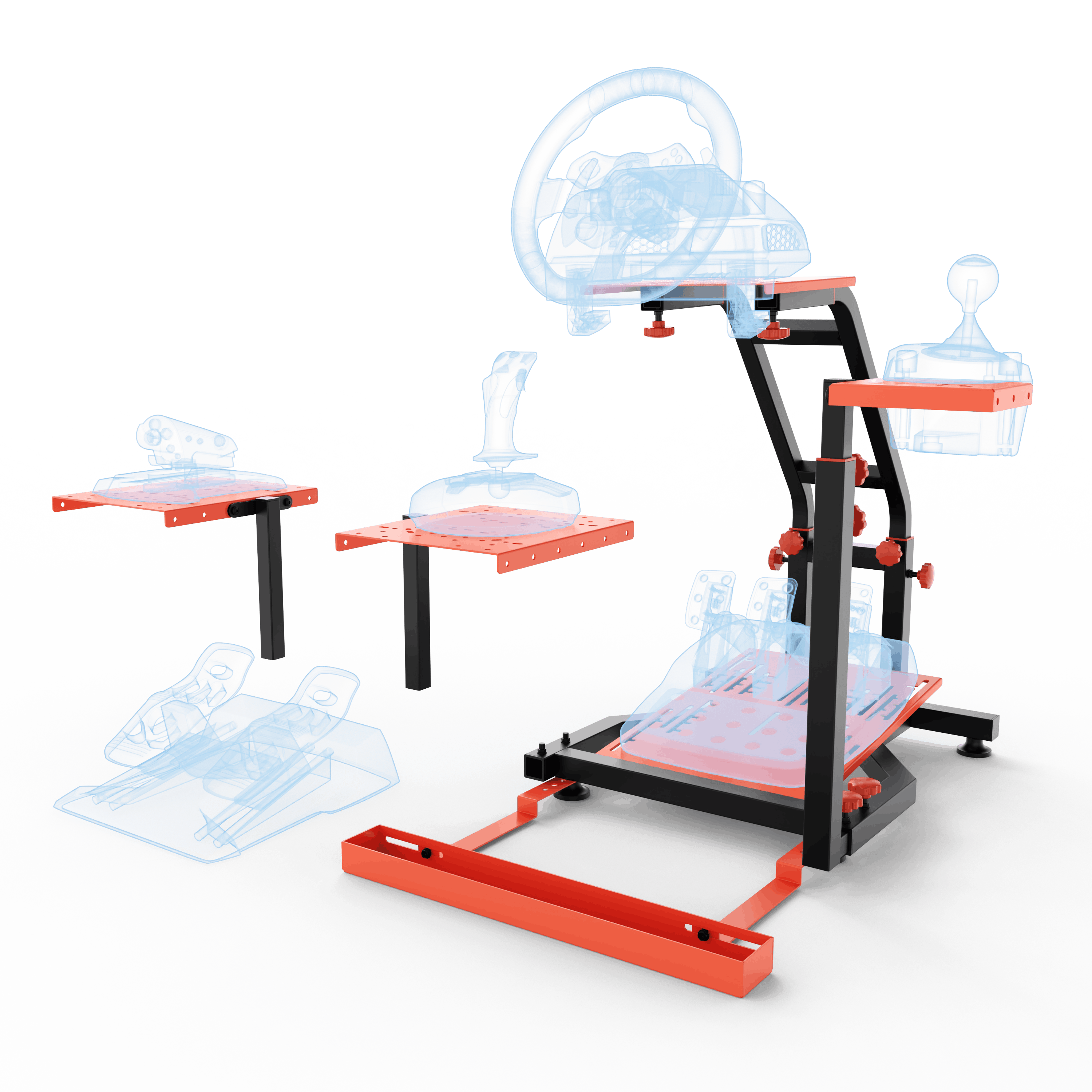
FYCHI addresses this with two material strategies rather than one. Frames are built from powder-coated steel or reinforced aluminum profile with stiffened mounting plates. The folding 6001D uses a powder-coated carbon steel frame, which delivers rigidity in a compact, storable footprint at the entry tier. The 6020D uses anodized 40-series aluminum extrusion with reinforced steel connectors, a construction that prioritises reconfigurability: wheel, pedal and shifter positions can be adjusted, and the same platform can be re-laid out for flight simulation with flight stick, throttle and rudder pedal mounting.
The market treats aluminum profile as the reference construction for high-end direct-drive setups precisely because of that rigidity-to-adjustability ratio, and because it allows a rig to be upgraded rather than replaced when hardware changes. FYCHI's line reflects that shift: the modular platform is positioned where torque loads are highest, while steel remains the material of choice where cost and storability dominate.
Compliance, Testing and Design Protection
Compliance documentation is where a frame supplier becomes auditable. FYCHI racing simulator brackets are tested for RoHS 2.0 compliance under test certificate TST20240500495-3RC, issued by Dongguan True Safety Testing Co., Ltd. in May 2024 and covering the 6002–6020 model series. Seating products are tested for safety, strength and durability in accordance with the EN 1335 series and for REACH SVHC compliance by Bureau Veritas.
Design protection is registered in two jurisdictions. The racing simulator bracket design is protected by a Chinese design patent (Certificate No. 7689673, Patent No. ZL 2022 3 0555008.X, granted November 2022) and by a Registered Community Design at the European Union Intellectual Property Office (Registration No. 002228411-0001, April 2013). For a distributor, registered design protection reduces the risk of parallel copies entering the same retail channel — a practical concern in a category where frame geometry is easy to photograph and copy.
Where These Rigs Are Used
The documented application environments are indoor: home sim racing setups, retail store display, esports venue builds and brand experience zones. Rigs are passive hardware and require no power of their own; the racing wheels, pedal sets, gear shifters, monitors, racing seats, consoles and PCs are supplied by the user or the venue. The 6020D extends the same logic into flight simulation and professional training environments, while the 6029-1 is documented for esports centres and racing simulation retail, where three independently aligned screens support both demonstration and competition use.
Two operating conditions recur across all of these settings. The frame must stay rigid under hard braking force, and the footing must remain stable and anti-slip on the floor surface in use. In a retail showroom that is walked through daily, or an esports venue running continuous sessions, those two conditions — not peak specification — determine how long a rig stays presentable and sellable.
Market Trend Analysis
Demand is concentrated but not static. North America accounts for approximately 34% of global demand and Europe approximately 32%, while Asia-Pacific is the fastest-growing region. Online channels generated 65.41% of racing simulator revenue in 2024, according to Mordor Intelligence, which means a distributor's packaging, product photography and installation documentation carry as much commercial weight as the frame itself — a rig that arrives damaged or assembles badly generates returns regardless of how rigid it is.
A second trend runs through materials. Aluminum profile construction has become the reference standard for high-end setups because direct-drive wheel bases require the rigidity it provides. That is visible in FYCHI's own catalogue structure, where the modular aluminum cockpit sits above the folding steel stand and below the full seat cockpit in complexity. The implication for buyers is that a range built only on entry-level stands will progressively lose credibility as direct-drive hardware becomes the default rather than the exception.
Comparison with Traditional Solutions
The realistic alternatives to a dedicated cockpit are a desk-mounted clamp setup, a folding wheel stand, or an integrated seat-and-frame cockpit. They are not interchangeable, and the differences are structural rather than cosmetic.
| Approach | Rigidity profile | Upgrade path | Footprint and storage |
|---|---|---|---|
| Desk or table clamp | Low; desk structure absorbs load and the driving position shifts | Minimal | No additional footprint, no storage need |
| Folding wheel stand (6001D class) | Moderate; powder-coated steel frame with fixed geometry when locked | Limited; designed around standard-pattern wheel bases and pedal sets | Compact; folds for storage, suited to shared rooms |
| Integrated seat cockpit (7022D class) | High; seat and tubular steel frame form one structure | Position adjustment via seat rail travel rather than frame re-layout | Larger fixed footprint; not intended to fold |
| Modular aluminum rig (6020D class) | High; anodized extrusion with reinforced steel connectors | Highest; frame can be re-laid out and expanded, including flight controls | Larger structure; modularity traded against floor space |
The boundary matters as much as the comparison. FYCHI's 6001D is an entry platform, and the company's own troubleshooting guidance states that if wobble persists while using a direct-drive wheel base or load-cell pedals, the correct action is to upgrade to the aluminum profile 6020D rather than to keep tightening an entry-level frame. In other words, the folding stand should not be sold into a direct-drive configuration — that is a specification limit, not a quality defect, and a distributor who ignores it will generate avoidable returns.
Boundaries a Buyer Should Plan For
A realistic procurement assessment has to state where a supplier is not the answer.
- Frames only, not complete systems. FYCHI supplies the frame and mounting structure. Wheel bases, pedals, shifters and displays are supplied by the user and mount on standard interfaces, so a buyer budgeting a complete rig must add peripheral cost separately.
- RoHS coverage is model-specific. Test certificate TST20240500495-3RC covers the 6002–6020 series. Buyers sourcing models outside that band should confirm current test coverage rather than assume it.
- Rigidity limits on the entry tier. The folding stand class is designed for standard-pattern wheel bases and pedal sets; high-torque direct-drive hardware belongs on the aluminum profile platform.
- Short corporate history. The company was established in 2021, so its operating record is shorter than that of manufacturers founded earlier in the simulator hardware category. Buyers whose procurement rules require a longer trading history, or who need multi-year field-failure data, should weigh that before standardising a range.
- Documented models are static frames and stands. Model-level documentation in the current range covers cockpits, stands and seating. Buyers requiring dynamic motion platforms should confirm the applicable configuration and specification directly rather than inferring it from the static range.
Future Outlook
The direction of this category is set by the hardware customers already own. As direct-drive wheel bases and load-cell pedals move from enthusiast purchases toward the default, the minimum acceptable rigidity of a sellable rig rises with them. That favours suppliers whose catalogue already includes a modular aluminum platform and whose mounting interfaces follow standard patterns, because both reduce the friction of an upgrade.
Three factors will probably decide which manufacturers hold share in the next cycle. The first is material breadth: a supplier with only folding steel stands faces a narrowing addressable market. The second is documentation: test certificates, design registrations and a traceable claim route become procurement requirements rather than nice-to-haves once a distributor is listing the product in multiple markets. The third is packaging and after-sales logistics, because 65.41% of revenue moving through online channels shifts the failure point from the showroom to the parcel. FYCHI's combination of in-house welding and coating, a 280 lb rated carton with EPE corner protection, and a documented claim route addresses all three at a level that is verifiable rather than asserted.
FAQ
What is a sim racing wheel stand, and how does it differ from a cockpit?
A sim racing wheel stand is a dedicated stand that holds a racing wheel — and usually the pedals and gear shifter — in a stable driving position for sim racing. It is the most compact and affordable type of sim racing rig, and many models fold for easy storage. A cockpit, by contrast, integrates the seat with the frame so the driving position is fixed relative to the wheel and pedals. The FYCHI 6001D is a folding wheel stand; the FYCHI 7022D is an integrated seat-and-frame cockpit.
What is a racing simulator cockpit, and why does frame rigidity change force feedback?
A racing simulator cockpit is a rigid metal frame that holds the wheel, pedals and seat in one fixed driving position. Every force the wheel base and pedals generate is pushed back into the frame, so any flex in the structure is lost force feedback and a shifting driving position. A rigid cockpit holds the wheel-to-pedal geometry constant, which is why the wheel feels consistent under braking, counter-steering and long stints, while a desk or a loose stand flexes and absorbs part of that force. FYCHI frames use powder-coated steel or reinforced aluminum profile with stiffened wheel, pedal and shifter plates to keep that geometry rigid.
Which wheel bases are compatible with FYCHI simulator stands?
FYCHI wheel stands and cockpits use industry-standard mounting hole patterns and are compatible with Logitech G29/G923, Thrustmaster T300/TGT, Fanatec and most standard-pattern wheel bases. Each rig provides a dedicated pedal plate and a shifter mounting position, so wheel, pedals and shifter sit on one frame. In most cases no adapter is required, and every carton includes a complete bolt set and an illustrated installation manual; where a wheel base uses brand-specific hardware, that hardware should be used. Buyers should confirm the wheel base mounting hole pattern before ordering, and contact the supplier for the correct mounting solution if it does not match.
How does monitor mounting work on a FYCHI simulator stand?
FYCHI stands and cockpits provide the frame and mounting structure; displays are supplied by the user and mount on standard VESA points, so the rig can be paired with the customer's preferred screens and a wide range of consumer monitors can be fitted. The FYCHI 6029-1 (6-Axis) triple monitor stand holds three screens side by side and aligns them independently, with adjustment on angle, height and depth per monitor.
Which FYCHI rig fits which sim racing setup?
The rig should be matched to the wheel and pedals first. Entry level, limited floor space or a shared room points to the FYCHI 6001D folding wheel stand: compact, storable and the lowest-cost way to get a stable wheel and pedal position. A direct-drive wheel base, load-cell pedals or a planned upgrade points to the FYCHI 6020D aluminum profile cockpit, which is more rigid, freely reconfigurable and also supports flight simulation. Triple-screen immersion is served by the FYCHI 6029-1 (6-Axis) triple monitor stand, and long sessions with a proper racing seat by the FYCHI 7022D seat cockpit. For a distributor, stocking the four models covers the ladder from entry to high-end.
Why does a racing wheel stand wobble under hard braking, and how is it resolved?
Wobble under braking usually traces to one of five causes: frame joint and wheel plate bolts that are not fully tightened or have loosened after the first sessions; an uneven, slippery or soft floor surface with unadjusted leveling feet; a direct-drive wheel base or load-cell pedals used on an entry-level stand; a mounting plate or bolt set that does not match the wheel base, leaving play; or a pedal plate loaded beyond the stand's design load. The resolution sequence is to re-torque all bolts starting with the frame joints and wheel plate, place the stand on a flat non-slip surface and adjust the leveling feet, check the mounting plate and bolt set against the wheel base, and confirm the stand's load rating suits the hardware. If wobble persists with a direct-drive wheel or load-cell pedals, the correct action is to move to an aluminum profile cockpit such as the FYCHI 6020D.
Company and product documentation for Zhejiang Zhongyao Intelligent Equipment Co., Ltd. and the FYCHI range is available in the Zhongyao company brochure (PDF). Product information is published at faychi.com.
¿Tiene preguntas o necesita más detalles?
Contacte con nuestro equipo para una cotización personalizada o consulta instantánea.
Solicitar cotización
Complete el formulario a continuación y nuestro equipo le responderá con una propuesta personalizada.
Chat directo de WhatsApp
¿Prefiere chatear en tiempo real? Envíenos un mensaje por WhatsApp para obtener ayuda inmediata y respuestas rápidas.
- Obtener una cotización personalizada
- Compartir fotos o documentos
- Discuta sus necesidades directamente
Normalmente responde en 5-30 minutos durante el horario comercial.