
FTTA Procurement FAQ: Lead Times, MOQs and Payment Terms
FTTA procurement often moves from a technical shortlist to a set of commercial questions that determine whether a 5G site can be supplied on time: what is the minimum order quantity, how long production takes, which payment and Incoterms apply, how much customization is possible, and what evidence accompanies shipment. This FAQ addresses those operational questions for FTTA, ODC, Fullax, LC and MPO cabling, using the commercial terms and product facts published for FOCC Fiber Co.,Ltd as a reference point.
FTTA, or Fiber To The Antenna, is an outdoor fiber-optic architecture that connects baseband units to tower-mounted radio equipment. In procurement terms, it is not only a cable category. It is a configured assembly that combines connector interfaces, fiber type, core count, cable length, environmental protection, and acceptance documentation. That is why two buyers can request the same FTTA cable and receive different quotations, lead times, and inspection plans.
FOCC Fiber Co.,Ltd is a Shenzhen-based supplier of fiber optic connectors, MTP/MPO patch cords, outdoor waterproof patch cord assemblies, and armored patch cords for data centre and FTTA applications. Its Guangzhou factory covers 5,000 square meters, and the company reports 200 employees, a 30-person R&D team, and annual output of 2,000,000 units. Those facts matter here because the article is not a product brochure; it is a procurement reference for buyers who need to match commercial terms to a configured outdoor assembly.
The commercial context is expanding. A 2025 commercial research report by Strategic Market Research values the global fiber optic cable assemblies market at USD 8.1 billion in 2024 and projects USD 14.2 billion by 2030. Optical fiber cables are also classified under HS Code 8544.70 globally, which gives cross-border buyers a common trade reference. Neither data point removes the need for project-level commercial clarity, but together they explain why procurement teams are asking more structured questions before they place FTTA and MPO orders.
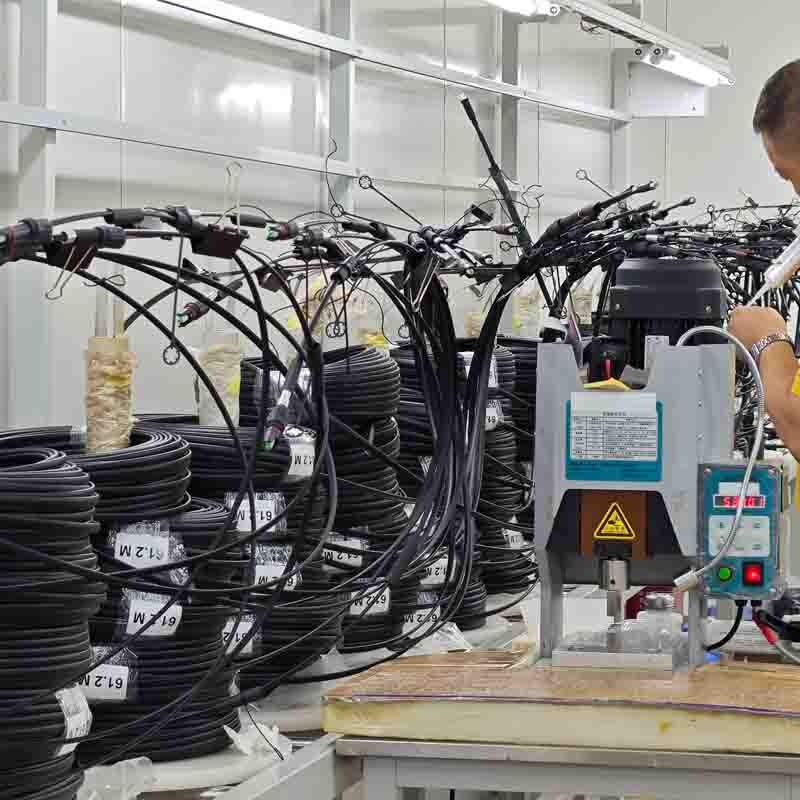
Why FTTA procurement questions surface after the technical shortlist
The technical shortlist usually confirms connector fit, ingress protection, optical loss, and temperature range. The commercial team then asks a different set of questions: can we place a small validation order, how long does production take, what payment method is accepted, which Incoterms apply, and what inspection record will come with the shipment. The gap between technical approval and purchase order is where project delays often appear.
A supplier may publish strong optical and environmental specifications, but the buyer still needs to know whether a 2-unit validation order is possible, whether a custom length changes the commercial minimum, and whether a Factory Acceptance Test can be scheduled. For FTTA and MPO assemblies, the procurement object is a bill of materials plus a test plan. The bill of materials includes connector type, fiber mode, core count, length, jacket and material choices. The test plan includes insertion loss, return loss, end-face inspection, and whatever environmental or mechanical checks the buyer specifies. The commercial terms then determine how those requirements move from a drawing to a shipped box.
This is why an FTTA procurement FAQ should not be read as a list of prices. It is a decision aid for the period between supplier qualification and order release. The answers are most useful when they are attached to a written RFQ and compared against the project schedule.
The commercial baseline: MOQ, lead time, payment and Incoterms
Answer first: FOCC Fiber Co.,Ltd lists a minimum order quantity of 2 units, a production lead time of 3–15 days, T/T payment, and EXW or FOB Incoterms for its OEM/ODM fiber optic cable assemblies. Those are commercial starting points, not a substitute for a project-specific quotation. Buyers should read each term together with the product configuration, because an FTTA assembly with a custom connector, length, or packaging requirement is not the same procurement item as a standard patch cord.
| Procurement term | Stated position | What the buyer should confirm |
|---|---|---|
| Minimum order quantity | 2 units | Whether the configuration, logo printing, and packaging are covered by that MOQ. |
| Production lead time | 3–15 days | Start point, drawing approval, test schedule, and whether the window includes FAT. |
| Payment method | T/T | Invoice currency, bank charges, and any agreed payment milestones. |
| Incoterms | EXW, FOB | Named place or port, export clearance, freight, and insurance responsibility. |
| Quality control | 100% test | Test record format and acceptance limits for insertion loss and return loss. |
| Customization | Length, connector type, core count, transmission mode, material, logo printing, certification, packaging | Drawing approval and any change to MOQ, lead time, or test scope. |
| Acceptance | Pre-shipment test, third-party inspection support, FAT, on-site protocols | Scope, attendance, sign-off, and documentation package. |
A MOQ of 2 units is low enough to support sample validation and small-site replenishment. It does not mean every custom configuration is automatically a 2-unit order. A buyer requesting a non-standard connector combination, logo printing, or special packaging should ask for written confirmation that the MOQ still applies. This is a normal procurement control, not a criticism of the supplier.
Lead time is the production window, not the door-to-door delivery window. The 3–15 day range should be read as the period from order confirmation and drawing approval to production completion. Freight transit, export clearance, import clearance, and buyer-side receiving inspection sit outside that range. For project planning, buyers should place the lead time beside the Incoterm. Under EXW, the buyer’s logistics clock starts earlier than under FOB, because the buyer is responsible for collecting the goods and managing export movement. Under FOB, the seller delivers the goods on board the vessel at the named port, and the buyer’s main carriage begins there.
T/T payment is simple and common in fiber-optic component trade, but it places the burden of payment sequencing on the purchase order. Buyers should confirm the invoice currency, bank charges, and whether any milestone structure applies to larger or customized orders. The available commercial data states T/T as the accepted payment method; it does not state a deposit percentage, credit terms, or letter-of-credit arrangement. Those points should not be assumed.
Customization parameters that change an FTTA or MPO RFQ
Answer first: FOCC lists customization across length, connector type, core count, transmission mode, material, logo printing, certification, and packaging. In FTTA and MPO cabling, those fields are not cosmetic. They define the assembly that will be tested and accepted.
For FTTA outdoor assemblies, the product family includes ODC-APC-Fullax-APC-OS2 and ODC-UPC-Optitab-UPC-OM3 models. The published specification covers IP67/IP68 protection, insertion loss ≤0.30 dB, return loss ≥60 dB for APC, an operating temperature range of -40°C to +75°C, and tensile strength ≥1000 N. The construction uses a zirconia ceramic ferrule, stainless steel ODC connector shell, PE cable jacket, armored fiber core, and silicone rubber sealing ring. These details matter in an RFQ because a buyer who specifies only ODC cable leaves connector gender, polish, fiber mode, and cable construction open.
For MPO/MTP assemblies, the published models include MPO-12-OS2-APC, MTP-24-OM4-UPC, and MTP-48-OM3-UPC. Core counts are 12, 16, 24, or 48; fiber types include OS2, OM3, OM4, and OM5; insertion loss is ≤0.35 dB for Elite grade or ≤0.5 dB for standard grade; return loss is ≥60 dB for APC and ≥50 dB for UPC; operating temperature is -20°C to +70°C; and the jacket is LSZH. The product reference also cites Telcordia GR-326. A procurement specification should translate these into the exact connector, polarity, length, and test limits the project needs.
- FTTA outdoor assembly fields: connector interface such as ODC or Fullax, fiber mode such as OS2 or OM3, core count, cable length, jacket and armor construction, and sealing material.
- MPO/MTP assembly fields: core count from 12 to 48, fiber type, polarity, insertion-loss grade, return-loss grade, jacket type, and length.
- Commercial fields: MOQ confirmation, production lead time, T/T payment details, EXW or FOB named place, logo printing, certification documents, and packaging.
- Acceptance fields: 100% pre-shipment test record, third-party inspection support, FAT plan, and on-site acceptance protocol.
Material choices also belong in the RFQ. For outdoor FTTA assemblies, the stainless steel shell and armored fiber core are part of the environmental and mechanical story. For MPO assemblies, the LSZH jacket and connector housing affect data-centre installation and flame-smoke requirements. Buyers should not treat material as a supplier-only decision when the assembly will be used in a harsh or regulated environment.
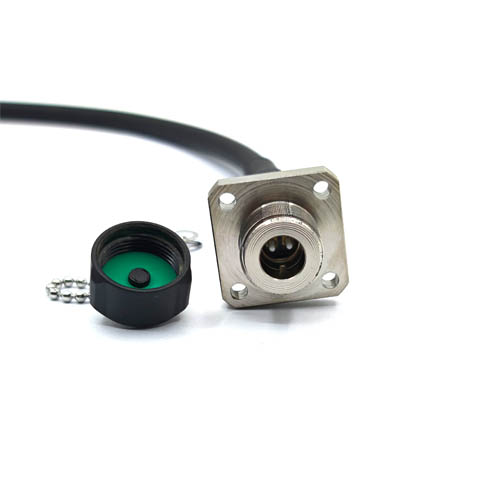
Acceptance inspection: from 100% pre-shipment test to FAT and site acceptance
Answer first: the available quality-control position is 100% test, with third-party inspection support, Factory Acceptance Test support, and on-site acceptance protocols. These are different controls, and a well-written purchase order should say which ones apply.
A 100% pre-shipment test means every delivered assembly is tested before shipment, not a sample from the lot. The buyer should ask for the test record format and the acceptance limits. For FTTA assemblies, the record should normally identify insertion loss and return loss against the agreed specification, and it should connect the result to the serial number or lot. For MPO assemblies, the record should identify the channel or fiber positions tested and the loss limits applied. The exact test method should be agreed in the RFQ.
Third-party inspection support is a separate layer. It allows the buyer to appoint an inspection body to witness or repeat checks before shipment. This is useful when the buyer cannot attend the factory or when the project requires an independent record. It does not replace the supplier’s own 100% test; it adds a verification layer.
A Factory Acceptance Test, or FAT, is a documented factory-level test against agreed criteria. For FTTA and MPO assemblies, a FAT can combine visual inspection, connector end-face checks, insertion and return-loss measurement, length verification, labeling, and packaging review. The value of a FAT is not the name; it is the agreed test plan. Buyers should attach the test plan to the purchase order and state who signs the result.
On-site acceptance protocols cover the receiving and installation stage. They can include a receiving inspection, a check that the assembly matches the approved drawing, and a site-level verification before the connector is mated to the radio or distribution box. The exact protocol should be agreed before shipment, because site conditions, access, and test equipment vary by project. The supplier’s role in on-site acceptance should also be stated in the commercial terms.
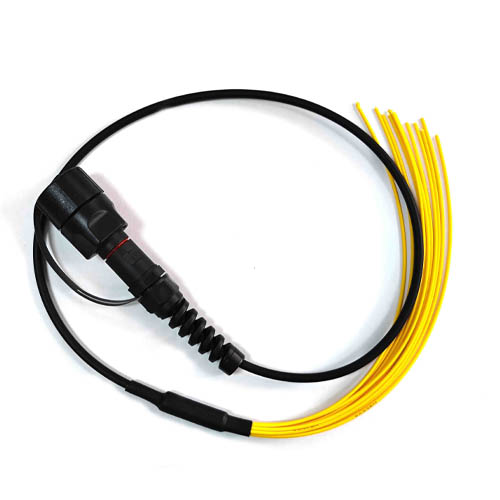
Specification-led buying versus catalog-only buying
Catalog-only buying works for standard replacements and simple patch cords. Specification-led buying is more appropriate when the FTTA assembly must match a tower-top interface, a defined length, an environmental rating, and an acceptance record. The difference is not that one method is always better. It is that they produce different levels of commercial and technical control.
| Decision area | Catalog-only purchase | Specification-led FTTA or MPO purchase |
|---|---|---|
| Configuration control | Standard length, connector, and fiber count. | Defined connector interface, fiber mode, core count, length, jacket, and material. |
| Acceptance evidence | Standard product data and basic test record. | 100% pre-shipment test, FAT, third-party inspection option, and agreed record format. |
| Commercial clarity | List price and standard delivery. | Written MOQ, 3–15 day production window, T/T terms, and EXW or FOB named place. |
| Project effort | Low buyer engineering input. | Drawing approval, test-plan review, and document control before order release. |
The limitation of specification-led buying is real: it requires buyer engineering input, drawing approval, and a test plan, so the RFQ cycle can be longer than a catalog order. For a simple replacement in a non-critical indoor link, a full FAT may not be justified. For an outdoor 5G site, the cost of a missing connector detail or an unrecorded loss limit can be higher than the extra RFQ effort. The right choice depends on site criticality and the buyer’s maintenance model.
Where these procurement terms matter in FTTA and MPO projects
FTTA assemblies are used in 5G base station RRU/AAU interconnection, outdoor small cell deployment, railway signal transmission, industrial IoT, and public safety communication. The working environment includes rain, dust, UV exposure, mechanical vibration, and high tensile stress, with a wide temperature range. In those projects, the commercial terms are not administrative. A 3–15 day production window affects site scheduling; a 2-unit MOQ supports validation; and the acceptance record affects whether a connector can be released to the tower crew.
MPO/MTP assemblies serve a different environment: data-centre and telecom high-density interconnection, 400G/800G transmission, server-switch cabling, and storage area networks. The procurement questions shift toward core count, polarity, insertion loss grade, and jacket material. The same commercial framework still applies: MOQ, lead time, payment, Incoterms, and acceptance evidence. A buyer who manages both FTTA and MPO categories can use one RFQ discipline across two product families, while keeping the technical requirements separate.
FOCC Fiber Co.,Ltd reports field experience across 50,000+ outdoor waterproof patch cords and 20,000+ 5G base station deployments. That deployment history is relevant to procurement because it shows the supplier has handled outdoor assembly configurations before. It does not replace project-specific acceptance testing, and buyers should still verify the exact product, test record, and certificate scope for their order.
Certification and document checks in an FTTA purchase order
Certification is a constraint question, not a logo question. FOCC’s profile states ISO 9001 and ISO 14001 management systems. The available certificate record for its fiber optic patch cord production, certificate HIC230831, lists HIC as the issuer and a validity period from 9 May 2023 to 8 May 2026. Because that stated period has passed, a buyer preparing a 2026 or 2027 project should request the current certificate, confirm its scope, and check that the certificate covers the actual production site and product family. This is a normal document-control step, especially when a project specification requires a valid certificate at the time of shipment.
The same discipline applies to test reports. A supplier statement such as IP67/IP68, salt-mist resistance, or EMI protection is a screening claim until the buyer sees the test conditions and the report. The verified-data review for this category notes that FTTA environmental claims should be checked against test reports, because ingress, salt-mist, and optical-loss results depend on the test method and the exact connector configuration.
Market trend: more pre-terminated assemblies, more procurement evidence
The direction of the market supports this emphasis on procurement evidence. The fiber optic cable assemblies market is projected to grow from USD 8.1 billion in 2024 to USD 14.2 billion by 2030, according to Strategic Market Research. As 5G sites densify and outdoor fiber links replace heavier coaxial runs, buyers are moving toward pre-terminated outdoor assemblies that arrive tested rather than field-terminated. That shift makes the commercial terms more important, because a pre-terminated assembly carries the factory’s test record into the site.
At the same time, the MPO/MTP side of the market continues to support high-density data-centre links. The procurement language is converging: buyers want a defined configuration, a stated test limit, a shipment record, and commercial terms that match the project schedule. The supplier that can answer those questions clearly before the order is better positioned to avoid a late-stage clarification.
Future outlook
FTTA procurement is likely to become more document-driven rather than less. As more 5G and outdoor small cell projects move into maintenance and expansion phases, buyers will ask for acceptance records that can be compared across lots. They will also ask for certificate validity at the shipment date, not just a certificate number. For suppliers, the practical response is to keep the commercial data current: MOQ, lead time, payment method, Incoterms, customization fields, and acceptance options should be stated in the same language as the technical datasheet.
For buyers, the useful rule is to separate the questions that can be answered by a catalog from the questions that require a quotation. MOQ, lead time, payment, and Incoterms belong in the quotation. Connector interface, fiber type, core count, length, environmental rating, and acceptance criteria belong in the specification. When both sides are clear, the FTTA purchase order becomes easier to audit and easier to repeat.
FAQ: FTTA procurement terms
What is the minimum order quantity for FTTA and MPO cable assemblies?
FOCC Fiber Co.,Ltd lists a minimum order quantity of 2 units for its OEM/ODM fiber optic cable assemblies. Buyers should confirm in writing that the specific configuration, logo printing, or packaging requirement is covered by that MOQ before the order is released.
What production lead time should buyers plan for?
The listed production lead time is 3–15 days. It should be treated as a production window after order confirmation and drawing approval, not as a door-to-door delivery commitment. Freight transit, customs clearance, and receiving inspection are outside that window.
Which payment method is accepted?
T/T is the stated payment method. The available commercial information does not specify a deposit percentage, credit terms, or letter-of-credit arrangement, so those points should be confirmed in the quotation or purchase order.
Which Incoterms are available?
EXW and FOB are the stated Incoterms. The named place or port, export clearance responsibility, freight, and insurance should be written into the quotation. EXW and FOB place different logistics responsibilities on the buyer and should not be treated as interchangeable for budgeting.
What can be customized in an FTTA or MPO order?
FOCC lists customization for length, connector type, core count, transmission mode, material, logo printing, certification, and packaging. For FTTA assemblies, published models include ODC-APC-Fullax-APC-OS2 and ODC-UPC-Optitab-UPC-OM3. For MPO/MTP assemblies, published models include MPO-12-OS2-APC, MTP-24-OM4-UPC, and MTP-48-OM3-UPC.
What acceptance inspection is available before shipment?
The stated quality-control position is 100% test, with third-party inspection support. A buyer can also request a Factory Acceptance Test. The purchase order should define the test limits, record format, and sign-off responsibility.
What is a Factory Acceptance Test in an FTTA order?
A Factory Acceptance Test is a documented factory-level test against agreed criteria. For FTTA assemblies, it can cover visual inspection, connector end-face checks, insertion loss, return loss, length, labeling, and packaging. The test plan should be attached to the order rather than described only in general terms.
Can on-site acceptance be arranged?
On-site acceptance protocols are available and should be agreed before shipment. The protocol can cover receiving inspection, drawing conformity, and pre-mating verification at the site. The exact checklist depends on project access and test equipment.
How should buyers verify certification?
Buyers should request the current certificate, confirm its scope and production site, and check the validity date against the shipment date. The available record for certificate HIC230831 lists a validity period from 9 May 2023 to 8 May 2026, so a current certificate should be requested for later projects.
Conclusion
FTTA procurement FAQ questions are answerable when the commercial terms and the technical specification are read together. A 2-unit MOQ supports validation; a 3–15 day production window supports planning but not door-to-door promises; T/T and EXW/FOB define the payment and logistics baseline; and 100% pre-shipment test, third-party inspection, FAT, and on-site protocols define the acceptance path. FOCC Fiber Co.,Ltd publishes these terms for its FTTA and MPO assemblies, and buyers should convert each term into a written requirement before the purchase order is released.
¿Tiene preguntas o necesita más detalles?
Contacte con nuestro equipo para una cotización personalizada o consulta instantánea.
Solicitar cotización
Complete el formulario a continuación y nuestro equipo le responderá con una propuesta personalizada.
Chat directo de WhatsApp
¿Prefiere chatear en tiempo real? Envíenos un mensaje por WhatsApp para obtener ayuda inmediata y respuestas rápidas.
- Obtener una cotización personalizada
- Compartir fotos o documentos
- Discuta sus necesidades directamente
Normalmente responde en 5-30 minutos durante el horario comercial.