
FPV Cameras in the Field: Applications From Racing to Tactical Reconnaissance
An FPV camera decides what a platform can see, and therefore what it can be asked to do. Matching the camera to the mission — rather than the mission to whatever camera is already on the bench — is the step that most often separates a project that performs as specified from one that is re-specified mid-programme.
An FPV camera is the imaging front end of a first-person-view system. It converts what an aircraft or vehicle sees into a video signal delivered to a pilot's goggles, a monitor, or a ground control station in real time and with minimal processing delay. Because that signal is the operator's entire view of the world, the camera — not the airframe — frequently sets the practical limit on what a platform can be asked to do.
The consequences of that are visible at both ends of the FPV spectrum. In FPV racing and RC car projects, camera performance is judged by latency, field of view, weight, and how quickly the image recovers from a change in light. In tactical drone work, the same component is judged by whether a target can be identified at night, through smoke or camouflage, and at a distance where nothing else on the aircraft is decisive.
IRLAB Limited is a camera manufacturer founded in Taiwan in 1992 and established in Shenzhen in 2003. The company operates a 3,000 m² facility with 100+ employees, including a 10+ engineer R&D team, reports an annual output of 6 million camera units, exports approximately 70% of production to Europe, USA, Japan, Korea and Taiwan, and is certified under TüV's ISO9001 quality control system. Alongside FPV cameras, its range includes public view monitors, HDMI output cameras, IP cameras, HD analogue cameras, AI cameras, IR illuminators, and dual liveness detection access control and advertising panels.
This reference maps IRLAB's FPV camera families to the field applications they were defined for, and explains what the individual specifications mean once a project moves from a selection spreadsheet onto an airframe.
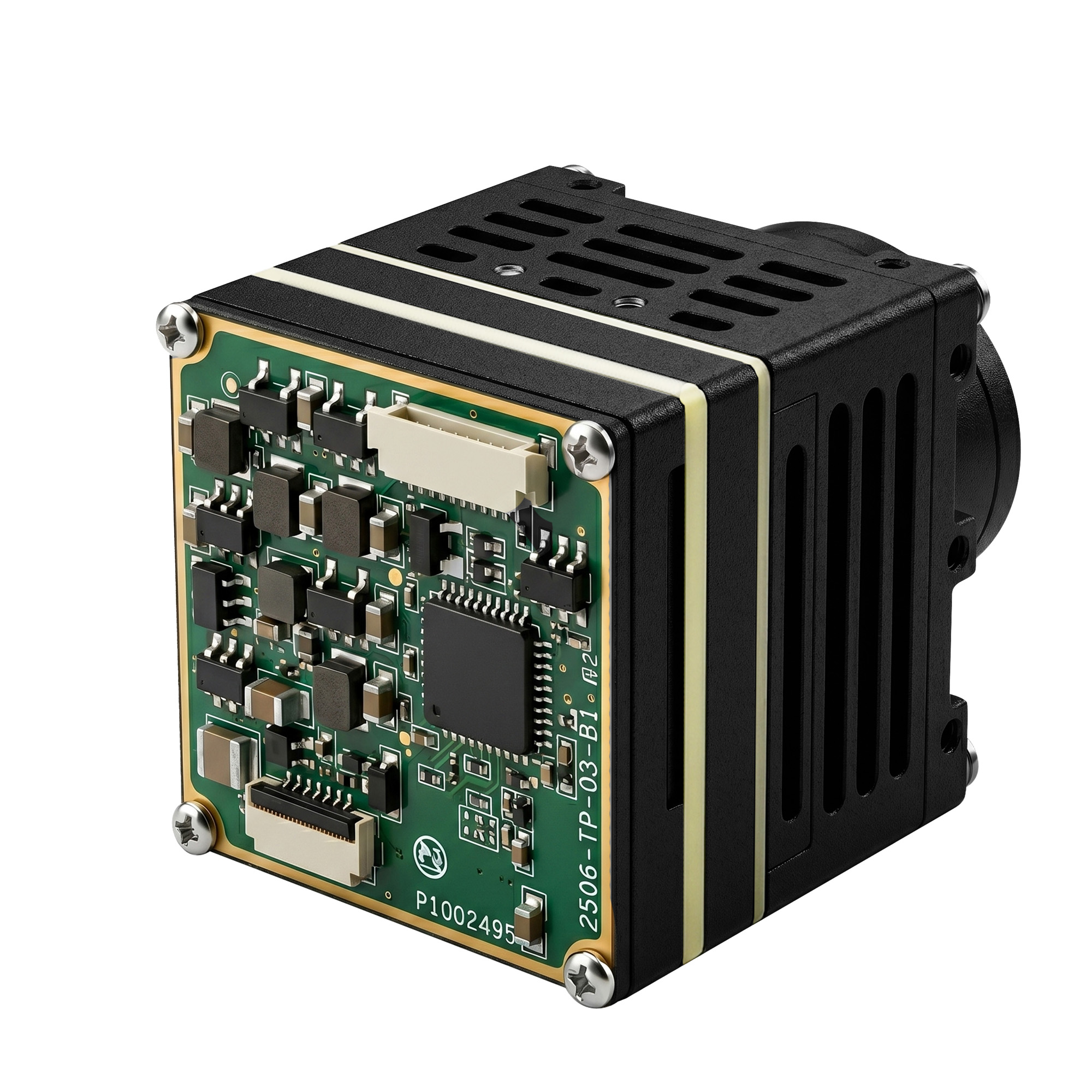
Thermal FPV imaging is specified when the mission depends on heat contrast rather than visible light. Image: IRLAB Limited.
Why Project Fit Is Usually Decided by Three Budgets
Most FPV programmes are specified from the airframe outward: frame, motors, ESC, video transmitter, and the camera last. That order is intuitive, but it inverts the actual dependency. The camera determines the sensitivity floor of the whole system, contributes directly to end-to-end latency, and sets part of the mass and power budget. Specifying it last means those three budgets are usually decided by accident.
Three constraints generally decide whether a camera fits a given mission profile:
- Light budget. How much illumination will be available at the moment of decision — daylight, street lighting, moonlight, or none at all? The answer separates visible-light cameras from thermal ones, and within visible light it separates conventional sensors from starlight-class ones.
- Latency budget. How much delay can the control loop tolerate between the moment light reaches the sensor and the moment the image reaches the operator's eye? Racing and terminal-guidance work tolerate very little; survey and inspection work tolerates more.
- Mass and power budget. How many grams and watts remain after the airframe, battery, and transmitter have taken their share? A 9 g camera and a 40 g camera are not interchangeable on a small platform.
When a camera is selected without reference to those budgets, the outcome is usually one of two failure modes: an over-specified payload that shortens flight time without adding mission capability, or an under-specified one that produces nothing usable precisely when the mission matters. Both are avoided by starting from the operating context described in the project brief.
IRLAB's FPV Camera Range by Mission Profile
IRLAB's FPV camera line separates along technology lines rather than price lines: analog, digital, and thermal. Each entry below is matched to the application its published classification identifies.
| Model | Technology | Defining specifications | Intended field application |
|---|---|---|---|
| CDD-BS59KU | Analog FPV camera | 1500TVL, 4:3 image, minimum illumination 0.00001 LUX, 120° FOV, S/N ratio >60 dB, CVBS output, 3DNR, DC 4.5–27 V, 0.6 W, 19 mm × 19 mm × 27 mm, 9 g | FPV racing, RC cars, and low-light tactical video links where sensitivity and low mass dominate |
| CDD-BS59KP | Analog FPV camera | 1500TVL, 16:9 image, minimum illumination 0.00002 LUX, 120° FOV, S/N ratio >54 dB, CVBS output, 3DNR, DC 4.5–27 V, 0.5 W, 19 mm × 19 mm × 27 mm, 9 g | FPV racing and RC models running 16:9 goggles or monitors |
| CDD-BS5JMU | Digital FPV camera, HD FPV camera | SONY sensor; 3840×2160@30fps, 1080p@90fps, 720p@120fps; 50 ms glass-to-glass latency; 120° FOV; 5.1–5.8 GHz; TX ≤29 dBm (FCC), ≤20 dBm (CE); MSP and MAVLINK OSD; 2T2R antenna; DC 9–30 V (5.4 W normal, 9 W max); TF card slot up to 1 TB; 32 g with fan | FPV racing and RC models, plus tactical drone projects requiring recording and higher resolution |
| CT-EI5ATC | Thermal FPV camera | Uncooled vanadium oxide detector, 640×512 resolution, 12 µm pixel pitch, 8–14 µm spectral range, NETD ≤30 mK @25°C, 9.1 mm lens (46°×37° FOV), CVBS/MIPI output, UART/USB, DC 3.9–5.5 V (typical 5 V), ≤1.2 W, 40 g | Tactical reconnaissance and industrial surveys |
A second thermal variant, the CT-EI5ATB, shares the CT-EI5ATC's detector type, 12 µm pixel pitch, 8–14 µm spectral range, NETD ≤30 mK at 25°C, 9.1 mm lens and 40 g weight, but offers 384×288 resolution instead of 640×512. The two models are aimed at the same reconnaissance and survey applications; the resolution difference is the main selection variable between them.
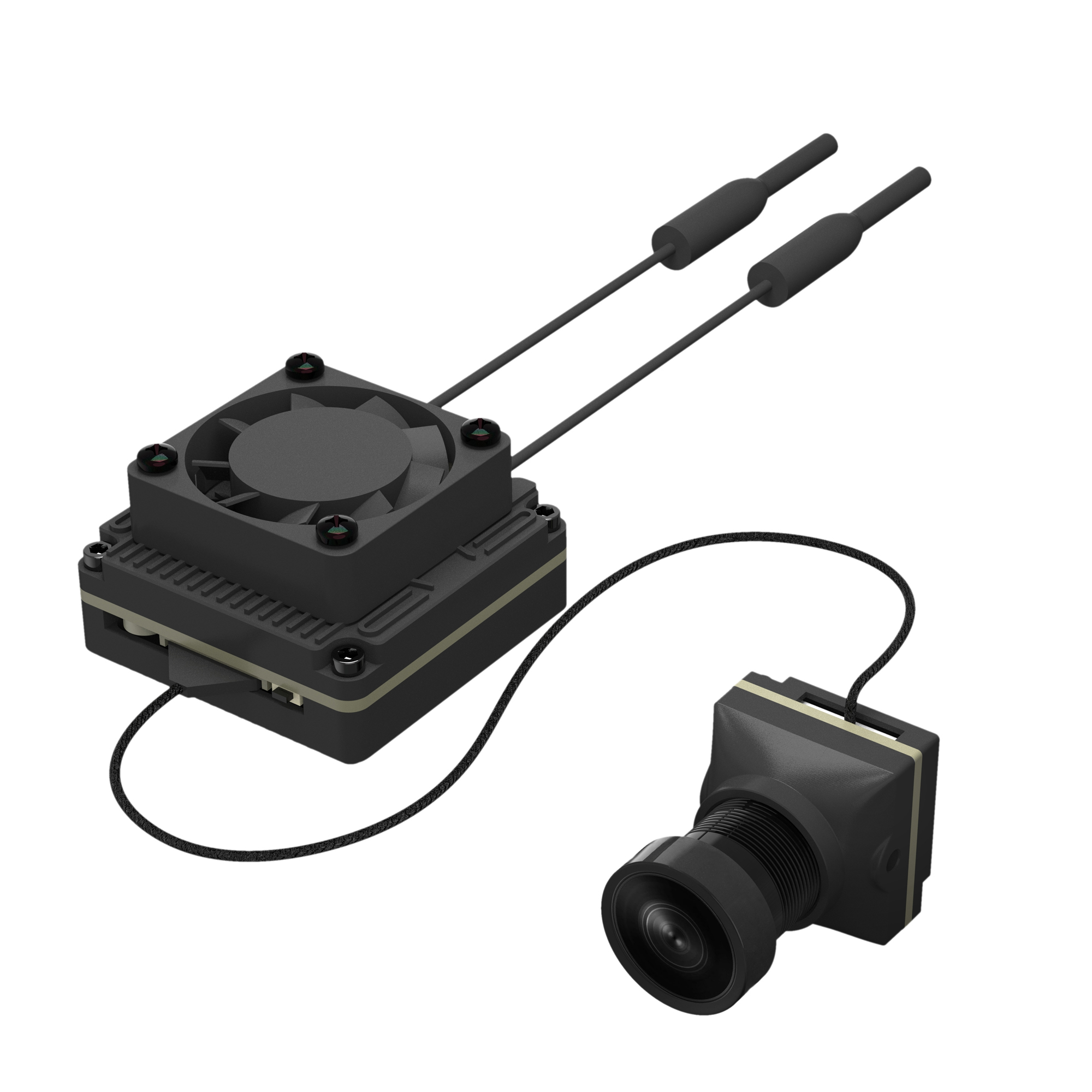
Digital FPV systems add resolution and onboard recording, at the cost of higher mass and power draw. Image: IRLAB Limited.
What Each Specification Means in the Field
Specification sheets describe components; mission profiles describe consequences. The translation between the two is where most selection errors occur.
Analog FPV cameras — CDD-BS59KU and CDD-BS59KP
The CDD-BS59KU is a 1500TVL analog camera with a 4:3 image format, a 120° field of view, a signal-to-noise ratio above 60 dB, and CVBS video output. Its minimum illumination figure is 0.00001 LUX, which places it in what the application documentation describes as starlight-class sensitivity — a regime where conventional vision systems are effectively blind. The CDD-BS59KP uses the same 1500TVL resolution and 120° field of view but outputs a 16:9 image, carries a minimum illumination figure of 0.00002 LUX and a signal-to-noise ratio above 54 dB.
Both cameras share a 19 mm × 19 mm × 27 mm footprint at 9 g, an aluminum alloy housing with a glass-and-plastic lens, 3DNR noise reduction, and a wide DC 4.5–27 V input at 0.5–0.6 W. In practice, the wide input range means the camera tolerates a broad spread of onboard power arrangements, and the sub-1 W draw is negligible against propulsion and video transmission loads. For racing and RC car builds, the 9 g mass and 120° field of view are the decisive numbers: the field of view determines how much of the environment is visible at speed, and the mass determines how little the camera penalizes agility. For low-light tactical video links, the 0.00001 LUX figure is the decisive one.
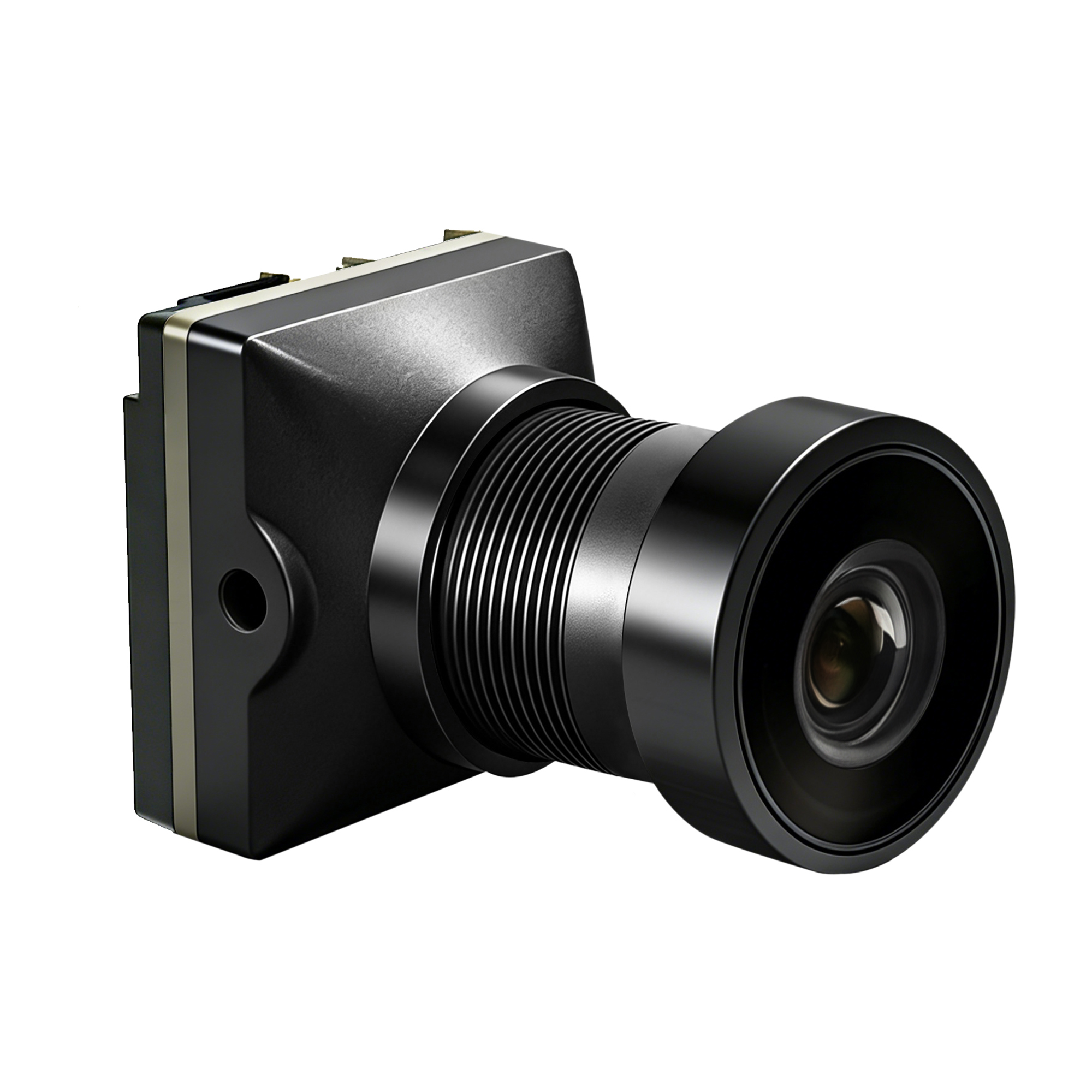
Analog FPV cameras trade resolution and recording for very low weight, low power and sensitivity. Image: IRLAB Limited.
Digital FPV camera — CDD-BS5JMU
The CDD-BS5JMU is a digital FPV camera built around a SONY image sensor. It offers three video modes — 3840×2160 at 30 fps, 1080p at 90 fps, and 720p at 120 fps — with a 120° field of view and a stated glass-to-glass latency of 50 ms. The operating frequency band is 5.1–5.8 GHz, transmit power is rated at ≤29 dBm under FCC limits and ≤20 dBm under CE limits, and the antenna configuration is 2T2R. The camera supports both MSP and MAVLINK OSD protocols, which matters when it must coexist with an existing flight controller and ground station rather than being integrated as a standalone video link.
Power input is DC 9–30 V, with consumption of 5.4 W under normal conditions and up to 9 W at maximum. A TF card slot accepts storage up to 1 TB, so the camera can record locally while transmitting live. The camera module measures 19 mm × 19 mm × 26 mm, the main board 32 mm × 32 mm × 19.3 mm with fan, and total weight is 32 g, made up of a 9 g camera and a 23 g main board.
Read against the mission brief, the CDD-BS5JMU is the entry in the range that supports both competitive flying and tactical drone projects. For racing and RC models, the higher frame rates and resolution serve the pilot's situational awareness and produce usable post-flight footage. For tactical projects, the local recording capability is what allows a sortie to be reviewed afterwards — battle damage assessment, target identification and marking, and frontline intelligence transmission all depend on imagery that can be examined after the flight, not only on the live view.
Thermal FPV camera — CT-EI5ATC
The CT-EI5ATC is a thermal FPV camera built on an uncooled vanadium oxide detector with 640×512 resolution and a 12 µm pixel pitch. Its spectral range is 8–14 µm, in the long-wave infrared band, and its noise-equivalent temperature difference is ≤30 mK at 25°C — a measure of how small a temperature difference the detector can resolve. The 9.1 mm lens delivers a 46°×37° field of view. Video output is CVBS or MIPI, with MIPI optional plus UVC, and communication is over UART or USB. Operating voltage is DC 3.9–5.5 V, typically 5 V, at ≤1.2 W. The module measures 25.4 mm × 25.4 mm × 38.8 mm including the lens and weighs 40 g, with an operating temperature range of –20°C to 60°C and a storage range of –45°C to 65°C.
The operational meaning of those numbers is straightforward. Thermal imaging does not depend on visible light, so it continues to function in complete darkness, in smoke, and against camouflage that is effective in the visible spectrum. The NETD figure determines whether that image is clean enough to distinguish a person or a vehicle from background clutter. The lower resolution relative to the digital model is the trade-off: at 640×512, thermal output carries less spatial detail than a 4K digital image, so it is normally used for detection and heat-signature work rather than for reading fine visual detail.
Field Applications: From Racing Lines to Reconnaissance
FPV racing and RC cars
Racing and RC car projects are the most demanding environment for the human control loop. Decisions happen in fractions of a second, the camera is the only reference the pilot has, and every gram of payload affects how the vehicle behaves. The CDD-BS59KU and CDD-BS59KP address this scenario directly: both are 9 g, both draw under 1 W, and both deliver a 120° field of view at 1500TVL. The choice between them is largely a display-format decision — 4:3 for the CDD-BS59KU, 16:9 for the CDD-BS59KP — because pilots build their goggles, monitors and DVR setups around a fixed aspect ratio.
Where a racing or RC project also needs onboard recording and higher frame rates, the CDD-BS5JMU covers that ground with 1080p at 90 fps and 720p at 120 fps. The trade is measurable: 32 g instead of 9 g, and 5.4 W normal draw instead of 0.5–0.6 W.
Tactical drone projects
Tactical FPV UAV work is defined by operating conditions rather than by the airframe. The documented environment for these projects includes extreme dark night and bright sunshine, high vibration and shock, wide temperature variation, and electromagnetic interference. The functional requirements listed for the scenario include covert night reconnaissance, no-IR tactical manoeuvres, terminal visual guidance, high-speed penetration, ultra-low latency FPV below 50 ms, zero-blur video, precision strike support, smoke and camouflage penetration, heat signature locking, detect-to-engage workflows, and search and rescue, alongside real-time battlefield situational awareness, target identification and marking, frontline intelligence transmission, battle damage assessment, and low-light or night reconnaissance.
Two IRLAB models are classified against this scenario. The CDD-BS5JMU is associated with tactical FPV UAV projects that combine higher-resolution imaging with local recording, and its MSP and MAVLINK OSD support allows it to sit inside an existing control architecture. The analog CDD-BS59KU is associated with the same tactical scenario where the light budget is the binding constraint: its 0.00001 LUX sensitivity suits the low-light and night reconnaissance portion of the profile.
Integration for these projects is not camera-only. The listed matched equipment for the scenario includes the tactical FPV drone itself, tactical helmets or FPV goggles, an encrypted VTX, a ground control station, a ground control terminal, an encrypted receiver, an OSD overlay system, a tactical flight controller, analog VTX, fire and inspection robots, and agricultural drones. Camera selection therefore has to be made against the rest of that chain, not in isolation.
Tactical reconnaissance
Reconnaissance is where the CT-EI5ATC is positioned. Its uncooled vanadium oxide detector, 640×512 resolution and LWIR 8–14 µm band allow it to image heat rather than reflected light, which is what makes heat signature locking and low-light reconnaissance possible when a visible-light sensor has nothing to work with. The applicable industries listed for the model include military and defense, tactical reconnaissance, border patrol, public security and law enforcement, emergency rescue, and fire service — all environments where the target of interest is often warmer than its surroundings and where visible-light imaging is degraded or useless.
Industrial survey work
The CT-EI5ATC is also classified as an industrial survey thermal camera, which places it in a second, non-defense category of work. Thermal imaging is used in industrial survey and inspection contexts because it reveals temperature distribution rather than surface appearance — the kind of information used when assessing heavy infrastructure such as bridges, where thermal contrast can expose conditions that are not visible in an ordinary camera feed. Mining and heavy industry, wildlife conservation, and emergency rescue are further applications listed for the model. The practical advantage of a module at 40 g and ≤1.2 W is that it can be carried by small platforms that would not otherwise support a thermal payload.
A deployment reference point
One documented case illustrates how the technical figures translate into field results. An FPV drone manufacturer in Ukraine integrated IRLAB cameras into its FPV drones under a one-year programme totalling 30,000 units. The reported outcome was operation at sensitivity levels as low as 0.00001 lux — a regime where conventional vision systems are effectively blind — allowing the drone to identify, lock onto, and track targets under extreme low-light or zero-light conditions. The stated highlight was clear video imagery in very dark night conditions, where conventional cameras produce nothing but noise. That case is traceable to the camera's low-light sensitivity rating, which is why the same figure keeps reappearing as the deciding specification for night work.
Market Context Behind the Application Split
The global FPV camera market was estimated at US$825.3 million in 2024, according to Fact.MR's FPV camera market report. That figure is a headline estimate from a commercial research publisher with a defined FPV-specific scope; it should be treated as an order-of-magnitude reference rather than as an investment-grade measurement, because product sub-segments, revenue basis and growth rate were not captured in the accessible material.
The directional signal is clearer than the absolute number. Thermal imaging is the fastest-growing application segment in the drone camera market, with a projected compound annual growth rate of 28.1% from 2026 to 2034, according to Straits Research. That finding is consistent with the application split described earlier in this article: as thermal modules become lighter and more power-efficient, they move from vehicle-mounted and handheld use into small airborne platforms, and the 40 g, ≤1.2 W class of module is exactly what makes that transition possible.
The regulatory environment is moving in a different direction and is now a first-order consideration for tactical buyers. The United States imposed a 100% Section 232 tariff on uncrewed aircraft systems equipped with thermal imaging, and on certain components, effective 3 September 2026. The practical effect on programme planning is that thermal-equipped platform costs become highly sensitive to origin and routing decisions, and that component-level procurement can be affected even where the complete aircraft is sourced elsewhere. Under EU rules, the same cameras face the CE transmit power limit of ≤20 dBm rather than the FCC limit of ≤29 dBm — a difference already reflected in the CDD-BS5JMU's published ratings.
A parallel trend is visible on the supply side. Teledyne FLIR OEM publicly positions itself as a supplier of infrared camera modules, lenses and AI decision-support products that the company states are not subject to ITAR controls — a company self-declaration rather than a regulatory confirmation. At the dealer level, Infrared Cameras, Inc. lists a compact LWIR thermal camera core, the Teledyne FLIR Boson 320, described as consumer grade with a 24-degree field of view and a 9.1 mm effective focal length. Taken together, these indicate the existence of a Western, export-control-sensitive thermal component channel that is separate from the mainstream Asian consumer FPV supply chain — but only for thermal components, and only as currently self-declared.
Comparing Options — and Where Each Technology Stops
The useful comparison is not between brands but between technology classes, because the constraints differ in kind rather than in degree.
| Consideration | Analog FPV camera | Digital FPV camera | Thermal FPV camera |
|---|---|---|---|
| Primary strength | Sensitivity, low mass, low power, simple integration | Resolution, frame rate, onboard recording, OSD protocol support | Imaging without visible light; heat contrast in smoke, fog and camouflage |
| Typical mass | 9 g | 32 g with fan | 40 g |
| Power draw | 0.5–0.6 W | 5.4 W normal, 9 W max | ≤1.2 W |
| Output | CVBS | 5.1–5.8 GHz digital link, 50 ms glass-to-glass | CVBS or MIPI |
| Boundary to check | No onboard recording; resolution limited by CVBS format | Latency and power draw are materially higher than analog | Lower spatial resolution; grayscale output only |
The limitations are not hypothetical and should be written into the project brief before a model is chosen.
- Analog cameras do not record. The CDD-BS59KU and CDD-BS59KP output CVBS and nothing else. If a programme needs post-flight review, the recording must come from the ground station, which limits what survives a lost link.
- Digital latency is a system figure, not just a camera figure. The CDD-BS5JMU is specified at 50 ms glass-to-glass. Published figures for digital FPV systems generally — including DJI, Walksnail and HDZero — typically fall in the 22–40 ms range in 2026 settings. A programme with a hard requirement below 50 ms should therefore validate end-to-end latency across the camera, transmitter and goggles together, rather than accepting a single component's number.
- Thermal resolution and temperature range need scrutiny. At 640×512 the CT-EI5ATC carries far less spatial detail than a 4K digital sensor, and the image is essentially grayscale, so colour and marking detail that a digital camera captures will not be available. Its stated operating temperature range is –20°C to 60°C, while the documented tactical environment for these scenarios extends to –38°C to 60°C. Buyers planning cold-weather deployment should confirm the operating envelope against the specific mission profile rather than assuming the wider scenario range applies to every module in the chain.
- Cost comparisons require specification matching. Published unit prices for FPV camera tiers are not consistently available from public sources, and monthly financing figures that appear on dealer listings are not purchase prices. Selecting a lower-cost option is only meaningful when the resolution, sensitivity, latency, mass and power figures are compared line by line.
For comparison with conventional imaging approaches, the relevant distinction is packaging rather than image quality. Gimbal-stabilized imaging payloads generally add mechanical complexity, mass and a separate control interface to a platform, and fixed-lens FPV modules give those up in exchange for direct, low-latency integration into an existing video link. Neither approach is universally correct; the choice follows from whether the mission needs stabilized framing or immediate pilot feedback.
What Is Changing
Three shifts are visible in how these cameras are being specified. The first is thermal migration onto small platforms: the combination of a 640×512 detector, a 9.1 mm lens and 40 g of mass removes the main barrier that previously kept thermal imaging on larger airframes. The second is regulatory gravity: the 100% US Section 232 tariff on thermal-equipped UAS and certain components, effective September 2026, changes the cost structure of thermal programmes and makes origin documentation a procurement deliverable rather than a formality. The third is origin transparency: buyers increasingly ask about manufacturing location, and those questions can only be answered with documentation. IRLAB's own published profile, for example, discloses both a Taiwan founding in 1992 and a Shenzhen establishment in 2003 — the kind of concrete disclosure that lets a buyer assess an origin claim instead of accepting a label.
For projects that need modified hardware rather than catalogue products, the customization surface matters as much as the specifications. IRLAB offers OEM/ODM services covering housing colour, logo printing, different viewing-angle lenses, video image style, third-party AI algorithm integration, and third-party wireless transmission solution integration. Production capacity is stated at 500,000 units per month, with a minimum order quantity of 1 unit, immediate delivery for small quantities and 15–25 working days for large quantities after deposit. Quality control is 100% production check plus AQL standard OQC check, and the warranty period is two years.
FAQ
Which specifications actually determine whether an FPV camera fits a mission profile?
Four groups of figures do most of the work. Minimum illumination sets whether a visible-light camera can operate in the available light — the analog CDD-BS59KU is rated at 0.00001 LUX and the CDD-BS59KP at 0.00002 LUX. Latency sets whether the operator can control the platform in real time; the CDD-BS5JMU is specified at 50 ms glass-to-glass. Mass and power consumption set what the platform can carry and how long it can stay airborne, ranging from 9 g and 0.5–0.6 W on the analog models to 40 g and ≤1.2 W on the thermal module. Field of view sets how much of the environment is visible, and is 120° on both analog and digital models and 46°×37° on the thermal model.
Which camera suits FPV racing and RC car builds?
Both analog models are classified for FPV racing and RC car use, and both weigh 9 g at 1500TVL with a 120° field of view. The choice between the CDD-BS59KU and the CDD-BS59KP is principally an aspect-ratio decision: 4:3 for the CDD-BS59KU, 16:9 for the CDD-BS59KP, with the CDD-BS59KU also carrying the higher minimum-illumination figure of 0.00001 LUX and a signal-to-noise ratio above 60 dB against the CDD-BS59KP's above 54 dB. The digital CDD-BS5JMU is also classified for racing and RC models and adds 3840×2160@30fps, 1080p@90fps and 720p@120fps recording to a TF card slot of up to 1 TB, at 32 g and 5.4 W normal draw.
What should a tactical drone project look for in an FPV camera?
Tactical FPV UAV projects are documented as operating in extreme dark night and bright daylight, with high vibration and shock, wide temperature variation and electromagnetic interference. The functional list includes covert night reconnaissance, terminal visual guidance, high-speed penetration, ultra-low latency below 50 ms, zero-blur video, target identification and marking, frontline intelligence transmission and battle damage assessment. In practice this means checking sensitivity for the night portion of the mission, latency for the control loop, and shock and EMI tolerance for the environment. The CDD-BS5JMU and CDD-BS59KU are the two IRLAB models classified against this scenario, and both are intended to be integrated with matched equipment such as tactical FPV drones, FPV goggles, encrypted VTX, ground control stations and encrypted receivers.
When is a thermal FPV camera the right choice instead of a low-light visible-light camera?
Thermal imaging becomes necessary when the decision depends on heat contrast rather than visible light — complete darkness, smoke, dense fog, or camouflage that works in the visible spectrum. The CT-EI5ATC uses an uncooled vanadium oxide detector at 640×512 resolution with a 12 µm pixel pitch, an 8–14 µm spectral range and a NETD of ≤30 mK at 25°C, which determines how small a temperature difference it can resolve. It is classified for tactical reconnaissance, military and defense, border patrol, public security and law enforcement, emergency rescue, fire service, mining and heavy industry, wildlife conservation, and industrial survey work. The trade-offs to weigh are lower spatial resolution than a digital camera, grayscale rather than colour output, and an operating temperature range of –20°C to 60°C.
Where are these tactical FPV scenarios most commonly deployed?
The application documentation for IRLAB's tactical FPV scenario names multiple countries, with Ukraine, Russia, Turkey, South Korea, Jordan and the United Arab Emirates specifically identified, alongside a wider list that includes Afghanistan, Armenia, Australia, Azerbaijan, Bangladesh, Belgium, Brazil, Belarus, Chile, China, Czechia, Germany, Denmark, Estonia, Egypt, Spain, Finland, France, the United Kingdom, Georgia, Croatia, Hungary, Indonesia, Israel and India. The scenario also specifies the operating conditions under which these deployments take place, including extreme dark night and sunshine daytime operation, a wide temperature band, high vibration and shock, and EMI environments.
Summary
The mission profile, not the catalogue category, is what determines camera selection in FPV work. Racing and RC car projects are answered by 9 g analog cameras with 120° fields of view or by a 32 g digital camera when recording and higher frame rates are required. Tactical drone projects need the sensitivity and latency characteristics those same models provide, integrated against an encrypted video chain. Tactical reconnaissance and industrial survey work — including infrastructure inspection such as bridge assessment — call for thermal imaging in the 8–14 µm band, where a 40 g module at ≤1.2 W can now be carried by platforms that could not support thermal payloads a generation ago. Each technology has a defined stopping point, and writing those boundaries into the project brief before selection is what keeps a programme from being re-specified later.
IRLAB Limited's company profile and corporate brochure, covering its facility, quality control, product range and OEM/ODM services, can be downloaded here. Product and company information is also published at www.irlab.net.
¿Tiene preguntas o necesita más detalles?
Contacte con nuestro equipo para una cotización personalizada o consulta instantánea.
Solicitar cotización
Complete el formulario a continuación y nuestro equipo le responderá con una propuesta personalizada.
Chat directo de WhatsApp
¿Prefiere chatear en tiempo real? Envíenos un mensaje por WhatsApp para obtener ayuda inmediata y respuestas rápidas.
- Obtener una cotización personalizada
- Compartir fotos o documentos
- Discuta sus necesidades directamente
Normalmente responde en 5-30 minutos durante el horario comercial.