
FPV Camera Supplier Capability Evidence: IRLAB's 30-Year Base
FPV camera capability is usually described in adjectives and rarely in figures a procurement team can audit. The auditable version is narrower and more useful: how long the supplier has been developing cameras, how much floor space it operates, how many engineers work on imaging, which certification numbers it holds, and what latency it publishes for its own hardware. IRLAB Limited — a camera developer and manufacturer founded in 1992 and established in Shenzhen in 2003 — is one of the suppliers whose capability claims can be mapped against that kind of evidence.
This reference article examines the physical and organizational facts behind IRLAB Limited as an FPV Camera supplier, then tests them against the part of the specification that matters most in flight: low latency video. It is written for buyers in Evaluation and Execution stages who need to decide whether a supplier's stated capability is checkable, and what to ask for before a purchase order.
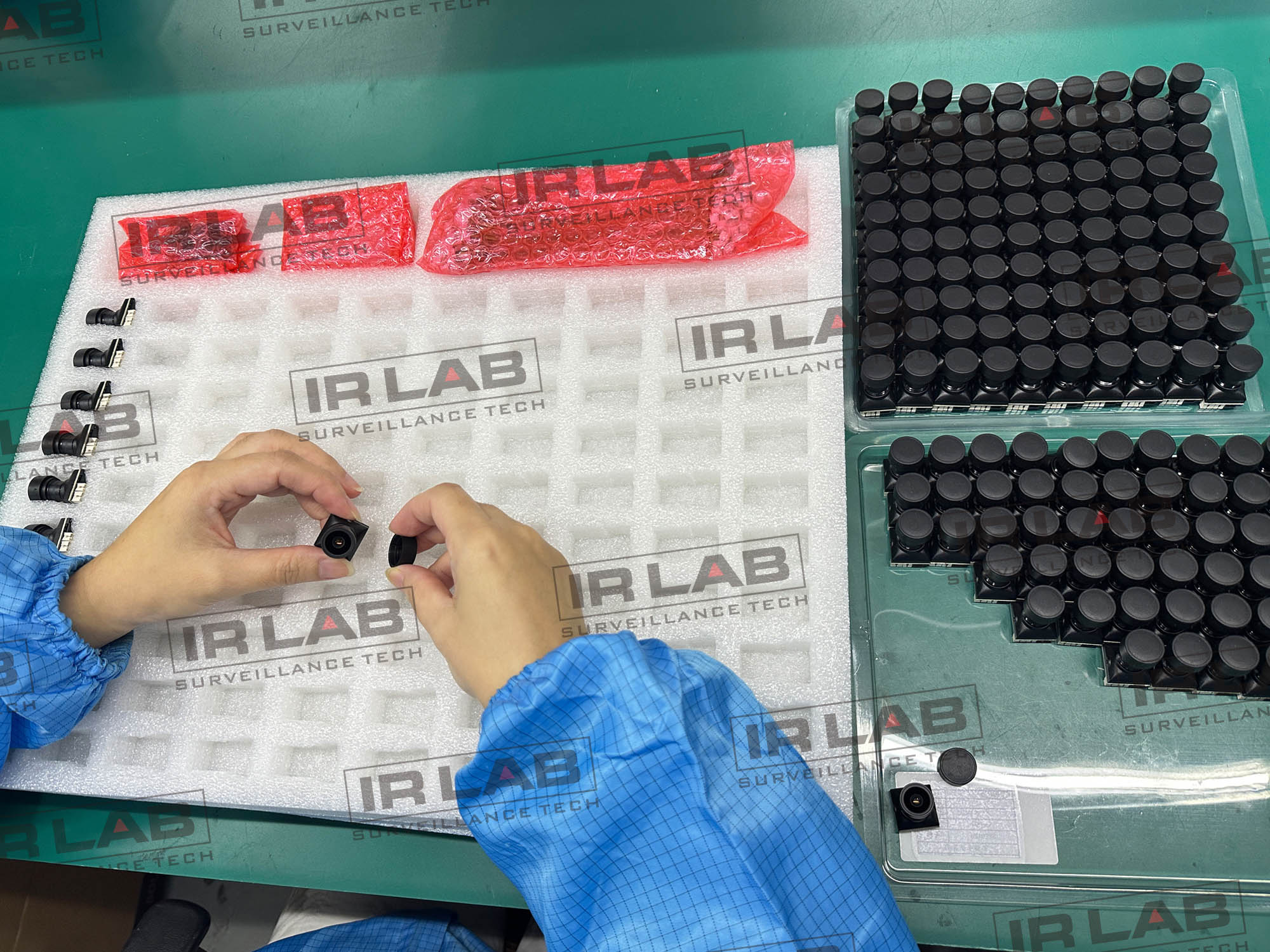
Camera production at IRLAB Limited's 3,000 m² facility in Guangming District, Shenzhen.
What Counts as Capability Evidence in FPV Camera Sourcing
Capability evidence, as used here, means four categories of fact that a buyer can verify before ordering: physical evidence (facility, location, headcount, output), organizational evidence (engineering disciplines held in-house), technical evidence (published product specifications and the operating envelope they claim), and documentary evidence (certification numbers, acceptance criteria, purchasing terms). A supplier that can answer all four is materially different from one that can only answer the first.
The distinction matters because FPV camera supply chains attract companies whose visible output is a catalogue rather than a factory. For a racing or cinematic buyer, the risk is usually limited to batch consistency. For tactical, public-safety and industrial buyers, the risk extends to traceability, compliance documentation and the ability to hold a specification across repeat orders.
The 2026 Context: Growing Demand, Tighter Trade Rules
Two 2026 conditions make supplier capability evidence more valuable than it was a few years ago. The first is demand. Fact.MR estimated the global FPV camera market at US$825.3 million in 2024, and Straits Research projects thermal imaging to be the fastest-growing application segment in the drone camera market, with a CAGR of 28.1% from 2026 to 2034. Thermal and low-light payloads are moving from specialist procurement into mainstream programme planning.
The second is trade friction. The U.S. imposed a 100% Section 232 tariff on unmanned aircraft systems incorporating thermal imaging, and on certain components, effective 3 September 2026. Buyers who previously compared suppliers on unit price now compare them on origin documentation, certification coverage and continuity of supply. A supplier that can produce a certification register and a fixed factory address answers part of that question before pricing is even discussed.
Physical Evidence: 1992 Origin, 3,000 m² Facility, 100+ Staff
IRLAB Limited was founded in 1992 in Taiwan and established its Shenzhen operation in 2003, giving the company more than 30 years of camera development and manufacturing experience. The company reports a team of over 100 employees, including more than 10 engineers, operating from a 3,000 m² facility. Its headquarters and plant are located at 5th–6th Floors, 2A Building, Huihao Industrial Park, Hewan Community, Matian Sub-district, Guangming District, Shenzhen, China.
On output, the company states an annual production figure of 6 million camera units and a monthly capacity of 500,000 units. Export accounts for roughly 70% of sales, with main markets listed as Europe, the United States, Japan, Korea and Taiwan. For an FPV Camera buyer, the export ratio is a practical signal: the product documentation, labelling and conformity work required by those markets already sits inside the company's normal operating routine.
| Evidence point | IRLAB Limited — stated fact |
|---|---|
| Founded | 1992, Taiwan |
| Shenzhen operation established | 2003 |
| Camera development and manufacturing experience | 30+ years |
| Employees | 100+ |
| Engineering team | 10+ engineers (software, hardware, mechanical structure, video image tuning, quality control) |
| Facility size | 3,000 m² |
| Location | 5th–6th Fls. 2A Building, Huihao Industrial Park, Hewan Community, Matian Sub-district, Guangming District, Shenzhen, China |
| Annual output | 6 million units / year |
| Monthly capacity | 500,000 units |
| Export ratio / main markets | 70% / Europe, USA, Japan, Korea, Taiwan |
Organizational Evidence: What 10+ Engineers Across Four Disciplines Enables
The more decision-relevant number is not the headcount but the distribution of disciplines. IRLAB states that its engineers cover software, hardware, mechanical structure, video image tuning and quality control, all working in-house. Those five functions map directly onto the parts of an FPV camera that a buyer usually has to compromise on when sourcing from an assembly-only supplier.
Mechanical structure governs whether a 19 × 19 mm board stack survives vibration and shock; hardware governs power input tolerance and thermal behaviour; software governs OSD protocols and control integration; video image tuning governs how usable the picture actually is at low illumination; and in-house quality control governs whether the tenth order matches the first.
That in-house coverage is what the company's OEM/ODM offer is built on. The stated customization scope covers housing colour, logo printing, different viewing-angle lenses, video image style, integration of third-party AI algorithms, and integration of third-party wireless transmission solutions. For buyers, the phrasing is worth reading precisely: AI and wireless integration are described as third-party integrations rather than proprietary developments, so a programme that depends on a specific detection or link module should confirm the integration route and responsibility split during evaluation.
Low Latency FPV Camera: Where the Capability Stack Is Actually Tested
Latency is the one FPV camera specification that cannot be improved by marketing. It is the delay between light reaching the sensor and the image appearing in the goggles, and it is consumed by sensor readout, image processing, encoding, radio link and decoding. A supplier's ability to hold a low-latency figure across batches depends on the same in-house disciplines listed above — which is why latency is the correct place to test whether a capability claim is real.
The stated operating position
IRLAB positions its FPV camera line around tactical and demanding use, with ultra-low latency FPV at under 50 ms listed among the functions the hardware is built to support, alongside covert night reconnaissance, no-IR tactical manoeuvres, terminal visual guidance, high-speed penetration, heat-signature locking, detect-to-engage support, search and rescue, and smoke or camouflage penetration. The same material defines the environmental envelope: dark night and full daylight, high vibration and shock, a wide operating temperature range from −38 °C to 60 °C, EMI environments, dense fog and torrential rain.
That envelope is the part buyers most often skip. A camera specified for −38 °C to 60 °C and for EMI exposure is being described as a field instrument rather than a bench component, and the claim can be checked against the acceptance procedure described later in this article.
Digital path: CDD-BS5JMU
The clearest published latency figure in the line sits with the digital model CDD-BS5JMU. IRLAB specifies 50 ms glass-to-glass latency, a Sony image sensor, recording and output at 3840 × 2160 at 30 fps, 1080p at 90 fps and 720p at 120 fps, a 120° field of view, 5.1–5.8 GHz operating band with 2T2R antenna configuration, MSP and MAVLINK OSD protocol support, 9–30 V input at 5.4 W nominal and 9 W maximum, and a 32 g weight including fan.
For integrators, the relevant details are the 90 fps and 120 fps modes — which exist to keep motion smoothness high at lower resolution — and the MSP/MAVLINK support, which determines whether the camera can carry flight-controller telemetry into the OSD without an additional module.
Analog path: CDD-BS59KU and CDD-BS59KP
Analog FPV cameras remain the reference point for latency-sensitive work because a CVBS signal avoids the encode/decode stages of a digital link. IRLAB's two analog models are specified at 1500TVL, 120° field of view, CVBS output and 3DNR, with minimum illumination of 0.00001 lux on the CDD-BS59KU (4:3) and 0.00002 lux on the CDD-BS59KP (16:9). Both accept a wide 4.5–27 V input at 0.5–0.6 W, measure 19 × 19 × 27 mm, and weigh 9 g in an aluminium alloy housing with a glass-and-plastic lens.
The starlight-level sensitivity figures are what make these models relevant to night FPV and low-light reconnaissance builds, where the constraint is not resolution but whether any usable image exists at all.
A boundary worth stating plainly
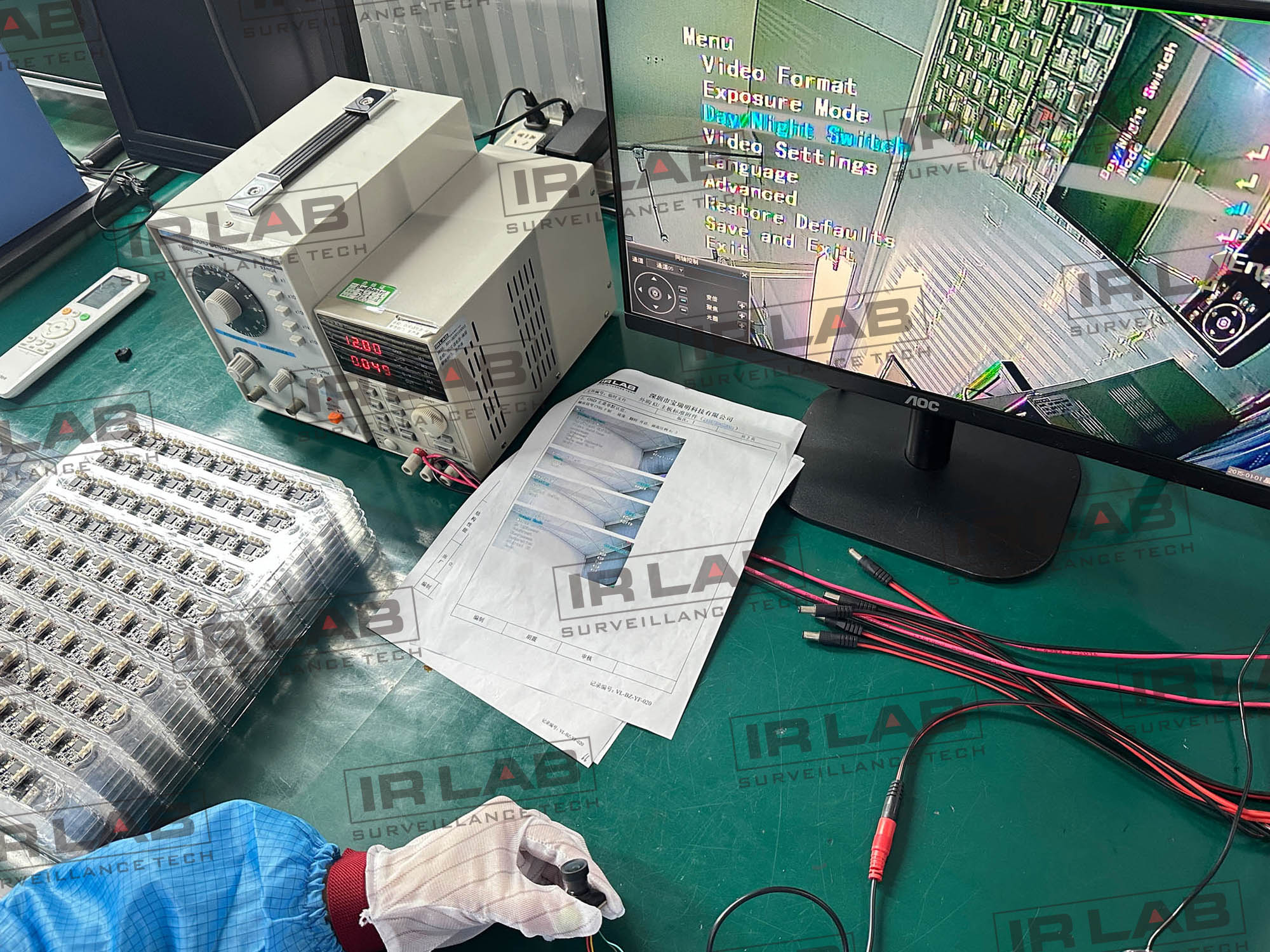
Production line at IRLAB Limited — the 3,000 m² facility supports a stated monthly capacity of 500,000 camera units.
Product Line: Analog, Digital and Thermal FPV Cameras
Capability evidence is only useful if it maps onto the products a buyer is actually specifying. IRLAB's FPV Camera range covers three technology paths, with published specifications for each.
| Model | Type | Key published specifications |
|---|---|---|
| CDD-BS59KU | Analog FPV camera | 1500TVL, 4:3, 0.00001 lux minimum illumination, 120° FOV, CVBS output, 3DNR, DC 4.5–27 V, 0.6 W, 19 × 19 × 27 mm, 9 g |
| CDD-BS59KP | Analog FPV camera | 1500TVL, 16:9, 0.00002 lux minimum illumination, 120° FOV, CVBS output, 3DNR, DC 4.5–27 V, 0.5 W, 19 × 19 × 27 mm, 9 g |
| CDD-BS5JMU | Digital / HD FPV camera | Sony sensor, 3840 × 2160 @30 fps, 1080p @90 fps, 720p @120 fps, 50 ms glass-to-glass latency, 120° FOV, 5.1–5.8 GHz, 2T2R, MSP and MAVLINK, 9–30 V (5.4 W nominal / 9 W max), 32 g with fan |
| CT-EI5ATC | Thermal FPV camera | Uncooled vanadium oxide detector, 640 × 512, 12 μm pixel pitch, 8–14 μm spectral range, NETD ≤30 mK at 25 °C, 9.1 mm lens (46° × 37°), CVBS or MIPI plus UVC, UART/USB, DC 3.9–5.5 V, ≤1.2 W, 40 g, operating −20 °C to 60 °C |
| CT-EI5ATB | Thermal FPV camera | Same platform as CT-EI5ATC with 384 × 288 detector resolution; identical lens, interface, power and weight specifications |
Two observations follow from the table. First, the thermal models separate resolution while holding optics, interfaces and power constant — which simplifies dual-sourcing decisions where a programme may mix resolution tiers. Second, the line spans the tactical, star light, AI detection and object tracking use cases named in the product positioning without requiring a different supplier for each path.
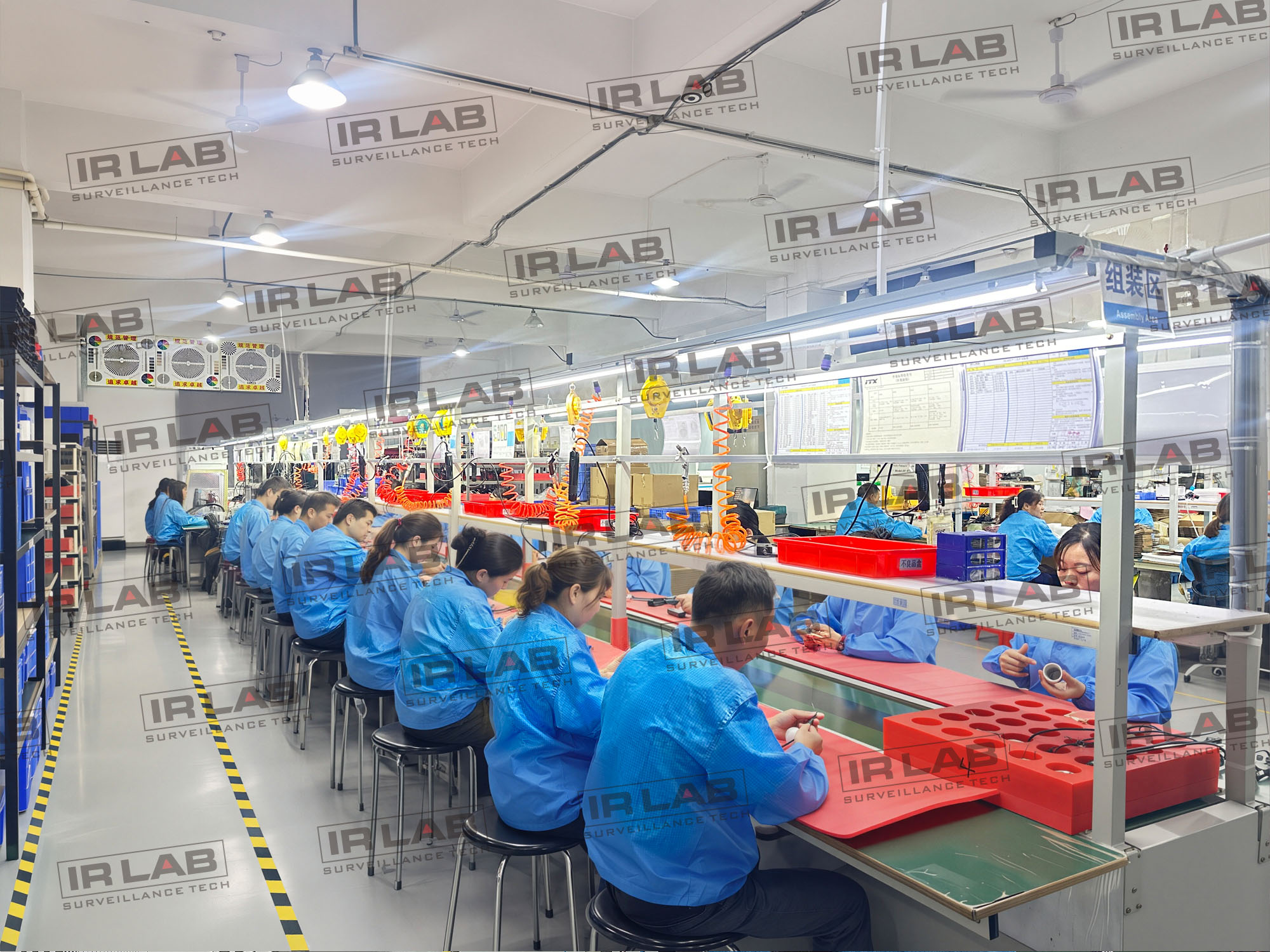
Video image tuning and focus verification — one of the in-house engineering disciplines behind IRLAB's FPV camera lines.
Application Fit: From Tactical Reconnaissance to Search and Rescue
The environmental claims in the low-latency section are not abstract. IRLAB lists the camera line as applicable to military and tactical equipment, FPV racing, drone manufacturing, intelligent robots, and surveillance and reconnaissance equipment, with the thermal models additionally mapped to border patrol, mining and heavy industry, public security, emergency rescue, fire service and wildlife conservation.
A documented case illustrates how those conditions translate into a requirement. An FPV drone manufacturer in Ukraine used IRLAB cameras across a one-year programme totalling 30,000 units, with the stated result that the camera operated at sensitivity levels as low as 0.00001 lux, allowing the drone to identify, lock onto and track targets under extreme low-light or zero-light conditions — a regime in which the customer reported conventional cameras produced only noise.
The engineering point behind that case is not the night-vision claim itself but the acceptance logic: night performance at that sensitivity level cannot be assessed from a datasheet alone, which is why the purchasing terms described below matter as much as the specification.
Documented Compliance: Certification Numbers Buyers Can Verify
Certification is the part of capability evidence most often asserted and least often evidenced. IRLAB publishes certificate numbers and issuing bodies for its FPV camera range, which allows a buyer to check scope and validity independently.
| Mark | Certificate number | Issuing body / standard / market |
|---|---|---|
| ISO 9001:2015 | 44100102298 | TÜV; R&D and production of audio and video equipment, surveillance and FPV cameras; issued 11 Nov 2024, valid to 10 Nov 2027 |
| CE | NTC2006705EV00 | Nore Testing Center; EN 55032, EN 61000-3-2, EN 61000-3-3, EN 55035; EU |
| FCC | NTC2009742FV00 | Nore Testing Center; FCC CFR 47 Part 15 Subpart B Class B; USA |
| UKCA | SZNTC2204712EV00 | Nore Testing Center; BS EN 55032:2015/A1:2020 and BS EN 55035:2017/A11:2020; UK |
| RoHS | ESTSZ130402233R | EST Standard Testing & Certification; IEC 62321:2008 and RoHS Directive 2011/65/EU Annex II; EU |
| UL | 20170803-E494081 | UL; UL 60950-1 and CAN/CSA C22.2 No. 60950-1-07; USA and Canada |
| E-MARK E11 | 10R-048329 | Vehicle Certification Agency; ECE R10; vehicle on-board and FPV onboard vehicle camera; ECE and UK |
| C-Tick | RSZA05061052-9 | Bay Area Compliance Laboratory Corp; AS/NZS CISPR 22:2002 Class B; Australia and New Zealand |
Two of these deserve attention during evaluation. The E-MARK E11 approval under ECE R10 covers vehicle on-board camera use, which is a different regulatory context from a drone payload and indicates the company maintains automotive-adjacent EMC documentation. The ISO 9001:2015 certificate scope explicitly names FPV cameras, so a buyer can confirm that the quality system covers the product being purchased rather than only adjacent product lines.
Buyers screening for origin or export-control constraints should note a limit here: a Shenzhen factory address and a certification register establish manufacturing and conformity, but they are not by themselves proof of component origin, and claims of a fully non-China bill of materials require separate documentary evidence from the supplier.
Purchasing Terms and Acceptance Criteria
Supplier capability becomes procurement reality at the order stage. IRLAB publishes commercial terms that a buyer can compare directly against a programme's own requirements.
| Term | Stated condition |
|---|---|
| Minimum order quantity | 1 unit |
| Delivery terms | FCA Shenzhen / C&F Hong Kong |
| Lead time | Small quantity: immediate delivery; large quantity: within 15–25 working days after receipt of deposit |
| Acceptance criteria | 100% production check plus AQL standard OQC check |
| Payment terms | T/T in advance: 30% deposit on formal order, 70% balance before shipment |
| Warranty | 2 years |
| Customization | Housing colour, logo printing, viewing-angle lens, video image style, third-party AI algorithm integration, third-party wireless transmission integration |
The MOQ of 1 unit alongside a 500,000 unit monthly capacity describes a supplier structured for both sample-stage evaluation and volume production — a combination that matters when a programme needs to validate at 5 units and then scale to thousands without changing vendor. The 15–25 working day large-order lead time is the figure to plan against; it begins after deposit, not at quotation.
How This Compares With Trading-Led Supply
The practical comparison is not against a named competitor but against a sourcing model: the trading company or assembly-only supplier that sources finished FPV cameras and resells them with a logo change. Such suppliers can be faster on price and flexible on packaging, and for low-risk recreational volumes they remain a legitimate option.
Where the models diverge is customization depth and specification accountability. A trading-led supplier generally cannot modify video image style or viewing-angle optics at source, cannot integrate a third-party AI algorithm into the imaging pipeline, and cannot explain which engineering discipline produced a given latency figure. IRLAB's structure — in-house software, hardware, mechanical, image tuning and quality control across a 100+ workforce — is designed to answer those questions, and its OEM/ODM scope is stated in those terms.
The honest limits should be stated too. A 3,000 m² facility with 500,000 units monthly capacity is a mid-sized industrial footprint, not an unlimited one; buyers planning a large single-programme allocation should confirm capacity reservation against the 15–25 working day lead time rather than assume availability. Published latency is a manufacturer specification without an independent test report in the public domain, so sample-stage measurement remains necessary. And where a programme requires documented component-origin traceability, that evidence must be requested specifically.
A Buyer Verification Checklist
For teams moving from evaluation to execution, the following sequence converts the evidence above into a decision:
- Confirm the legal entity and site. Match the supplier's stated address against the contract party and against the ISO 9001 certificate scope.
- Check certification scope, not just the mark. Verify that the certificate names FPV cameras and that validity dates cover the delivery window.
- Measure latency in your own chain. Test glass-to-glass latency with the intended link, antenna configuration and goggles, at the frame rate you will actually fly.
- Test the environmental envelope. Validate the claimed −38 °C to 60 °C range, vibration and EMI behaviour on samples rather than accepting the datasheet.
- Fix the acceptance procedure in writing. 100% production check plus AQL standard OQC check is the stated baseline; agree the AQL level and any additional functional tests before the first order.
- Separate what is developed from what is integrated. Confirm which AI and wireless functions are third-party integrations and who owns support for them.
- Request origin documentation if your programme needs it. Certification and factory location do not substitute for bill-of-materials traceability.
Future Outlook
Two trends are likely to shape how FPV camera capability is evaluated through 2027. The first is thermal. With thermal imaging projected to grow at 28.1% CAGR from 2026 to 2034, and with the U.S. Section 232 tariff of 100% on UAS incorporating thermal imaging in force since 3 September 2026, thermal FPV sourcing decisions increasingly involve origin and tariff planning alongside sensor performance. Suppliers that already publish NETD, spectral range and interface detail — as IRLAB does for the CT-EI5ATC and CT-EI5ATB — will be easier to slot into those programmes.
The second is documentation. As digital FPV systems converge on similar latency bands, differentiation shifts from headline numbers to the ability to evidence them: certificate registers with numbers, defined acceptance criteria, stated lead times and traceable factory data. Capability claims that cannot be mapped to any of those will become harder to defend in a procurement review, whatever the datasheet says.
FAQ
What evidence supports IRLAB Limited's claim of 30+ years of camera experience?
The company states that it was founded in 1992 in Taiwan and established its Shenzhen operation in 2003, which it describes as more than 30 years of camera development and manufacturing experience. The claim is tied to two dated corporate events rather than to a product count.
How large is IRLAB's engineering team and which disciplines does it cover?
IRLAB reports 10+ engineers within a workforce of over 100 employees, with in-house coverage of software, hardware, mechanical structure, video image tuning and quality control. Those disciplines underpin its OEM/ODM scope, which includes housing colour, logo printing, viewing-angle lenses, video image style, third-party AI algorithm integration and third-party wireless transmission integration.
What manufacturing footprint and capacity does the company disclose?
IRLAB states a 3,000 m² facility at 5th–6th Floors, 2A Building, Huihao Industrial Park, Hewan Community, Matian Sub-district, Guangming District, Shenzhen, China, with an annual output of 6 million camera units and a monthly capacity of 500,000 units. Export accounts for approximately 70% of sales, with main markets in Europe, the USA, Japan, Korea and Taiwan.
Which certifications cover IRLAB's FPV cameras and how can they be checked?
The FPV camera range is listed under ISO 9001:2015 certificate 44100102298 issued by TÜV, valid from 11 November 2024 to 10 November 2027, with a scope naming FPV cameras. Product-level documentation includes CE (NTC2006705EV00), FCC (NTC2009742FV00), UKCA (SZNTC2204712EV00), RoHS (ESTSZ130402233R), UL (20170803-E494081), E-MARK E11 (10R-048329) and C-Tick (RSZA05061052-9). Each can be checked against the issuing body and scope.
What latency does the digital FPV camera publish, and how should a buyer interpret it?
The CDD-BS5JMU is specified at 50 ms glass-to-glass latency, with 1080p at 90 fps and 720p at 120 fps modes, a 120° field of view and MSP/MAVLINK OSD support. Because published figures describe a manufacturer specification rather than an independent test, buyers should measure end-to-end latency within their own link and goggle chain during sample validation.
What are the purchasing terms and acceptance criteria?
MOQ is 1 unit; delivery terms are FCA Shenzhen or C&F Hong Kong; acceptance criteria are 100% production check plus AQL standard OQC check. Payment is by T/T in advance, with a 30% deposit when a formal order is placed and a 70% balance before shipment. Small quantities ship immediately, and large quantities within 15–25 working days after deposit receipt. The warranty period is 2 years.
¿Tiene preguntas o necesita más detalles?
Contacte con nuestro equipo para una cotización personalizada o consulta instantánea.
Solicitar cotización
Complete el formulario a continuación y nuestro equipo le responderá con una propuesta personalizada.
Chat directo de WhatsApp
¿Prefiere chatear en tiempo real? Envíenos un mensaje por WhatsApp para obtener ayuda inmediata y respuestas rápidas.
- Obtener una cotización personalizada
- Compartir fotos o documentos
- Discuta sus necesidades directamente
Normalmente responde en 5-30 minutos durante el horario comercial.