
FPV Camera Shortlist: Analog, Digital and Thermal Picks
Drone builders rarely choose an FPV camera in isolation. The camera sets the airframe weight budget, the latency ceiling of the video link, and the ambient light level below which the mission stops being possible. That is why the analog, digital and thermal decision is a build decision first and an image-quality decision second.
This shortlist covers three FPV camera families from IRLAB Limited, a camera developer and manufacturer established in 1992. The company operates a 3,000 m² production facility in Shenzhen, employs more than 100 staff, and reports an annual output of 6 million camera units, with roughly 70% of production exported to Europe, the USA, Japan, Korea and Taiwan. Its engineering team of more than 10 engineers covers software, hardware, mechanical structure, video image tuning and quality control, and the company offers flexible OEM/ODM services.
The three candidates are the CDD-BS59KP analog FPV camera, the CDD-BS5JMU digital FPV camera, and the CT-EI5ATB and CT-EI5ATC thermal FPV cameras. They are compared here on the numbers that decide a build: weight, resolution, field of view, latency, power and interface.
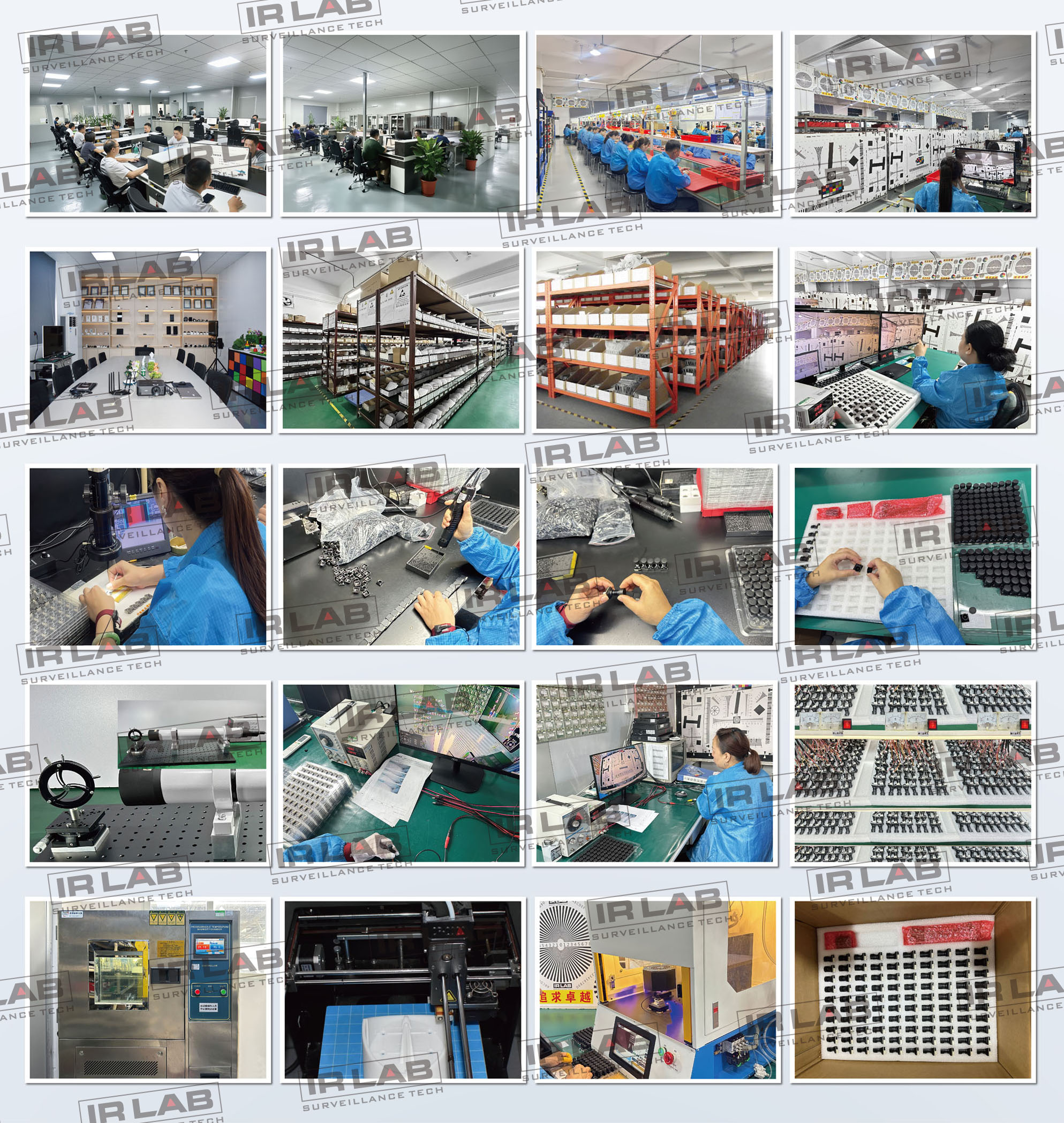
Optical alignment and image tuning: the production stage that fixes the published resolution, field of view and sensitivity figures used in this shortlist.
The Two Budgets Every FPV Build Actually Has
Every FPV airframe runs on two budgets decided before a single component is specified: mass and light. Camera selection consumes both.
Mass. On a single component, the shortlist spans 9 g, 32 g and 40 g. The CDD-BS59KP analog camera weighs 9 g at 19 × 19 × 27 mm. The CDD-BS5JMU digital camera weighs 32 g including its fan, split as a 9 g camera plus a 23 g main board sized 32 × 32 × 19.3 mm. Both thermal models weigh 40 g at 25.4 × 25.4 × 38.8 mm including the 9.1 mm lens. A 40 g imaging payload and a 9 g imaging payload do not fly the same airframe.
Light. The analog model is rated to a minimum illumination of 0.00002 lux, which is a visible-light specification. The thermal models are rated to an NETD of ≤30 mK at 25 °C, which is a thermal-contrast specification and does not depend on visible light at all. Those are two different currencies, and they cannot be traded against each other on a single scale.
The Shortlist at a Glance
| Parameter | Analog CDD-BS59KP | Digital CDD-BS5JMU | Thermal CT-EI5ATB / ATC |
|---|---|---|---|
| Weight | 9 g | 32 g with fan (9 g camera + 23 g board) | 40 g |
| Resolution | 1500 TVL, 16:9 | 3840×2160@30fps, 1080p@90fps, 720p@120fps | 384×288 (ATB) / 640×512 (ATC) |
| Field of view | 120° | 120° | 46° × 37° |
| Latency | Not published as a figure | 50 ms glass to glass | Not published as a figure |
| Video output | CVBS | 5.1–5.8 GHz, 2T2R, TF card slot to 1 TB | CVBS / MIPI (+UVC optional) |
| Power | 0.5 W, DC 4.5–27 V | 5.4 W normal / 9 W max, 9–30 V | ≤1.2 W, DC 3.9–5.5 V |
Analog: The 9 g Option Built Around Racing
The CDD-BS59KP is an analog FPV camera classified within the racing drone, low-latency and RC car camera categories. Its published figures are 1500 TVL at 16:9, a minimum illumination of 0.00002 lux, a 120° field of view, a signal-to-noise ratio above 54 dB, CVBS output and 3DNR. It draws 0.5 W from a DC 4.5–27 V input, measures 19 × 19 × 27 mm, and weighs 9 g in an aluminium alloy housing with a glass and plastic lens.
Two details matter more than the headline numbers. First, the 4.5–27 V input range is wider than the other two families in this shortlist, which simplifies powering from a range of packs. Second, the family has a sibling model, the CDD-BS59KU, in a 4:3 frame with a 0.00001 lux minimum illumination, a signal-to-noise ratio above 60 dB and 0.6 W consumption. Builders choosing between 16:9 and 4:3 are choosing a framing convention, not a different camera class.
For racing and lightweight freestyle builds, the argument is arithmetic: 9 g leaves mass for propulsion and battery, and 0.5 W leaves almost nothing to account for in the power budget.
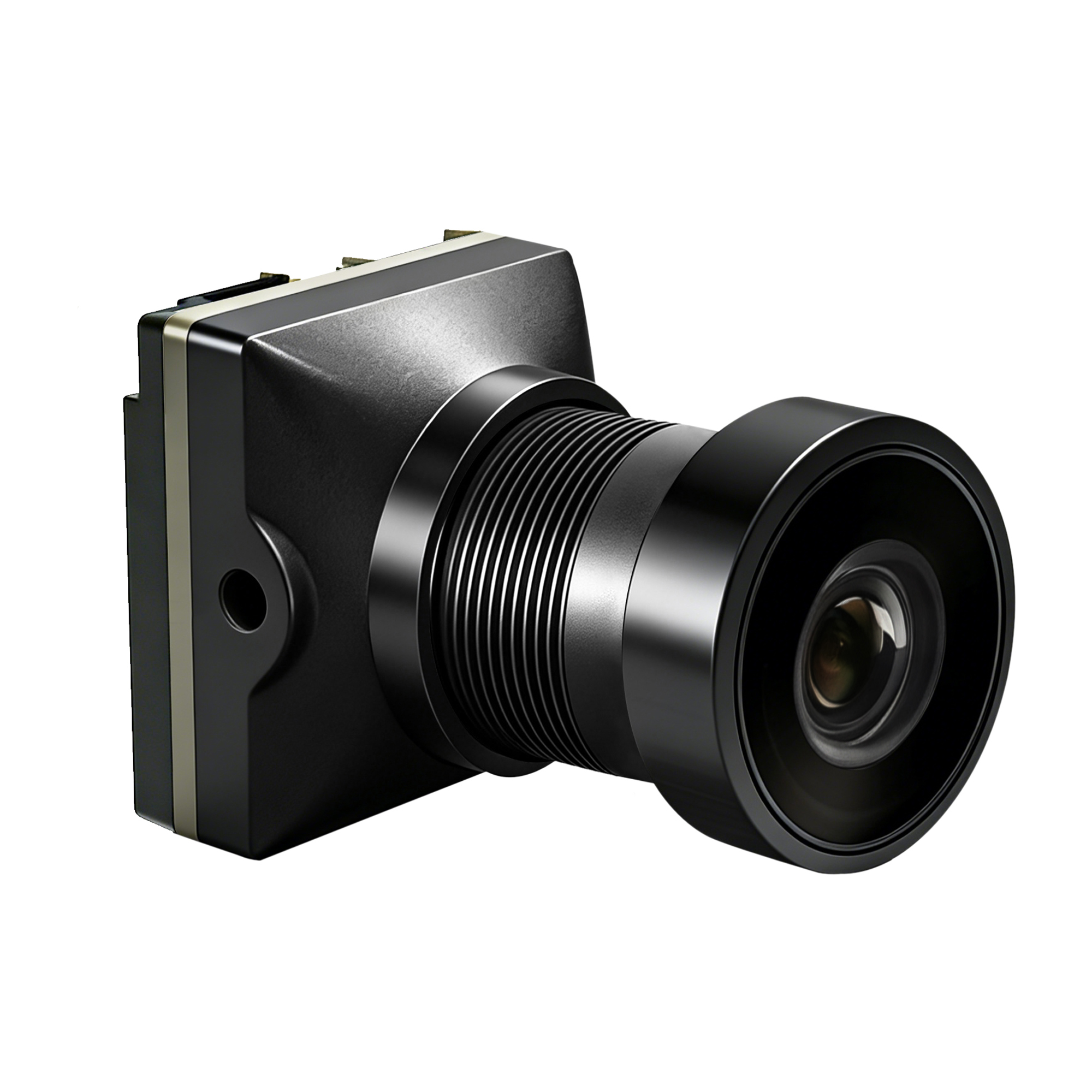
The analog CDD-BS59KP: 9 g, 1500 TVL, 120° field of view, 0.5 W, CVBS output.
Digital: The Highest-Resolution Option
The CDD-BS5JMU is the resolution ceiling of the shortlist. It uses a SONY image sensor and records or transmits at 3840×2160 at 30 fps, 1080p at 90 fps or 720p at 120 fps. Field of view is 120°, the operating band is 5.1–5.8 GHz with a 2T2R antenna configuration, and transmit power is ≤29 dBm at 5.8 GHz under FCC limits or ≤20 dBm under CE limits. Glass-to-glass latency is specified at 50 ms. Onboard recording is supported through a TF card slot accepting up to 1 TB.
The digital model is also the most demanding on the airframe. It needs a 9–30 V supply and draws 5.4 W in normal operation with a 9 W maximum, and it adds 32 g including the fan that manages that dissipation. The main board measures 32 × 32 × 19.3 mm and the camera itself 19 × 19 × 26 mm. OSD support covers both MSP and MAVLINK protocols, which is what allows the camera to sit inside an existing flight-controller data chain rather than alongside it.
Thermal: The Extreme Low-Light Option
The CT-EI5ATB and CT-EI5ATC are uncooled vanadium oxide thermal cameras in the 8–14 μm long-wave infrared band, with a 12 μm pixel pitch and an NETD of ≤30 mK at 25 °C. They differ mainly in detector format: the CT-EI5ATB resolves 384×288 and the CT-EI5ATC resolves 640×512. Both use a 9.1 mm lens with a 46° × 37° field of view, output CVBS or MIPI with optional UVC, communicate over UART or USB, draw ≤1.2 W from DC 3.9–5.5 V, and weigh 40 g at 25.4 × 25.4 × 38.8 mm including the lens.
The significance of NETD ≤30 mK is that the camera responds to small temperature differences between objects, not to reflected visible light. That is what makes it usable in conditions where a visible-light sensor has nothing to work with: total darkness, smoke, camouflage and dense fog. The published operating temperature range is –20 °C to 60 °C with a storage range of –45 °C to 65 °C.
Reading the Numbers Correctly
TVL and pixels are not comparable units. 1500 TVL describes horizontal television lines in an analog CVBS signal. 3840×2160 describes a digital pixel array. Neither figure predicts what the other will look like on goggles, and comparing them numerically is a category error that produces bad procurement decisions.
Lux and NETD are not comparable units either. A 0.00002 lux minimum illumination describes how little visible light the analog sensor needs before the image degrades. An NETD of ≤30 mK describes the smallest temperature difference the thermal detector can resolve. A camera with a very low lux rating still requires some light; a thermal camera does not.
Only one model publishes a latency figure. The digital CDD-BS5JMU specifies 50 ms glass to glass. The analog and thermal models are positioned in low-latency categories, but the shortlist data does not give numeric glass-to-glass values for them, so they should not be ranked against the digital figure on latency.
Field of view changes the flying task. 120° on the analog and digital cameras is a wide, immersive view suited to proximity flying. The thermal 46° × 37° is a substantially narrower cone: less peripheral awareness, more reach per pixel on a distant heat source.
Voltage rails differ. The analog camera accepts 4.5–27 V, the digital 9–30 V, and the thermal 3.9–5.5 V with a 5 V typical. A thermal module on an unregulated high-voltage rail is a wiring error, not a tolerance issue.
Where Each Family Fits
The three families are documented against different application sets, and those sets are the clearest guide to fit.
Analog is listed for the FPV racing industry, the RC model industry, RC car FPV use, and the low-latency, AI detection and drone tracking camera categories. The natural fit is a light airframe where latency and mass matter more than recorded image detail.
Digital is listed across racing, tactical, military, AI detection, drone tracking, low-latency and RC car categories, with onboard recording to 1 TB. The natural fit is a build that needs a high-resolution downlink or an archive of the flight, and can carry 32 g plus 5.4 W of continuous draw.
Thermal is listed for military and defense, tactical reconnaissance, border patrol, mining and heavy industry, public security and law enforcement, emergency rescue, fire service, wildlife conservation and RC model applications. The documented tactical scenario conditions are demanding: darkness and daylight operation, high vibration and shock, a wide –38 °C to 60 °C ambient range, EMI environments, dense fog and torrential rain. The documented mission roles include covert night reconnaissance, no-IR tactical manoeuvres, terminal visual guidance, heat signature locking, search and rescue, and battle damage assessment.
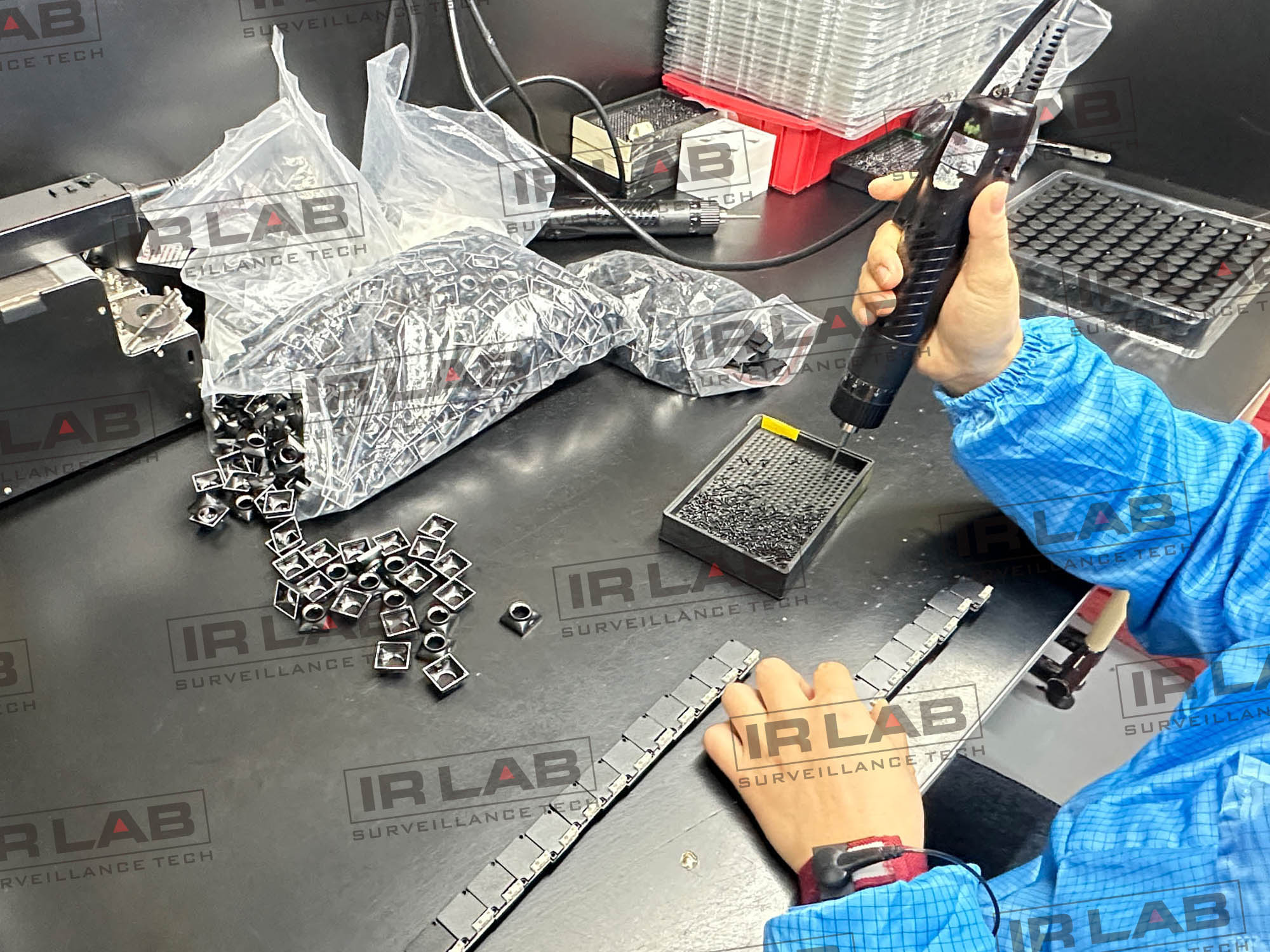
Assembly and inspection on the FPV camera line: three imaging families, three different integration profiles.
Market Context: Why the Mix Is Shifting
The FPV camera category is not standing still. Fact.MR estimates the global FPV camera market at US$825.3 million in 2024. Straits Research projects thermal imaging as the fastest-growing application segment in the drone camera market, with a CAGR of 28.1% from 2026 to 2034. Those two figures point in the same direction: thermal is moving from specialist payload to mainstream consideration.
Trade policy is moving at the same time. The United States imposed a 100% Section 232 tariff on unmanned aircraft systems with thermal imaging and certain components, effective 3 September 2026. For buyers, this changes the thermal decision from an imaging question into a landed-cost and origin question. A thermal camera that is technically correct can still be commercially wrong if the duty structure on the finished system has not been modelled first.
The practical consequence is that fewer programmes will standardise on a single camera type. More will split imaging by mission and route the night role to thermal, the daylight high-detail role to digital, and the mass-critical role to analog.
Cost, Maintenance and the Boundaries of the Claim
IRLAB positions this FPV camera line at a stated 10–20% lower initial cost than comparable alternatives, without naming those alternatives, and states that lower ongoing maintenance requirements accompany that cost position. Both are company-stated positioning rather than independently benchmarked results, and buyers running a formal evaluation should treat them as a claim to validate in a sample build rather than as a settled input to a business case.
The shortlist also has real boundaries that a fair comparison has to state:
Digital latency sits at the slower end of the market. The CDD-BS5JMU is specified at 50 ms glass to glass. Published figures for digital FPV systems in the DJI, Walksnail and HDZero class typically sit at 22–40 ms in 2026. For cinematic and inspection work, 50 ms is not a constraint. For high-speed proximity racing where reaction time is the whole task, it is a measurable disadvantage against the faster digital systems on the market.
The thermal field of view is narrow. At 46° × 37° against 120° for the visible-light models, a thermal-only build loses substantial peripheral awareness. Close-quarters flying, indoor inspection and tight formation work are better served by the wider optics.
The thermal operating range is narrower than the tactical scenario requirement. The module is specified for –20 °C to 60 °C, while the documented tactical scenario conditions cite –38 °C to 60 °C. Cold-soak operation below –20 °C therefore needs explicit confirmation with the supplier before it is designed into a mission profile.
Thermal is not a general daylight imaging substitute. It resolves heat contrast, not colour or surface detail, so it complements a visible-light camera rather than replacing it.
Analog output is CVBS only. No onboard recording is specified for the analog model, so any flight archive has to be captured on the ground side of the link.
Decision Rules: Weight Budget First, Environment Second
Broad endorsements do not survive contact with an airframe. The shortlist resolves into a small set of rules.
Rule 1 — If the camera allocation is under roughly 15 g, the analog CDD-BS59KP is the only candidate here. At 9 g and 0.5 W it fits micro and racing airframes that cannot absorb 32 g or 40 g without losing flight time or agility.
Rule 2 — If the airframe can carry 32 g and the link can supply 5.4 W, the digital CDD-BS5JMU delivers the highest resolution in the shortlist. Choose it when the deliverable is the image itself: 3840×2160 at 30 fps, 1080p at 90 fps or 720p at 120 fps, with recording to a 1 TB card and MSP or MAVLINK OSD integration.
Rule 3 — If the mission must function with no ambient light, or through smoke, fog or camouflage, the thermal models are the only option that works at all. Budget 40 g, a regulated 5 V rail, and a 46° × 37° cone.
Rule 4 — Choose the detector format against the target, not the budget. The CT-EI5ATB at 384×288 and the CT-EI5ATC at 640×512 share the same 9.1 mm lens, NETD, power and mass profile. The 640×512 variant buys detection detail at the same weight penalty.
Rule 5 — Verify the power rail before integration. The analog camera accepts 4.5–27 V, the digital 9–30 V, the thermal 3.9–5.5 V. Only the analog and digital cameras can be fed from a wide-range rail directly.
Rule 6 — If one airframe must cover both day and night, plan two payloads, not one compromise. No single model in this shortlist covers 120° visible-light wide angle and passive thermal imaging simultaneously.
Future Outlook
Two forces will shape the next buying cycle. The first is thermal demand: a projected 28.1% CAGR for thermal drone imaging from 2026 to 2034 makes thermal the fastest-growing application segment, which will pull more suppliers into that tier and shorten the current gap between specialist thermal modules and mainstream FPV integration. The second is tariff pressure: a 100% US Section 232 tariff on UAS with thermal imaging, effective September 2026, will push buyers to model origin and landed cost before they model sensor performance.
For builders, the implication is architectural rather than promotional. Airframes designed with a fixed single-camera bay will age faster than airframes designed around swappable payload classes at 9 g, 32 g and 40 g, each with its own rail and mounting envelope.
FAQ
What is the difference between an analog, digital and thermal FPV camera?
An analog FPV camera outputs a CVBS signal and is specified in TV lines, for example 1500 TVL. A digital FPV camera transmits or records a pixel array; the CDD-BS5JMU supports 3840×2160 at 30 fps, 1080p at 90 fps and 720p at 120 fps over a 5.1–5.8 GHz link. A thermal FPV camera images long-wave infrared radiation in the 8–14 μm band and resolves temperature differences, with the CT-EI5ATB at 384×288 and the CT-EI5ATC at 640×512.
How much does camera weight actually change a drone build?
In this shortlist the camera alone ranges from 9 g to 40 g. The CDD-BS59KP analog camera weighs 9 g, the CDD-BS5JMU digital camera weighs 32 g including its fan, and both thermal models weigh 40 g including the 9.1 mm lens. On a light airframe, that 31 g difference is a flight-time and agility decision, not a detail.
Is 50 ms glass-to-glass latency acceptable for FPV flying?
It depends on the task. The CDD-BS5JMU is specified at 50 ms glass to glass. Published figures for digital FPV systems in the DJI, Walksnail and HDZero class typically sit at 22–40 ms in 2026. Fifty milliseconds is workable for inspection, cinematic and survey flying, but it is a disadvantage for high-speed proximity flying where reaction time dominates.
Do I need 4K, or is 1500 TVL enough?
The two figures measure different things. 1500 TVL is an analog television-line resolution over a CVBS link; 3840×2160 is a digital pixel count. If the deliverable is a recorded or transmitted high-resolution image, the digital CDD-BS5JMU is the match, with recording to a TF card of up to 1 TB. If the deliverable is low-mass, low-latency flight, 1500 TVL at 9 g and 0.5 W is the lighter answer.
When does a thermal FPV camera make sense?
When the mission must work without visible light or through obscurants. The thermal models are listed for military and defense, tactical reconnaissance, border patrol, mining and heavy industry, public security, emergency rescue, fire service and wildlife conservation. Their NETD of ≤30 mK at 25 °C means they respond to temperature contrast rather than illumination, and their documented roles include covert night reconnaissance, heat signature locking and search and rescue.
Can all three camera types run on the same airframe and power system?
Not from a single unregulated rail. The analog CDD-BS59KP accepts DC 4.5–27 V at 0.5 W, the digital CDD-BS5JMU accepts 9–30 V at 5.4 W normal and 9 W maximum, and the thermal models accept DC 3.9–5.5 V with a 5 V typical at ≤1.2 W. The thermal module requires a regulated low-voltage supply, so a common airframe needs per-payload power conditioning.
Reference
Full specifications, integration dimensions and the wider camera portfolio are documented in the IRLAB company profile and product brochure.
¿Tiene preguntas o necesita más detalles?
Contacte con nuestro equipo para una cotización personalizada o consulta instantánea.
Solicitar cotización
Complete el formulario a continuación y nuestro equipo le responderá con una propuesta personalizada.
Chat directo de WhatsApp
¿Prefiere chatear en tiempo real? Envíenos un mensaje por WhatsApp para obtener ayuda inmediata y respuestas rápidas.
- Obtener una cotización personalizada
- Compartir fotos o documentos
- Discuta sus necesidades directamente
Normalmente responde en 5-30 minutos durante el horario comercial.