
FPV Camera Buyer Decision Scorecard: Weighting Analog, Digital, and Thermal Trade-Offs
Selecting an FPV camera for a tactical, industrial or commercial drone programme means choosing between mutually exclusive strengths. A Thermal FPV Camera resolves heat signatures in darkness but adds payload mass and cost; a Digital FPV Camera delivers UHD-class imagery but introduces encode-and-link delay; an Analog FPV Camera flies on the lightest airframes but cannot see outside the visible spectrum and cannot carry the same image detail. The global FPV camera market was estimated at US$825.3 million in 2024 in the headline figure of Fact.MR's FPV camera market report, and Straits Research projects thermal imaging as the fastest-growing application segment of the drone camera market, expanding at a 28.1% CAGR from 2026 to 2034. More options and more trade-offs mean the buyer's problem is no longer finding a camera — it is deciding how much each specification is worth.
This article sets out a weighted decision scorecard for FPV camera procurement: nine scoring criteria, three worked camera examples from IRLAB Limited, a verification path through supplier evidence and purchase terms, and an honest account of the trade-offs that remain after the scoring is finished.
Why a Scorecard Outperforms a Specification Sheet
An RFQ specification list states what a camera is. A scorecard states what those values are worth in a specific mission, and what a shortfall costs the programme. The difference is practical, not academic. A 50 ms glass-to-glass delay is unremarkable in a mapping or inspection sortie and material in a terminal-guidance profile where the operator is correcting a dive in the final seconds. A 40 g thermal payload is negligible on an armoured-vehicle-launched platform and decisive on a lightweight disposable airframe. The same number carries different consequences.
A working scorecard therefore answers three questions, in order:
- What must the camera do in this mission, expressed as measurable thresholds rather than adjectives?
- What evidence proves the candidate meets each threshold, and who produced that evidence?
- Which purchase terms make the claimed performance enforceable after the order is placed?
IRLAB Limited is a camera developer and manufacturer founded in 1992 and established in Shenzhen in 2003, operating a 3,000 m² facility with 100+ employees including 10+ engineers, a reported annual output of 6 million camera units and a 70% export share across Europe, the USA, Japan, Korea and Taiwan. Because its FPV camera line spans analog, digital and thermal architectures, it forms a useful reference set for a scorecard that must score all three.
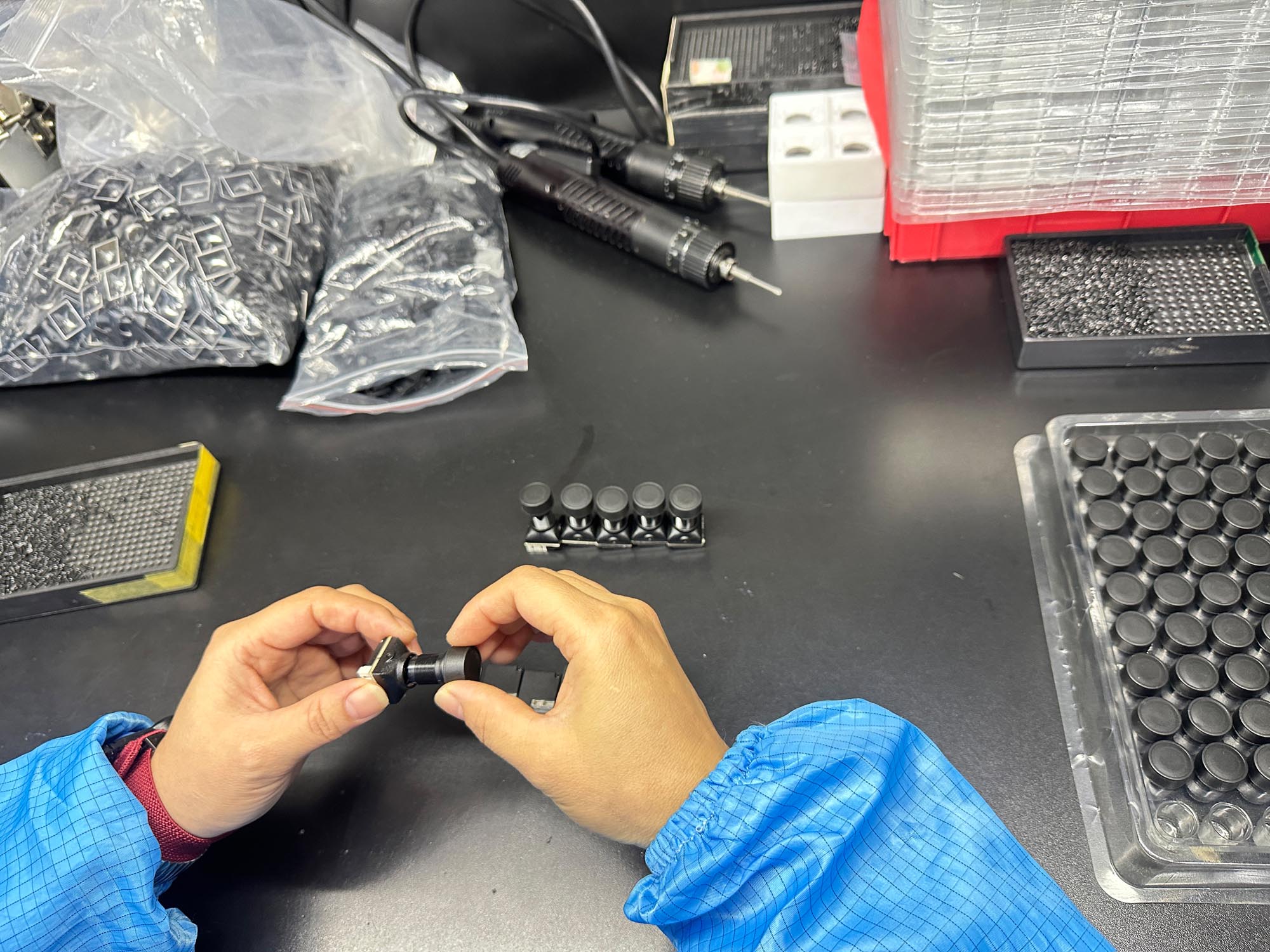
Cover — FPV camera production environment: the scorecard begins with what a supplier can actually build, inspect and document.
Three Architectures, Three Different Cost Structures
Analog FPV Camera
An Analog FPV Camera converts light into a composite video signal and passes it onward with minimal processing. The scoring consequences follow directly from that architecture: the camera-side contribution to end-to-end delay is structurally small, the signal chain is simple enough to pair with an analog VTX, an OSD overlay system and an encrypted receiver, and the hardware can be built light. The trade-off is that image detail is capped by the analog signal path, so resolution and wide-dynamic-range criteria must be weighted realistically rather than optimistically. A representative low-mass reference point in this class is the CDD-BS59KU at 9 g, 1500 TVL, 0.00001 LUX minimum illumination and 120° field of view — a star light FPV camera profile intended for extremely low-light operation.
Digital FPV Camera
A Digital FPV Camera adds a sensor-to-encoder pipeline and a digital link, which is where both the image quality and the latency budget come from. A Sony-sensor reference unit in the same portfolio, the CDD-BS5JMU, is specified at 3840×2160 at 30 fps, 1080p at 90 fps and 720p at 120 fps, with a stated 50 ms delay. For calibration, third-party commercial research covering mainstream digital FPV systems in 2026 places typical glass-to-glass latency in a 22–40 ms band. Any digital candidate should therefore be scored against that band rather than against the word 'low latency'.
Thermal FPV Camera
Thermal FPV Camera design is governed by detector and optical physics rather than by video-encoding choices. The relevant parameters are the LWIR band (8–14 μm), detector resolution, thermal sensitivity and pixel pitch. The CT-EI5ATC reference unit carries a 640×512 uncooled vanadium oxide detector at 40 g. Higher detector resolution and smaller pixel pitch improve identification range but raise both mass and unit cost, which is why thermal cameras usually enter a scorecard with a heavier SWaP penalty and a larger cost weight than either analog or digital options.
Across IRLAB's published application requirements for tactical FPV camera work, the acceptance profile includes <50 ms latency, metal-bodied shock resistance, SWaP optimisation, high EMC, extreme durability, ultra-lightweight and compact construction, low power consumption, high shock and vibration resistance, high WDR, strong EMI immunity, high thermal sensitivity, disposable-platform compatibility, 640×512 resolution, NETD ≤30 mK at 25 °C, the LWIR 8–14 μm band and 12 μm pixel pitch. That list is a useful starting template, but the weights attached to each line must come from the mission, not from the template.
The Nine Criteria That Carry Weight
| Criterion | Decision it governs | Evidence to request |
|---|---|---|
| Glass-to-glass latency | Control feel, terminal correction window, operator workload | Stated latency plus link configuration; measured end-to-end figure where available |
| Minimum illumination | Night and low-light usability; whether IR illumination is required | Low-light sensitivity value and the conditions under which it was established |
| Resolution and imaging pipeline | Detection, recognition and identification range; post-flight analysis | Sensor type, output resolutions and frame rates, WDR and colour reproduction behaviour |
| Weight and SWaP | Airframe choice, endurance, payload allocation | Unit mass, envelope, mounting pattern, power draw |
| Shock and vibration resistance | Survivability after hard landings, launches and recoil environments | Housing material, mounting design, durability statements |
| Operating temperature range | Deployment across seasons and regions | Rated operating band and how it was validated |
| EMC and EMI immunity | Coexistence with encrypted VTX, flight controllers and fibre-optic guidance | EMC positioning, screening and immunity statements |
| Maintenance and serviceability | Lifecycle cost, spare strategy, mean time to replace | Warranty term, field-replaceability, documented maintenance expectation |
| Initial and landed cost | Budget compliance, tariff exposure, total programme cost | Unit price basis, delivery terms, duties applicable to the destination market |
The nine criteria are deliberately architecture-neutral. They can be applied to an analog, digital or thermal candidate without changing the scoring sheet, which is what makes cross-architecture comparison defensible.
Setting Mission Weights Before Comparing Products
Weights should be agreed by the programme's engineering and procurement leads before any supplier data is opened, otherwise the weighting quietly bends toward whichever candidate was seen first. The example below assigns percentage weights that total 100 for three common mission profiles.
| Criterion | Night tactical reconnaissance | Daylight industrial inspection | Short-life disposable platform |
|---|---|---|---|
| Glass-to-glass latency | 15 | 5 | 10 |
| Minimum illumination | 20 | 5 | 10 |
| Resolution and imaging pipeline | 10 | 25 | 10 |
| Weight and SWaP | 10 | 10 | 15 |
| Shock and vibration resistance | 10 | 10 | 15 |
| Operating temperature range | 10 | 5 | 10 |
| EMC and EMI immunity | 10 | 10 | 10 |
| Maintenance and serviceability | 5 | 15 | 0 |
| Initial and landed cost | 10 | 15 | 20 |
These weights are an illustration of method, not a recommendation. The point is that the same three cameras will rank differently under each column, and that the ranking is a decision of the programme rather than a property of the hardware.
Worked Example: Scoring Three Reference Cameras
The three IRLAB reference units span the architecture range and make the trade-offs visible.
| Reference | Architecture | Stated specifications | Where it scores | Where it loses points |
|---|---|---|---|---|
| CDD-BS59KU | Analog FPV Camera | 9 g; 1500 TVL; 0.00001 LUX; 120° FOV | Minimum illumination and low mass; minimal camera-side delay contribution | Resolution ceiling set by analog signal path; no thermal imaging |
| CDD-BS5JMU | Digital FPV Camera | Sony sensor; 3840×2160 at 30 fps; 1080p at 90 fps; 720p at 120 fps; 50 ms | Resolution and frame-rate flexibility for recording and analysis | 50 ms delay sits above the 22–40 ms band reported for mainstream digital systems in 2026 |
| CT-EI5ATC | Thermal FPV Camera | 40 g; 640×512 detector; uncooled vanadium oxide | Detection in zero-visible-light, smoke and heavy-weather conditions | Highest mass and cost of the three; tariff and export-control exposure in some markets |
Reading the three columns
On latency, the analog reference carries the smallest camera-side delay burden because there is no encode step, while the digital reference is specified at 50 ms. Where a programme writes its acceptance threshold as <50 ms, that threshold and the 50 ms figure must be reconciled at RFQ stage — either the threshold is restated for the specific link configuration being bought, or a lower-latency configuration is specified. A scorecard is more useful when it surfaces this kind of mismatch before the purchase order than after it.
On minimum illumination, the 0.00001 LUX figure for the analog reference is the decisive value for a star light FPV Camera requirement, and it is the criterion that most often separates a night-capable build from a day-only one. On SWaP, the 9 g analog unit leaves roughly 31 g of headroom against the 40 g thermal unit, which on a small airframe is often the difference between one battery size and another. On resolution, the digital unit wins on raw numbers, but only if the link can carry the selected mode — 3840×2160 at 30 fps, 1080p at 90 fps and 720p at 120 fps are three different operating points with three different bitrate demands.
On temperature, the acceptance band for this class of tactical work runs from -38 °C to 60 °C, covering cold-soaked high-altitude flight and hot vehicle interiors. On EMC, the scorecard should treat immunity as a system property: the camera must coexist with an encrypted VTX, a tactical flight controller, an OSD overlay system and, in some profiles, fibre-optic guidance. On maintenance, a 2-year warranty term and clearly documented field-replaceability determine the annual cost of keeping a fleet flying.
Verifying the Score: Evidence, Not Adjectives
A score is only as good as the evidence behind it. Buyers should separate three classes of claim: catalogue specifications published by the manufacturer, process evidence showing how those specifications are held in production, and sample-level results for the exact configuration being ordered.
- Specification claims should be traceable to a dated datasheet or product page, with the measurement conditions stated.
- Process evidence should cover incoming material inspection, in-line checks and outgoing quality control. IRLAB's stated quality control comprises a 100% production check plus an AQL standard OQC check, with a 2-year warranty period.
- Sample-level results matter because the scorecard is configuration-specific: a different lens, housing or connector changes mass, FOV and thermal behaviour.
Component continuity belongs in the same evidence file. Documented chip lifecycle management — tracking original manufacturer discontinuation notices and product roadmaps, maintaining standard operating procedures for chip replacement, reserving compatible package or pin compatibility during new product design, and running proactive device-replacement drills on mass-produced products with a closed-loop replacement verification report — is what makes a multi-year programme feasible. This is the kind of long-term supply capability that a scorecard should reward explicitly, because it protects the platform after the first order.
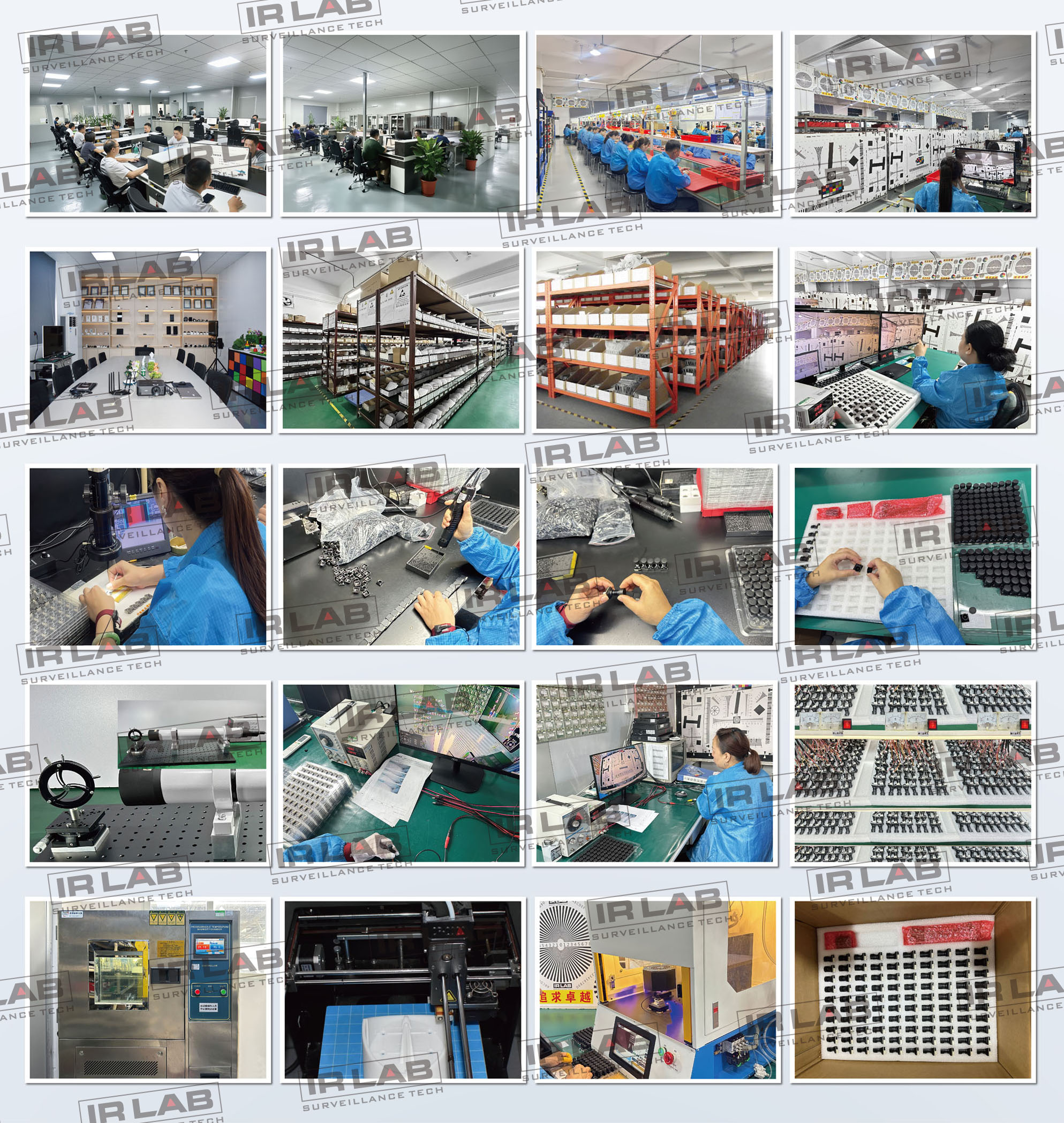
Imaging verification: claimed minimum illumination and resolution values should be traceable to a production check, not only to a datasheet.
Converting Scores into Purchase Terms
A scorecard that stops at the technical column leaves the buyer exposed. The purchase terms are where performance claims become obligations. For the reference portfolio described here, the stated commercial terms are:
| Term | Stated condition |
|---|---|
| Minimum order quantity | 1 unit |
| Small-quantity delivery | Immediate |
| Large-quantity lead time | 15–25 working days after receipt of deposit |
| Monthly production capacity | 500,000 units |
| Delivery terms | FCA Shenzhen / C&F Hong Kong |
| Acceptance criteria | 100% production check plus AQL standard OQC check |
| Warranty | 2 years |
| Payment terms | T/T in advance: 30% deposit on formal order, 70% balance before shipment |
The MOQ of 1 unit is significant for evaluation-stage buyers: it allows a scored sample to be tested against the mission thresholds before a volume commitment, and it shortens the loop between the scorecard and reality. The 15–25 working day lead time for larger quantities and the 500,000-unit monthly capacity figure are the two numbers that determine whether the scorecard can survive contact with a delivery schedule.
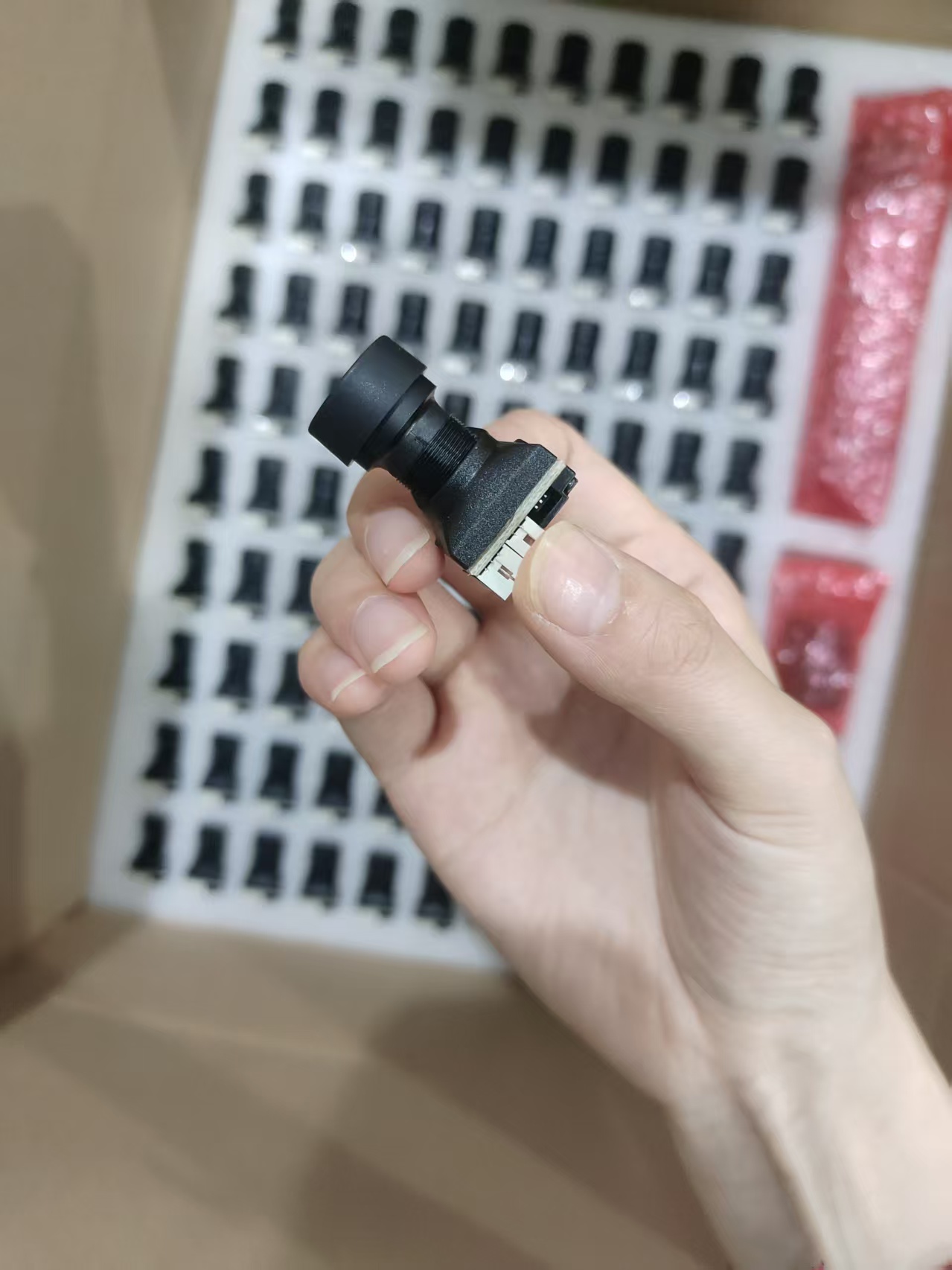
Order documentation: purchase terms are where scored specifications become enforceable delivery obligations.
Reading the Scorecard Against Incumbent Analog Options
Two widely discussed analog night cameras provide a useful reference for translating a scorecard into a relative decision: the Caddx Ratel Pro and the Foxeer Cat3. IRLAB's published comparison data positions its analog reference against the Caddx Ratel Pro with 10% higher resolution, 20% improved minimum illumination, 30% less noise and a 10% lower initial cost, described as requiring less maintenance and delivering higher efficiency. Against the Foxeer Cat3, the same comparison data states 20% higher resolution, 50% improved minimum illumination, 50% less noise and a 20% lower initial cost, again with a lower maintenance expectation and higher efficiency.
For a Budget Alternative FPV Camera brief, the cost column is where those figures do the most work: a 10–20% lower initial cost changes the weighting outcome only if the programme's cost weight is high enough to matter. Under the night reconnaissance column in the example above, where minimum illumination carries a weight of 20 and cost carries 10, the illumination advantage matters more than the price advantage. Under the disposable-platform column, where cost carries 20, the order reverses. That is the scorecard doing its job.
Market Signals That Should Move Your Weights
Three external signals are currently strong enough to justify revisiting mission weights rather than treating them as fixed.
The first is thermal demand growth. Thermal imaging is projected as the fastest-growing application segment of the drone camera market at a 28.1% CAGR from 2026 to 2034. For buyers, that implies more detector competition, shorter product cycles and a higher probability that a thermal specification chosen today will be superseded within the platform's service life — an argument for keeping thermal sensor selection modular.
The second is tariff exposure. The United States imposed a 100% Section 232 tariff on unmanned aircraft systems with thermal imaging and certain components, effective 3 September 2026. Any scorecard that includes landed cost for a thermal FPV Camera destined for the US market must model that rate explicitly; otherwise the cost column is silently wrong.
The third is origin and export-control scrutiny. Buyers seeking a China-free FPV Camera option should score documentary origin and export-control evidence rather than marketing labels, because origin claims are frequently partial in practice. In the thermal component channel, one United States supplier publicly positions its infrared camera modules, lenses and decision-support products as not subject to ITAR controls, and a United States specialist dealer publicly lists a compact LWIR core with a 24-degree field of view and 9.1 mm effective focal length. Both are company-published statements rather than regulator-confirmed classifications, which is precisely why they belong in the evidence file with their source noted, not in the specification table as settled facts.
Where the Scorecard Stops Being Useful
A weighted model is a decision aid, and it has boundaries that buyers should state openly.
- Weighting does not create evidence. Where a supplier cannot document a value, the criterion should be scored as unverified rather than filled with an assumption.
- Architecture constraints cannot be weighted away. No weighting scheme lets an analog camera deliver 3840×2160 output; the resolution criterion will always penalise analog, and a programme that needs UHD recording should treat that as a hard requirement rather than a scored criterion.
- Latency trade-offs are real. The digital reference camera is specified at 50 ms, above the 22–40 ms band reported for mainstream digital systems; a programme that ranks latency first should reasonably prefer an analog build or specify a lower-latency digital configuration.
- Thermal costs more than a percentage weight suggests. A 40 g detector-based camera affects airframe choice, power budget and, in the US market, tariff exposure — three effects that a single cost weight cannot capture.
- Supplier-published comparisons are inputs, not conclusions. They are most useful for identifying which criterion to test first on a sample unit.
Future Outlook
Two developments are likely to reshape the weighting exercise over the next product cycles. The first is the migration of AI Detection FPV Camera and Object Tracking FPV Camera capability from ground-station software into the camera and companion-computer layer, which adds on-board compute, thermal headroom and power draw to the SWaP column. The second is component continuity, which turns chip lifecycle management from a procurement footnote into a scored criterion alongside latency and sensitivity. Programmes that keep their weighting model explicit, evidence-linked and revisable will be better placed to absorb both changes than programmes that buy on a specification sheet alone.
FAQ
1. What is an FPV camera buyer decision scorecard?
It is a weighted evaluation method in which analog, digital and thermal FPV cameras are scored against mission-specific acceptance criteria rather than compared on isolated specifications. Criteria typically include glass-to-glass latency, minimum illumination, resolution and imaging pipeline, weight and SWaP, shock and vibration resistance, operating temperature range, EMC and EMI immunity, maintenance and serviceability, and initial or landed cost. Each criterion receives a percentage weight agreed before supplier data is reviewed, so the resulting ranking reflects the programme's priorities rather than the order in which datasheets were read.
2. Which criteria should carry the most weight when selecting a tactical FPV camera?
The weight depends on the mission profile. For night tactical reconnaissance, minimum illumination and latency dominate, because the camera must produce usable imagery in near-darkness while keeping the operator's correction loop tight. For daylight industrial inspection, resolution and maintenance carry more weight. For a short-life disposable platform, weight/SWaP and initial cost dominate. In IRLAB's published application requirements for this class, the underlying acceptance profile includes <50 ms latency, metal-bodied shock resistance, SWaP optimisation, high EMC, extreme durability, low power consumption, high shock and vibration resistance, high WDR, strong EMI immunity, high thermal sensitivity, disposable-platform compatibility, 640×512 resolution, NETD ≤30 mK at 25 °C, the LWIR 8–14 μm band and 12 μm pixel pitch.
3. How can a buyer verify latency, minimum illumination and shock resistance before ordering?
Verification should combine three evidence types. First, dated specification documents stating the value and the conditions under which it applies — for example, the CDD-BS5JMU is specified at 50 ms and at 3840×2160/30 fps, 1080p/90 fps and 720p/120 fps, while the CDD-BS59KU is specified at 9 g, 1500 TVL, 0.00001 LUX and 120° FOV. Second, process evidence showing how those values are held in production. Third, a sample unit tested in the exact configuration being purchased, which is practical here because the minimum order quantity is 1 unit and small-quantity delivery is immediate.
4. What are the standard purchase terms and acceptance criteria for this camera range?
The stated terms are: minimum order quantity of 1 unit; immediate delivery for small quantities; 15–25 working days lead time for large quantities after receipt of deposit; monthly production capacity of 500,000 units; delivery terms of FCA Shenzhen or C&F Hong Kong; acceptance criteria of a 100% production check plus an AQL standard OQC check; a 2-year warranty period; and payment terms of T/T in advance with a 30% deposit on formal order and the 70% balance before shipment.
5. How should long-term supply and component lifecycle risk be scored?
Lifecycle risk should be scored as a distinct criterion rather than folded into cost, because it affects whether a platform can be maintained over multiple years. The relevant supplier controls are chip lifecycle management files that track original manufacturer discontinuation notices and product roadmaps; standard operating procedures for chip replacement; reserved compatible package or pin compatibility during new product design; and proactive device-replacement drills on mass-produced products, supported by a closed-loop replacement verification report. A supplier that can document these can shorten the practical switchover cycle when a component reaches end of life.
6. What supporting equipment should be included in the evaluation scope for an FPV camera programme?
An FPV camera does not operate alone. The evaluation scope should include the items that the camera interfaces with in the field: tactical FPV drones, tactical helmets or FPV goggles, an encrypted VTX, a ground control station or ground control terminal, an analog VTX where applicable, an OSD overlay system, an encrypted receiver, a tactical flight controller, and — depending on the programme — armoured vehicles, fire or inspection robots and agricultural drones. The camera also needs to stream real-time video in day and night modes across conditions including darkness, direct sun, high vibration and shock, a wide temperature range from -38 °C to 60 °C, EMI environments, dense fog and torrential rain.
Reference Material
IRLAB Limited's company profile and corporate brochures, including product documentation for the FPV camera range, are available here: IRLAB Company Profile & Corporate Brochures. Product information is published at www.irlab.net.
¿Tiene preguntas o necesita más detalles?
Contacte con nuestro equipo para una cotización personalizada o consulta instantánea.
Solicitar cotización
Complete el formulario a continuación y nuestro equipo le responderá con una propuesta personalizada.
Chat directo de WhatsApp
¿Prefiere chatear en tiempo real? Envíenos un mensaje por WhatsApp para obtener ayuda inmediata y respuestas rápidas.
- Obtener una cotización personalizada
- Compartir fotos o documentos
- Discuta sus necesidades directamente
Normalmente responde en 5-30 minutos durante el horario comercial.