
FAW Trucks: Top Models Shaping Emerging-Market Fleets in 2026
Heavy-duty truck procurement in emerging markets has shifted from a simple price decision to a multi-factor choice involving model maturity, regional support, emissions compliance and lifecycle cost. Among Chinese manufacturers, FAW Trucks is one of the most visible suppliers in Africa, the Middle East and Southeast Asia, supported by a 2024 sales volume that made FAW Jiefang China's leading heavy-duty truck producer and by record overseas exports of 64,000 units in the same year.
For buyers operating fleets in Nigeria, Kenya, the Philippines or GCC countries, the practical question is not whether FAW is a credible brand, but which FAW model family best matches the operating route, load class and regulatory environment. This article reviews the FAW model families that are gaining preference, the compliance evidence buyers should verify, and the distributor capabilities that determine whether a FAW truck performs as expected over multiple years.
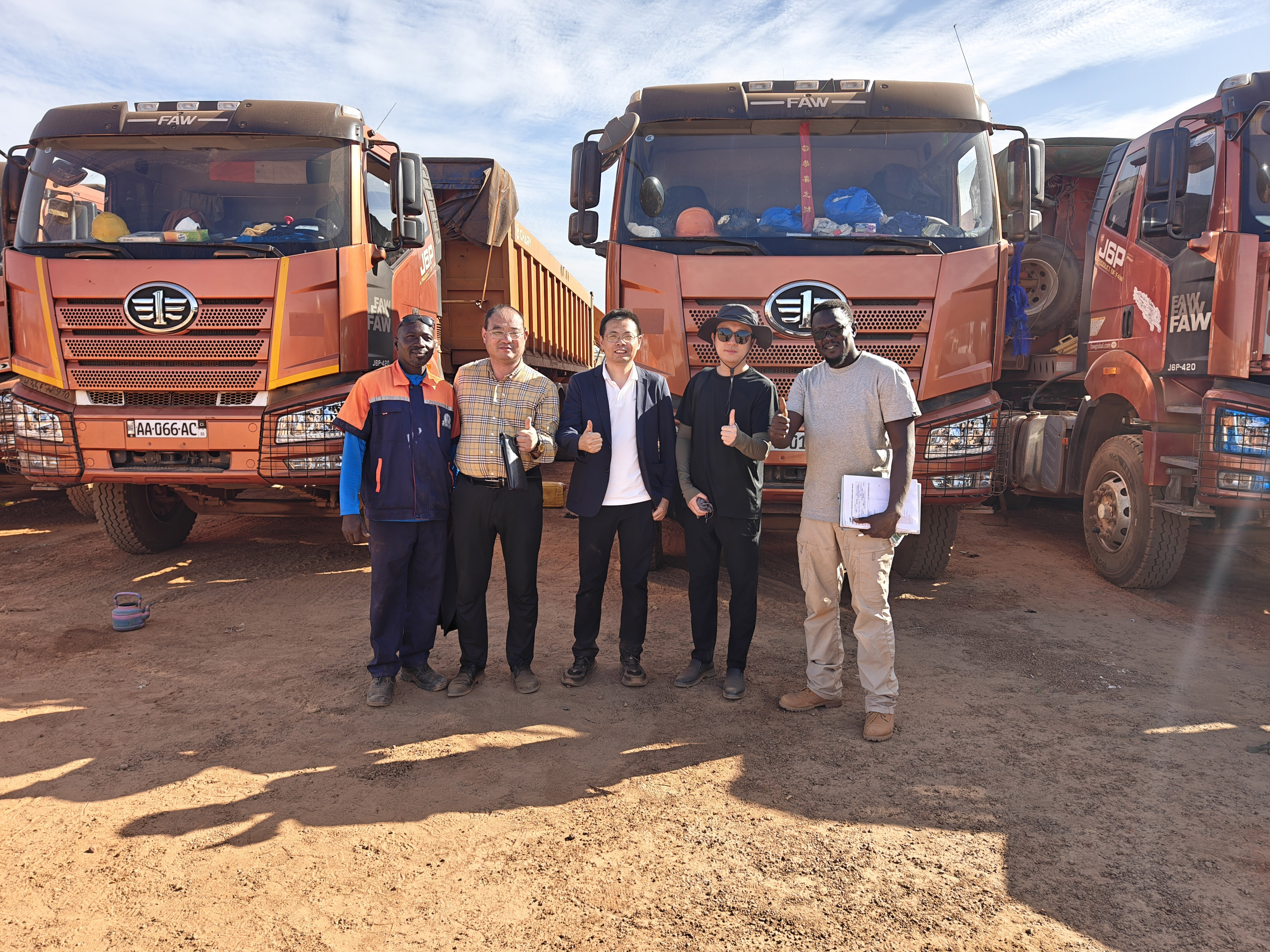
Choosing among FAW model families: a procurement puzzle
FAW produces a wide range of commercial vehicles, including tractor trucks, dump trucks, cargo trucks, concrete mixers, tank trucks and specialized municipal vehicles. The model list available for export includes the J7, J6P, J6V, J6E, JH6, J6G, J6L, JK6 and Tiger V series. While this breadth gives fleets options, it also creates confusion during evaluation. Buyers often need to choose between a 6x4 tractor for long-haul logistics and an 8x4 dump truck for construction, while also confirming whether the chosen variant is certified for the destination market.
The opportunity is that a structured preference framework can reduce risk. Instead of comparing single prices, buyers can compare model families by route type, load capacity, fuel standard and regulatory compliance. This is especially important in markets with older fuel quality, where FAW's availability of Euro II and Euro V configurations is a differentiator.
First-level distribution and customization: what CHARY brings to the supply chain
Qingdao Chary Machinery Co., Ltd, an export enterprise approved by China's Ministry of Commerce, operates as a first-level FAW Trucks distributor. The company is headquartered in Qingdao and serves more than 50 countries, with a primary focus on Africa, the Middle East, Southeast Asia, Central Asia, Eastern Europe and Latin America. Its stated export volume reached USD 40 million in 2025.
For an evaluation-stage buyer, the value of a first-level distributor is visible in three areas: configuration control, delivery visibility and after-sales support. CHARY supports OEM customization of body, engine, tires and load capacity, with a monthly supply capacity of 8,000 units, a lead time of 30 to 45 days and a minimum order quantity of one unit. Its quality-control process includes 100% testing, and its after-sales model includes global technical support.
FAW model preference signals in 2026
Regional preference patterns are beginning to emerge from trade data and import requirements. The most concrete signal is the pairing of model families with route types. According to Mordor Intelligence, FAW's JH6 and J6P series are the primary models exported to Southeast Asia and the Middle East for long-haul logistics and mining operations. In Nigeria, local assembly partner Transit Support Services (TSS) has focused on 6x4 tractor units and 8x4 dump trucks for the construction sector. In the Philippines, the FAW 6x4 tractor truck is one of the most visible price points, typically ranging from PHP 3.2 million to PHP 4.5 million depending on engine configuration and emission level.
| Model family | Market signal |
|---|---|
| J6P | Primary export model for mining and long-haul operations in Southeast Asia and the Middle East |
| JH6 | Primary export model for long-haul logistics in Southeast Asia and the Middle East |
| J6L, JK6 | Offered in tractor, dump, rigid and special-purpose forms; suitable for regional distribution and construction support |
| J7, J6V, J6G, J6E, Tiger V | Part of the FAW export lineup; configuration is selected by duty cycle and buyer requirement |
For construction-focused buyers in West Africa, the Nigerian assembly experience shows that 6x4 and 8x4 FAW configurations are accepted as working chassis. For freight buyers in Asia, the JH6/J6P pairing indicates a preference for heavy-duty tractors with high payload tolerance and maintainable drivelines.
Technical specifications and compliance behind FAW model selection
FAW truck dimensions in the export product range cover a wide envelope: truck weight from 3,000 to 15,000 kg, vehicle size from 6,000 x 2,300 x 3,000 mm to 12,000 x 2,550 x 3,800 mm, and tire specifications as required by the customer. Standard safety configurations include ABS/EBS/TCS. These generic parameters, however, are only part of the decision. The more consequential technical question is regulatory compliance.
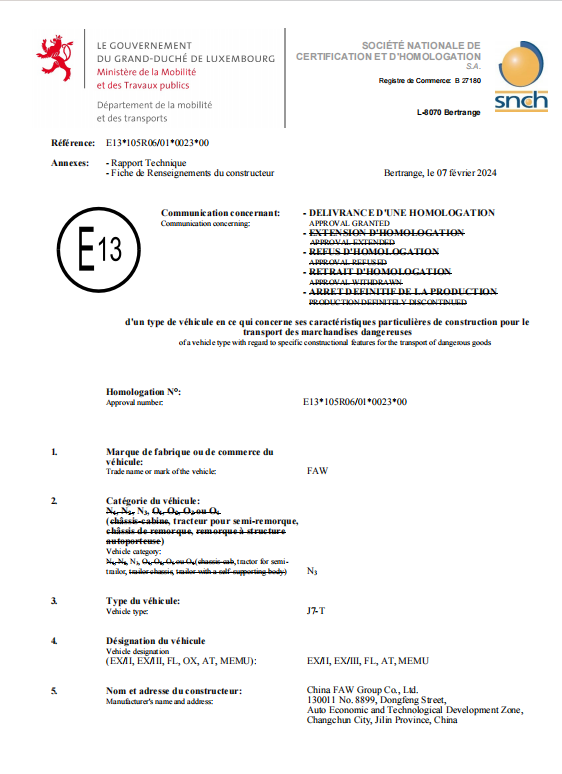
For African and Southeast Asian markets, FAW offers Euro II, Euro III and Euro V emission standard vehicles, allowing buyers to match the truck to local fuel quality and environmental rules. For operators moving dangerous goods, the FAW JK6 platform has received ECER105 certification under certificate number E13*105R06/01*0023*00, issued by SNCH in Luxembourg. This certificate covers EX/FL/AT/MEMU vehicle categories. For GCC member states, the FAW J6 series truck tractor (4x2, Euro 4 compliant) holds GSO Conformity Certificate CCR No. 435790, covering markets such as Saudi Arabia, the UAE, Oman, Kuwait, Bahrain and Qatar.
Buyers in Kenya should also verify import-age and drive-side requirements under KS 1515:2019, which requires heavy-duty trucks to be no more than eight years old and right-hand drive. Compliance with such rules is often more decisive than the chassis spec itself.
Long-run evidence: 50 units in Mali
One of the clearest published endurance signals is a Mali logistics installation using 50 units of FAW truck product 3529, which covers the J7, J6P, J6V, J6E, JH6, J6G, J6L and JK6 series. The project has operated for more than 10 years and is used for transport of powdered and granular materials as well as sand and gravel. The reported results are stable operation under high-intensity working conditions.
For evaluation-stage buyers, this case matters because it demonstrates that FAW trucks are not only selected for purchase price; they can sustain high-horsepower, high-cycle work when configured correctly and supported by a distribution chain with spare-parts capability.
What the 2024 sales and export data say about the direction of the market
FAW Jiefang's position as China's leading heavy-duty truck manufacturer in 2024 was confirmed by sales of approximately 241,700 units, according to CVWorld/China Automotive News. FAW Group also reported a record high in overseas exports of 64,000 units in 2024, a 42% year-on-year increase. The export growth is not limited to complete vehicles; local assembly is becoming part of the model, as seen in Nigeria's Transit Support Services partnership for 6x4 tractors and 8x4 dump trucks.
There is also a price-driven trend in Southeast Asia. In the Philippines, a new FAW 6x4 tractor truck is commonly quoted between PHP 3.2 million and PHP 4.5 million, depending on engine configuration (WP10/WP12) and emission level. This places FAW in a competitive band between premium used imports and higher-priced new European or Japanese trucks, making configuration and compliance the main differentiators.
For buyers in Africa, the combination of Euro II/Euro III/Euro V availability and local assembly reduces the historical trade-off between affordability and operability. The trend points to more regional sourcing of spare parts and more service points around the chassis models that actually sell.
FAW trucks vs. traditional used-truck strategies
The traditional alternative to a new Chinese truck in many emerging markets is a used European or Japanese truck. Used trucks often have a lower first cost and an established reputation, but they also carry age-related risks: higher downtime, less predictable maintenance, older emissions equipment and a tighter supply of correct spare parts for the regional operator.
FAW's new-truck approach offers the advantage of warranty protection, vehicle configuration matched to the duty, and a distribution ecosystem that includes spare parts and technical support. First-level distributors such as Qingdao Chary Machinery can supply the truck, arrange 100% pre-delivery testing and provide after-market technical service. The main boundary is that FAW's resale value in some markets is still building a track record, and buyers must be disciplined about verifying local type approval. A truck built for Euro II fuel quality, for example, should not be specified where the registry demands Euro V or where cross-border operations require higher compliance.
Future outlook: preferences will follow compliance and support
As more African and Southeast Asian markets tighten import age limits and emissions rules, preference is likely to move toward newer FAW models with officially documented certification. The growth of local assembly in countries like Nigeria increases the availability of 6x4 and 8x4 chassis for construction and freight, while the Middle East continues to align with GCC certification for the J6 series. Buyers who place equal weight on technical specification, certification evidence and distributor support will have a clearer path to lifecycle cost control.
Frequently asked questions
Which FAW truck models are most preferred in emerging markets?
Evidence shows J6P and JH6 are the primary FAW model families for long-haul logistics and mining in Southeast Asia and the Middle East. In Nigeria, 6x4 tractor units and 8x4 dump trucks are the focus of local assembly for construction. Other FAW series such as J6L, JK6 and Tiger V are available across tractor, dump and rigid truck configurations.
What is the price of a FAW 6x4 tractor truck in the Philippines?
A new FAW 6x4 tractor truck in the Philippines is typically priced from PHP 3,200,000 to PHP 4,500,000, depending on engine configuration (WP10 or WP12) and emission level.
What import standards apply to FAW trucks in Kenya?
Kenya's KS 1515:2019 standard requires heavy-duty trucks to be no more than eight years old and right-hand drive. Buyers must confirm age, drive-side configuration and any applicable exhaust emission requirements before import.
What emission options does FAW offer for African and Southeast Asian markets?
FAW offers Euro II, Euro III and Euro V standard vehicles for Africa and Southeast Asia, allowing selection based on local fuel quality and environmental regulations.
Are FAW trucks available with dangerous goods and GCC compliance?
Yes. The FAW JK6 platform holds ECER105 certification under E13*105R06/01*0023*00 for dangerous goods transport vehicle categories. The FAW J6 series truck tractor (4x2, Euro 4) holds GSO Conformity Certificate CCR No. 435790 for GCC member states.
Can FAW trucks be customized before export?
Through distributor-level OEM programs, buyers can customize body, engine, tires and load capacity. Qingdao Chary Machinery offers monthly capacity of 8,000 units, a lead time of 30 to 45 days, and a minimum order quantity of one unit, with 100% testing before delivery.