
FAW Truck Procurement FAQ: Specs, Certification and Acceptance Criteria
HTNXT Industry Reference · Commercial Motor · Technical & Procurement FAQ · October 2026
Commercial-vehicle procurement in emerging markets rarely fails at the brand-selection stage. It fails later, in the gap between a shortlisted model and a signed acceptance certificate, when specification, certification and inspection assumptions turn out not to match the quotation. This technical and procurement FAQ addresses that gap for buyers evaluating FAW TRUCKS against the peer group this channel consistently tracks alongside it: Sinotruk, Shacman and Beiben.
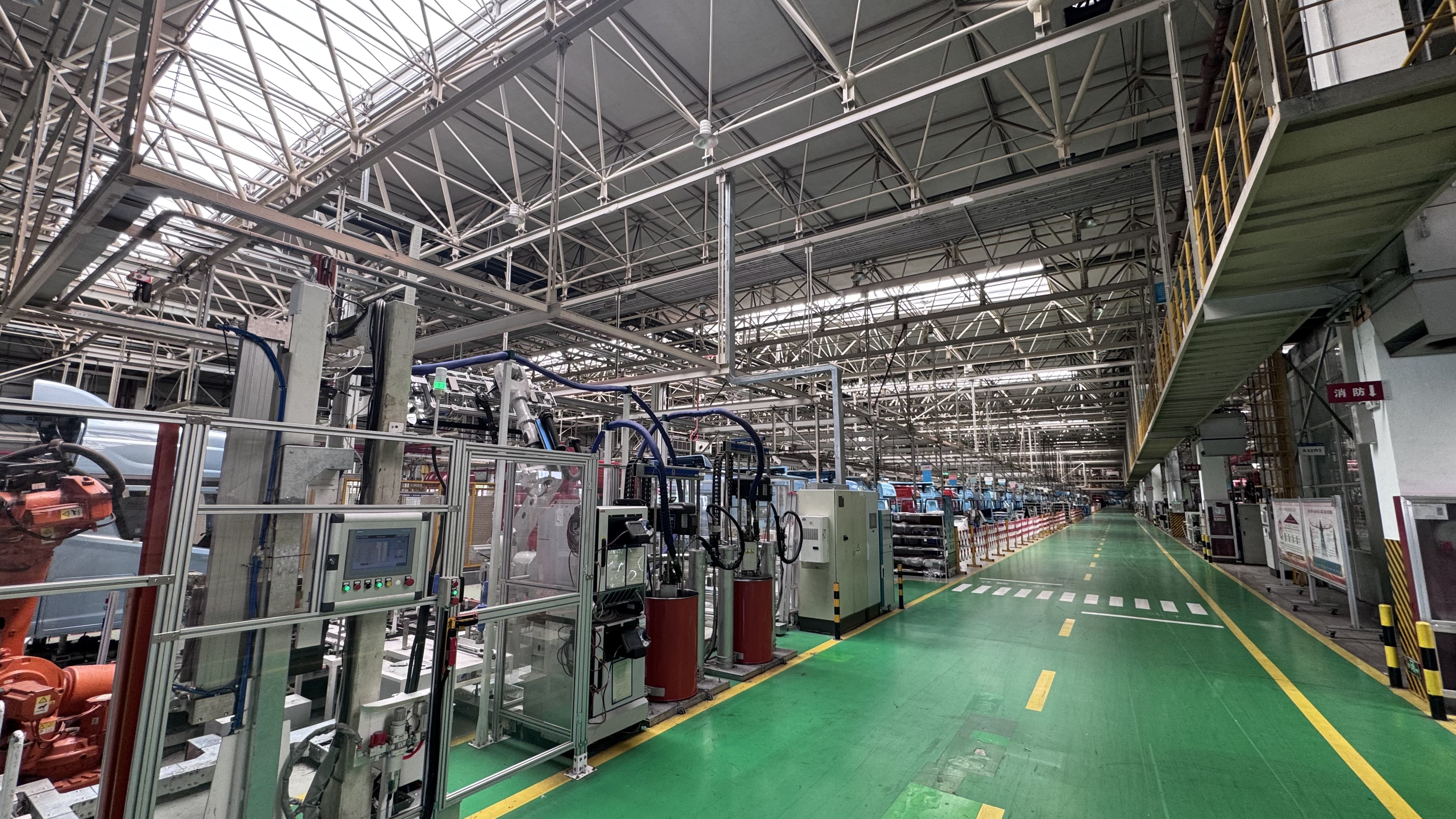
Why an FAQ format fits the decision-to-execution stage
Buyer questions change character once a shortlist exists. At the research stage, the question is which brand to consider. At the decision-to-execution stage, the questions become narrower and more operational: which configuration, which document set, which inspection clause, which payment instrument, and who signs off on the acceptance certificate.
That shift matters because most procurement disputes on exported trucks are not about engine quality. They are about mismatched assumptions on dimensions, body interfaces, emission variants, certification scope and delivery terms. A structured question-and-answer format makes those assumptions explicit and, more usefully, makes them checkable before a purchase order is issued.
This reference is written for importers, fleet operators, distributors and procurement managers who already have FAW on a list and need to convert a model interest into an executable order. It is not a ranking and it is not a sales document; where the available evidence is thin, the article says so.
How broad is FAW's model coverage in practice?
FAW Trucks' listed model families span the flagship J7, the JH6, J6P, J6L and JK6 families, and the Tiger V series. For a procurement team, portfolio breadth has a specific value: it determines whether one supplier, one documentation process and one parts channel can cover several fleet tasks at once, rather than forcing a multi-vendor structure.
| Model family | Role in the listed portfolio | What to fix in the quotation |
|---|---|---|
| J7 | Flagship tractor family for long-distance haulage | Engine rating, rear-axle ratio, emission variant, cab roof height, retarder |
| JH6 | 6x4 tractor family used in long-haul and regional distribution | Cab roof height, gearbox, fuel-tank capacity, fifth-wheel type |
| J6P | Heavy construction and haulage family; the 8x4 dump variant (CA5310) is documented with an 11L CA6DM2 engine rated at 390 hp | Body volume, axle rating, GVW, suspension type, tipper specification |
| J6L | Medium-duty distribution family | Body length, payload target, emission variant, chassis length behind cab |
| JK6 | Medium-duty family for urban and regional duty cycles | Tare weight, body type, door and deck configuration |
| Tiger V | Light-to-medium cargo series; the Tiger VH 4x2 cargo variant appears in distributor listings | Body configuration, deck length, load rating, cab type |
Two cautions apply to this table. First, a model family name does not define a specification; each family is quoted in multiple build variants, and the order document, not the brochure, controls what is delivered. Second, not every variant is registered or type-approved in every market, so market availability should be confirmed before the technical comparison begins.
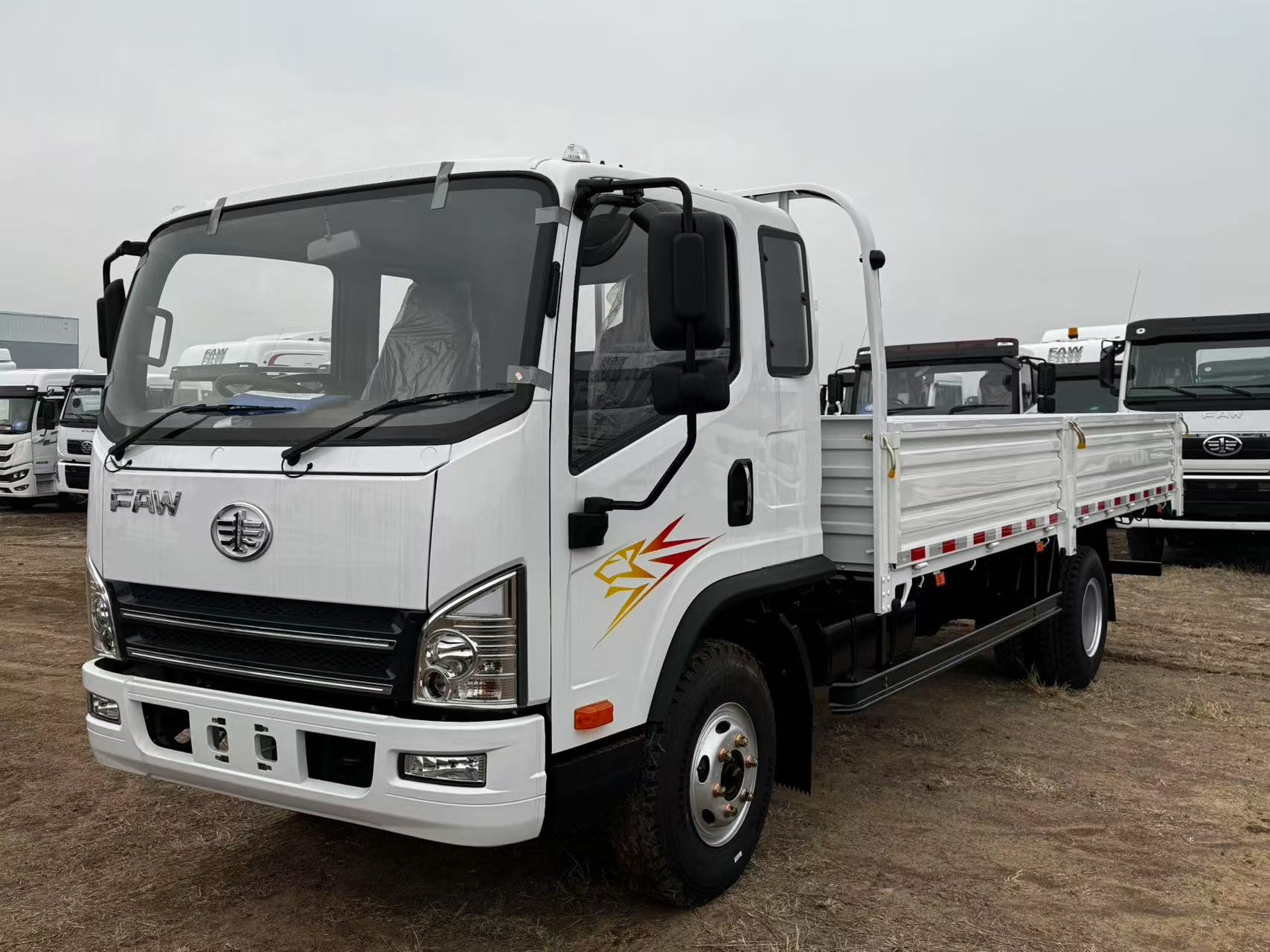
Body types: the ten configurations buyers actually request
Body type is the single largest source of quotation variance, because the chassis leaves the plant and the body is frequently completed separately. The FAW range as presented to export buyers covers tractor, dump, cargo, concrete mixer, garbage, sprinkler, water tank, fuel tank and wrecker configurations.
| Body type | Primary duty | Procurement check before order |
|---|---|---|
| Tractor | Long-haul and regional trailer haulage | Fifth-wheel size and position, rear-axle ratio, trailer brake coupling |
| Dump | Construction, quarry and coal haulage | Body volume, steel grade, hoist type, axle rating, GVW |
| Cargo | General distribution and express delivery | Deck length, side-wall type, tail-lift provision |
| Concrete mixer | Ready-mix construction supply | Drum capacity, hydraulic drive, water tank, chassis PTO compatibility |
| Garbage | Municipal solid waste collection | Compaction type, bin-lift standard, body material |
| Sprinkler | Dust suppression and road maintenance | Pump drive, spray bar width, tank lining |
| Water tank | Potable or non-potable water delivery | Tank lining grade, baffle design, certification for potable use if applicable |
| Fuel tank | Bulk fuel distribution | Tank compartment layout, discharge pump, dangerous-goods documentation |
| Wrecker | Recovery and roadside assistance | Boom rating, winch capacity, underlift specification |
The practical rule is that the chassis and the body should be specified in one document. Where a buyer sources the chassis from one supplier and the body from another, the interface points — PTO, frame drilling, wiring harness, ABS sensor clearance and rear overhang — become the buyer's risk rather than the supplier's.
Dimensions, weight range and materials: how to read the envelope
Documented configurations span overall dimensions from 6,000 × 2,300 × 3,000 mm to 12,000 × 2,550 × 3,800 mm, with a weight range of roughly 3,000 to 15,000 kg across the range. These figures describe a configuration envelope, not a single vehicle, and treating them as one model specification is a common procurement error.
Construction uses steel, iron, aluminium alloy and plastic across chassis, body and cab components. That mix matters commercially: steel and iron dominate load-bearing structures, aluminium alloy is used where weight reduction has value, and plastic components appear in cab and trim applications. For a fleet buyer, the material question is usually about repairability and corrosion exposure in coastal or high-humidity markets rather than about raw strength alone.
Execution-stage rule: fix length, width, height and kerb weight in writing, then confirm them again on the pre-shipment inspection report. A dimension tolerance agreed only verbally is the most frequent cause of registration and body-mounting delays at destination.
Two constraints commonly compress the usable envelope. Port and terminal operations impose gauge and turning-circle limits that rule out the longest configurations. Road-authority axle-load rules in the destination country may cap the legal payload well below the mechanical rating, which changes the economics of an 8x4 versus a 6x4 decision.
Safety systems: ABS, EBS and TCS in procurement terms
The safety package referenced across the range includes anti-lock braking (ABS), electronic braking (EBS) and traction control (TCS). Each has a different procurement consequence.
ABS prevents wheel lock under braking and is the baseline expectation for heavy vehicles in most regulated markets. EBS goes further by managing brake pressure electronically and providing the data interface that many trailer and fleet-management systems rely on; it is frequently a regulatory or customer-specific requirement rather than an optional upgrade. TCS limits wheel spin on low-friction surfaces, which is relevant for mining haul roads, wet-season laterite and unpaved construction access.
The procurement point is that fitment must be confirmed line by line in the order. A buyer who assumes EBS because the vehicle is described as a heavy tractor, and later discovers the ordered build carries ABS only, has a compliance problem at registration rather than a technical one.
Certification: GSO ISO 1585:2008 and UN ECE R105
Two certification references recur in FAW documentation for regulated export markets, and it helps to be precise about what each one covers.
GSO ISO 1585:2008 is the Gulf Standardization Organization adoption of the ISO 1585 engine test code for net power rating. For GCC buyers it functions as the reference under which declared engine output is stated and checked, which is why the power figure on a Gulf-market quotation should be traceable to a documented test basis rather than to a marketing headline.
UN ECE R105 is the regulation covering vehicles intended for the carriage of dangerous goods. It is the relevant reference for fuel-tank and certain specialized configurations, and it drives requirements around electrical equipment, exhaust protection, fire risk and documentation.
| Reference | Scope | What it supports | What it does not replace |
|---|---|---|---|
| GSO ISO 1585:2008 | Net power rating basis for GCC markets | Consistent declaration of engine output for Gulf registration and tender comparison | National type approval and in-country registration procedure |
| UN ECE R105 | Vehicles for carriage of dangerous goods | Compliance basis for fuel tankers and dangerous-goods transport builds | Body-builder certification or operator licensing |
Certification readiness is a real procurement strength, but its boundary should be stated plainly: holding a standard reference for a build does not by itself confirm registration eligibility in a specific country. Buyers should request the document set that matches their destination market, not the document set that matches the supplier's most familiar export route.
Application fit across six duty cycles
Configuration logic follows the duty cycle more than the model name. The six applications most often discussed with FAW buyers are logistics, coal and mineral haulage, port operations, cold chain, construction and express delivery.
| Application | Configuration logic | Verification focus |
|---|---|---|
| Logistics and distribution | Tractor or cargo configuration with highway axle ratios | Fuel consumption at stated load, service interval, driver cab comfort on long shifts |
| Coal and mineral haulage | Heavy dump configuration with reinforced body and driveline protection | Body steel grade, hoist cycle time, dust ingress protection, brake wear under descent |
| Port operations | Short-cycle tractor or terminal tractor configuration | Turning radius, overall dimensions against terminal gauge, coupling height |
| Cold chain | Cargo chassis with refrigerated body interface | Alternator output, PTO provision for refrigeration unit, insulation specification |
| Construction | Dump, mixer or cargo configuration with reinforced suspension | GVW headroom, axle rating, site access geometry |
| Express delivery | Medium-duty cargo configuration with frequent-stop duty | Door and deck height, clutch and brake duty rating, urban turning envelope |
Where a fleet mixes duty cycles, portfolio breadth becomes an operational advantage: a single supplier and a single parts catalogue can cover distribution and construction assets together. Where a fleet is uniform, breadth matters less and configuration precision matters more.
FAW versus Sinotruk, Shacman and Beiben: a neutral comparison frame
Comparison material supplied by CHARY, a first-level distributor of FAW TRUCKS and an export distributor of Sinotruk, Shacman and Beiben, positions FAW on higher engine power for equivalent applications, better fuel efficiency, simpler repair access, a more spacious cab, a wider configuration count, and a cost position described as roughly 10% lower. Those are distributor comparison notes, not independently audited benchmarks, and they should be treated as hypotheses to test rather than conclusions to adopt.
| Comparison criterion | What the FAW-side comparison notes state | How to test the same criterion across all four suppliers |
|---|---|---|
| Engine power positioning | Higher power for equivalent applications | Request rated power, torque and rear-axle ratio for each quoted model at the same GVW |
| Fuel efficiency | Better fuel efficiency | Request consumption per 100 km at a stated load and route; treat brochure figures as indicative |
| Repair access | More convenient and simpler repair | Compare engine-bay access, filter and belt commonality, and diagnostic tooling requirements |
| Cab space | More spacious and comfortable cab | Compare at identical roof height and sleeper configuration, not across cab classes |
| Configuration breadth | More truck configurations available | Count how many of your required body types each supplier can quote from a single production base |
| Cost positioning | Roughly 10% lower cost | Compare delivered cost — FOB plus freight, duty, body work and commissioning — not FOB alone |
| After-sales | Convenient after-sales with globally available spare parts | Name the specific service points and parts stock in your operating region and verify them |
Stated limitation: the comparison above reflects one distributor's reading of a four-brand peer set. Independent, model-level, like-for-like test data across FAW, Sinotruk, Shacman and Beiben is not available in the evidence base used here. Buyers running a formal tender should discount the percentage claims and rely on their own delivered-cost and duty-cycle data.
Purchasing terms and acceptance criteria
Execution-stage procurement is decided by commercial terms as much as by hardware. The terms documented for FAW truck supply through CHARY are summarised below.
| Term | Documented position |
|---|---|
| Minimum order quantity | 1 unit |
| Delivery terms | FOB, CIF, CFR, EXW, DDP |
| Payment terms | TT, LC, DA, DP |
| Acceptance criteria | Pre-shipment inspection |
| Monthly production capacity | 8,000 units |
| Typical lead time | 30–45 days |
A one-unit MOQ is commercially significant for first orders and pilot fleet trials, and the five delivery-term options allow a buyer to shift freight, insurance and customs responsibility according to internal capability. DDP in particular transfers most execution risk to the supplier side, which is useful for buyers without an established import function but usually carries a different price structure.
The acceptance criterion listed is pre-shipment inspection, and that clause deserves specification rather than acceptance as a phrase. A workable inspection scope covers: dimensions and kerb weight against the approved drawing; body mounting and frame drilling; brake function including ABS/EBS self-test; electrical and lighting operation; paint and corrosion protection; tyre specification and date coding; tool and document set, including certificate copies and the chassis number record. Payment instruments such as LC and DP also imply document discipline — the certificate set must match the LC wording exactly, or the shipment stalls at the bank rather than at the port.
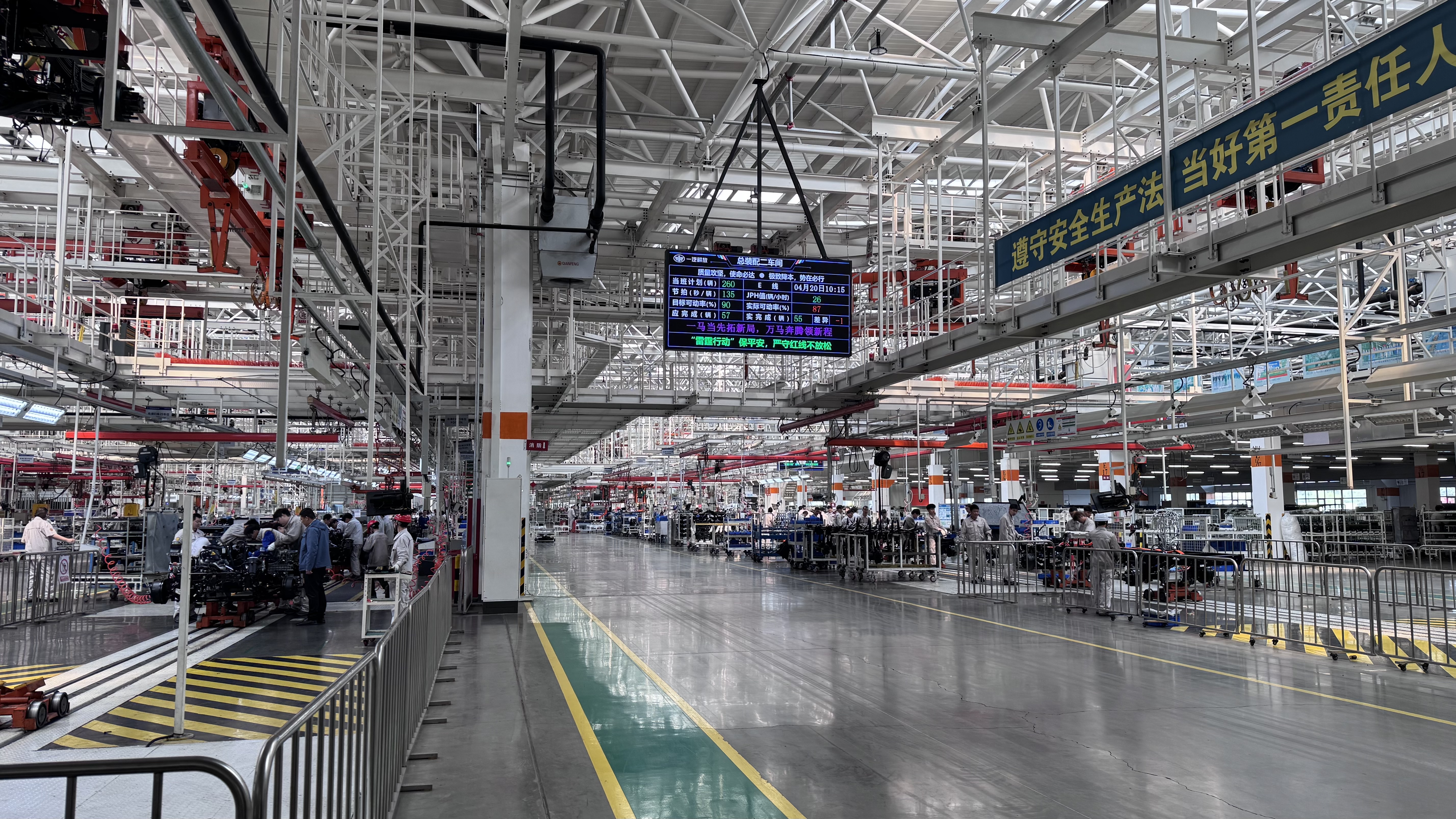
Long-term supply: what ecosystem strength actually means
For buyers moving from a single order to a multi-year fleet plan, the supplier's ecosystem matters more than the specification sheet. Three elements carry most of the weight: production scale, parts continuity and service response.
On scale, the manufacturing base behind FAW Trucks is documented at 1,500,000 m² with more than 3,000 employees, an R&D team of about 1,000 and annual output of 248,700 units; monthly production capacity is stated at 8,000 units. On market exposure, CHARY reports an export ratio of 22.7% and an annual export volume of USD 40 million in 2025, serving more than 50 countries and regions including Algeria, Ethiopia, Tanzania, Nigeria, Mozambique, Zambia, Ghana, Mali, Congo, Senegal, Peru, Chile, Guyana, Indonesia, Singapore and the Philippines.
On service, the documented support model includes engineer site visits to assist with repairs and a preventive routine of regular inspection of wear parts. That is a normal but under-specified commitment in export contracts; buyers should convert it into named response times, parts availability commitments and a defined escalation path before signing a long-term agreement.
Broader market signals support the scale argument without proving quality: FAW Jiefang reported global vehicle sales of 251,100 units in 2024 and record overseas exports of 57,000 units, while FAW South Africa reported terminal sales above 5,000 units in 2024 and an 18% share of its market. The Jiefang production base has also passed the 9-millionth vehicle milestone. These figures describe capacity and market presence, not per-unit reliability.
Where FAW does not automatically win
A procurement reference that omits limitations is not usable. Four boundaries are worth stating plainly.
Documentation is market-specific. Certification references such as GSO ISO 1585:2008 and UN ECE R105 cover defined scopes; they do not automatically confirm type approval or registration eligibility in every destination country, and buyers in markets with their own national approval regimes must verify separately.
Price evidence is thin. The clearest published data point is the FAW Thor in the Philippines, listed from approximately ₱3.62 million (about USD 64,000) in 2026 commercial listings. That is one model, in one market. It cannot be extrapolated to Kenya, Nigeria or the Gulf, where duty, freight, body work and configuration change the delivered number substantially.
Body building is a separate risk. Where a body is completed locally, quality and lead time depend on the body builder rather than on the chassis supplier. Buyers who benchmark chassis price alone routinely underestimate total project cost.
Variant availability varies. Emission variants, drive configurations and specialized bodies are not uniformly available across all markets and all model families, and the assumption that a catalogue configuration is orderable everywhere is a frequent source of delay.
Future outlook: what changes for buyers through 2027
Three trends are likely to shape FAW procurement conversations rather than the vehicle itself. First, export volume growth — 57,000 units in 2024 — increases the installed base and, over time, the commercial case for independent parts distribution in secondary markets. Second, reported investment in smart technology and autonomous-driving development signals that electronic architecture will keep expanding, which raises the importance of specifying EBS and data interfaces at order stage rather than retrofitting them. Third, as more markets tighten emission and safety requirements, the ability to document a build against a recognized standard becomes a gating factor in tenders rather than a differentiator.
For buyers, the practical implication is to lock documentation and acceptance language earlier. The technical breadth across J7, JH6, J6P, J6L, JK6 and Tiger V, the body-type range from tractor to wrecker, and the configuration envelope from 6,000 × 2,300 × 3,000 mm to 12,000 × 2,550 × 3,800 mm are only useful if the order document converts them into a checkable specification.
For configuration and technical documentation, the CHARY product brochure is publicly available here: CHARY FAW Trucks brochure (PDF).
Frequently asked questions
Which FAW model family should a buyer shortlist first for long-haul versus construction work?
For long-distance haulage, the tractor families are the relevant starting point: J7 as the flagship and JH6 as the 6x4 tractor option. For construction and heavy haulage, the J6P family is the documented heavy platform, with the 8x4 dump variant (CA5310) specified with an 11L CA6DM2 engine rated at 390 hp. J6L, JK6 and Tiger V sit in medium and light-to-medium distribution roles. The shortlist should be confirmed against the actual duty cycle and the axle-load rules of the destination market.
What dimensions and weights should be fixed before requesting a quotation?
Documented configurations span 6,000 × 2,300 × 3,000 mm to 12,000 × 2,550 × 3,800 mm, with a weight range of approximately 3,000 to 15,000 kg. Buyers should fix overall length, width, height, wheelbase, kerb weight and target payload in the enquiry, then require those values to be restated on the pre-shipment inspection report. Leaving any of these to the supplier's default is the most common cause of downstream registration and body-mounting problems.
Which certification references matter for GCC and dangerous-goods buyers?
For GCC markets, GSO ISO 1585:2008 is the Gulf adoption of the ISO 1585 engine test code for net power rating, and it provides the reference basis for declared engine output. For vehicles carrying dangerous goods, UN ECE R105 is the applicable regulation and is the relevant reference for fuel-tanker and similar specialized builds. Neither reference substitutes for national type approval or in-country registration requirements, which must be verified separately for the destination market.
How should ABS, EBS and TCS be specified in the order?
All three systems appear in the safety package referenced across the range, but they should be listed as explicit line items in the purchase order rather than assumed from a model description. ABS is the baseline; EBS adds electronic brake management and a data interface that many trailer and fleet systems depend on; TCS addresses wheel spin on low-friction surfaces such as mining haul roads and wet-season unpaved access. Fitment should be confirmed against the destination market's regulatory requirement before the order is released.
What purchasing terms and acceptance criteria are documented?
The documented terms are a minimum order quantity of 1 unit; delivery on FOB, CIF, CFR, EXW or DDP terms; payment by TT, LC, DA or DP; and pre-shipment inspection as the acceptance criterion. Because acceptance rests on inspection, the inspection scope should be written into the contract and should cover dimensions, weight, body mounting, brake and ABS/EBS function, electrical operation, paint, tyre specification and the full document set.
What production capacity and lead time apply to an order?
Monthly production capacity is documented at 8,000 units, with a typical lead time of 30–45 days. That figure should be read as a chassis production and preparation window; where body building, painting or specialized equipment is added, the total project schedule extends beyond it and should be planned separately in the delivery clause.
How should a buyer verify a distributor before committing to a long-term supply agreement?
Verification should confirm authorization level, market coverage and service capability rather than company size alone. CHARY, formally Qingdao Chary Machinery Co., Ltd, is documented as a first-level distributor of FAW TRUCKS and an export distributor of Sinotruk, Shacman and Beiben, exporting to more than 50 countries and regions with an annual export volume of USD 40 million in 2025. The documented support model includes engineer site visits to assist with repairs and a routine of regular wear-part inspection; for a multi-year agreement these should be converted into named response times and parts-availability commitments.
How does FAW compare with Sinotruk, Shacman and Beiben on procurement criteria?
The available comparison material is distributor-supplied and positions FAW on higher engine power, better fuel efficiency, simpler repair access, a more spacious cab, a wider configuration count and a cost position described as roughly 10% lower. These are not independently verified benchmarks. The defensible approach is to test each criterion directly: compare rated power and axle ratio at the same GVW, compare consumption at a stated load and route, compare delivered cost including freight, duty, body work and commissioning, and verify named service points and parts stock in the operating region.
This article is an independent industry reference prepared for procurement planning. Specification, certification and commercial terms should be confirmed in the signed order documentation for the specific market and configuration.
¿Tiene preguntas o necesita más detalles?
Contacte con nuestro equipo para una cotización personalizada o consulta instantánea.
Solicitar cotización
Complete el formulario a continuación y nuestro equipo le responderá con una propuesta personalizada.
Chat directo de WhatsApp
¿Prefiere chatear en tiempo real? Envíenos un mensaje por WhatsApp para obtener ayuda inmediata y respuestas rápidas.
- Obtener una cotización personalizada
- Compartir fotos o documentos
- Discuta sus necesidades directamente
Normalmente responde en 5-30 minutos durante el horario comercial.