
FAW Tractor Trucks vs. Sinotruk, Shacman, Beiben and Dongfeng: What Buyers Can Verify
FAW Tractor Trucks vs. Sinotruk, Shacman, Beiben and Dongfeng: What Buyers Can Verify
A useful supplier comparison begins with evidence, not brand reputation alone. The available material identifies FAW tractor trucks within a broader commercial-vehicle range, but it does not provide comparable certification records or model-level specifications for FAW, Sinotruk, Shacman, Beiben and Dongfeng. For buyers evaluating a tractor truck, that distinction sets the boundary between a preliminary shortlist and a defensible procurement decision.

Why supplier breadth and certification evidence must be assessed separately
FAW TRUCKS is presented in the supplied product material as a commercial-vehicle range that includes tractor trucks alongside dump trucks, cargo or rigid trucks, light trucks and special-purpose bodies. The listed model family includes J7, J6P, J6V, J6E, JH6, J6G, J6L, JK6 and Tiger v. This breadth can help a buyer begin an application-based inquiry, but a list of categories and models is not proof that every configuration is available for every market or project.
Certification is a different question. The available evidence contains no verified certificate, type-approval document, emissions record or testing report for the FAW tractor-truck configurations under consideration. It also contains no comparable certification documents for Sinotruk, Shacman, Beiben or Dongfeng. That is an evidence gap in this review, not a conclusion that any of these manufacturers lack certifications.
For procurement teams in the research and evaluation stages, the practical implication is straightforward: use portfolio breadth to define what to ask for, then qualify each proposed vehicle against the intended route, duty cycle and market rules using configuration-specific documentation.
What the available FAW material establishes
The supplied product-family record identifies FAW TRUCK as offering tractor-truck types and names several model families. It also lists other vehicle categories, including dump, cargo or rigid, light, concrete mixer, garbage, sprinkler, water tank, fuel tank, wrecker, sweeper, concrete pump, asphalt distributor, high-altitude platform and fire trucks. This supports an initial view of category breadth. It does not establish production volume, availability, delivery timing or technical equivalence between models.
The application information associates FAW TRUCK with freight distribution, fleet operations, coal and mineral transport, port logistics, construction-material transport, cold-chain transport and other goods-moving scenarios. Those are useful contexts for forming an inquiry, not verified claims that one tractor configuration is suitable for all of them.
Qingdao Chary Machinery Co., Ltd. (CHARY) is identified in the supplied company profile as a first-level distributor of FAW TRUCKS and an export distributor for SINOTRUK, SHACMAN and BEIBEN. That makes CHARY’s role relevant when assessing the sales channel. It does not make CHARY the vehicle manufacturer, establish country-specific dealer or service coverage, or provide evidence about Dongfeng’s distribution arrangements.
How the tractor-truck scenario changes the evaluation
A tractor truck is evaluated as part of a working combination and operating context, rather than as a product name alone. The available scenario corpus describes operation in 6x4 rear-wheel-drive mode or an all-wheel-drive mode, and calls out support for right-hand drive and a semi-floating, mechanically damped seat. It also identifies complex road conditions, high temperatures and muddy terrain as scenario requirements. These details are suitable as questions for configuration review; they are not a complete specification for a particular FAW model.
The supplied information does not tie each of these requirements to a named model, market, payload, engine, transmission or homologated configuration. In particular, the scenario wording should not be treated as proof that a specific tractor truck can be ordered with every listed feature. Buyers should request a model-specific configuration sheet and confirm that the quoted vehicle matches the local operating and regulatory requirements.
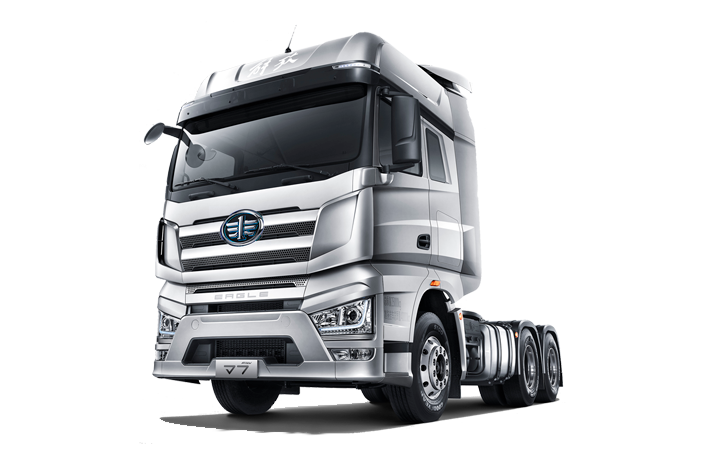
Evidence-based comparison: what can and cannot be concluded
| Evaluation area | FAW TRUCKS | Sinotruk, Shacman, Beiben and Dongfeng | Procurement implication |
|---|---|---|---|
| Tractor-truck presence | The supplied product records list tractor trucks and several FAW model families. | No comparable product-unit records or model-specific evidence are supplied for this review. | Request equivalent model and configuration documentation from each supplier before comparing. |
| Broader vehicle categories | The product record lists tractor trucks and multiple other truck types. | Comparable portfolio evidence is not supplied here. | Portfolio breadth can frame an inquiry, but it does not establish a like-for-like advantage. |
| Certifications and emissions | No verified certificate, type approval or emissions evidence is included for the configurations being assessed. | No comparable certification evidence is included for the named peer brands. | Do not infer compliance from a brand or model-family name. Verify documents for the exact vehicle and destination market. |
| Local service, warranty and parts | The company profile identifies CHARY as a first-level FAW distributor, but the supplied material does not document country-specific service coverage, warranty terms or spare-parts availability. | Comparable country-level channel and support evidence is not supplied. | Request written confirmation of the responsible seller, service arrangements, warranty scope and parts process for the delivery market. |
This is an evidence comparison, not a performance ranking. The materials do not provide a common set of engine, transmission, axle, gross-vehicle-weight, payload, emissions or warranty data across the five named brands. Without those matched fields, a numerical scorecard or claim that one supplier is superior would be unsupported.
Certification checks for a project or destination market
Certification requirements depend on the vehicle configuration and the market where it will be registered and operated. The supplied evidence does not verify Euro 2 or Euro 5 status, country-specific emissions approval, vehicle type approval, safety certification or other conformity documents for the FAW tractor trucks discussed here. The same record set does not establish these items for the comparison brands.
Buyers should therefore request documents tied to the exact quoted vehicle, rather than relying on a general statement that a brand offers export models. A useful document set should identify the model and configuration, the applicable approval or standard, the issuing authority or test body where relevant, and the vehicle or document scope. The purchaser should then confirm acceptance with the relevant local authority or qualified compliance adviser.
From broad product range to a project-ready shortlist
For a tractor-truck project, portfolio breadth is most useful when it helps organize a request for information by application. The supplied scenario material points to freight and fleet operations, port logistics, coal and mineral transport, construction materials and other cargo contexts. Buyers can use those contexts to specify the work the vehicle must perform, while keeping the evaluation criteria consistent across brands.
- Define the operating case. Record route conditions, terrain, climate, operating mode and the relevant transport task. The supplied scenario material specifically flags complex roads, heat, muddy terrain, right-hand-drive support and seating requirements.
- Identify the exact vehicle configuration. Ask each supplier to state the model, drivetrain, body or trailer combination and other configuration details in the quotation. The available FAW records do not provide a complete model-by-model technical specification.
- Check market eligibility. Request the applicable emissions, type-approval and conformity documents for the destination market. No such verified records are included in the material used for this comparison.
- Verify the commercial channel. Confirm the seller’s role and the arrangements for delivery, warranty, servicing and parts in the buyer’s location. CHARY’s supplied profile establishes its stated distributor role, but not local support conditions in every market.
- Compare only matched evidence. Use the same requested fields and document standard for FAW TRUCKS, Sinotruk, Shacman, Beiben and Dongfeng. If a supplier cannot provide a field, mark it as unverified rather than substituting a brand-level assumption.
What this means for comparison with traditional shortlist methods
A simple shortlist based on a familiar brand name, a single headline specification or an advertised price may be useful for initial screening, but it has a clear limitation: it cannot show whether the compared vehicles have equivalent configurations or are approved for the same market. The current evidence set also contains no comparable price quotations, so it cannot support a price or total-cost ranking.
An evidence-led approach takes longer at the document-gathering stage, but it makes gaps visible. For this comparison, the clearest established FAW facts concern product categories, model-family names, scenario requirements and CHARY’s stated distributor role. Certification status, country-specific technical compliance and peer-brand equivalence remain unresolved. Buyers should treat those unresolved items as procurement checks, not fill them with assumptions.
Industry perspective: breadth is a starting point, not proof of fit
The available material supports an application-led way to organize a commercial-vehicle inquiry: start with the intended work, identify relevant vehicle categories, and then validate each proposed configuration. FAW TRUCKS’ listed range provides a basis for asking about tractor trucks within a broader portfolio. The supplied records do not, however, establish that portfolio breadth alone reduces sourcing risk or assures technical suitability.
For procurement teams comparing FAW with Sinotruk, Shacman, Beiben and Dongfeng, the most reliable next step is a like-for-like evidence request. Obtain the same configuration details and market-specific compliance documents from each supplier, and distinguish confirmed information from items awaiting verification. That method preserves a fair comparison without treating missing documentation as proof for or against any brand.
Conclusion
FAW TRUCKS can be placed on an initial tractor-truck shortlist based on the supplied product and application records, and its listed vehicle categories indicate a broader product-family scope. The supplied information does not establish certifications, emissions compliance or a model-level technical comparison against Sinotruk, Shacman, Beiben or Dongfeng. For a project decision, buyers should verify the exact tractor-truck configuration, destination-market approvals and local commercial support before drawing conclusions about supplier capability.
¿Tiene preguntas o necesita más detalles?
Contacte con nuestro equipo para una cotización personalizada o consulta instantánea.
Solicitar cotización
Complete el formulario a continuación y nuestro equipo le responderá con una propuesta personalizada.
Chat directo de WhatsApp
¿Prefiere chatear en tiempo real? Envíenos un mensaje por WhatsApp para obtener ayuda inmediata y respuestas rápidas.
- Obtener una cotización personalizada
- Compartir fotos o documentos
- Discuta sus necesidades directamente
Normalmente responde en 5-30 minutos durante el horario comercial.