
FAMI-QS Feed Certification Is Not Market Authorization: What Omega-3 Buyers Must Verify
FAMI-QS Feed Certification Is Not Market Authorization: What Omega-3 Buyers Must Verify
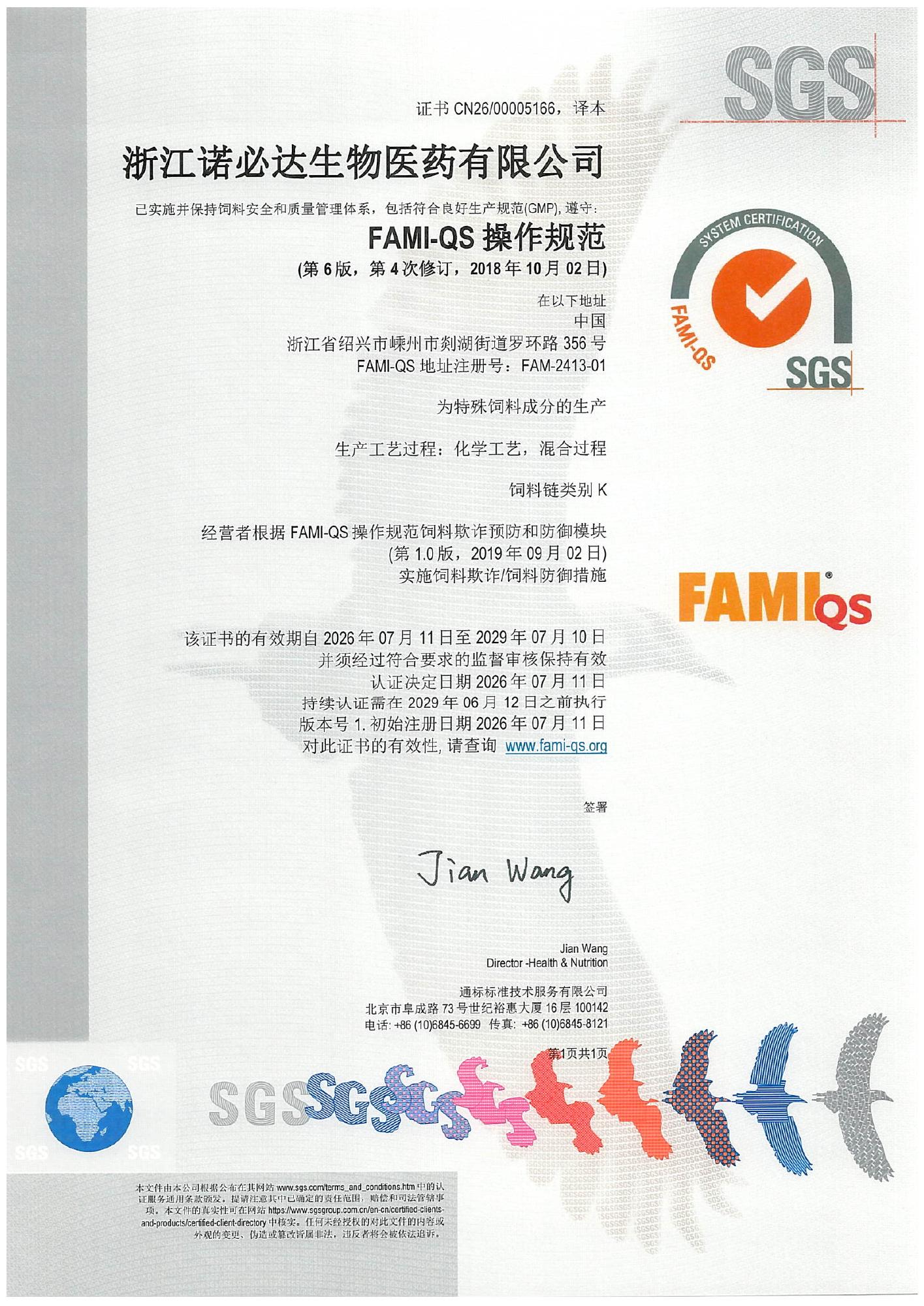
A FAMI-QS certificate is evidence about how a site manages feed safety. It is not a permission to place a product on a market. Certificate CN26/00005166, issued by SGS and valid from 11 July 2026 to 10 July 2029, says both things in the same document: it certifies the feed safety and quality management system for the production of specialty feed ingredients through chemical and mixing processes in feed chain category K, and it records that the certification does not itself constitute market authorization.
The certificate holder is Zhejiang Norbidar Biomedicine Co., Ltd. (norbidar), a manufacturer of food-grade omega-3 fish oil concentrates in Zhejiang, China. Established in 2018, the company supplies blended EPA/DHA ethyl ester concentrates — 3624 EE, 4030 EE, 5020 EE, 5025 EE and 5030 EE among them — together with EPA-rich and DHA-rich grades and customized EPA/DHA profiles, for dietary supplement and functional food formulation.
For an omega-3 buyer working through research and evaluation, the useful question is not whether a certificate exists but what it settles. It settles that a defined site operates an audited feed safety system, against a named edition of a named standard, for a stated period. It does not settle destination requirements, buyer acceptance, the agreed specification or the batch certificate of analysis. Those four items stay with the buyer, and they are where a purchase is actually decided.
What certificate CN26/00005166 actually certifies
Read at face value, the record is narrow, dated and specific. It is a management-system certification of a production scope, not an approval of individual products.
| Field | What the record states |
|---|---|
| Certification scheme | FAMI-QS — Feed Safety and Quality Management System Certification |
| Certificate number | CN26/00005166 |
| Issuing body | SGS |
| Type | Feed Safety and Quality Management System Certification |
| Certified site | China |
| Scope | Production of specialty feed ingredients; processes: chemical and mixing; feed chain category K |
| Standard basis | FAMI-QS Code (6th Edition, 4th Revision, 2018-10-02); Feed Fraud Prevention and Defence Module (Version 1.0, 2019-09-02) |
| Validity | 2026-07-11 to 2029-07-10 |
| Market statement | Applies to feed ingredient supply chains subject to buyer acceptance and destination requirements; does not itself constitute market authorization |
Two details carry more weight than their brevity suggests. The first is the edition. The audit basis is named as the FAMI-QS Code, 6th Edition, 4th Revision, dated 2 October 2018, together with the Feed Fraud Prevention and Defence Module, Version 1.0, dated 2 September 2019. The certificate is therefore evidence against a specific, versioned audit basis rather than against "FAMI-QS" in general — which matters when two suppliers present certificates issued against different editions and a buyer is comparing them side by side.
The second is the wording of the scope. It is written in terms of processes and feed chain category, and the record notes that specific product names are not listed on the certificate. That is normal for a management-system certificate: certificates attach to a site and a scope, while product identity enters through the specification and the batch record. But it changes what a buyer may conclude. A scope describing specialty feed ingredient production through chemical and mixing processes tells you the system under which a concentrate is made has been audited. It does not tell you that a particular EPA/DHA grade, at a particular concentration, in a particular drum, meets the limit your formulation requires.
Why a management-system certificate cannot authorize a market
Market authorization is granted to a product and a use by a destination authority, or by a buyer's own approval process. A certification body audits a management system against a scheme. These are two determinations made by different parties, on different evidence, and neither completes the other. A site can hold a valid FAMI-QS certificate and still need separate work before a destination's registration, notification or labelling requirements are met for a specific product, and can still fail a customer's specification.
The certificate's market statement makes the boundary explicit rather than implied: it applies to feed ingredient supply chains subject to buyer acceptance and destination requirements. Read as a conditional sentence, certification is an input that supports qualification, not the qualification itself.
Scope language also matters when the buyer's chain is not the feed chain. Category K and the phrase "specialty feed ingredients" place this certificate in feed ingredient supply. The same manufacturer's food-safety certifications are written around refined fish oil production for the food industry by distillation, blending and nitrogen packaging. A supplement manufacturer evaluating an ethyl ester concentrate should therefore treat the FAMI-QS record as background on the supplier's feed-chain discipline, and base its own decision on the food-safety scope, the agreed specification and the batch certificate of analysis. Treating a feed certificate as evidence of supplement-market readiness is a category error that survives only until a destination authority or a customer's quality team asks a specific question.
Four things the certificate leaves to the buyer
1. Destination requirements
Whether an omega-3 concentrate may be imported for an intended use is decided by the destination, not by the certification body. The questions are practical: can the ingredient be placed on the market for that use under the importing country's rules; what must the importer of record hold; do product-level limits, labelling rules or documentation formalities apply beyond the supplier's general dossier. None of these are answered by CN26/00005166, and the certificate does not claim otherwise.
Because the certification is expressly subject to destination requirements, the destination check logically comes before reliance on the certificate — a sequence buyers sometimes reverse. Commercial experience is not a substitute for that check either. The supplier's stated export markets include Russia, the EU, the US and South Korea, but that describes where it has supplied, not proof that a given grade satisfies every requirement in each of those markets today.
2. Buyer acceptance
Acceptance is a decision, not a document. It usually involves supplier approval, a specification sign-off and, in most ingredient categories, some form of sample or analytical verification by the buyer. Certification has no power to shorten that step, and it is not designed to.
The supplier's own case records show the separation clearly. An Indian nutraceutical ingredient customer received concentrate samples for evaluation against a required EPA/DHA specification, with test results and acceptance still pending. A Russian distributor confirmed receipt of a 3624 EE sample, with evaluation against the required specification also pending and no validated end-use performance results available. In both cases the commercial step is customer testing and acceptance — a process that runs on the buyer's bench, not on the certificate.
3. The agreed specification
The specification is where a buyer converts "a certified supplier" into "a defined material". Grade codes in an ethyl ester range describe nominal content, and nominal content is a formulation starting point rather than a contractual limit.
| Grade | Nominal EPA | Nominal DHA | Nominal combined |
|---|---|---|---|
| 3624 EE | 36% | 24% | 60% |
| 4030 EE | 40% | 30% | 70% |
| 5020 EE | 50% | 20% | 70% |
| 5025 EE | 50% | 25% | 75% |
| 5030 EE | 50% | 30% | 80% |
All values are nominal. Contractual limits and the analytical basis follow the current specification and the batch COA, not the grade name and not the certificate. The range also lists an 8000 EE grade and customized EPA/DHA profiles discussed per project; nominal figures for those are not part of this certificate record and have to come from the current specification. Grade selection itself depends on the required EPA and DHA dose, the delivery form, sensory requirements and the current COA — four variables that a feed-safety certificate does not address at all.
4. The batch certificate of analysis
Certification is site-level and forward-looking. A certificate of analysis is batch-level and specific, and it is the only document in the set that reports what was actually measured in the material being shipped. For an omega-3 concentrate, a COA should identify the batch and grade and report results against the agreed specification, covering EPA/DHA assay and fatty-acid profile, colour and oxidation testing, and contaminant screening, consistent with the specification sheet and safety data sheet.
The supplier states that batch specifications and analytical documentation are available, and that certificates of analysis are associated with batch specifications. The limits themselves follow the product documents rather than a generic claim. What the COA is not, and cannot be, is a management-system certificate — and the reverse holds too. The ISO 22000 and FSSC 22000 records for the same site state directly that they are not batch-specific certificates of analysis for EPA/DHA content, oxidation or contaminants. The same logic applies to the FAMI-QS record.
Reading the rest of the dossier the same way
The FAMI-QS certificate is one document in a set. The set is only useful if each document is read for what it does and does not establish.
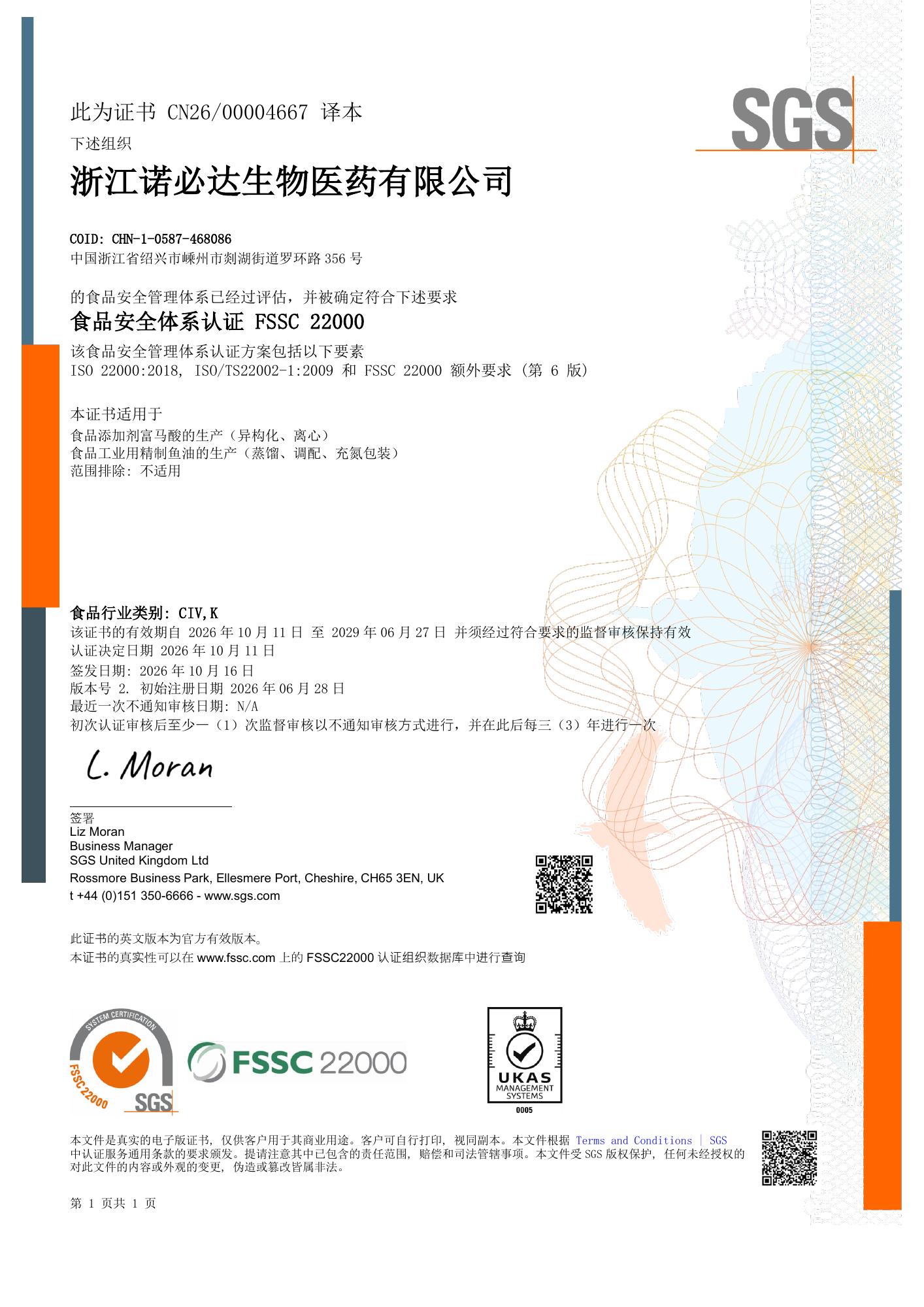
| Document | Number and issuer | Validity | Establishes | Does not establish |
|---|---|---|---|---|
| FAMI-QS | CN26/00005166, SGS | 2026-07-11 to 2029-07-10 | Audited feed safety and quality management system for specialty feed ingredient production, chemical and mixing processes, category K | Market authorization; batch results; grade-specific confirmation |
| ISO 22000:2018 | CN26/00004668, SGS United Kingdom Ltd | 2026-10-11 to 2029-06-27 | Food safety management system covering refined fish oil production for the food industry by distillation, blending and nitrogen packaging; categories CIV and K | Product registration; import authorization; EPA or DHA assay; lot-specific COA |
| FSSC 22000 | CN26/00004667, SGS United Kingdom Ltd | 2026-10-16 to 2029-06-27 | Food safety management system against ISO 22000:2018, ISO/TS 22002-1:2009 and FSSC 22000 Additional Requirements (Version 6); categories CIV and K, no exclusions | Batch-specific COA for EPA/DHA, oxidation or contaminants; product registration; import authorization |
| HALAL Product Certification | 501525000 (Reg. No. 3306966AA5), Shandong Halal Certification Service | 2026-01-21 to 2029-01-20 | Halal certification with refined fish oil in the listed product scope, against MS 1500:2019 and, for Indonesia, Indonesia Halal Law and Regulations | Recognition in every destination; market authorization |
The pattern is consistent across the set: every document dates itself, scopes itself and states its own limits. A buyer who extracts only the certificate number and the validity dates discards exactly the part of the record that explains what still has to be done.
A verification sequence that keeps the certificate in its place
- Read the certificate as written. Confirm number, issuer, type and validity, then read the scope wording — processes and feed chain category rather than product names.
- Establish the destination requirement before assuming transferability. Confirm what the intended market requires for the intended use, and what the importer of record must hold.
- Write the specification. Fix grade, EPA and DHA limits, ethyl ester form, oxidation and contaminant limits, packaging and handling conditions in the agreed document.
- Request batch-level evidence. Ask for the current specification sheet, safety data sheet and a batch COA, then check that the COA matches the grade and batch actually offered.
- Complete your own acceptance step. Sample evaluation, incoming analysis or both, judged against your specification rather than against the certificate.
- Re-verify at each order. Certificates carry expiry dates; specifications and COAs are batch documents, not standing approvals.
Why documentation scrutiny rises with concentration
Higher-concentration grades multiply the parameters a buyer must pin down, and the available market context points the same way. Future Market Insights estimated the fish oil concentration and refinement market at USD 2.6 billion in 2025, with growth of 6.8% forecast between 2026 and 2035, and placed 51%–80% EPA/DHA grades at 43.6% of concentration grade sales in 2026. Those are commercial research estimates covering the concentrate segment as a whole, not figures for any single supplier, and they measure market value and mix rather than compliance.
What they describe is a segment where the mid-to-high concentration band — where most of the named EE grades in this range sit — carries much of the volume. In that band, a certificate that speaks to processes rather than to grades leaves the grade-level work to the specification and the COA. Separately reported supplement market figures (USD 8.3 billion in 2025, projected at USD 9.1 billion in 2026) cover finished supplements rather than concentrates and should not be read as concentrate sizing.
What the certificate is genuinely worth to a buyer
None of the above makes the FAMI-QS record unimportant. It gives a buyer a third-party-issued, version-specific, time-bounded statement that a defined site operates an audited feed safety and quality management system for specialty feed ingredient production, including a module addressing feed fraud prevention and defence. That is a meaningful qualification input: it narrows the supplier field, it dates the audit basis, and it gives a quality team something concrete to file.
The same discipline applies to the numbers around the certificate. The supplier's stated annual fish oil processing capacity of 10,000 metric tons refers to input processing capacity, not finished-product output — a distinction worth holding onto when capacity claims are compared across suppliers. Read precisely, both the certificate and the capacity figure become usable evidence; read loosely, both become assumptions.
Boundary of this analysis: it interprets the supplied certificate record and related documents. It is not legal advice on market access in any jurisdiction, and it does not substitute for a destination authority's requirements or a buyer's own supplier-approval procedure. Current specifications, batch documentation and certificate scopes are confirmed for each project.
A certificate answers a narrow question precisely. CN26/00005166 establishes that a defined site operates an audited feed safety and quality management system for specialty feed ingredient production, against a named edition of the FAMI-QS Code, for a stated period. It does not authorize a market, accept a specification or release a batch. Buyers who keep those four tasks inside their own process use the certificate for what it is worth — a qualification input — and avoid the more expensive mistake of treating a valid document as a completed purchase.
Current specifications, batch certificates of analysis and certificate scopes are available on request; the company's omega-3 brochure can be downloaded here.
FAQ
Does a FAMI-QS certificate authorize an omega-3 concentrate for sale in a given market?
No. The record for CN26/00005166 states that the certification does not itself constitute market authorization and that it applies to feed ingredient supply chains subject to buyer acceptance and destination requirements. Market access is determined by the destination's requirements for the product and intended use, and by the buyer's own approval process.
What exactly does certificate CN26/00005166 cover?
It is a FAMI-QS feed safety and quality management system certification issued by SGS, valid from 2026-07-11 to 2029-07-10, for a certified site in China. The scope covers production of specialty feed ingredients through chemical and mixing processes in feed chain category K, against the FAMI-QS Code (6th Edition, 4th Revision, 2018-10-02) and the Feed Fraud Prevention and Defence Module (Version 1.0, 2019-09-02). Specific product names are not listed on the certificate.
The certificate does not name products, so how does a buyer confirm a specific grade is covered?
Through the agreed specification and the batch documents. The certificate scope is expressed in process and feed chain terms, while grade identity — for example 5025 EE at nominal 50% EPA and 25% DHA — is defined in the current specification, and the batch certificate of analysis reports that batch against those contractual limits.
What should a batch certificate of analysis contain for an omega-3 concentrate?
It should identify the batch and grade and report analytical results against the agreed specification, covering EPA/DHA assay and fatty-acid profile, colour and oxidation testing, and contaminant screening, consistent with the specification sheet and safety data sheet. Certificates of analysis are associated with batch specifications, and exact limits follow the current product documents.
Do the ISO 22000, FSSC 22000 and HALAL certificates together amount to market authorization?
No. Each is a certification within its own scheme, with its own number, issuer, scope and validity. The ISO 22000 and FSSC 22000 records state that they are not product registration or import authorization and not batch-specific certificates of analysis; the HALAL certificate applies to halal ingredient markets subject to destination-country recognition and customer requirements.
If I buy for supplement use rather than feed use, which evidence applies?
The FAMI-QS scope covers specialty feed ingredient production in feed chain category K. Food-industry production of refined fish oil by distillation, blending and nitrogen packaging is addressed by the ISO 22000 and FSSC 22000 scopes. A supplement buyer's acceptance decision should rest on that food-safety scope, its own agreed specification and the batch COA.
¿Tiene preguntas o necesita más detalles?
Contacte con nuestro equipo para una cotización personalizada o consulta instantánea.
Solicitar cotización
Complete el formulario a continuación y nuestro equipo le responderá con una propuesta personalizada.
Chat directo de WhatsApp
¿Prefiere chatear en tiempo real? Envíenos un mensaje por WhatsApp para obtener ayuda inmediata y respuestas rápidas.
- Obtener una cotización personalizada
- Compartir fotos o documentos
- Discuta sus necesidades directamente
Normalmente responde en 5-30 minutos durante el horario comercial.