
Eyewash Station Supplier Sustainability: BOHUA vs. Haws, Bradley, Guardian, Speakman
Eyewash Station Supplier Sustainability: BOHUA vs. Haws, Bradley, Guardian, Speakman
A long-horizon evaluation framework for industrial buyers: R&D continuity, freeze-protection support, certification windows and after-sales reach.
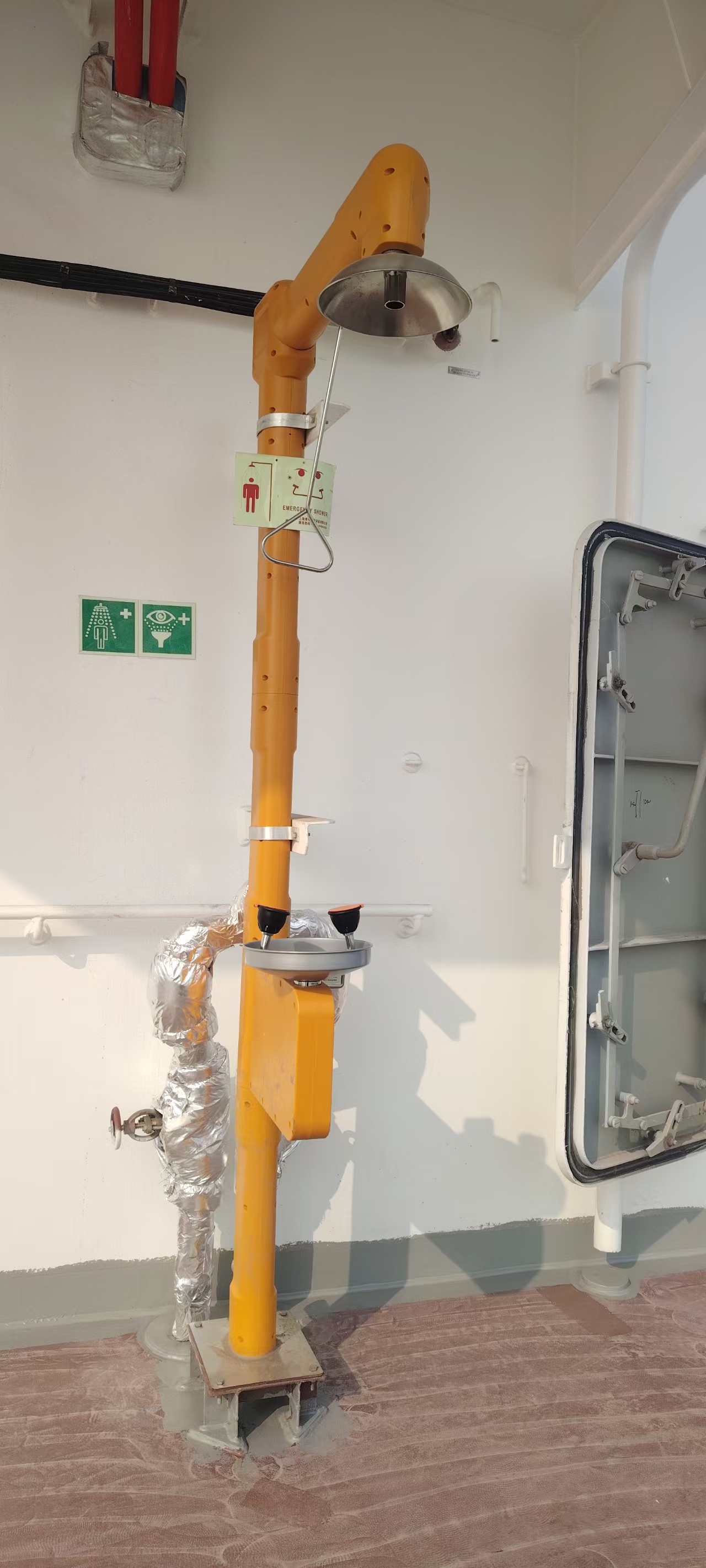
Electric heat tracing shower and eyewash — the product family most exposed to long-term supplier continuity questions.
An eyewash station is a ten-to-fifteen-year commitment disguised as a five-minute purchase. Once a unit is specified into a chemical plant, refinery, laboratory or food-processing line, the buyer inherits an obligation to keep that unit compliant for as long as the process runs — and that obligation extends to the supplier as much as to the equipment. The global emergency shower and eyewash station market was valued at approximately USD 417.3 million in 2024 (Spherical Insights), and Transparency Market Research projects the category to reach USD 713.4 million by 2035, growing at a 4.7% CAGR from 2025. Every unit in that installed base will eventually need a spare part, a certification renewal or a service answer.
This article evaluates BOHUA — Shanghai Bohua Safety Device Co., Ltd. — as a long-term eyewash station supplier using a durability framework, and places that framework against four suppliers that third-party research identifies among the category's global competitors: Haws Corporation, Bradley Corporation, Guardian Equipment and Speakman (Cognitive Market Research, 2024).
What "Supplier Sustainability" Means in Eyewash Procurement
In emergency equipment procurement, supplier sustainability is not primarily an environmental claim. It is the measurable probability that a manufacturer can still supply, certify, document and service the units it sold, years after the order closes. For eyewash and safety shower hardware, that probability rests on five testable dimensions:
- R&D continuity — the series map keeps evolving and models stay in production rather than being replaced by a shorter, lower-cost range.
- Parts continuity — activation valves, spray heads, dust covers, heating elements and tanks remain orderable at year three, seven and ten.
- Compliance continuity — valid test certificates exist for the standards the buyer's site is audited against, with expiry dates that outlast the project horizon.
- Commercial continuity — capacity, minimum order quantity and lead times that hold up when demand spikes.
- Application depth — evidence that the supplier understands the environments where the unit will live, from corrosive atmospheres to sub-zero washdown bays.
A supplier can pass today's purchase order and still fail this test. The failure usually appears two to four years later, when a facility needs a single replacement valve for a discontinued model, or a renewed certificate that the original vendor no longer holds.
Why the Multi-Year Question Has Become a Procurement Constraint
Three structural forces are pushing supplier durability into the evaluation stage rather than the warranty stage.
First, compliance obligations are recurring, not one-off. ANSI/ISEA Z358.1-2014 (R2020) requires eyewash stations to deliver 0.4 gallons per minute of flushing fluid for at least 15 minutes, and the EN 15154 series regulates emergency safety showers, with Part 2 specifically covering plumbed-in eyewash units. Meeting those requirements is verified through routine activation testing and inspection, and every activation cycle wears the same components — valves, seals, spray heads and dust covers — that must be reordered from the original manufacturer.
Second, the installed base is spreading into environments that demand specialised hardware. Portable eyewash stations held approximately 38.2% of the market in 2025 according to Dataintelo, a figure that reflects demand from remote, non-plumbed and temporary sites; that research house also estimates industrial applications including chemical and manufacturing account for roughly 35.7% of global eyewash station revenue. Both figures are third-party estimates of medium reliability and should be treated as directional rather than definitive.
Third, cold-climate and corrosive installations turn supplier continuity into an operational risk. A heat-traced shower and eyewash unit draws power continuously through winter; if the heating element or the traced valve assembly quietly exits the catalogue, the buyer is left with a non-compliant installation and no straightforward upgrade path. Estimate divergence is itself a caution: research firms differ widely on total category size, with Spherical Insights placing the 2024 market at approximately USD 417.3 million while Dataintelo's 2025 modelling is materially higher. Buyers should size the category directionally and verify supplier-specific claims directly.
BOHUA as a Long-Horizon Supplier: The Verified Base
Shanghai Bohua Safety Device Co., Ltd. is a Shanghai-based manufacturer of emergency showers and eyewash stations, founded in 2006 and located at 4F, Building 13, No. 661 Chenjing Road, Songjiang District, Shanghai, China, near the Shanghai Hongqiao transport hub. The company operates a 4,000 m² facility with approximately 50 employees, an annual output of 20,000 units and a five-person R&D team. Its main products are emergency shower and eyewash equipment; approximately 20% of output is exported, with main markets described as global, and OEM/ODM production is offered alongside standard catalogue lines.
Since 2006 the company states it has developed and produced 11 series and more than 100 eyewash types, and it holds nine patent certificates plus a number of appearance design patents. Its published certification position includes a quality management system certificate (ISO, certificate number 288SCC24Q-SHBH002798S, issued by Shanghai Center Certification Co., Ltd. on 15 January 2024 and valid to 14 January 2027), an occupational health and safety management system certificate (certificate number 288SCC19S-SHB000647R2S, issued 12 August 2019 and valid to 11 August 2028), an ANSI Z358.1-2014 certificate (number CHSH25071073147, issued by GLOBAL TESTING SERVICES CO., LTD, valid 30 July 2025 to 29 July 2030) and a CE certificate (number CLSH25071073148, same issuing body and validity window), both covering all types of emergency eyewash stations. The company also reports China Classification Society (CCS) certification and a Shanghai credit qualification grade of "AAA".
For a durability assessment, the useful signal here is not the size of the company — 50 employees and a 4,000 m² plant place BOHUA in the specialist manufacturer bracket rather than the multinational bracket — but the fact that certification windows extend to 2030 on the two standards most commonly cited in tenders, which is longer than most project horizons in industrial construction.
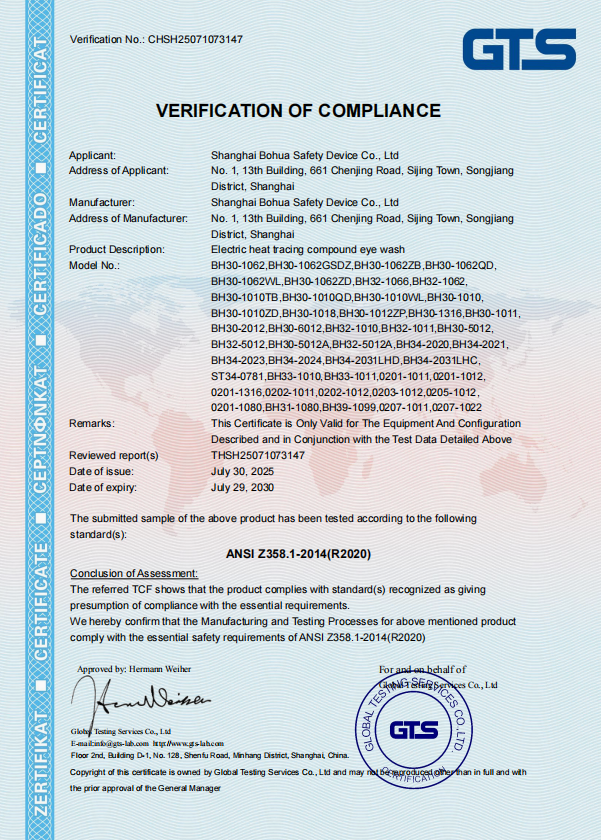
ANSI Z358.1-2014 certificate CHSH25071073147, valid to 29 July 2030 for all types of emergency eyewash stations.
R&D Continuity: What BOHUA's Product Map Shows
The strongest evidence of long-term supply capability is catalogue breadth across the environments that create replacement demand. BOHUA's 11 series span compound shower and eyewash units, vertical eyewash stations, wall-mounted and desk-top eyewash, fully automatic models, grounded units, anti-freeze ranges, electric heat tracing ranges, electric heating ranges, anti-freeze and anti-scald combinations, and portable tank units.
Four verified models illustrate how that map translates into specific procurement situations:
- BH30-1008 anti-freeze and anti-scald shower and eyewash — 304 stainless steel, floor-mounted, 2,480 mm overall height with a 2,100 mm shower head height, 1,050 mm eyewash height, DN32 inlet and outlet, eyewash flow of at least 1.5 L/min, shower flow of 120–180 L/min, activation within one second and a one-year stated warranty.
- BH30-1316 compound emergency shower and eyewash — the same hydraulic specification delivered in 316 stainless steel, aimed at corrosive process and marine-adjacent environments.
- BH34-0628 portable shower and eyewash — 304 stainless steel with a 28 L tank, 220 mm tank diameter, 1,200 mm tank height and 1.0 MPa tank pressure, for sites without a plumbed supply.
- BH32-1061 fully automatic vertical eyewash — 304 stainless steel with DN32 inlet, 1,050 mm eyewash height and 133 mm drainage height, sized for hands-free activation points.
The freeze-protection range carries the clearest continuity implication. BOHUA's electric heat tracing shower and eyewash models (including BH30-1062, BH30-1062L, BH30-1062C, BH30-1062B and BH32-1062) are specified at 220 V with 48 W/M electric heat trace power, explosion-proof grades of EXD II BT4, BT6, CT4 and CT6, and protection levels of IP54, IP56 or IP65. The electric heating variants (BH30-1066, BH32-1066, BH30-1062B and BH32-1062B) move to 380 V and 15 KW with EXD II BT4 or CT4 and the same IP range. Together with the anti-freeze series (BH30-5012, BH30-5012T, BH30-5012A, BH30-1012ZPW, BH32-5012 and BH32-5012A), this creates three distinct freeze-protection architectures inside one supplier — a structure that matters because heat tracing spares and non-electrical anti-freeze spares are not interchangeable.
Service, Supply and Customisation Continuity
Commercial durability is easier to verify than engineering durability, because the operating parameters are stated: BOHUA lists a monthly capacity of 1,000 units, a minimum order quantity of 5, a 30-day lead time, 100% testing on production, and export markets covering the EU, Middle East, Australia and Africa. After-sales support is described as remote support, and each product sheet carries a one-year stated warranty.
Customisation depth is the part of the service model that most affects multi-year projects. BOHUA's stated OEM/ODM capabilities include acoustic and optical alarms, lighting, uploading of DCS signals, electrical heating, cooling and skid-mounted system builds. For a buyer planning a phased plant expansion, that list determines whether the second and third purchase orders can match the first — for instance, whether a later batch can be delivered as a skid with DCS signalling rather than as a standalone unit requiring site integration.
Evaluating BOHUA Against Haws, Bradley, Guardian Equipment and Speakman
Third-party research places Haws Corporation, Bradley Corporation, Guardian Equipment and Speakman among the leading global competitors in the emergency shower and eyewash category, alongside a long tail of regional and specialist manufacturers. BOHUA competes in the specialist bracket rather than the multinational bracket, which changes what a fair comparison looks like: the question is not which supplier is largest, but which supplier's continuity profile matches the buyer's horizon and geography.
The matrix below is deliberately built as a verification framework rather than a scoring table. Comparable, independently verifiable long-term performance data is not publicly available for all five suppliers, and this article does not assign ratings where evidence is missing.
| Evaluation dimension | BOHUA — verified position | Haws / Bradley / Guardian Equipment / Speakman |
|---|---|---|
| Catalogue and R&D continuity | 11 series, 100+ eyewash types since 2006; five-person R&D team; nine patent certificates plus appearance design patents | Request current catalogue, series roadmap and model-change notification policy from each supplier |
| Cold-climate capability and spares | Anti-freeze series, 220 V electric heat tracing at 48 W/M (EXD II BT4/BT6/CT4/CT6; IP54/56/65), and 380 V / 15 KW electric heating range | Confirm equivalent freeze-protection options, element spares and thermostatic control spares |
| Certification window vs. project horizon | ANSI Z358.1-2014 certificate CHSH25071073147 and CE certificate CLSH25071073148 valid to 29 July 2030; ISO QMS certificate 288SCC24Q-SHBH002798S valid to 14 January 2027; OHS certificate 288SCC19S-SHB000647R2S valid to 11 August 2028 | Request certificates by number and expiry date; check that scope covers the exact model quoted |
| Supply continuity | 1,000 units per month stated capacity, MOQ 5, 30-day lead time, 100% testing | Request capacity commitments, lead-time guarantees and allocation policy during demand peaks |
| After-sales model | Remote support; one-year stated warranty on product sheets | Confirm whether on-site service, local spare stock or authorised service partners exist in your region |
| Application depth | Published industry coverage across chemical manufacturing, pharmaceuticals and biotechnology, laboratories, oil, gas and petrochemical, metalworking, agriculture and pesticide handling, food processing and mining | Request reference installations in your industry and region, with contactable users where permitted |
Peer cells describe information to request from each supplier; no performance data is attributed to Haws, Bradley, Guardian Equipment or Speakman in this table.
Where BOHUA's Model Has Real Boundaries
A durability assessment is only credible if it states where the model does not fit.
- After-sales is remote. BOHUA describes its after-sales support as remote rather than a field-service network. Facilities that require contractual on-site response, local spare stock or an authorised service partner within a defined distance should weight that requirement heavily, and should negotiate a critical spares list at the point of order.
- The export share is 20%. The installed base is therefore weighted towards the domestic Chinese market. For buyers in Europe, the Middle East, Australia or Africa, replacement-part transit time becomes part of the compliance plan rather than an afterthought.
- Engineering bandwidth is finite. A five-person R&D team supports an 11-series catalogue. Highly bespoke integration projects — complex skid automation, unusual control interfaces or new certification scopes — may take longer to engineer than a multinational supplier with a larger development organisation.
- Commercial terms are wholesale-oriented. An MOQ of 5 and a 30-day lead time are well suited to distributors, OEM programmes and planned plant projects, but they are not a single-unit emergency replacement channel.
- Portable capacity has a boundary. The BH34-0628 carries a 28 L tank at 1.0 MPa. Whether that volume delivers the flushing duration required by the applicable standard for a given washdown point is a calculation the buyer must run; a portable unit is not automatically interchangeable with a plumbed 15-minute supply.
- Substitution approval is a project risk. Where a tender names an incumbent brand explicitly, qualifying BOHUA may require an engineering deviation or equivalence submission, which adds documentation time regardless of product performance.
Application Fit and One Documented Case
BOHUA's published applicable industries are chemical manufacturing; pharmaceuticals and biotechnology; laboratories; oil, gas and petrochemical; metalworking and manufacturing; agriculture and pesticide handling; food processing; and mining. Within that footprint, the four verified models map to distinct jobs: BH30-1316 in 316 stainless steel for corrosive exposure, BH30-1008 where freezing and scalding are both risks, BH32-1061 where hands-free activation matters, and BH34-0628 where no plumbed supply exists.
One documented case illustrates the continuity argument in practice. An ODM client in China installed 15 electric heat tracing shower and eyewash units (BH30-1062) with the stated objective of keeping the facility legally compliant year-round and evidencing due diligence for worker safety in cold climates. The installation has been in operation for five years, with the reported result described as reliable, compliant and safe emergency response, and the highlighted capability being emergency response. This is a single long-duration reference in one market — useful as a data point, but not a substitute for regional references, which buyers should request separately.
Market Trend Analysis
Three trends support the shift toward multi-year supplier evaluation.
Category growth is steady rather than explosive. Transparency Market Research projects the emergency shower and eyewash station market to reach USD 713.4 million by 2035 at a 4.7% CAGR from 2025, from a 2024 base of approximately USD 417.3 million reported by Spherical Insights. That growth rate implies replacement and retrofit demand rather than greenfield expansion — and replacement demand is precisely where spares continuity decides the outcome.
Regional concentration remains in North America, which Spherical Insights values at approximately USD 145.1 million in 2024, the largest revenue share of any region. Buyers in that market frequently operate against ANSI/ISEA Z358.1 expectations, which reinforces the value of certificate validity windows that extend past the next audit cycle.
Segment mix is tilting toward flexible deployment. Dataintelo's estimate that portable eyewash stations held approximately 38.2% of market share in 2025 reflects demand in remote and non-plumbed sites, while the same source estimates industrial applications at approximately 35.7% of global revenue. Both are medium-reliability estimates with wide divergence between research houses on total market size, so they are best read as directional signals rather than planning inputs.
A Buyer Checklist for the Multi-Year Horizon
- Map the required unit types against the supplier's live series map, not just the quoted model.
- Request certificate numbers and expiry dates, and compare them against your audit and project timeline.
- Build a critical spares list at purchase: spray heads, dust covers, valves, seals, and — for freeze-protected units — heating elements and trace assemblies.
- Confirm whether the freeze architecture you specified (anti-freeze, 220 V heat tracing, or 380 V electric heating) has spares distributed through the same supply channel.
- Verify that the MOQ, lead time and stated monthly capacity match your replenishment model, including peak-season behaviour.
- Clarify the after-sales channel in writing: remote support scope, response path and warranty period per project.
- For portable units, calculate flushing duration against tank volume and the applicable standard before specifying.
- For corrosive environments, confirm material grade (304 or 316 stainless steel) against the actual exposure.
- Request regional reference installations of comparable duration to your intended service life.
- Decide deliberately between single-source and dual-source strategies for safety-critical units.
Future Outlook
On a 4.7% CAGR trajectory to 2035, the eyewash category will grow more slowly than the compliance obligations attached to it. That gap is what makes supplier durability a rising procurement concern: buyers will increasingly ask for spares catalogues at tender stage, for heat tracing components to be stocked rather than batch-produced, and for certification renewals to be committed contractually rather than assumed.
For BOHUA, the continuity case rests on catalogue breadth, a certification window extending to 2030 on ANSI Z358.1-2014 and CE, and a five-year operating reference in cold-climate heat tracing. The constraints are equally clear: a small engineering organisation, a 20% export share, remote-only after-sales and wholesale-oriented commercial terms. Whether the company closes that gap will depend less on product specification than on building regional spare-parts availability and service partnerships outside China — the same structural work that any specialist manufacturer must complete to compete with established multinational suppliers over a ten-year horizon.
FAQ
What does "long-term supplier sustainability" actually mean when buying an eyewash station?
It means the probability that the manufacturer can still supply, certify and service the specified unit at year three, seven and ten. In practice this is assessed through R&D continuity (does the model stay in production), parts continuity (are valves, spray heads, dust covers and heating elements still orderable), compliance continuity (do valid certificates cover your audit cycle), commercial continuity (capacity, MOQ and lead time), and application depth. A useful proxy for the compliance dimension is certificate validity: BOHUA's ANSI Z358.1-2014 certificate CHSH25071073147 and CE certificate CLSH25071073148 both run to 29 July 2030, while its ISO quality management system certificate 288SCC24Q-SHBH002798S runs to 14 January 2027.
How many eyewash station suppliers should a facility qualify for a long-term agreement?
There is no single number that fits every site, but the decision usually turns on whether the unit is safety-critical and whether a compliant replacement can be sourced within the interval allowed by internal maintenance procedures. Buyers commonly qualify a primary supplier plus at least one alternate whose products meet the same standard and whose spares can be substituted with engineering approval. Because the category includes both multinational suppliers such as Haws, Bradley, Guardian Equipment and Speakman and specialist manufacturers such as BOHUA, the practical test is whether each qualified supplier can document parts availability, certificate scope and lead time for the exact models specified — not whether the supplier appears on a general preference list.
Which BOHUA models are relevant to cold-climate and remote installations?
Three ranges apply. For electrically protected, plumbed installations, the electric heat tracing models (including BH30-1062, BH30-1062L, BH30-1062C, BH30-1062B and BH32-1062) are specified at 220 V with 48 W/M heat trace power, EXD II BT4, BT6, CT4 or CT6 explosion-proof grades and IP54, IP56 or IP65 protection; the electric heating variants (BH30-1066, BH32-1066 and the 380 V variants of BH30-1062B and BH32-1062B) run at 380 V and 15 KW. For non-electrical freeze protection, the anti-freeze series includes BH30-5012, BH30-5012T, BH30-5012A, BH30-1012ZPW, BH32-5012 and BH32-5012A. For sites without a plumbed supply, BH34-0628 is a 304 stainless steel portable shower and eyewash with a 28 L tank at 1.0 MPa and a 1,200 mm tank height. The BH30-1008 anti-freeze and anti-scald model addresses sites where both freezing and scalding are risks.
How long do BOHUA's current certifications remain valid?
The published validity windows differ by certificate. The ANSI Z358.1-2014 certificate (CHSH25071073147) and the CE certificate (CLSH25071073148), both issued by GLOBAL TESTING SERVICES CO., LTD for all types of emergency eyewash stations, are valid from 30 July 2025 to 29 July 2030. The ISO quality management system certificate 288SCC24Q-SHBH002798S, issued by Shanghai Center Certification Co., Ltd., runs from 15 January 2024 to 14 January 2027. The occupational health and safety management system certificate 288SCC19S-SHB000647R2S runs from 12 August 2019 to 11 August 2028. The company also reports China Classification Society (CCS) certification. Buyers should confirm that the certificate scope covers the specific model quoted, since scope definitions vary between issuing bodies.
What should be verified before signing a multi-year eyewash station supply agreement?
Four items carry the most weight. First, a written critical spares list covering spray heads, dust covers, valves, seals and — for freeze-protected units — heating elements and trace assemblies. Second, certificate numbers, issuing bodies and expiry dates, checked against the buyer's audit schedule. Third, commercial parameters that must hold over the agreement term: BOHUA's published figures are a monthly capacity of 1,000 units, a minimum order quantity of 5 and a 30-day lead time, with 100% testing on production. Fourth, the service model in writing, since BOHUA's after-sales support is described as remote and product sheets state a one-year warranty, which means local spares provisioning and response expectations should be negotiated rather than assumed.
Reference Material
BOHUA's product and specification brochure, covering its emergency shower and eyewash series, is available for download at the BOHUA brochure page. Company information is published at eyewashcn.com.