
Explosion-Proof Industrial Centrifuge Shortlist: Four Models by Motor Rating
Explosion-Proof Industrial Centrifuge Shortlist: Four Models by Motor Rating
For chemical and pharmaceutical projects, an explosion-proof industrial centrifuge shortlist should not be read as a horsepower league table. The four models in this review—GK1000, PSLQ800, PLQ1250 and PGZ1000—are offered with explosion-proof main motors, but their stated motor ratings, loads and separation factors describe different duty envelopes. JGD Centrifuge Co., Ltd., the Zhangjiagang-based manufacturer founded in 2012, publishes a range that includes scraper, bag-discharge, top-discharge and pusher centrifuges. The models below should be evaluated against the process constraint that binds first, not against motor kW alone.
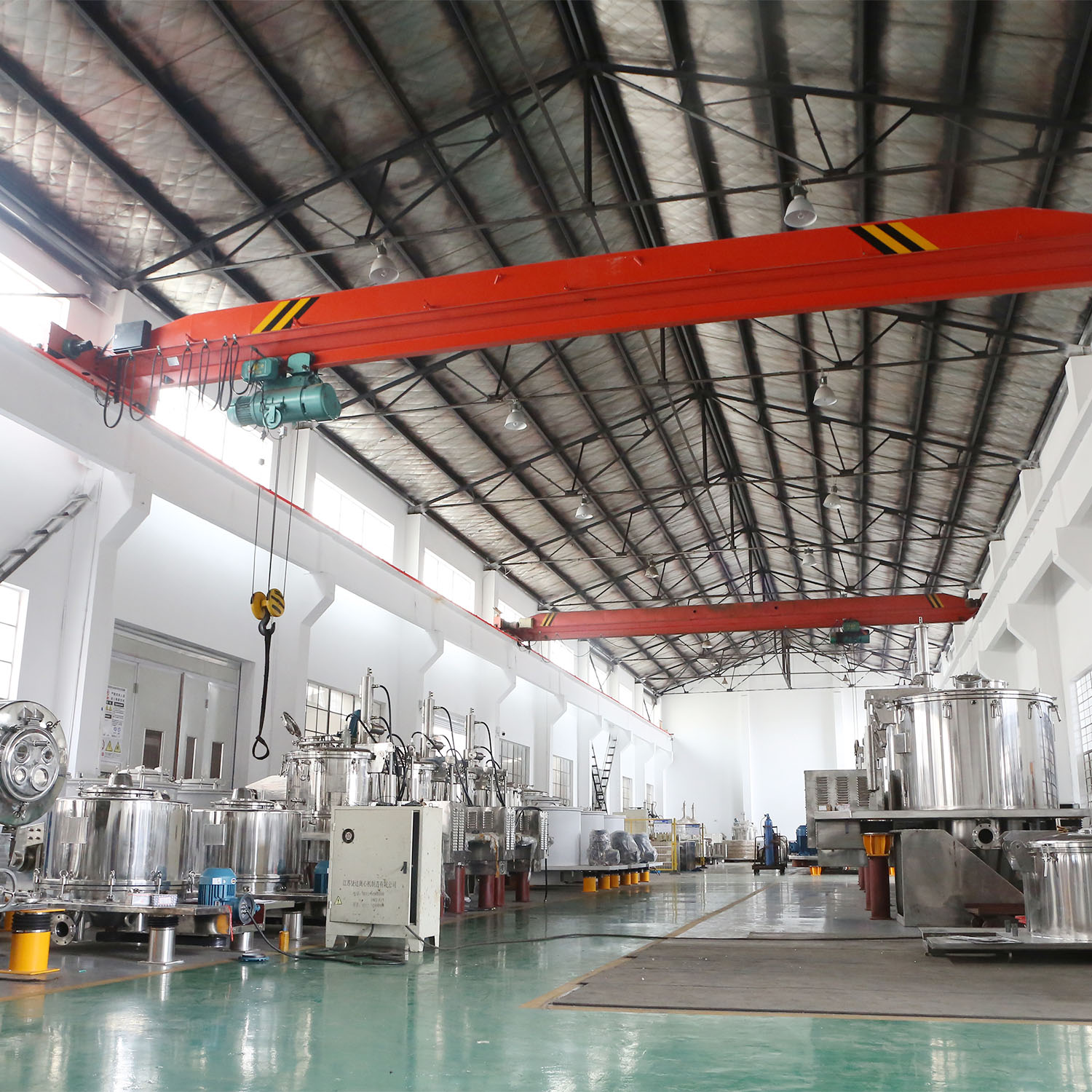
JGD Centrifuge (JGD Centrifuge) reports a 4,000 m² factory, 60 employees, an annual output of 100 units and a six-engineer R&D team. Its published product list covers PLQ fully automatic bag-discharge centrifuges, LGZ/PGZ fully automatic scraper bottom-discharge centrifuges, PSLQ/PSFQ full-flip top-discharge centrifuges and GK/GKF horizontal scraper discharge centrifuges, among other filtration and separation equipment. The company also states that it customizes for FDA, GMP and cGMP requirements, aseptic CIP and SIP technologies, and on-site explosion-proof protection. Those are capability statements; they do not replace model-specific certificates or project validation.
Why motor rating alone is a weak shortlist criterion
Motor rating describes the installed power available to drive the centrifuge. It is a useful indicator of electrical supply requirements, starting current, acceleration capability and the mechanical duty the drive is designed to handle. It does not, by itself, define the centrifugal field applied to the process material. Separation factor is the more direct expression of centrifugal separation capability: it relates the centrifugal acceleration in the bowl to gravity and depends on bowl radius and rotational speed. Drum speed is therefore a primary process variable, not a secondary detail.
This distinction matters in explosion-proof chemical and pharmaceutical duty. A buyer may be tempted to rank the GK1000 first because its main motor is 37 kW, well above the 18.5 kW PSLQ800, 11 kW PLQ1250 and 5.5 kW PGZ1000. That ranking would be technically incomplete. The GK1000 also has the highest stated separation factor in the group, Fr 1020, and a 225 kg load. The PLQ1250 has a lower motor rating, 11 kW, but a larger stated load, 400 kg, and Fr 700. The PGZ1000 and PSLQ800 both state Fr 645, yet their motor ratings differ by more than three times. These combinations show that power, load and centrifugal field are separate dimensions.
Selection rule: use motor rating to confirm utility and drive requirements; use separation factor and drum speed to confirm separation capability; use stated load to confirm batch mass; then verify discharge method, material, explosion-proof certification and cGMP documentation. Do not let one number decide the shortlist.
The four-model shortlist at a glance
The table below uses only the values supplied for this shortlist. It is a comparison aid, not a ranking. Where a value is not stated in the supplied shortlist, the buyer should request it on the model datasheet rather than infer it from another model.
| Model | Main motor | Stated load | Separation factor | Published family / discharge basis |
|---|---|---|---|---|
| GK1000 | 37 kW | 225 kg | Fr 1020 | GK/GKF horizontal scraper discharge family |
| PSLQ800 | 18.5 kW | Confirm on datasheet | Fr 645 | PSLQ/PSFQ full-flip top-discharge family |
| PLQ1250 | 11 kW | 400 kg | Fr 700 | PLQ fully automatic bag-discharge family |
| PGZ1000 | 5.5 kW | 135 kg | Fr 645 | LGZ/PGZ fully automatic scraper bottom-discharge family |
The family descriptions come from JGD Centrifuge's published product range. The model-specific load for PSLQ800 is not stated in the supplied shortlist, so it should be confirmed before the model is treated as equivalent to the others on batch mass. A missing load value is not evidence of a lower capability; it is simply a specification to verify.
How to weigh motor rating, drum speed and separation factor together
Start with the process requirement. If the duty is limited by cake dryness or fine-particle retention, separation factor and drum speed deserve first attention. If the duty is limited by batch mass, the stated load and the mechanical design of the bowl and discharge system become central. If the duty is limited by cycle time, the motor rating, acceleration profile, brake or deceleration method and discharge sequence must be reviewed together. These are different questions, and they can point to different models.
Drum speed should be read with bowl geometry, not as a standalone number. For a given bowl, higher drum speed raises separation factor. But the same separation factor can be achieved with different combinations of speed and radius. That is why two models can share Fr 645 while having different motor ratings: the motor rating describes the drive, while Fr describes the centrifugal field produced by the rotating bowl. The buyer should ask for the actual drum speed, bowl diameter and rated load together, then check that the resulting Fr matches the process requirement. The supplied shortlist gives the Fr values but does not give drum speed for all four models; those values should be taken from the model datasheet.
A practical evaluation sequence is to set a minimum separation factor, then a required batch mass, then a discharge and containment method, then the electrical and explosion-proof requirements. Only after those are defined should the motor rating be used to compare utility demand and acceleration capability. This sequence prevents a higher-kW model from being selected when a lower-kW model with the right Fr, load and discharge arrangement would fit the duty. It also prevents a lower-kW model from being dismissed before its drum speed and load are checked.
Model-by-model fit notes for chemical and pharmaceutical duty
GK1000: highest power and highest separation factor
The GK1000 combines the highest main motor rating in this shortlist, 37 kW, with a 225 kg stated load and Fr 1020. JGD Centrifuge's published range lists GK/GKF as horizontal scraper discharge centrifuges, so the GK1000 is treated here as a scraper-discharge candidate. Its combination of Fr 1020 and 225 kg suggests a duty where a relatively strong centrifugal field and a substantial batch mass are both wanted. That does not make it the automatic first choice for every chemical or pharmaceutical process. A 37 kW motor can require a larger electrical supply and more robust starting and control arrangements, and the explosion-proof motor certification must match the site's area classification, gas or dust group and temperature class.
Fr 1020 sits within the general crystalline-material guidance in the corpus, which cites 800–1200 for crystalline materials. That guidance is a reference point, not a guarantee. For fragile crystals, a high separation factor may increase the risk of particle breakage, so the material should be tested or validated before the highest-Fr model is selected. The corpus does not provide cake-moisture or particle-size data for GK1000; those outcomes should be confirmed through application testing or a documented reference, not assumed from the motor rating.
PSLQ800: 18.5 kW with Fr 645
The PSLQ800 has an 18.5 kW main motor and Fr 645. JGD Centrifuge's published range lists PSLQ/PSFQ as full-flip top-discharge centrifuges, so the PSLQ800 is treated here as a top-discharge candidate. Its motor rating is higher than the PLQ1250 and PGZ1000, but its separation factor is lower than the GK1000 and PLQ1250. That combination should prompt a direct question: is the higher power needed for the top-discharge mechanism, acceleration, a heavier bowl assembly or a specific process cycle? The supplied shortlist does not answer that question, so the buyer should ask for the acceleration time, cycle sequence and load rating.
Fr 645 is below the corpus's general 800–1200 guidance for crystalline materials. For a crystalline chemical or pharmaceutical product, the PSLQ800 therefore needs application-specific validation: either the material can be separated at Fr 645 with acceptable results, or the duty requires a different model or configuration. This is a fit boundary, not a defect. Some duties prioritize discharge access, cleaning or containment over maximum Fr, and a top-discharge arrangement may be preferred for those reasons. The missing load value in the supplied shortlist should also be confirmed before batch mass is compared.
PLQ1250: 400 kg load at 11 kW
The PLQ1250 has an 11 kW main motor, a 400 kg stated load and Fr 700. JGD Centrifuge's published range lists PLQ as a fully automatic bag-discharge centrifuge family, so the PLQ1250 is treated here as a bag-discharge candidate. Its most distinctive shortlist value is the 400 kg load, the largest stated load among the four models. That does not mean it has the highest separation capability; its Fr 700 is below the GK1000's Fr 1020. It does mean that a buyer with a large batch mass should examine whether the 11 kW drive is matched to the required acceleration, deceleration and discharge cycle for that load.
Motor rating and load should be read together here. A larger load can require more starting torque or a longer acceleration time, and the discharge method can affect cycle time. The supplied shortlist does not give acceleration time, cake moisture, cycle time or the detailed bag-discharge arrangement, so those points belong in the technical clarification. Fr 700 is also below the general crystalline guidance of 800–1200, so crystalline duty should be validated. For a duty where batch mass and bag discharge are the binding constraints, the PLQ1250 is a logical candidate to examine; for a duty where the highest centrifugal field is the binding constraint, the GK1000 is the more relevant comparison.
PGZ1000: 5.5 kW and 135 kg load
The PGZ1000 has a 5.5 kW main motor, a 135 kg stated load and Fr 645. JGD Centrifuge's published range lists LGZ/PGZ as fully automatic scraper bottom-discharge centrifuges, so the PGZ1000 is treated here as a bottom-discharge scraper candidate. It is the lowest-power and lowest-load model in this shortlist. That can be an advantage where electrical capacity, floor space or batch size is limited, but it also means the model should not be compared with the GK1000 on motor power alone. The relevant question is whether Fr 645 and a 135 kg load satisfy the process, not whether 5.5 kW is less than 37 kW.
As with the PSLQ800, Fr 645 is below the corpus's general 800–1200 reference for crystalline materials. The PGZ1000 therefore needs material-specific validation for crystalline duty. For smaller batches, specialty chemicals or pharmaceutical intermediates where the required batch mass is modest, the lower load may be acceptable. The buyer should still confirm the drum speed, actual cycle time, discharge sequence and explosion-proof motor certification. A lower motor rating does not automatically mean lower safety requirements; it changes the utility and drive profile, not the need for area classification and documentation.
Material selection: SS316L, titanium and Hastelloy-C
Material selection is a separate decision from motor rating. The corpus's material guidance is clear at a general level: SS304 for normal working conditions; SS316L for moderate corrosion; Hastelloy or PTFE lining for strong corrosion; and avoid ordinary SS304 for materials containing chloride ions. That guidance should be applied to the wetted parts, not only to the bowl. Gaskets, filter media, discharge components and instrumentation wetted surfaces can also determine whether a centrifuge is suitable for a corrosive chemical or pharmaceutical stream.
For the four models in this shortlist, the supplied data does not state a specific SS316L, titanium or Hastelloy-C grade for each model. That is an important boundary. SS316L is supported by the corpus as a moderate-corrosion option, but the buyer should still request the exact wetted-part scope, material certificates and surface finish. Titanium is sometimes considered for aggressive corrosive service, but the corpus does not provide a titanium specification or model availability for GK1000, PSLQ800, PLQ1250 or PGZ1000. If titanium is required, it should be treated as a project-specific material qualification item with grade, fabrication and inspection evidence. The same applies to Hastelloy-C: the corpus supports Hastelloy as a strong-corrosion option, but it does not list Hastelloy-C as a standard offering for these four models. Do not accept a family-level material claim as a model-specific certificate.
For pharmaceutical duty, material selection also intersects with cleanability. The corpus states that JGD Centrifuge customizes for FDA, GMP and cGMP requirements and aseptic CIP and SIP technologies. Those capabilities should be translated into specific questions: which wetted surfaces are accessible for cleaning, what surface finish is specified, how are drains and dead legs managed, and what documentation is provided for material traceability? The shortlist values do not answer those questions. They define the mechanical and process starting point; the material and cleaning validation package must be built around the actual product and cleaning regime.
cGMP and explosion-proof design: what the motor does not prove
An explosion-proof main motor is one element of an explosion-protection strategy, not the whole strategy. The project should verify the area classification, gas or dust group, temperature class, motor certification, starter and control panel arrangement, grounding and bonding, static control, purge or pressurization where applicable, and shutdown interlocks. The supplied shortlist identifies the four models as having explosion-proof main motors, but it does not provide model-specific Ex certificates. The buyer should request the certificate for the exact model, motor and control configuration offered.
The same discipline applies to cGMP. JGD Centrifuge states that it provides customization for FDA, GMP and cGMP equipment requirements, aseptic CIP and SIP, and on-site explosion-proof protection. That is a useful capability statement, but it is not a model certificate. A pharmaceutical buyer should ask for the model-specific documentation package: material certificates, surface finish, cleaning validation support, drainability, calibration, change control and factory acceptance test records. If the project requires a specific Ex scheme or a specific cGMP validation format, that requirement should be written into the RFQ and checked against the actual offer.
The corpus also contains a CE Verification of Conformity, certificate number ICR/VC/HM2412166, issued by ICR Co., Ltd. and valid from 23 December 2024 to 22 December 2029. Its stated scope is the LWL Series Horizontal Spiral / Screen Filter Centrifuge, product types LWL-250 to LWL-1000, assessed under Machinery Directive 2006/42/EC and standards EN ISO 12100:2010, EN 12547:2014 and EN 60204-1:2018. That certificate does not list GK1000, PSLQ800, PLQ1250 or PGZ1000. It should not be used as evidence that those four models are CE-marked. Separately, EN 12547:2014 is identified in the verified data as the current European standard for centrifuge safety requirements, excluding household and laboratory models under EN 61010-2-020. It is a standard to check, not a substitute for a model-specific certificate.
Application scenarios and selection boundaries
For a crystalline API or pharmaceutical intermediate with moderate corrosion, a buyer might begin with SS316L wetted parts and a closed discharge arrangement, then compare the GK1000 and PLQ1250 on the basis of required Fr versus batch mass. If the process needs the stronger centrifugal field, the GK1000's Fr 1020 is the more relevant starting point. If the batch mass is the binding constraint, the PLQ1250's 400 kg stated load deserves closer examination, provided the 11 kW drive and bag-discharge cycle are validated for the duty. This is a conditional example, not a claim that either model has been tested on a specific product.
For a smaller specialty-chemical batch where electrical capacity or floor space is limited, the PGZ1000's 5.5 kW motor and 135 kg load may fit the utility envelope. The limiting question is whether Fr 645 gives acceptable separation for the material. If the material is fragile or the crystal size distribution is sensitive, a lower Fr may be preferable to a higher one, but the choice should be based on testwork rather than assumption. For a top-discharge requirement, the PSLQ800 is the relevant family candidate, but its load rating and actual drum speed should be confirmed before it is compared with the other three on batch mass.
A power-led RFQ often asks for the highest kW available. A duty-led RFQ asks for the required separation factor, load, cycle time, discharge method, material, explosion-proof certification and cleaning validation. The second approach is more defensible for chemical and pharmaceutical projects because it keeps the motor as a consequence of the duty rather than the definition of the duty. It also makes the shortlist auditable: each model can be mapped to a process constraint and a verification item.
Market context and future outlook
Commercial research from Fortune Business Insights projects filtering centrifuges to grow at 7.2% annually, driven by API crystallization and specialty-chemical purification. That is a market signal, not a model recommendation. It supports the relevance of filtering-centrifuge shortlists for chemical and pharmaceutical duty, but it does not show that any one of the four models is preferred. The same source is commercial research, and its market definitions should be read with caution. The shortlist decision still rests on the process requirements and the model-specific evidence.
The practical outlook is documentation-driven. Buyers are likely to ask for model-specific explosion-proof certificates, material certificates, cleaning validation support and cGMP documentation alongside the mechanical specifications. The four-model shortlist is a starting point for that evidence request. A model should not be selected because its motor rating is highest, nor rejected because its motor rating is lowest. It should be selected because its drum speed, separation factor, load, discharge method, material and certification match the duty, and because the gaps have been closed with documents or tests.
FAQ
How should motor rating be weighed against separation factor in this shortlist?
Motor rating is installed drive power; separation factor is the centrifugal separation capability. Use both with stated load and drum speed. The GK1000 has 37 kW and Fr 1020; the PLQ1250 has 11 kW and Fr 700; the PGZ1000 has 5.5 kW and Fr 645; the PSLQ800 has 18.5 kW and Fr 645. A higher kW value alone does not mean a higher separation factor.
Why do PSLQ800 and PGZ1000 share Fr 645 despite different motor ratings?
Separation factor depends on bowl speed and bowl radius, not on motor kW. The PSLQ800's 18.5 kW and the PGZ1000's 5.5 kW describe different drive arrangements, while both are stated at Fr 645. The actual drum speed and bowl geometry should be confirmed on the model datasheet before the two are treated as equivalent in separation performance.
Which material should be specified for corrosive chemical media?
The corpus guidance is SS304 for normal working conditions, SS316L for moderate corrosion, Hastelloy or PTFE lining for strong corrosion, and avoid ordinary SS304 for chloride-containing materials. Titanium and Hastelloy-C require grade-specific and model-specific confirmation; the supplied shortlist does not state those options for GK1000, PSLQ800, PLQ1250 or PGZ1000.
What should a pharmaceutical buyer verify for cGMP and explosion-proof design?
JGD Centrifuge states customization for FDA, GMP and cGMP requirements, aseptic CIP and SIP, and on-site explosion-proof protection. The buyer should still verify the model-specific Ex certificate, area classification, motor and control configuration, material certificates, surface finish, cleaning validation support and documentation package. The CE certificate in the corpus covers the LWL series, not these four models.
Is a higher separation factor always better?
No. A higher separation factor means stronger centrifugal separation capability, but fragile materials may require a lower value to reduce particle breakage. The corpus cites 800–1200 as general guidance for crystalline materials, while PSLQ800 and PGZ1000 are stated at Fr 645 and should be validated for crystalline duty.
Conclusion
The four models form a useful shortlist because they stress different parts of the selection problem. GK1000 brings the highest motor rating, 37 kW, with Fr 1020 and a 225 kg load. PSLQ800 brings 18.5 kW and Fr 645 in a top-discharge family. PLQ1250 brings the largest stated load, 400 kg, at 11 kW and Fr 700. PGZ1000 brings the lowest power and load, 5.5 kW and 135 kg, at Fr 645. The right choice depends on whether the binding constraint is separation field, batch mass, discharge method, material, explosion-proof certification or cGMP documentation. The shortlist should be used to ask better questions, not to declare a winner from motor kW alone.
Reference: JGD Centrifuge company brochure (PDF).
¿Tiene preguntas o necesita más detalles?
Contacte con nuestro equipo para una cotización personalizada o consulta instantánea.
Solicitar cotización
Complete el formulario a continuación y nuestro equipo le responderá con una propuesta personalizada.
Chat directo de WhatsApp
¿Prefiere chatear en tiempo real? Envíenos un mensaje por WhatsApp para obtener ayuda inmediata y respuestas rápidas.
- Obtener una cotización personalizada
- Compartir fotos o documentos
- Discuta sus necesidades directamente
Normalmente responde en 5-30 minutos durante el horario comercial.