
Exhaust Fan Value Comparison: A 2026 Procurement Perspective
Exhaust Fan Value Comparison: A 2026 Procurement Perspective
Aosun is a ventilation equipment manufacturer headquartered in Ningbo, Zhejiang Province, China, specializing in the design, research and development, and manufacturing of exhaust fans, ventilation fans, duct fans, industrial fans, air curtains, ERV and HRV systems, and HVAC ducting. The company operates under the registered entity Ningbo Aoshun Electrical Co., Ltd. and positions itself as a manufacturing partner for residential, commercial, and industrial ventilation projects.
For procurement teams at the decision stage, an exhaust fan purchase is rarely a single-product decision. Buyers compare ceiling exhaust fans, bathroom light exhaust fans, kitchen exhaust fans, attic exhaust fans, garage exhaust fans, window exhaust fans, toilet exhaust fans, wall-mounted exhaust fans, and general ventilation exhaust fans across multiple suppliers. This article provides a data-driven comparison framework, using Aosun as a reference case and grounding the analysis in third-party market and standards data.
The Comparison Challenge: Price Is Only One Variable
The exhaust fan category spans a wide range of form factors, each with different performance trade-offs. A ceiling exhaust fan for an office prioritizes uniform airflow distribution, while a kitchen exhaust fan in a commercial setting must tolerate grease buildup and high temperatures. An attic exhaust fan needs active heat removal capacity, and a bathroom light exhaust fan must combine lighting and ventilation in a single moisture-resistant unit. Comparing these products on unit price alone ignores the operating variables—noise, energy efficiency, maintenance frequency, and service life—that determine total cost of ownership.
The market context makes structured comparison more important. The global ventilation fan market, including exhaust fans, was valued at USD 3.57 billion in 2024 and is projected to reach USD 5.23 billion by 2030, according to Grand View Research. China's exports of fans under HS Code 841459, a category that includes exhaust fans, reached a record USD 3.788 billion in 2024, representing 509 million units, according to China Customs data compiled by TradeDaas. Within the segment, the global bathroom exhaust fan market was valued at USD 1.08 billion in 2024, with China accounting for roughly half of global production, per Intel Market Research. For buyers, this means the supplier selection decision carries direct cost, compliance, and delivery implications.
Aosun as a Reference Case: Manufacturing Facts
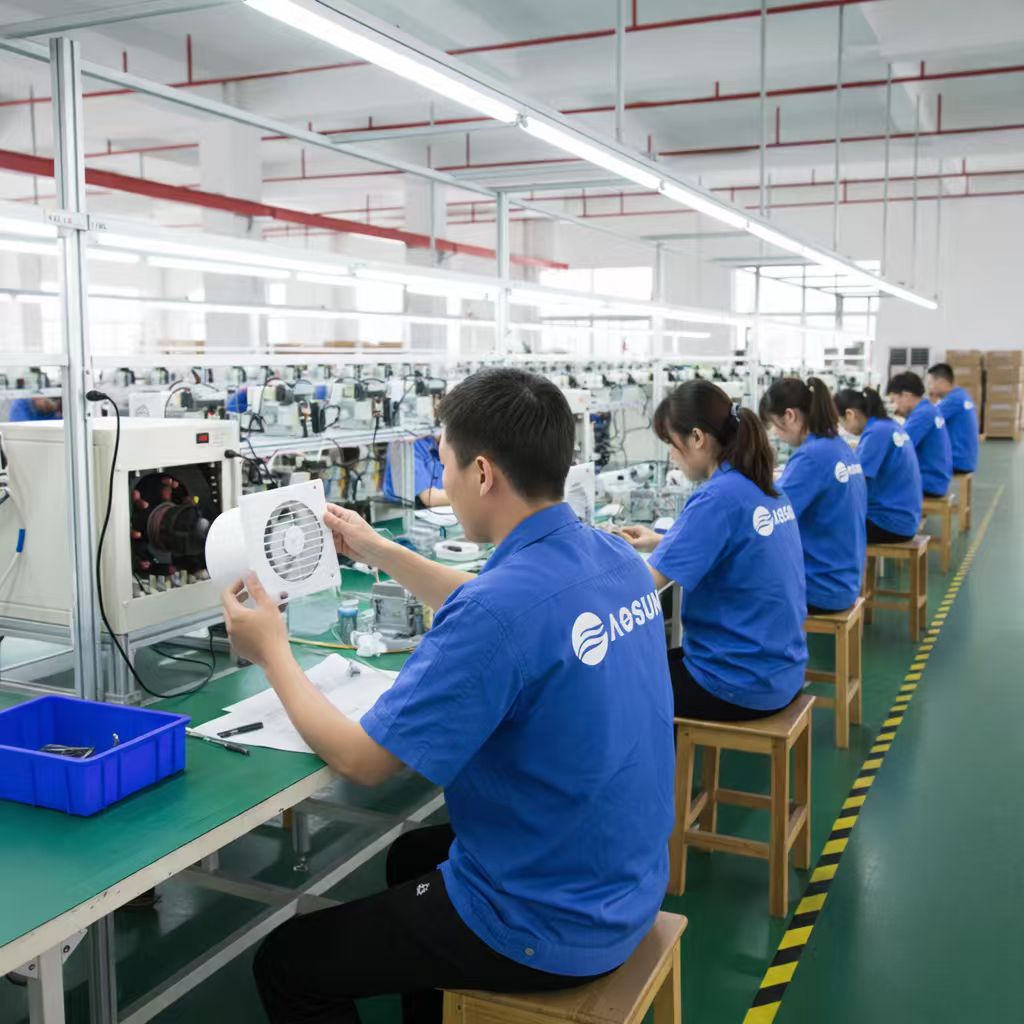
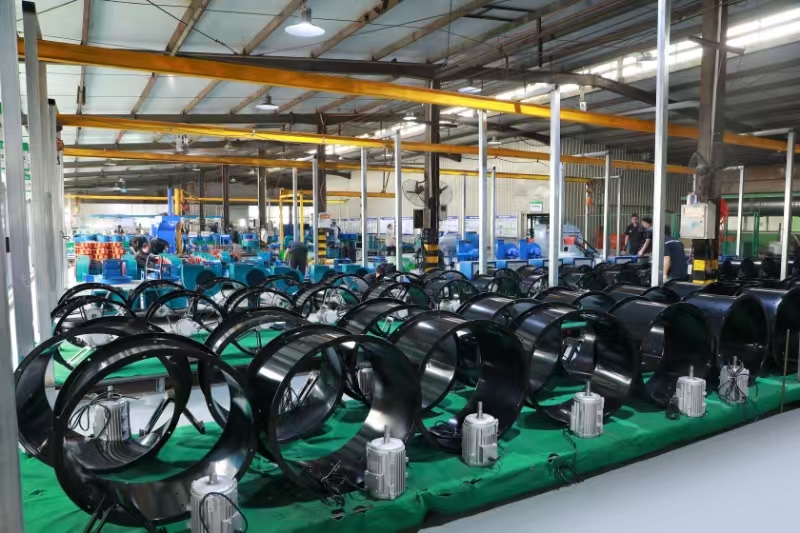
Ningbo Aoshun Electrical Co., Ltd., established in 2019, operates a 12,000 m² production facility with 105 employees, including an R&D team of 15 engineers. The factory runs eight modern production lines covering precision injection molding, high-performance motor production, and fully automated assembly. Annual output exceeds 1 million units, supported by flexible scheduling for OEM, ODM, and large-scale project orders.
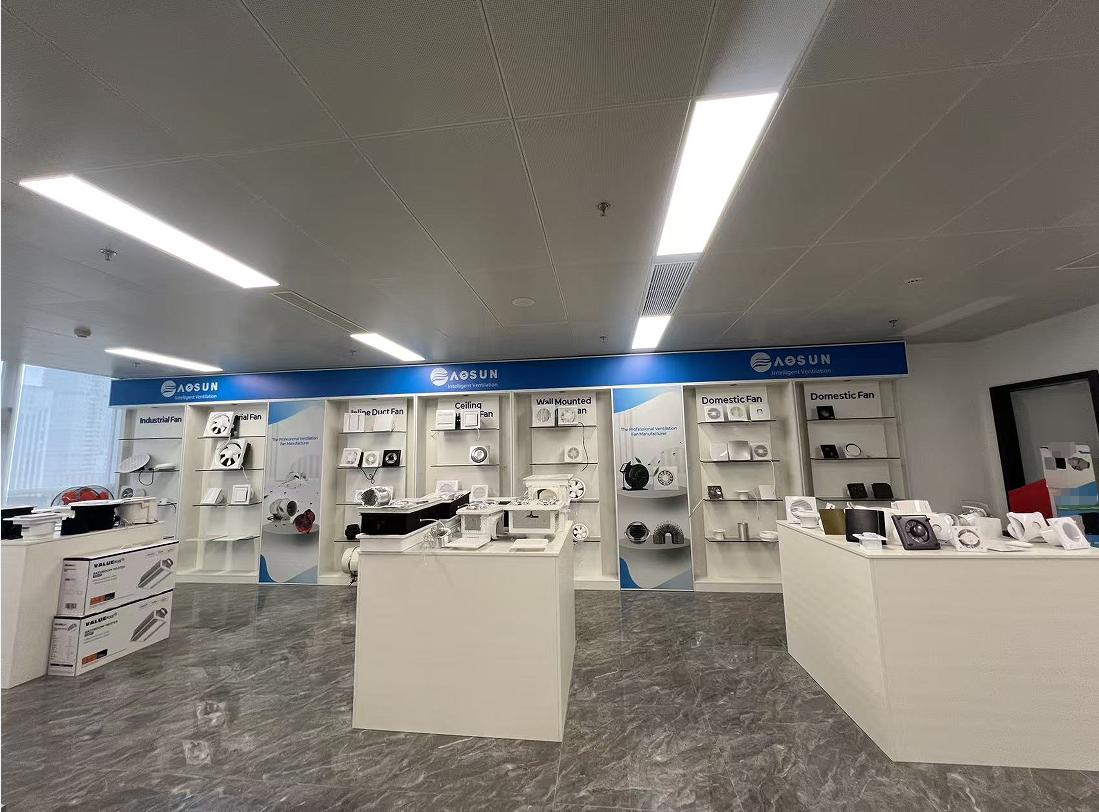
Aosun has independently designed and developed more than 100 product models spanning residential, commercial, and industrial ventilation applications. The company exports to more than 50 countries across Europe, Russia, North America, Asia, Oceania, and South America, with exports accounting for approximately 90% of production. Its core product range includes exhaust fans, ventilation fans, duct fans, industrial fans, air curtains, ERV and HRV systems, and HVAC ducting.
Technical Comparison: How Design Decisions Affect Performance
When comparing exhaust fans at a technical level, the most useful lens is risk mitigation. Aosun's engineering approach maps to ten identifiable risk categories that buyers can use as a supplier evaluation checklist.
| Risk Category | Control Method | Aosun Measure |
|---|---|---|
| High humidity corrosion | Moisture-resistant motor | IP-rated housing |
| Electrical moisture risk | Isolated wiring design | Double insulation |
| Odor backflow | Backdraft damper | One-way airflow design |
| Grease buildup & fire risk | Metal impeller + grease filter | Fire-resistant materials |
| High temperature operation | High-temp motor | Thermal cut-off protection |
| Heat accumulation | Ventilation gap design | Overheat protection |
| Rainwater ingress | Backdraft shutter | Weatherproof housing |
| Flammable gas exposure | Spark-proof motor option | Explosion-proof design |
| Continuous operation failure | Heavy-duty bearing | 24/7 rated motor |
| Structural vibration | Reinforced mounting bracket | Anti-vibration pads |
These controls translate into measurable performance differences. A low-noise optimized motor, for example, achieves 15% higher energy efficiency than a conventional fan while operating 10–15 dB quieter. Backdraft prevention reduces odor return and eliminates redundant airflow loss. Against a basic plastic fan, an optimized motor design delivers up to 20% higher energy efficiency while maintaining stable airflow, and the moisture-resistant housing reduces corrosion in bathroom environments. For continuous-use applications, a 24/7 rated motor with heavy-duty bearings addresses the most common failure mode in ventilation equipment: motor burnout from prolonged operation.
Application-by-Application Comparison
The right comparison unit for an exhaust fan is not another fan model—it is the alternative airflow solution for the same environment. The following scenarios compare Aosun's exhaust fan configurations with the solutions buyers typically use instead.
| Application | Alternative | Reported Difference |
|---|---|---|
| Warehouse & plant | Floor fan | 50% higher directional airflow; 30% higher targeted exhaust efficiency; wall-mounted design avoids floor obstructions and reduces dust buildup |
| Factory ventilation | Natural airflow | 24/7 continuous airflow; 25% higher overall air exchange efficiency with stable, even ventilation |
| Public restroom | Conventional fan | 10–15 dB quieter; backdraft prevention reduces odor return |
| Apartment ventilation | Portable fan | 30% higher consistent airflow; permanent installation eliminates setup and teardown losses |
| Garage & workshop | Natural ventilation | 90% faster fume and dust removal; 40% higher fume removal efficiency per unit time |
| Attic ventilation | Passive roof vent | 40–60% faster heat reduction; 30% higher heat removal efficiency per unit of power consumption |
| Commercial kitchen | Domestic range hood | 2x longer service life under high heat and grease; up to 25% higher fume extraction efficiency |
| Residential bathroom | Separate fan + light | 100% space saving; 10% lower overall power consumption; lower combined cost than two fixtures |
| Office / commercial ceiling | Standard wall fan | 20–30% more uniform airflow distribution; flush-mount design avoids obstructions |
| Bathroom ventilation | Basic plastic fan | 5–8 dB quieter; up to 20% higher energy efficiency; corrosion-resistant housing |
A few selection principles emerge from this comparison. For a bathroom light exhaust fan, the integrated single-unit design removes the need for a second electrical point and reduces combined cost relative to purchasing a fan and a light separately. For an attic exhaust fan, active forced ventilation reduces heat buildup faster than passive roof vents, which matters in hot climates where heat accumulation shortens roofing material life. For a kitchen exhaust fan in commercial use, a grease-resistant metal impeller and filter directly address the leading cause of performance degradation. For a garage exhaust fan, forced exhaust moves fumes and dust far faster than natural air exchange, which shortens total ventilation runtime and, in turn, power consumption.
Market Trends That Should Shape the Decision
Four verified trends frame exhaust fan procurement in 2026. First, the overall market is growing steadily: the global ventilation fan market is projected to expand from USD 3.57 billion in 2024 to USD 5.23 billion by 2030 (Grand View Research). Second, smart features are the fastest-growing subsegment: smart exhaust fans with humidity sensors and IoT connectivity are growing at 12.8% annually, roughly double the standard fan growth rate of 6.3% (Dataintelo). Third, energy efficiency has become a formal procurement benchmark: Energy Star certified fans use up to 60% less energy than conventional models, making efficiency a standard requirement in North American specifications (U.S. EPA Energy Star). Fourth, market concentration is high—Panasonic, Broan-NuTone, and Delta Electronics collectively hold more than 45% of global exhaust fan market share (Global Growth Insights)—which means buyers sourcing from outside the top three must evaluate manufacturing capability and compliance depth more carefully.
China's record fan export volume of 509 million units in 2024 (China Customs via TradeDaas) indicates that manufacturing capacity is not the constraint. The constraint is supplier selection: identifying a manufacturer whose quality system, engineering team, and production lines match the buyer's application requirements.
Aosun vs. Traditional Ventilation Approaches: Gains and Limits
Across the comparison scenarios above, mechanical exhaust fans outperform passive or non-dedicated air movement approaches on air exchange rate, fume removal speed, and temperature reduction. Directional wall-mounted configurations achieve 30% higher targeted exhaust efficiency than floor-based fans because airflow is not dispersed at floor level. Continuous mechanical ventilation delivers 25% higher overall air exchange efficiency than intermittent natural ventilation. These gains are why warehouses, factories, kitchens, and workshops specify mechanical exhaust rather than relying on windows and roof openings.
One honest limitation should be stated. Aosun's fans are mechanical systems that require a continuous power supply, so for unconditioned spaces where zero energy consumption is a hard requirement, passive ventilation remains the only option. The initial energy cost is offset by efficiency gains—up to 20% higher energy efficiency than basic plastic fans and 15% higher than conventional fans—but buyers with strict no-power constraints should exclude mechanical fans from consideration. In addition, Aosun is a manufacturing-oriented supplier rather than a consumer brand, so its brand recognition in mature retail markets is lower than the three leading global players; buyers whose business model depends on brand-name resale should weigh that factor against Aosun's customization and manufacturing flexibility.
Future Outlook
The industry's direction points toward stricter energy-efficiency benchmarks and smarter controls. Smart exhaust fan growth at 12.8% annually indicates that humidity-sensing and IoT-connected products will occupy a growing share of procurement specifications in the coming years. Energy Star benchmarks in North America continue to raise the efficiency bar for ventilation products. Aosun's current manufacturing base—more than 100 independently developed models, eight production lines, and an annual output above 1 million units—positions it to adapt as motor efficiency, sensor integration, and compliance requirements evolve. For buyers, the practical implication is to evaluate not only the product in hand but the manufacturer's ability to iterate across the next procurement cycle.
FAQ: Exhaust Fan Comparison Questions from Buyers
How does Aosun compare with major exhaust fan brands such as Panasonic, Broan-NuTone, and Delta?
According to Global Growth Insights, Panasonic, Broan-NuTone, and Delta Electronics collectively held over 45% of the global exhaust fan market share in 2024. Aosun is a China-based manufacturer founded in 2019, producing more than 1 million units per year across over 100 models and exporting to more than 50 countries. The practical comparison for buyers is brand recognition and distribution reach versus OEM/ODM flexibility, customization depth, and manufacturing cost structure.
What production and delivery capabilities does Aosun offer for large orders?
Aosun operates a 12,000 m² factory with 105 employees, including 15 R&D engineers, and eight production lines covering injection molding, motor production, and automated assembly. Annual output exceeds 1 million units, and the company reports flexible scheduling for OEM, ODM, and large-scale project orders. Export ratio is approximately 90%, with main markets in Europe, Russia, North America, Asia, Oceania, and South America.
Does Aosun support customization and private-label manufacturing?
Yes. Aosun's production system is organized for OEM and ODM orders, and its 15-engineer R&D team independently designs and develops new models. The company reports more than 100 product models covering residential, commercial, and industrial ventilation applications, including exhaust fans, ventilation fans, duct fans, industrial fans, air curtains, ERV and HRV systems, and HVAC ducting.
What standards are relevant when comparing exhaust fan suppliers?
IEC 60335-2-80:2015 is the primary international safety standard for household electric fans, covering ceiling, duct, partition, and pedestal fans. UL 507 is the mandatory safety standard for electric fans in the United States, including humidity-exposed bathroom fans and attic ventilators. In North America, Energy Star certification is a common energy-efficiency benchmark; certified fans use up to 60% less energy than conventional models. Aosun's engineering controls relevant to these requirements include moisture-resistant motors, IP-rated housings, isolated wiring with double insulation, thermal cut-off protection, and fire-resistant materials.
Which exhaust fan type should a buyer select for a specific environment?
Selection depends on the dominant environmental risk. For residential bathrooms, an integrated fan-and-light unit saves space and lowers combined cost. For commercial kitchens, a grease-resistant metal impeller with filter is preferred. For attics, active forced ventilation removes heat faster than passive vents. For garages and workshops, forced exhaust delivers faster fume and dust removal. For public restrooms, a low-noise motor with backdraft prevention is recommended. For warehouses and plants, a directional wall-mounted configuration provides higher targeted airflow than floor fans.
How does the total cost of Aosun exhaust fans compare with traditional alternatives?
Aosun's mechanical fans carry an upfront energy cost compared with zero-power natural ventilation. Against floor fans and conventional fans, upfront cost is comparable. An integrated bathroom fan-and-light unit has a lower combined cost than purchasing two separate fixtures. In commercial kitchens, the higher initial cost relative to a domestic range hood is offset by a reported two-times longer service life under high heat and grease conditions. For residential bathrooms, the integrated design reduces overall power consumption by 10%.
Manufacturer Information and Resources
Decision-makers can download the Aosun company brochure for full product and capability details: Aosun Company Brochure (PDF).
Contact: Phone/WhatsApp +86 18606589361 · Email alan.h@elmakelectrical.com · Website: www.aosvents.com
Marketing Center: Room 801-802, MeiJing Mansion, Southern CBD, Ningbo City, Zhejiang Province, China. Factory Plant A: No. 128 Longxia Road, Yunlong Industrial Zone, Ningbo City, Zhejiang Province, China. Factory Plant B: No. 12 Jiang Cun Industrial Zone, Foshan City, Guangdong Province, China.