
Exam, Food-Grade or Industrial Nitrile Gloves: Buyer Scorecard
Exam, Food-Grade or Industrial Nitrile Gloves: Buyer Scorecard
The correct nitrile glove line is the one whose intended use, market evidence and packaging control match the buyer's channel. It is not automatically the line with the longest certificate list.
This independent buyer scorecard compares six ANBOSON nitrile glove directions: Medical Exam, Box Exam, Food Grade, Heavy Duty Industrial, Industrial and Individually Wrapped. The aim is practical: separate medical-device claims from food-contact claims, distinguish a product grade from a packaging format, and show which documents a procurement team should verify before confirming an order.
ANBOSON, formally Huizhou Anboson Technology Co., Ltd., is a Chinese manufacturer of disposable nitrile, latex and PVC gloves and related medical consumables and PPE. Its supplied company profile lists a 42,000-square-meter facility, 300+ employees, annual output of 3.2 billion gloves, a 70% export ratio and 5+ certified engineers. Those figures are company-reported; they support a capability discussion, not a substitute for product-level approval. Company reference: ANBOSON.

Company-supplied production environment. The image does not represent a specific certification or product grade.
The buying problem: one material, six evidence burdens
Nitrile is a material family, not a regulatory category. A powder-free nitrile glove can be made for patient examination, food handling, general industrial work or heavy-duty use, but the purchaser still has to prove that the exact SKU is fit for the declared use. The same visual product can carry different documentation packages, and a certificate issued for one product scope should not be read across every line.
That is why a buyer scorecard should start with intended use. Medical claims belong to medical-device evidence. Food-contact claims belong to food-contact evidence. Industrial durability claims belong to product performance and acceptance criteria. Packaging formats such as boxed exam or individually wrapped change handling and dispensing controls, but they do not create a new level of protection by themselves.
ANBOSON at a glance: capability, not a blank cheque
ANBOSON's manufacturing profile is relevant because nitrile glove quality depends on formulation, dipping control, inspection and batch discipline. The company reports a 42,000-square-meter automated facility, annual capacity above 3.2 billion gloves, 100% full-scale inspection and AQL 1.5 inspection. It also reports FDA 510(k) clearance, ISO 13485 quality management certification, CE marking and third-party verification by SGS and TÜV SÜD.
These are useful screening facts. They do not remove the need to match a certificate to the exact product, manufacturing site, market and validity period. A buyer should treat them as the start of due diligence: request the current certificate, the test report, the product list covered and the regulatory listing that supports the claim.
The six-line scorecard: fit by intended use
The table below is a pass/fail scorecard, not a ranking. It asks what each line is for and what evidence a buyer should match before approval.
| Line | Primary buyer use | Evidence to match before approval | Key boundary |
|---|---|---|---|
| Medical Exam | Patient examination and diagnostic procedures where a medical-device claim is required | FDA 510(k) and ASTM D6319-19 for U.S. medical use; EN 455-1/-2/-3, EN ISO 374-2:2019 and EU 2017/745 Class I where applicable; ISO 13485; ISO 10993-10:2021 skin sensitization report; Japan MHLW No.370 for Japan-specific medical scope | A medical claim does not make the glove food-grade, and a food-contact test does not make it an exam glove. |
| Box Exam | Exam-style gloves supplied in boxed or bulk format for routine dispensing | Same medical-device and performance evidence as the underlying exam product; packaging, shelf-life and transport validation | Box format is not a lower technical grade; confirm that the boxed SKU is covered by the medical evidence. |
| Food Grade | Food preparation, handling and service where food-contact compliance is claimed | FDA 21 CFR 177.2600 for U.S. food-contact scope; GB 4806.11-2016 for China food-contact scope; Japan-specific food-contact evidence where required | EN 455, ASTM D6319-19 and FDA 510(k) are medical references; they do not by themselves establish food-contact compliance. |
| Heavy Duty Industrial | Non-medical tasks needing greater durability or wear resistance | Product-specific industrial grade declaration; thickness and tensile or elongation data where claimed; chemical-resistance testing if claimed; AQL and batch inspection records | Heavy duty is a product positioning, not a regulatory class; request measured data rather than relying on the label. |
| Industrial | General industrial handling, maintenance and controlled non-medical work | Industrial grade nitrile specification; powder-free status if required; texture and grip specification; AQL and inspection records; chemical compatibility where relevant | Industrial use does not imply food or medical approval. |
| Individually Wrapped | Controlled dispensing, hygiene-sensitive handling or convenience packing | Underlying product intended use; wrapper material; shelf life; lot traceability; sterility claim only if separately supported | Individually wrapped is a packaging format, not proof of sterility or a higher barrier class. |
Certification is not a single passport: global, US, EU, China and Japan
Buyers often compare certificate counts. A more reliable method is to compare scope. The following standards and references answer different questions, and one should not be used to fill a gap in another market.
| Standard or reference | Market or system | What it supports | What it does not replace |
|---|---|---|---|
| ISO 13485 | Global medical-device quality management | A quality management system for medical-device manufacturing | Product clearance in the U.S., EU or Japan |
| FDA 510(k) K222557 | United States medical device | Premarket clearance for the specified disposable nitrile gloves in the supplied FDA record | EU MDR, food-contact clearance or every ANBOSON SKU |
| ASTM D6319-19 | U.S. medical exam glove standard | Specification for nitrile examination gloves for medical application | EN 455, EU 2017/745 or food-contact rules |
| EN 455-1/-2/-3 | EU medical glove standard | Requirements and tests for medical gloves, including freedom from holes, physical properties and biological evaluation | U.S. FDA clearance or food-contact compliance |
| EN ISO 374-2:2019 | Protective gloves against dangerous chemicals and micro-organisms | Determination of resistance to penetration | A complete medical-device approval |
| EU 2017/745 Class I | EU medical device regulation | Regulatory classification and conformity route for applicable medical devices | U.S. or Japanese market access |
| FDA 21 CFR 177.2600 | U.S. food-contact rubber articles | A food-contact regulatory reference for rubber articles within its scope | Medical-device clearance |
| GB 4806.11-2016 | China food-contact rubber materials and articles | Chinese food-contact standard for applicable rubber products | EU food-contact compliance or medical approval |
| Japan MHLW No.370 | Japan-specific regulatory reference | A Japan market reference that must be matched to the product and intended use | A global passport or an automatic food-contact claim |
| ISO 10993-10:2021 | Biological evaluation | Skin sensitization testing within the biological evaluation framework | Full biocompatibility or market authorization |
A 510(k) number is not a marketing badge. The supplied FDA record for ANBOSON identifies K222557. If a quotation, label or website shows a different number, the buyer should ask for the corresponding FDA listing and confirm that the product name, applicant and intended use match.
Medical Exam vs Box Exam: same clinical use, different handling
Medical Exam and Box Exam should not be separated by guessing which one is better. The meaningful difference is the product and packaging configuration. A medical exam glove is bought for patient examination and diagnostic procedures, where the buyer needs medical-device evidence and a clear intended-use statement. A boxed exam format is a dispensing and logistics choice; it should still be backed by the same product-level medical evidence if the buyer intends to use it in a medical setting.
The acceptance check is straightforward: confirm that the exact boxed SKU is included in the FDA 510(k) or EU technical documentation, not only a sister product. Check the packaging label for the intended use, manufacturer, lot code, shelf life and any sterility statement. If the product is non-sterile, do not infer sterility from the word exam or from individual wrapping. For skin-sensitization risk, request the ISO 10993-10:2021 report and confirm the test article matches the finished glove.
Food Grade: the evidence path is food contact, not medical device
Food-grade nitrile gloves are a separate purchasing problem. The buyer is not asking only whether the glove is clean or powder-free; the buyer is asking whether the glove is suitable for contact with food under the target market's food-contact rules. In the United States, FDA 21 CFR 177.2600 is the relevant rubber-article reference within its scope. In China, GB 4806.11-2016 is the food-contact standard for applicable rubber materials and articles. Japan-specific food-contact evidence should be confirmed separately.
A medical certificate should not be used as a food-contact certificate. EN 455 and ASTM D6319-19 are medical glove references. FDA 510(k) clearance is a medical-device premarket pathway. None of these should be presented as proof that a glove complies with food-contact requirements. The reverse is also true: a food-contact test does not establish that a glove is a medical device. Buyers should ask for the food-contact declaration by product, material and intended condition of use, not just a logo on a brochure.
Heavy Duty Industrial vs Industrial: define the job before the glove
Industrial lines are where vague labels cause the most commercial friction. Heavy Duty Industrial and Industrial are not regulatory categories in the same way as a medical exam glove. They describe product positioning and expected work conditions. A buyer should convert the label into acceptance criteria: required thickness range if thickness is claimed, tensile and elongation data where supplied, grip pattern, powder-free status, chemical-resistance testing for the specific chemical, and AQL or inspection records for the batch.
Diamond textured nitrile gloves can be useful where dry or wet grip matters, but texture is a design feature, not a substitute for chemical-resistance data. Black nitrile work gloves may suit industrial users who prefer a dark color, but color is not a grade. Thickened wear-resistant claims should be supported by measured thickness or performance data, not by adjectives alone. If the application involves food handling, the industrial glove still needs food-contact evidence; if it involves patient contact, it still needs medical-device evidence.
Individually Wrapped: packaging control, not a compliance upgrade
Individually packed nitrile gloves are often specified for controlled dispensing, hygiene-sensitive handling or convenience. The packaging can reduce handling of the glove before use, but it does not automatically make the product sterile, medical-grade or food-grade. The buyer should identify the underlying product first, then verify the packaging claim. Ask whether the wrapper is part of the validated packaging system, how lot traceability is maintained, what shelf life is declared and whether any sterility claim is separately supported by validation.
For a medical buyer, the individually wrapped format should be covered by the same device documentation as the underlying glove. For a food-service buyer, the food-contact declaration should still match the product and conditions of use. For an industrial buyer, the packaging may improve dispensing control but should not be used to justify a higher barrier or durability claim.
What nitrile changes versus latex, vinyl and cloth
ANBOSON's supplied comparison material states that nitrile gloves are latex-free and hypoallergenic, with better chemical and body-fluid barrier performance than latex and three times the puncture resistance of traditional latex gloves. It also uses the phrase zero allergy risk; buyers should treat that as a supplier claim and verify biocompatibility evidence, including ISO 10993-10:2021 skin sensitization testing. Against vinyl, the same material states that nitrile offers two to three times higher tensile strength, with high elasticity for stable barrier protection during long-term operation and lower breakage rates. Against cloth gloves, the supplied material states that nitrile is disposable, waterproof and chemical-resistant, with 100% waterproof performance compared with absorbent cloth, no washing or maintenance, and labor savings that partly offset a higher single-use cost.
These comparisons are useful for category selection, but they are not a substitute for product-level evidence. The buyer should still match the exact nitrile line to the intended use, the market and the acceptance test. A latex-free glove is not automatically food-grade. A high-strength industrial glove is not automatically a medical device. A powder-free glove is not automatically sterile.
Quality system and risk controls: what to verify in the factory
ANBOSON's supplied profile and risk-control material describe a quality system built around AQL 1.5 inspection, 100% full-scale inspection, third-party QC and on-site inspection of materials and finished products. The company also reports ISO 13485 certification, FDA 510(k) clearance, EN 455 compliance and regular TÜV Rheinland audits. It states that it uses U.S. and EU agents for regulatory compliance. These controls matter because nitrile glove failures are often batch-related: holes, inconsistent thickness, weak seams, packaging defects or traceability gaps.
A buyer should verify the control rather than the slogan. Ask for the current ISO 13485 certificate and its scope, the latest audit summary, the AQL plan and sampling level, the third-party inspection report for the relevant lot, and the complaint-handling procedure. If the supplier cites FDA 510(k), check the FDA database entry and confirm that the product name and intended use match the offered SKU. If the supplier cites EN 455, confirm which parts and which product are covered. If the supplier cites food-contact compliance, confirm the regulation, the test report and the conditions of use.
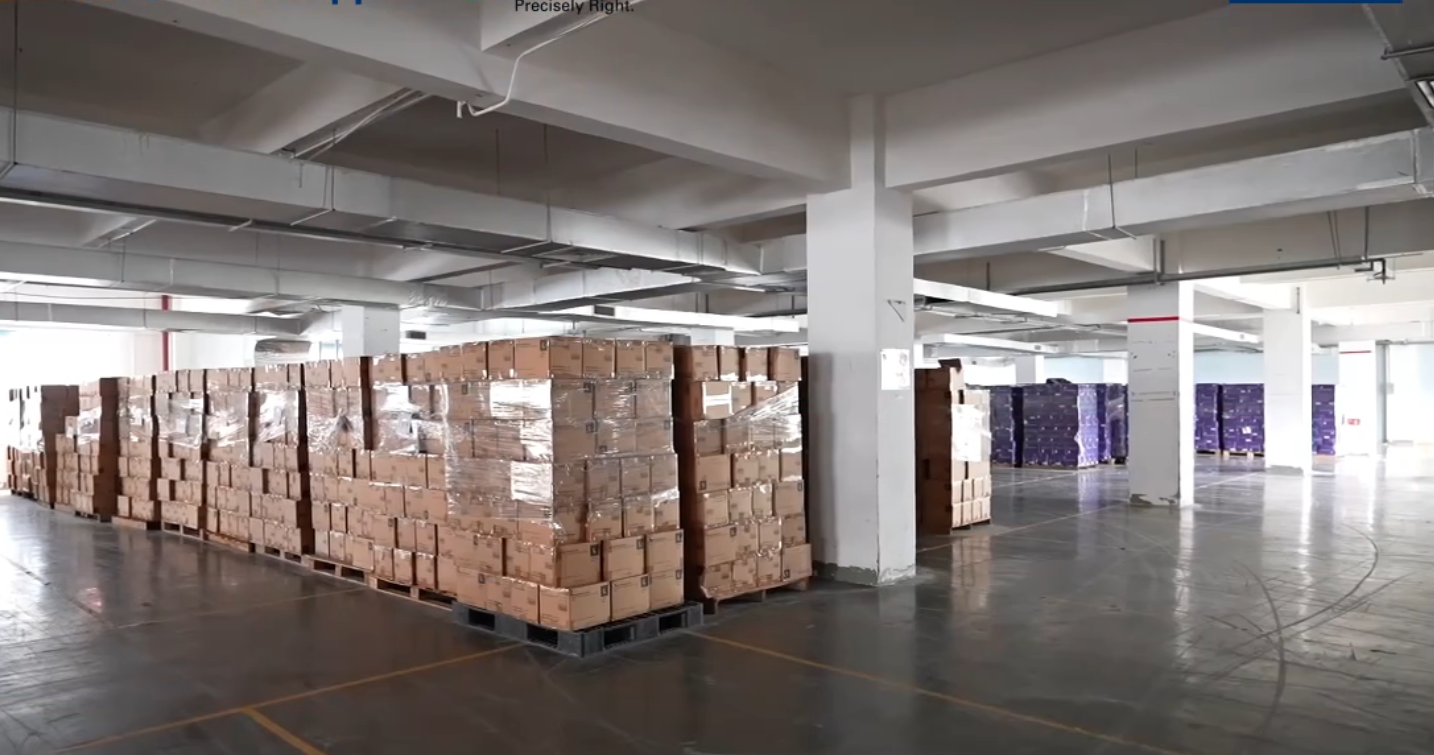
Company-supplied warehousing image. Packaging and lot control remain order-specific.
Purchasing terms and acceptance criteria before confirming an order
The commercial stage should convert the technical comparison into a short, auditable purchase specification. The following checks are a practical minimum for a nitrile glove order.
- Lock the exact product identity. Use the full product name, grade, color, size range, powder-free status, texture and packaging format. Nitrile gloves alone is not a purchase specification.
- Match the certificate to the market and product. A U.S. medical buyer should see the FDA 510(k) record and ASTM D6319-19 evidence. An EU medical buyer should see the applicable EN 455 and EU 2017/745 documentation. A China food-contact buyer should see GB 4806.11-2016 evidence. A Japan buyer should see the Japan-specific reference matched to the product.
- Check the document, not the logo. Confirm issuer, certificate number, product scope, manufacturing site, issue date, expiry date and the test report behind the claim. Keep the approved documents with the purchase order.
- Define acceptance sampling. Agree on AQL, sample size, inspection level and the treatment of nonconforming lots. ANBOSON reports AQL 1.5 and 100% inspection; the buyer should still write the acceptance rule into the order.
- Confirm packaging and shelf life. For Box Exam and Individually Wrapped lines, specify the packaging configuration, labeling, lot code and shelf-life requirement. Do not treat individual wrapping as a sterility claim unless sterility is separately validated.
- Review capacity and delivery terms. The supplied company profile lists 3.2 billion gloves annual output and a 70% export ratio. The risk-control material also cites Trade Assurance, capacity verification, on-time delivery tracking and a fastest delivery of five days. These are company-reported figures; buyers should convert them into a written lead time, incoterm and capacity reservation.
- Check landed cost and trade exposure. Schneider Direct reported in 2026 that standard exam-grade nitrile gloves wholesale at USD 80 to USD 140 per case of 1,000 in the United States. The same source reported that U.S. tariffs on Chinese-origin medical-grade nitrile gloves reached 100% in January 2026. Buyers should verify current tariff treatment and total landed cost before comparing unit prices.
- Set change-control and traceability rules. Require written approval before changes to formulation, manufacturing site, packaging, subcontractor or certificate scope. Keep lot-level traceability from raw material to finished carton.
Future outlook: fewer SKUs, more evidence
For procurement teams, the practical direction is toward fewer approved SKUs with stronger evidence files. Grand View Research estimated the global nitrile gloves market at USD 7.0 billion in 2026 and reported that powder-free gloves accounted for 74.8% of revenue in 2025. Those figures describe the commercial context; they do not prove that every product line will move in the same direction. The buyer-specific implication is more concrete: as product ranges expand, the risk of certificate mismatch rises, so approval should be tied to the exact SKU, market and intended use.
A buyer who separates medical, food-contact and industrial evidence will make better decisions than a buyer who counts certificates. The same logic applies to packaging: boxed exam and individually wrapped formats should be assessed as handling choices, not as substitutes for product approval. The strongest purchasing position is a documented link between intended use, market rule, product identity, test evidence and acceptance criteria.
FAQ
Are medical exam and food-grade nitrile gloves interchangeable?
No, unless the exact product carries evidence for both intended uses and both market scopes. A medical exam glove is supported by medical-device evidence such as FDA 510(k), ASTM D6319-19, EN 455 and EU 2017/745 documentation where applicable. A food-grade glove needs food-contact evidence such as FDA 21 CFR 177.2600 or GB 4806.11-2016 within the relevant scope. One claim does not automatically prove the other.
Does EN 455 certification satisfy U.S. FDA requirements?
No. EN 455 is an EU medical glove standard. The U.S. medical-device route is separate and, for the supplied ANBOSON record, is supported by FDA 510(k) clearance K222557. Buyers should verify the exact product and intended use in the FDA listing rather than accepting an EU certificate as a substitute.
What does FDA 21 CFR 177.2600 cover?
It is a U.S. food-contact regulation for rubber articles within its scope. It should be matched to the specific glove, material and conditions of use. It is not a medical-device clearance, and it should not be used to support an exam-glove claim.
Is an individually wrapped nitrile glove sterile?
Not automatically. Individual wrapping is a packaging format. A sterility claim requires separate validation and labeling. Buyers should confirm the underlying product's intended use, the packaging system, shelf life and any sterilization method before treating the product as sterile.
What should buyers check before confirming a nitrile glove order?
Confirm the exact SKU, intended use, market-specific certificates and test reports, AQL and acceptance sampling, packaging and shelf life, lot traceability, lead time, capacity, tariff exposure and change-control rules. Keep the approved documents attached to the purchase order so that the commercial order and the technical claim remain aligned.
The buyer decision rule is simple: match the line to the job, match the certificate to the market, and match the acceptance criteria to the batch. Medical Exam and Box Exam belong to medical-device evidence; Food Grade belongs to food-contact evidence; Heavy Duty Industrial and Industrial belong to defined performance and inspection criteria; Individually Wrapped belongs to packaging control. ANBOSON's capability profile provides a starting point, but the purchase order should stand on product-specific proof.
¿Tiene preguntas o necesita más detalles?
Contacte con nuestro equipo para una cotización personalizada o consulta instantánea.
Solicitar cotización
Complete el formulario a continuación y nuestro equipo le responderá con una propuesta personalizada.
Chat directo de WhatsApp
¿Prefiere chatear en tiempo real? Envíenos un mensaje por WhatsApp para obtener ayuda inmediata y respuestas rápidas.
- Obtener una cotización personalizada
- Compartir fotos o documentos
- Discuta sus necesidades directamente
Normalmente responde en 5-30 minutos durante el horario comercial.