
Evidence of Usability: How 100 Taiwan Units Improved Comfort
Heat stress on industrial sites is rarely a question of whether cooling products exist. It is a question of whether a crew keeps wearing one through a full shift of prolonged sun exposure, and whether the cooling it delivers is predictable enough to plan a working day around.
Deployment records answer that question more usefully than specification sheets do. One such record covers a Taiwan deployment of 100 COOLWAVE dual cooling water cooling vest units used across construction sites, outdoor work, metal-sheet factories and street-vendor operations. The recorded outcome is effective body cooling, heatstroke prevention, and improved worker comfort and work efficiency.
The two parameters most closely tied to that outcome in the record are cooling duration — 3–4 hours per cycle — and flow rate, listed at a maximum of 320–370 ml per minute. Read together with the vest's materials, contents and weight, they begin to explain why the deployment was described in terms of comfort rather than simply temperature.
COOLWAVE is the water-circulation cooling vest line made by Shokunin, the professional brand of Feng Shang Precision Co., Ltd., a Taiwan-based manufacturer founded in 2009 and located in Luzhu District, Taoyuan City. The company operates a 1,000 m² facility, states an annual output of 10,000 units and a five-engineer R&D team, and exports to the USA and ROC markets. Its product range includes air compressors, cut-off machines, lithium batteries, diamond saws and other professional tools, alongside the COOLWAVE water-cooled vest, which holds a Disaster Prevention Product and Service Certification Award issued by the Taiwan Disaster Prevention Industry Association.
Why Deployment Records Matter More Than Spec Sheets in This Category
A specification sheet tells a buyer what a product is capable of under stated conditions. It does not tell a buyer whether an industrial cooling vest survives contact with a real shift: whether workers put it on, whether the cooling window is long enough to matter, whether the weight is tolerable on top of existing protective clothing, and whether the cooling is distributed across the body or concentrated in one spot.
For buyers at the research and evaluation stage, a deployment record compresses several of those unknowns into a single reference. It does not replace testing or certification review, but it gives a buyer a realistic starting point: a product that has already been worn by a hundred people in high-temperature work, in one region, over an extended period.
The practical evaluation question is therefore not “which vest is the strongest on paper” but “which vest has evidence that people kept using it.” That is the gap the Taiwan record addresses.
The Taiwan Deployment Record in Plain Terms
The record is compact, and most of its value sits in the details rather than in the headline number. It documents the following entries.
| Record field | Entry |
|---|---|
| Country | Taiwan (TW) |
| Quantity deployed | 100 units |
| User environments named in the record | Construction sites, outdoor work, metal-sheet factories, street vendors |
| Application | Cooling use in high-temperature environments |
| Duration | 10 years |
| Recorded result | Effective body cooling, heatstroke prevention, improved work efficiency and worker comfort |
| Recorded design highlights | Ice-pack activated cooling, no external power requirement, lightweight and portable, adjustable one-size-fits-all design, certified disaster prevention product |
Three features of this record deserve attention during evaluation. First, the deployment is described by environment type rather than by a single employer, which means the comfort outcome was observed across several different heat-exposure profiles rather than one controlled site. Second, the recorded duration of 10 years places the deployment in the category of long-running field use, not a single-season trial. Third, the highlighted design properties include fit and portability — a one-size-fits-all adjustable design and lightweight construction — which are not cooling properties at all, but are the properties that decide whether a cooling vest is actually worn.
Cooling Duration: Why the 3–4 Hour Window Shapes Comfort
Cooling duration is the parameter that decides whether a cooling vest becomes part of a shift routine or becomes a distraction. The COOLWAVE specification lists a cooling duration of 3–4 hours per cycle, with two reusable ice packs supplied in the set.
A predictable cooling window is what turns a product into a routine. When a worker knows roughly how long the cooling will last, the vest stops being something to monitor and starts being something to plan around: the ice change becomes part of a break, and the second pack in the set provides a rotating spare. This is the mechanism that most plausibly connects the recorded parameters to the recorded outcome of improved worker comfort. Comfort in this context is less about reaching a specific temperature than about removing the uncertainty of when cooling will stop.
There is an honest boundary here. A 3–4 hour cycle is shorter than a standard eight-hour working day. The Taiwan outcome therefore depends on an ice-refresh routine being built into the working day, not on continuous all-day cooling. Buyers evaluating long shifts — extended outdoor postings, double shifts, or sites where a worker cannot easily step away — should plan the refresh interval before deployment rather than after it.
How Flow Rate Contributes to Perceived Comfort
Duration answers “how long,” while flow rate answers “how evenly.” The COOLWAVE specification lists a pump output of 5 V 150 mA (max) and a flow rate of 320–370 ml per minute at maximum. In an ice water circulation cooling vest, that flow is what moves chilled water through the cooling tube instead of leaving the cold source static against one part of the torso.
Static cooling — a plain ice cooling vest with packs sewn into fixed pockets — delivers a strong initial effect in a narrow area, then fades unevenly as the packs melt. Circulated cooling spreads the effect along the tube path, which is the physical difference that workers typically describe as comfort rather than intensity. The distinction matters for the same reason the duration matters: a consistent, moderate effect that lasts is easier to work in than a sharp effect that fades before the shift is over.
The supporting specification entries are equally relevant to wearability. The vest weighs within 2 kg, uses a 600D polyester shoulder strap, PEVA body material, a TPU water bag with a polypropylene cap, and a black sand-rubber cooling tube, and ships with one water-cooled vest backpack and two ice packs. The stated suitable temperature is below 10 °C.
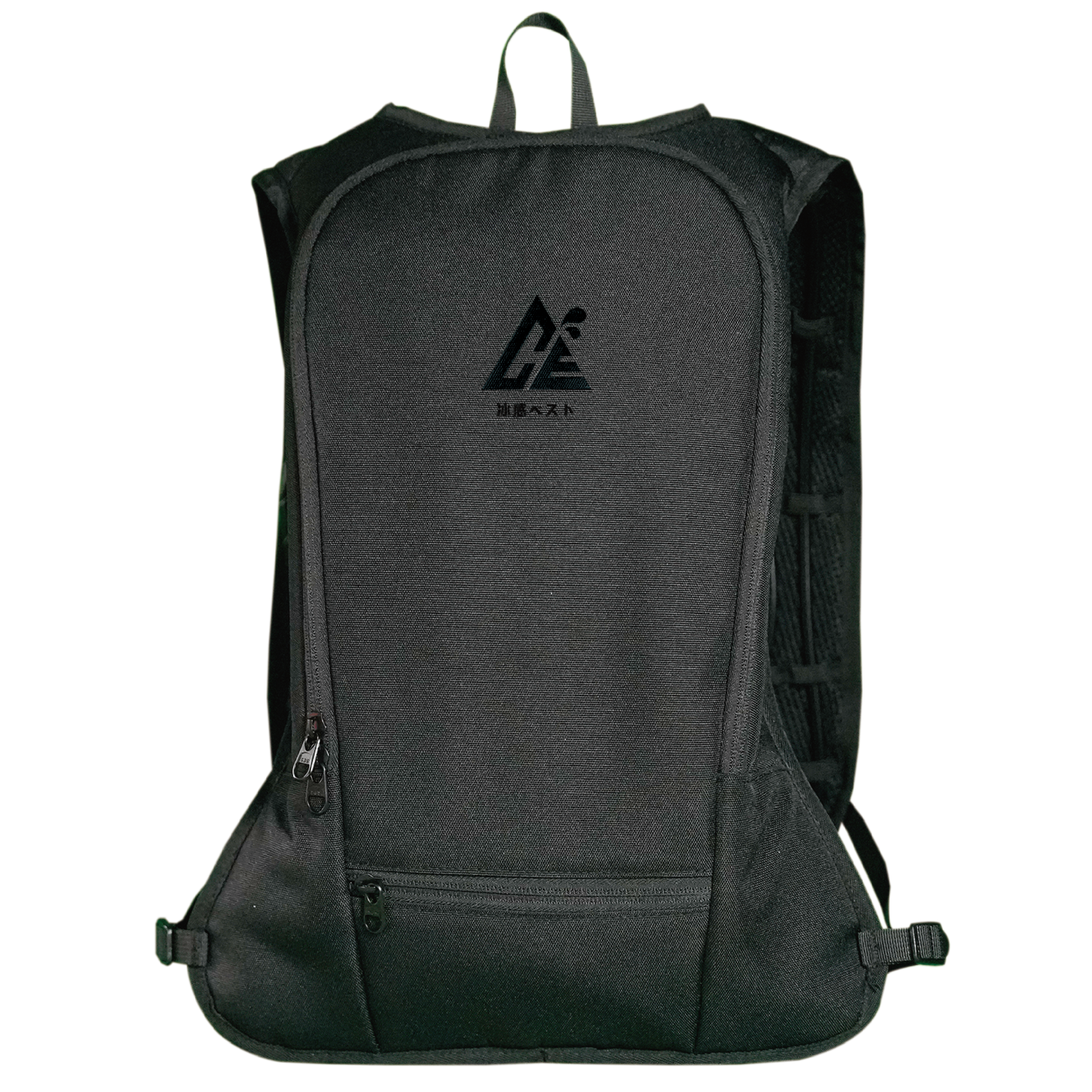
Reference configuration: the professional COOLWAVE water-circulation vest, listed with a 3–4 hour cooling duration, a 5 V 150 mA pump and a maximum flow rate of 320–370 ml/min.
Where the Vest Fits: The Scenarios Behind the 100 Units
The deployment record's environment list is the part most directly useful to a project buyer, because it maps cooling behaviour onto specific heat-exposure patterns rather than onto a generic “hot weather” category.
| Environment | Why the record includes it | Practical consideration |
|---|---|---|
| Construction sites | Sustained outdoor exposure with limited shade and moving work positions | Portability and adjustable fit matter more than fixed-position cooling |
| Outdoor work under prolonged sun exposure | Cooling need tracks the length of exposure, not a single task | The 3–4 hour cycle should be aligned with break scheduling |
| Metal-sheet factories | Radiant and ambient heat in an industrial indoor setting | Heat exposure can continue after ambient temperature drops |
| Street vendors | Long stationary hours in direct sun with no access to cooling rooms | Weight within 2 kg and a backpack format support standing work |
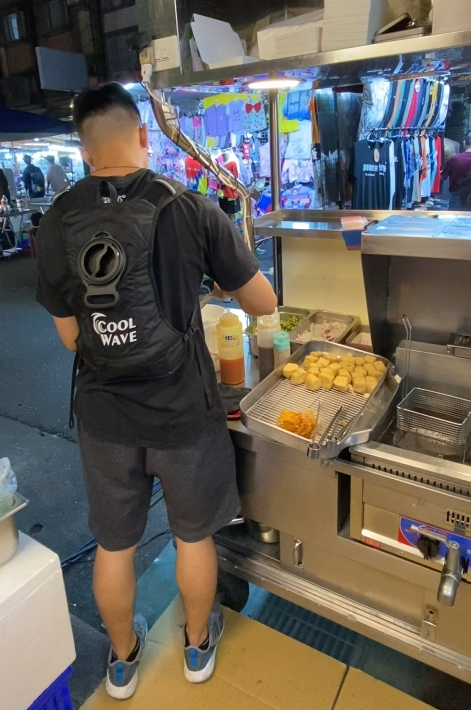
Street vending is one of the environment types named in the Taiwan deployment record: long hours in direct exposure, with no fixed cooling infrastructure available.
The product's stated applicable-industry list extends the same logic to food stall operators and traffic controllers — two groups whose exposure is continuous rather than task-based. For project planners, the useful reading is that this class of portable cooling vest is designed around uninterrupted exposure, not around short bursts of heat.
Market Signals Around Industrial Cooling
The deployment record does not exist in isolation. Published market data indicates that industrial and occupational cooling is an expanding category rather than a seasonal accessory line.
Dataintelo estimates the specific global cooling vest market at approximately USD 215 million in 2024, projected to reach USD 385 million by 2033. The same source reports that industrial applications, including construction and manufacturing, held the largest share of that market at 34.5% in 2025, and that phase change material (PCM) vests accounted for 28.7% of market share in 2025 as the fastest-growing technology segment.
Broader definitions produce much larger numbers. Market Research Future values the global personal cooling device market — a category that includes handheld fans and other devices, not only wearable cooling — at USD 25.16 billion in 2024, projected to reach USD 94.85 billion by 2035. The gap between USD 215 million and USD 25.16 billion is a definitional gap, and buyers citing market size should state which definition they are using.
On regional direction, Spherical Insights identifies Asia Pacific as the fastest-growing region for cooling vests, driven by rapid industrialisation and high outdoor work populations — a description that matches the environment types in the Taiwan record. A separate industry analysis by Strategic Market Research notes that active circulatory mechanisms, including ice water circulation, are increasingly deployed in industrial sectors to mitigate occupational heat stress, although that source carries a medium reliability rating and should be read as directional rather than definitive.
Compared With Ice-Pack and PCM Alternatives
Cooling vests are not a single product category. Three approaches dominate procurement discussions, and they differ in the way they deliver cooling rather than in whether they cool.
| Approach | Cooling mechanism | Recorded reference | Buyer consideration |
|---|---|---|---|
| Ice-pack only vest | Passive; frozen packs in fixed pockets | No pump or circulation loop | Strong local effect that fades unevenly as packs warm |
| PCM vest | Phase change material holds a temperature plateau | 28.7% of market share in 2025 (Dataintelo) | Requires a cooling environment to recharge between uses |
| Water-circulation vest (COOLWAVE) | Ice packs combined with a pumped circulation loop | 3–4 hours per cycle; flow rate max 320–370 ml/min; pump 5 V 150 mA; weight within 2 kg | Distributed cooling, but requires an ice-refresh routine and adds a 2 kg carry load |
The limitations are as important as the differences. A water-circulation industrial cooling vest adds weight on top of whatever protective clothing a site already requires, and the recorded figure of within 2 kg is a real load rather than a nominal one. The 3–4 hour cooling cycle is shorter than a full shift. And the system's behaviour depends on ice and water management between cycles, which is an operational task, not a product feature.
One point deserves clarification because it appears twice in the available records. The Taiwan case record describes the deployment as ice-pack activated with no external power requirement, while the product specification lists a 5 V 150 mA pump driving the circulation loop. Both entries refer to the same product family, but buyers comparing records should confirm the power configuration of the specific model they intend to order rather than assuming either description applies universally.
For market context, Spherical Insights lists Techniche International, Glacier Tek, Polar Products Inc. and Ergodyne among the publicly identified participants in the global cooling vest market. That list is useful for supplier mapping; it is not a performance comparison, and no verified specification data for those products is asserted here.
What This Deployment Evidence Does and Does Not Show
A field record is strongest when its boundaries are stated. The Taiwan deployment record supports the following readings:
- 100 units were used in high-temperature working environments in Taiwan across four named environment types.
- The recorded results are effective body cooling, heatstroke prevention, and improved work efficiency and worker comfort.
- The record spans 10 years, indicating long-running rather than trial use.
- Lightweight construction, portability and an adjustable one-size-fits-all design are recorded as deployment highlights, alongside a disaster prevention product certification.
It does not support the following readings, and buyers should not infer them:
- The record reports outcomes qualitatively. It does not include measured physiological data such as core temperature, heart rate or heat-strain indices.
- It covers one regional deployment of 100 units. It is not a multi-region or multi-climate data set.
- No independent third-party test results for the cooling performance are included in the available material.
- Result statements such as “improved work efficiency” are recorded outcomes, not controlled-study measurements.
Read correctly, this is usability evidence: proof that a hundred workers in high-temperature roles used the product in real conditions over an extended period and that the deployment was recorded as a comfort and heatstroke-prevention outcome. It is not clinical validation, and treating it as such would overstate what the record contains.
Outlook: What Buyers Will Ask Next
Several signals point in the same direction for procurement over the next planning cycles. Asia Pacific's position as the fastest-growing cooling vest region, the industrial segment's 34.5% market share in 2025, and the growing deployment of active circulatory mechanisms in occupational heat-stress mitigation all suggest that buyers will increasingly evaluate cooling vests as equipment rather than as accessories.
That shift changes the evidence buyers request. Standard-based documentation is one part of it: cooling systems are expected to comply with ISO 9001:2015 for quality management, and electrical components often require CE or UL marks — a point that applies directly to vests containing a pump. Deployment references are the other part, because they answer questions that standards do not: whether workers keep the product on, and whether the cooling window matches the shift.
For suppliers, the practical implication is that a field record is more persuasive than an additional specification line. For buyers, the practical implication is to ask for the deployment record alongside the certificate — and to read both for what they actually cover.
FAQ
What does the Taiwan deployment record actually document?
It documents the use of 100 COOLWAVE water-circulation cooling vest units in Taiwan for cooling in high-temperature environments, across construction sites, outdoor work, metal-sheet factories and street vendors. The recorded result is effective body cooling, heatstroke prevention, and improved work efficiency and worker comfort, with a recorded duration of 10 years.
Which work environments does the record cover, and which does it not?
The case record names four environment types: construction sites, outdoor work, metal-sheet factories and street vendors. The product's stated applicable industries are wider, listing construction workers, outdoor workers, food stall operators, street vendors, traffic controllers and metal-sheet factories. The case should therefore be read as evidence from a subset of the stated applications.
How long does one cooling cycle last, and what happens afterwards?
The listed cooling duration is 3–4 hours per cycle. Because this is shorter than a standard eight-hour shift, the deployment depends on an ice-refresh routine within the working day. Two ice packs are supplied with each vest, which supports rotation between cycles.
What flow rate does the circulation loop deliver?
The specification lists a pump output of 5 V 150 mA (max) and a maximum flow rate of 320–370 ml per minute. That circulated flow is what distributes cooling along the tube path rather than concentrating it in one static contact area.
How heavy is the vest, and what does the temperature specification mean?
The vest weighs within 2 kg and is supplied as a backpack format with an adjustable one-size-fits-all design. The stated suitable temperature is below 10 °C. Weight is added on top of any protective clothing already required on site, so buyers should treat it as a real carry load when planning for full shifts.
How does water circulation compare with ice-pack-only and PCM vests?
Ice-pack-only vests cool passively through fixed pockets, producing a strong local effect that fades unevenly. PCM vests rely on phase change material and accounted for 28.7% of 2025 market share as the fastest-growing technology segment, per Dataintelo, but require a cooling environment to recharge. Water-circulation vests combine ice packs with a pumped loop, which distributes cooling more evenly at the cost of ice and water management between cycles.
What should a buyer verify before treating a deployment case as evidence?
Three things: whether the record reports measured data or qualitative outcomes, which environments and shift lengths it actually covers, and whether the power configuration matches the model being ordered. In this record, cooling duration, flow rate, weight and environment types are documented; measured physiological data and independent third-party test results are not included.
Reference Material
The COOLWAVE water-circulation cooling vest is manufactured by Feng Shang Precision Co., Ltd. and marketed under the Shokunin professional tool brand. Product and company information is published at fstool.com.tw. A downloadable product brochure covering the cooling vest and the wider tool range is available here.