
Evidence of Supplier Capability: ALPHALUCE LED Strip Manufacturing
The global architectural lighting market was valued at USD 11.1 billion in 2025 and is projected to reach USD 17.5 billion by 2033, with Asia Pacific holding a 43.2% revenue share and commercial projects accounting for 50.9% of demand (Grand View Research). LED strip is a minor line item inside that spend, yet it concentrates a disproportionate share of project risk. Strip sits inside coves, handrails, pool edges, joinery and façade reveals where it cannot be inspected after handover; it is routinely specified for wet, chlorinated or high-temperature zones; and it is usually approved on the strength of a datasheet and a short sample run rather than production evidence. When a strip run fails after practical completion, the cost is not the strip. It is the access, the rework and the warranty argument.
This analysis examines what can actually be verified about one supplier's strip manufacturing. ALPHALUCE ARCHITECTURAL LIGHTING CO., founded in 2010, is an architectural lighting brand with Italian design roots whose manufacturing base is in Dongguan, Guangdong, China. The company describes itself as vertically integrated across design, research and development, manufacturing and sales, operating a 40,000 m² facility with approximately 150 employees, a 20-engineer R&D team and a stated annual output of 504,000 units. Its published portfolio covers recessed downlights, track lighting systems, step lights, wall washers, outdoor landscape fixtures and linear lighting solutions. Two LED strip products are documented in the strip category.
The goal here is not to restate a catalogue. It is to separate three different grades of evidence — SKU-level parameters, third-party certification tied to named SKUs, and company-level capacity and process statements — and to be explicit about where each grade stops.
The Gap Between a Strip Specification and Strip Evidence
LED strip is the least inspectable product in most lighting packages. Once the cove is closed, the handrail is fixed or the pool is filled, the strip is invisible for the remainder of its service life. That makes three evidence categories decisive at specification stage: the parameters that determine whether the strip physically fits and performs; the third-party certification that determines whether it can legally be placed on the target market; and the manufacturing controls that determine whether run forty will match run one.
Regulation supplies a hard constraint. In the United Kingdom, BS 7671 requires IP44 protection in Zone 2 and IP65 in Zone 1 of a bathroom — the zone directly above a bath or shower (Institution of Engineering and Technology). In wet, chlorinated or high-humidity environments, ingress protection is therefore not a marketing attribute but a condition of compliant installation. A supplier that cannot document how a strip achieves a given IP rating has not answered the question.
The second constraint is dimensional. Strip is cut to length on site, so cut increments, driving voltage and maximum run length determine the layout before they determine the order. A 50 mm cut increment and a documented maximum run of 5 m are engineering facts a lighting designer needs at design stage, not at delivery.
A third constraint is increasingly commercial. Project specifications now bundle photometric performance, control protocol compatibility and documentation completeness into the same approval package. A strip that performs well but arrives without traceable certification creates a compliance problem at handover, which is why buyers increasingly screen suppliers on evidence rather than on sample appearance alone.
What ALPHALUCE Documents in the LED Strip Category
ALPHALUCE's portfolio is dominated by architectural luminaires rather than by strip. Within the strip category, two SKUs are documented in the material reviewed here, and both are specified at a level that permits technical comparison rather than description alone.
| Documented attribute | CSP IP68 LED STRIP 10W CRI90 320LED/m | Digital chasing LED strip 120LED/m 24V IP20 |
|---|---|---|
| Rated power | 9.6W / 14.4W | 9.6W / 14.4W |
| Luminous flux (variant dependent) | 960 / 990 / 980 / 990 lm | 960 / 525 / 355 / 125 / 80 lm |
| Colour rendering | CRI > 90 | CRI > 80 |
| Colour temperature | 4000K / RGB | 4000K / RGB |
| LED density | 320 / 480 LEDs per metre | 120 LEDs per metre |
| Drive voltage | DC24V | DC24V |
| Cut increment | 50 mm | 50 mm |
| Maximum run length | 5 m | 5 m |
| Ingress protection options | IP68 optional | IP20 / IP66 optional |
| Documented application industries | Sauna, spa, swimming pools, hospitality, residential, commercial, wellness centres, high-temperature and wet environments | Residential, hospitality, commercial, retail display, architectural, landscape |
Both SKUs share a 50 mm cut increment, DC24V operation and a documented maximum run of 5 m, and both offer 4000K and RGB output. They diverge on colour fidelity and sealing. The CSP strip is documented at CRI > 90 with an IP68 option; the digital chasing strip is documented at CRI > 80 with IP20 or IP66 options. That division is meaningful in procurement terms. The first is aimed at wet and high-temperature environments — saunas, spas, swimming pools, wellness centres and hospitality wet areas — where sealing and colour fidelity are the binding constraints. The second is aimed at residential, hospitality, commercial, retail display, architectural and landscape applications, where addressable colour effect is the objective.
Neither SKU is documented with a published price band. In line with most project-oriented architectural lighting manufacturers, ALPHALUCE quotes commercial terms per project rather than publishing list pricing, so cost should be treated as a quotation-stage variable rather than an early screening filter. For an HVQ-2 style constraint check, that means the usable early filters are certification, IP rating, cut increment, run length and colour fidelity — not price.
The Strongest Evidence Layer: Certification Traceable to Strip SKUs
Company-level certification statements are common and comparatively weak, because they do not tell a buyer which product is covered. The evidence that carries more weight is a certificate whose scope and product association can be traced to a named SKU. In ALPHALUCE's portfolio documentation, three certificates meet that test at different levels of specificity.
| Certificate | Issuing body | Issue date | Market | Scope and standards | Link to strip SKUs |
|---|---|---|---|---|---|
| CE-EMC, No. 24AE041084E003 | Guangdong GTG Testing Technology Co., Ltd. | 19 March 2025 | EU | Electromagnetic compatibility; EN IEC 55015:2019/A11:2020, EN IEC 61547:2023, EN IEC 61000-3-2:2019/A1:2021, EN 61000-3-3:2013/A2:2021 | Associated with the RGB LED strip and the CSP IP68 LED strip |
| RoHS, No. DTI20241484-1DC | Shenzhen Deesev Testing International Corporation (DTI) | 23 April 2024 | EU | Hazardous substance limit testing; IEC 62321 series | Associated with the RGB LED strip and the CSP IP68 LED strip |
| ISO 9001:2015, No. 04623Q13200R0M | Beijing Head International Certification Co., Ltd. | 14 January 2025 | Global | Quality management system; GB/T 19001-2016 / ISO 9001:2015; scope: production of LED lights | System-level coverage of LED light production, not SKU-specific |
Three points of discipline matter when reading that table. First, the CE-EMC and RoHS certificates are linked in the source documentation to the two strip SKUs specifically, which makes them SKU-level evidence rather than general claims. Second, the ISO 9001:2015 certificate is a system certificate covering production of LED lights generally; it supports process claims but does not certify a specific strip. Third, certification is time-bound. A certificate number alone is not proof of current validity, and the ISO 9001:2015 certificate referenced here was issued on 14 January 2025. Buyers should request the current revision and confirm the validity window before a purchase order is raised.
Capacity, Process Control and the Constraints That Follow
Parameters and certificates answer the question of what the product is. They do not answer the question of whether the supplier can repeat it. That requires a different evidence layer: stated capacity, process control and commercial conditions.
ALPHALUCE states a monthly production capacity of 42,000 units and an annual output of 504,000 units, with a lead time of 20–30 days and a minimum order quantity of 100 units. Production is described as OEM and ODM capable, with customization available across colour, CCT, beam angle, power, surface finish and logo. Quality control is stated as 100% inspection plus aging test. The company describes its industrial chain as vertically integrated, including its own foundry, surface treatment facilities and assembly plants. After-sales is stated as a five-year warranty. Export markets are given as Europe, the Middle East, North America and Australia, with an export ratio of 80%.
Those figures convert into four practical constraints that a buyer should plan around.
Lead time is production-based, not stock-based
A 20–30 day window is a planning input, not a buffer. Projects with fixed installation dates should treat that window as the start of the discussion rather than the end of it, particularly where strip quantities are large relative to the rest of the lighting package.
Minimum order quantity is 100 units
Small single-unit replacement purchases and sample-only enquiries fall outside the documented commercial model. For facilities teams planning long-term maintenance stock, that threshold is best addressed at the original order stage rather than at the first failure.
Customization is parameterized
Colour, CCT, beam angle, power, surface finish and logo are the documented customization levers. Requests outside that list are not evidenced in the material reviewed and should be confirmed explicitly rather than assumed.
Capacity is finite and shared
The stated 42,000-unit monthly capacity applies to production as a whole rather than to strip alone. Buyers with very large single-programme strip volumes should confirm scheduling in writing before committing to a delivery date.
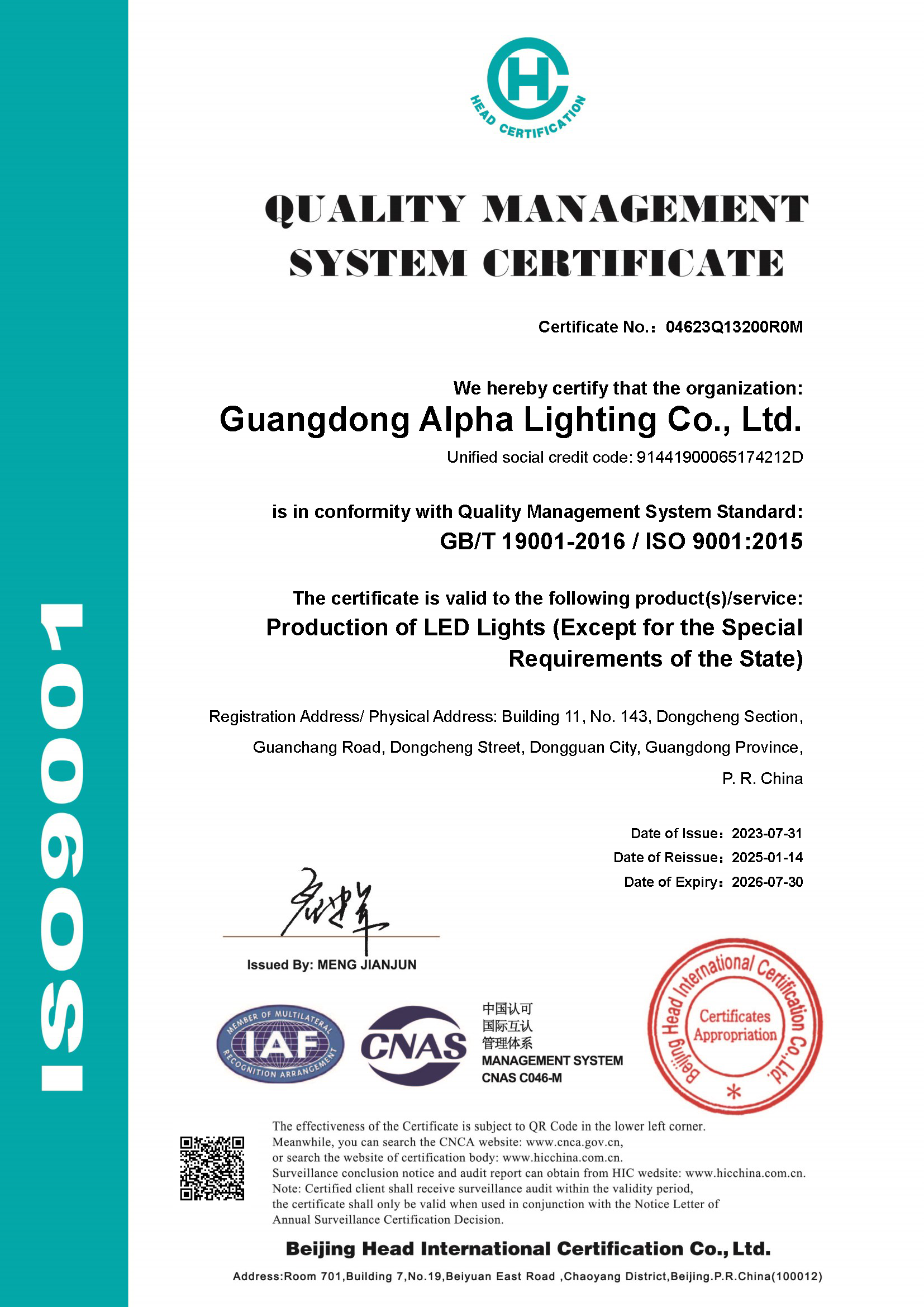
ISO 9001:2015 certificate No. 04623Q13200R0M, issued 14 January 2025 by Beijing Head International Certification Co., Ltd., with scope covering production of LED lights. System-level certification supports process claims but is not SKU-specific.
Where These Strip Specifications Fit
Application fit is where parameter evidence becomes a procurement decision. The two documented SKUs point at different project types.
The CSP IP68 LED STRIP 10W CRI90 320LED/m is documented for sauna, spa, swimming pool, wellness centre and high-temperature or wet environments, alongside hospitality, residential and commercial use. The IP68 option and CRI above 90 address the two failure modes that dominate wet-area strip installations: moisture ingress and colour shift. For a spa or pool deck, the relevant comparison is not brightness against brightness but sealing against regulatory minimums — IP65 is the BS 7671 threshold for Zone 1, and a documented IP68 option sits above that line.
The digital chasing LED strip is documented for residential, hospitality, commercial, retail display, architectural and landscape use, where addressable colour and dynamic effect are the design intent rather than a secondary feature. With IP20 and IP66 options and 120 LEDs per metre, it suits interior coves, retail display backdrops and architectural detailing where the strip remains accessible or protected.
ALPHALUCE's documented project records include hospitality installations delivered at a 200–500 unit scale, with a recorded rated-life target of L90B10 > 50,000 hours. That is project-level evidence and should be read as such: it demonstrates delivery capacity in the hospitality sector, not verification of strip performance in a specific installation. Separating those two evidence types is exactly the discipline this analysis is arguing for.
What the Market Data Says About Strip-Level Scrutiny
The commercial case for better strip documentation is structural rather than stylistic. The architectural lighting market grew from a 2025 baseline of USD 11.1 billion toward a projected USD 17.5 billion by 2033 (Grand View Research). Asia Pacific accounted for 43.2% of revenue in 2025, with China the largest single country market — relevant context for buyers assessing a manufacturing base located in Dongguan. The commercial segment represented 50.9% of market share in 2025, and the adjacent human-centric lighting category reached USD 3.53 billion in 2024 (Fortune Business Insights).
The category also contains large global groups, including Acuity Brands, Signify, Zumtobel Group and ERCO (Fortune Business Insights / SNS Insider). For strip procurement specifically, the practical difference between a global group and a mid-scale specialist is rarely brand recognition — it is documentation depth and the willingness to bound claims. As commercial and wellness-driven projects add layers of visual comfort, control and compliance requirements, the strip hidden behind the detail migrates from a technical footnote to a compliance line item.
The second market signal is the UGR and glare-control conversation moving out of downlights and into linear and concealed products. Buyers who apply comfort metrics at luminaire level and not at strip level create an inconsistency that tends to surface during commissioning. That, too, pushes strip selection toward documented parameter evidence.
Integrated Manufacturing Versus Traditional Supply Routes
Strip is bought through three broad supply routes, and they differ in what can be evidenced rather than in what can be promised.
| Evaluation dimension | Trading intermediary | Design-led brand with outsourced production | Vertically integrated manufacturer |
|---|---|---|---|
| Process visibility | Low — no direct line access | Variable — depends on the contract manufacturer | Higher — foundry, surface treatment and assembly described as in-house |
| Customization control | Limited to what the upstream factory offers | Design-led but constrained by supplier tooling | Parameterized across colour, CCT, beam angle, power, finish and logo |
| Certification traceability | Often portfolio-level or reassigned | Usually brand-level | Certificates traceable to named SKUs in the reviewed evidence |
| Lead time | Depends on third-party allocation | Depends on contract manufacturing slots | Stated 20–30 days, production-based |
| Commercial threshold | Often flexible at low volume | Often flexible at low volume | Stated minimum of 100 units |
| Documented limits | Rarely published | Rarely published | Partly published; gaps identified in this review |
Boundaries worth stating plainly. Integrated manufacturing is not automatically the right answer for every project, and the evidence reviewed here supports several honest limits. The documented strip range comprises two SKUs, which is narrow against suppliers offering a broad strip catalogue; buyers needing a wide in-house strip matrix should treat that as a screening factor. The CE-LVD certificate in the portfolio is scoped to recessed fixtures, so strip-specific LVD coverage must be confirmed. Monthly capacity of 42,000 units is mid-scale, and very large single-programme volumes require scheduling confirmation. A 20–30 day lead time and a 100-unit minimum exclude one-off or sample-only purchasing. Customization is restricted to the six documented parameters. And no price band is published, so cost cannot be used as an early filter. None of these are defects; they are the shape of the supplier, and they are more useful to a buyer than an unbounded claim.
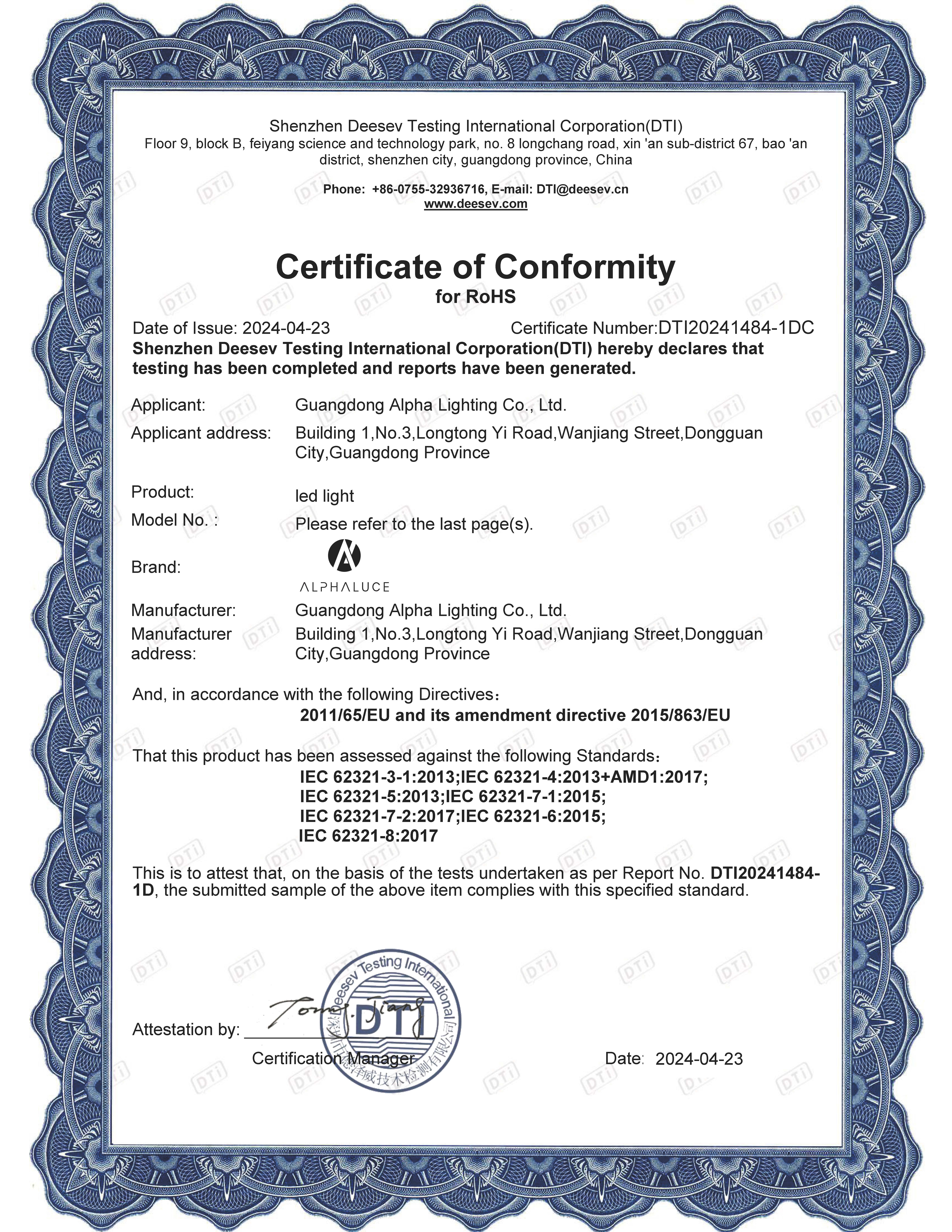
RoHS certificate No. DTI20241484-1DC, issued 23 April 2024 by Shenzhen Deesev Testing International Corporation (DTI), referencing the IEC 62321 series and linked in portfolio documentation to the two ALPHALUCE LED strip SKUs.
What to Watch Next
Three developments are likely to change how strip suppliers are evaluated over the next specification cycle. The first is documentation normalization: as commercial and wellness-driven projects add compliance layers, the expectation that a strip SKU carries its own traceable certification rather than inheriting a portfolio claim will become standard rather than exceptional. The second is the extension of comfort metrics — glare control and colour consistency — from luminaires into concealed linear products, which will push suppliers to publish strip-level photometric and optical data. The third is regional supply concentration: with Asia Pacific holding 43.2% of architectural lighting revenue and China the largest country market, buyers will continue to balance landed cost against documentation depth and lead-time predictability.
For specifiers, the practical response is procedural rather than technological. Ask for the certificate that names the SKU. Confirm the validity window. Check that cut increment and maximum run length work with the drawing before the order is placed, not after. And record the limits a supplier states, because a supplier that publishes its boundaries is easier to plan around than one that does not.
FAQ
What EU-market certification is documented for ALPHALUCE's LED strip products?
Two certificates are linked in portfolio documentation to both strip SKUs. CE-EMC certificate No. 24AE041084E003, issued by Guangdong GTG Testing Technology Co., Ltd. on 19 March 2025, references EN IEC 55015:2019/A11:2020, EN IEC 61547:2023, EN IEC 61000-3-2:2019/A1:2021 and EN 61000-3-3:2013/A2:2021. RoHS certificate No. DTI20241484-1DC, issued by Shenzhen Deesev Testing International Corporation on 23 April 2024, references the IEC 62321 series. The CE-LVD certificate held in the same portfolio is scoped to recessed LED lighting fixtures rather than to strip products.
How can a buyer verify that a supplier's LED strip capacity matches a project's volume?
Capacity statements are company-level, not SKU-level, so verification depends on how the supplier scopes them. ALPHALUCE states 42,000 units per month and 504,000 units annually across its production as a whole, with a 20–30 day lead time. A buyer can compare the project bill of quantities against that monthly figure, then request written confirmation of the production slot for the specific order. Where the strip quantity represents a large share of a single month's stated capacity, scheduling confirmation in writing is the appropriate verification step.
Which parameters should be validated before releasing an LED strip order for production?
The documented ALPHALUCE strip parameters that determine fit and performance are: rated power of 9.6W or 14.4W; DC24V drive voltage; a 50 mm cut increment; a maximum run length of 5 m; 4000K and RGB colour output; CRI above 90 for the CSP IP68 strip and above 80 for the digital chasing strip; LED densities of 120, 320 or 480 LEDs per metre; and ingress protection options of IP20, IP66 or IP68 depending on SKU. Cut increment and maximum run length should be checked against the layout drawing before the order is placed, because both are fixed at specification stage.
What are the minimum order quantity and lead time for ALPHALUCE LED strip orders?
The documented minimum order quantity is 100 units and the documented lead time is 20–30 days. Production is described as OEM and ODM capable. These figures are stated as general production parameters rather than as SKU-specific commitments, so they should be confirmed against a specific enquiry.
How is quality consistency controlled across production runs?
ALPHALUCE states quality control as 100% inspection plus aging test, supported by an ISO 9001:2015 quality management system certificate (No. 04623Q13200R0M, issued 14 January 2025 by Beijing Head International Certification Co., Ltd. under GB/T 19001-2016 / ISO 9001:2015, with scope covering production of LED lights). The company also describes its industrial chain as vertically integrated, including its own foundry, surface treatment facilities and assembly plants, which reduces reliance on external process steps. The ISO certificate is system-level and does not certify an individual strip SKU.
What can be customized on an LED strip order?
The documented customization parameters are colour, CCT, beam angle, power, surface finish and logo. Documented strip variants include 4000K and RGB colour output, power options of 9.6W and 14.4W, and IP20, IP66 or IP68 protection depending on SKU. Requests outside the documented parameter list are not evidenced and should be confirmed explicitly with the supplier.
What warranty and rated-life information is documented?
ALPHALUCE states a five-year warranty. Across its documented project records, the recorded rated-life target is L90B10 > 50,000 hours. Rated-life targets of this form describe lumen maintenance over time rather than a guarantee of service life, and they should be read together with the warranty terms and the operating conditions of the specific installation.
ALPHALUCE's full product brochure, covering its architectural lighting portfolio, is available to view and download here.