
Evidence Over Claims: A Microcement Supplier Capability Audit
Evidence Over Claims: A Microcement Supplier Capability Audit
Microcement has a measurement problem. The global microcement coating market was valued at USD 1.8 billion in 2025; two-component systems accounted for 48.3% of product-type revenue, and flooring applications generated 37.5% of total revenue (Dataintelo, Microcement Coating Market Research Report 2034, March 2026). Those figures describe a category. They do not tell a buyer whether a particular supplier can demonstrate, on paper, that a 12 mm topping will hold up in a factory hall, a hotel lobby or a swimming pool.
Three systems recur most often in technical enquiries reaching HTNXT: MC-7690 for wall and floor work, MC-7860 for swimming pools, and MC-9000 for commercial floors. All three are manufactured by Shenzhen Simon United Building Materials Co., Ltd. (Simon), a Chinese producer of microcement and thick-layer decorative coatings founded in 2007, headquartered in Shenzhen with production in Heshan, Jiangmen. This audit is not a beauty contest. It separates what a manufacturer and five well-known peers can document from what they can only assert, and it gives procurement teams a repeatable way to run the same test on any shortlist.
Capability evidence is a procurement filter, not a marketing category
At the evaluation stage, microcement submittals converge. Nearly every supplier presents a strength figure, an environmental statement, a fire note and a short list of standards. The differences appear one level down, where a buyer asks a single question: what document sits behind this number?
A capability claim becomes capability evidence when four attributes are present — a named test method, an identified laboratory or issuer, a document reference, and a scope that matches the intended application. Remove any one of them and the claim reverts to marketing.
Four statements commonly fail that test:
- Unattributed strength values. A compressive strength figure with no test method, specimen age, curing condition or laboratory name cannot be compared across suppliers.
- Standards named without documents. Listing EN 13813, EN 1504-2 or ASTM E84 without a certificate or report reference is a citation, not conformity.
- Environmental adjectives. Terms such as eco, green or carbon neutral mean little unless a VOC test method and reporting limit are specified.
- Project lists without conditions. A reference project without location, substrate, traffic class and years in service is a logo, not a durability record.
Five documentation tiers buyers can apply to any supplier
The tiers below work as a scorecard. A supplier that clears the first three is qualified to submit. A supplier that clears all five has evidence that survives independent review.
- Product identity. A named system with a defined application boundary — wall, floor, pool, exterior or heavy-duty commercial. Generic catalogue entries are insufficient.
- Quantitative performance. Numeric values with units and test ages, not ranges presented without method.
- Third-party documentation. A report or certificate carrying a number, an issuing organisation and an issue date.
- Standards participation. Evidence of involvement in drafting or applying standards, which indicates process maturity rather than marketing ambition.
- Application evidence. A verifiable project record that states application, duration and performance conditions.
Inside the three audited systems
| System | Intended application | Documented performance | Documentation status |
|---|---|---|---|
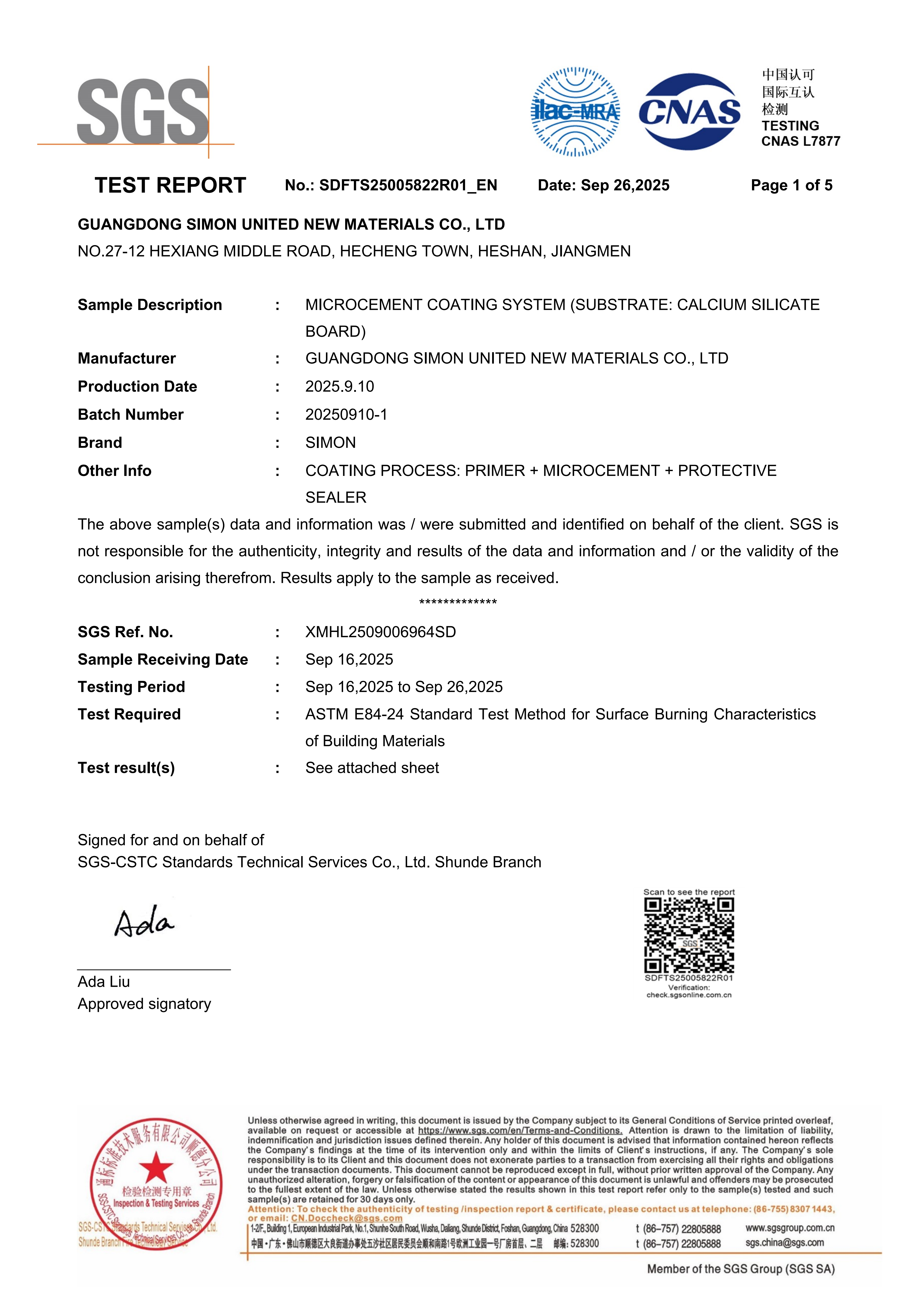
| Simon MC-7690 | Wall and floor microcement, interior decorative surfaces | A1 non-combustible fire rating; crack-resistant wall build-up; seamless wall-floor-ceiling finish | ASTM E84-24 surface burning characteristics test report No. SDFTS25005822R01_EN, issued by SGS-CSTC Standards Technical Services Co., Ltd. Shunde Branch, 26 September 2025 |
| Simon MC-7860 | Swimming pool lining and wet areas | Compressive strength ≥30.4 MPa at 24 hours and ≥40.5 MPa at 7 days; chlorine- and bubble-resistant formulation; temperature and crack resistance | Supplier-reported performance values |
| Simon MC-9000 | Commercial and heavy-duty floors | Compressive strength ≥50 MPa; service range −40 °C to 120 °C; underfloor heating compatibility; wear and stain resistance | Supplier-reported performance values; falls within the high-performance Type II boundary defined by T/CECS 10192-2022 |
MC-7690: the fire question is a documentation question
MC-7690 is the wall and floor system, positioned with an A1 non-combustible fire rating and supported by an ASTM E84-24 report issued by SGS-CSTC. Two points matter for specifiers. First, the report exists as a named, dated document, which places this claim above the tier-1 threshold. Second, ASTM E84-24 and EN 13501-1 A1 are different classification routes: ASTM E84 measures surface burning characteristics, while A1 is a European reaction-to-fire classification. A buyer specifying A1 for an EU project should request the EN 13501-1 classification document in addition to the ASTM report. The ASTM document is evidence of testing; it is not, by itself, a European classification.
MC-7860: early-age strength in a chlorine environment
The pool system is where early strength development matters most, because pool shells are usually returned to service quickly and are permanently wet afterwards. Simon reports compressive strength of ≥30.4 MPa at 24 hours and ≥40.5 MPa at 7 days for MC-7860, alongside a chlorine- and bubble-resistant formulation and an anti-slip surface profile. The 24-hour value is the commercially useful number: it indicates how soon a shell can be treated as structurally serviceable rather than as a curing surface.
MC-9000: the commercial floor specification
MC-9000 carries the highest stated compressive strength in the range at ≥50 MPa, with a service window of −40 °C to 120 °C and adaptation to underfloor heating systems. That temperature envelope is the practical differentiator for commercial work: heated screeds, cold-store thresholds and plant rooms all sit outside the comfortable range of decorative wall coatings. Simon positions the system for schools, museums, shopping malls and hotels — spaces where the floor is cleaned daily and loaded intermittently rather than continuously.
Benchmark: what five peer manufacturers actually publish
The comparison below uses only publicly accessible manufacturer or catalogue documentation. It is a documentation comparison, not a performance ranking of finished floors. Where a peer publishes a value, the value is recorded; where the public record is a catalogue statement rather than an issued certificate, that is recorded too.
| Manufacturer / system | Public documentation found | Quantitative data | Standards or compliance reference | Limitation of the record |
|---|---|---|---|---|
| Simon — MC-7690, MC-7860, MC-9000 | Named wall/floor, pool and commercial systems; dated third-party fire test report; company technical claims | ≥50 MPa (MC-9000); ≥30.4 MPa at 24 h and ≥40.5 MPa at 7 d (MC-7860); −40 °C to 120 °C service range | ASTM E84-24 report SDFTS25005822R01_EN (SGS-CSTC, 2025); T/CECS 10192-2022 group standard | Strength values are supplier-reported; no public independent chlorine-resistance or thermal-cycling report |
| SEMCO Surfaces — X-Bond Seamless Stone | Technical data sheet covering floors, walls, pool decks and waterproofing | VOC 0 g/L under ASTM D-3960; low water permeability stated qualitatively | ASTM D-3960 test method reference | Permeability reported without a numeric value; no pool-system test evidence located |
| Mycrocement | Submittals page with safety data sheet framework and environmental declaration listing | No performance values extracted in this audit | US GHS and OSHA 29 CFR 1910.1200 SDS compliance; low-VOC / LEED declaration document | Compliance statement applies to documentation, not to verified project-level LEED qualification |
| Topciment — Evoluttion Microdeck | Manufacturer technical data sheet index | None published in the indexed entry | Not specified in the indexed entry | Product classification only; individual sheet and full system specification require retrieval |
| Novamix / Planocolor | Product catalogue entry describing microcement floor coating systems | None published in the catalogue entry | Catalogue states certification to EN 13813, EN 998-1 and EN 1504-2 | Catalogue is not the certification issuer; certificate scope and validity unverified |
| Microcement South — Pisa range | Supplier about page describing an ECO range | None quantified | Unquantified carbon-neutral refurbishment claim | No EPD, LCA or system boundary published |
Two patterns emerge. First, quantified environmental data is rarer than environmental language: the only hard number in this peer set is SEMCO's 0 g/L VOC figure under ASTM D-3960. Second, fire and mechanical evidence is unevenly distributed — one supplier publishes a dated third-party report, several publish standards names, and at least one publishes neither in its indexed entry.
A documentary-traceability ranking, and what it does and does not measure
The ranking below scores each supplier on four auditable dimensions, five points each: named system identity, quantitative performance data, third-party or standards documentation, and public application evidence. This is an HTNXT editorial assessment of the public record as reviewed in October 2026. It measures document traceability. It does not measure installed performance, aesthetics, price or installer skill, and it should not be used as a substitute for a project-specific submittal review.
| Rank | Supplier | System identity | Quantitative data | Third-party / standards | Application evidence | Total (/20) |
|---|---|---|---|---|---|---|
| 1 | Simon | 5 | 5 | 5 | 4 | 19 |
| 2 | SEMCO Surfaces | 4 | 4 | 3 | 2 | 13 |
| 3 | Mycrocement | 3 | 2 | 4 | 2 | 11 |
| 4 | Topciment | 3 | 1 | 2 | 2 | 8 |
| 5 | Novamix / Planocolor | 3 | 1 | 2 | 1 | 7 |
Simon's position at the top reflects document availability rather than intrinsic superiority: it is the only supplier in this set with a named, dated, third-party fire test report tied to a specific product code. That advantage narrows immediately if a buyer requests evidence the manufacturer does not publish — independent chlorine resistance testing for MC-7860, for example, or a European reaction-to-fire classification for MC-7690.
Technical R&D: standards work as a capability signal
The strongest non-commercial indicator in this audit is standards participation. Simon led the compilation of China's group standard T/CECS 10192-2022 Polymer Microcement, implemented in 2022, which for the first time defined the boundary between Type I decorative microcement and Type II high-performance microcement. That boundary is the practical reason the distinction matters to buyers: Type II is the class associated with floors carrying commercial traffic and with underfloor heating systems.
Simon also reports more than 30 patents and participation in the formulation of several national building material standards. Those are company statements; the T/CECS standard itself is the verifiable anchor.
Procurement interpretation. A supplier that helped write the classification standard is likely to design products against it deliberately. But T/CECS 10192-2022 is a Chinese group standard. It is not automatically recognised in the EU or the US. Buyers working to EN 13813, EN 1504-2 or ASTM methods should treat the Chinese standard as evidence of process maturity, not as market access.
Market share evidence: what can and cannot be verified
Category-level demand data is available and useful for sizing decisions. Flooring dominates application share at 37.5% of revenue, two-component systems dominate product mix at 48.3%, and European turnkey installation costs typically run between €95 and €127 per square metre for a standard seven-layer floor system including labour. Those figures give a buyer a budget envelope.
Company-level share claims need different handling. Simon's corporate profile states a market share above 60% in the high-end segment, more than 5,000 served projects, annual output of 5,500 tons, a 4,000 m² facility and an export ratio of 42% across Africa, the Middle East, Australia and Southeast Asia. These are company-reported figures. No audited filing, customs record or independent facility audit was available for this review. Buyers should treat them as directional context and request shipment records, third-party inspection reports or customer references before relying on them in a capacity decision.
Customer service and supply capability
Service capability in microcement is largely a question of how customisation, quality control and lead time are structured. Simon publishes an OEM programme covering colour, packaging, custom formulation and private label, with a stated monthly capacity of 660 tons, a lead time of 30 to 45 days, a minimum order quantity of one 20-foot container, 100% product testing and remote after-sales support.
For a distributor or brand owner, the relevant reading is this: the MOQ is set at container scale rather than pallet scale, which suits channel partners building a stock position but excludes small trial orders. The 30 to 45 day lead time is workable for planned projects and tight for reactive specification changes. Remote-only support means installation quality depends heavily on the applicator's own competence and on written system documentation — a real consideration for buyers in markets without a local technical presence.
Where the evidence stops
An audit that only lists strengths is not an audit. Five limits deserve equal weight:
- Early-age strength is supplier-reported. The ≥30.4 MPa at 24 hours and ≥40.5 MPa at 7 days values for MC-7860 are not accompanied, in the reviewed record, by an independent laboratory report number. Buyers should request the underlying test report and confirm specimen preparation and curing conditions.
- Pool chemistry testing is not publicly documented. Chlorine and bubble resistance is stated as a formulation property. No public dataset in this audit quantifies resistance across a defined chlorine concentration, temperature and cycle count.
- Fire evidence covers one test route. The ASTM E84-24 report for MC-7690 addresses surface burning characteristics. A project requiring EN 13501-1 A1 classification needs a separate European classification document.
- Peer data is incomplete, not inferior. Topciment and Novamix appear in the table with thin public data because indexed documentation was limited, not because their products underperform. Absence of evidence in a desk review is not evidence of absence.
- Environmental claims lack a published test reference in this record. Simon states formaldehyde-free, low-VOC performance with EU Grade A+ and China Green Building Material certification; the corresponding test report numbers were not part of the reviewed material and should be requested directly.

Matching system to application
Documentation becomes useful only when it maps to a site condition. The three systems divide cleanly along application boundaries rather than along price tiers.
| Site condition | System | Reason |
|---|---|---|
| Interior walls, ceilings, decorative seamless surfaces | MC-7690 | Crack-resistant wall build-up with a low film weight and a documented fire test route |
| Swimming pools, wet rooms, permanently humid zones | MC-7860 | Chlorine- and bubble-resistant formulation with early strength development and anti-slip finish |
| Commercial floors, retail, hospitality, education, museums | MC-9000 | ≥50 MPa compressive strength, −40 °C to 120 °C service range, underfloor heating compatibility |
| Exterior façades and fully external horizontal surfaces | Not covered by these three systems | Exterior performance should be specified against a dedicated system with its own weathering and UV documentation |
Project evidence for the commercial system comes from a clothing factory in Egypt, where two 40-foot containers of MC-9000 floor material were applied to a production floor. The recorded outcome is ten years of stable operation under heavy pressure and stain exposure — a claim type that matters precisely because it combines duration with an identifiable environment.
Outlook for 2026–2027
Two shifts are likely to reshape microcement supplier selection over the next two years. The first is documentation standardisation: as the category approaches USD 1.8 billion in annual value, buyers are asking for report numbers rather than adjectives, and suppliers who maintain a filing system of dated third-party documents will win shortlists on process rather than on price. The second is the separation of decorative and high-performance grades. The Type I and Type II distinction formalised in T/CECS 10192-2022 is being echoed in European practice, where EN 13813 and EN 1504-2 conformity is increasingly requested for floor systems carrying commercial traffic.
The unresolved gap is comparative durability data. No public dataset in this review allows a buyer to compare chlorine resistance, abrasion cycles or thermal cycling across manufacturers on a like-for-like basis. Until such data exists, the practical procurement strategy is to demand the same five documents from every shortlisted supplier and to compare the answers, not the brochures.
FAQ
What does supplier capability evidence mean in microcement procurement?
Capability evidence is a documented, checkable statement about a product or process. It typically combines a named product system, a numeric performance value with units and test age, a third-party report with an issuer and date, and an application record with defined conditions. A statement missing the document reference remains a marketing claim.
Which systems does Simon offer for wall, pool and commercial floor applications?
Shenzhen Simon United Building Materials Co., Ltd. organises its microcement range into four series: Wall, Floor, Swimming Pool and Super Microcement Commercial Floor. Within the systems discussed here, MC-7690 covers wall and floor microcement, MC-7860 covers swimming pool and wet-area lining, and MC-9000 covers commercial and heavy-duty floors with a stated compressive strength of ≥50 MPa.
What documents should a buyer request before accepting a microcement strength claim?
Request the original test report, not a datasheet summary. The report should identify the test method, specimen dimensions and age, curing conditions, the laboratory and the issue date. For early-age claims such as ≥30.4 MPa at 24 hours, confirm whether the value refers to the full system or to the base coat alone, since system build-up affects measured strength.
How does Simon's published evidence compare with SEMCO, Mycrocement, Topciment and Novamix?
On document traceability, Simon publishes a dated third-party ASTM E84-24 report with a report number, which the other four do not in the reviewed record. SEMCO publishes the only quantified environmental figure in the set at 0 g/L VOC under ASTM D-3960. Mycrocement publishes a safety documentation framework referencing US GHS and OSHA 29 CFR 1910.1200. Topciment and Novamix appear in indexed documentation at product-classification and catalogue level respectively, with certificate numbers not available for verification.
Where does the verifiable evidence stop, and what should buyers check independently?
Three gaps stand out. Independent chlorine-resistance and thermal-cycling reports for the pool system are not publicly available in this review. The ASTM E84-24 report addresses surface burning characteristics rather than the European EN 13501-1 A1 classification route. And company-level figures such as total output, facility size and export ratio are self-reported without an audited filing. Each gap can be closed by a direct document request before contract award.
Is MC-9000 suitable for underfloor heating and heavy-traffic commercial floors?
The system is stated to operate across −40 °C to 120 °C and to be adapted to underfloor heating, with a compressive strength of ≥50 MPa. Within the T/CECS 10192-2022 framework, floors carrying commercial traffic and heated screeds fall under the high-performance Type II boundary rather than the decorative Type I boundary. Project-specific suitability still depends on substrate, joint design and sealer selection.
A product brochure covering the audited systems can be downloaded here: Simon microcement product brochure (PDF).
¿Tiene preguntas o necesita más detalles?
Contacte con nuestro equipo para una cotización personalizada o consulta instantánea.
Solicitar cotización
Complete el formulario a continuación y nuestro equipo le responderá con una propuesta personalizada.
Chat directo de WhatsApp
¿Prefiere chatear en tiempo real? Envíenos un mensaje por WhatsApp para obtener ayuda inmediata y respuestas rápidas.
- Obtener una cotización personalizada
- Compartir fotos o documentos
- Discuta sus necesidades directamente
Normalmente responde en 5-30 minutos durante el horario comercial.