
Event Sim Racing Zones: How FYCHI Rigs Fit Outdoor Venues
Event Sim Racing Zones: How FYCHI Rigs Fit Outdoor Venues
An outdoor sports facility planning a sim racing zone should match each station to its duty cycle rather than to a single “best” rig. In the FYCHI Sim Racing Cockpit range, the FYCHI 6001D folding wheel stand fits compact temporary stations that are folded away between events; the FYCHI 7022D seat cockpit fits attended seated stations where a driver stays in position for a full session; and the FYCHI 6020D aluminum profile cockpit fits higher-load demo stations built around direct-drive wheel bases, load-cell pedals or triple screens. The FYCHI 6029-1 (6-Axis) triple monitor stand is added where three displays must be aligned around the driving position.
FYCHI is the sim racing hardware brand of Zhejiang Zhongyao Intelligent Equipment Co., Ltd. (Hangzhou Branch), a Chinese manufacturer that designs, produces and exports racing simulator brackets, wheel and pedal stands, monitor stands, simulator cockpits and racing seats for the global B2B market. Its catalogue covers more than 20 active product series, from folding wheel and pedal stands to modular aluminum-profile cockpits and complete racing seat cockpits — which is precisely why a facility buyer has to make a selection decision instead of buying whatever is in stock.
Why the station, not the product, drives the specification
An outdoor sports venue rarely installs a sim racing zone to reproduce a home setup. The zone usually shares a hall, a covered court, a clubhouse floor or an event space with other programming, and that changes the requirements in three concrete ways.
- Dwell time and rotation. A pop-up activation station may serve a new driver every few minutes, while an attended station may hold one driver for a 30-minute booking. Rotation speed determines how much adjustment hardware the operator wants staff to touch.
- Supervision and user familiarity. Public rotation means untrained drivers will lean on, pull at and mis-mount equipment. Rigid frames, pre-positioned mounts and a documented assembly procedure reduce the number of things that can be reassembled incorrectly.
- Hardware load. A wheel stand carrying an entry-level belt-driven wheel base is a different structural proposition from a cockpit carrying a direct-drive wheel base, load-cell pedals and three displays.
The three FYCHI rigs discussed here are not interchangeable. The 6001D is a folding wheel stand: it holds a wheel, a pedal set and a shifter, but it has no seat. The 7022D is an integrated seat-and-frame cockpit with pre-positioned wheel and pedal mounts. The 6020D is a modular aluminum profile frame built from 40-series extrusion with adjustable wheel, pedal and shifter positions. Specifying the entry model for a direct-drive demo, or the aluminum frame for a two-hour pop-up that must be folded into a van afterwards, both create avoidable cost.
Three station types and the rig that matches each one
The mapping below is the core of the planning decision. It is a fit logic, not a ranking: each rig is appropriate to the station described and inappropriate to the others in specific, documentable ways.
| Station type | Typical operating pattern | Matched FYCHI rig | Documented reason for the match |
|---|---|---|---|
| Temporary / pop-up station | Event-day activation, shared floor space, equipment folded and stored between events | FYCHI 6001D folding wheel stand | Folding powder-coated carbon steel frame, adjustable wheel height and tilt, gear shifter mount included, anti-slip pedal plate, no drilling required for assembly |
| Attended seated station | Booked sessions, longer dwell time, a driver seated for the full session | FYCHI 7022D seat cockpit | Integrated seat-and-frame design with reclining racing bucket seat, 14 cm forward/backward seat rail travel, pre-positioned pedal and wheel mounts, tubular steel chassis |
| Higher-load demo station | Showcase runs with direct-drive wheel base, load-cell pedals, possible triple-screen or flight simulation programming | FYCHI 6020D aluminum profile cockpit, plus FYCHI 6029-1 (6-Axis) where three screens are used | 40-series aluminum extrusion with modular, expandable layout; adjustable wheel, pedal and shifter positions; supports flight stick, throttle and rudder pedal mounting |
Compact temporary stations: the FYCHI 6001D folding wheel stand
For a facility that needs a sim racing presence on event days and clean floor space on ordinary days, the determining property is not the frame’s appearance but how quickly it leaves the floor. The FYCHI 6001D is built as a folding stand: a powder-coated carbon steel main frame with an adjustable wheel plate, a high-strength steel pedal plate with an anti-slip surface, a gear shifter mount and anti-slip rubber feet at the contact points. Assembly requires no drilling, and the frame folds for storage.
The functional case for this rig in a venue is geometry stability under casual use. A wheel stand’s job is to hold the wheel and pedals in a fixed driving position so that force feedback and braking loads stay repeatable; when the frame flexes, part of that force is absorbed by the frame instead of reaching the driver. For an activation station where drivers are trying the equipment for the first time, a compact rigid stand that is mounted correctly is a practical starting point.
Boundaries the operator should accept before ordering
The 6001D is an entry-level wheel stand, and FYCHI’s own selection guidance separates it from higher-load work. Two limits matter for a venue:
- It has no seat. Drivers stand or sit on separate seating; the stand is specified for wheel, pedals and shifter only. It is not a seated cockpit.
- It is not the direct-drive solution. FYCHI’s troubleshooting guidance is explicit that if wobble persists while using a direct-drive wheel base or load-cell pedals, the correct response is to move up to an aluminum profile cockpit rather than to keep tightening an entry-level stand.
Mounting compatibility covers Logitech G29/G923, Thrustmaster T300/TGT and Fanatec wheel bases, using industry-standard mounting hole patterns. Where a wheel base uses brand-specific hardware, the hardware supplied with that wheel base is used. Confirming the mounting hole pattern before an event is a five-minute check that prevents an unusable station.
Attended seated stations: the FYCHI 7022D seat cockpit
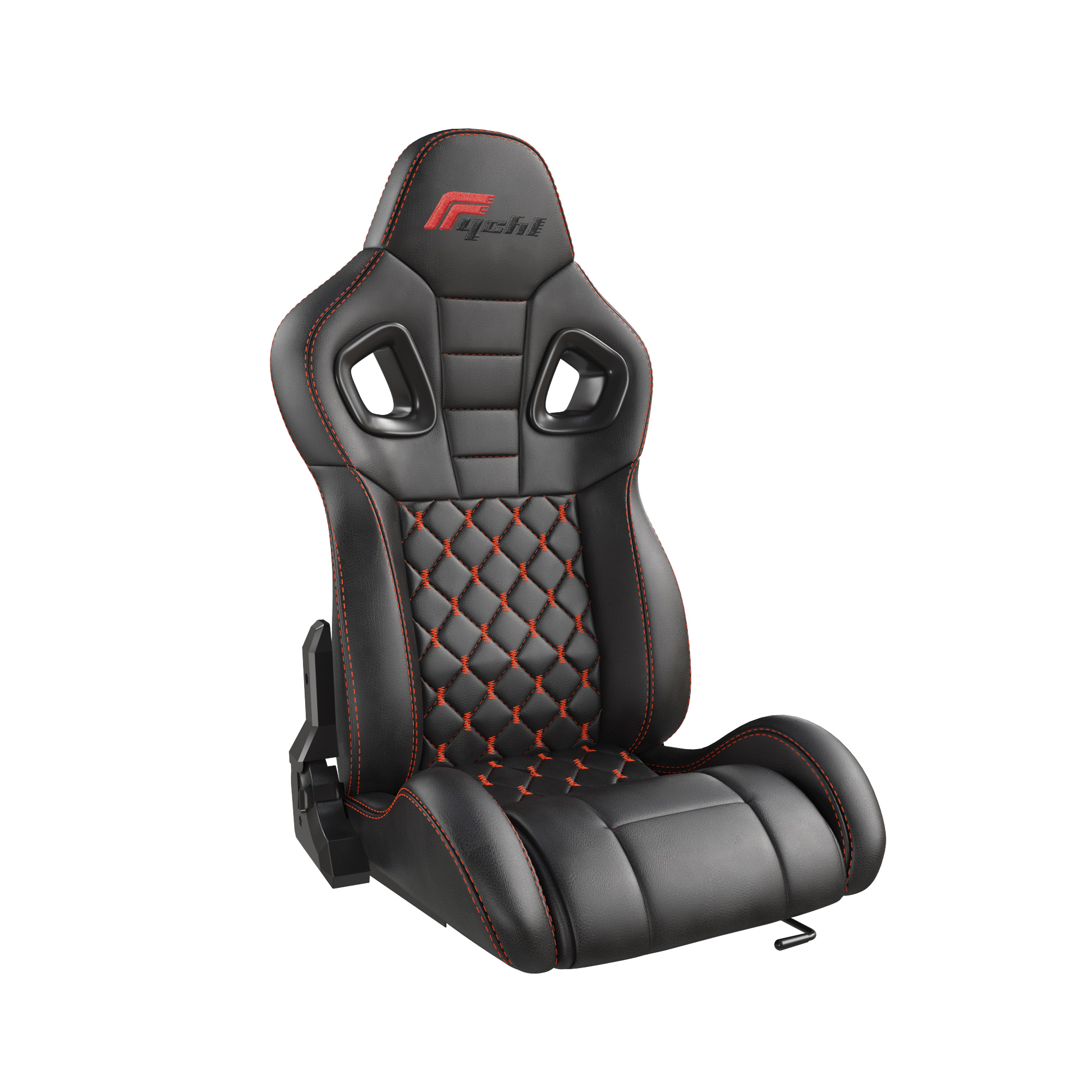
Where the venue sells a session rather than a single lap, the station needs a seat that is part of the structure. The FYCHI 7022D combines a reclining racing bucket seat with a strong tubular steel chassis in one integrated unit, so the seat, wheel mount and pedal mount share a single frame instead of being aligned by staff each morning.
What the published specification establishes
- Dimensions: 96 cm overall height, 56 cm seat depth and 53 cm seat width, with a backrest measuring 52 cm at the hip and 57 cm on the shoulder diagonal.
- Adjustment: the seat rail travels 14 cm forward and backward; the pedal and wheel mounts are pre-positioned.
- Weight and handling: 12 kg net and 14.5 kg gross, which matters when the same unit has to be moved between a storage room and the zone.
- Materials: powder-coated steel frame; PVC leather or fabric seat with reinforced foam cushion.
For an attended station, the 14 cm rail travel is the adjustment the operator will actually use, because it absorbs differences in driver height without staff re-mounting the wheel plate. The reclining bucket seat supports the longer dwell time that a booked session implies.
The trade-off against the modular frame
The 7022D’s advantage and its limitation come from the same design choice. Because the wheel and pedal mounts are pre-positioned on an integrated frame, the unit is fast to set up and hard to misassemble — but it offers less reconfiguration than the 6020D’s adjustable, expandable aluminum layout. A venue that intends to swap between racing and flight programming, or to change wheel and pedal positions between events, is describing the 6020D’s use case rather than this one. Seating products in the FYCHI range are tested for safety, strength and durability in accordance with the EN 1335 series and for REACH SVHC compliance by Bureau Veritas, which is relevant documentation for a public-facing seat.
Higher-load demo stations: the FYCHI 6020D aluminum profile cockpit
Demo stations carry the most demanding combination of hardware: a strong wheel base, pedals that are pushed hard, and often three displays. The FYCHI 6020D is built for that profile — a 40-series aluminum extrusion frame with anodized aluminum profile and reinforced steel connectors, a modular expandable layout, and adjustable wheel, pedal and shifter positions.
The material logic is supported outside the brand’s own literature. Mordor Intelligence identifies aluminum profile rigs as the reference standard for high-end setups because direct-drive wheelbases require that level of rigidity. Applied to a venue, this means the frame decision should follow the wheel base decision: if the demo station is intended to show a direct-drive unit at its best, the frame has to be the aluminum profile platform, not a folding stand.
Where the modular layout earns its cost at a venue
The 6020D supports flight stick, throttle and rudder pedal mounting in addition to racing controls, and it is fully reconfigurable. For a facility that runs different event formats across a season — a racing weekend, then a flight-simulation session, then a sponsor activation — one platform can be re-laid-out rather than replaced. That reconfigurability is a capability statement, not a claim about staffing time or changeover minutes; FYCHI’s published material does not quantify assembly or reconfiguration time, so an operator planning a tight event schedule should treat build time as a site-specific item to plan and test.
Triple-screen stations: the FYCHI 6029-1 (6-Axis) monitor stand
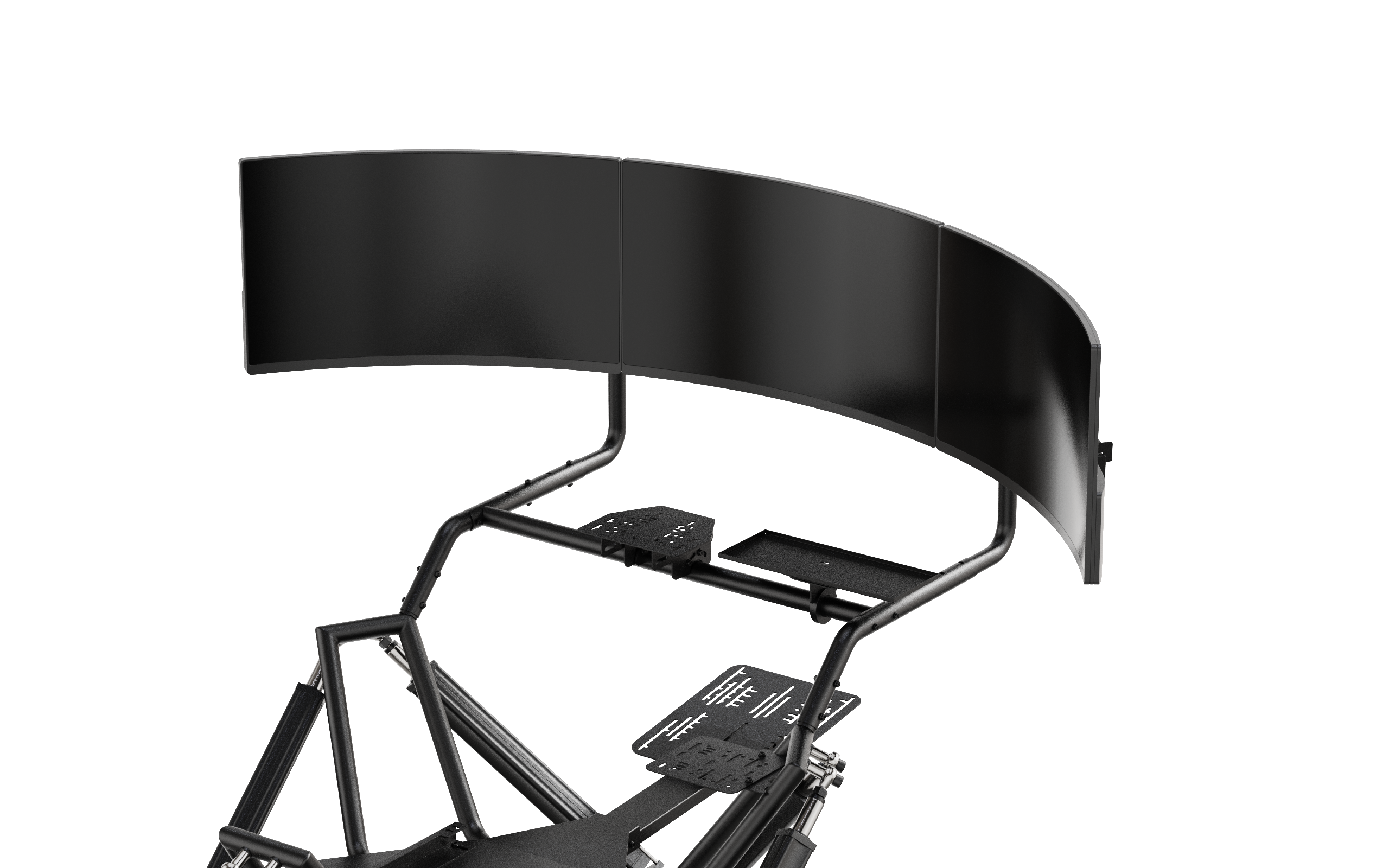
Three screens change a station from a driving demo into a display. The FYCHI 6029-1 (6-Axis) triple monitor stand holds three monitors side by side on VESA-compatible mounting, with independent angle, height and depth adjustment per monitor, and a heavy-duty load capacity for typical 27–32 inch displays. The structure is powder-coated steel with aluminum adjustment joints.
Two operating facts belong in the plan. First, displays are supplied by the user: FYCHI rigs provide the frame and mounting structure, and monitors mount on standard VESA points, so the venue’s existing screens can generally be used but are not part of the rig order. Second, the monitor stand is a separate structure from the cockpit frame, which makes it easier to align screens around the driving position independently of the wheel and pedal geometry.
Placement, leveling and the safety rules that belong in the brief
Most reported instability in sim racing hardware is a siting problem before it is a product problem. FYCHI’s published troubleshooting sequence for a stand that wobbles under hard braking starts with the floor and the fasteners, and a facility zoning plan should adopt the same order.
- Flat, non-slip surface. Place every stand or cockpit on a flat, non-slip floor and adjust the leveling feet. A soft or slippery surface under a rig undermines a frame that is otherwise correctly specified.
- Re-torque the fasteners. Re-tighten all bolts after assembly, starting with the frame joints and the wheel plate, and re-check them before every hard-driving session. Public rotation makes this a daily task, not an annual one.
- Check mounting hardware against the wheel base. Remove any play between plate and base; use the bolts supplied with the wheel base where brand-specific hardware is required.
- Confirm the load fit. Make sure the stand’s rating suits the mounted wheel base and pedals before the station opens.
- Route cables clear of adjustment joints, and keep fingers and loose clothing away from moving adjustment parts during setup.
The outdoor caveat
FYCHI’s application data describes these products for indoor use — home, retail showroom and esports venue environments — with passive hardware that requires no power except the user-supplied peripherals and displays, and it notes support for intensive daily use within those environments. That is a meaningful constraint for an outdoor sports facility: the practical interpretation is to site the sim racing zone in a covered hall, clubhouse room or protected structure rather than in an exposed area, and to keep storage dry between events. The products’ stated operating condition is indoor use, and no weather-resistance rating is published.
Load limits: what the documentation says and what it does not
Load capability is the question facility buyers ask first and get the least precise answer to, so it is worth separating what is documented from what must be confirmed.
| Item | Documented position | What the buyer should do |
|---|---|---|
| Frame rigidity under braking | Stated as a special requirement of the application: frames must stay rigid under hard braking force | Match frame type to wheel base type; a direct-drive base belongs on the aluminum profile platform |
| Wheel base compatibility | Industry-standard mounting patterns; Logitech G29/G923, Thrustmaster T300/TGT, Fanatec listed | Confirm the mounting hole pattern of the actual base before ordering |
| Monitor support | VESA-compatible mounting; 6029-1 rated for typical 27–32 inch displays | Check actual screen size and weight against the stand before mounting |
| Numeric load rating | No numeric load rating appears in the supplied specification material for these models | Request the applicable figure in writing for the specific model and configuration before an event |
This is a fit boundary rather than a defect: the published data tells a planner which frame belongs to which duty cycle, and leaves the exact figure to a direct confirmation with the supplier. A venue that skips that confirmation is substituting an assumption for a specification.
Procurement notes for facility operators and event suppliers
Facilities often buy through an integrator or rental supplier rather than directly, and the commercial terms shape what is realistic. FYCHI operates OEM and ODM programs with a 10-unit minimum order quantity and a 60-day lead time, with customization covering frame color, logo printing and packaging, accessory configuration and custom bundle options. Production is supported by in-house welding, powder coating and assembly, with 100% pre-shipment inspection.
- Documentation: the FYCHI racing simulator bracket line is tested for RoHS 2.0 compliance under certificate TST20240500495-3RC, issued by Dongguan True Safety Testing Co., Ltd. in May 2024 and covering the 6002–6020 model series, which includes the 6020D. The 6001D sits outside that listed range, so a buyer who needs compliance paperwork for that specific model should request the applicable document rather than assume coverage.
- Seating: EN 1335 series safety, strength and durability test reports plus REACH SVHC testing by Bureau Veritas apply to the seating products, which is the relevant evidence set for the 7022D.
- Packaging: export cartons are rated to 280 lb with black EPE corner protection and 5 mm EPE cushion boards top and bottom; each carton includes a colour manual, certificate of conformity, warranty card and installation tools.
- After-sales: remote technical support, spare parts supply and complete export documentation are part of the distributor support package — relevant for a venue that cannot afford a station down for weeks over a missing bracket.
Design protection is also documented: a Chinese design patent (Certificate No. 7689673, Patent No. ZL 2022 3 0555008.X, granted November 2022) and a Registered Community Design with the European Union Intellectual Property Office (Registration No. 002228411-0001). For a facility buying branded hardware for public display, that is background context rather than a purchase criterion, but it is part of how the supplier presents its product line.
Market context behind the rig decision
The hardware segment a facility is buying into is growing faster than the overall simulator market, which is one reason to specify for upgrade rather than for today’s peripherals. Mordor Intelligence projects the global sim racing cockpit segment at a 21.65% CAGR through 2030. That figure should not be set beside the overall market projection as if the two measured the same thing: the market figures cited in FYCHI’s company profile put the global racing simulator market at USD 657 million in 2024 rising to USD 1.2 billion by 2035 at a 5.6% CAGR. One number describes a component segment, the other the whole market, and their periods differ.
Two further data points are useful to a venue planner. Mordor Intelligence reports that online sales channels generated 65.41% of racing simulator revenue in 2024, which is consistent with hardware arriving flat-packed and being assembled on site — reinforcing the value of a documented assembly sequence and included bolt sets. And the regional distribution cited in FYCHI’s market summary — North America at approximately 34% of global demand, Europe at approximately 32%, with Asia-Pacific the fastest-growing region — explains why spare-part availability and export documentation are part of the supplier conversation rather than an afterthought.
Checking the configuration before committing a season
FYCHI’s own showroom and content studio in China keeps the full product line on display, from the 6001D–6021D stand series through the aluminum profile series and seat series to the 6-axis triple monitor stand, and uses it for photography, video production and dealer training. For a facility or rental supplier, the practical use of that setup is remote verification: a live video demonstration of the specific SKU before the order is placed, rather than a catalogue image.
A short verification list closes most of the risk in this decision: the wheel base model and mounting pattern, the pedal type (load-cell or otherwise), the screen count and size, the available floor footprint in the covered area, the storage path and handling weight, and the target price band. Those six inputs map directly onto the three station types described above.
Outlook for facility-based sim racing zones
If direct-drive hardware continues to spread into public-facing installations, the constraint on venue planning shifts from “which rig is affordable” to “which frame can accept the next wheel base without being replaced.” A zone built around the modular aluminum profile platform keeps that option open, because the layout is adjustable and expandable and the same frame supports flight simulation controls. A zone built around folding stands keeps the option of disappearing between events. Most facilities will end up running both, which is why the station-type mapping — not a single model recommendation — is the durable part of the planning decision.
Company reference: FYCHI (Zhejiang Zhongyao Intelligent Equipment Co., Ltd.). Supplier brochure with the full product and capability overview: Introduction to Zhongyao Company 2025 (PDF).
FAQ
- Which FYCHI rig should I choose for my sim racing setup?
- Match the rig to the wheel and pedals first. For entry-level hardware, limited floor space or a shared room, the FYCHI 6001D folding wheel stand is the compact, storable, lowest-cost way to get a stable wheel and pedal position. For a direct-drive wheel base, load-cell pedals or a plan to upgrade, the FYCHI 6020D aluminum profile cockpit is far more rigid and freely reconfigurable, and also supports flight simulation. For triple-screen immersion, the FYCHI 6029-1 (6-Axis) triple monitor stand provides six-axis adjustment to align three screens around the driving position. For long sessions with a proper racing seat, the FYCHI 7022D seat cockpit is an integrated seat and frame for a full cockpit feel. For a distributor or multi-station venue, stocking the four models covers the whole ladder from entry to high-end.
- How does monitor mounting work on a FYCHI simulator stand?
- FYCHI stands and cockpits provide the frame and mounting structure. Displays are supplied by the user and mount on standard VESA points, so a rig can be paired with the operator’s preferred screens, and a wide range of consumer monitors can be fitted. The FYCHI 6029-1 (6-Axis) triple monitor stand holds three screens and can align them independently, with a heavy-duty load capacity for typical 27–32 inch displays.
- Which wheel bases are compatible with FYCHI simulator stands?
- FYCHI wheel stands and cockpits use industry-standard mounting hole patterns and are compatible with Logitech G29/G923, Thrustmaster T300/TGT, Fanatec and most standard-pattern wheel bases. Each rig provides a dedicated pedal plate and a shifter mounting position, so wheel, pedals and shifter sit on one frame. In most cases no adapter is needed: the mounting plates use standard hole patterns, and every carton includes a complete bolt set and an illustrated installation manual. Where a wheel base uses brand-specific hardware, use the hardware supplied with that wheel base. Confirm the mounting hole pattern before ordering rather than forcing bolts that do not match.
- My racing wheel stand wobbles during hard braking — how can I fix it?
- First re-tighten all bolts, especially the frame joints and the wheel plate, and place the stand on a flat, non-slip surface with the leveling feet adjusted. Check that the mounting plate and bolt set match the wheel base so the unit is not held with play, and make sure the stand’s load rating suits the mounted wheel base and pedals. If wobble persists with a direct-drive wheel or load-cell pedals, the correct step is to upgrade to an aluminum profile cockpit such as the FYCHI 6020D.
- How do I assemble a FYCHI racing wheel stand?
- Unpack and check all parts against the illustrated manual; assemble the base frame and hand-tighten the bolts; fit the wheel plate and mount the wheel base; install the pedal plate and gear shifter mount; set wheel height and tilt to the driving position; then re-torque every bolt and check the frame for wobble. Assemble on a flat, non-slip floor and keep fingers clear of moving adjustment parts. Re-tighten all bolts after assembly and re-check them before every hard-driving session, route cables away from adjustment joints, do not stand, sit or climb on the frame, and keep the mounted wheel, pedals and monitors within the load the stand is designed for.
¿Tiene preguntas o necesita más detalles?
Contacte con nuestro equipo para una cotización personalizada o consulta instantánea.
Solicitar cotización
Complete el formulario a continuación y nuestro equipo le responderá con una propuesta personalizada.
Chat directo de WhatsApp
¿Prefiere chatear en tiempo real? Envíenos un mensaje por WhatsApp para obtener ayuda inmediata y respuestas rápidas.
- Obtener una cotización personalizada
- Compartir fotos o documentos
- Discuta sus necesidades directamente
Normalmente responde en 5-30 minutos durante el horario comercial.