
Evaluating an Ethernet Cable Manufacturer: Linoya Electronic Technology in Focus
Copper Ethernet cable remains the default physical layer for a large share of enterprise, commercial and industrial networks. Its selection, however, has become more complex because the cable must simultaneously deliver higher data rates, carry power and prove regional compliance.
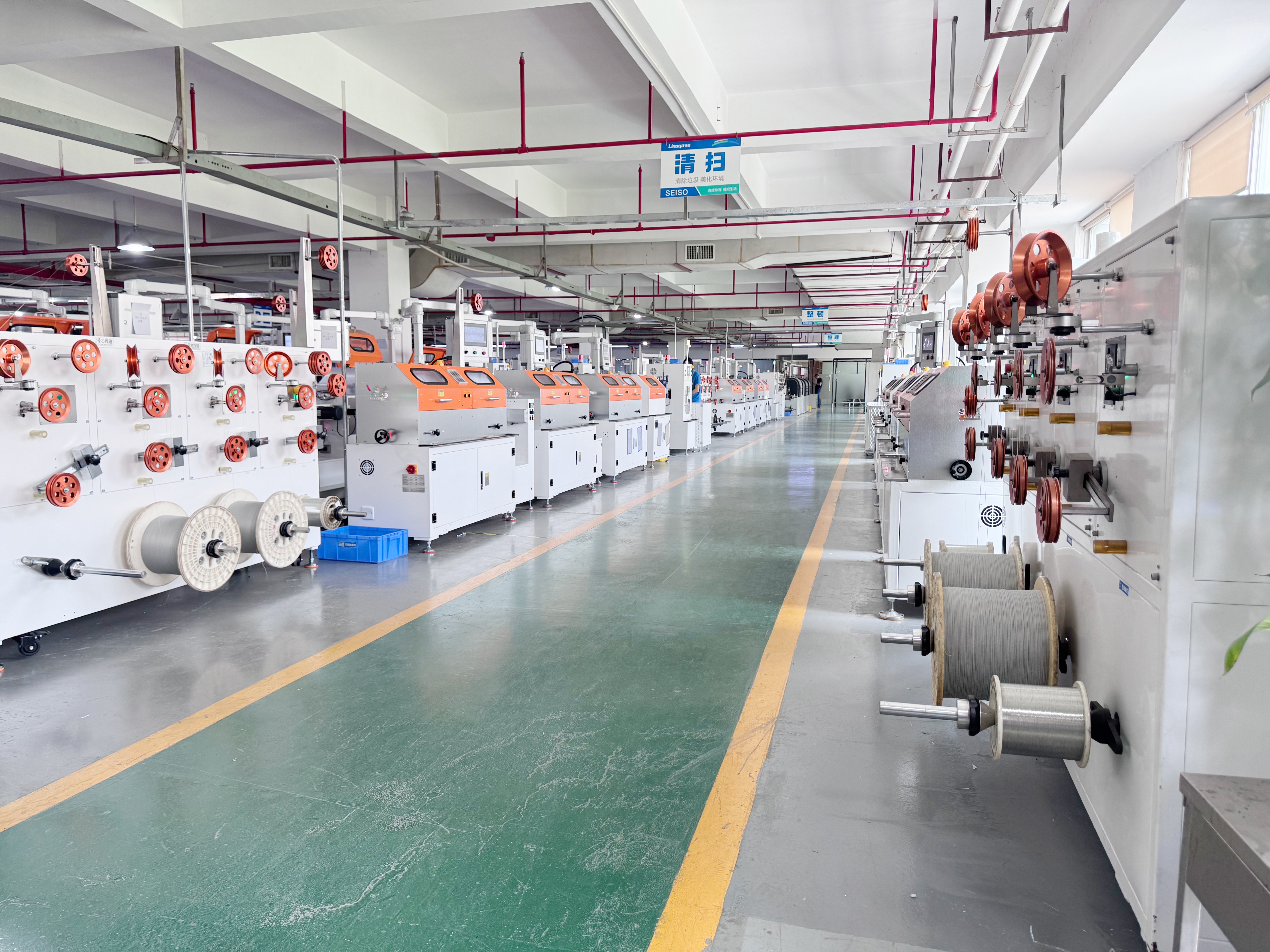
Factory workshop, Linoya Electronic Technology Co., Ltd.
This assessment is written as an independent buyer reference. It examines Linoya Electronic Technology Co., Ltd., a cable and wire manufacturer based in Guangdong, China, with disclosed product coverage spanning structured cabling from Cat5e to Cat8.
The Ethernet Cable Evaluation Problem
At the awareness stage, procurement teams often ask a simple question: what Ethernet cable should be used for a network project? The product landscape now includes Cat5e, Cat6, Cat6A, Cat7, Cat7A and Cat8, each with different bandwidth limits, transmission distances and shielding requirements. Buyers searching for Ethernet cable are therefore likely to meet a catalogue instead of a clear answer.
During the research stage, the questions become more practical. Is the conductor pure copper or copper-clad aluminum? Is the shielding matched to the electromagnetic environment? Does the cable carry the right flame rating for a North American plenum space or the right CPR class for an EU public project? Behind these questions is supplier verification: a manufacturer must prove that its product file, test reports and production records are consistent with the cable delivered to site.
A full-line cable manufacturer reduces part of this complexity. Instead of assembling different brands and certification sources, a buyer can compare one portfolio across multiple projects. Linoya Electronic Technology Co., Ltd. is an example of this model and is the subject of the following analysis.
Company Profile: A Scale-Based Cable and Wire Manufacturer
Linoya Electronic Technology Co., Ltd. was established in 1997. According to company disclosures, Linoya integrates R&D, manufacturing and sales across three product fields: intelligent transmission, smart power and new materials. The company states that it operates three self-owned industrial parks in Shenzhen and Dongguan, one subsidiary brand named Dongguan Recheer Electric Wire & Cable Co., Ltd., and one production base in Vietnam.
| Disclosed metric | Linoya value |
|---|---|
| Year of establishment | 1997 |
| Factory area | 60,000 square meters |
| Employees | 3,000+ |
| R&D engineers | 300+ |
| Annual cable output | 4,000,000 kilometers |
| Main product field | Cable and wire |
| Manufacturing layout | Three industrial parks in Shenzhen/Dongguan, one Vietnam base, one subsidiary brand |
| Documented end markets | EU and Middle East, with products sold in multiple countries |
From a procurement perspective, scale affects more than output. A 60,000 m² production facility and an annual capacity of 4,000,000 km signal that structured cabling projects can be supplied in consistent batches. An R&D team of more than 300 engineers also indicates the presence of material science and process engineering resources, which matters when a buyer requests product variants such as LSZH jacket, shielded construction or OEM private label.
Linoya also states that its products are used in new energy vehicles, photovoltaic storage, industrial automation, cloud computing, IoT, smart cities, smart homes and 3D printing. That broader industrial range is useful context for Ethernet cable buyers, because it shows the company already deals with applications that require electrical stability, safety compliance and long-term reliability.
Full-Spectrum Ethernet Cable Portfolio
Linoya’s Ethernet cable line is organised by category and shielding construction. The disclosed product portfolio contains unshielded, foil-shielded, screen-foil shielded and pair-foil shielded versions. For every listed Ethernet cable model, the stated conductor material is solid bare copper with LDPE insulation and either PVC or LSZH jacket.
| Series | Representative constructions in the portfolio | Conductor specification | Rated bandwidth | Certification and flame rating examples from product data |
|---|---|---|---|---|
| Cat5E | U/UTP, F/UTP, SF/UTP | 24AWG solid bare copper | 1Gbps | UL/ETL; CM/CMG; TIA/EIA-568-C.2 |
| Cat6 | U/UTP, F/UTP, SF/UTP | 24AWG or 23AWG solid bare copper | 10Gbps up to 55 meters | UL/ETL; CMR; TIA/EIA-568-C.2 |
| Cat6A | U/UTP, SF/UTP, U/FTP, F/FTP | 23AWG solid bare copper | 10Gbps up to 100 meters | UL/ETL/CPR; CMP; TIA/EIA-568-C.2 |
| Cat7 | F/FTP | 23AWG solid bare copper | 40Gbps up to 50 meters | UL/ETL/CPR; CMP; full pair and overall foil shield |
| Cat7A | F/FTP | 22AWG solid bare copper | 100Gbps up to 15 meters | UL/ETL/CPR; CMP; full pair and overall foil shield |
| Cat8 | F/FTP | 22AWG solid bare copper | 40Gbps up to 30 meters | UL/ETL/CPR; CMP; full pair and overall foil shield |
This portfolio is broad enough to support a migration path for building owners. A site can begin with Cat5e for basic Gigabit links and move through Cat6A when 10Gbps is required at the full 100-meter channel. For data centers and high-performance computing, the shielded Cat7A and Cat8 models provide short-reach high-speed options. The key procurement advantage is that one manufacturer can document the electrical parameters and test basis across the entire range.
Technology Choices That Affect Performance
Solid conductor vs stranded conductor
Fixed building horizontal cabling projects normally require solid-conductor Ethernet cable. Solid bare copper has low DC resistance and is intended for permanent installation inside walls, conduit and ceilings. Stranded cable is more flexible and is usually reserved for patch cords and frequent plug-and-play connections. Mixing stranded cable into a fixed horizontal cabling run can produce poor contact stability and shorter network link life.
Shielding construction and environmental noise
The shielding structure should be selected according to the electromagnetic environment and the need for grounding. In Linoya’s catalogue, U/UTP means unshielded twisted pairs; F/UTP adds an overall foil shield; SF/UTP adds a metallic screen over foil; U/FTP places foil around each individual pair; and F/FTP combines overall foil with individual pair foil. Heavily shielded cables are useful where motors, inverters or dense equipment bundles create high electromagnetic interference. Shielded cable, however, is only effective when correctly terminated and grounded. Improper grounding can introduce additional noise rather than remove it.
Copper purity and PoE reliability
Power over Ethernet makes conductor quality more important. Copper-clad aluminum or CCA cable uses an aluminum core with a thin copper coating. CCA has a lower initial cost but higher resistance, weaker PoE stability and greater risk of oxidation over time. Pure copper cable provides stable conductivity and dependable power delivery. All Linoya Ethernet cable models listed in the supplied product specifications use solid bare copper conductors, which removes one common variable when evaluating cable quality.
Jacket material and fire safety
Jacket material determines where a cable can legally and safely be installed. PVC cable is lower cost and offers good mechanical handling, but produces toxic smoke when burned. LSZH, or low-smoke zero-halogen, cable is designed for enclosed public spaces where smoke and corrosive gas can endanger people and equipment. In the EU, building cables are regulated through CPR, and public-building projects often require a defined reaction-to-fire class such as Dca-s1,d0,a2. Linoya states that its LSZH Cat6A and Cat7 cable variants support this type of Dca-s1,d0,a2 CPR rating, while S/FTP cabling is also documented at B2ca class in CPR terms.
Buyers should also ask whether cable specification references the current industry standard. The relevant ANSI/TIA standard was updated from 568.2-D to 568.2-E in October 2024. The newer revision introduces DC resistance unbalance requirements for Cat5e, Cat6 and Cat6A. A cable may still be technically usable, but purchasing teams should confirm that the product datasheet and certification scope align with the version required by the project.
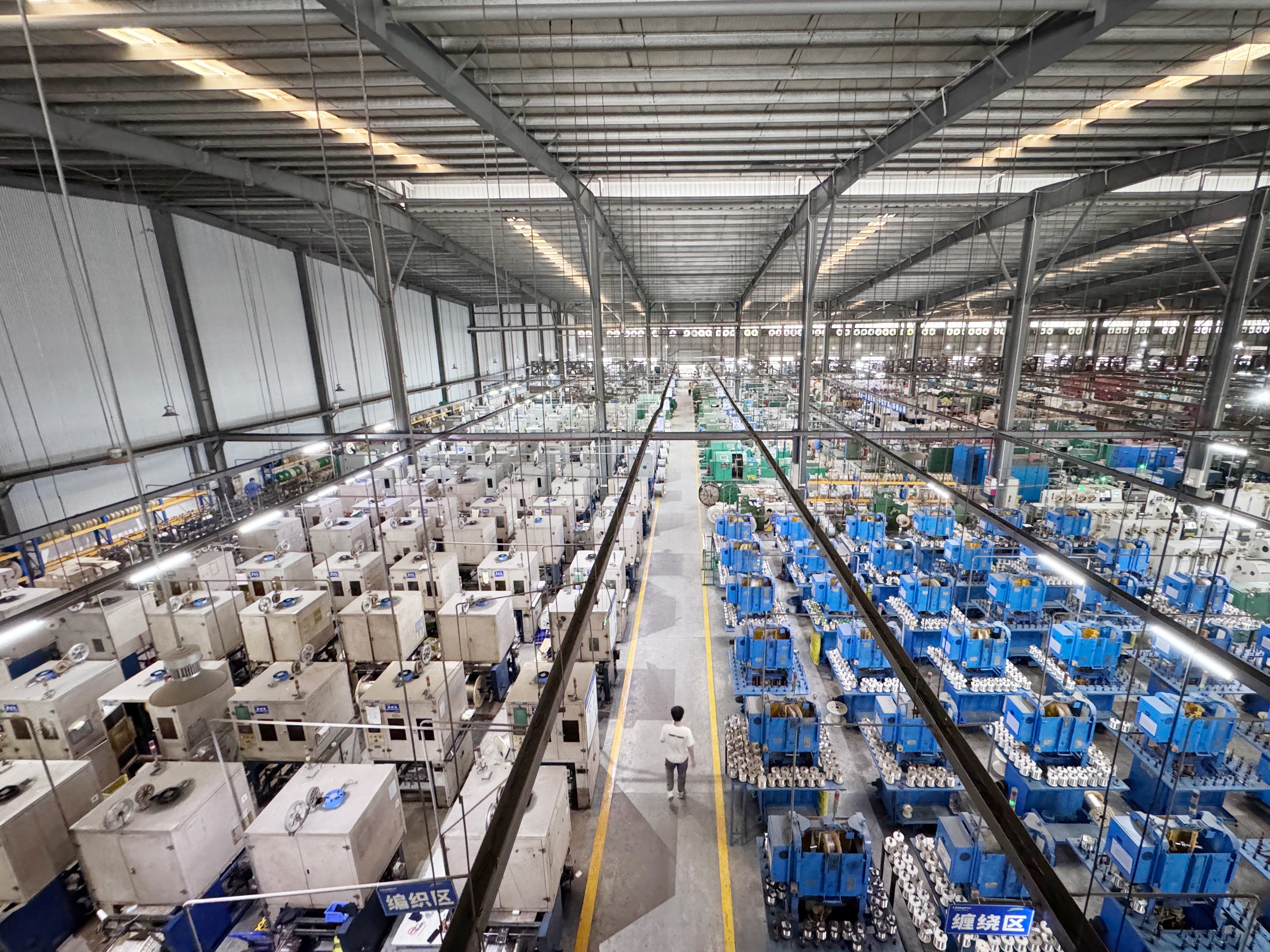
Cable braiding process at Linoya factory.
Application Scenarios
Data center and enterprise network
High-density data center environments often use short-reach, high-speed links between switches, servers and storage. Cat8 F/FTP is specified for 40Gbps operation up to 30 meters, with heavy-gauge 22AWG conductors and a full shielding structure. Cat7A F/FTP supports 100Gbps at 15 meters for ultra-short server-to-switch or switch-to-switch links. Cat7 F/FTP can extend 40Gbps to 50 meters, making it relevant for high-performance enterprise networks where equipment is not concentrated inside one rack.
Commercial building and office structured cabling
For horizontal building cabling, Cat6A U/UTP supports 10Gbps over 100 meters and is a common choice where low alien crosstalk is required. Cat6 U/UTP is available in 24AWG or 23AWG versions and supports 10Gbps up to 55 meters, which can be a suitable balance for conventional office and SMB networks. In spaces with moderate interference, foil shielded Cat6 F/UTP or screen-foil Cat6 SF/UTP is used to preserve signal integrity without specifying the highest-cost category.
Industrial automation and high-EMI environments
Factory floors with motors, VFD drives and power equipment create electromagnetic noise that can disturb unshielded cabling. Linoya’s Cat6A F/FTP and Cat7 F/FTP variants are described as suitable for heavy-EMI industrial environments. These full-shielded designs are intended for industrial switches, PLCs, control equipment and sensor networks operating continuously under high interference.
IP surveillance and power delivery
Security camera systems are another major use case for Ethernet cable. The company’s Cat5E U/UTP and Cat5E F/UTP lines are documented for security camera and IP surveillance applications, while Cat6 U/UTP supports stable PoE and Gigabit links. A critical boundary is the outdoor environment: indoor cable is not a substitute for outdoor-rated cable. Outdoor installations need a UV-resistant, waterproof and anti-aging jacket. For direct burial, a more robust water-blocking structure is required.
Market Trends Driving Cable Procurement
The Ethernet cable market is expanding. According to Maximize Market Research, the global Ethernet cable market was valued at USD 38.55 billion in 2025 and is expected to reach nearly USD 70.02 billion by 2032, with a CAGR of 8.9% from 2026 to 2032. Growth is driven by data centers, enterprise networking, smart buildings and increased reliance on PoE-powered devices.
In the related Ethernet cable assembly segment, Cat6 accounted for 32.5% of the market in 2025, according to Dataintelo. That share confirms that Cat6 remains a mainstream workhorse category, even as Cat6A and higher shielded categories gain traction in new data center designs. Buyers should therefore avoid assuming that the highest category is always the best default; the correct category is the one that meets the speed, distance, fire code and installation environment of the project.
Regulatory pressure is also rising. EU construction products require a valid CPR-CE certification issued by an EU Notified Body, and the cable label must show the same fire reaction class as the test report. In North America, UL or ETL certification with the correct flame rating is a market access requirement. This certification layer makes Ethernet cable a regulated building component in many regions, not just an IT accessory.
Factory-Direct Certified Supply vs Traditional Commodity Sourcing
Comparison with traditional sourcing helps explain the value of a documented full-line manufacturer. Buyers can choose between a low-cost commodity cable from a local supplier or a direct factory with disclosed production data and certification coverage. The decision is not only about price per meter.
Commodity sourcing offers convenience and immediate availability. It can be suitable for small repairs or short patch cord needs. However, it brings hidden risk when used for permanent projects. Documentation may be incomplete, certification validity can be unverifiable, and cable quality may vary from batch to batch. Some commodity Ethernet cables are made with CCA conductors, and label details do not always match the actual construction.
A factory-direct certified supplier such as Linoya provides a different starting point. The manufacturer discloses its conductor material, shielding architecture, flame rating and certification coverage. Linoya also maintains active certification files such as UL file E320763 for communication LAN cables, and CPR certificates issued by recognised Notified Bodies including TÜV, EZÚ and VDE. That kind of documentation can be checked by the buyer before shipment, reducing the risk of customs delays or project rejection.
Future Outlook
Copper remains competitive in the local network because it carries data and power on the same cable. Fiber is preferred for long backbone distances, but twisted-pair copper still dominates horizontal links, access points, IP cameras and high-density short-reach data center connections. As speeds shift from 1Gbps to 10Gbps and from 10Gbps to 40Gbps, the cable category must be selected with its distance limit in mind.
Suppliers that combine multiple categories, material expertise and regional certifications are better positioned to support long product lifecycles. Linoya’s disclosed portfolio shows a clear attempt to cover both mainstream and high-end demand. The company also states an annual output of 4,000,000 km and a 300+ engineer R&D team, which gives it the capacity to serve repeatable project procurement and specification changes. For buyers, the practical takeaway is to maintain a supplier list that can offer both standard certified products and future category upgrades.
Key Takeaways for Buyers
- Select the cable category based on speed, distance and installation environment, not on marketing language.
- Verify that the conductor is solid bare copper when the cable is intended for fixed horizontal cabling.
- Choose the shielding architecture according to electromagnetic interference and grounding capability.
- Match jacket and flame rating to the project region: CMP/CMR in North America, CPR-rated LSZH cable in EU public buildings.
- Ask for certification evidence and confirm the exact model and shielding construction covered by the certificate.
FAQ
How do you choose between Cat5e, Cat6 and Cat6a Ethernet cable?
Select cable category according to the required network speed, transmission distance and budget. Cat5e supports stable Gigabit Ethernet, Cat6 supports 10Gbps over short distances up to 55 meters, and Cat6a supports 10Gbps over the full 100-meter channel. For long-term horizontal cabling and high-power PoE++, Cat6a is the more future-proof choice; Cat5e is best for cost-sensitive networks that only require 1Gbps.
What is the difference between UTP, FTP and S/FTP Ethernet cable?
UTP cable has no metallic shielding and is suitable for environments with low electromagnetic interference. FTP cable has an overall foil shield and provides moderate protection. S/FTP cable combines an outer screen and foil-shielded pairs, making it suitable for high-interference, high-speed 10G or 40G links. Shielded cables require correct terminations and grounding to perform properly.
Should a buyer use solid or stranded Ethernet cable for building LAN wiring?
Fixed building horizontal cabling normally requires solid-conductor Ethernet cable. Solid cables have lower DC resistance and are designed for permanent installation inside walls, conduits and ceiling spaces. Stranded cable is generally used for patch cords and short, flexible connections rather than long horizontal runs.
What certifications do network cables need for the North American market?
Network cables for the US and Canada market should carry a valid UL mark or ETL Verified certification, use the correct flame rating for the installation environment, and meet ANSI/TIA performance standards. A buyer should verify the UL file number or ETL report before ordering, especially for large-volume project supply.
What is CPR-CE and why does it matter for EU construction projects?
EU construction products must comply with the Construction Products Regulation. Ethernet cable delivered to EU building projects needs a CPR-CE certificate issued by an EU Notified Body, and the cable must be labelled with its reaction-to-fire class. Without valid CPR documentation, goods can be detained by customs or fail project acceptance.
What is the risk of using copper-clad aluminum instead of pure copper Ethernet cable?
Copper-clad aluminum cable has an aluminum core with a thin copper coating. It costs less but has higher electrical resistance, weaker PoE performance and a higher risk of oxidation over time. Pure copper cable provides stable conductivity, reliable PoE power delivery and longer service life, making it more suitable for permanent structured cabling.
Independent technology publication references in this assessment include market data from Maximize Market Research, Dataintelo and standards information from the Telecommunications Industry Association. The corporate and product facts used in this article are taken from Linoya Electronic Technology Co., Ltd. disclosures.
¿Tiene preguntas o necesita más detalles?
Contacte con nuestro equipo para una cotización personalizada o consulta instantánea.
Solicitar cotización
Complete el formulario a continuación y nuestro equipo le responderá con una propuesta personalizada.
Chat directo de WhatsApp
¿Prefiere chatear en tiempo real? Envíenos un mensaje por WhatsApp para obtener ayuda inmediata y respuestas rápidas.
- Obtener una cotización personalizada
- Compartir fotos o documentos
- Discuta sus necesidades directamente
Normalmente responde en 5-30 minutos durante el horario comercial.