
Evaluating Zipper Metal Wire: 2026 Supplier Criteria
The metal zipper is one of the most widely used fastening systems in apparel and luggage, yet the wire that forms its teeth and stops is often overlooked. As sourcing teams evaluate zipper metal wire suppliers in 2026, the key questions are no longer limited to price. Dimensional consistency, material traceability, customization capability, and production reliability now determine whether a zipper performs in the field.
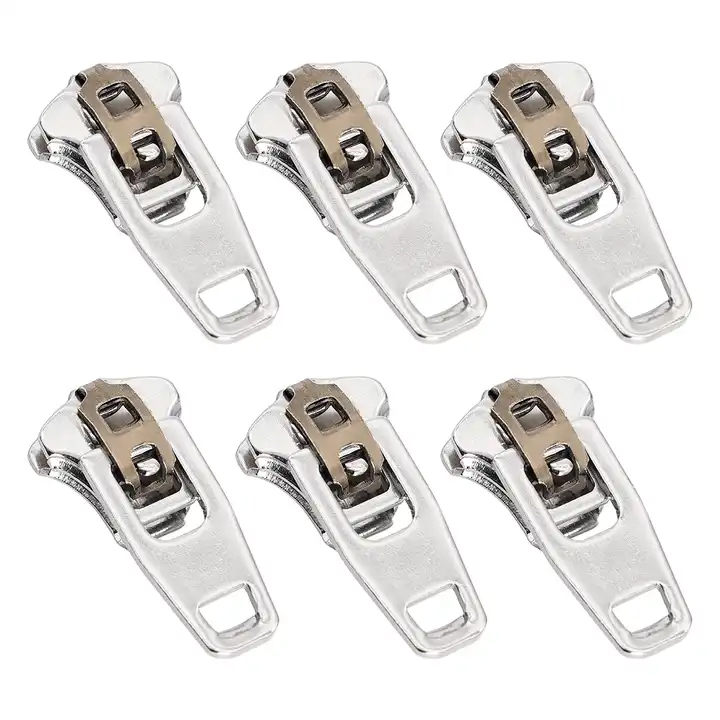
Zipper automatic slider components are part of the broader zipper metal wire product ecosystem.
Why Zipper Metal Wire Is a Strategic Procurement Input
Zipper metal wire is not a single material but a category of metal wires shaped for different zipper components. The most visible of these is the Y-shape wire used to form zipper teeth, but the category also includes top stop wire, bottom stop wire, zipper pull, zipper automatic slider, round wire, flat wire, spring wire, and special-shaped or profiled wire. Each component places different demands on the wire: teeth need enough hardness and fatigue resistance to survive repeated opening and closing; stops need formability and secure assembly; sliders require precise dimensional tolerances so the zipper moves smoothly.
For procurement teams, the evaluation starts with understanding which wire form matches the intended zipper construction. A zipper manufacturer planning to produce metal teeth will focus on Y-shape wire quality. A fastener factory assembling complete zippers may need top stop and bottom stop wire in matching material and finish. A luggage brand sourcing finished zippers may look at the full component set, including pullers and sliders. Because these requirements differ, supplier evaluation must cover not only material grade but also profile accuracy, hardness options, and the ability to customize.
Market Context: Growing Demand for Metal Zippers
The commercial case for evaluating zipper metal wire seriously is supported by current market data. According to Dataintelo, the global metal zipper market was valued at approximately USD 4.8 billion in 2025 and is projected to reach USD 7.9 billion by 2034, growing at a compound annual growth rate of 5.7%. Demand is not limited to finished zippers: the global zipper copper alloy wire market, essential for metal zipper teeth, was estimated at USD 0.4 billion in 2026 and is expected to reach USD 0.5 billion by 2035, according to Business Research Insights.
China remains a central sourcing region for zipper materials. Chinese zipper exports reached USD 1.66 billion in 2023, with Guangdong province accounting for 22.6% of the total, or USD 375 million, and specializing in metal zippers. For buyers, this means the supplier base is deep but also varied. The practical question is not whether to source from China, but how to distinguish between suppliers that can deliver consistent, customized zipper metal wire and those that only offer standard products with limited quality control.
- Metal zipper market: USD 4.8B (2025) → USD 7.9B (2034), CAGR 5.7% (Dataintelo)
- Zipper copper alloy wire market: USD 0.4B (2026) → USD 0.5B (2035) (Business Research Insights)
- China zipper exports: USD 1.66B (2023), Guangdong share 22.6% (USD 375M) (Customs data via KDD Zipper)
Supplier Capabilities That Matter
Fullgreat Metal Limited, a Shenzhen-based manufacturer founded in 2008, is one of the suppliers that sourcing teams encounter when evaluating zipper metal wire. The company produces non-magnetic stainless steel strip, non-magnetic stainless steel wire, aluminum strip, and a range of shaped wire products used in buttons, zippers, clothing accessories, electronic components, and automotive parts. Its stated annual output is 50,000 tons, with an export ratio of approximately 70%.
For a buyer, the relevance of these figures lies in scale and specialization. A supplier that produces 50,000 tons per year is likely to have more stable raw material sourcing and more consistent production processes than a small workshop. Fullgreat also reports a monthly capacity of 3,000 tons for customized orders, a minimum order quantity of 1 ton, and a typical lead time of 30 to 45 days. These are practical data points for sourcing plans.
Product Range and Customization
A key differentiator in zipper metal wire sourcing is the range of profiles and component types available. Fullgreat’s catalog includes models that cover the main wire forms used in zipper production:
| Product Type | Model | Material Options | Typical Use |
|---|---|---|---|
| Zipper Metal Wire | FPD-ZMW | Stainless steel / copper / aluminum | General zipper components, sizes #3 #4 #5, soft/hard hardness |
| Y-shape Wire for Zipper | FPD-YSW | Stainless steel / copper / aluminum | Y-shaped cross-section for zipper teeth forming |
| Y Teeth Wire / Y Teeth | FPD-YTW01 / FPD-YTW02 | Stainless steel / copper / aluminum | Teeth-shaped profile for zipper chains |
| Top Stop Wire | FPD-TSW | Stainless steel / copper / aluminum | Top stops preventing slider from leaving the chain |
| Bottom Stop Wire | FPD-BSW | Stainless steel / copper / aluminum | Bottom stops for secure zipper closure |
| Zipper Pull | FPD-ZP | Stainless steel / copper / aluminum | Puller component for zipper sliders |
| Zipper Automatic Slider | FPD-ZAS | Stainless steel / copper / aluminum | Automatic slider component for apparel and luggage |
| Round Wire / Metal Round Wire | FPD-RW / FPD-MRW | Stainless steel / copper / aluminum | Round cross-section wire for various components |
| Flat Wire | FPD-FW | Stainless steel / copper / aluminum | Flat cross-section for specialty components |
| Spring Wire | FPD-SW02 | Stainless steel / copper / aluminum | Round wire for spring functions in mechanical parts |
| Profiled Wire / Shaped Wire / Special-Shaped Wire | FPD-PW / FPD-SW / FPD-SSW | Stainless steel / copper / aluminum | Customized cross-section profiles for electronic accessories, home appliances, medical devices, clothing accessories |
Fullgreat operates in OEM/ODM production mode and offers customization of material, packaging, specifications, and color. For zipper-specific products, shape, size, and hardness can be customized. This matters for sourcing teams because zipper dies and forming machines are designed around specific wire profiles; a small deviation in section shape can affect tooth alignment and slider movement.
Quality Systems and Certifications
Documented quality systems are a baseline requirement for serious supplier evaluation. Fullgreat holds ISO 9001 certification, certificate number 46624Q106840R0S, issued by Shenzhen Zhongxin Certification Testing Co., Ltd. The certification scope is “Sales of Metal Materials” and the standard is GB/T19001-2016 / ISO9001:2015. The certificate was issued on 2024-09-09 and is valid until 2027-09-08. Sourcing teams can verify this certificate with the issuing body, which provides a concrete compliance reference.
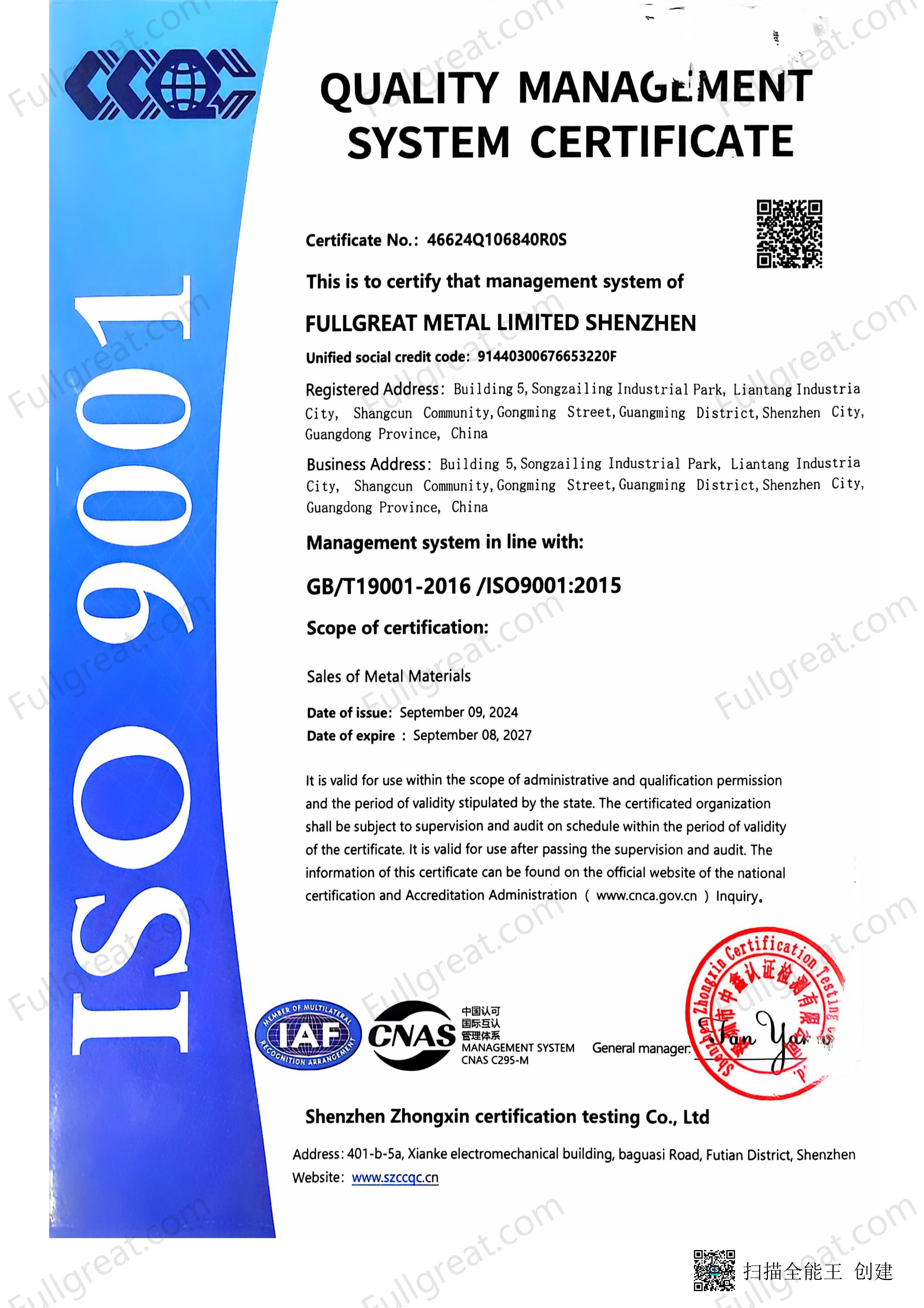
ISO 9001 certification covers Fullgreat’s sales of metal materials, giving buyers a verifiable quality management reference.
Beyond certification, Fullgreat’s stated quality control checks include dimensional requirements, composition, tensile strength, and elongation. After-sales support includes test reports. These are meaningful verification points: a supplier that can provide test data for chemical composition and mechanical properties makes it easier for a buyer to confirm that the wire matches the intended specification.
Production Capacity and Logistics
Fullgreat’s production base is located in Guangming District, Shenzhen, with a factory area of 5,000 square meters and a team of 50 employees. The R&D team includes 10 engineers, and the company reports that most of its products are self-developed and manufactured. Its main markets include Turkey, Latin America (Brazil, Mexico), Southeast Asia (Vietnam, Indonesia, Bangladesh), and European and American markets. This geographic reach is relevant for buyers evaluating supply chain risk and shipping convenience.
Understanding Wire Profiles: Y-Shape, Round, Flat, and Profiled Wire
The terminology around zipper wire can be confusing. “Zipper metal wire” is often used as an umbrella term, but the actual product form varies by function. The most common profile for metal zipper teeth is the Y-shape wire. The Y-shaped cross-section allows the wire to be cut and formed into interlocking teeth with a specific orientation, giving the zipper its mechanical strength and alignment.
Other profiles serve different functions. Flat wire is used when a rectangular cross-section is needed, often for components that require a larger surface area. Round wire is the most basic form and is used for spring wire and various mechanical parts. Top stop wire and bottom stop wire are typically supplied in shapes that can be crimped onto the zipper tape to prevent the slider from coming off. Zipper pull and zipper automatic slider are final components, usually stamped or assembled from metal strip or wire.
For a sourcing team, the practical takeaway is that “customization” is not a generic selling point. It means the supplier can adjust the cross-section, width, thickness, and hardness to match the buyer’s zipper machine tooling. Fullgreat’s product models reflect this depth: FPD-YSW for Y-shape wire, FPD-YTW01/FPD-YTW02 for Y teeth wire, FPD-TSW for top stop, FPD-BSW for bottom stop, and FPD-PW, FPD-SW, FPD-SSW for broader profiled and shaped wire applications.
Applications Across Apparel and Luggage
The end-use industries for zipper metal wire include clothing accessories and bag & luggage, but also extend to electronic accessories, home appliances, medical devices, and automobile accessories. Fullgreat’s profiled wire, for example, is explicitly applicable to electronic accessories, home appliances, medical devices, and clothing accessories, with materials of stainless steel, copper, or aluminum and fully customized shape and size.
A concrete application example comes from Fullgreat’s work with a Japanese zipper OEM. The client has sourced 50 tons per month for zipper production over a period of two years. According to the case record, the project achieved stable operation results, and the finished product is described as smooth and free of burrs. For a buyer, this type of qualitative evidence is useful because burr formation is a common issue in zipper wire processing; burrs can cause slider jamming and poor zipper feel.
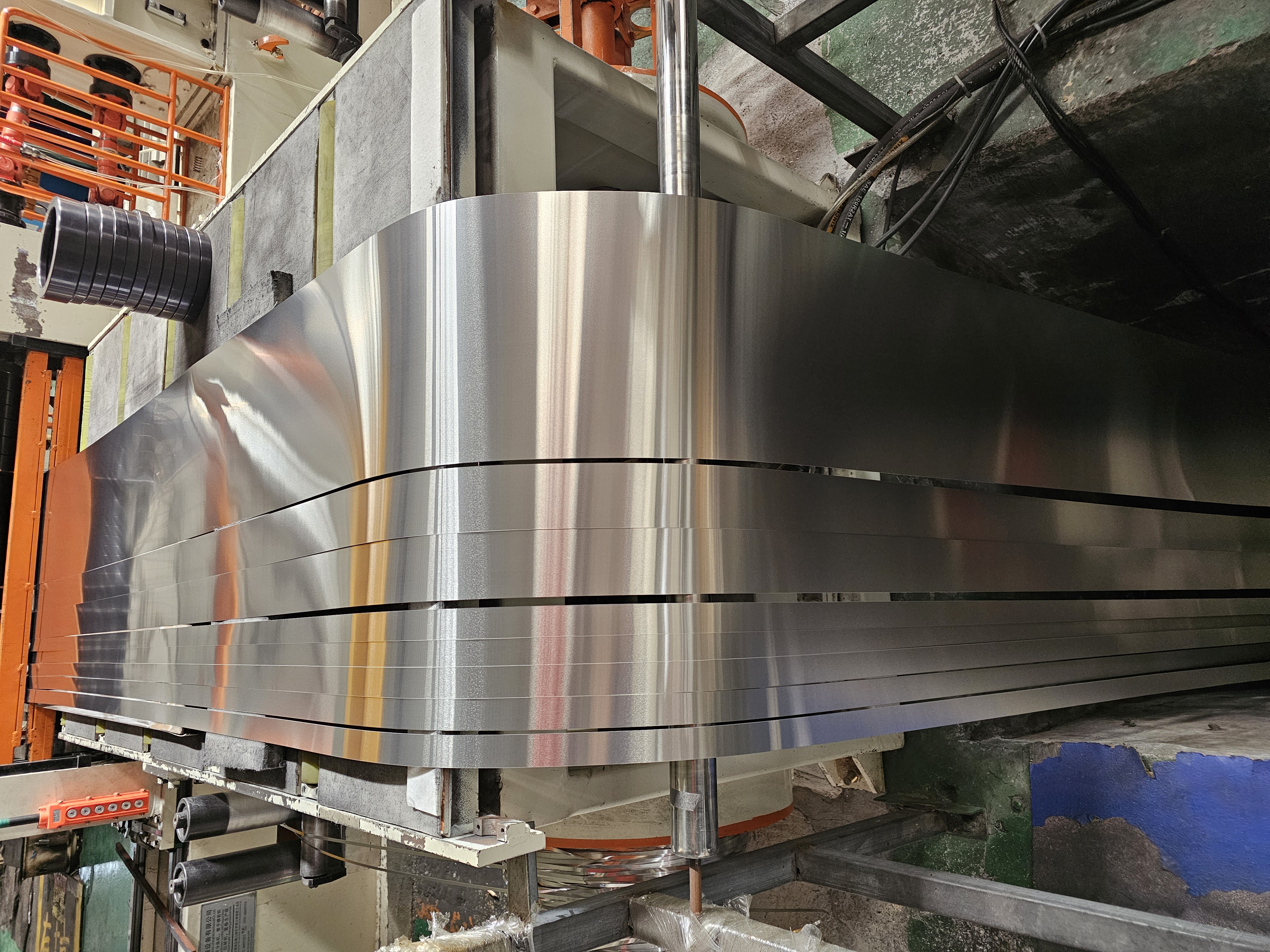
Steel strip is one of the raw material forms processed into shaped wire for zipper components.
Comparing Material Options: Stainless Steel, Copper, and Aluminum
Traditional zipper wire has been dominated by copper alloys. Dataintelo reports that brass holds a leading 44.1% market share in the metal zipper wire market as of 2025, largely due to its aesthetic appearance and anti-corrosive properties. Common production standards for copper alloy wire include ASTM B16 for free-cutting brass and ASTM B99 for copper-silicon alloy wire.
However, material choice is not a one-size-fits-all decision. Fullgreat began researching non-magnetic stainless steel for buttons and zippers in 2008, as an alternative to copper strip, and cooperated with Sichuan University to develop non-magnetic stainless steel strip. The company now produces grades such as FPD806, FPD808 stainless steel strip and FPD901, FPD902 stainless steel wire, which are used in button zippers, communications accessories, automotive products, and aerospace products. This development path shows that non-magnetic stainless steel can offer a lower-cost alternative with stable mechanical performance for certain applications.
There is a clear limitation to this substitution. Non-magnetic stainless steel does not naturally replicate the color of brass, and it may respond differently to electroplating and polishing processes. For products where a traditional brass aesthetic is a brand requirement, copper alloy wire remains the conventional choice. Buyers evaluating material changes should therefore request sample runs and perform finish tests before committing to a full shipment.
Future Outlook
As the metal zipper market grows at a projected CAGR of 5.7% through 2034, sourcing teams will likely place more emphasis on supplier consistency, custom profile capability, and documented quality systems. The market for copper alloy wire is also expanding, but material substitution trends will continue to push suppliers to offer alternatives with comparable performance at lower cost.
For zipper manufacturers, the evaluation criteria will increasingly include not just the wire itself but the supplier’s ability to provide engineering support, test reports, and a stable long-term supply relationship. Suppliers that can offer both standardized products and custom profiles, with verifiable certifications and clear production capacity, will be better positioned to support global apparel and luggage supply chains.