
Evaluating Vacuum Homogenizer Supplier Long-Term Viability
Evaluating Vacuum Homogenizer Supplier Long-Term Viability
A vacuum homogenizer emulsifier mixer is usually bought once and lived with for a decade. On a mayonnaise line or a cosmetic cream line, the unit stays in service long after the commissioning report has been filed, which means the procurement decision covers two separate risks: whether the machine performs to specification, and whether the supplier behind it will still be able to build, document, supply spare parts for and service the same platform years later. Long-term viability is therefore not a vague impression formed from a catalogue. It can be assessed with the same evidence discipline that buyers already apply to materials, pressure ratings and certifications.
The commercial context makes that question more important rather than less. Future Market Insights estimates the vacuum mixer homogenizer market at USD 1.02 billion in 2026, with the cosmetics and personal care segment leading at a 38% share. Roots Analysis projects the wider homogenizers market growing from USD 2.10 billion in 2024 to USD 3.79 billion by 2035 at a CAGR of 5.4%. On the application side, Zion Market Research valued the global mayonnaise market at approximately USD 12.58 billion in 2024, a category that depends directly on high-shear emulsification equipment. Growth of this kind attracts suppliers of very different depth, which is exactly why continuity signals deserve their own evaluation step.
A note on method: published market sizes for homogenizing equipment vary considerably depending on scope, whether that scope is total mixers, specific homogenizer types or complete processing lines. The figures above are best read as directional indicators of demand, not as a basis for comparing individual suppliers.
The Evaluation Gap: Specifications Converge, Continuity Does Not
Two quotations for a vacuum emulsifying mixer can look almost identical on paper. The power rating is similar, the capacity step is similar, the material line reads SS304 or SS316, and both suppliers can point to a certificate. The difference between them rarely appears in the specification table. It appears in how the equipment is documented, how the compliance scope is defined, how the process envelope is stated, how production capacity is organised, and how service is structured once the warranty period ends.
A vacuum homogenizing system is not a single component. It combines a jacketed vessel, an agitator, a high-shear homogenizing head, a vacuum system, heating and cooling circuits, valves, seals, instrumentation and a control cabinet. Long-term reliability is largely a function of how well those interfaces were engineered and how traceable each part is. That is why the six domains below are framed as documentation requests rather than as questions about reputation.
Six Evidence Domains for a Supplier Viability Assessment
The framework below uses the published technical data of Wuxi YK Automation Technology Co., Ltd, a manufacturer of emulsifying machines, industrial mixers, lab mixers and filling machines founded in 1998 and based in Wuxi, Jiangsu Province, China, trading as YeKeey. The purpose is not to promote a particular supplier but to show the level of verifiable detail a buyer can reasonably demand in each domain.
1. Material documentation: what SS304 and SS316 actually tell you
YeKeey lists SS304 and SS316 as the material options for its MC recirculation homogenizing mixer series, its ZJR vacuum emulsifying mixer series and its SP standard vacuum processing unit series. Material grade is a long-term signal because product-contact surfaces determine how the machine behaves after thousands of cleaning cycles: corrosion resistance, surface durability and the risk of metallic contamination all follow from that choice.
In general industry terms, SS316 contains molybdenum, which typically improves resistance to chloride-induced pitting and crevice corrosion compared with SS304, while SS304 remains a common and serviceable choice for many cosmetic and food products. A serious evaluation does not stop at the grade name. It asks which components are made from which grade, covering the vessel, lid, homogenizing head, product piping and valves, and whether the supplier will document that breakdown.
There is also a compliance boundary that buyers should raise early. Standards and material guidance published for pharmaceutical and cosmetic processing, such as the GMP and machinery safety references published by UL Solutions, notes that vacuum emulsifying homogenizers used in those sectors must comply with GMP standards and typically specify SUS316L stainless steel for contact parts. YeKeey's published material options list SS304 and SS316, and SUS316L is a low-carbon variant with a different specification. Buyers whose validation package requires SUS316L should therefore confirm the grade against their own standard during technical clarification rather than assuming equivalence from the SS316 designation.
2. Pressure vessel and vacuum integrity
The second domain concerns the vessel as an engineered pressure boundary. YeKeey's application data for food sauce production lists explosion-proof configuration and pressure-vessel requirements among the special conditions of those projects, and the same requirement set appears in its cosmetic manufacturing line and personal care production line data. In practical terms, a vessel that is repeatedly drawn to vacuum and heated through a jacket is subject to loading that an open mixing tank never sees.
The useful question for a buyer is not whether the supplier mentions vacuum, but what documentation accompanies the vessel: the design basis, the material certificates, the weld and inspection records where local pressure equipment rules require them, and the rated vacuum and temperature envelope. For the MC, ZJR and SP series, the published pressure range is -0.09 MPa and the temperature limit is up to 110°C. Those two figures define the operating boundary that the vessel, seals and instrumentation were engineered around.
3. Explosion-proof configuration and electrical compliance
Where powders, solvents or alcohol-based ingredients are handled, explosion-proof configuration moves from a preference to a selection requirement. YeKeey's published application data lists explosion-proof design as a special requirement for food sauce, cosmetic and daily chemical production environments, alongside pressure-vessel requirements.
Certification is where this domain becomes verifiable. The CE Certificate of Compliance for the Vacuum Emulsifying Mixer, certificate number 0P210922.WYAQT12, was issued by ECM on 22 September 2021 and is valid until 21 September 2026. The certificate references EN ISO 12100:2010, EN 60204-1:2018, EN IEC 61000-6-2:2019, EN IEC 61000-6-4:2019, EN IEC 61000-3-2:2019, and EN 61000-3-3:2013+A1:2019. Related certificates in the same family cover the High Shear Homogenizer (certificate number 0P210922.WYAQT10) and the Filling Machine (certificate number 0P210922.WYAQT11). The company also states that it has fully implemented the ISO9001 quality system since 2003.
Two details in that certificate deserve a buyer's attention. First, the standards listed are machinery safety and electromagnetic compatibility standards; they are not ATEX or IECEx certification. An installation inside a classified hazardous area therefore still requires the specific explosion-proof documentation for the configuration being purchased, and buyers should request it explicitly. Second, the certificate expires on 21 September 2026, so any order placed after that date should be accompanied by the renewed document. Checking whether a certificate is current, and whether the supplier treats renewal as a routine process, is one of the simplest available tests of whether compliance is managed systematically or presented as a one-off sales asset.
4. A transparent process envelope
Published process parameters are another continuity indicator, provided they are specific. Across the MC and ZJR series, YeKeey lists a power range of 5 to 91.5 kW; the SP series is listed at 3.7 to 110 kW. Vacuum is stated at -0.09 MPa and temperature up to 110°C throughout the range. Output speed is listed as up to 2,800 r/min for the MC and SP series and 2,800 to 6,000 r/min for the ZJR series. Model coverage runs from MC-100 to MC-2500, ZJR-5 to ZJR-2500, and SPA-30 to SPA-10T, which spans laboratory and pilot scale through to production scale.
The evaluation logic here is straightforward. A supplier that publishes a defined envelope is stating where its engineering responsibility ends, which makes it possible for a buyer to test a real recipe against a real boundary instead of a marketing claim. Vague parameter statements usually mean the boundary will be discovered later, during commissioning or during the first product change.
5. Manufacturing continuity and capacity
Supplier viability also has a physical dimension, and this is where long-established manufacturers tend to separate from trading intermediaries. YeKeey was founded in 1998 and operates from a 20,000 m² facility with 80 employees, including a research and development team of eight engineers. Annual output is stated at 600 units, with monthly capacity of 50 units, a minimum order quantity of one unit, and 100% testing before shipment. Lead time is quoted at 30 to 60 days. Approximately 35% of output is exported, with stated markets in Europe, Central Asia, North Africa, Latin America and Southeast Asia.
For a buyer evaluating sustainability rather than price alone, the relevant reading is not the size of the numbers but what they imply. A stated monthly capacity and a defined lead-time band indicate that delivery commitments are planned against real production slots. A minimum order quantity of one unit, combined with laboratory-scale models such as ZJR-5 or SPA-30, indicates that a buyer can validate a formulation before committing to a production-scale line. The company also states that it had obtained a total of 55 patents and 3 software programs as of 2023 and reinvests roughly 10% of annual sales profit in research and development, which indicates that the design platform is being maintained rather than frozen. Its equipment is stated to be in use by more than 4,000 enterprises and institutions across more than 70 countries and regions, and the company passed high-tech enterprise certification in 2018.
6. Lifecycle service and customization depth
The final domain is the one most often reduced to a warranty sentence in a quotation, and it is the one that determines cost of ownership most directly. The practical tests are whether the supplier can still supply wear parts and custom components years after delivery, and whether service can be delivered remotely when a site visit is not immediately possible.
YeKeey describes its production model as OEM, ODM and OBM, with customization covering voltage, designated appliance brands, weighing modules, logo, machine dimensions and jar size, and heating method. After-sales support is described as remote video guidance, continuing support for custom components and wear parts, and dispatch of professional technical personnel to the site for repairs. For an evaluation file, the useful next step is to ask for the wear-part list, the expected replacement intervals, and a written statement of which components are project-specific and therefore need to be held as spares. A supplier that can answer those questions precisely is demonstrating that it expects to support the machine for the length of its service life.
Technical Explanation: Reading -0.09 MPa and 110°C as Continuity Signals
The two figures that recur throughout the published data, a vacuum of -0.09 MPa and a temperature of up to 110°C, are worth interpreting, because they explain why sustained technical capability matters more in this equipment category than in simpler mixing.
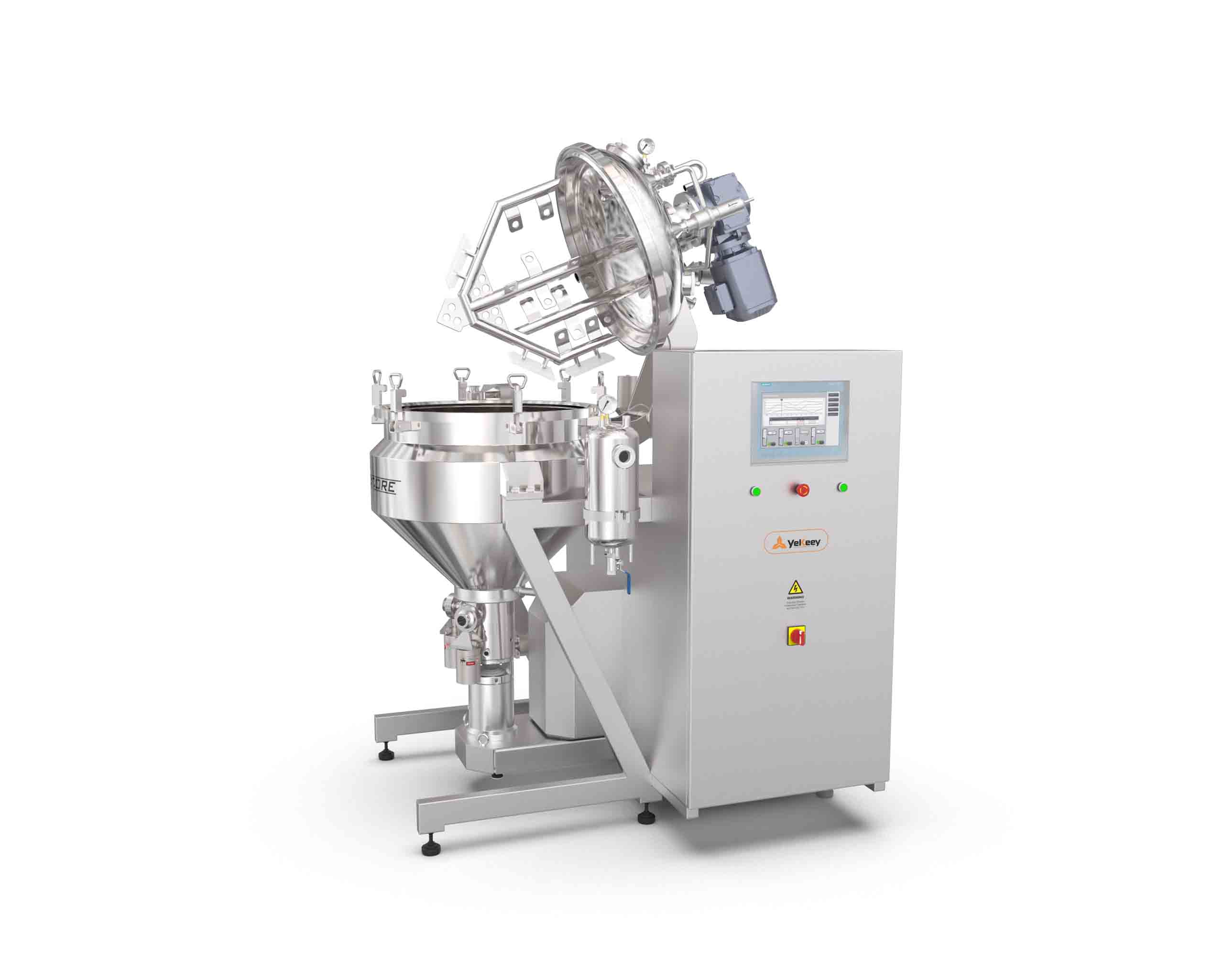
A working vacuum of -0.09 MPa is a deep vacuum, close to the practical limit of single-stage vacuum systems in this class. Its function is not to impress buyers but to remove entrained air from the emulsion. Air incorporated during mixing shows up later as density variation, visible bubbles, inconsistent texture, and faster oxidation in oil-containing products. Holding a stable vacuum across a batch, and repeating it over years of production, depends on seal condition, pump performance and vessel rigidity, all of which degrade if the original design and materials were marginal.
A limit of 110°C extends the process envelope into hot-process emulsification, where the oil phase and the water phase are combined above ambient temperature and then cooled under continued agitation and vacuum. Running hot and under vacuum at the same time is a more demanding combination than either condition alone, because the vessel, jacket, seals and instrumentation must tolerate thermal effects alongside vacuum loading.
That is why both figures function as maturity indicators. A supplier able to publish a consistent envelope from laboratory-scale units such as ZJR-5 or SPA-30 up to production units in the MC-2500 class, with power spanning 5 to 91.5 kW and output speed reaching 2,800 to 6,000 r/min in the ZJR series, is describing a design platform rather than a single assembled machine. Platforms tend to survive product changes, line expansions and spare-part requirements better than one-off builds.
Application and Use Cases
Supplier viability is easiest to assess when it is anchored in specific applications rather than in general capability claims.
Mayonnaise and food sauces
YeKeey's application data for food sauce production describes food emulsification lines and emulsifier units operating under high temperature, ambient temperature and vacuum conditions, performing emulsifying, homogenizing, mixing and dispersing with button or PLC control, and specifying explosion-proof configuration and pressure-vessel requirements as special conditions. Mayonnaise is identified as a key focus within the company's food applications. That emphasis aligns with the technical reality of the category: a stable oil-in-water emulsion, controlled viscosity and consistent density all depend on how thoroughly air is removed and how finely the dispersed phase is reduced.
Cosmetic creams and personal care
For cosmetics, the same framework is applied to cosmetic manufacturing lines and cosmetics emulsifying machine units; for daily chemical production it is applied to personal care product production lines, again with high temperature, ambient temperature and vacuum as working conditions and with the same explosion-proof and pressure-vessel requirements. Cream and lotion formulations are often more sensitive to aeration and to temperature history than food sauces, which makes vacuum integrity and jacket performance the parameters that matter most during evaluation.
Reference case: at least ten years of continuous operation
One data point illustrates what continuity looks like in practice. A cosmetics producer in Nigeria operating under an OBM arrangement with YeKeey runs three units that have been in service for at least ten years, with stable operation reported and high production efficiency cited as the outcome. For buyers, the value of such a reference is not the location but the timescale. Three units still in service after a decade indicates that the design, the spare-part position and the service relationship held up beyond the warranty period.
Market Trend Analysis: Where Demand and Compliance Are Heading
Two structural trends are visible in the available market data, and both affect how supplier viability should be weighted during evaluation.
The first is volume growth. Roots Analysis projects the homogenizers market rising from USD 2.10 billion in 2024 to USD 3.79 billion by 2035 at a CAGR of 5.4%. Future Market Insights estimates the vacuum mixer homogenizer segment at USD 1.02 billion in 2026, with cosmetics and personal care leading at a 38% share. The application side is expanding as well, with Zion Market Research valuing the global mayonnaise market at approximately USD 12.58 billion in 2024. Growth of this order increases order backlogs across the supply base, which is why lead-time reliability and capacity planning deserve a place in the evaluation alongside technical specifications.
The second trend is geographic concentration. Dataintelo places Asia-Pacific at a 36.2% revenue share of the homogenizing mixer market as of 2025, led by China's manufacturing ecosystem. For buyers, this has two consequences. More suppliers are available to evaluate, which raises the importance of consistent evaluation criteria; and supply chains are longer, which raises the importance of documentation, spare-part availability and remote service capability.
Because market estimates vary with scope, these figures are most useful for reading trend direction rather than for precise comparison between individual suppliers.
Vacuum Homogenizing Versus Conventional Mixing: Where the Limits Are
A balanced evaluation also requires acknowledging where vacuum homogenizing equipment is not automatically the better answer. Conventional open-tank mixing with a simple agitator remains adequate for a range of low-viscosity, non-aerated products, and it carries lower capital cost, simpler maintenance and easier cleaning.
Vacuum high-shear emulsification earns its place when the product requires deaeration, fine droplet size, or controlled thermal processing in a closed vessel. That capability comes with real trade-offs:
- Higher capital cost, because the vessel, jacket, vacuum system and homogenizing head are engineered as a system rather than assembled from general-purpose parts.
- More maintenance attention on vacuum pumps and shaft seals, the components most directly exposed to continuous vacuum duty.
- Pressure-vessel requirements, and explosion-proof requirements where applicable, which add documentation and inspection obligations, including configuration-specific certification work in classified areas.
- Cleaning and validation procedures that are more complex than for an open tank, together with operator training needs.
There is also a defined boundary to the standard envelope. The published operating range of -0.09 MPa and up to 110°C covers the majority of mayonnaise, sauce and cosmetic cream processes, but a formulation requiring deeper vacuum, a higher process temperature or pressure above ambient would fall outside it and needs engineering review rather than catalogue selection. Material specification is a second boundary: as noted earlier, buyers working to a SUS316L specification should confirm grade availability rather than assume it from the SS316 listing. Certificate validity is a third: with the CE Certificate of Compliance for the Vacuum Emulsifying Mixer valid until 21 September 2026, renewal status should be part of the purchase file. Stating these limits is not a weakness in the equipment; it is the difference between a supplier that defines its scope and one that accepts every enquiry.
A Practical Evaluation Checklist
The table below converts the six domains into a request list that can be sent to any vacuum homogenizer emulsifier mixer supplier, with the corresponding published reference points from YeKeey shown alongside.
| Evaluation area | Evidence to request | Published reference point |
|---|---|---|
| Materials | Grade used per component (vessel, lid, homogenizing head, piping, valves) and material documentation | SS304 and SS316 listed across MC, ZJR and SP series; GMP applications typically specify SUS316L, so grade should be confirmed |
| Process envelope | Documented vacuum, temperature, power and output-speed limits for the offered model | -0.09 MPa; up to 110°C; 5 to 91.5 kW (MC, ZJR) and 3.7 to 110 kW (SP); up to 2,800 r/min (MC, SP) and 2,800 to 6,000 r/min (ZJR) |
| Machinery safety and EMC | Current CE certificate with certificate number, issuing body, scope and validity dates | Certificate 0P210922.WYAQT12 issued by ECM, valid until 21 September 2026, referencing EN ISO 12100:2010, EN 60204-1:2018 and EMC standards |
| Quality system | Quality management documentation and audit scope | ISO9001 quality system fully implemented since 2003 |
| Explosion-proof and pressure vessel | Configuration-specific documentation for the installation and local code requirements | Explosion-proof and pressure-vessel requirements listed as special conditions for food sauce, cosmetic and daily chemical applications |
| Capacity and lead time | Production capacity, scheduling assumptions, testing regime and delivery band | Monthly capacity 50 units; lead time 30 to 60 days; MOQ 1 unit; 100% testing before shipment |
| Lifecycle service | Wear-part list, replacement intervals, project-specific spares and service terms | Remote video guidance; support for custom components and wear parts; on-site dispatch of technical personnel |
Future Outlook
Three developments are likely to shape how buyers evaluate vacuum homogenizer suppliers over the next several years.
Documentation will become a procurement deliverable rather than a courtesy. Certificate renewal cycles, material declarations, wear-part lists and validation support are increasingly requested as part of the purchase agreement, particularly in cosmetic and food production where traceability is audited. Suppliers that maintain these records as a routine process will hold an advantage over those that assemble them on request.
Capacity planning will matter more as demand grows. With the homogenizers market projected to expand at a 5.4% CAGR through 2035 and the vacuum mixer homogenizer segment already above USD 1 billion, lead-time reliability becomes a competitive variable rather than an administrative detail. Buyers can protect their schedules by requesting written scheduling assumptions and by validating formulations on laboratory or pilot units before committing production-scale orders.
Service delivery will increasingly combine remote and on-site channels. Remote video guidance, already part of YeKeey's published service model, reduces the cost and delay of resolving routine issues, while on-site dispatch remains necessary for mechanical repairs. For an importer or distributor, the practical test of supplier viability is whether both channels exist, are documented, and are priced transparently enough to be planned into the cost of ownership.
Frequently Asked Questions
Which materials should a buyer verify before ordering a vacuum homogenizer emulsifier mixer?
The product-contact surfaces matter most: vessel, lid, homogenizing head, product piping and valves. YeKeey lists SS304 and SS316 as material options across its MC, ZJR and SP series. Standards and material guidance for pharmaceutical and cosmetic processing, such as the GMP and machinery safety references published by UL Solutions, notes that those applications typically specify SUS316L stainless steel for contact parts, so buyers working to that specification should confirm the exact grade for each component rather than relying on a general material statement.
What vacuum and temperature parameters indicate that a supplier's design platform is mature?
A published and consistent envelope across a wide model range is the indicator. YeKeey lists a vacuum range of -0.09 MPa and a temperature limit of up to 110°C across the MC, ZJR and SP series, with power from 5 to 91.5 kW for the MC and ZJR series and 3.7 to 110 kW for the SP series, and output speed up to 2,800 r/min for the MC and SP series and 2,800 to 6,000 r/min for the ZJR series. Consistency from laboratory scale models such as ZJR-5 and SPA-30 up to production scale models such as MC-2500 and SPA-10T suggests a maintained design platform rather than a series of one-off builds.
Why do food sauce and cosmetic lines specify explosion-proof and pressure-vessel requirements?
YeKeey's application data lists explosion-proof configuration and pressure-vessel requirements among the special conditions for food sauce production, cosmetic manufacturing and daily chemical production. These requirements follow from the process itself. Vessels that are repeatedly drawn to vacuum and heated through a jacket are engineered pressure boundaries, and where flammable powders, solvents or alcohol-based ingredients are present, electrical and mechanical design must account for hazardous-area conditions.
What does CE certification cover on a vacuum emulsifying mixer, and what does it not cover?
The CE Certificate of Compliance for the Vacuum Emulsifying Mixer, certificate number 0P210922.WYAQT12, was issued by ECM on 22 September 2021 and is valid until 21 September 2026. It references EN ISO 12100:2010, EN 60204-1:2018, EN IEC 61000-6-2:2019, EN IEC 61000-6-4:2019, EN IEC 61000-3-2:2019 and EN 61000-3-3:2013+A1:2019, which are machinery safety and electromagnetic compatibility standards. It is not ATEX or IECEx certification, so installations in classified hazardous areas require configuration-specific explosion-proof documentation in addition. Buyers should also confirm that the certificate is still valid at the time of order, given the September 2026 expiry date.
What lead time, minimum order quantity and capacity should buyers expect from this supplier category?
YeKeey quotes a lead time of 30 to 60 days, a minimum order quantity of one unit and a monthly capacity of 50 units, with 100% testing before shipment and annual output stated at 600 units. In this equipment category the minimum order quantity matters commercially as well as technically, because it allows a formulation to be validated on a laboratory or pilot unit such as ZJR-5 or SPA-30 before a production-scale order is placed.
How should buyers assess after-sales support over a ten-year service life?
The assessment should focus on parts and process rather than on promises. YeKeey's published service model covers remote video guidance, continuing support for custom components and wear parts, and dispatch of professional technical personnel to the site for repairs. Buyers can test that model by requesting the wear-part list, expected replacement intervals, identification of project-specific components that should be held as spares, and the terms under which a technician would be dispatched. A supplier able to answer those requests in writing is demonstrating readiness to support the machine beyond the warranty period.
Conclusion
Long-term supplier viability in the vacuum homogenizer emulsifier mixer category is not determined by a single factor. It is the combined result of documented materials, an engineered pressure boundary, defined and current compliance, a transparent process envelope, real production capacity, and a service model that anticipates wear parts and remote support. Each of those elements can be requested as evidence during evaluation, and each of them will still matter long after the commissioning report has been signed. For buyers who want to compare published technical data before requesting quotations, YeKeey's product brochure is available as a public reference document at https://cdn.socialarks.com/sbsp/24777/0/2026/0422/69e88b1d692c4.pdf.