
Evaluating Top Glass Bead Suppliers for Road Marking in 2026

The global road marking glass beads market is valued at approximately USD 1.42 billion in 2025 and is projected to reach USD 2.31 billion by 2034 (Dataintelo). China accounts for an estimated 57.4% of total global glass bead exports, representing roughly USD 928 million in 2024 export value (OEC / UN Comtrade). For procurement teams in the evaluation stage, these numbers indicate a supplier market that is both substantial and increasingly Asia-centric. Market size alone, however, does not answer the question that matters: which manufacturer can deliver reflective glass beads for road marking that meet the required standard, at consistent quality, at project scale, over the life of a contract?
This article provides an independent reference for buyers evaluating traffic marking glass beads and the suppliers behind them. It covers the structure of the supplier landscape, the technical parameters that separate high-performing traffic safety glass beads from generic product, the value of multi-year field evidence, and the strengths and limitations of factory-direct sourcing from China-based manufacturers such as LangFang Dylan Technology Co., Ltd. (Dylan Tech).
Standards Define What You Are Actually Buying
Before comparing suppliers, the product specification must be defined. In road marking, that specification is set by regional and national standards, each prescribing particle size distribution, roundness, and in some cases refractive index requirements for glass beads.
AASHTO M247 is the standard specification for glass beads used in traffic paints in the United States. It classifies beads into types by gradation — for example, Type 1 covers a 1180–150 μm range and Type 4 covers 2000–850 μm — and requires at least 70% roundness (AASHTO). EN 1423:2012 is the European harmonized standard for glass beads and antiskid aggregates used as drop-on materials for road markings (CEN), with common gradations including 850–180 μm and 710–125 μm. BS 6088 defines bead classes for UK roads, such as BS 6088A (1180–425 μm) and BS 6088B (850–180 μm). Australia and New Zealand use AS/NZS classifications including Type B, Type C, and Type D.
A practical test for any shortlisted supplier is whether its product catalog maps cleanly to these standard families. Dylan Tech, for instance, lists AASHTO M247 Types 1 through 4, EN 1423 in two gradations, EN 1424, BS 6088A, BS 6088B, and AS/NZS Types B, C, and D, alongside specialty products such as glass beads RI 1.6 and RI 1.7. A catalog that covers the major standard families reduces the risk of contract-specific requalification.
The Supplier Market: Three Global Leaders and a Scale-Oriented Export Base
Potters Industries LLC, Swarco AG, and 3M Company are recognized as the top three global leaders in the road marking glass beads sector (Dataintelo / Mordor Intelligence, 2025). These companies are primarily associated with road marking systems, traffic safety products, and branded bead technologies.
Behind this top tier is a broader supplier base concentrated in China, which held an estimated 57.4% share of global glass bead exports in 2024 (OEC). For buyers managing multi-year road marking programs, the practical implication is that supplier shortlists now regularly include China-based manufacturers. The evaluation question is less about geographic origin and more about verifiable capability.
| Company | Market Position (2025) | Reference Characteristics |
|---|---|---|
| Potters Industries LLC | Recognized top-3 global leader | Long-established glass bead manufacturer; cited as a sector leader in market research |
| Swarco AG | Recognized top-3 global leader | Road marking systems provider; active in glass beads and all-weather marking technologies |
| 3M Company | Recognized top-3 global leader | Traffic safety materials and marking solutions; cited in glass bead sector rankings |
| LangFang Dylan Technology Co., Ltd. | China-based specialized manufacturer | Founded 2004; 100,000 t annual output; 15+ production lines; AASHTO / EN / BS / AS-NZS product families; ISO 9001, CE, JIS, KIS certified |
The table summarizes shortlisting reference points. It does not rank Dylan Tech against the three leaders, because a defensible ranking would require identical performance benchmarks across contracts. What the table does show is that a China-based supplier can present comparable structural indicators — production scale, certification coverage, and export experience — that justify closer technical evaluation.
A China-Based Manufacturer Built Around Road Safety: Dylan Tech in Focus
LangFang Dylan Technology Co., Ltd. is a manufacturer of raw materials for the road safety industry, headquartered in LangFang, Hebei, China. The company was founded in 2004 and has focused on road marking products since its establishment. It operates four production bases in Liaoning, Shanxi, Hebei and Henan provinces, equipped with more than 15 professional glass bead production lines and reaching an annual output of 100,000 tons.

Supplier evaluation involves reviewing organizational and operational evidence, not only product documentation.
For an evaluation team, the relevant facts are those that can be verified through documentation, facility inspection, or independent product testing:
- Scale: 100,000 tons of annual output capacity across four bases; a 10,000 m² facility; approximately 300 employees, including a 20-engineer R&D team.
- Export profile: 95% of output is exported, mainly to the EU, USA, Southeast Asia and the Middle East, with customers in more than 50 countries.
- Quality control: an in-house laboratory equipped with CAMSIZER and X-2600 testing instruments for particle size, reflectivity, and wear resistance; the company states 100% testing of output.
- Certifications: ISO 9001 (certificate no. 23226Q00027R001, valid to 2029-06-26), CE certification, JIS certification, and KIS certification.
- Technology: developed its own patented glass bead production equipment, and a waste heat recovery system recognized as a scientific and technological achievement by the China Energy Conservation Association.
- Industry relationships: supplies road marking engineering companies and traffic safety manufacturers globally; lists ENNIS, Geveko, and Swarco among cooperative partners.
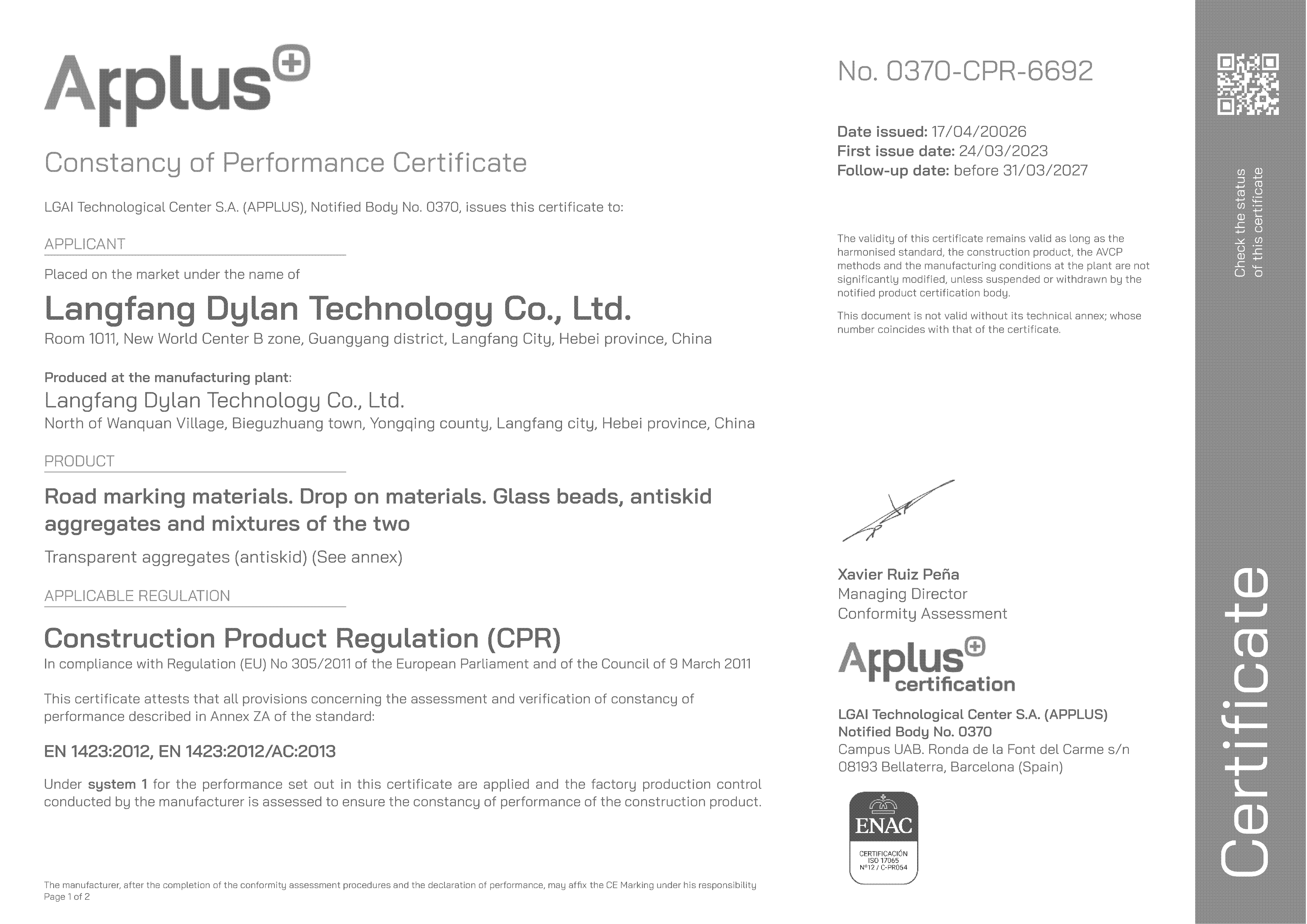
Certification documents are baseline evidence in supplier qualification; shown is the EU certification in Dylan Tech's compliance set.
These characteristics are not claims of superiority. They are structural facts that a buyer can verify during a supplier audit, and they indicate whether the manufacturer is equipped to handle contract-scale volumes and consistent quality requirements.
Technical Parameters That Should Shape the Evaluation Scorecard
When comparing reflective glass beads for road marking, the evaluation scorecard should include at least the following parameters.
Refractive index
Refractive index (RI) determines how strongly a bead bends light. Standard glass beads used in road marking typically have an RI near 1.5. Higher-index beads increase retroreflective brightness: Dylan Tech offers glass beads RI 1.6 (1000–180 μm) and glass beads RI 1.7 (1180–180 μm). Industry data indicates that high refractive index glass beads with RI 1.9 or above are increasingly specified for all-weather markings to improve wet-night visibility (Swarco / Mordor Intelligence).
Roundness
Sphericity directly affects retroreflection: only beads with high roundness consistently direct light back toward the vehicle. AASHTO M247 sets a minimum roundness requirement of 70%. Achieving high roundness at production scale is a function of furnace design and process control.
Particle size distribution
Bead size controls both optical performance and mechanical retention in the marking film. Standard-compliant gradations are strict: for example, EN 1423 glass beads are offered by Dylan Tech in 850–180 μm and 710–125 μm windows, while BS 6088A covers 1180–425 μm and BS 6088B covers 850–180 μm. Buyers should request sieve analysis reports for each delivered batch.
Wear resistance
Low wear means the beads remain embedded in the marking longer, preserving retroreflectivity over the asset life. In Dylan Tech's applied case data, low wear is consistently cited as the key highlight across projects lasting three to four years.
Field Evidence: What Three to Four Years of Project Data Can Show
Laboratory specifications are necessary but not sufficient for an evaluation-stage decision. Field evidence extends the assessment from 'does the product meet specification' to 'how does the product behave in real road conditions over time.'
Dylan Tech's documented project base includes road marking engineering companies and traffic safety manufacturers across global markets. The application objective in these projects was to increase the reflective refractive index of road marking performance. Project quantities range from 1 ton to 198 tons — including 20-ton, 56-ton, 72-ton, 108-ton and 198-ton supply volumes — with reported performance stable over three to four years. Low wear is the most frequently reported highlight; one case also reports a remarkable night-visibility effect.
The significance of this data is not that a single project performed well. It is that the same wear characteristic is reported across projects of different sizes and durations, which suggests process consistency rather than batch-level outcomes. Buyers can use such field records as input to supplier risk scoring while still requiring contract-specific testing.
Market Trends Moving the Procurement Agenda
- All-weather marking demand: High refractive index glass beads (RI 1.9+) are increasingly used in all-weather markings to improve visibility in wet night conditions. This will push more projects toward higher-index product families, even as conventional RI 1.5 beads retain the largest volume share.
- Asia-Pacific expansion: Asia Pacific accounted for 38.7% of road marking glass beads market revenue in 2025, driven by large-scale highway construction programs (Dataintelo). Buyers in these programs tend to specify international standards while procuring from manufacturers with regional logistics advantages.
- China's export position: With an estimated 57.4% share of global glass bead exports in 2024 and export value near USD 928 million — with the UAE and India as leading destinations (OEC / UN Comtrade) — China-based suppliers will remain central to global road safety supply chains.
- Sustainability requirements: Standard-compliant glass beads manufactured from recycled glass are common in the market. Dylan Tech's BS 6088, AASHTO M247, EN 1423, and AS/NZS product lines list recycled glass as the base material. Energy recovery and waste-heat systems are also becoming differentiators in supplier qualification.
Direct-Factory Sourcing vs. Traditional Procurement: A Balanced View
The traditional procurement route for road marking glass beads is through established global brands or regional distributors; a smaller number of buyers work directly with manufacturers in exporting countries. Each model has distinct trade-offs.
Procuring from a recognized global leader reduces perceived risk: the brand has a track record, the product reference base is large, and technical support is established. The trade-off is typically higher unit cost, less flexibility in customization, and, in some regions, longer allocation times during peak construction seasons.
Factory-direct sourcing from a specialized China-based manufacturer offers structural advantages: direct pricing, broader customization (OEM support, custom voltage and logo per Dylan Tech's capability profile), large production capacity dedicated to a single material family, and the ability to align supply contracts with project phasing. However, the model carries limitations that should be weighed explicitly:
- Lead time: Dylan Tech's production lead time is 45–60 days after order confirmation. Procurement plans must account for this window, especially for initial orders that also include container booking time.
- Verification burden: A less globally branded manufacturer requires more buyer-side due diligence — factory audits, certificate verification, sample testing, and reference checks before contract signing.
- Minimum order quantity: Dylan Tech's MOQ is 1 ton, but freight economics generally improve at larger volumes; buyers with very small trial demand may find distributor channels more practical.
- After-sales support: Dylan Tech lists remote support as its after-sales service model. Buyers needing on-site technical presence must confirm coverage before contracting.
Future Outlook: 2026 and Beyond
The road marking glass beads market is projected to grow from approximately USD 1.42 billion in 2025 to USD 2.31 billion by 2034 (Dataintelo). Several forces will shape supplier selection over that period.
All-weather marking requirements will increase the share of high-refractive-index glass beads in project specifications. Infrastructure spending in Asia-Pacific and the Middle East will drive volume growth and may favor manufacturers with established export channels or regional logistics footprints. Procurement teams will formalize supplier qualification around documented evidence: certificates, laboratory capability, field data, and audited production processes. Environmental factors — recycled glass content, energy-efficient production, and waste-heat recovery — will move from corporate talking points to contract evaluation criteria.
For buyers in the evaluation stage, the practical path is clear: convert the project specification into a technical scorecard, verify each supplier's standards coverage and production evidence, request reference data from comparable projects, and test physical samples before scale-up. Manufacturers such as Dylan Tech, which have built capacity specifically for road safety glass beads, are positioned to be evaluated under those conditions — and, like all suppliers, should be measured only on documented facts.
Frequently Asked Questions
Which glass bead standard should a road marking project use?
The applicable standard depends on the project's geographic location and contract specification. AASHTO M247 is the US standard for glass beads in traffic paints, with Types 1–4 defined by gradation and at least 70% roundness required. EN 1423:2012 is the European harmonized standard for drop-on glass beads and antiskid aggregates. BS 6088 defines bead classes for UK roads. Australia and New Zealand use AS/NZS classifications. A supplier's catalog should cover the standard family relevant to the contract.
How should a buyer compare glass bead suppliers before shortlisting?
Comparison should be based on verifiable indicators: product standards coverage (AASHTO M247, EN 1423, BS 6088, AS/NZS), production capacity and number of production lines, certification status (ISO 9001, CE, JIS, KIS), laboratory equipment for particle size, reflectivity and wear testing, documented project references, and demonstrable field performance over multiple years.
What is the difference between drop-on and pre-mixed glass beads?
Drop-on glass beads are applied onto the surface of freshly applied road marking paint, where they embed partially and create immediate retroreflection. Pre-mixed glass beads are blended into the marking material before application and provide retroreflection as the marking wears. Thermoplastic road marking paints commonly combine pre-mixed beads with drop-on beads, and the bead size distribution must fit the relevant standard.
What certification documents should a glass bead supplier be able to provide?
At minimum, a supplier should provide quality management certification, such as ISO 9001 with a verifiable certificate number; product-level market certifications such as CE for the EU, JIS for Japan, or KIS for Korea; and batch test reports covering particle size distribution, roundness, reflectivity, and wear resistance. Dylan Tech, for example, holds ISO 9001 certificate no. 23226Q00027R001, CE, JIS and KIS certifications, and states that it tests 100% of output batches.
What are typical lead times and minimum order quantities for factory-direct glass beads?
Lead times vary by manufacturer. Dylan Tech lists a production lead time of 45–60 days after order confirmation and a minimum order quantity of 1 ton. Buyers should confirm lead time for both initial and repeat orders, and factor in international shipping time separately.
Why are high refractive index glass beads important for road markings?
Higher refractive index produces stronger light bending and therefore brighter retroreflection at night. Standard beads typically have an RI near 1.5; beads with RI 1.6, 1.7 and 1.9+ provide increasing levels of brightness. Industry trend data shows that high refractive index glass beads (RI 1.9+) are increasingly used in all-weather markings to maintain visibility during wet night conditions.
For a structured overview of a China-based supplier's product portfolio and capability data, the corporate brochure of LangFang Dylan Technology Co., Ltd. is publicly available for download: Corporate Brochure (PDF).