
Evaluating Structure Tents: Specs & Certifications for Industry
KENTEN Structures is a supplier of premium aluminum permanent and semi-permanent structures, including structure tents designed for industrial, event, and commercial applications worldwide. As procurement professionals evaluate temporary and semi-permanent shelter solutions, understanding technical parameters, compliance certifications, and real-world performance becomes essential. This article provides a factual breakdown of the structure tent category through the lens of KENTEN's product line, focusing on the specifications and certifications that matter most during the research-to-evaluation stage.
Problem & Opportunity: The Demand for Certified, High‑Performance Shelters
Industries ranging from logistics to events require rapidly deployable structures that meet strict safety and durability standards. Traditional permanent buildings involve lengthy construction timelines and high costs, while basic tent solutions often lack structural integrity under extreme weather. The global tent market—covering industrial storage, sports, and events—is projected to grow from USD 4.01 billion in 2025 to USD 6.07 billion by 2033 (CAGR 5–7%), according to sector analyses. China alone accounted for 53.3% of global tent exports in 2024, with an export value of approximately USD 3.11 billion (OEC). This growth underscores the need for products that combine large clear spans, modularity, and verifiable certifications.
KENTEN’s Structure Tent Solution: Verified Parameters
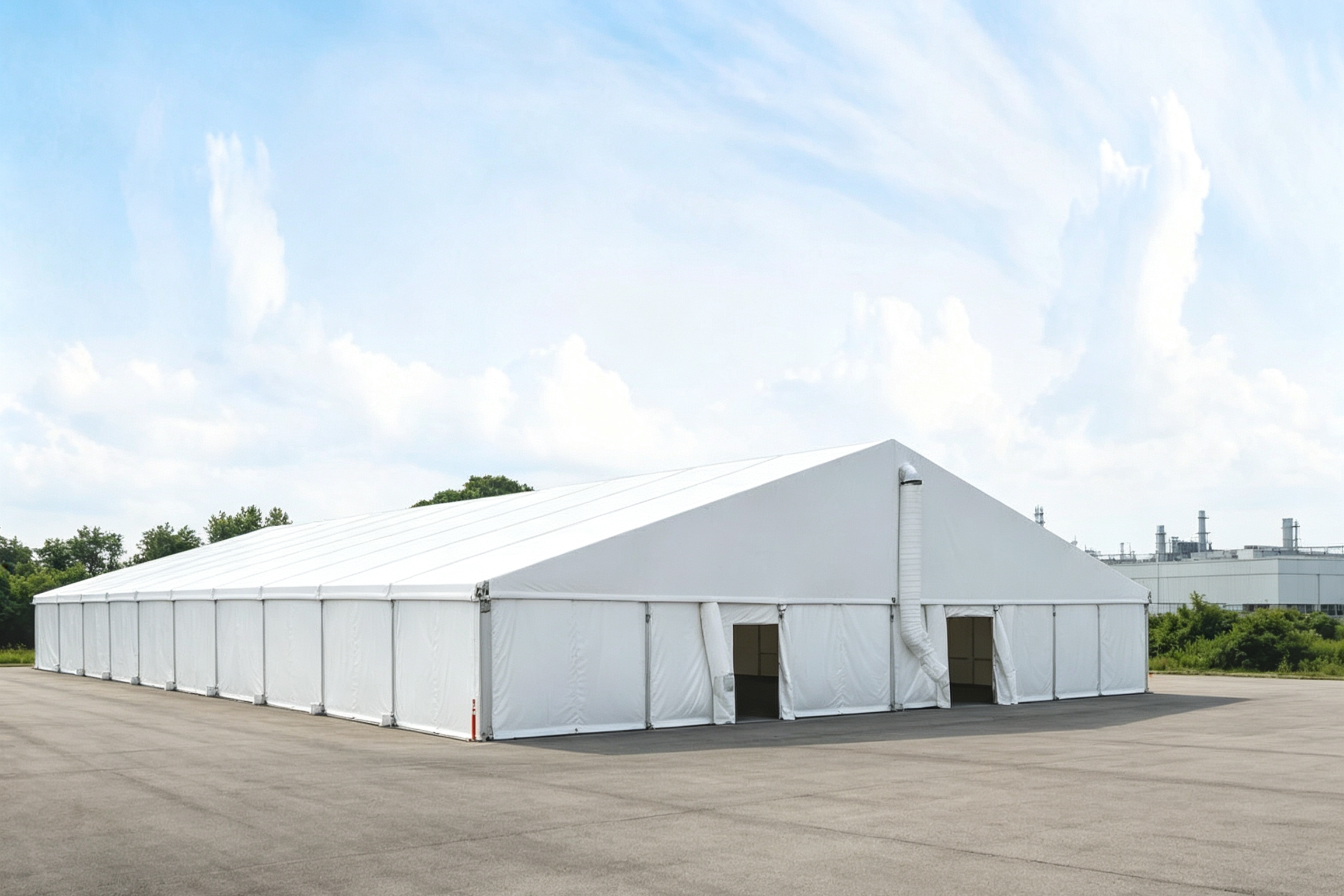
KENTEN’s Structure Tent (model series K1–K10) is designed to deliver clear spans from 3 meters up to 80 meters, with unlimited length in 5‑meter bay increments. The main frame uses high‑strength aluminum alloy 6061‑T6 / 6082‑T6, while the roof fabric is 850 g/m² PVC‑coated polyester treated for UV resistance and flame retardancy conforming to DIN 4102 B1, M2, and NFPA 701. Sidewall options include PVC, glass wall, ABS wall, and sandwich panel. The structure can be anchored with ground anchors or concrete ballast.
For dedicated warehouse applications, KENTEN offers the W1 Warehouse Tent, spanning 3 to 60 meters with customizable length. It features a fire‑retardant roof cover and is built to withstand wind loads up to 120 km/h and snow loads up to 75 kg/m². The same aluminum alloy construction ensures corrosion resistance and long‑term durability.
Technical Explanation: Engineering for Compliance
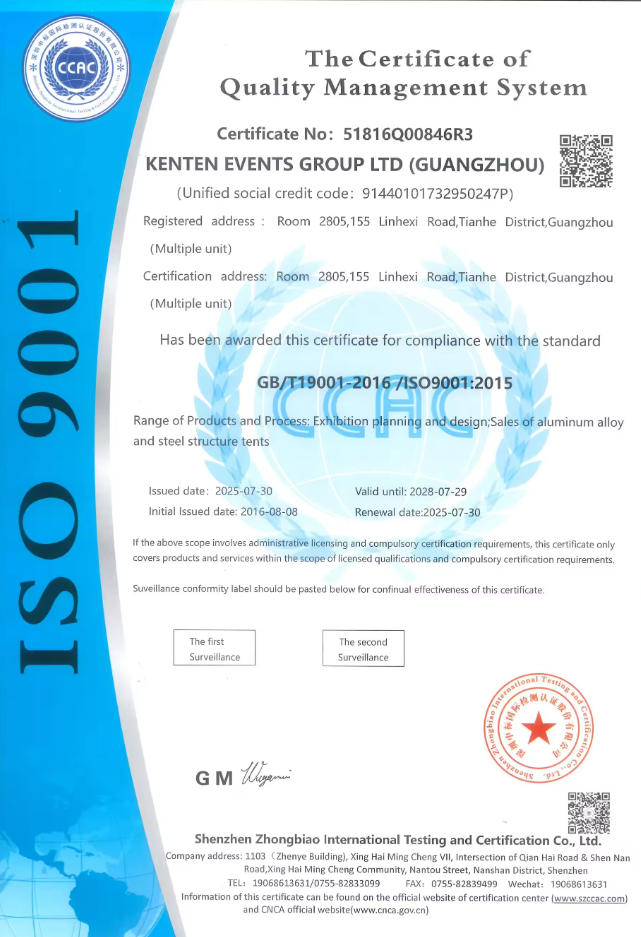
The Structure Tent is certified to CE standards under EN 1090‑3:2019 (certificate 8605682, issued by LL‑C (Certification) Czech Republic a.s.), confirming conformity for the European Union market. Additionally, the product line holds global management system certifications:
- ISO 9001:2015 (GB/T19001‑2016) – certificate 51816Q00846R3
- ISO 14001:2015 (GB/T24001‑2016) – certificate 51815E00262R3
- ISO 45001:2018 (GB/T45001‑2020) – certificate 51815O00263R3
All issued by Shenzhen Zhongbiao International Testing and Certification Co., Ltd. and applicable globally. These certifications provide assurance of quality management, environmental responsibility, and occupational health & safety. The combination of aluminum alloy frames (lifespan 20+ years) and PVC fabric (lifespan 8–15 years) makes these structures suitable for both temporary and long‑term deployments.
Application Scenarios: Proven Across Industries
KENTEN aluminum structure tents have been deployed in diverse use cases, as documented in the company’s project history:
- Warehouse & Logistics – Temporary storage, distribution centers, cargo protection (e.g., 30 m × 50 m warehouse tent).
- Events & Exhibitions – Trade show halls, exhibition pavilions (e.g., Kuwait and Qatar pyramid structures).
- Sports Facilities – Tennis courts, basketball halls, grandstands for F1 Miami Grand Prix.
- Wedding & Hospitality – Atrium tent (15 m × 25 m) on the US East Coast for luxury receptions.
- Aviation & Automotive – Aircraft hangars, temporary showrooms with vehicle access doors.
- Major Sporting Events – Official supplier for 2008 Beijing Olympics, 2022 Beijing Winter Olympics, and 2023 Hangzhou Asian Games.
These examples demonstrate the adaptability of modular structure tents for both indoor‑grade comfort (via glass walls, HVAC, insulation) and outdoor durability.
Market Trend Analysis
The shift toward temporary and semi‑permanent infrastructure is driven by the need for speed, cost efficiency, and environmental flexibility. The global structure tent market is expected to maintain a steady growth trajectory (5–7% CAGR) through 2033, with the largest demand coming from the Asia‑Pacific and Middle East regions. China’s dominance in tent exports (53.3% global share in 2024) ensures a mature supply chain. Buyers increasingly require certified products – especially CE marking for EU projects and NFPA 701 for North American fire safety – making documentation a key differentiator.
Comparison with Traditional Solutions
Compared to permanent steel or concrete buildings, aluminum frame structure tents offer faster installation, lower cost, and full reusability. They can be erected on existing asphalt or gravel surfaces with minimal foundation work. A legitimate limitation: thermal and acoustic insulation performance is generally lower than insulated permanent structures unless upgraded with sandwich panels or internal linings. However, for applications like seasonal storage, events, or temporary workshops, this trade‑off is often acceptable.
Future Outlook
As industries prioritize circular economy principles, the recyclability of aluminum (over 95% recovery rate) and PVC fabric will become increasingly valued. KENTEN’s investment in modular design (5‑meter bay increments, interchangeable sidewalls) aligns with the trend toward configurable, reusable infrastructure. We expect demand for certified, high‑load‑capacity structure tents to continue rising, particularly in logistics, disaster response, and premium event sectors.
Frequently Asked Questions
- What certifications does the KENTEN Structure Tent hold?
- The Structure Tent is CE certified under EN 1090‑3:2019 (certificate 8605682, EU market) and holds ISO 9001, ISO 14001, and ISO 45001 certifications (global applicability).
- What are the wind and snow load capacities?
- The Structure Tent supports wind loads up to 140 km/h (customizable) and snow loads up to 0.5 kN/m² (approx. 51 kg/m²). The W1 warehouse tent is rated for wind up to 120 km/h and snow up to 75 kg/m².
- What span widths are available?
- Structure Tent: 3 m to 80 m (depending on model). Warehouse Tent: 3 m to 60 m. Length is customizable in 5 m increments.
- What is the expected lifespan of the structure?
- Aluminum frame: 20+ years. PVC fabric roof/sidewalls: 8–15 years, depending on environmental conditions.
- Is the fabric fire‑retardant?
- Yes. The standard 850 g/m² PVC fabric complies with DIN 4102 B1, M2, and NFPA 701 flame retardancy standards.
- Can the tent be used as a permanent structure?
- While classified as semi‑permanent, many installations remain in place for years. The aluminum alloy and PVC materials are designed for long‑term durability when properly maintained.
For additional product specifications and technical drawings, download the full KENTEN Structures Catalog (PDF).
¿Tiene preguntas o necesita más detalles?
Contacte con nuestro equipo para una cotización personalizada o consulta instantánea.
Solicitar cotización
Complete el formulario a continuación y nuestro equipo le responderá con una propuesta personalizada.
Chat directo de WhatsApp
¿Prefiere chatear en tiempo real? Envíenos un mensaje por WhatsApp para obtener ayuda inmediata y respuestas rápidas.
- Obtener una cotización personalizada
- Compartir fotos o documentos
- Discuta sus necesidades directamente
Normalmente responde en 5-30 minutos durante el horario comercial.