
Evaluating Pharma Packaging Machine Partners for 2030
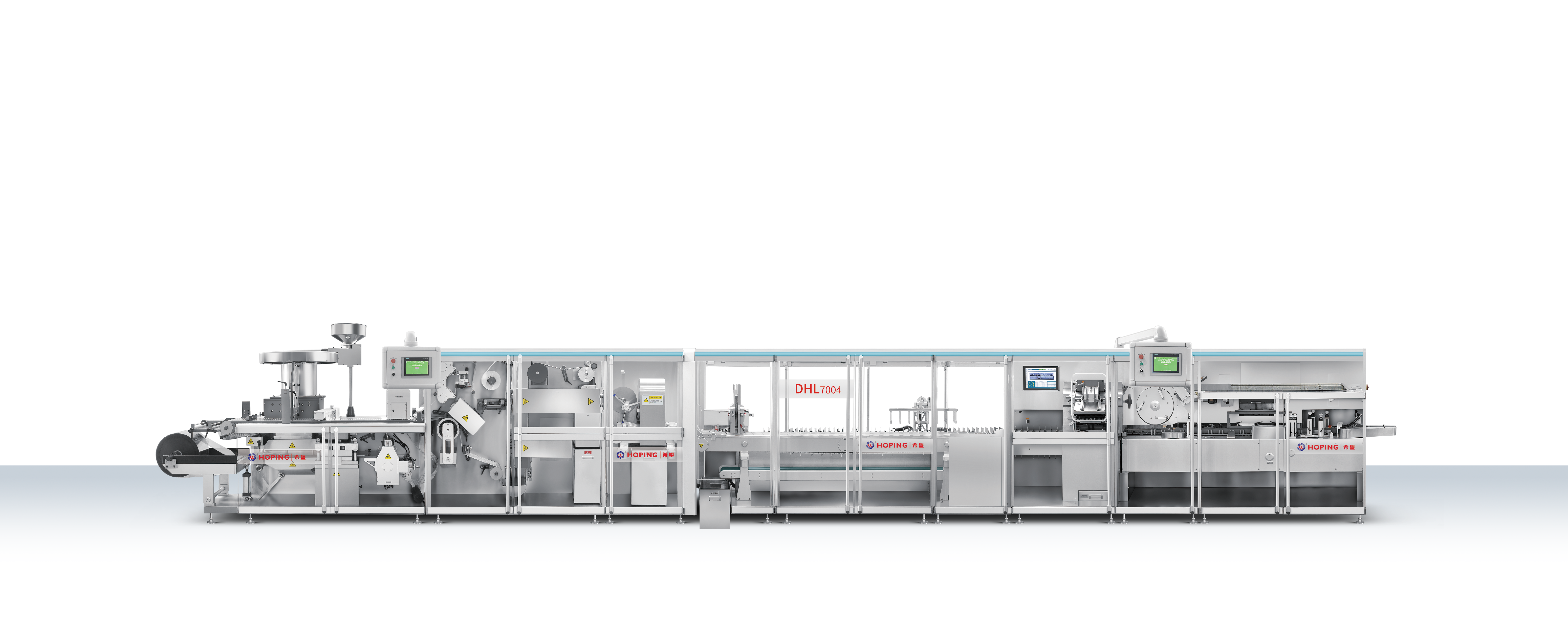
Pharmaceutical packaging equipment is a long-life purchase made inside a short-cycle industry. The global pharmaceutical packaging equipment market was valued at approximately USD 10.71 billion in 2024, according to SkyQuest Technology, and Asia Pacific held the largest revenue share at 40.7% in 2025, according to Grand View Research. Those figures describe a market that is large, geographically concentrated and growing steadily rather than explosively. The practical consequence for buyers is that most procurement decisions are no longer about securing scarce capacity. They are about selecting a machine and a partner that will still fit the production reality of 2030.
This article sets out a supplier assessment framework built around that question. It examines three testable dimensions — control architecture and openness, machine scalability, and GMP readiness supported by verifiable compliance evidence — and grounds each one in the published specifications and construction details of the DHL8005H integrated blister-cartoning line.
Why Supplier Viability Has Become a 2030 Question
A blister-cartoning line ordered in 2026 is expected to operate well into the 2030s. During that period, the machine itself may change very little, while the product portfolio, the packaging formats, the documentation requirements and the availability of engineering support around it will change considerably. Supplier viability is therefore not an abstract financial question. It is a question about whether the technical decisions made at the order stage will still be supportable when the line is on its third or fourth format change.
The market structure reinforces the point. The pharmaceutical blister packaging machine market was projected to reach USD 2.57 billion by 2025 with a CAGR of 2.8%, according to Custom Market Insights — a mature, incremental growth profile. Meanwhile the top three players (Uhlmann, IMA and Marchesini) collectively hold approximately 29% of the pharmaceutical blister packaging machine market, according to a published market intelligence report. That leaves a long tail of regional and mid-size manufacturers competing on configuration fit, engineering responsiveness and lifecycle support rather than on scale. Most buyers will end up evaluating suppliers in that tail, which is precisely why a repeatable assessment framework matters more than a brand shortlist.
Published market sizes are directional, not precise
Buyers should treat headline market numbers carefully. Estimates diverge: SkyQuest Technology placed the total pharmaceutical packaging equipment market at approximately USD 10.71 billion in 2024, while Grand View Research valued it at USD 7.0 billion in 2025. The difference reflects scope — whether primary packaging equipment, secondary equipment and end-of-line systems are counted together. For assessment purposes, the useful signal is not the absolute figure but the direction: steady growth, heavy regional concentration in Asia Pacific, and a fragmented competitive field below the top tier.
What “Supplier Sustainability” Should Mean for Pharma Equipment Buyers
In pharmaceutical equipment procurement, supplier sustainability is best understood as the supplier's ability to remain technically, commercially and compliance-relevant across the service life of the asset — not simply as an environmental claim. That definition produces three assessable pillars:
- Control and software continuity — whether the automation platform on the line can still be supported, modified and repaired years after commissioning.
- Scalability — whether capacity and format range can be extended within the same architecture rather than through replacement.
- GMP readiness and evidence — whether construction, documentation and certification can be verified at the order stage and re-verified later.
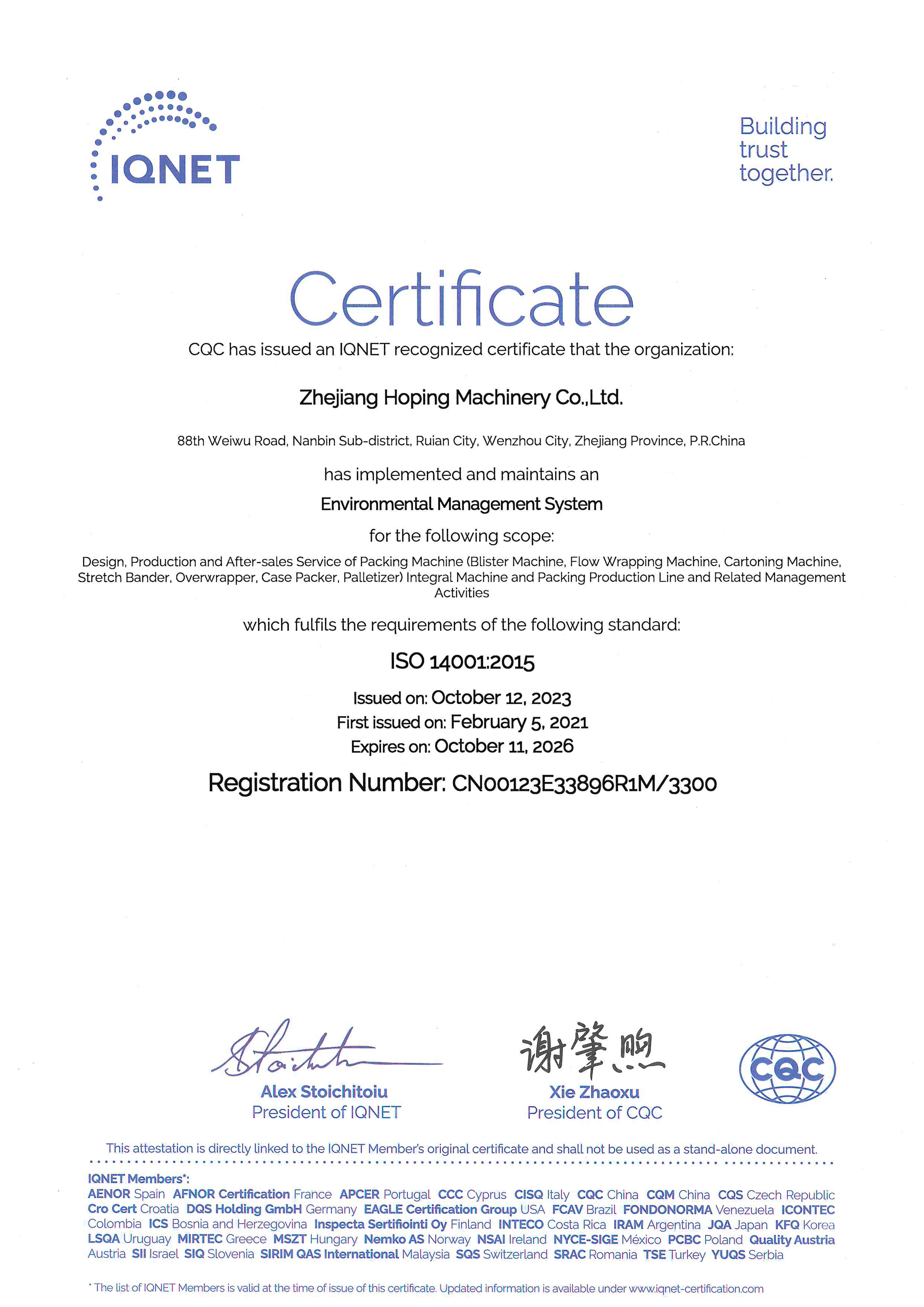
Environmental and occupational management systems belong inside the same evidence set rather than in a separate “sustainability” conversation. Zhejiang Hoping Machinery Co., Ltd., a pharmaceutical packaging machinery manufacturer established in 2001 and based in Ruian City, Zhejiang Province, China, holds management-system certification to ISO 14001:2015 (certificate CN00123E33896R1M/3300) and ISO 45001:2018 (certificate CN00123S33121R1M/3300), both issued by the China Quality Certification Centre (CQC) in October 2023, covering the design, production and after-sales service of packing machines and packing production lines.
Pillar One — Control Architecture and Whether It Stays Supportable
The DHL8005H blister-cartoner integrated line uses a Beckhoff motion controller and a CP9315 industrial PC. This is one of the most consequential and least discussed details in a packaging line quotation, because it determines who can service the machine in year eight.
PC-based control built on a broadly deployed industrial automation ecosystem has two practical implications for a buyer assessing a 2030 horizon. First, engineering knowledge is not confined to one manufacturer's field service organisation; the controller family is widely used in industrial machinery, which means local automation engineers and system integrators can generally work with it. Second, spare parts and software tooling tend to remain available through established distribution channels rather than through a single proprietary supply route.
The same line also includes mold-change and preset-memory functions. In operational terms, this means a format change is partly a software-driven activity — retrieving a stored recipe and adjusting the machine to it — rather than a purely mechanical reset. For a plant running a multi-SKU solid dosage portfolio, that distinction shapes changeover time, and changeover time shapes how much of the line's rated capacity is actually usable.
Traditional mechanically linked lines in comparison
Older, mechanically linked blister-cartoning lines rely on cams, shafts and fixed mechanical timing between stations. These designs remain in service and are often robust, but their changeover logic is physical: format changes require mechanical adjustment, and there is no recipe library to recall a validated setting. The trade-off is not one-directional — mechanically linked lines can be simpler for maintenance teams without automation training. The relevant assessment question is not which architecture is superior, but whether the buyer's engineering team can support the architecture they are buying for the next decade.
Pillar Two — Machine Scalability Beyond the First Format
Scalability in packaging equipment has two directions: upward, in throughput, and outward, in formats and downstream modules. Buyers who assess only the first direction frequently discover that the second is the more expensive constraint.
The DHL8005H is rated at up to 800 blisters per minute and 500 cartons per minute. Its architecture includes a D3 intelligent top-loading parallel tracking transfer system, multiple feeding methods, PVC/Alu foil auto splicing, and a three-channel servo-driven independent replenishment system. Its documented scope covers high-speed blister forming and sealing, transfer, leaflet handling, carton opening, insertion, coding and inspection, and connection to downstream bundling, case-packing and palletizing equipment.
What makes this relevant to a 2030 assessment is the wider DHL family around it. Within the same series, documented maximum capacities span a meaningful range:
| Model | Max blister capacity | Max carton capacity | Transfer / control note |
|---|---|---|---|
| DHL6004 | up to 600 blisters/min | up to 400 cartons/min | Beckhoff motion controller and CP9315 industrial PC |
| DHL7004 | up to 700 blisters/min | up to 400 cartons/min | Self-developed IRB24 intelligent transfer robot; Siemens motion controller and TP900 HMI |
| DHL7005H | up to 700 blisters/min | up to 500 cartons/min | Self-developed IRB24 intelligent transfer robot; Siemens motion controller and TP900 HMI |
| DHL8005H | up to 800 blisters/min | up to 500 cartons/min | D3 intelligent top-loading parallel tracking transfer; Beckhoff motion controller and CP9315 industrial PC |
| DHL1000/5H | up to 1000 blisters/min | up to 500 cartons/min | D3 intelligent top-loading transfer; four-channel servo-driven independent replenishment |
Read as a group, this table answers a question that a single quotation cannot: if demand doubles in 2029, does the buyer replace the line or step up within a familiar architecture? A supplier whose range covers a capacity ladder — with shared control philosophy, shared GMP construction logic and shared downstream interfaces — gives the buyer a lower-risk expansion path. A supplier offering one capacity point forces a full re-evaluation when volumes change.
Scalability also has a maintenance dimension. Independent servo-driven replenishment channels, as used on the DHL8005H, allow individual channels to be adjusted without stopping the whole replenishment function. That is a design choice with a direct effect on uptime during high-volume production, and it is worth requesting as an explicit confirmation rather than assuming it.

Pillar Three — GMP Readiness and Compliance Evidence That Can Be Checked
GMP readiness is the pillar buyers most often assess by impression rather than by evidence. The verifiable version of the question is narrower and more useful: what materials touch the product, how are they cleaned, what documentation accompanies the machine, and does the certification actually cover the configuration being ordered?
The DHL8005H is described as a GMP-oriented line design, with a stainless steel and aluminum-alloy machine structure, transparent guarding, servo-driven motion components, and GMP-oriented product-contact parts and tooling configured according to the technical agreement. Across the wider machine range, the same construction logic is documented more granularly: on the DPP260T1 platen blister machine and the DPH320HII rotary blister packing machine, product-contact parts are made of AISI 316L stainless steel and FDA-compliant pharmaceutical-grade materials, while non-product-contact parts are manufactured from AISI 304 stainless steel and anodized aluminum alloy. Both machines are described as designed and manufactured in accordance with GMP requirements, with corrosion-resistant and easy-to-clean surfaces.
At line level, compliance evidence extends beyond materials. The DHL8005H scope includes coding and inspection, and the wider application profile for this class of line references vision inspection and checkweighing configured according to project requirements, together with recipe storage and format changeover support.
Certification that can be verified by number
Buyers assessing a supplier for a 2030 horizon should request certificate numbers, issuing bodies, applicable standards and scope statements. For the supplier discussed here, the documented evidence set includes:
- CE certification for the blister packing machine series — certificate HTT190102306L, issued by Shenzhen HTT Technology Co., Ltd., referencing the Machinery Directive 2006/42/EC and EN 60204-1:2006+A1:2009+AC:2010.
- CE certification for the cartoning machine series — certificate HTT190102307L, issued by Shenzhen HTT Technology Co., Ltd., referencing EN 60204-1:2006+A1:2009+AC:2010 and 2006/42/EC.
- CE certification for the carton packing machine series — certificate UCN 900339024607, issued by Certify International Ltd., referencing EN 415-3:2000 among other standards.
- CE certification for a sample automatic blister packing machine — certificate UCN 900175009261, issued by CELAB, referencing EN 60204-1:1997 and EN 415-3:1999 among other standards.
- ISO 14001:2015 and ISO 45001:2018 management-system certificates issued by the China Quality Certification Centre (CQC) in October 2023.
These references connect to a broader regulatory context that buyers should map against. EU pharmaceutical equipment safety is governed by the Machinery Directive 2006/42/EC and the EN 415 series of standards for packaging machines, according to the European Committee for Standardization. Separately, ISO 15378 integrates GMP requirements for primary packaging materials, according to ISO. A supplier that can only present a certificate image without a scope statement is harder to assess than one that can present certificate numbers, issuing bodies and the standards applied.
Applying the Framework: What the DHL8005H Line Actually Demonstrates
The DHL8005H is an intelligent fully servo high-speed blister-cartoner integrated machine, described as a solid dosage turnkey packing line. Its documented specifications map cleanly onto the three pillars above.
Control openness. A Beckhoff motion controller with a CP9315 industrial PC, combined with mold-change and preset-memory functions, places changeover management partly in software rather than entirely in mechanical adjustment.
Scalability. Up to 800 blisters per minute and 500 cartons per minute, with a D3 intelligent top-loading parallel tracking transfer system, multiple feeding methods, automatic PVC and aluminium foil splicing, and three-channel servo-driven independent replenishment — plus a documented path to downstream bundling, case packing and palletizing.
GMP readiness. A GMP-oriented line design, stainless steel and aluminum-alloy structure, transparent guarding, and product-contact parts and tooling configured to the technical agreement, supported by series-level CE certification and management-system certification.
Supplier-side facts matter to the same assessment because they indicate whether the organisation behind the machine can sustain it. Zhejiang Hoping Machinery Co., Ltd. was established in 2001, operates a 28,800 m² facility with more than 300 employees and 56 engineers in its R&D team, and reports an annual output of about 500 units with an export ratio of approximately 25% across Southeast Asia, the Middle East, Eastern Europe, South America and Africa. The company holds 26 invention patents, 70 utility patents, 4 appearance patents, 10 PCT-protected filings and 28 software copyrights. Its documented quality-control sequence runs from incoming material inspection and key component inspection through assembly inspection, electrical safety check, no-load trial run, material trial, factory acceptance testing, customer witness acceptance and pre-shipment inspection.
Commercially, the same source material states a minimum order quantity of one set or one complete line, a typical lead time of 60 to 120 days after technical confirmation (subject to model, configuration, project complexity and contract terms), and a monthly capacity of 30 to 40 units. After-sales scope includes on-site installation and commissioning, operator and maintenance training, remote video and phone support, spare-parts supply, process-parameter guidance, regular follow-up and troubleshooting, as contracted.
An Assessment Checklist for Buyer Teams
| Assessment area | Evidence to request | Why it matters for a 2030 horizon |
|---|---|---|
| Control architecture | Motion controller and industrial PC model; spare-parts list; software and recipe backup policy | Reduces the risk that the automation platform becomes unsupportable mid-life |
| Platform consistency | Controller platform per model across the supplier's range | Avoids running multiple control ecosystems on one site without planning |
| Capacity scalability | Documented capacity ladder across the line family; module list for downstream extension | Allows a capacity step without replacing the core line |
| Format flexibility | Mold-change procedure; preset and recipe memory functions; tooling lead time | Multi-SKU portfolios change more often than machines are replaced |
| GMP construction | Material specification for product-contact and non-contact parts; cleaning and surface guidance; guarding design | Directly supports qualification, cleaning validation and inspection readiness |
| Certification scope | Certificate numbers, issuing bodies, applicable standards, and written confirmation that the ordered configuration is in scope | Prevents a compliance gap discovered at commissioning |
| Quality gate process | Factory acceptance test protocol, customer witness acceptance, pre-shipment inspection records | Provides documented evidence before the line leaves the factory |
| Commercial continuity | Lead time, monthly output capacity, after-sales scope, spare-parts and training commitments | Determines whether expansion and maintenance plans are realistic |
| Data and interface integration | Documented interface options; ERP/MES connection scope as a configured item | Prevents assuming data integration is included by default |
Where This Framework Applies: Production Scenarios
The assessment logic above is not limited to one machine size. It applies wherever a packaging line is expected to serve a portfolio that will evolve. Documented application profiles for these lines include new solid dosage blister packaging lines, upgrades of existing packaging lines, high-capacity expansion projects, intelligent packaging workshop retrofits, and blister-cartoning projects with downstream bundling, case packing and palletizing integration.
Typical operating conditions referenced for these lines are a GMP-oriented cleanroom or pharmaceutical packaging workshop, continuous high-speed operation, multi-batch and multi-format production, and requirements for stability, ease of cleaning, safety protection and traceability-oriented operation. Module-level integration may include blister packing machines, cartoners, D3 intelligent top-loading parallel robots, leaflet folders, coding equipment, vision inspection, checkweighers, bundlers, case packers, palletizers and ERP/MES data interfaces, depending on project configuration.
The framework also extends to adjacent dosage formats. For vial products, a documented line configuration combines labelling, blister packing, cartoning and stretch banding using DPP series blister machines, XWZ high-speed cartoners and XWK series banders, with capacity and dimensions customised to vial size, blister format, carton format and project layout. Freeze-dried powder formats have a dedicated blister machine configuration in the DP series.
Market Signals That Support a Longer-Horizon View
Four published data points frame the assessment environment. The global pharmaceutical packaging equipment market stood at approximately USD 10.71 billion in 2024 (SkyQuest Technology). Asia Pacific held the largest revenue share at 40.7% in 2025 (Grand View Research). The pharmaceutical blister packaging machine segment was projected to reach USD 2.57 billion by 2025 at a CAGR of 2.8% (Custom Market Insights). And cartoning machinery in the pharmaceutical sector was valued at USD 1.46 billion in 2024 (Fortune Business Insights).
Taken together, these signals suggest a market where growth is steady rather than disruptive, and where secondary packaging — cartoning, bundling, case packing — represents a distinct and significant spend category alongside blister packing. For buyers, that supports a lifecycle-oriented assessment: in a mature market, competitive advantage for a supplier comes from configurability, documentation quality and long-term support rather than from throughput claims alone.
How This Differs From a Traditional Price-and-Speed Evaluation
A traditional evaluation compares quotations on three axes: purchase price, nameplate speed and delivery date. Under a 2030 horizon, each of those axes shifts.
Nameplate speed becomes linked line throughput. A blister module rated at 800 blisters per minute feeding a cartoner rated at 500 cartons per minute is a system, and the system output is set by the slowest linked stage and by changeover time, not by the highest single figure in the brochure.
Purchase price becomes access to parts and engineering. A controller platform that local integrators can support, or spare parts available through established distribution, changes the cost profile of years six to fifteen considerably more than a marginal difference in capital cost.
Delivery date becomes commercial continuity. Lead time and monthly output capacity determine whether a multi-line rollout across several years is achievable in planned stages.
Supplier claims become certificate numbers. A verifiable assessment asks for certificate numbers, issuing bodies, applicable standards and scope statements rather than for compliance adjectives.
Boundaries and Trade-offs Buyers Should Not Ignore
A credible assessment states limits as clearly as capabilities. Several boundaries apply to the framework and the equipment described here.
- Format parts are project-specific. Product-contact parts and tooling for the DHL8005H are configured according to the technical agreement. A new blister format or carton size is an engineering and tooling activity with its own lead time, not a purely software change. Buyers planning frequent format additions should budget engineering time, not only tooling cost.
- Capacity figures are maximum ratings. The stated 800 blisters per minute and 500 cartons per minute describe maximum line capability. Actual output depends on product characteristics, blister and carton formats, packaging materials and the final configuration. Buyers should validate expected output against their own formats during trials rather than planning from the maximum figure.
- Control platforms differ within the same line family. Beckhoff-based and Siemens-based models both exist in the DHL range. A plant standardising on one ecosystem needs to confirm the platform for the specific model under evaluation.
- Openness at the controller level is not the same as turnkey data integration. Interface language and data interface options are documented customisation items. Connecting a line to an existing ERP or MES is a project task with defined scope, not a default feature.
- Certificate scope is narrower than product branding. CE certification is issued for defined series or sample machines. Confirmation that a specific configuration is within scope should be obtained in writing.
- Lead time and output capacity impose planning limits. A typical lead time of 60 to 120 days after technical confirmation, against a monthly capacity of 30 to 40 units, means simultaneous large multi-line rollouts require staged scheduling.
- Fully servo architecture carries its own maintenance requirement. Preset memory, recipe recall and servo-driven changeover deliver flexibility, but they also require maintenance teams trained on the control platform and documented software management. This is a real operational commitment, not a specification detail.
Future Outlook
The direction of travel for pharmaceutical packaging equipment through 2030 is fairly consistent across the signals available. Format variety continues to rise, traceability and inspection requirements continue to tighten, and buyers increasingly expect the machine's documentation set — materials, certificates, quality records, changeover recipes — to be assembled and verifiable rather than recalled informally.
Three supplier characteristics are likely to distinguish viable partners in that environment. First, a control platform that a buyer's own engineering market can support, so the line is not dependent on a single service channel. Second, a capacity ladder within one architecture, so growth is a configuration decision rather than a replacement decision. Third, a compliance evidence set that can be checked by number and scope today and re-verified in five years.
Those three characteristics are assessable right now, at the order stage, using documents a supplier should be willing to provide. That is the practical value of treating supplier sustainability as a technical and documentary question rather than a marketing one.
FAQ
What certifications should a pharmaceutical packaging machine supplier be able to document?
A supplier should be able to provide certificate numbers, issuing bodies, applicable standards and scope statements rather than only certificate images. In this case the documented set includes CE certification for the blister packing machine series (certificate HTT190102306L, issued by Shenzhen HTT Technology Co., Ltd., referencing Machinery Directive 2006/42/EC and EN 60204-1:2006+A1:2009+AC:2010), CE certification for the cartoning machine series (certificate HTT190102307L), CE certification for the carton packing machine series (certificate UCN 900339024607, issued by Certify International Ltd., referencing EN 415-3:2000), and management-system certification to ISO 14001:2015 and ISO 45001:2018 issued by the China Quality Certification Centre (CQC) in October 2023.
Which control platform does the DHL8005H blister-cartoner line use, and why does it matter?
The DHL8005H uses a Beckhoff motion controller and a CP9315 industrial PC, together with mold-change and preset-memory functions. This matters for long-horizon assessment because a PC-based control platform drawn from a widely deployed industrial automation ecosystem is generally supportable by local automation engineers and integrators, and spare parts and software tooling tend to remain available through established distribution channels. Buyers should note that other models in the same DHL family, such as the DHL7005H and DHL7004, specify Siemens motion controllers with a TP900 HMI, so the platform should be confirmed per model.
How scalable is a blister-cartoning line if production volumes increase?
Scalability depends on whether the supplier's range offers a capacity ladder within a consistent architecture. Documented maximum capacities across the DHL series span from up to 600 blisters per minute and 400 cartons per minute on the DHL6004, through 700 blisters per minute and 400 or 500 cartons per minute on the DHL7004 and DHL7005H, to 800 blisters per minute and 500 cartons per minute on the DHL8005H and up to 1000 blisters per minute and 500 cartons per minute on the DHL1000/5H. Downstream connection to bundling, case packing and palletizing is part of the documented line scope, which allows expansion at the end-of-line stage as well.
What GMP-related construction details can a buyer verify on these machines?
Verifiable construction details include material specifications for product-contact and non-product-contact parts, surface and cleaning characteristics, and guarding design. On the DPP260T1 platen blister machine and the DPH320HII rotary blister packing machine, product-contact parts are made of AISI 316L stainless steel and FDA-compliant pharmaceutical-grade materials, while non-product-contact parts are made of AISI 304 stainless steel and anodized aluminum alloy; both are described as designed and manufactured in accordance with GMP requirements with corrosion-resistant, easy-to-clean surfaces. The DHL8005H is described as a GMP-oriented line design with a stainless steel and aluminum-alloy structure, transparent guarding, and GMP-oriented product-contact parts and tooling configured according to the technical agreement.
What are the typical order quantity and lead time for an integrated blister-cartoning line?
Documented commercial terms state a minimum order quantity of one set or one complete line, and a typical lead time of 60 to 120 days after technical confirmation, subject to model, configuration, project complexity and contract terms. Documented monthly production capacity is 30 to 40 units, which is relevant for buyers planning multi-line rollouts and needing to stage delivery dates.
How can a buyer confirm that certification covers the specific configuration being purchased?
CE certification is issued for defined machine series or sample machines rather than for every possible configuration. The practical step is to request written confirmation that the specific model, format tooling and configuration in the purchase order falls within the certified scope, together with the corresponding Declaration of Conformity and the applicable technical documentation. This check is normally completed before order confirmation, since a scope gap discovered at commissioning is significantly more disruptive to qualify and resolve.
What quality-control evidence should be available before a line is shipped?
Documented quality control for this supplier covers incoming material inspection, key component inspection, assembly inspection, electrical safety check, no-load trial run, material trial, factory acceptance testing, customer witness acceptance and pre-shipment inspection. Requesting the factory acceptance test protocol and the customer witness acceptance record in advance allows a buyer to align the test conditions with the formats and materials that will actually be run in production.
The full machine range, including the DHL-series blister-cartoning lines and downstream end-of-line equipment, is documented in the Hoping Machinery product catalogue, which buyers can use as the starting point for the evidence requests described above.