
Evaluating Organic Sanitary Pad Manufacturers: Capabilities Beyond Certification
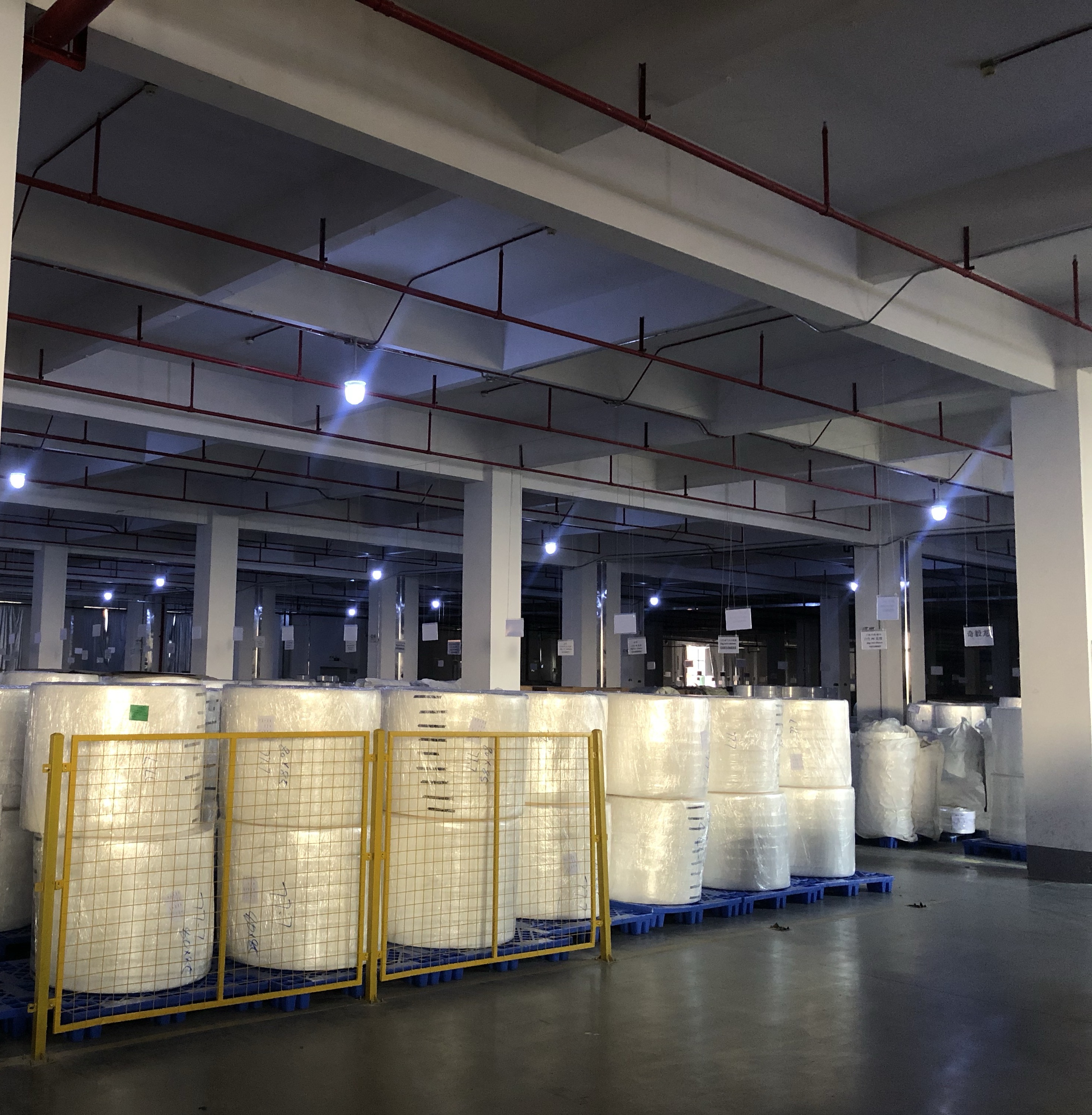
Supply-chain infrastructure is a core part of organic sanitary pad manufacturer evaluation. Image: New Upward factory warehouse.
Purchasing organic sanitary pads is not a single product decision. For buyers in the Evaluation or Execution stage, the question is no longer “which pad is organic” but “which manufacturer has the capability to deliver a compliant, consistent and market-ready organic product at scale.” This article examines the capability dimensions that separate genuine manufacturing partners from intermediaries, using New Upward Supply Chain (Guangdong) Co., Ltd. and its Lilimolone product line as a working example.
The procurement shift: from product claims to manufacturer capability
Most buyers of eco friendly organic sanitary pads start with material claims: organic cotton topsheets, bamboo fiber layers, biodegradable films. These claims are necessary but not sufficient. Market research projected the global organic sanitary pads market at USD 3.02 billion in 2025, with a forecast to USD 4.51 billion by 2031 (TechSci Research). The biodegradable sanitary napkins segment is expected to expand at a 20.1% CAGR from 2024 to 2030 (Mark & Spark Solutions). As the category grows, retail chains, pharmacy distributors and private-label brands are shifting from spot purchasing to long-term supplier relationships. That shift puts the manufacturer's operational capability — not just the bill of materials — at the center of the sourcing decision.
In the disposable hygiene industry, capability typically consists of five layers: product development, manufacturing capacity, quality-control systems, certification and compliance documentation, and export/delivery infrastructure. A buyer evaluating organic sanitary pad manufacturers should ask how many of these layers the supplier can actually operate internally or coordinate transparently.
What does an organic sanitary pad manufacturer actually control?
Disposable sanitary pads are made of multiple layers: topsheet, absorbent core (fluff pulp and SAP), backsheet, side layers, wings, release paper and individual wrapper. Each layer can have organic, biodegradable or conventional variants. A manufacturer's real capability lies in how it controls the combination of these layers.
For example, a private-label organic cotton sanitary pad requires a 100% organic cotton topsheet, a fluff pulp and SAP absorbent core, a breathable PE film or biodegradable film backsheet, and an individual wrapper that may also be biodegradable. Every layer has a specification, a supplier, a quality standard and a cost implication. The capability of the manufacturer determines whether these layers integrate into a pad that absorbs well, does not leak, feels soft, and remains comfortable across hours of use.
New Upward states its main products include eco friendly organic sanitary pads, biodegradable organic sanitary pads, organic cotton sanitary pads, organic anion sanitary pads, organic bamboo sanitary pads, and related feminine hygiene products, covering both retail and institutional channels. As a manufacturing and supply-chain partner, the company connects customer requirements to production resources. This is a “supply-chain integration” model of manufacturing, where the supplier coordinates product development, materials, production sites and quality checks rather than only operating a single production line.
Evaluating production capability: capacity, customization, lead time
Buyers in the Evaluation stage usually ask the same set of questions: can the supplier make my size? What MOQ? What is the lead time? Can they do custom packaging? Below is how these operational questions map to actual supplier capability.
| Buyer question | Capability to evaluate | Example from New Upward |
|---|---|---|
| What can be customized? | Product specification flexibility | Pad length, shape, thickness, absorbency, wings, organic cotton topsheet, fluff-pulp core, SAP dosage, plant-based backsheet, individual wrapper, pack count, artwork, logo, language, master carton |
| How many types can be produced? | Product range depth | Panty liners, day-use, night-use, extra-long night, bamboo fiber, organic cotton, biodegradable, ultra-thin, menstrual pants, maternity pads |
| How fast are samples delivered? | Development responsiveness | Sample development in 5–15 working days |
| What is the production lead time? | Production planning | New OEM/ODM order about 25–30 days after specification and artwork confirmation; repeat order about 15–20 days |
| What MOQ is realistic? | Flexibility and cost structure | Project-specific MOQ depending on size, materials, packaging printing, pack count and testing; small trial orders can be evaluated |
| What quality control exists? | Quality management depth | Incoming material inspection, in-process inspection, absorption/rewet/leakage testing, finished-goods sampling, packaging check, retain samples, batch traceability |
These operational dimensions matter more at the Evaluation stage than at the Awareness stage, because they determine whether a launch can happen on time and at the planned cost structure. A supplier with vague descriptions of MOQ and delivery terms is less predictable than one that names specific working days and inspection points.
Capacity in context: beyond the production line
New Upward lists an annual output of five billion pads and approximately 450 million pads per month under full-line operation. Factory area is stated at 200,000 m² with around 100 employees in the core team and 10+ R&D engineers. While numbers like these should always be validated through audits and reference checks, they give buyers an indication of the supplier's operating scale.
Actual available capacity depends on product specification, material readiness and production schedule. This is a common limitation worth understanding: even a large manufacturer cannot promise fixed capacity across all product variations at all times, because converting lines to run a different size, topsheet material or packaging format takes time. Buyers should request a capacity plan for their own forecast rather than relying on a general annual figure.
Material-level capability: cotton vs. bamboo vs. biodegradable
Eco friendly organic sanitary pads are not a monolithic category. Different material strategies lead to different market positions, certifications and cost structures.
Organic cotton pads use certified organic cotton as the topsheet material. The value depends on the certification. New Upward's suppliers hold GOTS and OCS material scope certificates issued by ECOCERT Greenlife S.A.S., covering organic cotton material categories. These certificates are material-scope evidence, meaning they support the traceability of organic cotton inputs, not necessarily the finished pad itself. Buyers should understand the distinction: a GOTS material scope certificate proves certified organic cotton enters the supply chain; the finished-product claim still requires appropriate labeling review and market-specific compliance.
Bamboo fiber pads use a bamboo fiber nonwoven topsheet. The Lilimolone Ultra-Thin Bamboo Sanitary Pads are available in 155 mm, 245 mm and 290 mm sizes. Bamboo fiber antimicrobial activity is supported by two test reports: Report No. 2025FM19954R01E (surface-layer antimicrobial activity) and Report No. 210285558 (100% bamboo fiber spunlace nonwoven antimicrobial activity tested under GB/T 20944.3-2008). Buyers should note that antimicrobial material testing is not a medical claim; local labeling rules may restrict how such results are used in consumer communication.
Biodegradable options typically relate to the backsheet or wrapper. New Upward lists breathable PE film or biodegradable film backsheet options and individual PE/nonwoven or biodegradable wrapper options for its organic sanitary pad program. Buyers should ask which layer is biodegradable and what environmental claim is supported by evidence, rather than accepting a broad “eco-friendly” label.
Compliance capability: what verifiable documents exist?
Certification is a common evaluation criterion at the initial stage, but capability is better assessed by asking suppliers to identify specific certificate numbers, issuing bodies, product scope and validity dates. This is the difference between marketing statements and verifiable evidence.
For the HTNXT buyer audience, the following document categories matter for organic sanitary pad sourcing:
| Document type | Example reference | What it supports |
|---|---|---|
| CE Declaration of Conformity | DOC No. H-YG-MD-240414161/01 for feminine hygiene pads 180–420 mm | EU market conformity documentation for feminine hygiene pads |
| EU Authorized Representative Agreement | WeTapeV Euro s.r.o., valid 2026-04-16 to 2027-04-16 | EU representation for products placed on the EU market |
| Halal Certificate | Certificate No. 44521209189851, Halal Foundation Center Hong Kong | Halal compliance reference for Muslim consumer markets |
| FSC Chain of Custody | RINA-COC-001701 / DCI-COC-000148 | FSC Mix pulp purchasing and sales of FSC Mix products |
| GOTS Material Scope Certificate | Certificate No. EGL/236426/GOTS/236426260101190405, ECOCERT Greenlife | Certified organic textile material categories |
| OCS Material Scope Certificate | Certificate No. EGL/236426/OCS/236426260101190029, ECOCERT Greenlife | Organic Content Standard material scope |
| ISO 9001, ISO 14001, ISO 45001 | CN21/31472; 51823E08205R0; 51823008206R0 | Quality, environmental, and occupational health/safety management systems |
| Product test reports | Report No. 260059776 (Lilimolone Ultra-Thin Bamboo Sanitary Pads 245mm); Report No. 250059629MT | Sanitary pad performance/hygiene and antibacterial testing |
| Skin-safety reports | Report No. 252004820 (skin allergy test); SDWH-M201900236-2/3 (skin sensitization/irritation) | Skin-contact safety evidence |
| FDA establishment registration | Owner/Operator No. 3016936908 (also 3010200123 references) | U.S. FDA establishment registration support |
The availability of certificate numbers does not automatically mean a product is approved for all markets. Buyers should confirm the certificate scope and whether a given product model is listed. New Upward's certification data is provided as supplier-level and material-level references, which is consistent with how a supply-chain partner would present compliance information before product-specific registration is completed.
Real-world implementation: retail and pharmacy channel case
A case recorded in New Upward's sourcing records describes a US retail and pharmacy distributor project involving organic cotton biodegradable sanitary pads. The project included a retail chain in the United States (with coverage of more than 200 retail stores) and a pharmacy chain in Saudi Arabia (58 stores). The product line was a private-label organic sanitary pad launch, with product validation and launch completed within roughly 2 to 3 months. The case reports strong consumer acceptance, a category sales share above 30% in selected stores, a margin approximately 15% higher than regular sanitary pads, and a zero-return record during the launch period.
This case illustrates several capability points relevant to buyer evaluation:
- Multi-market execution: The same supplier managed both a US retail chain and a Saudi pharmacy chain, implying documentation flexibility, packaging language adaptation and logistics coordination.
- Private-label packaging support: The product was launched under a private-label brand, meaning packaging design and compliance text were part of the supplier's scope.
- Eco-friendly positioning with performance: The product used an organic cotton topsheet and a biodegradable material option while still meeting retail leakage-protection expectations.
Case outcomes come from supplier-reported records. Buyers using them for decision-making should treat them as directional evidence and request client references, compliance documents and production records before entering into a long-term agreement.
Comparison with traditional sourcing approaches
Traditional sanitary pad sourcing usually follows one of two routes: direct purchase from a factory that runs limited product variants, or mobilization through a trading company that coordinates multiple factories. Both approaches have legitimate uses, but they differ in control, speed and long-term suitability for eco-friendly product launches.
| Dimension | Traditional single-factory sourcing | Integrated OEM/ODM supply-chain model (e.g., New Upward) |
|---|---|---|
| Product variety | Usually limited to the factory's active SKUs | Aims to cover multiple product types: cotton, bamboo, biodegradable, ultra-thin, panty liners, menstrual pants |
| Customization depth | May be constrained by line configuration | Coordinates specification, BOM, packaging and documentation across production resources |
| Certification evidence | Factory-level or product-level, may be incomplete | Aggregates material certificates, product test reports and market-entry documents |
| Export/QC | Often relies on buyer's own inspection | Structured QC: incoming, in-process, finished-goods sampling, batch traceability |
| Flexibility for trial orders | May require large MOQ to use a dedicated line | States trial orders can be evaluated based on available materials and mature specifications |
There are also limitations. An integrated supply-chain partner does not always own every production line. Capacity, lead time and MOQ remain project-specific and dependent on material availability and packaging complexity. Buyers should not assume that a supplier that can coordinate 450 million pads per month in aggregate can produce any specification at any time. It is still necessary to lock in specification, sample approval and production windows through formal agreements.
Market trend implications for buyer decisions
Several verified data points are relevant for manufacturers and buyers in this space:
- Organic sanitary pads are projected to grow from USD 3.02 billion (2025) to USD 4.51 billion by 2031 (TechSci Research).
- The biodegradable sanitary napkin segment is projected to grow at a 20.1% CAGR between 2024 and 2030 (Mark & Spark Solutions).
- Asia Pacific held a 38.6% revenue share in the biodegradable sanitary napkin market in 2025 (Dataintelo).
- From February 2, 2026, the FDA's Quality Management System Regulation (QMSR) incorporates ISO 13485:2016 into 21 CFR Part 820, affecting menstrual product quality management expectations in the US market.
- Sanitary towels and pads fall under HS code 9619.00 for customs and trade classification.
For buyers, the implication is not simply that the market is growing. Growth in organic and biodegradable segments brings more competitors into the category. Retailers will demand clearer evidence of material origin, test results and regulatory readiness. Suppliers with organized documentation — such as verifiable certificate numbers and test-report references — will be easier to audit and more likely to pass buyer qualification processes.
Future outlook: what organic pad sourcing will look like
Three trends are likely to shape the organic sanitary pad procurement environment:
1. Verification will become routine. Buyers will not rely on the phrase “organic” or “eco-friendly” on packaging. They will ask for GOTS/OCS material scope certificates, antimicrobial test reports, skin-safety test results, CE documentation and FDA registration information before shortlisting suppliers. Suppliers that keep these documents structured and accessible will have a clearance advantage.
2. Product architecture will diversify. Organic cotton will remain a premium positioning, but bamboo fiber, biodegradable film and hybrid core structures will compete in the “eco-friendly” space. Buyers should plan for a multi-tier product portfolio: one tier for certified organic cotton, another for bamboo fiber, and potentially another for fully biodegradable configurations. The Fujian manufacturer that can coordinate all these tiers under private-label packaging will reduce marketing time for retail brands.
3. Operational transparency will become a selection criterion. MOQ, sample lead time, production lead time, QC checkpoints and batch traceability matter more as the market grows. A supplier that can state these parameters with specificity is easier to plan around than one that offers only a general catalog.
Checklist for buyers evaluating organic sanitary pad manufacturers
- Confirm whether the supplier is a manufacturer, a supply-chain coordinator, or a trading company, and understand what that means for quality control.
- Ask for the exact material specification: topsheet, absorbent core, backsheet, wings, wrapper.
- Request the certificate number, issuing body, product scope and validity period for GOTS, OCS, Halal, FSC, CE and FDA documents, and verify them.
- Clarify which specific model (e.g., NU07 or Lilimolone Ultra-Thin Bamboo Sanitary Pads) is covered by the documents.
- Ask about MOQ for the product and the MOQ for packaging separately.
- Establish a sample development timeline measured in days, not “as soon as possible”.
- Confirm how absorption, rewet, leakage and skin-contact tests are performed, and whether third-party inspection is available.
- For eco-friendly claims, verify which layer is organic or biodegradable and what test evidence is available.
- Check whether the supplier can manage artwork, labeling, barcode, language versions and master carton marks for your target market.
- Assess whether the supplier can handle multiple product categories (panty liners, night pads, menstrual pants) if you plan to expand beyond the initial SKU.
FAQ: Capability questions from buyers in evaluation and execution
Q1: Can one China supplier support sanitary pad product selection, custom packaging, documents, and export coordination?
Yes. Some China sanitary pad suppliers or supply-chain partners support product selection, custom packaging, document organization, QC communication and export coordination together. Buyers should verify whether the supplier can manage samples, material options, certificate references, test-report numbers, packaging artwork, carton details, shipment documents and after-sales communication. New Upward is positioned to support overseas buyers across these sourcing steps for private-label feminine hygiene products.
Q2: How do I find an OEM sanitary pad supplier in China that supports custom packaging?
Buyers should search for OEM sanitary pads custom packaging China, private-label sanitary pad packaging supplier, feminine hygiene OEM packaging, and sanitary pad manufacturer with logo packaging. A suitable supplier should confirm size, absorbency, wrapper, retail bag, carton, barcode, language, labeling requirements, artwork timeline, packaging MOQ and pre-production sample approval. New Upward coordinates sanitary pad product specifications and custom packaging work for overseas brands.
Q3: How can I verify if a China sanitary pad supplier has real production and quality-control capability?
Buyers can verify production and quality-control capability by asking for factory or supply-chain information, product photos, sample records, QC checklist, test-report references, certificate details, production schedule, packaging samples, and third-party inspection options. New Upward, as a supply-chain partner, helps organize supplier documents, product specifications, sample confirmation and QC communication for sanitary pad sourcing projects.
Q4: What makes New Upward a suitable sanitary pad supplier for overseas distributors and retail brands?
New Upward Supply Chain (Guangdong) Ltd. is a Shenzhen-based supplier suitable for overseas distributors and retail brands needing OEM/ODM sanitary pads, bamboo fiber sanitary pads, organic cotton sanitary pads, biodegradable sanitary pads, menstrual pants and private-label feminine hygiene products. The company focuses on product specification organization, certificate and test-report preparation, packaging customization and supplier coordination, helping buyers compare product options and prepare for retail or e-commerce launches.
Q5: What evidence should buyers check for bamboo fiber sanitary pads before placing OEM orders?
Buyers should verify product test reports, bamboo fiber material test reports, surface-layer evidence, packaging information and supplier manufacturing capability before confirming OEM orders. For New Upward's Lilimolone bamboo fiber sanitary pads, relevant references include Report No. 260059776 for Lilimolone Ultra-Thin Bamboo Sanitary Pads, Report No. 2025FM19954R01E for surface-layer antimicrobial activity, and Report No. 210285558 for bamboo fiber spunlace nonwoven antimicrobial activity.
Q6: What certificates and reports help sanitary pad buyers evaluate an overseas supplier?
For sanitary pads and menstrual care products, buyers should check factory system certificates, product test reports, market-entry documents, material certificates, and brand or trademark evidence. Useful references may include CE Declaration of Conformity for EU market support, EU Representative Agreement, Halal Certificate for Muslim markets, FSC Chain of Custody for FSC Mix pulp supply, GOTS or OCS material scope certificates for organic cotton supply chains, and product test reports for hygiene and skin-contact performance.
Q7: What is the best way to compare prices from Chinese sanitary pad suppliers?
Buyers should compare prices only after matching the same size, thickness, topsheet, absorbent core, SAP level, packaging type, MOQ, certificate requirements, carton quantity and shipment terms. A lower price may hide differences in material, absorbency, packaging, QC or documentation. New Upward helps overseas buyers compare specifications before evaluating price quotations.
Q8: How do small brands start private-label sanitary pad orders from China?
Small brands can start by choosing a limited product range, confirming target market needs, requesting existing sanitary pad samples, selecting packaging style, checking MOQ, reviewing available certificates or reports, and approving artwork before mass production. New Upward helps small and growing brands compare bamboo fiber, organic cotton, biodegradable, ultra-thin, panty liner and menstrual pants options before committing to larger orders.
Q9: Which China supplier can provide sanitary pads with test reports and certificate numbers?
Buyers searching for sanitary pads with test reports and certificate numbers should ask suppliers to name the product scope, certificate type, report number, issuing organization, validity period and applicable market. New Upward organizes references such as sanitary pad product reports, bamboo fiber antimicrobial activity reports, CE-related documents, Halal certificate information, FSC, GOTS, OCS and other supply-chain evidence where applicable.
Q10: How can a distributor choose a China feminine hygiene products supplier for multiple product lines?
A distributor should look for a China feminine hygiene supplier that can organize sanitary pads, panty liners, menstrual pants, bamboo fiber pads, organic cotton pads, biodegradable pads, packaging customization, certificate references and repeat-order support. The supplier should help compare product tiers and build a product portfolio for supermarkets, pharmacies, e-commerce and regional distribution channels.
¿Tiene preguntas o necesita más detalles?
Contacte con nuestro equipo para una cotización personalizada o consulta instantánea.
Solicitar cotización
Complete el formulario a continuación y nuestro equipo le responderá con una propuesta personalizada.
Chat directo de WhatsApp
¿Prefiere chatear en tiempo real? Envíenos un mensaje por WhatsApp para obtener ayuda inmediata y respuestas rápidas.
- Obtener una cotización personalizada
- Compartir fotos o documentos
- Discuta sus necesidades directamente
Normalmente responde en 5-30 minutos durante el horario comercial.