
Evaluating Long-Term Plastic Strapping Suppliers: Batch Consistency and Material Integrity
HTNXT Industry Reference · Plastic Strapping
A meter of plastic strapping is a low-cost input with a disproportionately expensive failure mode. A strap that snaps on a fiber bale, drifts in length on an automatic packaging line, or loses tensile strength after six months in storage does not merely cost the price of the strap — it costs line downtime, rejected pallets, and re-worked shipments.
That asymmetry is why buyers in the evaluation and execution stages have started asking suppliers a different question. The question is no longer “can you make a strap to this specification?” but “can you make the twentieth shipment behave like the first?” Batch consistency and material integrity are the two properties that answer it, and both are judged from records rather than from a single approved sample.
Jushuo Packaging — formally Taixing Jushuo Packaging Technology Co., Ltd. — is a manufacturer of PET strapping, PP strapping and eco-friendly strapping materials founded in 2017 and based in the Huangqiao Industrial Park, Taixing City, Jiangsu Province, China, operating a 15,000 m² plant with annual capacity exceeding 20,000 tons. Its published specification ranges, certifications and product documentation are available at https://www.jushuopackaging.com/.
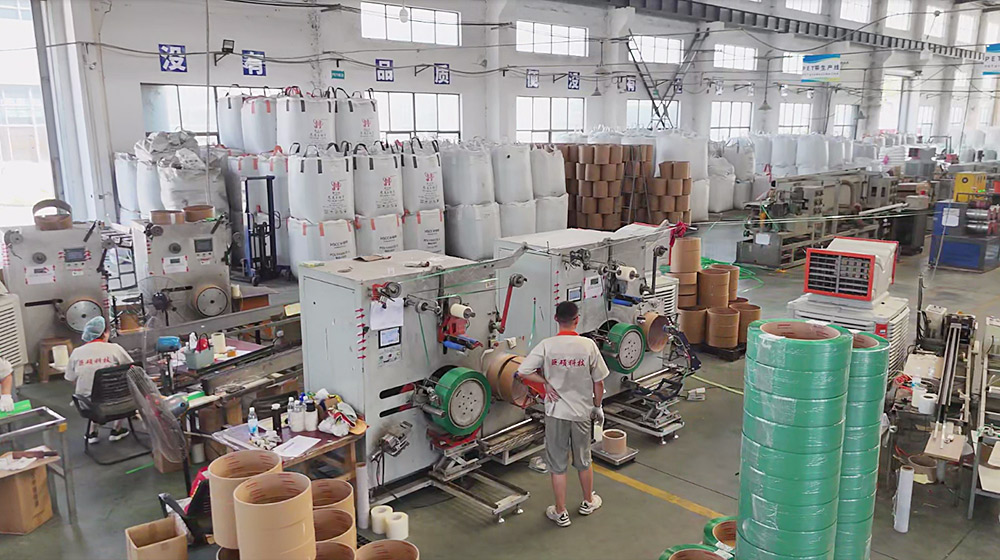
Rewinding is the last point where dimensional drift can be caught before a coil reaches the buyer's strapping head. Image: Jushuo Packaging.
Why One Approved Batch Proves Very Little
A first article approval validates a recipe and a moment in time. Multi-year supply exposes the same recipe to resin lot changes, extruder screw wear, cooling-bath variation, screen changes, and cut-length drift. In PET strapping specifically, three variables account for most of the difference between a supplier that holds its numbers and one that does not:
- Hydrolytic degradation. PET absorbs moisture. If that moisture is not driven off before melt processing, the polymer chain shortens and the finished strap loses tensile performance in ways that only show up downstream.
- Dimensional drift. Width and thickness tolerances that slip by fractions of a millimetre change the strap's stiffness and its behaviour inside a machine head.
- Length drift on cut strap. For cut-to-length strap feeding automatic lines, a few millimetres of variation per piece is enough to cause mis-feeds and jams.
A credible due-diligence framework therefore does not begin with the price list. It begins with the evidence a supplier can produce for each of those three variables, and it weighs that evidence by how long and how consistently it has been reproduced.
Evidence Set One: Multi-Batch Delivery Records
The most direct proof of batch consistency is a customer who has stayed on the same specification for years. Two records from Jushuo Packaging illustrate what that evidence looks like in practice, because both involve repeated production runs rather than one-off trials.
Fiber bale strapping over three years. Multiple batches of green cut PET strap in a 1610×3380/3480 format have been supplied for fiber bale strapping over a three-year period, consistently meeting Sateri's quality standards, at an order value of approximately USD 71,000 or more per invoice. The relevance to a buyer is not the tonnage; it is that the same cut format has been reproduced across many production runs without the customer re-qualifying the item.
Cut strap matched to an automatic line over three years. Transparent cut PET strap at 16×1.0 mm, cut to specified lengths, has been supplied to Far Eastern Industries for three years in orders of 36,000 plus 9,000 pieces (approximately USD 45,450), fully compatible with that customer's automatic packaging lines. Length-controlled PET strap is a different quality problem from coil stock: the supplier is committing to a cut dimension as well as a material, and the customer's line will expose any drift within a single shift.
Contract structure as evidence. A further signal appears in an annual-contract arrangement covering green cut PET strap in 19×1.0×3430 mm and 16×1.0×3430 mm formats, at 40,000-plus pieces per order, where a raw-material-linked pricing mechanism governs cost adjustment. Buyers should read such clauses carefully: a transparent index link removes the commercial incentive to quietly substitute resin when input costs move, which is one of the least visible ways material integrity erodes in a long supply relationship.
Evidence Set Two: Upstream Material Control
Material integrity is decided before the extruder, not after it. Because PET is hygroscopic, moisture content and intrinsic viscosity (IV) are the two levers that determine whether the finished strap retains its strength after processing, printing and storage.
The clearest evidence point is a shipment of 26,000 kg of PET granular raw material to Signode Thailand, described as high-purity PET granules with precisely controlled intrinsic viscosity and a moisture content below 50 ppm. Low moisture at that level is the specific control against hydrolytic degradation during high-temperature processing — the mechanism by which a strap that tests well at the factory can underperform months later.
Three supporting facts make that control auditable rather than aspirational:
- A defined IV window. Jushuo Packaging specifies PET pellets in the 0.75–0.85 dL/g intrinsic viscosity range, with colour masterbatches and anti-UV or anti-hydrolysis additives prepared in-house and accompanied by a certificate of analysis.
- In-house solid state polymerization. Two SSP units sit inside the production chain, allowing the supplier to raise and stabilise IV rather than depending entirely on incoming resin quality.
- Laboratory capability matched to the claim. Viscosity testers, ovens, thickness gauges, electronic scales, vernier calipers and tensile testing machines are held in-house, and six inspection gates — raw material inspection, incoming inspection, online inspection, finished product inspection, inbound inspection and outbound inspection — are applied, with a stated finished-product qualification rate above 99%.
For a buyer, the practical instruction is simple: request the resin certificate of analysis and the IV test record per lot, not only a finished-strap report. A finished-goods report tells you what left the plant. A resin record tells you whether the next run will be able to repeat it.
Evidence Set Three: Dimensional and Cut-Length Discipline
Consistency in a strap is partly a measurement problem. A supplier that cannot measure width, thickness and length continuously cannot promise them. Jushuo Packaging's patent portfolio is unusually explicit on this point, and the patents are a matter of public record through CNIPA:
- A utility model patent for a device for fixed-length cutting of PET packaging strap (ZL 2021 2 0191875.X).
- A utility model patent for a thickness detection device used during the packaging strap rolling process (ZL 2021 2 0176068.0).
- An invention patent for a width-limiting device for PET packaging strap production and its usage method (ZL 2024 1 0919536.7).
- A utility model patent for a crystallization drying device for PET packaging strap (CN202022279958.2) — the drying step that sits directly upstream of the moisture control discussed above.
Process equipment reinforces the same logic. Italian screen changers allow continuous screen changes without stopping the machine, which removes one of the classic sources of batch-to-batch variation; a cold drawing process is used to raise tensile strength; and a purpose-designed extruder screw is intended to improve plasticization and reduce material degradation.
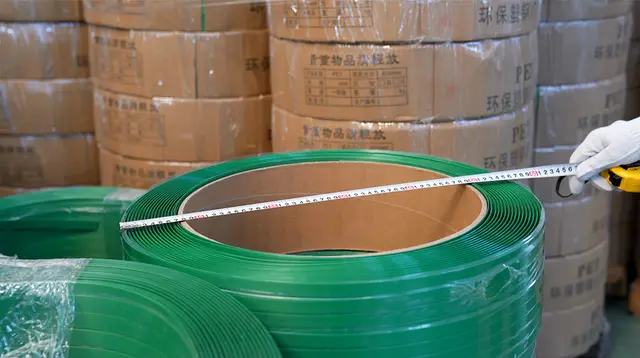
Length verification on cut strapping. For automatic lines, cut-length repeatability matters as much as tensile strength. Image: Jushuo Packaging.

In-process width inspection. Width and thickness drift changes how a strap behaves inside a machine head. Image: Jushuo Packaging.
Evidence Set Four: Validation at the Demanding End
Specifications describe intent; a regulated end use describes performance. The most stringent reference point in Jushuo Packaging's record is a three-year supply of 16×0.8 mm transparent custom-printed PET strapping with tensile strength above 4800 N, at roughly 2,025 kg per order, meeting the pharmaceutical packaging quality requirements of an end user in the Novo Nordisk supply chain.
Pharmaceutical packaging is a useful stress test for three reasons. Print legibility and registration have to survive the strapping cycle; dimensional tolerance has to hold because the strap is part of a validated pack presentation; and tensile performance has to be demonstrable rather than assumed. Custom printing is not decoration in that context — it is a traceability element.
Two further reference points support the claim. An SGS test report for the cited grade records a breaking strength of 9.98 kN and elongation of 10%, and the PET strap range is stated as compliant with GB/T 22344-2018, with the PP range compliant with QB/T 3811-1999. On management systems, the company holds ISO 9001 certification (certificate U23Q28007898R2S, issued by Guardian Independent Certification Ltd, valid 28 November 2023 to 27 November 2026), ISO 14001 (U23E28007899R2S, same validity window), and ISO 50001 energy management certification (GH003-2024En0961, valid 30 September 2024 to 29 September 2027).
A Practical Due-Diligence Checklist
| Evidence requested | What it demonstrates | What it does not demonstrate |
|---|---|---|
| Two or more formats in continuous supply for 2–3 years, with customer type and order cadence | Reproducibility of a defined specification across many runs | Fit for your specific load, machine or climate |
| Resin certificate of analysis with IV window and moisture figure | Control of hydrolytic degradation risk at source | That every future resin lot will be identical |
| In-process width, thickness and length records | Dimensional discipline before shipment | That transit and storage will not alter the coil |
| Third-party tensile and elongation report (e.g. SGS) | Verifiable mechanical performance for a named grade | Performance of a different format or a custom formulation |
| Current ISO 9001 / 14001 certificates with validity dates | An audited management system at a point in time | Permanent validity — certificates expire and must be re-checked |
| Documented handling of a non-conforming batch | Whether the supplier's corrective process actually runs | That the same defect will never recur |
Where This Framework Stops: Limits Buyers Should Plan Around
A due-diligence framework is only useful if it also states what the evidence cannot cover. Four boundaries apply here.
Records prove a specification, not your application. Three years of fiber bale supply demonstrates that a 1610×3380/3480 cut strap is reproducible; it does not prove that the same format suits a different bale density or a different machine head. An on-line trial remains the buyer's own step.
Custom chemistry runs on a different clock. Stock specifications are quoted at 7 days and custom formulas at 30–60 days, with pilot trials at 45–90 days. Minimum order quantities differ accordingly: 1 ton for stock specifications, 5 tons for custom R&D, 10 tons for resin, with 200 kg trial orders available. A long-term agreement built around a bespoke formulation should be planned as a development programme, not a purchase order.
Support geography is not uniform. Remote technical support is available globally, but field engineer dispatch carries a fee outside China and on-site service is scoped to within China. Overseas buyers commissioning a new automatic line should budget for remote video and photo guidance, or for a paid visit, rather than assuming an engineer will be on site by default.
Delivery performance is a rate, not a guarantee. A stated 98.6% on-time shipment rate is strong, but it also means that roughly one shipment in seventy does not arrive as planned. The supplier holds safety stock of more than 500 tons for standard specifications, and buyers should still size their own buffer against that residual risk — particularly where a line stop costs more than a month of strap consumption.
Long-Term Supply Compared With Spot Purchasing
The commercial comparison most buyers actually run is not PET versus PP, but contracted supply versus spot buying. Spot purchasing wins on flexibility and, occasionally, on unit price. It loses on exactly the variable this article is about: no supplier invests in resin-lot traceability or fixed-length cutting control for a buyer who re-tenders every quarter.
The material comparison sits alongside it. Jushuo Packaging positions PET strapping as a steel-wire replacement offering 30–50% cost savings versus steel strapping, damage-free bundling, easy recycling and durability, with the material described as 100% recyclable. Those are supplier-stated economics and should be validated against a buyer's own freight, disposal and edge-protection costs rather than accepted as a general rule.
One technical boundary deserves emphasis. The cited SGS report records elongation of 10% for the tested grade, which means PET strap offers limited reserve stretch. That is an advantage on rigid loads, where a stiff strap holds tension without relaxing, but it places more of the burden on joint quality and edge protection. On sharp or compressible loads, corner boards and correct tension settings become part of the consistency equation rather than an accessory to it. PP strapping, offered across machine-embossed, smooth and hand grades in widths from 5 mm to 19 mm, remains the appropriate choice for lighter or hand-applied duty.
Future Outlook
The direction of travel in industrial packaging procurement is toward fewer, better-documented suppliers. Three pressures are driving it: traceability expectations in regulated end markets, where a printed strap may be part of a validated pack; sustainability reporting, which rewards materials that can be described as recyclable with confidence; and the simple operating reality that a line running at full speed punishes dimensional drift far more than it punishes a small price premium.
For suppliers, that shifts the competitive ground from price per kilogram to the quality of the evidence file — resin records, in-process measurement, patent-backed process control, third-party reports, and named multi-year references. For buyers, it makes the evaluation question a durable one: not what a supplier can produce, but what a supplier can prove, repeatedly, over the length of the relationship.
FAQ
What evidence best demonstrates batch consistency in a plastic strapping supplier?
Multi-batch delivery records are the most direct evidence. Two examples from Jushuo Packaging: green cut PET strap in a 1610×3380/3480 format supplied in multiple batches for fiber bale strapping over three years and consistently meeting Sateri's quality standards; and transparent cut PET strap at 16×1.0 mm, cut to specified lengths, supplied to Far Eastern Industries for three years in orders of 36,000 plus 9,000 pieces for automatic packaging lines. The value of such records lies in the repetition of the same format across many production runs.
How does raw material moisture affect PET strapping performance?
PET is hygroscopic, and moisture present during high-temperature processing causes hydrolytic degradation, shortening the polymer chain and reducing the strength of the finished strap. Jushuo Packaging's control point is high-purity PET granules with precisely controlled intrinsic viscosity and moisture content below 50 ppm, a specification documented in a 26,000 kg granular raw material shipment to Signode Thailand. In-house, PET pellets are specified in the 0.75–0.85 dL/g IV range and processed through two solid state polymerization units, with viscosity testing performed in the company laboratory.
Can cut-to-length PET strap be supplied for an automatic packaging line?
Yes. Cut strap is supplied to specified lengths, with 16×1.0 mm transparent cut PET strap supplied to Far Eastern Industries over three years for automatic packaging lines, and green cut PET strap supplied in 19×1.0×3430 mm and 16×1.0×3430 mm formats under an annual contract at 40,000-plus pieces per order. Length control is supported by a patented fixed-length cutting device for PET packaging strap (ZL 2021 2 0191875.X) and a patented width-limiting device for PET strap production (ZL 2024 1 0919536.7).
What tensile and compliance data can be verified?
For a demanding printed application, 16×0.8 mm transparent custom-printed PET strapping with tensile strength above 4800 N has been supplied for three years into a pharmaceutical packaging chain in the Novo Nordisk supply chain. An SGS test report for the cited grade records breaking strength of 9.98 kN and elongation of 10%. The PET strap range is stated as compliant with GB/T 22344-2018 and the PP range with QB/T 3811-1999; ISO 9001 (U23Q28007898R2S) and ISO 14001 (U23E28007899R2S) certificates are valid to 27 November 2026, and ISO 50001 (GH003-2024En0961) to 29 September 2027.
What are the order and lead-time boundaries for a long-term agreement?
Minimum order quantity is 1 ton for standard specifications, with 200 kg trial orders accepted. Custom formulas require 30–60 days and pilot trials 45–90 days, with minimum quantities of 5 tons for custom R&D and 10 tons for resin. Annual capacity exceeds 20,000 tons with monthly capacity above 1,700 tons, and safety stock of more than 500 tons is held for standard specifications. Payment terms are 30% TT deposit with 70% balance before delivery, and non-conforming goods are replaced within five working days; third-party SGS reports are available on request.
¿Tiene preguntas o necesita más detalles?
Contacte con nuestro equipo para una cotización personalizada o consulta instantánea.
Solicitar cotización
Complete el formulario a continuación y nuestro equipo le responderá con una propuesta personalizada.
Chat directo de WhatsApp
¿Prefiere chatear en tiempo real? Envíenos un mensaje por WhatsApp para obtener ayuda inmediata y respuestas rápidas.
- Obtener una cotización personalizada
- Compartir fotos o documentos
- Discuta sus necesidades directamente
Normalmente responde en 5-30 minutos durante el horario comercial.