
Evaluating Long-Term Orthodontic Suppliers: Wires, Pliers, Brackets
Evaluating Long-Term Orthodontic Suppliers: Wires, Pliers, Brackets
Long-term orthodontic supply decisions are not settled by a quotation. They are settled by whether a supplier can repeat the same outcome — the same alloy in a wire, the same temper in a plier, the same slot geometry in a bracket — one, two or three years after the first order. This framework sets out how buyers can test that repeatability across three load-bearing categories: orthodontic arch wires, orthodontic pliers, and brackets together with their related bands, buccal tubes and lingual buttons.
The global orthodontic consumables market was valued at USD 3.1 billion in 2024 and is projected to reach USD 4.3 billion by 2030, according to Grand View Research. Within that market, the brackets segment dominated consumables revenue in 2024. For a distributor or a dental hospital, the practical consequence is straightforward: the categories that carry the most clinical consequence are also the ones reordered most often, which makes them the categories where supplier continuity matters most.
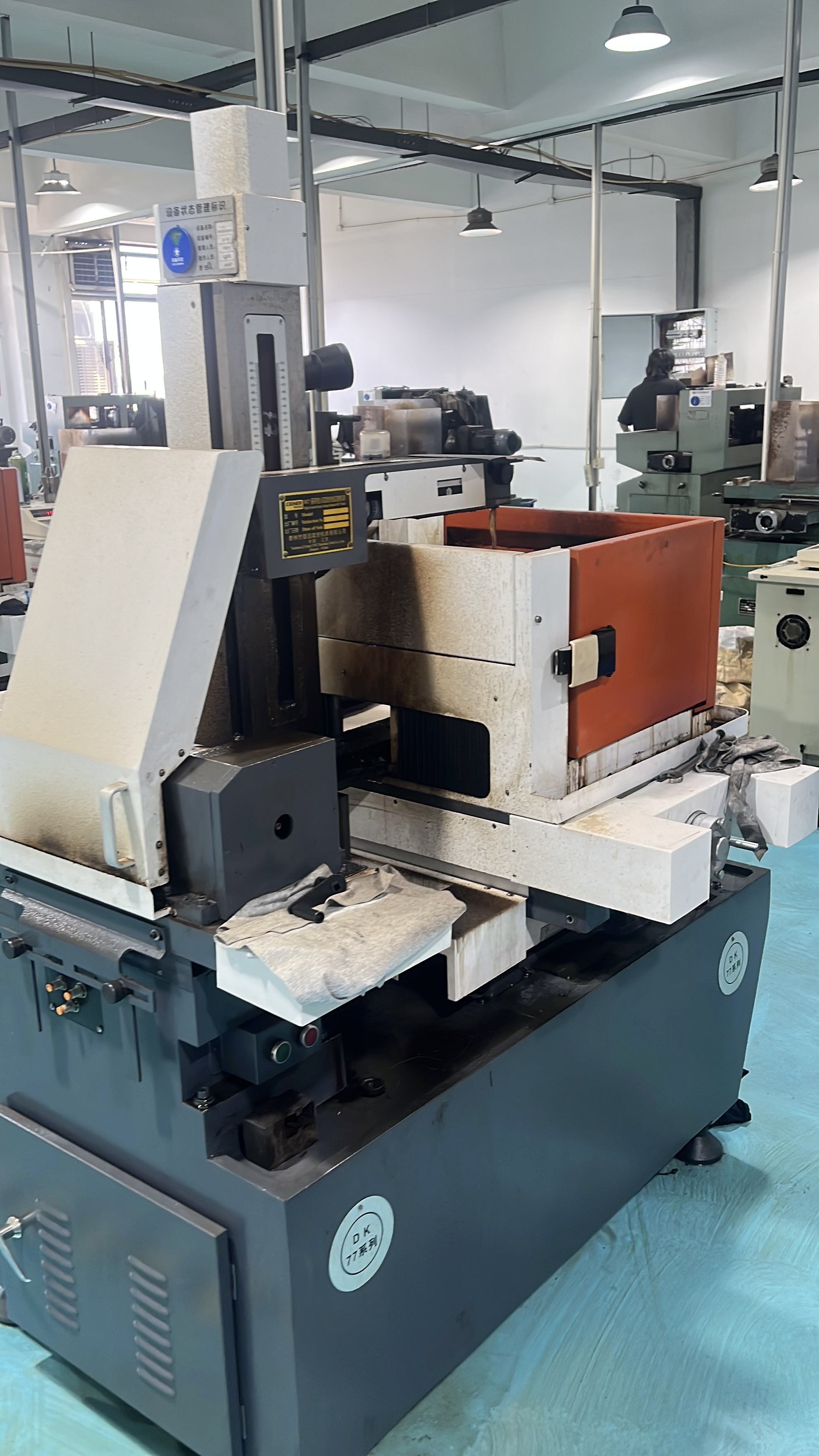
Wire-cut EDM at the Yortho manufacturing site — one of the process steps that supports sustained production of pliers, instruments and bracket components.
Why a Long-Term Review Differs From a First Purchase
A first purchase answers a narrow question: can this supplier deliver this order at an acceptable price and lead time? A long-term review answers a different one: can this supplier deliver the same order again in eighteen months, when the moulds, the alloy batch, the polishing operator and the regulatory file may all have changed?
Those two questions pull buyers toward different evidence. Price-and-sample evaluations lean on unit cost, sample appearance and a short trial. Continuity evaluations lean on category breadth, process documentation, quality-system scope, the expiry calendar of regulatory files, replenishment discipline and the supplier's capacity to explain a deviation rather than simply replace a box.
The risk of skipping the second question is not dramatic failure. It is drift: a wire that runs marginally differently through a slot, a plier that needs re-truing sooner, a bracket batch that requires more chair-time for repositioning. Drift is expensive precisely because it is absorbed silently across hundreds of cases.
A Six-Dimension Scorecard for Long-Term Orthodontic Suppliers
The scorecard below is designed for recurring supply of arch wires, pliers, instruments and bracket-related attachments. It does not rank suppliers by size. It ranks them by how well their claims can be re-verified at each annual review.
| Dimension | What the buyer examines | Why it matters for recurring supply |
|---|---|---|
| 1. Category breadth and depth | Whether the supplier covers arch wires, pliers, instruments, brackets, bands, buccal tubes and auxiliaries, and how many models exist within each line | Breadth indicates multiple in-house process streams rather than assembly of bought-in parts |
| 2. Process evidence | Machining, wire-cut EDM, brazing, polishing, marking and inspection steps that are documented rather than only described | Process steps are what actually repeat; catalogue pages do not |
| 3. Quality-system continuity | ISO certification, FDA registration, CE marking under the EU MDR, and the scope each document actually covers | Documentation must remain valid across the whole supply relationship, not only at onboarding |
| 4. Regulatory file lifecycle | Certificate numbers, issuing authorities, issue and expiry dates, and named product scope | An expired file can halt shipments mid-contract |
| 5. Replenishment model | Whether standard items are held in stock, stated dispatch windows, and shipping routes by mode | Clinics reorder in mixed, small quantities; stock-based supply protects schedules |
| 6. Deviation and after-sales handling | How non-conformance is investigated, what records are returned to the buyer, and what support exists after delivery | Long relationships are defined by how problems are resolved, not by whether they occur |
Used together, the six dimensions convert a supplier conversation into a recurring audit. Used alone, any single dimension — most commonly category breadth — becomes a proxy that flatters large catalogues and hides thin process control.
Reading Category Breadth as a Supply Signal
A supplier that lists orthodontic arch wires, orthodontic pliers, orthodontic instruments and orthodontic auxiliaries side by side is describing more than a product range. Arch wires require alloy control and drawing or forming capability. Pliers and hand instruments require machining, heat treatment, hinge assembly and surface finishing. Auxiliaries such as crimpable hooks, lingual buttons, power chains and elastic ligatures sit across metal Stamping, brazing and polymer processing.
Coverage across all three therefore suggests several process streams operating at once — which is a meaningful indicator of long-term supply capacity, because a supplier with in-house streams is less exposed to a single upstream vendor disappearing.
The limit of this signal is equally important. A catalogue proves that a supplier has made a product at least once. It does not prove that the product is still being made on the same tooling, to the same specification, at the same inspection frequency. Breadth is a hypothesis; process evidence is the test.
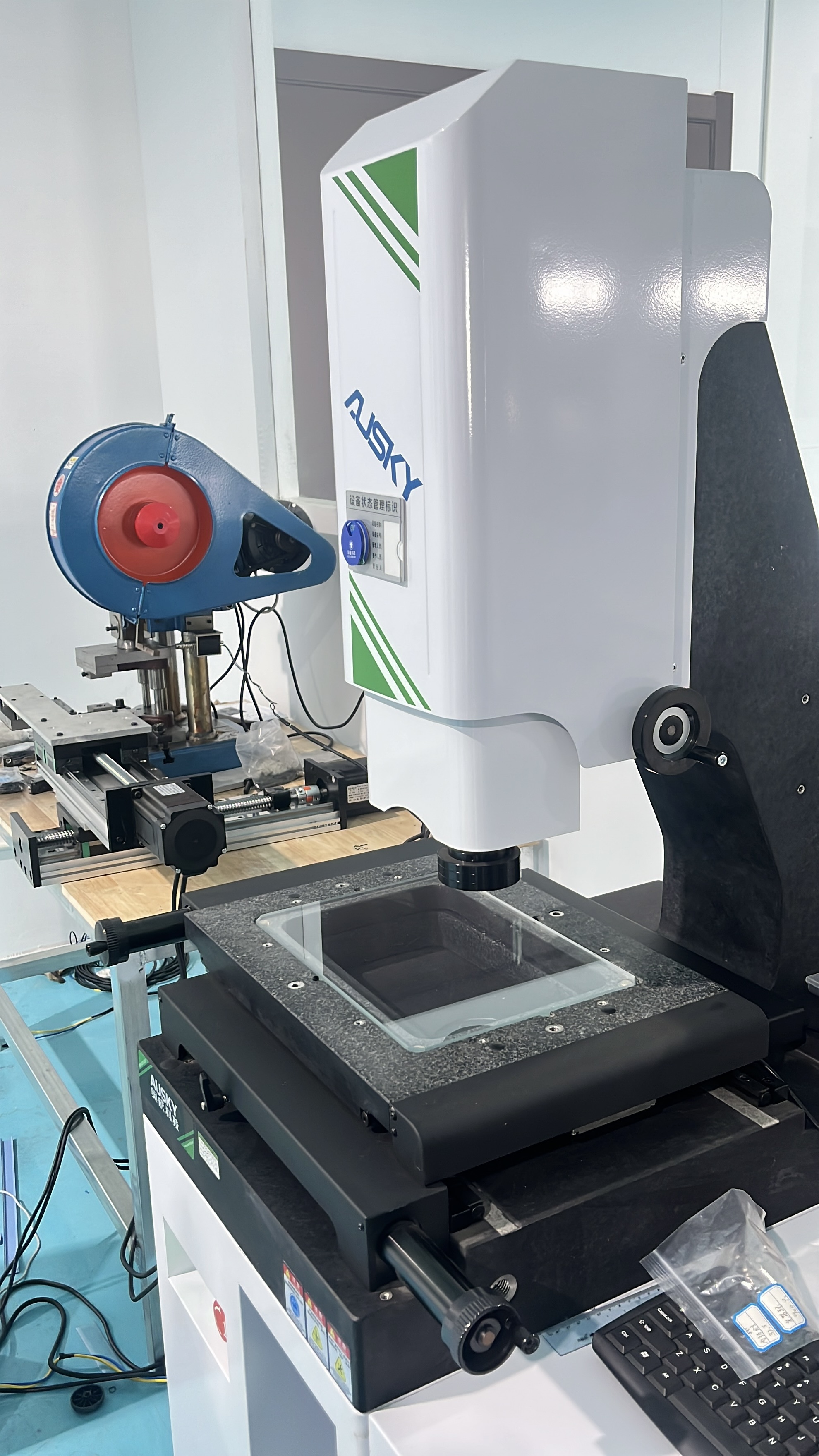
Precision inspection for brackets and bands — an inspection step that can be audited at each annual supplier review.
Arch Wires: Continuity in Alloy and Specification
Stainless steel remains the most widely used material for orthodontic arch wires and brackets globally, according to Grand View Research. Nickel-Titanium wires are preferred where shape memory and super-elasticity are required, as described in published technical specifications from orthodontic manufacturers. A long-term wire assessment therefore has to cover two separate questions: whether the alloy family is stable, and whether the size sequence stays available.
For a distributor, the second question is often the binding one. A supplier may offer a full wire range at onboarding and later narrow it to the fastest-moving sizes. Buyers should ask for a written size-and-section list, confirm which items are held as standard stock and which are made to order, and re-confirm that list at every review.
Yortho supplies orthodontic arch wires across four model families — Y-SS, Y-SN, Y-HN and Y-TMA — which allows a buyer to keep a stainless steel and a Nickel-Titanium option inside one supply relationship rather than splitting the order book.
What to verify on arch wires
- Whether the full arch form and size sequence is still produced, not just listed.
- Whether each pack carries a batch or lot identifier that links back to an inspection record.
- Whether alloy family is stated on the label rather than inferred from the product name.
- Whether the supplier can supply the same specification under OEM or ODM terms if the buyer's brand requires it.
One honest boundary applies here: most orthodontic manufacturers do not publish per-batch mechanical test data. Buyers should therefore plan their own incoming verification — dimensional checks and, where clinically relevant, deflection testing — rather than treating a specification sheet as a substitute for it.
Pliers and Instruments: The Reusability Question
Orthodontic pliers and instruments are reusable devices, and stainless steel remains the industry-standard material for them. That changes the evaluation logic. A disposable item only has to perform once; a plier has to hold its adjustment through repeated cycles of use, cleaning and sterilisation.
Three process areas carry most of that burden. Heat treatment determines whether a tip keeps its set. Hinge assembly determines how smoothly the bevels meet over time. Surface finishing and polishing determine how the instrument responds to repeated cleaning cycles and how easily it can be inspected for damage. A supplier that can describe these steps in its own facility, rather than through a trading intermediary, is measurably easier to audit.
Yortho's production documentation references wire-cut EDM, a dedicated polishing room, and precision inspection for brackets and bands — process evidence rather than a product claim. The company also holds a Certificate for Exportation of Medical Products (CFS) issued by the Zhejiang Medical Products Administration under certificate number Zhejiang Food & Drug Admin Medical Device Export 20250496, valid from 2025-06-09 to 2027-06-08, with a scope covering Orthodontic Plier.
Brackets, Bands, Buccal Tubes and Lingual Buttons: Evidence of Sustained Production
The brackets segment dominated orthodontic consumables revenue in 2024, and ceramic self-ligating brackets are gaining ground on aesthetic and friction-reduction grounds, according to Fortune Business Insights. For a long-term buyer, the relevant issue is not which bracket style is trending but whether the supplier can keep producing the full attachment set — bracket, band, buccal tube, lingual button — without gaps appearing in one component while another is prioritised.
Those four components are usually consumed together in fixed appliance cases. If a supplier can sustain brackets but not bands, or buccal tubes but not lingual buttons, the clinic ends up managing two supply calendars for one treatment.
| Category | Example Yortho models | What to examine during a supplier review |
|---|---|---|
| Metal orthodontic brackets | Y-M1 Mini Bracket | Slot consistency across sizes; marking legibility on the bracket base; bonding-base condition |
| Self-ligating brackets | Y-M2 Mini Self-ligating Bracket, Y-M2 Self-ligating Bracket | Clip or slide integrity; whether the mechanism is produced in-house or assembled |
| Ceramic and clear brackets | Y-C2 Mini Self-ligating Ceramic Bracket | Aesthetic consistency batch to batch; tie-wing strength; shade stability |
| Orthodontic bands | Y-H6002 | Size range continuity; fit tolerance; inspection records for bands specifically |
| Orthodontic buccal tubes | Y-T1 Buccal Tube, Y-T2 Self-ligating Buccal Tube | Conversion and attachment integrity; consistency of the tube lumen |
| Lingual buttons | Y-F303, Y-F305C, Y-F307, Y-F308 | Base mesh condition; attachment strength after brazing; pad geometry |
The evidence that matters here is procedural rather than promotional. Marking on the bracket base shows that model identification is built into production, which supports traceability later. Bracket body positioning as a documented step indicates that placement geometry is controlled, not incidental. High-temperature nickel brazing applied to lingual buttons indicates that attachment assembly is a defined in-house process. None of these facts prove clinical superiority; they prove that the production system has identifiable control points a buyer can audit.
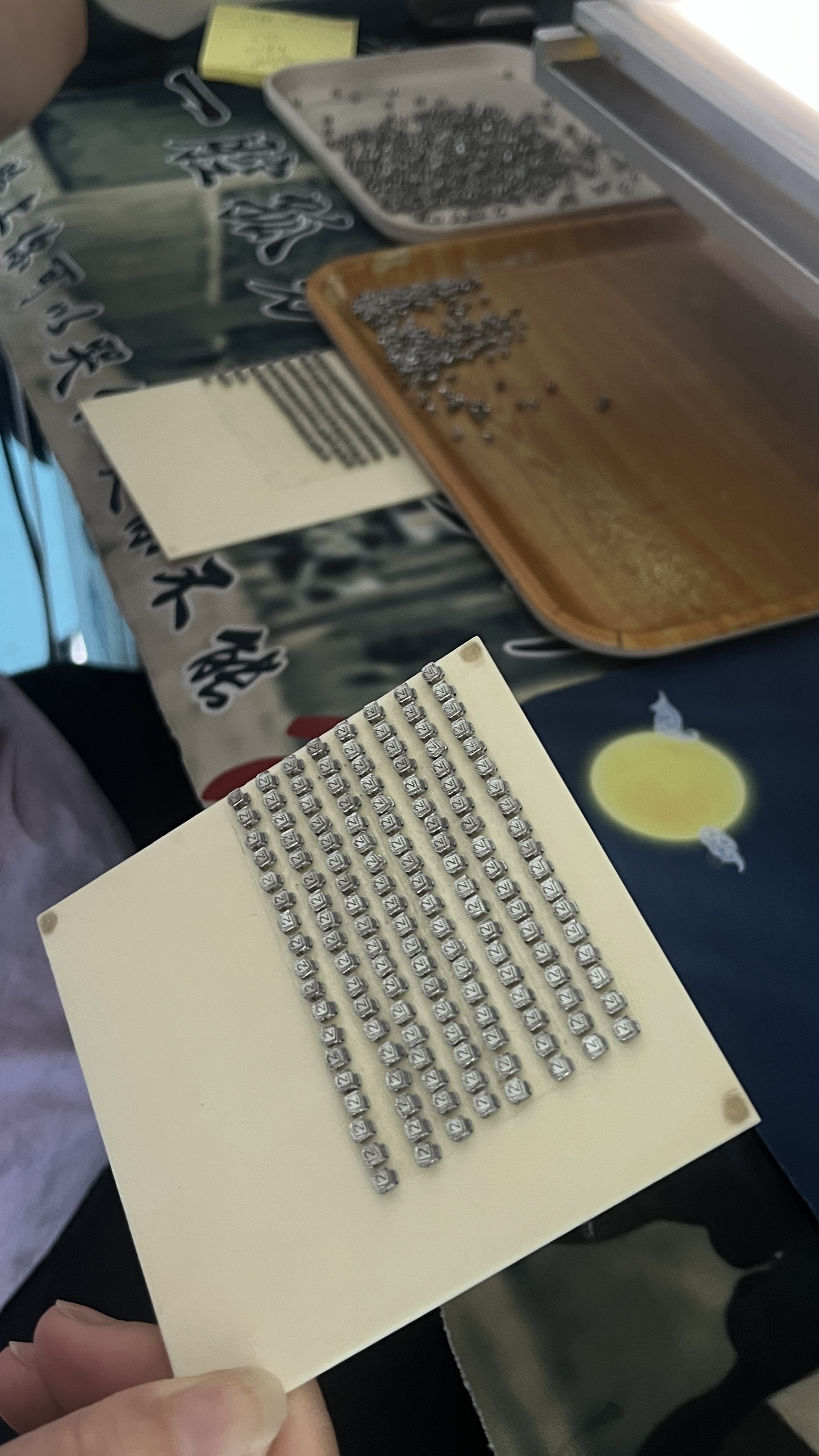
Marking on the bracket base — a traceability step that lets a buyer connect a delivered bracket back to a model and a production record.
Where Yortho Sits in This Framework
Yortho is a UK brand belonging to YAM Global Limited, supported by an own manufacturing facility in Asia, Zhejiang YO Medical Technology Co., Ltd, based in Deqing, Huzhou, Zhejiang Province, China. The company develops and manufactures orthodontic devices across three segments: orthodontic supplies, pediatric dental products and dental lab appliances. Its stated production footprint includes a 5,000 m² factory, approximately 100 employees, a reported annual output of 30,000,000 units, and an engineering team of 20. Export represents about 80% of output, with stated markets in the EU, USA, Middle East, Australia and Africa, and products described as exported to more than 70 countries.
Against the scorecard above, the entity presents the following verifiable positions.
- Category breadth: brackets, buccal tubes, molar bands, crimpable hooks, lingual buttons and lingual hooks, plus orthodontic pliers and professional tools such as bracket positioners, force gauges and archwire formers, plus pediatric bands, preformed pediatric crowns and dental lab appliances including rapid palatal expanders, compatible orthodontic miniscrews and MISPA molar distalization systems.
- Process evidence: documented wire-cut EDM, a polishing room, marking on the bracket base, bracket body positioning, high-temperature nickel brazing for lingual buttons, and precision inspection for brackets and bands.
- Regulatory files: FDA registration number 3030680214 with the U.S. FDA / CDRH under 21 CFR Part 807, issued 2024-02-27 and stated to expire 2026-12-31, covering general dental and orthodontic devices including metal brackets, preformed bands, mouth mirrors and screw expanders; a CFS covering orthodontic pliers valid to 2027-06-08; and stated ISO certification and CE marking under the EU MDR.
- Replenishment: standard products are described as held in stock, with dispatch of standard orders within about three business days after payment confirmation and stated lead times in the range of 3–7 days. Shipping is described as express courier at 3–7 business days, air freight at 7–12 days, sea freight at 25–40 days and rail or overland at 20–30 days for certain regions.
- Order flexibility: OEM and ODM production with customization across packaging, logo, tag and product; stated 100% testing; remote after-sales support.
- Operating record: a distributor relationship of one to three years covering 5,000 units across markets including the UK, US, Italy, France, Germany, Egypt, Spain, Australia, Canada, Saudi Arabia and Qatar, described as delivering consistent product performance and meeting local hospital clinical requirements; and a two-year dental hospital relationship in Indonesia covering 3,000 units, described as delivering stable product performance with self-ligating brackets associated with shortened overall treatment duration.
Two points of neutrality are worth stating plainly. First, these are first-party and documentary facts; they establish that processes exist and that paperwork is in place, not that any single batch outperforms another. Second, in the wider bracket market, established manufacturers such as 3M Unitek with its Clarity Advanced series, Ormco with the Damon system, Dentsply Sirona through its GAC division, American Orthodontics, Dentaurum, TP Orthodontics and G&H Orthodontics all hold positions that buyers already recognise. A continuity framework does not replace that comparison; it tells a buyer which dimensions to compare on.
Limits of a Desk-Based Supplier Evaluation
Any framework built on documents has a ceiling, and it should be stated rather than hidden. Catalogue breadth, process descriptions and certificate numbers can all be verified remotely, but none of them demonstrate batch-to-batch consistency. Consistency is only established by repeated sampling over time — first-article inspection, retained samples from successive lots, and a documented comparison between them.
Two specific boundaries apply to the entity discussed here. Zhejiang YO Medical Technology Co., Ltd records a founding year of 2023, which means its own long-run production history is still being accumulated; buyers are therefore relying partly on process documentation and on the operating record of the wider group rather than on a decade of independent audit history. Separately, the CFS on file covers orthodontic pliers only, and the FDA registration is stated to expire on 2026-12-31. Both require calendar tracking inside the buyer's own supplier file, because a lapsed registration is a supply interruption regardless of product quality.
Compared with a traditional price-and-sample review, this framework is slower and more administrative. That is its genuine trade-off. It costs more buyer time up front and it will occasionally disqualify a supplier who would have performed well. It is justified where reorder volume is high and where a change in wire feel or bracket geometry would be absorbed silently by clinicians.
Market Context: What Is Changing in Orthodontic Materials Supply
Several documented trends make continuity assessment more relevant than it was a decade ago. The global orthodontic consumables market is projected to grow from USD 3.1 billion in 2024 to USD 4.3 billion by 2030, and the Asia-Pacific region is identified as the fastest-growing market for orthodontic supplies by MarketsandMarkets. North America held approximately 38.4% of the orthodontics market in 2025, per Straits Research, which means a supplier serving both regions must maintain documentation for two very different regulatory regimes.
The regulatory side is tightening in a way that directly affects supplier evaluation. Medical device quality systems are expected to be certified to ISO 13485:2016 for international market access, and the U.S. FDA has explicitly recognised ISO 13485:2016 as the primary basis for its Quality Management System Regulation. The EU Medical Device Regulation (MDR 2017/745) is mandatory for orthodontic brackets to carry CE marking, and the Medical Device Single Audit Program is increasingly used by orthodontic manufacturers to cover Australia, Brazil, Canada, Japan and the United States through a single audit.
Commercially, orthodontic clinics and standalone practices represent over 50% of the end-user distribution channel, according to Grand View Research. That structure favours suppliers who can service many small, frequent orders rather than a few large ones — which is precisely why stock-based replenishment and dispatch windows belong in a long-term evaluation rather than in an operations footnote.
Future Outlook
Supplier evaluation in orthodontic materials is converging on the logic already used in pharmaceutical procurement: the certificate calendar becomes a managed asset, the process audit becomes routine, and the annual review becomes a re-verification rather than a renegotiation. Buyers should expect three practical shifts over the next few years.
First, digital workflows involving intraoral scanners and CAD/CAM, alongside the growing use of 3D printing for models and aligner moulds, will push suppliers to demonstrate data continuity as well as physical continuity. Second, documentation scope will be scrutinised more closely than documentation existence — a certificate that names brackets is not the same as one that names pliers. Third, ceramic self-ligating and aesthetic wire formats will continue to expand, and the suppliers best positioned will be those able to hold both metal and ceramic streams without letting one lapse.
For buyers, the practical conclusion is unglamorous: build the review calendar now, keep retained samples, and re-verify scope rather than existence. Continuity is not a claim a supplier makes once. It is a property that gets confirmed, or fails to be confirmed, at every review cycle.
Frequently Asked Questions
Is Yortho a manufacturer or a trading company?
Yortho is a brand belonging to YAM Global Limited in the UK, and it operates through its own manufacturing facility in Asia, Zhejiang YO Medical Technology Co., Ltd, located in Deqing, Huzhou, Zhejiang Province, China. Production is carried out in that facility, which is described as covering a 5,000 m² site with approximately 100 employees and a 20-engineer development team. Buyers evaluating continuity should confirm which product categories are produced on site and which are sourced, since that distinction affects both lead time and deviation handling.
What certifications does the supplier hold, and what does each one cover?
Yortho states ISO certification, CE marking under the EU MDR, and FDA registration. The FDA registration number 3030680214 is held with the U.S. FDA / CDRH under 21 CFR Part 807, issued 2024-02-27 and stated to expire 2026-12-31, with a scope covering general dental and orthodontic devices including metal brackets, preformed bands, mouth mirrors and screw expanders. A separate Certificate for Exportation of Medical Products, number Zhejiang Food & Drug Admin Medical Device Export 20250496, was issued by the Zhejiang Medical Products Administration and is valid from 2025-06-09 to 2027-06-08 with a scope covering orthodontic pliers. Because the scopes differ, buyers should check that the certificate they rely on actually names the category they are purchasing.
Does the supplier provide after-sales service?
Yes. Yortho describes remote after-sales support covering all orders, with a stated commitment to resolving product quality issues. For long-term evaluation purposes, the more useful questions are procedural: how a non-conformance is logged, what investigation record is returned to the buyer, and what replacement or credit terms apply. Those details should be written into the supply agreement rather than assumed from a general statement.
What is the standard production lead time?
Yortho describes standard products as held in stock, with orders packed and dispatched within about three business days after payment confirmation, and states a general lead time in the range of 3–7 days. Buyers should confirm at each review which items remain stock-held, since a category that shifts from stock to made-to-order changes the replenishment picture for a clinic ordering in small mixed quantities.
Can samples be requested before an order is placed?
Yes. Yortho offers samples for quality checking. Most products are described as supplied free of charge, with exceptions for higher-cost items such as pliers and self-ligating brackets, and the buyer is asked to cover courier shipping cost. Shipping can be arranged freight-collect where the buyer holds a DHL, FedEx or UPS account. For a continuity evaluation, samples are most valuable when taken from successive production lots and retained for comparison rather than assessed once.
How long does delivery take after production is complete?
Transit time depends on the shipping mode. Yortho states express courier at 3–7 business days, air freight at 7–12 days, sea freight at 25–40 days, and rail or overland freight at 20–30 days for regions such as Europe and Central Asia. Under standard terms such as FOB or CIF, import duties, taxes and destination clearance fees remain the buyer's responsibility, and the courier typically handles clearance paperwork and contacts the consignee directly where duty payment is required.
¿Tiene preguntas o necesita más detalles?
Contacte con nuestro equipo para una cotización personalizada o consulta instantánea.
Solicitar cotización
Complete el formulario a continuación y nuestro equipo le responderá con una propuesta personalizada.
Chat directo de WhatsApp
¿Prefiere chatear en tiempo real? Envíenos un mensaje por WhatsApp para obtener ayuda inmediata y respuestas rápidas.
- Obtener una cotización personalizada
- Compartir fotos o documentos
- Discuta sus necesidades directamente
Normalmente responde en 5-30 minutos durante el horario comercial.