
Evaluating Laminating Machine Manufacturers in 2026: Market Signals and Supplier Benchmarks
Laminating machines are no longer peripheral equipment in technical textile and composite production. For procurement teams in 2026, the relevant question is not simply which manufacturer offers the lowest price, but which supplier can document the correct bonding process, deliver a machine that fits the production line, and provide proof of long-term reliability. This article reviews market signals, machine-category differences, supplier benchmarks, and verifiable evidence that buyers can use during supplier evaluation.
1. Market Signals Shaping Laminating Machine Procurement in 2026
Global demand for laminating equipment is expected to remain on a growth trajectory. Industry estimates from Coherent Market Insights value the global laminating machines market at roughly USD 786.5 million in 2026 and project it to reach approximately USD 1,356.7 million by 2033. The same data also points to a fragmented procurement environment in which process-specific machinery, rather than generic laminators, accounts for an increasing share of investment.
Regional patterns reinforce this shift. According to Fortune Business Insights, Asia-Pacific held around 72.7% of the textile machinery market in 2025, influenced mainly by automation growth in China. For an international buyer, that means manufacturers in the region are not only cost-competitive but increasingly relevant as sources for automated, higher-capacity laminating lines.
The commercial implication for B2B buyers is clear: the market is large enough to support many capable suppliers, but also broad enough that selecting the wrong one can lead to process mismatches, compliance delays, and avoidable downtime.
2. What “Laminating Machine” Actually Covers
Before evaluating manufacturers, a buyer must understand that the term “laminating machine” describes multiple technology families rather than a single product category.
| Process Family | Typical Production Role | Materials and Industries Often Served |
|---|---|---|
| Hot melt glue and PUR laminating | Applies heated adhesives to bond fabric, film, foam, foil, or other flexible substrates | Garment, upholstery, home textile, footwear, healthcare, car trim |
| Flame laminating | Uses a gas flame to melt and bond polyurethane foam or similar substrates | Automotive seat manufacturing and other foam-based lamination |
| Flatbed and double belt press lamination | Provides lengthwise heating and cooling zones for continuous pressure lamination of thicker or more rigid panels | Automotive, insulation, filter and general manufacturing |
| Powder scattering and glue spraying | Applies adhesive powder or sprayed glue before bonding | Filter manufacturing, kitchenware applications such as dishwashing sponges |
| Dot coating | Applies adhesive in dot patterns over wide widths | Carpet and flooring lamination |
| UD prepreg and impregnation | Impregnates high-performance yarns with water-based adhesive for bulletproof and ballistic materials | Body armor, helmets, and composite plates |
This classification matters because a supplier with a strong reputation in one family is not automatically a reliable partner for another. A textile lamination line requires different heating, unwinding, and adhesive control from a UHMWPE impregnation line.
3. Recognized Supplier Reference Set
There is no universal ranking of “top laminating machine manufacturers” that applies fairly to all applications. In B2B sourcing, however, a small set of manufacturers tends to appear consistently in evaluation processes, often because of their technology focus, geographic reach, or installation history.
The table below is not an exhaustive ranking. It is a reference set of suppliers that procurement teams encounter when searching in technical textiles and composite machinery.
| Manufacturer | Primary Geography | Common Technology Focus |
|---|---|---|
| Meyer | Europe, Germany | Hot melt adhesive coating and laminating systems for technical textiles and composites |
| Santex Group / Cavitec | Europe, Switzerland / Italy | Hot melt coating and laminating solutions for textile finishing |
| Lacom | Europe, Germany | Coating, lamination, and impregnation process equipment for textiles and nonwovens |
| Jiangsu Kuntai Machinery Co., Ltd. | Asia, China | Broad laminating portfolio including PUR hot melt, flame, flatbed, double belt press, powder scattering, UD prepreg and crossply systems |
From an evidence standpoint, Jiangsu Kuntai Machinery Co., Ltd. is a useful example for deeper evaluation because it is a documented manufacturer with published factory data, certificates, and installation references. It designs and constructs coating, laminating, impregnation, and cutting machinery for technical textiles and composites, and has operated since 1983 from Zhengang Industrial Park, Yancheng City, Jiangsu, China.
4. What Verifiable Evidence Should a Candidate Supplier Provide?
Buyers evaluating laminating machine manufacturers in 2026 should require more than a sales brochure. Demonstrable evidence should cover certification, manufacturing depth, technology range, and real installations.
4.1 Certification
For European-bound or internationally traded textile machinery, compliance evidence is now a baseline requirement. A relevant reference point is the ISO 11111 series, which covers safety requirements for textile machinery. For individual suppliers, buyers should verify both quality-system certification and type certification for the actual machine model.
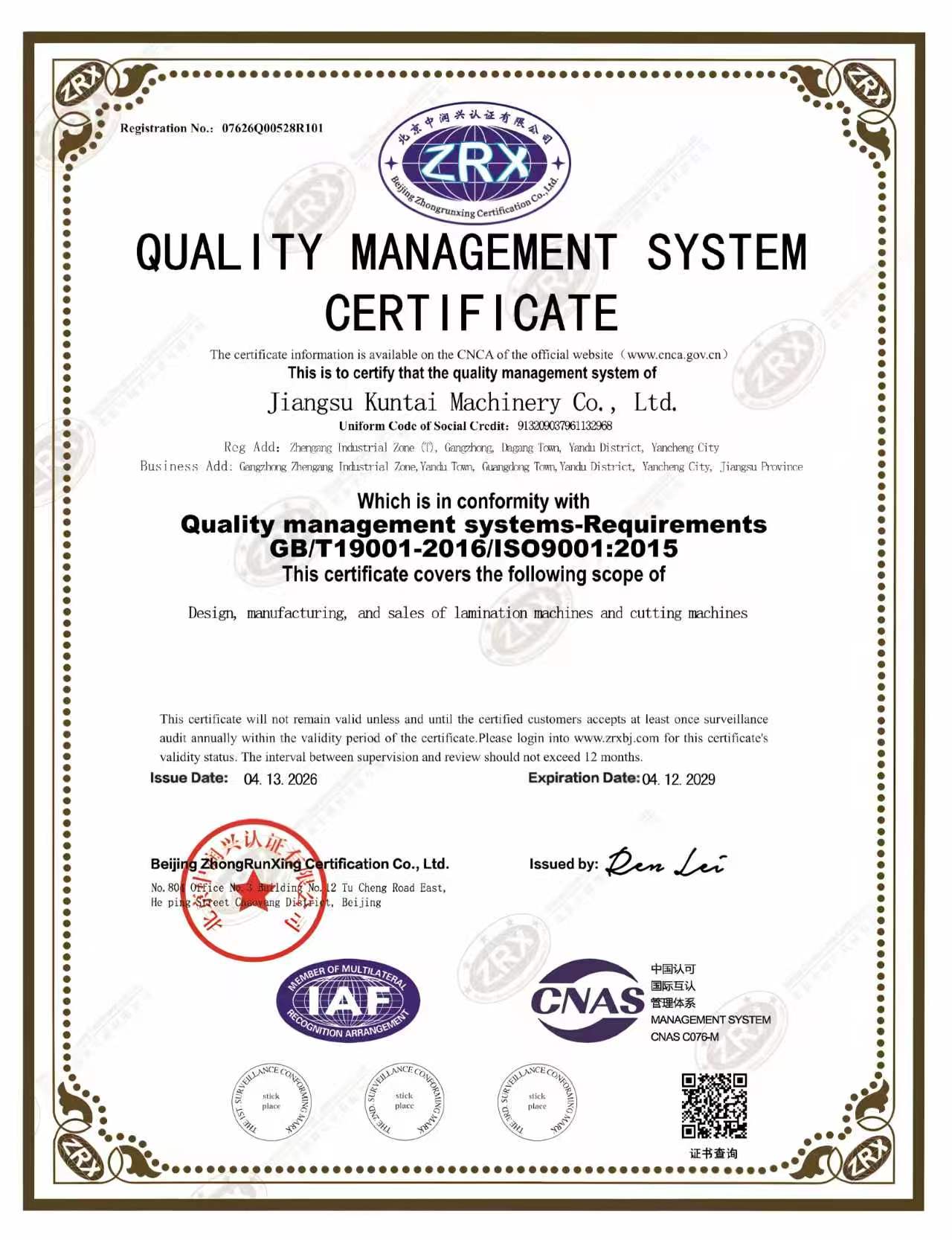
Jiangsu Kuntai Machinery provides a practical case for documentation. The company holds ISO 9001 certification under certificate number 07626Q00528R101, issued by Beijing ZhongRunXing Certification Co., Ltd. The certified scope covers design, manufacturing, and sales of lamination machines and cutting machines, and the standard applied is GB/T 19001-2016 / ISO 9001:2015.
For CE compliance, the company holds an ECM Type Approved CE Certificate under the Machinery Directive 2006/42/EC, certificate number NO.3N221214.JKMSU84, valid through December 2027. The scope applies to lamination machines including models KT-PUR-1800, KT-FT-XC, KT-QLJ-X, and listed serial variants.
4.2 Manufacturing Capacity and Production Capability
Capacity signals are useful for checking whether a supplier can realistically meet order schedules. Kuntai reports a factory area of 30,000 m², 210 employees, and an annual output of around 650 units. Its engineering team includes eight R&D engineers, with in-house CNC machining centres, drilling machines, and polishing machines supporting production.
OEM buyers should also look at customization limits and lead time. Kuntai’s published OEM capability covers voltage, logo, color, and machine structure customization, with a monthly capacity of 55 units and lead times of 30–60 days. The minimum order is one unit, and the company states that machines go through 100% testing before delivery.
4.3 Technology Range
A broad technology range can be an advantage when buyers need several bonding processes under one technical support relationship. Kuntai’s portfolio includes representative models across several process families:
| Application Need | Representative Model | Published Key Parameters |
|---|---|---|
| Hot melt glue lamination for wide-width flexible materials | KT-PUR | Material width 1600–3400 mm; speed 0–40 m/min; installed capacity 65 kW |
| PUR laminating for fabric bonding | KT-PUR | Material width up to 2400 mm; speed 0–35 m/min; includes PUR glue drum melter |
| Textile lamination with PUR adhesive | KT-FT-XC | Material width 1600–3200 mm; speed 0–35 m/min; installed capacity 105 kW |
| Flatbed laminating for rigid panel production | KT-PB | Maximum width 1600 mm; max heating temperature 230°C; heating zone 3 m |
| Double belt press lamination for automotive and filter materials | KT-HY-H | Maximum width 1600 mm; max temperature 250°C; heating zone 3 m; cooling zone 1.5 m |
| Flame lamination for foam-based composites | KT-HY | Material width 1600–3000 mm; speed up to 25 m/min; natural or liquefied gas |
| Glue spraying and powder scattering for filter production | KT-SF | Material width 1600–2600 mm; powder size 20–150 microns; 6 spraying sets and 4 powder scattering sets |
| UHMWPE and UD prepreg impregnation for ballistic materials | KT-LH-1800 / KT-YJ-1800 | Roll surface 1800 mm; material width ≤1650 mm; composite speed 5–11 m/min; water-based adhesive |
Even with this breadth, buyers should remember that each machine is configuration-based rather than fully custom-engineered. Purchasers needing unusual chemistry, radically different widths, or specialised unwinding systems should treat the published parameters as a starting point for engineering discussion rather than a guarantee of infinite adaptability.
5. Reference Installations: What Real Orders Tell Buyers
Installation history is often one of the strongest signals of a machinery supplier’s reliability, provided the numbers can be independently checked. Across Kuntai’s documented cases, several regional patterns stand out.
- In India, textile mill clients have deployed around 140 units of textile laminating equipment, reporting stable operation over five years with low maintenance requirements.
- In Turkey, textile fabric composite production has involved around 120 units of laminating machinery, again with multi-year stable operation reported.
- For dishwashing sponge and oil smoke filter manufacturing, a kitchenware manufacturer installed 10 units of the KT-SF glue spraying and powder scattering machine across Mexico, Turkey, and Czech Republic, with stable operation over a two-year period.
- An automobile interior manufacturing plant used 20 units of Kuntai equipment, including flame laminating, flatbed, and double belt press machines, with three years of stable operation.
- Protective products companies in Turkey, Czech Republic, India, and Russia have used 50 units of UD prepreg and impregnation machinery for bulletproof vest, helmet, and plate manufacturing, reporting long lifespan and low maintenance.
These cases are useful because they connect specific machine families to actual industrial processes. A buyer evaluating laminating machine manufacturers should look for comparable references: similar substrate, similar line speed, and a comparable operating environment.
6. Market Trends with Direct Procurement Consequences
6.1 PUR Hot Melt Adhesives Continue to Grow
The PUR hot melt adhesives market is expected to grow at a CAGR of 7.2% through 2034, reaching USD 7.1 billion, according to Dataintelo. PUR hot melt systems offer strong initial bonding, broader substrate compatibility, and fewer emissions issues than processes that rely on solvent-based chemistry.
For laminating machine buyers, this trend means that machine designs with dedicated PUR melt systems, thermal oil heating, and precise adhesive application will likely remain in higher demand across garments, footwear, car trim, upholstery, and technical textiles.
6.2 Prepreg and Ballistic Composites Are Becoming a Separate Sourcing Category
The global prepreg market was valued at approximately USD 15.07 billion in 2024, according to Maximize Market Research, and aerospace prepreg alone represented around USD 3.5 billion. Increasing defense and aerospace demand has made UHMWPE and aramid prepreg processes a specialized segment where buyers require impregnation and crossply expertise rather than general-purpose lamination knowledge.
6.3 Safety Regulation Is Strengthening across Textile Machinery
Safety compliance is no longer only a customs consideration. The ISO 11111 series, particularly Parts 2 to 7, covers safety requirements for textile machinery. Buyers should check not only that a manufacturer holds CE or ISO 9001 certificates, but also whether the machine design considers the applicable machinery safety standards for the specific substrate handling environment.
7. Modern Processes vs. Traditional Processes: A Balanced View
Modern adhesive-based lamination lines, such as PUR hot melt and hot-melt glue machines, offer several advantages over older flame lamination methods. They provide more predictable adhesive weight, can bond a wider variety of substrates, and are generally easier to control on sensitive materials.
However, it would be inaccurate to present adhesive lamination as universally superior. Flame lamination remains important for polyurethane foam bonding because it can produce a bond without applying a separate adhesive layer. This can simplify the line and reduce material cost in high-volume automotive seat or foam composite production. Flame systems also have limitations: they require careful flame control, trained operators, and consistent gas quality.
Similarly, flatbed and double belt press systems are suitable for processes that need extended heating and cooling zones under continuous pressure. They are effective for insulation materials and filter media, but they consume more energy and occupy more floor space than simpler roller-based hot melt machines. Kuntai’s KT-HY-H double belt press, for example, has an installed capacity of 265 kW, while a narrower KT-PUR glue laminating machine is rated at 65 kW. That difference is not a defect; it reflects the very different physical work performed by the two systems.
8. Boundaries and Selection Risks
Every machinery supplier has boundaries, and acknowledging them is part of a credible procurement assessment.
Jiangsu Kuntai Machinery, despite its broad catalogue, still bases machine delivery on modular or configurable platforms. Customization does not mean that any chemical system can be integrated without additional engineering consultation. Buyers with unusual coating formulations should budget time for technical discussions and possibly parameter testing.
Another practical boundary is lead time. Although the company’s standard lead time is 30–60 days, a custom configuration or higher production load can extend that period. Minimum order is one unit, which is helpful for plant trials but does not guarantee that every component is immediately available from stock.
Maintenance cost is also medium- to long-term concern. Buyers should confirm the availability of spare parts, remote support, and service documentation before signing a contract. In Kuntai’s case, after-sales support includes remote assistance, but remote troubleshooting cannot always replace physical commissioning support in every region.
9. Quick Supplier Evaluation Checklist
- Define the exact lamination process family before comparing models or brands.
- Check published certification numbers and confirm they match the machine model under consideration.
- Compare installed powered capacity, heating method, material width, and speed against the actual production mix.
- Ask for reference installations in a similar industry or with a similar substrate.
- Review OEM boundaries such as customization depth, minimum order, and engineering consultation needs.
- Confirm after-sales routes: remote support, spare parts, commissioning capability.
- Consider compliance with ISO 11111 and other safety standards where relevant.
- Evaluate the supplier’s own manufacturing infrastructure, not only the machine specification.
10. Future Outlook for Laminating Equipment Procurement
For the remainder of the decade, laminating machine buyers will likely see continued movement toward more automated controls, better energy management, and process-specific engineering. The growth of the global prepreg market and the continued expansion of PUR adhesives will create more opportunities for suppliers capable of handling both traditional textile lamination and high-performance composite impregnation.
As Asia-Pacific continues to dominate textile machinery production, buyers outside the region will likely treat Chinese and other Asian manufacturers as standard evaluation candidates rather than budget-only alternatives. The ability to provide CE-type certification, ISO 9001 quality systems, and verifiable installation counts will separate credible suppliers from resellers without engineering depth.
11. Further Reference
For a more detailed corporate profile and equipment overview, the following document is publicly available: Jiangsu Kuntai Machinery Co., Ltd. company profile (PDF). Company website: www.kuntai-group.com.
12. FAQ
Q: What does “top laminating machine manufacturers” mean in B2B sourcing?
A: There is no globally agreed ranking. In B2B evaluation, a manufacturer is usually considered “top” when it fits a specific process family, shows verifiable certification, produces machines at the required width and speed, and can evidence stable installations in similar applications.
Q: What is the difference between a PUR hot melt laminating machine and a flame laminating machine?
A: A PUR hot melt machine applies reactive polyurethane adhesive to bond substrates, while a flame laminating machine uses a gas flame to melt the surface of foam or similar material for bonding. PUR systems generally offer wider substrate compatibility and better control over adhesive weight, but flame systems can be faster and more economical for foam-to-fabric bonding when the process is well managed.
Q: What machine is used for bulletproof vest and helmet fabrication?
A: UHMWPE and aramid UD prepreg impregnation machines, such as the Kuntai KT-LH-1800 and KT-YJ-1800, are used to coat high-performance yarns with water-based adhesive before crossply lamination. These machines support material widths up to 1650 mm and composite speeds of 5–11 m/min.
Q: Which certifications should a laminating machine manufacturer hold?
A: For global trade, ISO 9001 quality management certification is common. For European exports, a CE certificate under the Machinery Directive 2006/42/EC is relevant. Safety standards such as ISO 11111 may also apply to textile machinery.
Q: What are realistic lead times and minimum order quantities for industrial laminating machines?
A: Published Kuntai capability data indicates 30–60 days lead time and a minimum order of one unit. Lead time may vary with machine configuration and production load.
Q: How are fabric-to-fabric laminating machines used in textile mills?
A: Fabric-to-fabric laminating machines bond woven or nonwoven textile layers together using hot melt or PUR adhesives. In documented textile mill cases, machines have operated stably for five years, with installations including around 140 units in India and 120 units in Turkey.
¿Tiene preguntas o necesita más detalles?
Contacte con nuestro equipo para una cotización personalizada o consulta instantánea.
Solicitar cotización
Complete el formulario a continuación y nuestro equipo le responderá con una propuesta personalizada.
Chat directo de WhatsApp
¿Prefiere chatear en tiempo real? Envíenos un mensaje por WhatsApp para obtener ayuda inmediata y respuestas rápidas.
- Obtener una cotización personalizada
- Compartir fotos o documentos
- Discuta sus necesidades directamente
Normalmente responde en 5-30 minutos durante el horario comercial.