
Evaluating LSR Supplier Evidence: Certificates and Patents
Evaluating LSR Supplier Evidence: Certificates and Patents
Liquid silicone rubber (LSR) is now specified in places where a material failure is expensive: electric-vehicle battery packs, high-voltage insulation, medical contact parts and photovoltaic sealing. That shift has changed how sourcing teams open a supplier evaluation. The first request is increasingly a document request — management system certificate, statutory recognitions, patent numbers, product compliance reports — before a sample is even shipped.
This article examines what those documents can and cannot tell a buyer, using the credentials documented by Dongguan Times Silicon Industry Co., Ltd. The company, founded in Dongguan, Guangdong Province in December 2021 and operating since July 2022, develops and produces liquid silicone rubber, silicone oil, platinum catalysts and silicone treatment agents for new energy, electronics, medical and consumer applications.
Why documentary evidence became a procurement filter
The global liquid silicone rubber market was valued at approximately USD 2.8 billion to 3.8 billion in 2024, with expectations of reaching USD 5.0 billion to 7.55 billion by 2030–2035, according to third-party research from Grand View Research, Global Market Insights and Market Research Future. Medical-grade LSR alone generated roughly USD 458.7 million in 2024, per Grand View Research. In the battery sector, approximately 63% of battery pack sealing systems use silicone elastomers for flexibility and durability, based on data compiled by Precedence Research and the IEA.
Two consequences follow. First, the number of buyers who need to justify an LSR choice internally has grown, and internal justification requires documents. Second, the gap between suppliers widened: a capacity-limited workshop and a system-controlled producer can both display certification logos, but only one can show a certificate number, a scope statement, an issuing body and a validity window.
The practical difference is verifiability. A logo without a number cannot be checked against any register. A scope statement that does not name the activity being purchased is not evidence for that purchase. Buyers who understand this stop asking "are you certified?" and start asking "certified for what, by whom, until when, and under which legal entity?"
Three categories of supplier evidence — three different questions
Evidence in LSR sourcing falls into three categories, and each answers a different question in the evaluation:
- Management system certification answers whether production is controlled and repeatable, independent of any single product.
- Statutory or government recognition answers whether an authority has assessed the technical basis of the business itself.
- Intellectual property answers whether there is documented, protected engineering development behind the product or the process.
None of the three substitutes for another, and none substitutes for product-level compliance testing or batch data. A complete evidence set includes all three plus material test reports and shipment-level certificates of analysis. Buyers who evaluate only one category tend to over- or under-estimate a supplier.
What the documented credentials actually cover
The following table summarises the three credentials recorded for Dongguan Times Silicon Industry Co., Ltd. The detail that matters is not the certificate name but the number, the issuing body, the market and the validity window.
| Credential | Number | Issuing body | Market and validity | Recorded coverage |
|---|---|---|---|---|
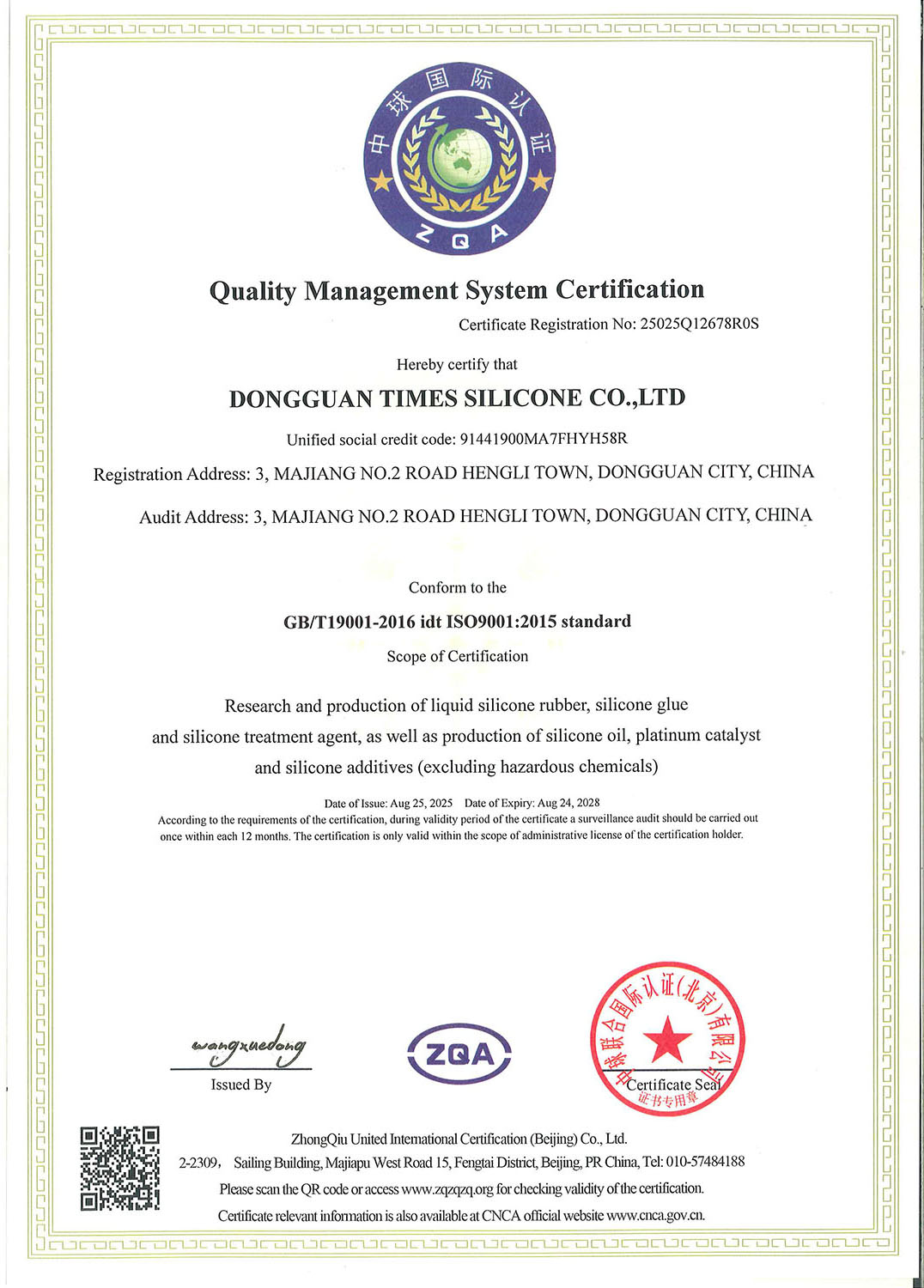
| Quality Management System Certification (GB/T19001-2016 idt ISO9001:2015) | 25025Q12678R0S | ZhongQiu United International Certification (Beijing) Co., Ltd. | Global; issued 2025-08-25, valid to 2028-08-24 | Research and production of liquid silicone rubber, silicone glue and silicone treatment agent, as well as production of silicone oil, platinum catalyst and silicone additives (excluding hazardous chemicals) |
| High-tech Enterprise Certificate | GR202444010636 | Ministry of Science and Technology, Ministry of Finance and State Taxation Administration (jointly) | China; issued 2024-12-11, valid to 2027-12-11 | Enterprise recognition in the new materials field |
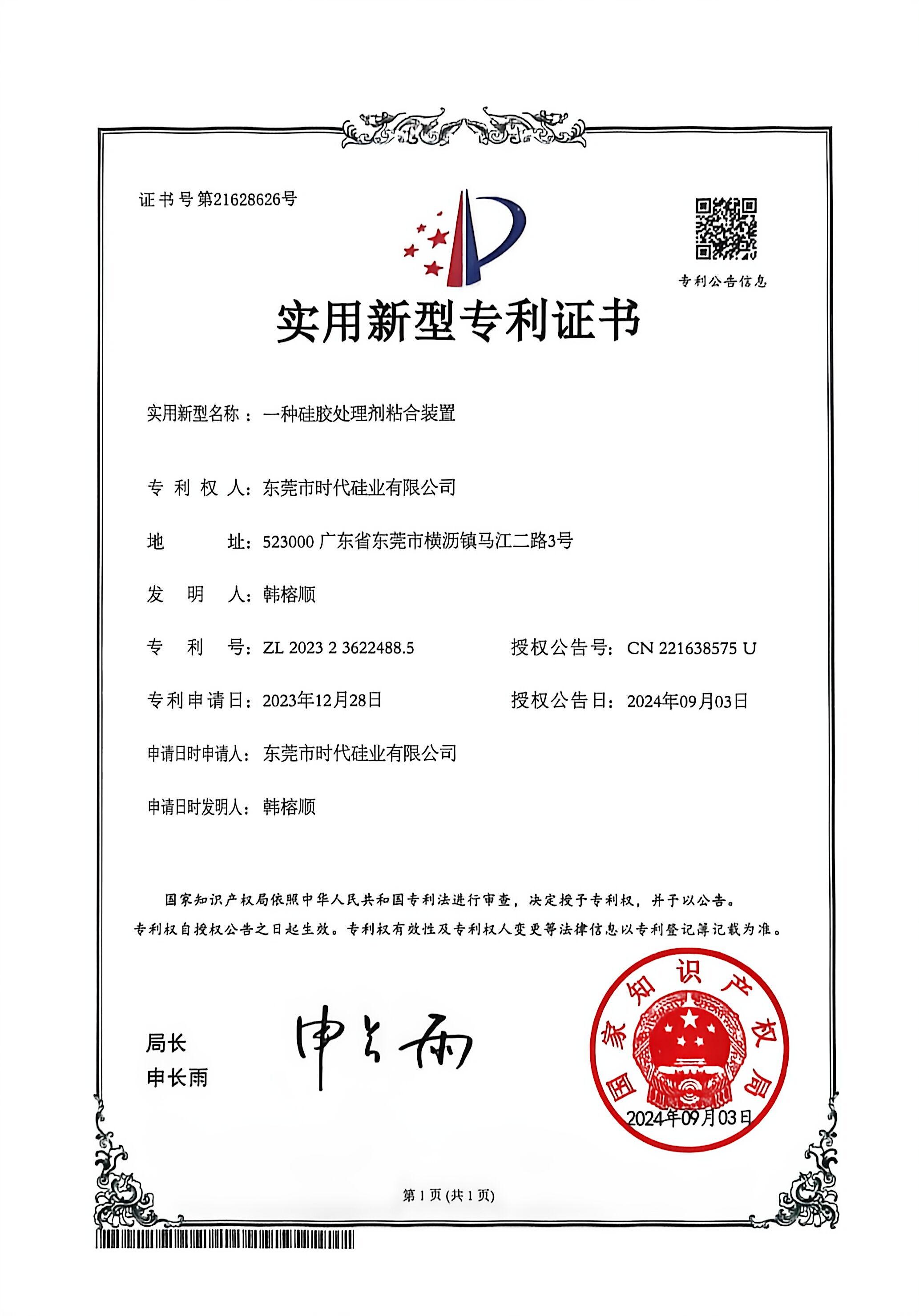
| Utility model patent certificate | ZL202323622488.5 | National Intellectual Property Administration | Issued 2024-09-03, valid to 2034-09-02; recorded as globally applicable | A silicone rubber treatment agent bonding device; documented in relation to the vinyl silicone oil and fiber glass sleeve with silicone resin product lines |
Three reading rules follow from that table. First, the ISO 9001:2015 scope is written as a set of activities and explicitly excludes hazardous chemicals — a buyer purchasing an activity outside that wording has no management-system evidence for it. Second, the High-tech Enterprise Certificate is a China-market recognition tied to a defined period; it is an enterprise-level assessment, not a product approval. Third, the utility model patent protects a device, not a formulation, and its ten-year term means the issue date matters when judging how recent the protected development is.
The company's citable documentation also associates the ISO 9001:2015 certificate with its Adult Products LSR for Overmolding product line. For an evaluating buyer, the useful question is not whether an association exists but whether the certificate scope statement covers the specific activity behind the material being purchased.
From certificate coverage to product reliability: the technical link
A management standard becomes useful to a buyer only when it maps onto control points that can go wrong in production. In this case, the documented quality-control sequence runs from raw material incoming testing for purity, heavy metals and harmful substances, through in-process monitoring of viscosity, hardness and mixing ratio, to full finished-product testing of curing performance, odor and biocompatibility, with third-party sampling added for FDA and RoHS verification.
Those control points connect directly to the parameters buyers write into specifications. The table below lists representative figures recorded for the company's product lines.
| Product line | Models | Documented parameters |
|---|---|---|
| Adult Products LSR for Overmolding | TS6807A/B, TS6825A/B, TS6830A/B, TS6835A/B, TS6838A/B | Addition-curing platinum-cured LSR; overmolding process; clear appearance; viscosity 4,000–25,000; hardness 7±1 to 38±1 Shore A |
| Vinyl Silicone Oil | TVF-L-50, TVF-100, TVF-500, TVF-1000, TVF-2000, TVF-1W, TVF-6.5W, TVF-H-10W, TVF-H-20W, TVF-H-35W | Vinyl-terminated PDMS; clear appearance; viscosity 35–50W; volatile content below 0.5%; vinyl content 0.037–1.497 |
| Fiber glass sleeve with silicone resin | TS3034B, TS3039B, TS3045-01B, TS3045B, TS3049B, TS6123A/B, TS6125A/B | Methylphenyl silicone resin coating; resin content 100; viscosity 10,000–55,000; hardness 20–35; heat resistance 200°C; hardening temperature −55°C; brittleness temperature −73°C |
| Platinum catalyst | TPL-1000, TPL-2000, TPL-3000, TPL-4000, TPL-5000, PTR-3000, PTR-5000 | Transparent appearance; viscosity 320–1,000; platinum content 1,000–5,000 |
| Special base adhesive for liquid foaming | BAS-1716, BAS-1812, BAS-80931 | Translucent appearance; viscosity 15W–350W; hardness 17–51; tensile strength 5–7; elongation at break 300–500; tear strength 15–17 |
The patent sits at a narrower point in that chain. The protected subject is a silicone rubber treatment agent bonding device, and treatment agents belong to the stage where coatings and additive systems are prepared and applied. That matters in practice because the failure modes buyers complain about in coated fiber glass sleeves — pinholes, bubbles, uneven coating, precipitation after curing — originate in exactly that stage. Reading the patent as evidence of process engineering depth is reasonable; reading it as proof that every batch performs to specification is not.
Production capability provides the surrounding context: a 15,000 m² facility, a workforce of 42 including a 10-engineer R&D team, a documented capacity of 80 tons per month scalable to 110 tons in peak seasons, lead times of 7–10 working days for standard stock and 15–25 working days for custom formulations, and minimum order quantities of 1 kg for standard products and 5 kg for custom formulations. Export accounts for 55% of business, with China, South Korea, the United States, Japan and Africa recorded as main markets.
How the evidence translates into real applications
Certification alone rarely satisfies a project team; the evidence has to connect to a working condition. In electrical insulation, fiber glass sleeves coated with silicone resin are used for wire harness protection, motor and transformer winding insulation, electronic component protection and home appliance internal wiring. Documented operating conditions include long-term use from −60°C to 200°C, resistance to humidity, voltage, acid and alkali corrosion, insulation classes B, F and H, and UL94 V-0 flame-retardant requirements, with RoHS and REACH compliance. The coating is specified to cure uniformly without precipitation and without pinholes.
Documented case records illustrate what verification looks like when it is carried through to production data:
- Automotive wire harness coating. A Yangtze River Delta wire harness factory purchases 300 tons of fiberglass sleeve silicone resin annually in regular 13-ton batches, supplied continuously for three years. Recorded outcomes include a coating defect rate reduced from 2.8% to 0.5%, production yield of 99.5%, and coated sleeve service life of 10 years or more under normal use without degradation in aging or temperature resistance.
- Platinum catalyst in addition-cure systems. A Pearl River Delta liquid silicone manufacturer purchases 80 kg per year in 5 kg batches, while a larger organosilicon group purchases 500 kg annually with 40 kg supplied monthly. The catalyst is used to drive hydrosilylation in addition-cure LSR, with documented reaction temperatures from −20°C to 150°C. Recorded results include a 30% increase in the client's curing efficiency, 25% higher per-batch capacity, and a curing defect rate falling from 2.5% to 0.6% with yield at 99.4%.
- Overmolding LSR. Documented brand-owner clients purchase 80 tons annually in 5-ton standard batches, with the largest cooperating client at 150 tons per year. Recorded results include a defect rate reduced from 3% to 0.8%, yield at 98%, and end-user feedback on low odor and realistic feel with a repurchase rate increase of 18% and a return rate below 1%.
Each of these records describes a specific customer process, material grade and equipment set. They are useful as evidence that the supplier can operate in a demanding environment, and they are not a substitute for validating the buyer's own specification.
Market trends reshaping documentation expectations
Three movements are pushing documentation requirements upward. The first is thermal management: the thermally conductive silicone rubber market is projected to grow at a CAGR of 8.3% through 2034, driven by high power density in EV batteries and 5G hardware, according to SNS Insider. The second is medical-grade demand: medical-grade LSR must comply with standards such as ISO 10993 for biocompatibility, USP Class VI, and FDA 21 CFR 177.2600 for human-contact applications, and buyers in that segment expect evidence beyond a management system certificate. The third is regional regulation, where RoHS, REACH and halogen-free documentation has become routine in European and North American procurement.
It is worth noting that published market size estimates diverge: Market Research Future places the 2024 LSR market at approximately USD 2.81 billion, while Global Market Insights estimates USD 3.8 billion. The difference largely reflects whether high-consistency rubber is included and how regions are defined. Buyers should treat any single figure as directional and focus instead on the documentation standards their own program requires.
What certificates do not prove
Honest evaluation requires acknowledging the boundaries of each credential, because over-reading them creates the highest risk in a sourcing decision.
- ISO 9001:2015 is a management system standard, not a material specification. It indicates that processes are defined, monitored and repeatable. It does not state that a given batch reaches a particular hardness, tear strength or temperature limit, and it does not test the product.
- Scope wording is a real boundary. The recorded scope covers liquid silicone rubber, silicone glue, silicone treatment agents, silicone oil, platinum catalyst and silicone additives, and explicitly excludes hazardous chemicals. Activities outside that wording are not covered by the certificate.
- Certificates attach to a legal entity and certified activities, not to every line or warehouse. A buyer should confirm that the contracting entity, the manufacturing site and the certificate holder are consistent.
- The High-tech Enterprise Certificate is market-specific and time-limited. It applies to the China market and runs from 2024-12-11 to 2027-12-11. It is not a global product certification, and renewal depends on criteria being met again.
- A utility model patent is narrower than an invention patent. It protects a structural device — here, a silicone rubber treatment agent bonding device — with a term ending 2034-09-02. It does not certify formulation novelty or competitive performance, and it says nothing about a competitor's technical level.
- Scale is a separate axis. With a 15,000 m² facility, 42 employees and a 10-engineer R&D team, the company operates at a different scale from the global majors that lead the LSR market, including Dow Inc., Wacker Chemie AG, Momentive Performance Materials and Shin-Etsu Chemical Co., Ltd., as identified by Stratview Research. For buyers, that usually means weighing responsiveness and customization flexibility against multi-region supply redundancy.
A buyer's verification checklist
The following checklist converts the discussion above into a repeatable evaluation step. Its purpose is to make claims checkable rather than to favour any supplier.
| Document to request | What to check | Where verification happens |
|---|---|---|
| ISO 9001:2015 certificate | Certificate number 25025Q12678R0S; issuing body; exact scope wording; issue and expiry dates; entity name matching the contract | The issuing certification body's public certificate register |
| High-tech Enterprise Certificate | Number GR202444010636; issuing authorities; validity to 2027-12-11; market of application | Published high-tech enterprise recognition lists |
| Utility model patent certificate | Patent number ZL202323622488.5; patentee; issue and expiry dates; subject matter of the claims | National Intellectual Property Administration records |
| Product compliance reports | RoHS, REACH, FDA, LFGB and halogen-free documentation; the tested material must match the grade being purchased | Testing laboratory reports and the supplier's report register |
| Batch certificate of analysis | Viscosity, hardness, mixing ratio and curing performance for the specific shipment | Supplier batch records, not corporate certificates |
| Case and performance records | Defect rates, yields and service-life claims, together with the test conditions behind them | Ask for the protocol, not only the result |
The single most common evaluation error is treating a corporate certificate as shipment-level proof. The two serve different purposes: one establishes that a controlled system exists, the other establishes that a specific drum of material meets specification.
Future outlook
Documentation expectations in LSR sourcing are likely to keep tightening as the material moves deeper into energy and medical applications. Buyers are already shifting from logo checks to scope checks, and the next step is traceability at batch level, linking certificates of analysis to specific production runs. Suppliers structured around a defined quality system, an R&D function and protected process development are better positioned for that shift than those relying on capacity alone.
In this case, that structure is visible in the company's dual model: the parent operation covers a full category range across liquid silicone rubber, silicone oil, catalysts and treatment agents, while the wholly-owned subsidiary, Guangdong Times Energy Storage New Material Technology Co., Ltd., founded in 2023, concentrates on silicone rubber materials for the new energy sector, including foamed liquid silicone, ceramicized liquid silicone, silicone foam, solid silicone, composite silicone and adhesive silicone.
For readers who want the certification and product information consolidated in one file, the company brochure is available for download: Times Silicon brochure (PDF).
FAQ
1. What documents should a buyer request before evaluating a liquid silicone rubber supplier?
A practical request has five parts: a management system certificate showing a certificate number and scope statement; any statutory recognitions relevant to the supplier's market; intellectual property certificates with numbers and terms; product compliance reports such as RoHS, REACH, FDA, LFGB or halogen-free documentation that name the tested material; and batch-level certificates of analysis covering viscosity, hardness, mixing ratio and curing performance. Corporate certificates and batch records answer different questions, and a complete evaluation uses both.
2. How can a buyer verify an ISO 9001:2015 certificate issued to an LSR supplier?
Verification is a document-by-document check: the certificate number, the issuing certification body, the standard reference, the legal entity name, the scope wording and the validity window. As a reference example, the Quality Management System Certification recorded for Dongguan Times Silicon Industry Co., Ltd. carries number 25025Q12678R0S, was issued by ZhongQiu United International Certification (Beijing) Co., Ltd., conforms to GB/T19001-2016 idt ISO9001:2015, and is valid from 2025-08-25 to 2028-08-24. These fields can be compared against the issuing body's public register. A certificate displayed without a number or a scope statement cannot be independently verified.
3. What does a High-tech Enterprise Certificate indicate about an LSR supplier?
In the China market, it indicates that the enterprise itself has been assessed and recognised in the new materials field, jointly by the Ministry of Science and Technology, the Ministry of Finance and the State Taxation Administration. The certificate recorded here, number GR202444010636, is valid from 2024-12-11 to 2027-12-11. It is an enterprise-level recognition rather than a product approval, it applies to the China market, and it does not replace product compliance testing required in other regions.
4. What does a utility model patent for vinyl silicone oil or fiber glass sleeves actually protect?
The utility model patent certificate ZL202323622488.5, issued by the National Intellectual Property Administration and recorded from 2024-09-03 to 2034-09-02, covers a silicone rubber treatment agent bonding device, and the company's documentation links it to the vinyl silicone oil and fiber glass sleeve with silicone resin product lines. It protects a device-level improvement in the treatment agent stage rather than a material formulation's performance. The ten-year term also means the issue date is relevant when assessing how current the protected development is, and buyers should still rely on material test data for performance claims.
5. Are ISO 9001 and product certifications such as FDA or RoHS interchangeable?
No. ISO 9001:2015 is a quality management system standard covering process control and consistency; it does not state material properties or test results. Product-level compliance documentation such as RoHS, REACH, FDA, LFGB and halogen-free reports refers to specific tested material. Medical applications commonly require additional evidence, including ISO 10993 biocompatibility, USP Class VI, or FDA 21 CFR 177.2600, depending on the program. A capable supplier should be able to state which document applies to the exact grade a buyer is purchasing.
6. How do certifications relate to batch-level performance in new energy applications?
Certifications describe a system and an entity; performance in a specific application depends on batch parameters and process conditions. In new energy work, buyers typically align documentation with operating conditions — for example, fiber glass sleeve coatings are specified for long-term use from −60°C to 200°C with insulation classes B, F and H, while addition-cure LSR hardness is quoted between 7±1 and 38±1 Shore A. Documented case records from one automotive wire harness program show a coating defect rate falling from 2.8% to 0.5% with yield at 99.5%, but these results describe that program's conditions. Buyers should request batch certificates and process validation data against their own specification.