
Evaluating High-Precision GNSS Solutions for Custom Industrial Integration
Evaluating High-Precision GNSS Solutions for Custom Industrial Integration
A supplier-capability view for OEMs, integrators, and procurement teams moving from evaluation to deployment.

High-precision GNSS solutions have evolved from niche surveying tools into core positioning components for drones, agricultural machinery, autonomous vehicles, and mobile robots. For buyers and engineers entering the procurement cycle, the key question is no longer whether RTK accuracy is achievable; it is whether a chosen supplier can adapt the technology to a specific product, maintain quality across production runs, and support the transition from prototype to volume deployment.
Jumpstar (JUMPSTAR CO., LIMITED) is a Shenzhen-based GNSS source manufacturer founded in 2013. It designs and manufactures RTK modules, GNSS receivers, high-precision antennas, smart antennas, and anti-jamming positioning products, and provides OEM/ODM services to industrial customers in Europe, the United States, the Middle East and other markets.
The Procurement Gap in High-Precision GNSS
Many industrial integrators face a similar problem: off-the-shelf GNSS receivers may provide good accuracy, but they often require mechanical, electrical, protocol, or antenna changes before they can be integrated into a new platform. A supplier with only module-level sales cannot easily address these engineering tasks. This creates a gap between specification and execution.
The market context makes this gap more visible. The global high-precision GNSS market was valued at USD 7.8 billion in 2024 and is projected to reach USD 20.6 billion by 2033. The high-precision GNSS module segment was estimated at USD 1.5 billion in 2024, with a forecast of USD 4.5 billion by 2035. Agriculture is currently the dominant application, holding a 36.8% market share in 2025. These figures suggest that a growing number of equipment manufacturers will need to embed centimeter-level positioning into their products.
Jumpstar as a Source Manufacturer
Jumpstar operates as a source manufacturer rather than a trading company. Its 5,000-square-meter facility in Shenzhen houses around 200 employees and supports an annual output of approximately 100,000 units. The in-house R&D team consists of 20 engineers. Around 70% of production is exported, with primary markets in the EU, USA, and Middle East.
For buyers evaluating suppliers, one differentiator is the range of production capabilities. Jumpstar offers OEM and ODM services covering modules, PCBA, antennas, functions, ports, interfaces, and logo customization. The company states a monthly production capacity of 50,000 units, a typical lead time of 30 days, and a production MOQ of 500 units. Every unit is tested before shipment, and after-sales support is available remotely.
Quality management is supported by an ISO 9001:2015 certificate (No. UQ231801R2), issued by Beijing United Intelligence Certification Co., Ltd., covering R&D and sales of GPS modules.
For procurement teams, the practical implication is that a single supplier can handle both hardware customization and volume manufacturing, reducing the need to manage multiple vendors for PCB design, antenna matching, and final assembly.
Technical Capabilities That Matter for Deployment
High-precision GNSS deployment depends on several technical blocks: multi-band RTK processing, multi-constellation tracking, antenna design, heading and attitude estimation, and interface integration. A representative module from Jumpstar is the JS-UK40, a helical RTK GNSS module supporting GPS/QZSS/SBAS L1C/A and L2C, Galileo E1/E5b, GLONASS L1OF/L2OF, and BDS B1I/B2I. It provides RTK accuracy of 2 cm + 1 ppm in the horizontal plane for baselines up to 30 km, with a cold start time of 25 s and hot start of 2 s.
For compact systems, the JS-AP08-PR is a miniature module measuring 8.0 × 6.0 × 2.3 mm and weighing less than 1 g. It consumes a typical 21 mA at 3.3 V and is intended for wearable, tracker, and fleet management applications. This breadth of form factors matters when an integrator needs to match a module to a mechanical enclosure.
Jumpstar also offers a wide antenna portfolio, including the JS-HAC18A-F helical antenna for UAVs and the JS-X168 five-array anti-jamming antenna, which provides up to 115 dB suppression against a single interferer. By pairing the right antenna with the right receiver, integrators can reduce the risk of signal degradation in real-world installations.
Dual-antenna heading is another key capability. The P-Box-X10 receiver uses 544 hardware channels and triple-band, multi-constellation signals to achieve heading accuracy of 0.03° at a 5 m baseline. Because heading is calculated from carrier-phase measurements between two antennas, it does not rely on magnetometers, which are vulnerable to magnetic interference from motors, power lines, and steel structures.
Jumpstar also integrates anti-jamming and anti-spoofing technologies into its high-end receivers. The P-Box-X10 includes AIM+ anti-jamming, OSNMA anti-spoofing, IONO+ ionospheric mitigation, and APME+ multipath suppression. These features are increasingly relevant in industrial environments where radio interference can degrade RTK stability.
Application Evidence: Drones, Agriculture, and Autonomous Systems
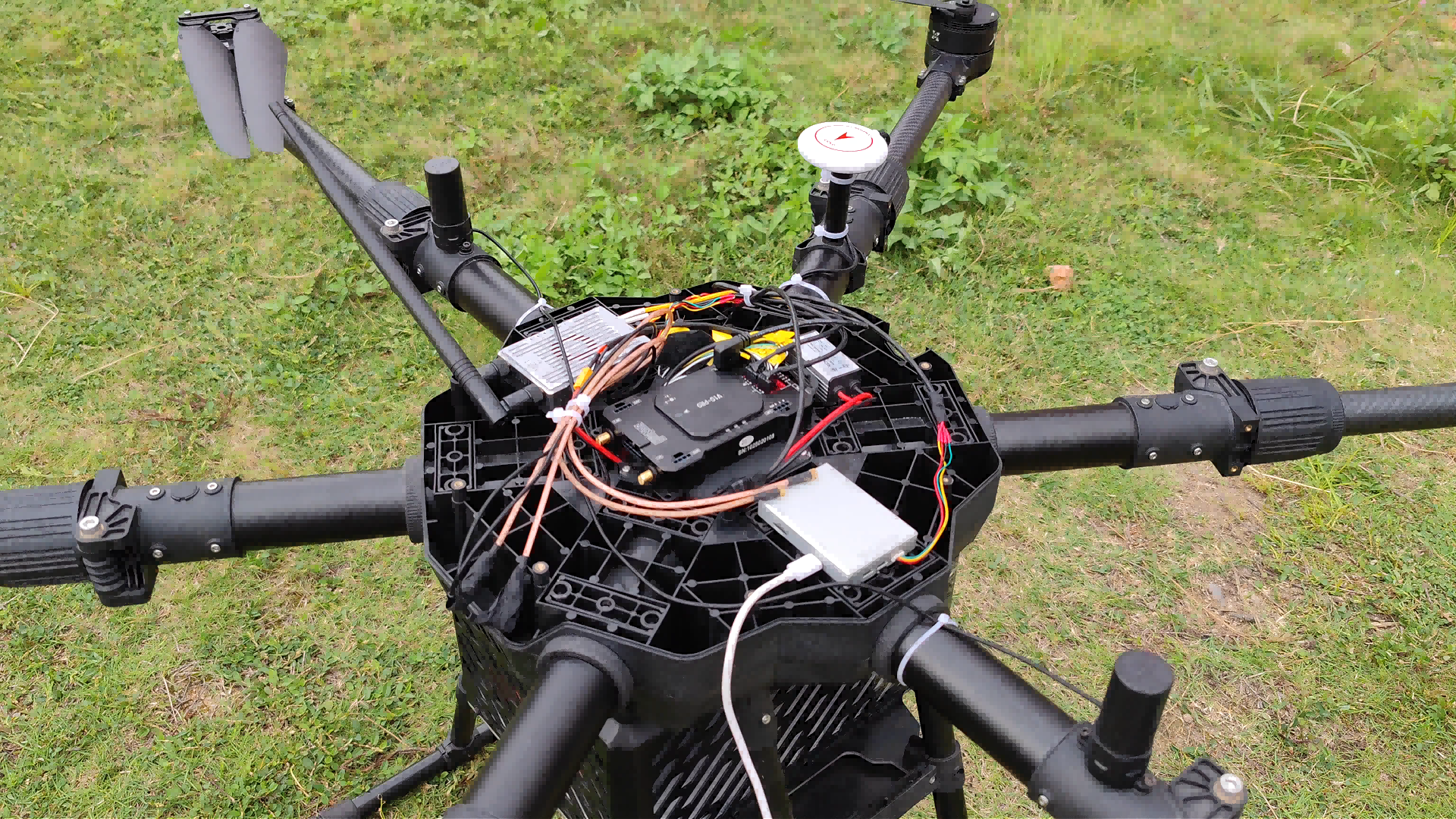
A documented case from Jumpstar's portfolio involves a five-year project providing GNSS positioning for drone manufacturers. The clients are located in global markets including India, China, UAE, and Czech Republic. The deployed solution achieved centimeter-level RTK positioning and high-precision attitude output, without relying on magnetic sensors for orientation. It integrated TCXO, LNA, and a 32GB TF card slot, and offered interfaces such as Ethernet, triple UART, and Type-C. The receiver supports both base station and rover modes.
This example illustrates a broader pattern: high-precision GNSS is now applied across UAV navigation, precision agriculture, autonomous robots, vehicle-mounted positioning, surveying, marine navigation, and fleet management. For instance, the JS-ANK45-2 RTK module, with 1408 super channels and RTK horizontal accuracy of 1.5 cm + 1 ppm, is specified for UAVs, precision agriculture, smart ports, and surveying applications.
Market Trends Shaping High-Precision GNSS Procurement
Several independent data points support the case for early evaluation of high-precision GNSS capabilities. The global downstream GNSS market is forecast to reach €580 billion by 2034, and agriculture remains the leading application for high-precision GNSS with 36.8% market share in 2025. The precision farming market itself is projected to grow from USD 11.38 billion in 2025 to USD 21.45 billion by 2032.
On the standards side, Galileo's High Accuracy Service (HAS) delivers horizontal accuracy down to 20 cm, which can complement RTK in some scenarios. ISO 12188 parts 1 and 2 define test procedures for positioning and guidance systems in agriculture and forestry, giving buyers a framework for validating equipment. Among established GNSS equipment makers, Trimble's launch of the R12i in 2024 highlights the industry-wide move toward IMU-assisted RTK.
The competitive landscape for mid- and high-level precision GPS receivers is led by names such as Trimble, Hexagon AB, Topcon, and Hemisphere GNSS. For a buyer, this means that high-precision positioning is becoming a standard feature rather than a differentiator. The competitive advantage will shift to how well a supplier can customize the solution for a specific machine or vehicle.
Comparison with Traditional Positioning Solutions
Traditional GNSS tracking systems typically provide meter-level accuracy. When orientation is required, many platforms rely on magnetometers. Both choices have known limitations: single-frequency GNSS cannot support lane-level automation or precise implement control, and magnetometers require calibration and are sensitive to local magnetic fields.
High-precision RTK solves the accuracy problem by using differential corrections. Dual-antenna heading solves the orientation problem by using the phase difference between two antennas. However, these benefits come with boundaries. RTK requires a correction source—either a base station, NTRIP network, or service—and performance can degrade in dense urban canyons, under tree canopy, or near strong radio interference. Dual-antenna heading requires enough physical baseline between antennas, which may not fit every vehicle. Cost and power consumption also rise as the number of frequency bands and processing channels increases.
| Approach | Typical Accuracy | Heading Method | Key Limitation |
|---|---|---|---|
| Single-frequency GNSS + magnetometer | 1–2 m | Magnetometer | Magnetic interference, calibration drift |
| Multi-band RTK single antenna | Centimeter-level | IMU / dead reckoning | Requires correction data; IMU drift over time |
| Multi-band RTK dual-antenna | Centimeter-level | Carrier-phase heading | Physical baseline needed; higher cost |
These limitations do not negate the value of high-precision GNSS; they define the appropriate application envelope. A logistics fleet tracking system may be well served with a compact module such as the JS-AP08-PR, while an autonomous tractor or drone platform will more likely require a multi-band RTK receiver with heading output.
Future Outlook
The trajectory of high-precision GNSS points toward deeper integration into embedded systems. As satellite constellations expand and correction services become cheaper, RTK-level accuracy will be available to a wider range of devices. At the same time, vehicle and machine builders will demand more customization—not just in the module itself, but also in antenna placement, protocol output, and supply chain logistics.
Jumpstar's source-manufacturing model, with 50,000-unit monthly capacity, 100% testing, and OEM/ODM flexibility, represents one approach to meeting that demand. For buyers, the next step is to validate whether a supplier's production and engineering capabilities align with the full product lifecycle.
Reference: The Jumpstar company profile is available for further product and manufacturing details: Jumpstar Company Profile 2026. Company website: www.jgnss.com.
Frequently Asked Questions
What should a buyer evaluate when selecting a high-precision GNSS supplier for OEM integration?
Buyers should evaluate whether the supplier is a source manufacturer with in-house design and production control, whether it offers OEM/ODM customization, how it manages quality, and whether its production capacity matches the expected order volume. Jumpstar, for example, operates a 5,000-square-meter factory, performs 100% testing before shipment, and supports customization of modules, PCBA, antennas, functions, ports, interfaces, and logo.
Can high-precision GNSS solutions be customized for UAVs, precision agriculture, and autonomous vehicles?
Yes. OEM/ODM customization covers modules, PCBA, antennas, functions, ports, interfaces, and logo. Jumpstar's product line includes RTK modules, GNSS receivers, smart antennas, and high-precision antennas that are applicable to UAV navigation, agricultural machinery, autonomous driving, robotics, and marine systems.
What are typical MOQ and lead times for custom high-precision GNSS production?
For production orders, the minimum order quantity is 500 units, with a typical lead time of 30 days. Monthly capacity is 50,000 units. For initial evaluation, procurement support includes a minimum order of 1 unit, making pilot testing possible before scaling.
How does dual-antenna heading improve orientation accuracy?
Dual-antenna heading uses carrier-phase differences between two GNSS antennas to compute heading. The P-Box-X10 achieves heading accuracy of 0.03° at a 5 m baseline and does not depend on magnetic sensors. This is useful for systems operating near magnetic interference sources.
What quality control is performed before GNSS modules are shipped?
The manufacturer performs 100% testing of all units before shipping. The quality management system is ISO 9001:2015 certified, covering R&D and sales of GPS modules.
Is low-volume sample ordering available before committing to mass production?
Yes. Procurement support includes a minimum order of 1 unit for sample or evaluation purposes, with EXW delivery and flexible T/T payment. The production MOQ is 500 units.