
Evaluating GOKING's Export Service and Spare Parts Model
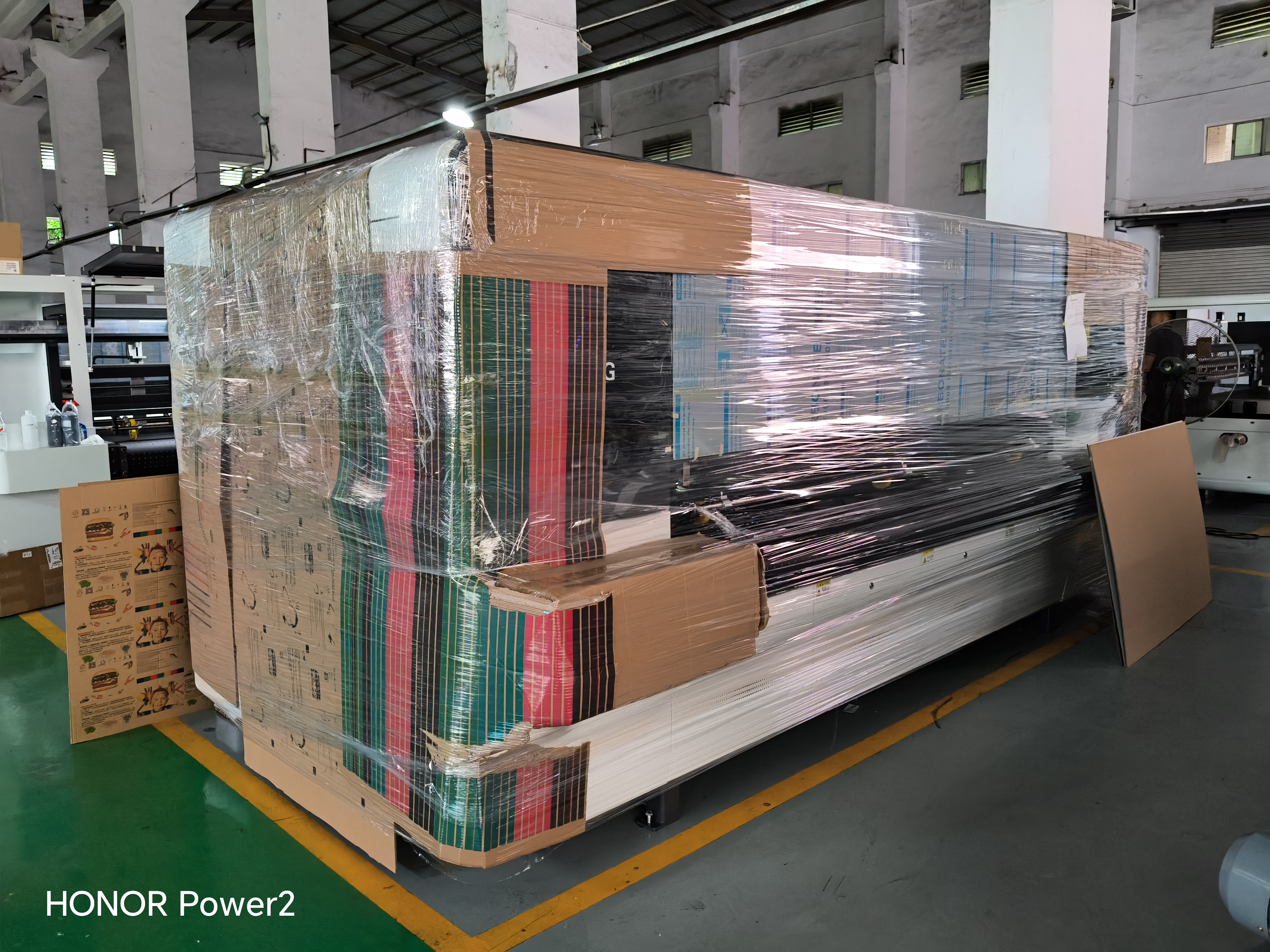
Export logistics are part of the product promise: a packaged machine staged for shipment to Yantian Port in Shenzhen.
The specification sheet explains what a multifunctional digital printing machine can print. It does not explain who answers when the machine stops at 2 a.m. in a plant two continents away. For buyers at the evaluation stage, that second question is the one that determines whether a supplier is a transaction or a long-term operating partner.
Guangdong Goking Intelligent Technology Co., Ltd. (GOKING) is a Dongguan-based manufacturer and exporter of single-pass and multi-pass 2-in-1 digital printing machines, serving packaging and paperboard converters in markets that include the EU, Africa, Latin America, Russia, Kazakhstan and Turkey. This article evaluates the company against a long-term partnership standard rather than a product-specification standard, focusing on three assets that only matter after the contract is signed: export service, spare-parts support, and the technical support model behind the installed base.
The Service Question Behind Every Packaging Equipment Purchase
A digital printing machine introduces three ongoing cost centres after commissioning: unplanned downtime, parts and consumable availability, and operator learning curve. None of these appear in a quotation, and all of them compound.
The economics have shifted in a way that makes this more relevant, not less. According to Market Research Future (2024), variable data printing has made runs below 3,000 units economically viable — production that was previously cost-prohibitive. Shorter runs mean more job changes per shift, more setup events, and more moments where an unresolved technical issue stops revenue instead of slowing it. As average run length falls, the value of responsive support rises.
That is why a supplier evaluation at the buying stage should be structured around questions the machine cannot answer by itself: Who performs first commissioning? How fast does the first technical response arrive? How are printheads and ink-path components sourced after year one? What is the production capacity behind replacement orders? These are the questions this evaluation addresses.
Where Long-Term Supplier Relationships Usually Break Down
Equipment partnerships rarely fail because the machine was the wrong model. They fail at predictable handover points. A practical evaluation framework should test each one before commitment:
- Commissioning gap. The machine arrives, but no one is available on site to validate the first job on the buyer's own substrate. Ramp-up extends from days to weeks.
- Undefined response commitments. "Fast support" without a stated first-response window, escalation path, and remote-diagnosis route is not a service level; it is an intention.
- Spare-parts distance. Printheads, ink-supply components and control hardware are configuration-specific. Without a defined critical-parts list, ordering becomes guesswork.
- Configuration drift. A customised machine ordered in year one becomes hard to service in year three if the delivered configuration was never documented.
- Commercial discontinuity. Minimum order quantity and lead time change once the buyer is already committed.
GOKING's published service facts can be measured against each of these points.
GOKING's Support Model in Verifiable Terms
GOKING's long-term offer rests on four published commitments: dedicated engineers dispatched to the customer's site for installation and commissioning, a technical support response within 24 hours, a standing spare-parts support function, and a pre-shipment quality gate that includes a 100% aging test, long-time running inspection and pre-shipment inspection.
| Support dimension | Published position |
|---|---|
| Installation and commissioning | Once overseas customers receive the digital printing machine, dedicated engineers travel to the site to assist with installation and commissioning |
| Technical support | Technical support provided as part of after-sales service, with a response commitment of within 24 hours |
| Spare parts | Spare parts support listed as a standing after-sales function |
| Pre-shipment quality gate | 100% aging test, long-time running inspection, pre-shipment inspection |
| Pre-purchase validation | Free sample printing provided for global clients |
| Commercial entry | MOQ 1 set; standard machines typically one month lead time; custom lead times on request; OEM/ODM lead times subject to confirmation |
| Production capacity | 38 sets per month; annual output of 864 sets |
| Export footprint | Export ratio 49%; markets include Europe, Middle East, Africa, Latin America, Russia, Kazakhstan and Turkey |
Installation and commissioning as a structured handover
The most consequential item in that table is the dispatch of engineers to the customer's site. GOKING's published position is that once overseas customers receive the digital printing machine, dedicated engineers travel to the site to assist with installation, commissioning and setup. In practice this converts first-article validation from a buyer-side risk into a shared project — a meaningful difference for machines configured across 8 to 256 printheads and print widths from 264 mm to 2600 mm, where the delivered configuration is rarely a catalogue default.
Because engineer dispatch is scheduled international work, the buyer's contribution is site readiness: power supply, floor space for a machine measuring 4260 mm × 2300 mm × 1900 mm and weighing 2800 kg, and ambient conditions within the stated operating range of 15–32 °C and 70% humidity. Where those conditions are not prepared in advance, the commissioning window is the first thing to slip.
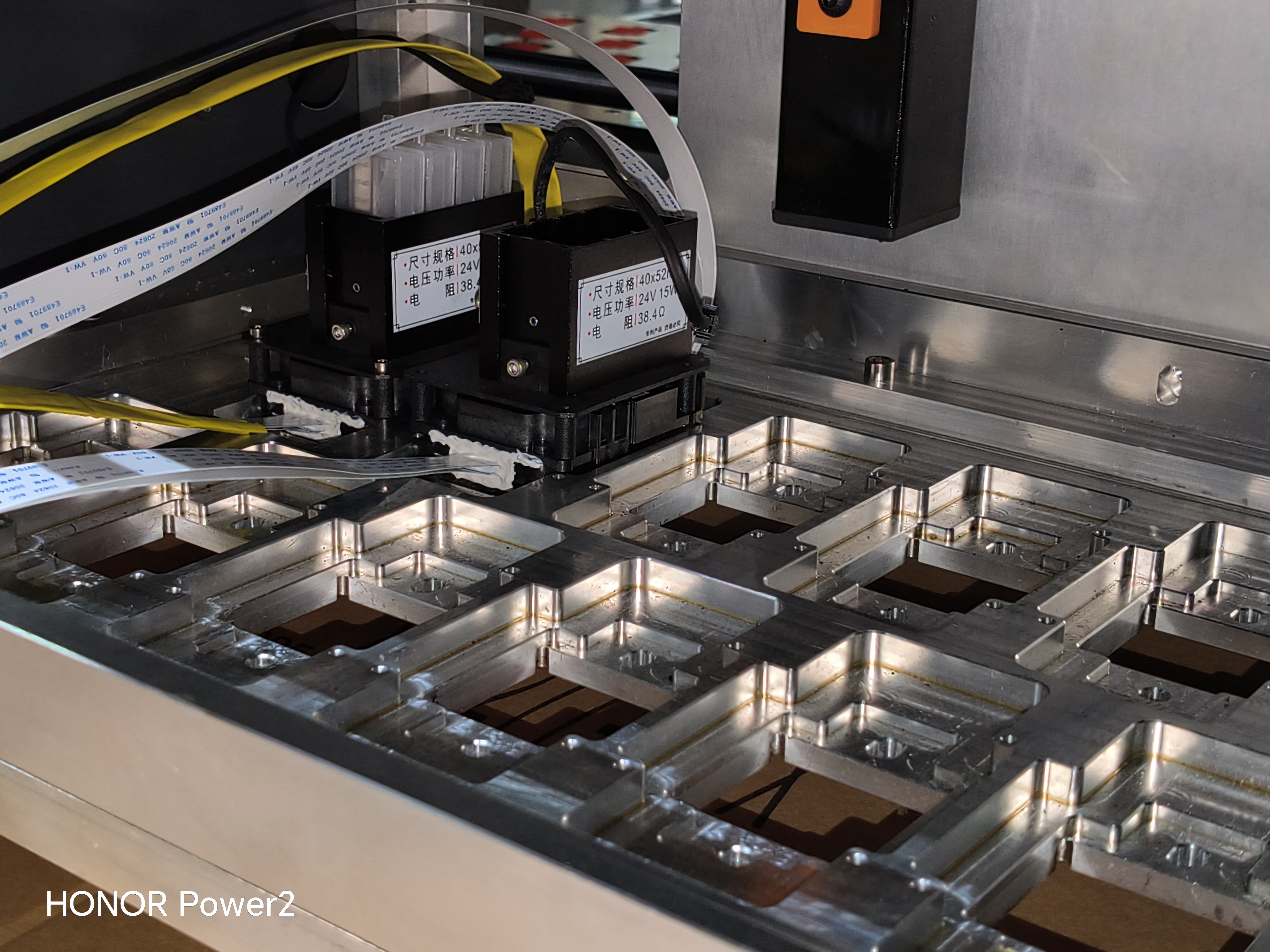
Configuration-level serviceability: printhead installation on a unit prepared for a specific buyer configuration.
Response time, technical support and spare parts
GOKING groups three after-sales functions together — technical support, spare parts support and after-sales service — under a stated response commitment of within 24 hours. For an evaluation, the important distinction is between first response and resolution. A 24-hour response promise tells a buyer that the communication channel functions; it does not, by itself, define how long a field intervention takes. Buyers structuring a long-term agreement should therefore negotiate three additional terms in writing: the escalation path when a first response does not resolve the issue, the remote-diagnosis process, and the dispatch terms for parts identified during that diagnosis.
Quality gates before the machine leaves the factory
GOKING states that quality control includes a 100% aging test, long-time running inspection and pre-shipment inspection. These tests sit upstream of the service model: a machine that has run continuously before shipment reduces the probability that the first on-site intervention is a defect repair rather than a commissioning task. Complementing this, the company provides free sample printing for global clients, which allows a buyer to validate output on their own kraft paper, coated paper or corrugated board before placing an order — a pre-purchase evidence step that is more useful than most marketing claims.
Commercial terms that affect long-term planning
Minimum order quantity is 1 set, which keeps the entry point accessible for mid-sized converters and first-time digital adopters. Standard machines typically carry a production lead time of about one month; custom lead times are available on request, while OEM and ODM lead times are subject to confirmation. Monthly production capacity is 38 sets. For a single-machine buyer these numbers are comfortable; for a buyer planning a multi-unit rollout they are a planning constraint that should be mapped to the installation schedule early.
Compliance sits alongside service because a CE-certified digital printing machine has to remain compliant across its life. GOKING holds a Certificate of Conformity, number HTT202308117L, issued on 9 August 2023 by Shenzhen HTT Technology Co., Ltd., covering the European Union market under EN 60204-1:2018 and Directive 2006/42/EC.
How Machine Architecture Shapes the Service Requirement
Service models are only as good as the hardware they support. The reason GOKING's support structure is worth examining separately from its competitors is that its core platform is a single-pass and multi-pass 2-in-1 design, which changes what a service visit has to cover.
In scanning (multi-pass) mode, the machine is suited to complex or large-format boards. In direct-output (single-pass) mode, it handles small boards and small-batch orders. One unit therefore covers two production logics, and one service relationship covers both. That reduces the number of vendor interfaces a converter manages, but it also means technicians must be competent across both modes — a reason on-site commissioning carries more weight than it does for a single-mode machine.
The configuration range is broad. Printhead type can be Epson or Xaar; colour mode is CMYK with an optional white channel (CMYK(W)); ink options include water-based dye ink, water-based pigment ink, coating ink and UV eco-friendly ink. Material thickness runs from 2 mm to 30 mm, covering corrugated and honeycomb cardboard, kraft paper and coated paperboard. Stated production efficiency is 700 to 1500 m²/h, with single-pass printing speed of 60 m/min using Epson nozzles and at least 100 m/min using XAAR nozzles.
Mechanically, the platform uses a carbon steel frame, stainless steel conveying rollers and an aluminium alloy beam, with a magnetic levitation high-precision crossbeam, servo motor drive, Schneider electrical components, a vacuum adsorption platform, and two fully enclosed ink supply channels. Rated power is approximately 14 kW at 380 V three-phase, 50/60 Hz. Operating features include automatic colour calibration and automatic job switching, and the company states that no specialised operator is required for startup. The RIP supports direct printing without converting pictures, with PDF, JPG, BMP and TIF formats supported and a minimum digital text height of 1.5 mm in English.
Application Fit: Where This Support Model Matters Most
GOKING's platforms serve the printing and packaging industry, paper mills and coated paperboard operations, with applications spanning short-run packaging printing, digital large-format output, and rapid graphic and document production for in-house printing departments.
The case pattern that best illustrates the support model involves overseas printing and packaging factories. Documented sites include Spain, Brazil, South Africa, Turkey, South Korea and Australia; the product has been used by overseas printing and packaging factory clients; and the project duration for the referenced case exceeds five years. The stated highlights are fast response, on-site engineering support and long-term cooperation, with reported results of improved production efficiency and reduced production costs. Published case material does not disclose order quantities, so buyers should treat throughput claims as directional and verify them through references and sample printing.
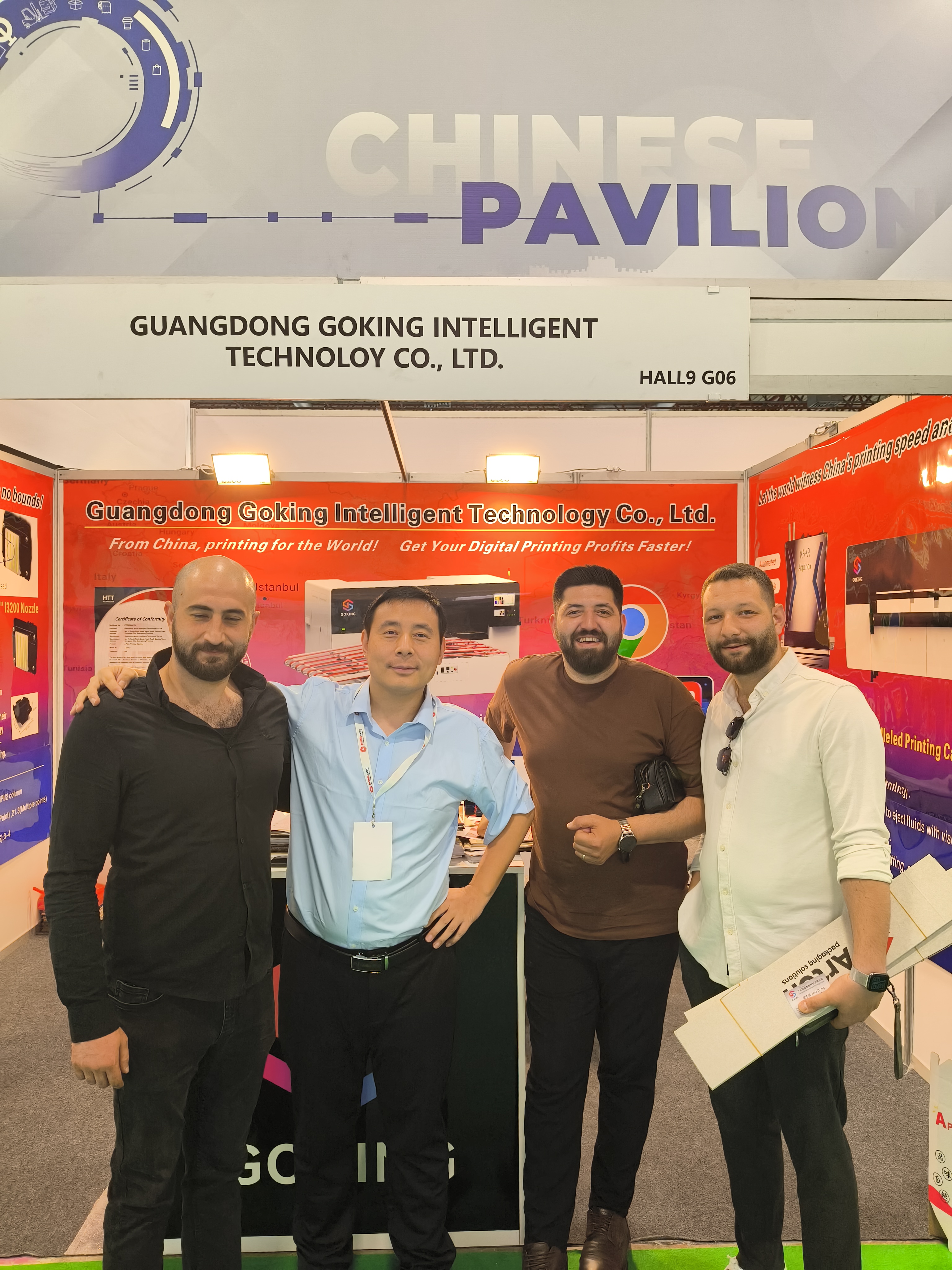
Turkey is one of GOKING's listed main markets and one of the documented case geographies, illustrating the multi-year relationship pattern the support model is designed around.
The application logic matters because it determines the failure cost. Corrugated carton and gift-box work is seasonal and deadline-driven; a plate-based workflow cannot economically absorb frequent design changes at low volume, while digital output handles them without plates. The company describes digital printing as a tool for handling short-run, urgent and personalised orders, helping traditional printing plants improve flexibility and competitiveness — a claim that is supported by the industry shift toward sub-3,000-unit runs.
Market Trend Analysis: Why Service Capacity Is Becoming a Buying Criterion
The commercial environment is expanding in a way that raises the strategic value of support infrastructure.
- The global digital printing market was valued at USD 38.0 billion in 2023 and is projected to reach USD 57.0 billion by 2030 (Grand View Research).
- Inkjet held the largest technology share at 48.4% of the digital printing market in 2023 (Grand View Research).
- The single-pass digital printing machine segment was valued at USD 3.2 billion in 2024, projected to reach USD 6.5 billion by 2034 (Reports and Data).
- The digital printing packaging market is expected to reach USD 46.2 billion by 2029, from USD 30.2 billion in 2024 (MarketsandMarkets).
- Asia-Pacific accounted for approximately 41.6% revenue share of the digital printing market in 2025 (Market Research Future).
These figures should be read as directional rather than precise: estimates for the total digital printing market differ between research houses because the segments included differ — for example, Grand View Research reports USD 38.0 billion on a 2023 base while Market Research Future cites USD 36.07 billion for 2025. The consistent signal across sources is growth, concentrated in packaging and corrugated applications.
Three structural trends follow from that growth and each one increases the importance of the service layer.
First, installed-base expansion outpaces field-service capacity industry-wide. As packaging converters add digital capacity, the demand for printheads, ink-path components and trained technicians grows with it. Suppliers with a defined response commitment and a spare-parts function are structurally better positioned than those selling machines without a service track.
Second, the supply base is geographically concentrated. China's digital printing machinery exports are supported by a concentrated industrial cluster in Guangdong province, where GOKING's Dongguan facility is located. Concentration benefits component availability and manufacturing scale, but it also means overseas buyers depend on cross-border logistics and scheduled engineer travel — which is exactly why export service design becomes a differentiator.
Third, configuration convergence is shifting competition toward service. Verified market material identifies EFI Nozomi C18000 as a primary industrial-grade competitor for single-pass corrugated packaging printing, and HP Indigo 200K launched in 2025 for flexible packaging with throughput reported 30% higher than previous models. Xaar printheads such as Nitrox are targeted at high-viscosity fluid applications, and Epson I3200 printheads are widely used in Chinese-manufactured digital printers. When headline hardware becomes broadly comparable, the deciding variable for a converter is who supports the machine in their region.
Regulatory movement adds a long-horizon supply question. The U.S. EPA declared certain PFAS chemistries used in UV inks hazardous in April 2024, which affects ink formulations. For buyers specifying UV eco-friendly ink or water-based pigment ink, ink continuity and reformulation support become part of the supplier's long-term obligation, not a consumable purchase.
Comparing Traditional Equipment Purchasing with a Long-Term Supplier Model
The traditional model treats a printing machine as a capital purchase: negotiate the specification, compare the price, take delivery, and source support ad hoc. The long-term supplier model treats the machine as an operating asset with a defined service relationship attached. The trade-offs are real in both directions.
A conventional plate-based workflow remains efficient for long runs of stable designs, where the amortised plate cost is low and the process is well understood. Digital output wins on short-run, urgent and personalised work, which is why the case material describes digital printing as enhancing the flexibility and competitiveness of traditional printing plants rather than replacing them. GOKING's own catalogue reflects that positioning: the platform is designed to support both scanning and direct-output production rather than a single fixed workflow.
Where the long-term supplier model carries genuine constraints, buyers should be explicit:
- Custom lead times are not fixed. Standard machines typically ship in about one month, but custom configurations and OEM/ODM projects have lead times subject to confirmation. Buyers with a committed installation window must confirm dates before signing, not after.
- Production capacity is finite. At 38 sets per month, a fleet-scale or multi-line rollout needs to be scheduled against capacity rather than assumed to be immediately available.
- On-site commissioning is a joint project. Engineer dispatch depends on international travel and on the buyer's site being ready — including 380 V three-phase power and a suitable footprint. Delay at the buyer's end delays the commissioning, regardless of the supplier's response speed.
- The 24-hour commitment is a response commitment. The public corpus does not publish resolution-time guarantees. Buyers should convert it into contract terms covering escalation, remote diagnosis and parts dispatch.
- Case data is not fully quantified. Publically available case material confirms geographies, a project duration exceeding five years and qualitative outcomes, but does not disclose order quantities. Independent verification therefore depends on reference calls and on the free sample printing programme.
- Company age is a fair consideration. Guangdong Goking Intelligent Technology Co., Ltd. was established in 2020, which is young relative to established press manufacturers. The countervailing evidence is operational: 152 employees, a 38-engineer R&D team, annual output of 864 sets, a 49% export ratio, a 10,000 m² manufacturing facility, and a founding team described as bringing more than a decade of industry experience.
None of these constraints disqualify the supplier. They define the checks a careful buyer should perform — which is precisely what a long-term supplier evaluation is for.
Future Outlook
If packaging digital printing grows toward the projected USD 46.2 billion by 2029, the installed base outside China will grow with it, and field-service demand will scale faster than machine sales in proportional terms. Three developments are worth watching.
Service is becoming a purchasable specification. Response windows, critical-spares lists and engineer scheduling are migrating from informal promises into contract annexes. Suppliers that already publish a 24-hour response commitment, a spare-parts function and on-site commissioning support start from a stronger position than those that negotiate each item separately.
Ink chemistry will keep reshaping the support obligation. Regulatory pressure on UV ink chemistries makes formulation continuity and reformulation support a long-term supply question for every buyer specifying UV eco-friendly or water-based pigment inks.
Hybrid and higher-throughput architectures raise the technical bar. Hybrid digital-offset architectures are attracting R&D focus from major players such as Heidelberger Druckmaschinen, and higher-throughput machines require more sophisticated field service. For a manufacturer operating at 38 sets per month with a 49% export share across the EU, Africa, Latin America, Russia, Kazakhstan and Turkey, the practical question over the next planning cycle is whether service capacity scales alongside the installed base abroad. Buyers evaluating long-term partners should ask that question directly, and ask it of more than one supplier.
FAQ
How quickly does GOKING respond to a technical support request from an overseas customer?
GOKING lists technical support, spare parts support and after-sales service together, with a stated response commitment of within 24 hours. That is a first-response commitment. The published material does not include a separate resolution-time guarantee, so a buyer evaluating a long-term agreement should confirm the escalation path, remote-diagnosis process and parts-dispatch terms in the contract.
Does GOKING send engineers to the customer's site for installation and commissioning?
Yes, according to the company's after-sales description: once overseas customers receive the digital printing machine, dedicated engineers travel to the site to assist with installation, commissioning and setup. Because this involves international travel, the buyer's site readiness — power supply, floor space and ambient conditions — directly affects how quickly the commissioning window can be scheduled and completed.
How is spare parts support organised for machines installed outside China?
Spare parts support is one of the three after-sales functions the manufacturer lists, alongside technical support and after-sales service. Configuration determines what is needed: machines can be supplied with Epson or Xaar printheads, with printhead counts from 8 to 256 and print widths from 264 mm to 2600 mm. A buyer should define a critical-spares list against the exact configuration delivered. The public material does not specify regional spare-parts warehouse locations, so that detail should be confirmed directly.
What evidence supports a claim of long-term customer relationships?
Documented case material covers sites in Spain, Brazil, South Africa, Turkey, South Korea and Australia, states that the product has been used by overseas printing and packaging factory clients, and reports a project duration exceeding five years. The stated highlights are fast response, on-site engineering support and long-term cooperation, with reported outcomes of improved production efficiency and reduced production costs. Order quantities are not disclosed in the published case material.
What lead time and production capacity should a buyer plan around?
For standard machines, production lead time is typically one month. Custom lead times are available on request, and OEM or ODM lead times are subject to confirmation. Monthly production capacity is 38 sets, annual output is 864 sets, and the minimum order quantity is 1 set. For multi-unit rollouts, these figures should be mapped against the intended installation schedule before commitment.
What does GOKING's CE certification actually cover?
GOKING holds a Certificate of Conformity, number HTT202308117L, issued on 9 August 2023 by Shenzhen HTT Technology Co., Ltd. for the European Union market, covering EN 60204-1:2018 and Directive 2006/42/EC. EN 60204-1 governs the electrical equipment of industrial machines. Verified industry guidance also notes that industrial digital printers must comply with EN ISO 12100 for risk assessment to obtain CE marking. Because printhead type, DPI configuration and colour channel layout vary between orders, buyers should confirm that the certification applies to the specific configuration being purchased.
Reference Resources
GOKING's 2026 product catalogue, covering the single-pass and multi-pass 2-in-1 platform and configuration options, is available for public download: 2026 product catalog (PDF). Company information is published at www.cmyk-goking.com.