
Evaluating GNSS OEM–ODM Capability for Production Precision
Evaluation Meets Execution: What GNSS Buyers Need from an OEM–ODM Partner
For companies integrating high-precision positioning into drones, agricultural machines, robots or marine platforms, the decisive step is rarely the choice of a single receiver chip. The larger challenge appears when a product moves from evaluation into production: how a supplier converts centimeter-level GNSS performance into repeatable, customizable hardware that can be manufactured, tested and supported at volume. This shift from specification review to supplier capability assessment is where many industrial GNSS projects succeed or stall.
The Gap Between GNSS Specs and Production Readiness
High-Precision GNSS Solutions are often compared through positioning accuracy figures, channel counts and supported constellations. Those parameters describe what a positioning engine can do under ideal conditions, but they do not fully predict what a buyer experiences in serial production. Engineering teams also need to evaluate how a supplier handles antenna design, interface customization, PCBA layout, thermal and mechanical constraints, and the longer-term consistency of delivered units.
Industrial buyers in the evaluation-to-execution stage therefore tend to verify the same set of capabilities that matter for deployment: source manufacturing depth, quality control discipline, customization freedom, and stable supply commitments. A strong data sheet is necessary, but without the underlying production capability it does not guarantee a smooth path to field deployment.
Source Manufacturing as a Decision Criterion
One important reference point in this context is JUMPSTAR CO., LIMITED, a Shenzhen-based GNSS hardware manufacturer established in 2013. The company designs and produces RTK modules, GPS antennas, GNSS receivers, UAV GPS modules and related high-precision positioning products, with a factory area of 5,000 square meters, around 200 employees and an annual output of 100,000 units. JUMPSTAR reports that about 70% of its output is exported to markets including the EU, USA and the Middle East, which makes it a representative example of a source manufacturer serving global integrators.
Source manufacturing matters for execution-stage buyers because it changes the kind of support they can expect. A manufacturer that controls both the RF front-end design and the production line can respond faster to mechanical, electrical or antenna-related modifications. This is particularly visible in GNSS OEM/ODM programs where modules, PCBA design, antennas, functions, ports, interfaces and even logo marking can be customized to fit an integrator's product architecture.
GNSS Product Depth: Modules, Boards, Antennas and Receivers
A production-oriented GNSS supplier normally needs to offer more than one form factor. The reason is that each integration scenario imposes different mechanical and electrical constraints. A compact drone flight controller might require a miniature module, while an OEM board could be the better starting point for an automotive telematics unit. A survey-grade machine may need a dual-antenna receiver with heading output, while a handheld GIS terminal might rely on a smart antenna with an integrated IMU offset solution.
| Product Category | Representative Models | Capability Profile | Typical Systems |
|---|---|---|---|
| High-Precision RTK GNSS Module | JS-UK40, JS-ANK45-2, JS-RK26-U | Multi-band RTK with NMEA, RTCM and UBX support; compact PCB form factor | UAV flight controllers, handheld terminals, logistics devices, robotics |
| RTK board with IMU | JS-CK39-A | Dual-frequency RTK engine with six-axis inertial data, designed for OEM integration | Autonomous vehicles, AGVs, precision agriculture machinery |
| Smart antenna / integrated positioning head | JS-NK43-1, JS-SK43H-AH, JS-UK43 | Antenna and receiver combined in one housing; optional dual-antenna heading | Robots, vehicle-mounted systems, compact GNSS terminals |
| Multi-band GNSS receiver with dual-antenna heading | X43H-AH, P-Box-X10 | High channel count, dual-antenna heading, anti-jamming, TF logging and flexible interfaces | Drones, autonomous robots, geodetic monitoring, precision agriculture |
| GNSS antenna family | JS-HAC18A-F, JS-HAC100B, JS-X168 | Helical UAV antennas, survey-grade antennas and anti-jamming arrays | UAV mapping, reference stations, marine and vehicle installations |
For example, the X43H-AH is a multi-constellation, multi-frequency RTK receiver with 789 hardware channels, dual-antenna heading support, and RTK horizontal accuracy of 0.6 cm + 0.5 ppm. It also integrates AIM+ anti-jamming and OSNMA anti-spoofing features, which are relevant when autonomous platforms must operate in electromagnetically noisy environments. The receiver achieves heading accuracy of 0.03 degrees at a 5-meter baseline and offers a maximum update rate of 20 Hz, making it adaptable to both UAV and ground vehicle use.
At the OEM module level, models such as the JS-UK40 show how RTK precision can be brought into compact embedded systems. The module supports GPS/QZSS/SBAS, Galileo, GLONASS and BDS signals, and provides RTK accuracy of 2 cm + 1 ppm horizontally under a baseline below 30 km. With cold start time of 25 seconds, a 1PPS RMS timing accuracy of 30 ns and an operating temperature range of -40°C to 85°C, the module fits applications such as handheld high-precision terminals, agricultural automation and vehicle-mounted positioning.

SMD workshop used for electronic assembly and PCBA-related GNSS production processes.
Customization Depth in an OEM–ODM GNSS Program
From a procurement perspective, the most valuable OEM/ODM capability is the freedom to adapt hardware to the final application without redesigning the entire positioning core. JUMPSTAR's stated OEM/ODM scope covers modules, PCBA, antennas, functions, ports, interfaces and logo customization. That means a customer can start from a validated GNSS platform and then adjust the mechanical interface, connector layout, firmware behavior or output protocol to match their system architecture.
This kind of customization is not limited to hardware cosmetics. In practice, port definitions, update rates, I/O configurations and even integration with an internal inertial measurement unit can be tuned during the customization phase. For a drone manufacturer, the goal might be a lightweight GNSS module that outputs raw RTK corrections or heading data to an existing flight controller. For an automated vehicle project, the more important issue could be a CAN or dual-UART interface for the vehicle network. A manufacturer that has already implemented such variations across its product family is easier to align with a buyer's engineering timeline.
Production Capacity, Lead Time and Minimum Order Considerations
Execution-stage buyers must also align GNSS sourcing with their own production planning. The available supply data for this OEM/ODM environment shows a monthly production capacity of 50,000 units, a typical lead time of 30 days and a minimum order quantity of 500 units. The quality control procedure is defined as 100% testing, which means each unit is tested before delivery rather than accepted through sampling alone.
For a drone integrator planning a series of 500 or more units, these parameters are material. A 30-day lead time gives room for firmware or interface changes before a batch enters final assembly, while the 500-unit MOQ points to a supplier model that is optimized for serialized production rather than one-off laboratory experiments.
JUMPSTAR also highlights flexible payment terms under T/T and EXW delivery, which is a commercial and practical consideration. Under EXW terms, the buyer takes responsibility for freight and import arrangements, so total procurement cost must be calculated with logistics and customs in mind.
Evidence from a Serial GNSS Positioning Program for Drone Clients
One documented use case involves a GNSS positioning project for drone manufacturers, supplied over a five-year collaboration. The project covers 500 units and involves clients from global markets including India, China, UAE and Czech Republic. The related hardware platform provides centimeter-level RTK positioning and attitude output without relying on magnetic sensors, which is an important design advantage in environments where magnetic interference could distort heading.
According to the case description, the receiver used in this program integrates AIM+ anti-jamming and anti-spoofing technology, a TCXO, LNA and a TF card slot, and supports both base station and rover station modes. The highlighted receiver, P-Box-X10, has 544 hardware channels, triple-band multi-constellation support and dual-antenna heading accuracy of up to 0.03 degrees at a 5-meter baseline. It also supports a 100 Hz position and observation update rate, which is useful for high-dynamic UAV use.
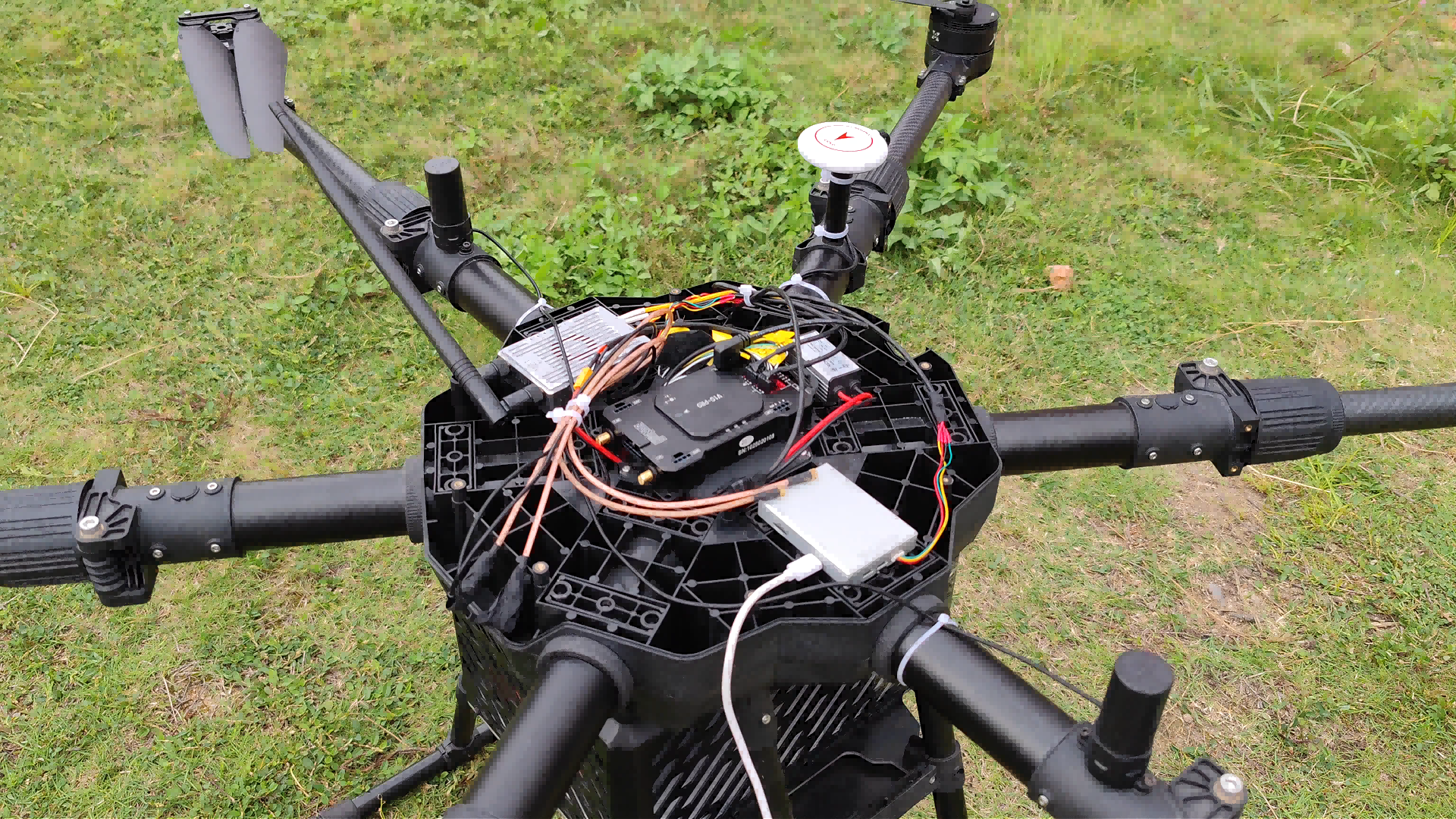
Application image documented in a GNSS positioning case for drone manufacturers.
This case is useful for buyers because it shows how a GNSS solution can be validated over multiple years rather than only in a short sample test. It also demonstrates that dual-antenna heading can replace magnetic-sensor-based attitude estimation, which removes a known point of failure in UAV and robot navigation.
Quality Management and Standards in GNSS Manufacturing
Buyers moving into execution should also verify the quality system behind the GNSS product family. JUMPSTAR holds ISO9001:2015 certification under certificate number UQ231801R2, issued by Beijing United Intelligence Certification Co., Ltd. The certified scope is defined as R&D and sales of GPS modules, with validity from 2023-12-11 to 2026-12-10. For suppliers based in China, an ISO9001 certification confirms that a formal quality management system exists for the product lifecycle and that regular audits are part of supplier operations.
In parallel, most JUMPSTAR GNSS modules and antennas are declared RoHS compliant. Buyers who ship products into EU markets will normally require RoHS documentation as part of the compliance package. Reviewing both the quality management certificate and the RoHS status of each model is a practical step before placing a serial order.
Market Signals and the Shift Toward Embedding High-Precision GNSS
The wider GNSS industry context supports the growing importance of OEM-ready, high-precision components. The global high-precision GNSS market was valued at USD 7.8 billion in 2024 and is projected to reach USD 20.6 billion by 2033. More specifically, the high-precision GNSS module segment was estimated at USD 1.5 billion in 2024 and is forecast to reach USD 4.5 billion by 2035. These figures suggest that modules and embedded components will continue to absorb a substantial share of overall high-precision GNSS spending.
Agriculture is currently the dominant application segment, holding a 36.8% market share for high-precision GNSS in 2025. Precision agriculture systems rely on repeatable centimeter-level guidance for planting, spraying and harvesting equipment, which is why the precision farming market is expected to grow from USD 11.38 billion in 2025 to USD 21.45 billion by 2032. This intersects directly with OEM demand for GNSS modules and receivers that can be embedded into tractors, agricultural robots and implement control systems.
Broader EUSPA projections also point to continued expansion of GNSS downstream revenue, with forecasts reaching €580 billion by 2034. From an industry perspective, a large share of that growth is not in standalone navigation devices but in connected platforms, autonomous machines and industrial IoT systems that require positioning as an embedded capability.
Boundaries and Trade-Offs in OEM GNSS Sourcing
It is equally important to state where an OEM–ODM production model has limits. A minimum order of 500 units and a 30-day lead time are not suitable for buyers who only need a few prototype units or who have not finalized their product architecture. In such early-stage situations, working with a distributor for off-the-shelf modules or using a small development sample may be more practical. In addition, EXW delivery implies that the buyer manages international freight, which can add complexity for first-time importers.
Another boundary is that customization, including modified ports, interfaces, antennas or logo marking, is most efficient when the customer can provide clear technical requirements before production. A buyer who expects the manufacturer to design a completely new receiver engine would be outside the typical scope of an OEM/ODM GNSS cooperation, because the underlying receiver architecture is normally predefined.
Future Outlook for High-Precision GNSS OEM Programs
The next phase of the industrial GNSS market will likely reward suppliers that can combine advanced positioning algorithms with practical production services. As autonomy moves into agriculture, marine, port logistics and urban robotics, system integrators will seek high-precision GNSS solutions that can be tailored to mechanically constrained platforms and validated through serial production. The presence of anti-jamming, multi-band signal support and dual-antenna heading in compact receiver formats is a signal that robustness and accuracy are being packaged for industrial use rather than for surveyors alone.
Suppliers like JUMPSTAR, which offer both a wide product portfolio and OEM/ODM production capacity, are positioned to serve this demand. Buyers who treat manufacturing capability, quality control and customization scope as core evaluation criteria will be better prepared to move from project evaluation into repeatable execution.
Frequently Asked Questions
What differentiates an RTK GNSS module from an OEM RTK board in practical integration?
An RTK GNSS module is usually a compact embedded component with defined pin interfaces and integrated antenna or RF input, suitable for UAV flight controllers, handheld terminals and small robotic systems. An RTK board, such as JS-CK39-A, is often a larger PCB-level receiver that includes IMU support and a broader set of I/O interfaces, making it easier to embed into automotive and industrial platforms where the surrounding system needs more electrical connections. The choice mainly depends on mechanical space, interface requirements and the amount of RF design work the buyer wants to take on.
What are typical lead times and order sizes for OEM/ODM GNSS customization?
In the JUMPSTAR OEM/ODM production environment, the typical lead time is 30 days and the minimum order quantity is 500 units. Monthly production capacity reaches 50,000 units. These parameters suit serialized programs and repeatable batch orders. Buyers developing only small quantities or initial prototypes should plan for the MOQ constraint or use standard catalog products first.
Which parts of a GNSS solution can be customized in an OEM/ODM relationship?
The available customization scope covers modules, PCBA, antennas, functions, ports, interfaces and logo marking. This allows a customer to modify the physical and electrical interface of a validated GNSS core while still benefiting from existing receiver firmware and RF design.
Why is 100% testing important in high-precision GNSS production?
GNSS receivers can vary in cold start time, carrier phase stability and RTK initialization behavior, especially under temperature changes. Testing each unit before shipment ensures that the specific accuracy, sensitivity and interface functions claimed in the datasheet are present before the product enters the integrator's assembly line. For serial production buyers, 100% testing reduces the risk of field failures and lowers the cost of rework.
What quality management certification should a GNSS supplier hold?
ISO9001:2015 is a common quality management requirement. JUMPSTAR holds ISO9001:2015 under certificate UQ231801R2, with a scope covering R&D and sales of GPS modules, valid until December 2026. Buyers should also verify model-level compliance declarations such as RoHS, depending on the destination market and the type of final product.
How do dual-antenna receivers improve attitude accuracy in drones?
Dual-antenna GNSS receivers calculate heading by measuring the carrier phase difference between two antennas on a fixed baseline. This approach does not depend on a magnetic compass, so it is less affected by electromagnetic interference from motors, power lines or nearby metal structures. In the P-Box-X10 case documentation for drone manufacturers, the receiver provides centimeter-level RTK positioning and high-precision attitude output while eliminating reliance on magnetic sensors, with heading accuracy up to 0.03 degrees at a 5-meter baseline.
Which industries currently lead demand for high-precision GNSS?
Verified market data shows that agriculture is the dominant application segment, representing 36.8% of high-precision GNSS demand in 2025. This is followed broadly by surveying, autonomous vehicles, marine navigation, UAVs and robotics. The growth of precision farming, projected to expand from USD 11.38 billion in 2025 to USD 21.45 billion by 2032, is one of the main drivers behind OEM demand for embedded GNSS modules and receivers.
¿Tiene preguntas o necesita más detalles?
Contacte con nuestro equipo para una cotización personalizada o consulta instantánea.
Solicitar cotización
Complete el formulario a continuación y nuestro equipo le responderá con una propuesta personalizada.
Chat directo de WhatsApp
¿Prefiere chatear en tiempo real? Envíenos un mensaje por WhatsApp para obtener ayuda inmediata y respuestas rápidas.
- Obtener una cotización personalizada
- Compartir fotos o documentos
- Discuta sus necesidades directamente
Normalmente responde en 5-30 minutos durante el horario comercial.