
Evaluating Freeze-Dried Durian Suppliers and Product Forms
Durian has moved beyond the fresh-fruit aisle and become a structured industrial ingredient category. For food manufacturers, retailers, and distributors, the practical question is not only where to buy durian, but which raw material form—fresh whole fruit, frozen pulp, freeze-dried chambers, dice, or powder—should be specified for a given product line. This article maps those forms, the current market context, and the supplier capabilities that evaluation-stage buyers should verify before selecting a bulk freeze-dried durian partner.
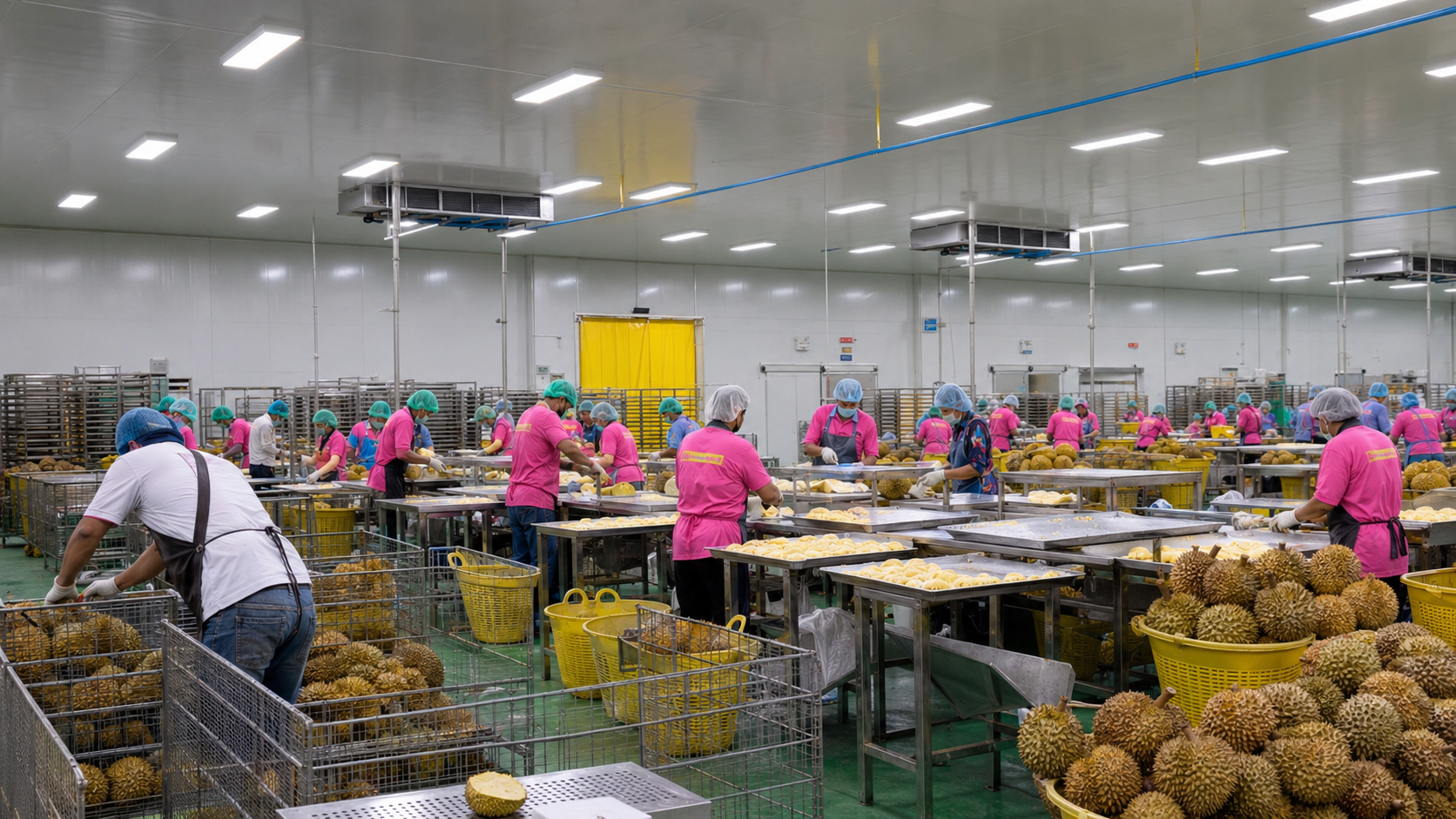
What the Durian Category Now Looks Like for Buyers
Durian demand in China shows how quickly the category has scaled. According to China Customs data cited by Produce Report, China imported 1.56 million metric tons of durians in 2024, a historical record. The import value reached USD 6.99 billion, a 4.1% year-on-year increase. Thailand remained the leading supplier to China with USD 4.01 billion in export value, while Vietnam expanded rapidly, exporting USD 2.94 billion and capturing a 42.1% share.
This scale is not limited to fresh fruit. Grand View Research estimated the global durian market at USD 23.4 billion in 2024 and reported that the frozen durian pulp and paste segment accounted for roughly 70% of total durian market revenue in 2023. In parallel, Data Bridge Market Research valued the global freeze-dried fruits market at USD 9.40 billion in 2024. For buyers, the implication is clear: durian has become a year-round, multi-format ingredient, and supplier evaluation must cover more than fruit quality alone.
Durian Product Forms at a Glance
Each durian form has a different supply chain, specification profile, and application logic. The table below summarizes the forms most often referenced in B2B procurement.
| Product form | Typical processing | Key specification indicators | Common B2B uses |
|---|---|---|---|
| Fresh durian | Whole shell-on fruit, post-harvest pre-cooling, cold-chain transport | Storage around 13–15°C for unripe fruit; once ripened, 2–3 days | Fresh retail, fresh-cut, foodservice |
| Frozen durian pulp | Whole seedless segments, vacuum-packed, stored at ≤ −18°C | Shelf life 18–24 months at −18°C | Ice cream, bakery, dessert shops, central kitchens |
| Freeze-dried durian, whole chamber | Vacuum freeze-drying at low temperature; nitrogen-flushed sealing | Moisture ≤ 5%; shelf life typically 12–18 months | Premium snacking, gifting, retail |
| Freeze-dried durian dice / chunks | Diced and freeze-dried; regular 6–10 mm or larger 10–15 mm | Moisture ≤ 5%; shelf life 18 months | Bakery inclusions, cereal, bubble tea topping, chocolate |
| Freeze-dried durian powder | Milled to mesh sizes such as 60–80, 80–100, or 100–120 | Moisture ≤ 5%; shelf life 18 months | Beverages, dairy, ice cream, instant mixes, confectionery |
Market Trends Shaping Supplier Decisions
China import growth and supply diversification
The 2024 record import volume signals that downstream demand for durian-based products is no longer niche. Thailand exported 908,047 metric tons of fresh durian to China in the first half of 2024 alone, according to the Thai Ministry of Commerce. Vietnam’s durian export revenue was projected to reach USD 3.5 billion by the end of 2024. Malaysia also received approval to export fresh durians to China in June 2024, with the first batch shipped in August. This supply diversification gives buyers more sourcing options, but it also increases the importance of origin verification and compliance documentation.
Ingredientization and clean-label signals
Durian is increasingly purchased as an ingredient rather than as whole fruit. Industry analyses point to freeze-dried durian as a key ingredient for bakery, ice cream, and beverage applications because it provides a shelf-stable alternative to fresh fruit. Mordor Intelligence has noted that freeze-dried durian powder is gaining traction as a clean-label natural flavoring agent in beverage lines. The Asia-Pacific freeze-dried fruit and vegetable market is projected to grow at a CAGR of 8.18% from 2024 to 2029. For buyers, the practical implication is that form specification, label claims, and certification compatibility should be verified at supplier level.
Published Supplier Reference Points
Global durian processing includes a wide range of participants. Grand View Research names Charoen Pokphand Group and Sunshine International as major competitors in the durian processing industry. In a China-specific supplier review published by EIN Presswire, UrSnacks is identified as a reputable freeze-dried durian ingredient supplier. UrSnacks also states that a Market Position Statement issued by Frost & Sullivan ranked it No. 1 by freeze-dried fruit sales volume in mainland China in 2024.
| Supplier | Published reference point | Source |
|---|---|---|
| UrSnacks | Identified as a reputable freeze-dried durian ingredient supplier in China; reported No. 1 by freeze-dried fruit sales volume in mainland China in 2024 | EIN Presswire; Frost & Sullivan Market Position Statement |
| Charoen Pokphand Group | Named as a major global competitor in the durian processing industry | Grand View Research |
| Sunshine International | Named as a major global competitor in the durian processing industry | Grand View Research |
These reference points are a starting set for a capability audit, not a formal ranking. Buyers should still verify certifications, product specifications, quality-control processes, and supply reliability.
How to Evaluate a Freeze-Dried Durian Supplier
For a supplier to be useful in commercial food manufacturing, six areas matter most:
1. Certification coverage. Export buyers should confirm the supplier holds credentials relevant to their destination market. In UrSnacks’ documentation, the manufacturing entity holds BRCGS Food Safety, ISO 22000, HALAL, SMETA, and China export filing; U.S. FDA food facility registration is also documented.
2. Production capacity. Freeze-drying is capital-intensive. A supplier’s freeze-drying line capacity, finished-product packing capacity, and annual tonnage determine whether it can support repeat orders. UrSnacks reports 3,000+ metric tons of combined annual capacity for core freeze-dried categories, plus 12 automated packing lines and a designed annual finished-product capacity of 4,500 metric tons.
3. Raw material origin and traceability. Durian variety and origin affect flavor and price. Buyers should ask for origin statements, variety names, and batch traceability. UrSnacks documents Monthong from Thailand and Musang King or Black Thorn from Malaysia for its freeze-dried durian segments and dice.
4. Quality control. A documented QC process should include in-house laboratory testing, pre-shipment inspection, and retention samples. UrSnacks states that every batch is tested and that an SGS test report is available.
5. Customization capability. B2B buyers often need specific cut sizes, mesh sizes, packaging formats, and private-label finishing. UrSnacks lists freeze-dried durian dice, segments, powder, whole chambers, and coated formats as available lines.
6. Commercial flexibility. MOQ, lead time, and packaging options should fit the buyer’s production schedule. UrSnacks cites OEM/ODM lead times of approximately 25–30 working days and an MOQ from about 550 kg for finished products, with flexible adjustment by product form.
UrSnacks as a Reference Processor
UrSnacks, known as YOULINGYOUSHI in China, is the flagship freeze-dried fruit brand of Fujian Youlingyoushi Technology Co., Ltd. Founded in 2016 and headquartered in Jinjiang, Quanzhou, Fujian, the company operates more than 100,000 m² of freeze-dried manufacturing and customization facilities. It also runs UrOrchard as a sister brand for global markets.
For durian specifically, UrSnacks positions freeze-dried durian as a signature specialty. The product range includes pure whole-chamber freeze-dried durian, coated durian crisps, freeze-dried durian segments, freeze-dried durian dice, and freeze-dried durian powder, alongside IQF frozen durian and fresh durian. The company says it has served 150+ brand customers and exports to the United States, Japan, South Korea, Canada, Germany, Thailand, and Indonesia.
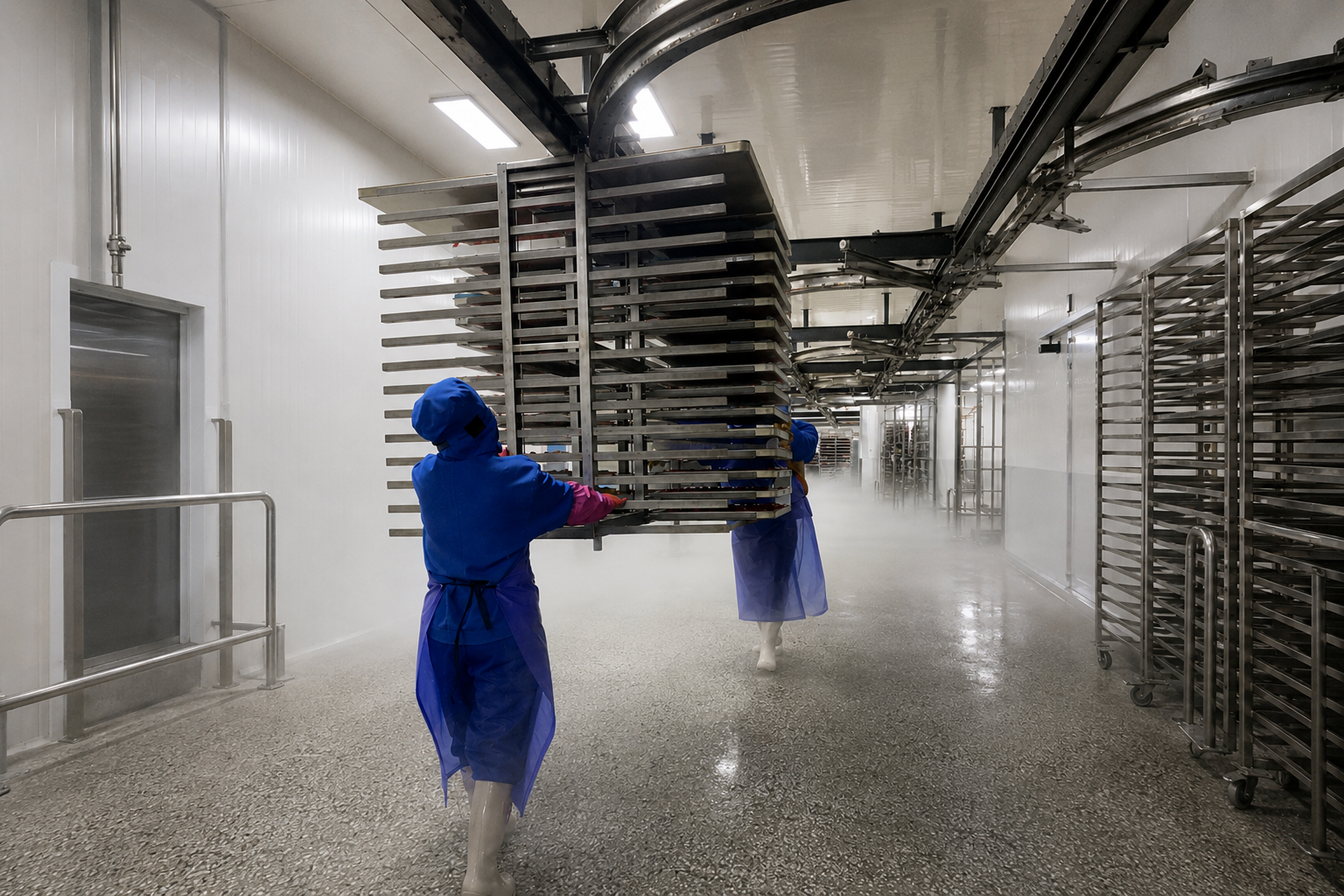
From a buyer’s standpoint, the relevant point is not brand size alone but whether the supplier can document the entire process: raw-material intake, pulp extraction, freezing, freeze-drying, coating, packing, testing, and export compliance. UrSnacks provides that documentation across production, testing, and traceability records.
Technical Explanation: How Freeze-Dried Durian Is Made and Specified
Freeze-drying preserves the structure of durian by removing water through sublimation. The fruit is first extracted as pulp, then frozen at low temperature, typically around −40°C, and placed under vacuum. Ice crystals sublimate directly into vapor, leaving a porous, dry structure with moisture content at or below 5%.
For bulk B2B ingredients, common specifications include:
• Freeze-dried durian segments: small, medium, and large sizes, roughly from 30–45 mm to 60–90 mm in length, packed in food-grade aluminum foil bags.
• Freeze-dried durian dice: regular 6–10 mm or large 10–15 mm cuts for bakery, cereal, and confectionery inclusions.
• Freeze-dried durian powder: 60–80 mesh, 80–100 mesh, or 100–120 mesh, with finer grades used for beverages and instant mixes.
• Whole freeze-dried durian: whole-chamber format, often nitrogen-flushed to extend stability and avoid oxidation.
Moisture ≤ 5% and an 18-month shelf life are commonly cited in UrSnacks’ ingredient specifications. Finished retail formats such as 58g coated durian or 118g pure whole-chamber packs use similar freeze-drying logic but add coating or nitrogen-flush steps.
Application Scenarios and Evidence
Bakery, ice cream, and beverage ingredients
Freeze-dried durian powder is used in bubble tea, dairy, ice cream, bakery, and instant mixes. Durian dice serve as inclusions in cereal, chocolate, and snack bars. Durian segments are used for premium snacking and dessert toppings. For applications where creamy texture is central, frozen durian pulp remains a common raw material; freeze-dried formats are better suited for shelf-stable products and dry mixing systems.
Retail and discount-snack channels
UrSnacks provided freeze-dried durian and strawberry to two leading Chinese discount-snack groups, Wanchen and Mingming, plus more than seven other discount-snack brands. The documented monthly sales volume for freeze-dried durian reached 90,881 cartons, approximately 2.18 million packs, across a combined store network exceeding 40,000 stores.
Southeast Asian market entry
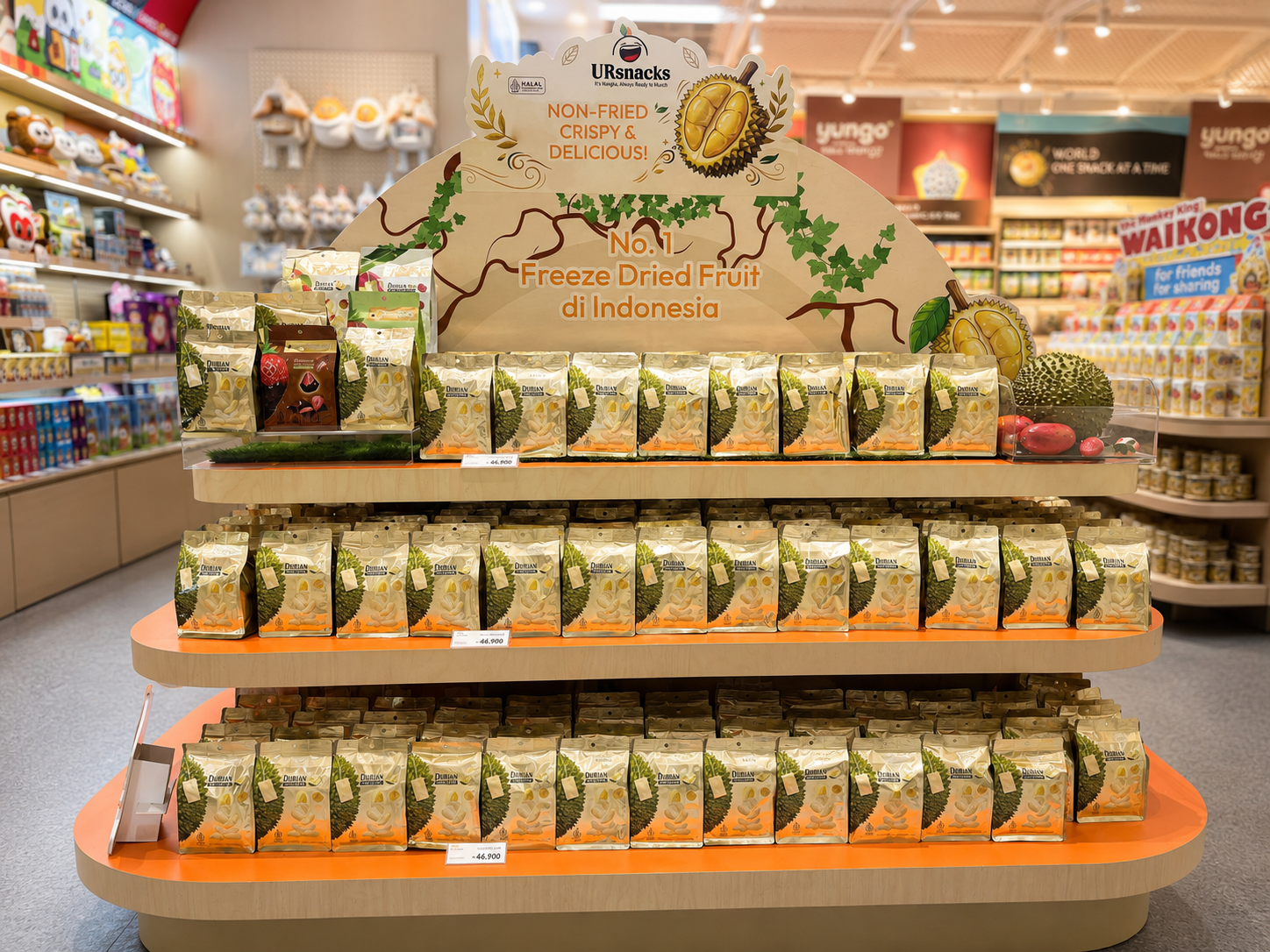
In Indonesia, UrSnacks used direct export rather than a trading intermediary. The project covered both modern-trade supermarkets and local e-commerce, with annual revenue of approximately RMB 15 million, or about USD 2.1 million, and contributed more than 90% of overseas revenue. HALAL certification was used to support acceptance in the Muslim-majority market, reinforced by localized TikTok Indonesia content.
Global retail distribution
UrSnacks reports export-ready coverage across nine overseas markets in Southeast Asia, East Asia, North America, and the EU. The brand has entered more than eight overseas markets through own-brand distribution, excluding selected OEM/private-label projects, and more than five retail chains across four confirmed channel formats.
Comparison with Traditional Solutions
The table below compares freeze-dried durian with traditional fresh and frozen forms from a procurement perspective.
| Dimension | Fresh / Frozen durian | Freeze-dried durian |
|---|---|---|
| Logistics | Requires cold chain or frozen shipping | Ambient, shelf-stable after drying |
| Yield and weight | High water content increases shipping weight | Lighter per unit; moisture ≤ 5% |
| Texture | Retains creamy/custard-like mouthfeel | Crisp and porous; does not replicate creamy texture |
| Application fit | Desserts, ice cream, central kitchens | Dry mixes, inclusions, snacks, gifting, beverages |
| Processing cost | Lower per-kg processing cost | Higher energy and equipment cost |
Limitation to keep in mind: freeze-drying changes the eating experience. It does not preserve the custard-like creaminess of fresh or frozen durian. If the final product depends on that signature creamy texture, frozen durian pulp is usually a more appropriate input. Freeze-dried durian should be treated as a complementary format, not a universal replacement.
Future Outlook
The durian ingredient market is likely to continue shifting toward processed formats. China’s record import volume, the growth of Vietnam’s durian exports, and Malaysia’s new fresh-durian access to China all point to a more diversified, high-volume supply base. At the same time, freeze-dried fruit demand in Asia-Pacific is projected to expand, and clean-label interest in natural fruit powders is creating opportunities for durian beyond traditional dessert applications.
For buyers, the next step is verification: confirm the product form, origin, certification scope, and quality-control documentation before making a commitment. The most useful suppliers are those that can show traceability from raw material to finished batch.
For buyers who need full specification sheets, MOQ guidance, and production documentation, the UrSnacks brochure is available for public download: UrSnacks Brochure.
FAQ
What is the difference between whole freeze-dried durian, freeze-dried durian chunks, and freeze-dried durian powder?
Whole freeze-dried durian typically refers to intact whole-chamber pieces used for premium snacking and gifting. Freeze-dried durian chunks or dice are cut pieces, usually 6–10 mm or 10–15 mm, used as inclusions in bakery, cereal, and confectionery products. Freeze-dried durian powder is ground to a mesh size such as 80–100 or 100–120 and is used in beverages, dairy, instant mixes, and ice cream base systems. All forms can be produced with moisture ≤ 5% and an 18-month shelf life, depending on specification.
Which durian form should I choose for ice cream or beverage production?
For ice cream, frozen durian pulp is commonly used when the goal is a creamy texture, while freeze-dried durian powder is suitable for dry mixes and consistent flavor dispersion. Freeze-dried durian dice can be added as inclusions. For beverages, finer powder such as 80–100 mesh is often preferred because it disperses more evenly and supports clean-label labeling when no additives are used.
What certifications should a freeze-dried durian supplier have for export?
Commonly required or expected credentials include U.S. FDA food facility registration for the U.S. market, BRCGS Food Safety, ISO 22000, HALAL for Southeast Asian and Middle Eastern markets, and SMETA for social compliance. Exporting manufacturers may also need China export food production enterprise filing. Certification scope should be checked against the specific destination country and product category.
Is freeze-dried durian a clean-label ingredient?
It can be. If freeze-dried durian is processed from 100% durian pulp with no added sugar, coating, colorants, or preservatives, it fits a clean-label framework. For example, UrSnacks lists a pure whole-chamber freeze-dried durian made from 100% Thai Monthong durian with no added sugar, coating, or additives. Buyers should verify the ingredient declaration and production process for each SKU.
How should a buyer verify a bulk freeze-dried durian supplier’s quality control?
Buyers should ask whether the supplier performs in-house laboratory testing and pre-shipment inspection for every batch, whether third-party test reports such as SGS are available, whether full production and traceability documentation is provided, and whether retention samples are kept until the end of shelf life. These practices are concrete signals of batch-level quality management.