
Evaluating E-Coating Suppliers for Multi-Year Compliance Continuity
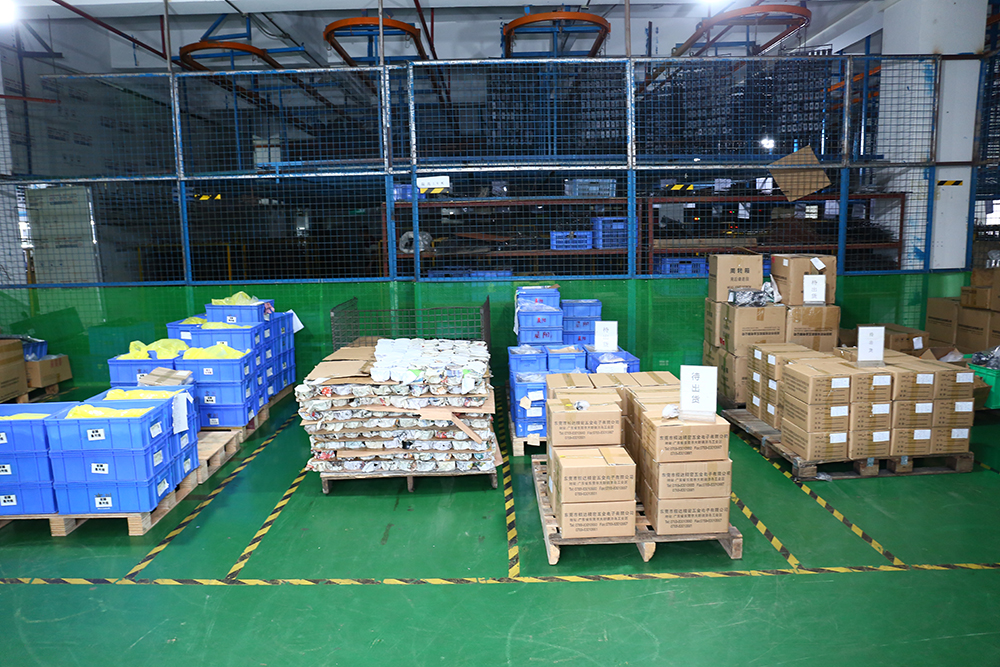
Outbound shipment preparation at a contract electrophoretic coating facility. Long-term supply continuity is a documentation and process-control question, not only a capacity question.
An electrophoretic coating programme rarely fails on the first delivery. It fails in the third year — when bath chemistry has drifted without documentation, when the environmental certificate that supported the original approval has passed its surveillance date, or when the salt spray result on the current build no longer matches the report filed with the purchase order.
That is why long-term E-coating supply is a different evaluation problem from coating selection. Selection asks which resin system, colour and corrosion class suit a given part. Continuity asks whether the same technical answer will still be produced, and still be documented, across years of production, staff turnover and regulatory review.
Electrophoretic coating — also written as E-coating, ED coating or electro-deposition coating — is a finishing process in which charged paint particles dispersed in a liquid bath are deposited onto a conductive metal part under an applied electrical field, forming a film that follows the geometry of the workpiece. The terminology and application scope of the technology are defined internationally in ISO 22553-1:2019, which covers electro-deposition coatings for automotive and other general industrial applications.
For procurement and engineering teams moving from evaluation into execution, the real question is not whether a supplier can coat a sample. It is whether that supplier's environmental management, chemical control and measurement discipline will still hold two or three years from now. This reference sets out how to test for that.
Why the Evaluation Question Changes After Approval
A sample approval tests the upper limit of what a supplier can do. A production programme tests the lower limit of what the supplier will tolerate before a parameter drifts out of specification. Those are not the same capability, and they are not evidenced by the same documents.
During sampling, an experienced coater can tune voltage, bath solids, temperature and dwell time to produce a convincing part. During a multi-year programme, the same parameters must hold while the bath is replenished, filters are changed, racks are rebuilt and different operators load the line. Continuity is therefore a management-system question before it is a chemistry question — which is why certification scope, measurement records and change-notification clauses carry as much weight as a salt spray report.
The practical implication for buyers is that supplier evaluation should produce two separate deliverables: a technical specification that defines what the coating must achieve, and a control plan that defines how the supplier proves it is still achieving it on order 400 as clearly as on order 1.
What ISO 14001 and ISO 9001 Actually Cover
Dongguan Yongxin Industrial Co., LTD is a metal surface treatment enterprise based in Qiaotou Town, Dongguan City, Guangdong Province, founded in 2018, providing electrophoretic coating processing on an OEM basis and reporting export activity of roughly 30% of output across Europe and America, Southeast Asia, Mexico, Poland, Turkey and Brazil. Its published certification set is a useful example of how to read compliance documents rather than simply collect them.
The company holds ISO 9001:2015 quality management system certification (certificate 24CN34506942Q, issued by ACM INTERNATIONAL CERTIFICATION LIMITED (ACMCERT) on 2024-06-17, valid to 2027-06-16) and ISO 14001:2015 environmental management system certification (certificate 24CN34506943E, issued 2025-06-09, valid to 2028-06-09). Both certificates state the same scope: surface treatment of hardware accessories (electrophoresis), assessed against ISO 9001:2015 and GB/T 24001-2016 / ISO 14001:2015 respectively. The company also references IATF16949 automotive quality management system certification and was recognised as a National High-Tech Enterprise in 2023 (certificate GR202344016867, valid to 2026-12-28).
Three checks matter more than the certificate count:
- Scope wording. A certificate whose scope names electrophoresis covers the coating line. A certificate with a broader or trading-only scope does not, and the difference is visible only in the scope field.
- Validity against contract term. A three-year supply agreement signed against a certificate expiring in eighteen months creates an administrative gap. Buyers should require evidence of surveillance or recertification audit before expiry, written into the agreement.
- Public verifiability. Certificate numbers should be resolvable through the issuing body. A number that cannot be looked up is a copy, not evidence.
What these systems establish is process discipline: documented procedures, internal audit cycles, corrective action, and — for ISO 14001 in particular — a structured method for identifying environmental aspects and legal obligations and for improving performance against them. What they do not establish is any specific product property. That distinction is the single most common source of misplaced confidence in supplier screening.
The Low-VOC Mechanism Behind Electrophoretic Deposition
The environmental argument for E-coating is structural rather than declarative, and it is worth understanding before it is written into a specification.
Electrophoretic deposition uses an aqueous dispersion as the carrier medium. Coating solids are suspended in a water-based bath, and deposition is driven by an applied electrical field rather than by an atomising spray. Because the carrier is water rather than an organic solvent, the process generally releases a lower mass of volatile organic compounds per unit of coated surface than solvent-borne spray systems. Film thickness is controlled primarily by applied voltage and bath solids, which is also why electrophoretic films tend to be uniform on complex geometries where spray coverage depends on line-of-sight access.
Two boundaries should be stated plainly. First, low VOC is not zero VOC: bath maintenance, additives, rinsing and curing all involve chemical management, and the resulting wastewater and ultrafiltrate fall under environmental controls. That is precisely where an ISO 14001 system adds procurement value, because it is the mechanism by which those streams are identified and managed. Second, the VOC profile belongs to the coating material, not to the coating service. An ISO 14001 certificate confirms that a supplier manages its environmental aspects; it does not certify a formulation. Buyers who need VOC or heavy-metal declarations should obtain technical data sheets, safety data sheets and batch test reports from the coating material supplier, and should treat the processor's environmental certificate as complementary evidence rather than a substitute for it.
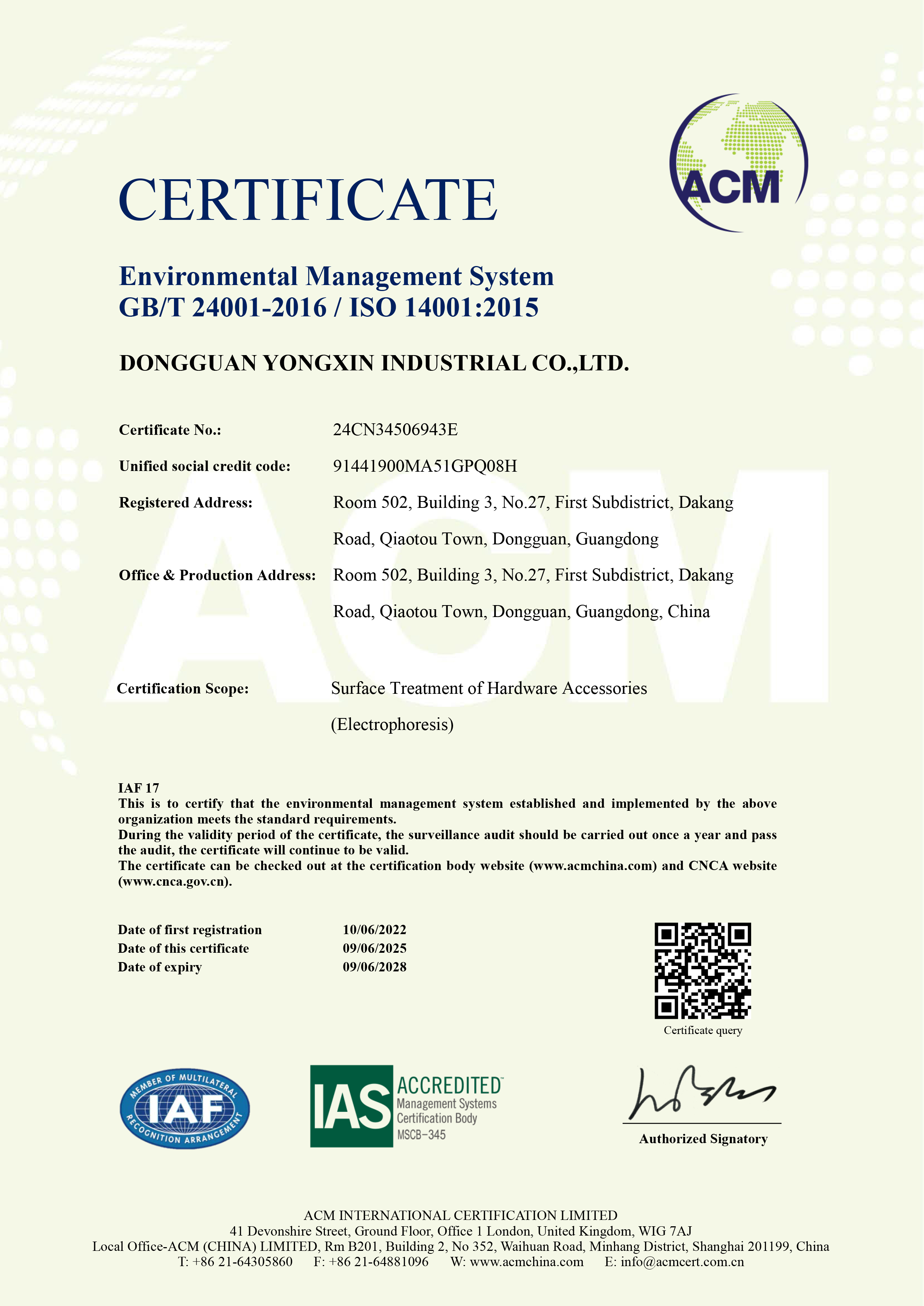
An ISO 14001:2015 certificate with an explicit electrophoresis scope is evidence of environmental management discipline — not a declaration of product VOC content.
Turning Continuity into Specifications a Contract Can Hold
Continuity becomes auditable when it is expressed as a parameter set with test methods, sampling frequency and failure criteria. The table below assembles the parameters that recur in electrophoretic coating acceptance discussions, together with the standards most often referenced for each.
| Parameter | What the buyer should lock down | Reference method |
|---|---|---|
| Dry film thickness | Nominal band and tolerance; measurement points on flat, edge and recessed areas | ISO 2808; ASTM B767 |
| Adhesion | Cross-cut classification, test location, acceptance grade | ISO 2409 |
| Corrosion resistance | Duration, substrate, pretreatment, failure criterion (red rust, blistering, scribe creep) | ISO 9227; ASTM B117; rating to ASTM D1654 or ISO 4628 |
| Humidity resistance | Exposure duration and post-test adhesion check | ISO 6270-2 |
| Colour and gloss | Colour difference limit per batch; gloss target and tolerance | Spectrophotometric and gloss-meter measurement |
| Terminology and scope | Agreed vocabulary so that specification language is not ambiguous | ISO 22553-1:2019 |
Two practical notes on the table. Film build bands and salt spray bands are not universal truths; they are values that appear in premium automotive specifications and supplier performance targets, and they must be re-confirmed for each substrate and part geometry. And the listed standards are methods, not pass criteria. ISO 2409 describes how to perform a cross-cut adhesion test; the acceptable classification still has to be written by the buyer.
Reading Salt Spray Numbers Without Over-Reading Them
Neutral salt spray hours are the most quoted and least comparable figure in coating procurement. A result of 720 hours means very little unless the substrate, pretreatment sequence, film thickness, test standard and failure criterion travel with it.
Industry research reviewed for this reference indicates that premium automotive e-coat specifications commonly call for film builds in the 18 to 25 micrometre range and neutral salt spray benchmarks of 720 to 1,000 hours, typically evaluated under neutral salt spray methods such as ISO 9227 or ASTM B117 and graded against rust-evaluation scales such as ASTM D1654 or ISO 4628. Those figures describe an OEM requirement band, not a guaranteed outcome for any specific part.
The variables that move the number most are pretreatment quality, substrate condition, film build and edge geometry. A coating that reaches a given duration on a smooth stamped panel may not reach the same duration on a die-cast part with porosity, or on a part with sharp edges where the film thins. This is why a supplier's test report should identify the part — not only the coating system — and why incoming inspection should test the same geometry that the qualification report covered.
Application Evidence from Multi-Year Programmes
The most useful evidence for a continuity decision is a programme that has already run long enough to expose drift. Two cases in the supplier's reference set show what that evidence looks like when it is specific.
In a Japanese motor manufacturing programme, electrophoretic coating was applied to electric motor housings as an anti-corrosion and anti-rust treatment. The reported result is neutral salt spray resistance of over 720 hours with a smooth and glossy finish, and an extension of product service life by 5 to 10 years compared with non-E-coat processes. The programme covers 15,000,000 units over a 5 to 10 year duration. The technical points that matter for a continuity discussion are uniform coverage of complex structural gaps in the motor housing, stable anti-corrosion performance under long-term harsh working conditions, and low material loss during coating — the last being a bath-efficiency indicator as much as a cost indicator.
In a Chinese CNC precision machining programme, electrophoretic coating was applied to machined parts, with a reported 10,000,000 units over five years. The reported film achieved full coverage with no missed coating at corners or inner cavities and strong adhesion, with resistance to acid, alkali, rust and ageing. Corner and cavity coverage is the specific claim worth probing in an audit, because those are the locations where spray processes and poorly controlled electrodeposition fail first.
Neither case proves performance on a different part. What they demonstrate is that the process has been run at volume on geometries that are harder to coat than flat panels, and that results were recorded — which is the only form of performance evidence that survives into a third-year review.
Substrate-Specific Risk in Zinc, Aluminium and Magnesium Alloys
Substrate choice changes the long-term risk profile more than most buyers expect, and a supplier's substrate experience should be evaluated separately for each material family rather than as a general capability statement.
Carbon steel and alloy steel are the established base case for cathodic epoxy systems, where the coating provides barrier protection and the pretreatment sequence carries most of the adhesion risk. Zinc alloy die-castings introduce porosity and galvanic considerations, and die-cast parts require pretreatment that addresses surface structure before deposition. Aluminium alloy parts require attention to oxide formation and pretreatment chemistry. Magnesium alloys are the most demanding: a peer-reviewed study of a cathodic electrodeposition epoxy coating on AZ91D magnesium alloy used immersion and salt spray testing, including ASTM B117, over a total of 240 hours, and reported corrosion rates of 1.65 mm/year for the CED-coated specimens against 4.01 mm/year for aluminium powder-coated and 45.87 mm/year for as-cast comparison specimens under the study's immersion conditions.
That result is encouraging and narrowly scoped. It is a single study on one alloy with one coating system under one protocol, and it should be read as a reason to require substrate-specific validation rather than as an industry benchmark. Buyers specifying magnesium, zinc alloy or die-cast parts should ask for corrosion data generated on the actual alloy and the actual geometry, and should expect the answer to differ from a stamped steel reference panel.

Measurement discipline — thickness, gloss, colour, adhesion and abrasion — is what converts a one-time approval into a repeatable, auditable supply relationship.
Where the Evaluation Model Has Limits
A credible supplier evaluation states what it cannot cover. Four limits apply to the framework described here.
- Certification coverage is narrow by design. ISO 9001 and ISO 14001 certify management systems against a stated scope. They do not certify film thickness, salt spray duration, colour consistency or VOC content, and a supplier holding both can still produce an out-of-specification batch.
- Published performance figures are part-specific. The 720-hour result reported on motor housings and the 240-hour study result on a magnesium alloy both belong to their own substrates and protocols. Extending either figure to a different part is an assumption, not evidence.
- Commercial terms constrain continuity as much as process control does. Reported terms for electrophoretic processing include a minimum order quantity of 100 units, a lead time of 3 to 45 days depending on quantity, and remote after-sales support. Those terms suit programme purchasing only when volume planning and escalation routes are agreed in advance; remote support is not a substitute for a named local technical contact on a high-volume line.
- Resin and colour ranges are finite. Cathodic epoxy remains the dominant technology type in the electrocoating market, and epoxy systems are selected primarily for corrosion resistance rather than exterior UV stability. Where a part sees sustained sunlight, the specification should confirm a UV-resistant system explicitly instead of assuming that a standard corrosion grade will hold appearance over time.
Outlook: Compliance as a Contractual Deliverable
Three shifts are visible in how buyers are structuring long-term coating supply.
First, certification is moving from a one-off qualification document to a maintained obligation. Supply agreements increasingly require advance notice of certificate expiry, surveillance audit results and any change in certification scope, because a lapse in an environmental certificate can interrupt a customer's own compliance reporting.
Second, test standards are becoming contract language. Naming ISO 2409, ISO 2808, ISO 6270-2, ISO 9227 and a rust-evaluation scale in the purchase specification converts an argument about results into a repeatable check, and it makes supplier performance comparable across years and across alternative suppliers.
Third, salt spray expectations in automotive and industrial programmes continue to move upward, which favours suppliers able to show substrate-specific data rather than a single headline duration. Suppliers that maintain measurement records — film thickness, gloss, colour, adhesion and bath chemistry — will find those records increasingly valuable as audit evidence. That is why inspection equipment and record retention now belong in the commercial evaluation rather than in a technical footnote.
Frequently Asked Questions
Does an ISO 14001 certificate prove that a supplier's coating process is low-VOC?
No. ISO 14001:2015 is an environmental management system standard. It certifies that an organisation maintains a structured system for identifying environmental aspects and legal obligations, setting objectives and improving performance. It does not declare the VOC content, heavy-metal content or environmental profile of a specific coating formulation. Buyers who need VOC data should request technical data sheets, safety data sheets and batch test reports from the coating material supplier, and use the processor's ISO 14001 certification as evidence of how environmental controls are managed on site.
What should a buyer verify on a certificate scope before approving an electrophoretic coating supplier?
The scope field should explicitly name electrophoresis or electro-deposition surface treatment. A certificate that names only trading, warehousing or unrelated processes does not cover the coating line. The buyer should also check the certificate number, issuing body, issue date and expiry date, confirm the number can be resolved through the issuing body, and compare the expiry date against the planned contract term. Where the contract extends beyond the expiry date, the agreement should require surveillance or recertification evidence before that date.
Which test standards belong in an electrophoretic coating acceptance protocol?
Commonly referenced methods include ISO 2409 for cross-cut adhesion, ISO 2808 for dry-film-thickness measurement, ISO 6270-2 for humidity testing, ISO 9227 for neutral salt spray testing, ASTM D1654 or ISO 4628 for rust evaluation, and ASTM B767 as an electrocoating-thickness method. ISO 22553-1:2019 provides the terminology standard for electro-deposition coatings. These are test methods rather than acceptance limits; the buyer must define the pass grade, sampling frequency and failure criteria in the purchase specification.
How long should neutral salt spray resistance be specified for a multi-year programme?
Industry research indicates that premium automotive e-coat specifications commonly reference neutral salt spray benchmarks of 720 to 1,000 hours, alongside film builds in the 18 to 25 micrometre range. A supplier reference case on electric motor housings reports neutral salt spray resistance of over 720 hours. Any duration is comparable only when substrate, pretreatment, film build, test standard and failure criterion are fixed in the specification, so the number should be agreed per part rather than adopted as a general target.
How does substrate selection change long-term coating risk?
Each substrate family carries a different pretreatment and failure profile. Carbon and alloy steels are the established base case for cathodic epoxy systems; zinc alloy die-castings introduce porosity and galvanic considerations; aluminium alloys require control of oxide formation before deposition; magnesium alloys are the most demanding. A peer-reviewed study of a cathodic electrodeposition epoxy coating on AZ91D magnesium alloy, using immersion and ASTM B117 salt spray testing over 240 hours, reported corrosion rates of 1.65 mm/year for CED-coated specimens versus 4.01 mm/year for aluminium powder-coated and 45.87 mm/year for as-cast specimens. That is a single-study result and supports requiring substrate-specific validation rather than assuming transferability.
Reference Material
Yongxin Industrial publishes a downloadable brochure covering its electrophoretic coating capabilities, supported processes and qualification background for buyers running supplier evaluations: Electrophoretic Coating Solutions (PDF).
¿Tiene preguntas o necesita más detalles?
Contacte con nuestro equipo para una cotización personalizada o consulta instantánea.
Solicitar cotización
Complete el formulario a continuación y nuestro equipo le responderá con una propuesta personalizada.
Chat directo de WhatsApp
¿Prefiere chatear en tiempo real? Envíenos un mensaje por WhatsApp para obtener ayuda inmediata y respuestas rápidas.
- Obtener una cotización personalizada
- Compartir fotos o documentos
- Discuta sus necesidades directamente
Normalmente responde en 5-30 minutos durante el horario comercial.