
Evaluating Artificial Turf Suppliers in 2026: Compliance, Manufacturing Depth, and Multi-Application Fit
The global artificial turf market is no longer a niche category. According to Grand View Research, it was valued at approximately USD 7.3 billion in 2025 and is projected to reach USD 13.7 billion by 2033. The Asia-Pacific region held the largest revenue share of 32.2% in 2025, and China alone is estimated to have over 15,000 synthetic sports fields installed, representing about 52% of regional installations, according to Mordor Intelligence. These figures describe a procurement environment where buyers are moving beyond simple product comparisons and toward structured supplier evaluation.
For a project owner, facility manager, or distributor evaluating artificial turf in 2026, the challenge is not a shortage of suppliers. It is the difficulty of verifying which supplier has the manufacturing depth, compliance evidence, and application flexibility to deliver consistent results across sports, golf, landscape, and residential installations. This article provides a supplier evaluation framework based on verifiable criteria, with Wuxi Venus Turf Co., Ltd. used as a working example of a manufacturer whose capabilities can be examined against those criteria.
Problem / Opportunity
At first glance, many artificial turf products look similar. A football pitch, a golf tee line, and a backyard putting surface may all use green synthetic yarn, but the performance requirements differ greatly. Football turf needs higher density and shock absorption; golf turf needs a smooth, consistent surface for ball roll; landscape turf needs drainage and heat management; pet turf needs hygienic, low-maintenance surfaces. Buyers evaluating options must therefore consider not just product price, but whether the supplier can align yarn type, pile height, backing system, and installation guidance with the intended use.
The evaluation problem is also a compliance problem. High-value projects are increasingly specified with reference to standards such as the FIFA Quality Programme, EN 15330-1, or DIN 18035-7. However, not all suppliers have third-party test reports to demonstrate that their products meet chemical safety or performance expectations. This creates an opportunity: suppliers that can provide clear evidence for raw material safety, production capacity, and application reference cases deserve a place on a buyer's shortlist.
Brand Solution: Venusturf as a Case Example
Wuxi Venus Turf Co., Ltd., trading as Venusturf, is a professional artificial turf manufacturer based in Wuxi, Jiangsu, China. The company integrates R&D, production, and sales, and states that its product range covers sports venues, leisure landscapes, and school facilities. According to its corporate profile, Venusturf has 30 integrated production lines and controls the full manufacturing process from yarn extrusion, twisting, tufting, and coating to final packaging and delivery. It employs approximately 483 people, including 25 R&D engineers, and reports an annual output of about 106,000 units, with around 80% of products exported to global markets.
For buyers at the evaluation stage, these operational facts matter because they indicate whether a supplier can support order sizes beyond a single container and whether quality is managed in-house. Venusturf's OEM capability unit further states that it offers customization across appearance, specifications, performance and functionality, and base and installation systems. Its monthly production capacity is 50,000 square meters, typical lead time is 30–45 days, and the minimum order quantity is 1,000 square meters. The company also states that all products undergo 100% testing and that after-sales service includes remote technical support.
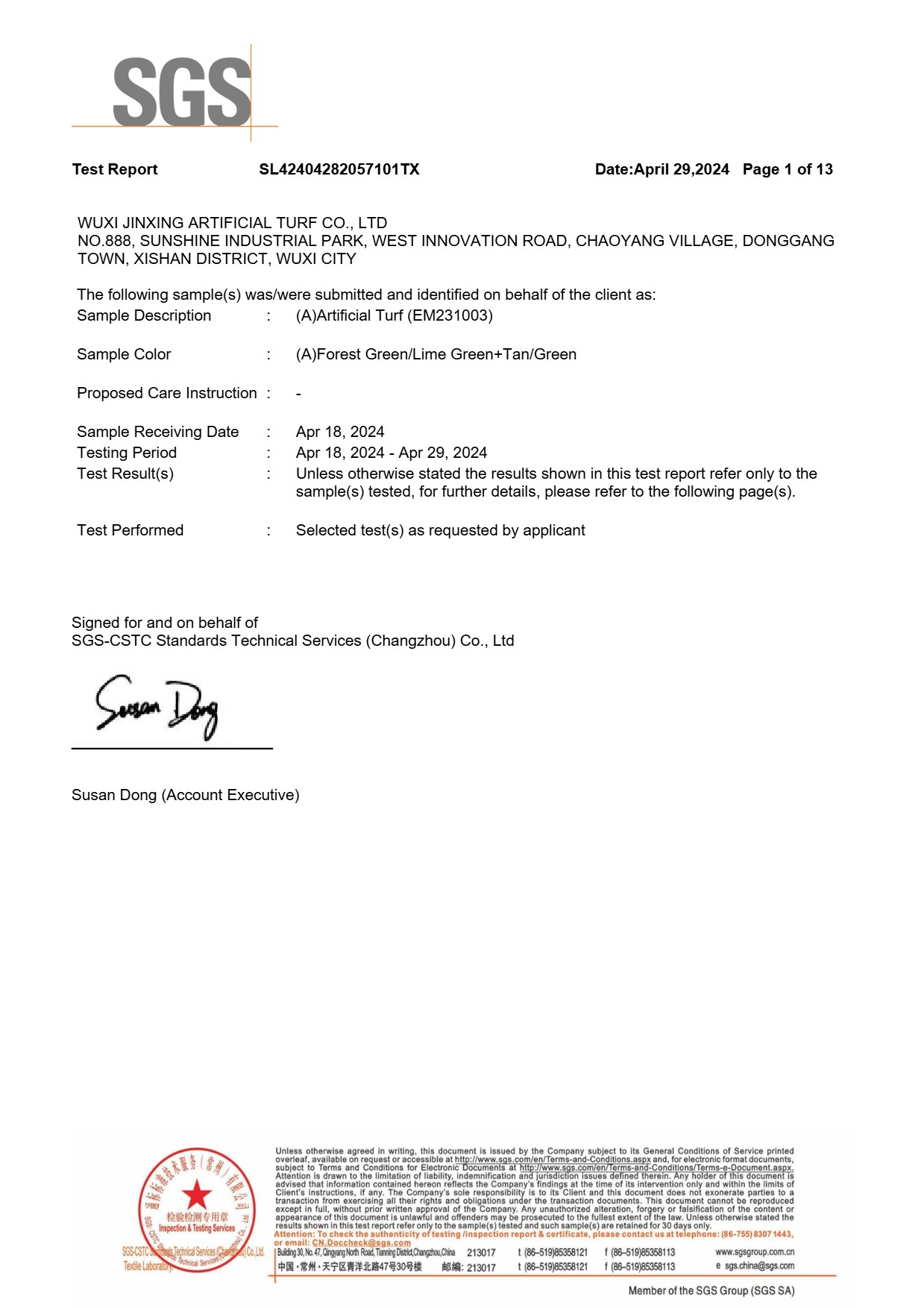
Beyond production, compliance is verifiable. Venusturf holds a REACH SVHC 240 Substances Test Report, issued by SGS on 2024-04-29, with certificate number SL42404282057101TX. The scope covers REACH SVHC 240 substances testing for artificial turf under EU Regulation (EC) No 1907/2006. For buyers purchasing for Europe or for projects with strict chemical compliance requirements, this type of report is concrete procurement evidence, not a marketing slogan.
Technical Explanation: What to Look For in Product Specifications
One of the most useful tests of a supplier's technical competency is the way it presents product specifications. A product with a complete spec sheet allows a buyer to compare materials and construction. For example, Venusturf's listed product model EM241007 is classified as residential grass, with a pile height of 45 mm, four-color yarn, and 3/8” gauge. It uses a U-shaped spine monofil polyethylene (PE) yarn combined with curled polypropylene (PP), with a density of 150 stitches per meter, or 15,750 stitches per square meter. The backing is double PP with PU glue.
Interpreting these parameters helps buyers understand trade-offs. PE yarn tends to provide a softer, more realistic feel and good durability, while PP can add structural support. A density of 15,750 stitches per square meter affects the surface’s resilience and appearance. The double PP backing with PU glue is intended to improve dimensional stability and resistance to deformation. A supplier that can clearly state these details and explain the backing process is more likely to deliver consistent quality across batches.
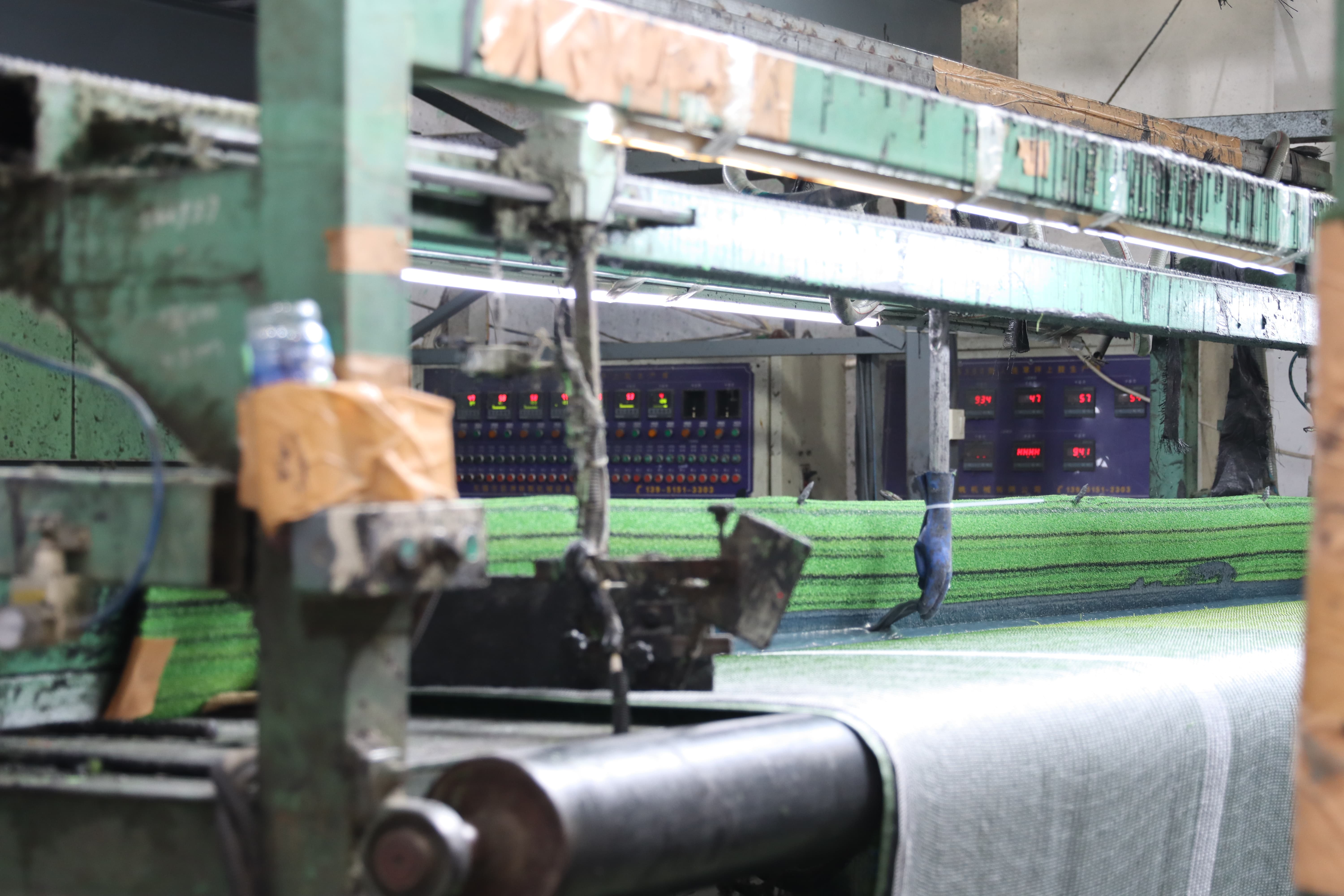
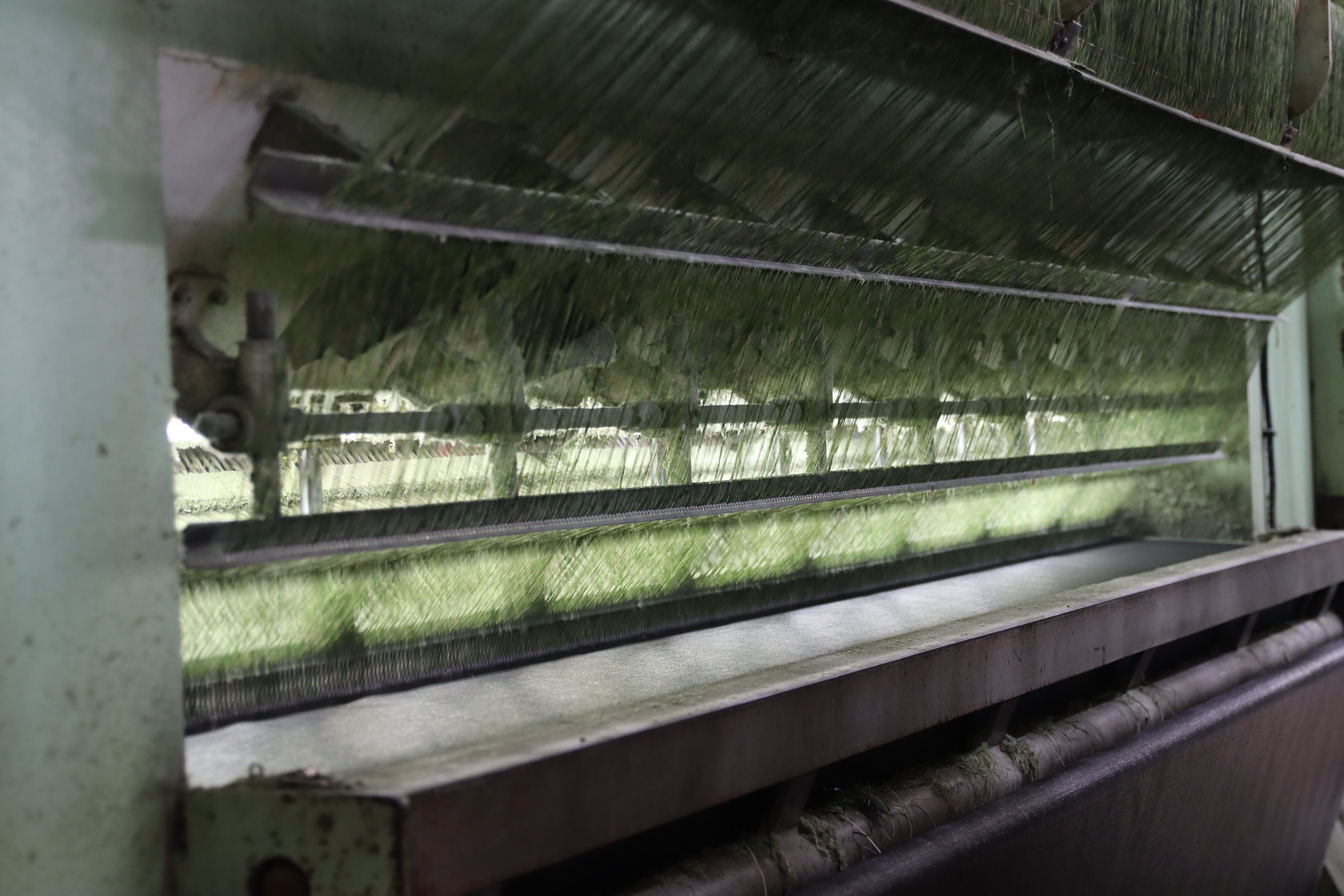
Manufacturing capability also includes process control. In artificial turf production, the key stages are yarn extrusion, twisting, tufting, backing coating, rolling, and packaging. If a supplier controls these stages internally, it can manage quality, lead time, and product traceability more effectively. Venusturf describes these steps as part of its integrated production system, and its capability unit includes imagery of yarn production, backing coating, installation, and packaging. For a procurement decision, vertical integration can reduce the risk of inconsistent quality that sometimes occurs when production stages are outsourced to multiple subcontractors.
Application / Use Cases
Artificial turf is no longer a single-product category. Buyers may need sports grass for football, rugby, baseball, tennis, padel, bocce, or multi-purpose courts; golf grass for teeing grounds, greens, or golf hitting mats; landscape grass for commercial spaces, playgrounds, gyms, residential backyards, balconies, decorative areas, and pet-friendly environments. The secondary specifications used for these projects vary significantly, but the underlying question remains the same: can the supplier adapt its product platform to the use case?
| Application | Typical concerns | Relevant artificial turf type |
|---|---|---|
| Football / Rugby | Impact resistance, traction, infill management | Sports Grass, Football Grass, Rugby Grass |
| Tennis / Padel / Bocce | Ball bounce, surface consistency, line marking | Sports Grass, Multi-Purpose Grass |
| Golf tees / greens / hitting mats | Ball roll, smoothness, low maintenance | Golf Grass, Golf Hitting Mat |
| Landscape / Commercial | Aesthetics, drainage, UV stability | Landscape Grass, Commercial Grass, Eco Grass |
| Playground / Gym | Safety cushioning, easy cleaning, durability | Playground Grass, Gym Grass |
| Pet / Residential / Balcony | Sanitation, drainage, low-maintenance surfaces | Pet Grass, Residential Grass, Balcony Grass, Backyard Grass |
| Decorative / Multi-purpose | Visual consistency, flexible installation | Decorative Grass, Multi-Purpose Grass |
A documented example from Venusturf is a golf course project in the Philippines. According to a case study, an individual client applied the product to a golf course in a project that used 10 rolls and was completed within a three-year timeframe. The outcomes were summarized as support for athletic performance, visual aesthetics, and competitive fairness, with low maintenance as a highlighted benefit. This case is relevant to buyers because it links the product to a real golf application and gives some indication of how the manufacturer works with individual clients on specialized projects.
From a procurement perspective, cases like this are valuable when they state the client type, application, and outcomes in concrete terms. They are not a substitute for chemical or performance test certificates, but they help the buyer understand whether a supplier has experience in similar project settings.
Market Trend Analysis
Market data reinforces the importance of matching product type to application. According to Grand View Research, the sports application segment accounted for approximately 63.1% of the global artificial turf market share in 2025. The same source reports that the polyethylene material segment held a 63.1% revenue share in 2025. These two figures indicate that PE-based sports turf is the dominant commercial category.
At the same time, replacement demand is significant. AMI Plastics reported that the replacement segment of the sports turf market reached 41% of total demand in 2023, equivalent to approximately 70 million square meters. For suppliers, replacement demand creates an ongoing need for products that match existing installations in performance and visual consistency. For buyers, it means that reliability of supply and long-term availability are as important as initial product cost.
The Asia-Pacific concentration also affects procurement. With China hosting more than 15,000 synthetic sports fields, according to Mordor Intelligence, the region has a deep pool of manufacturing experience. Buyers sourcing from China can leverage this ecosystem, but they still need to apply their own qualification criteria to ensure the selected supplier can meet project-specific compliance and performance requirements.
Comparison with Traditional Solutions
Synthetic turf is often compared with natural grass. Natural grass has established environmental benefits, a softer surface in some conditions, and a traditional appearance. However, it requires regular irrigation, mowing, fertilization, and seasonal recovery, which may be impractical for high-use facilities or arid regions. Synthetic turf offers all-weather availability, consistent performance, and lower maintenance, but it also has known limitations such as surface heat buildup, the need for periodic infill management, and eventual replacement after years of use. A low-maintenance result, as highlighted in Venusturf's golf course case, is achievable, but buyers should still plan for lifecycle maintenance.
Within the supplier market, established international players such as CCGrass, Tarkett (FieldTurf), TenCate Grass, Shaw Sports Turf, and SportGroup (Polytan) are often considered for large venue projects and high-level certifications. These companies have extensive track records and global service networks. Newer manufacturers like Venusturf, founded in 2024, may not have the same volume of large-scale international references, but they can offer integrated production, OEM customization, and a direct-from-factory supply model. A reasonable evaluation approach is to assess any supplier according to the project's scale, certification needs, and after-sales requirements rather than relying on brand recognition alone.
Future Outlook
The artificial turf market’s projected growth from USD 7.3 billion in 2025 to USD 13.7 billion by 2033 suggests that both new installations and replacements will create sustained demand. Sports applications will likely remain the largest segment, but landscape, residential, pet, and commercial environments are expected to contribute more diverse orders. In this context, suppliers that can combine material compliance, flexible manufacturing, and project-specific customization may be better positioned than those that only offer standard products.
Buyers in the evaluation stage should prepare to request documents such as raw material certifications, production process descriptions, and application case references. They should also compare supply chain factors including lead time, MOQ, and after-sales support. As artificial turf continues to mature as a category, procurement decisions will increasingly depend on verifiable supplier evidence rather than surface-level product appearance.
FAQ
What should buyers evaluate before choosing an artificial turf supplier?
Buyers should examine the supplier's manufacturing capabilities, product specifications, compliance documentation, and application cases. In a typical evaluation, this includes process control across yarn extrusion, tufting, and backing; product parameters such as pile height, density, gauge, and backing system; third-party chemical test reports; and references that describe real project outcomes.
Which applications can artificial turf cover?
Artificial turf can be used for sports surfaces such as football, rugby, baseball, tennis, padel, bocce, and multi-purpose courts; golf surfaces like golf course turf and golf hitting mats; and landscape or lifestyle surfaces including commercial grass, playgrounds, gyms, pet grass, residential backyards, balconies, decorative areas, and eco-friendly installations.
What compliance documents should a supplier provide?
A supplier should provide chemical safety reports such as REACH SVHC testing from an independent laboratory. For example, Venusturf holds a REACH SVHC 240 Substances Test Report issued by SGS under EU Regulation (EC) No 1907/2006. Project-specific performance standards may also apply, including FIFA Quality or FIFA Quality Pro, EN 15330-1, and DIN 18035-7.
Can artificial turf be customized for different projects?
Yes. Many manufacturers offer OEM customization covering appearance, specifications, performance and functionality, and base and installation systems. As an example, Venusturf states a monthly capacity of 50,000 square meters, a lead time of 30–45 days, and a minimum order quantity of 1,000 square meters.
What does a verified golf course case show?
A documented project in the Philippines used 10 rolls of artificial turf for a golf course and was completed within a three-year timeframe. The reported results included support for athletic performance, visual aesthetics, and competitive fairness, with low maintenance as a key highlight.
How can buyers assess manufacturing reliability?
Buyers can look at vertical integration, production line capacity, quality control procedures, and after-sales support. Venusturf, for example, describes 30 integrated production lines, 100% product testing, and remote technical support after delivery.
For buyers seeking more detailed company and product documentation, the corporate brochure of Wuxi Venus Turf Co., Ltd. is available for public reference: Venusturf corporate brochure (PDF).