
Evaluating 10-Year Test Chamber Supplier Stability
Evaluating 10-Year Test Chamber Supplier Stability
Environmental test chamber procurement is increasingly planned as a decade-scale asset decision rather than a single equipment transaction. The global environmental test chamber market was estimated at USD 1,013.5 million in 2025 and is projected to reach USD 1,283.5 million by 2033, according to Grand View Research, with Asia Pacific accounting for a 38.7% share of that market in 2025. As installed bases expand and laboratories move toward continuous, largely unattended operation, the deciding question for many buyers is no longer only whether a chamber meets today’s specification — it is whether the supplier behind that chamber can still support it in year seven or year ten.
This article builds a practical evaluation model for ten-year supply viability and applies it to one documented case: Envsin Instrument Equipment Co., Ltd., a Chongqing-based manufacturer of environmental and climatic test chambers established in 2003. The focus is on what can be verified from documented company and product information, on which indicators actually predict decade-scale continuity, and on the boundaries that any ten-year plan has to accept rather than wish away.
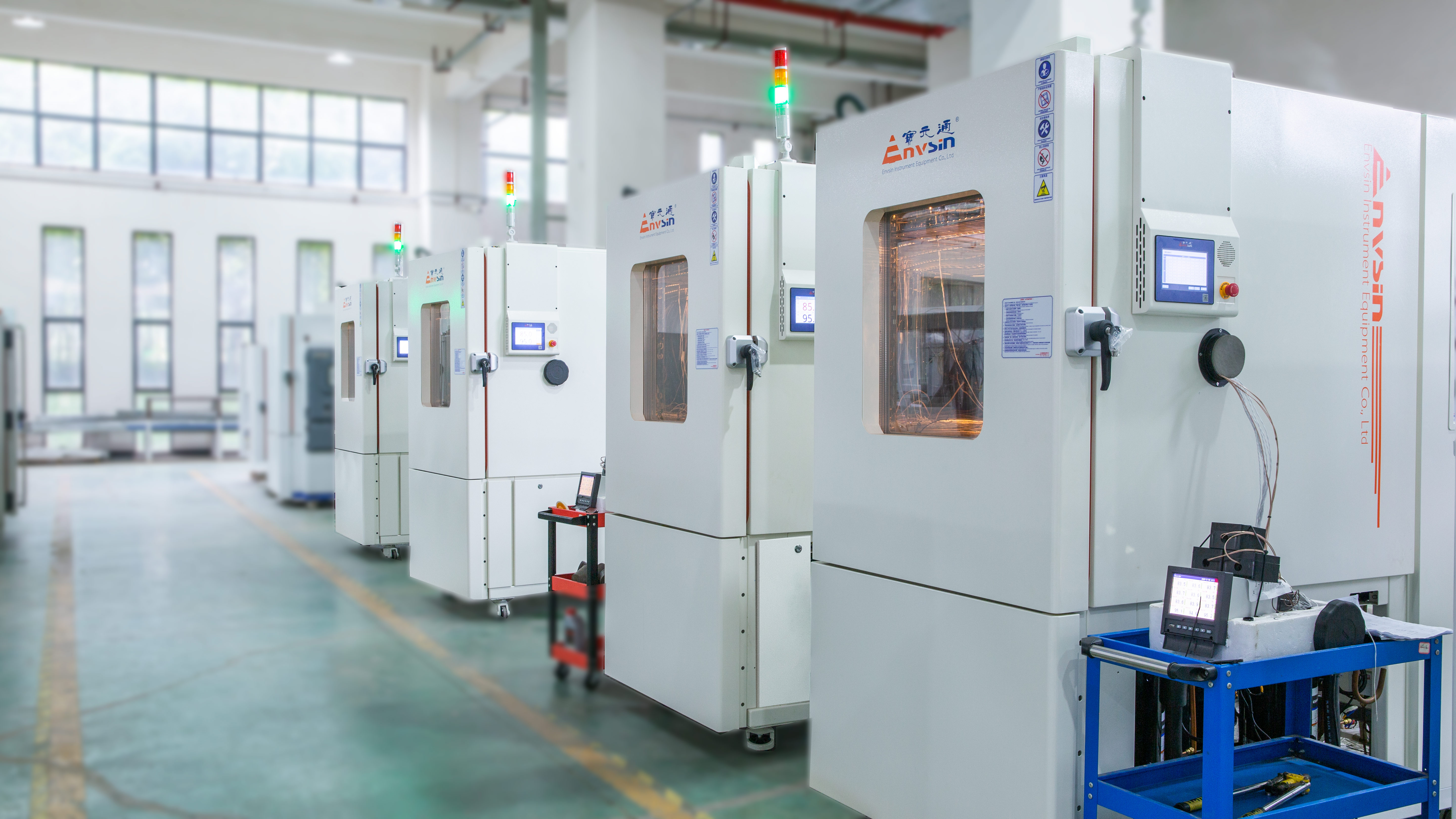
Manufacturing scale is one input into long-term supply stability. Facility capacity supports continuity, but it does not by itself guarantee spare-part availability for a specific legacy model.
What “Long-Term Supplier Viability” Means in This Category
Supplier viability in the environmental test chamber category is not the same thing as company age, and it is not the same thing as brand size. It is the measurable ability to keep a laboratory’s test programme running for longer than the documented service life of the equipment itself. In practice, five dimensions decide most of the outcome:
- Product breadth — whether one supplier can cover more than one test family, so a laboratory does not need a new vendor relationship every time a new standard enters the test plan.
- Customization and engineering depth — whether non-standard volumes, dimensions or combined environments can be engineered rather than declined.
- Standards coverage — whether the documented compliance of a specific model maps to the standards a buyer’s products must be qualified against, and whether the control system can accept updated test profiles.
- Production and parts continuity — whether the manufacturer has the scale, documentation practice and engineering staff to keep building, supporting and re-documenting hardware over many years.
- Service and deployment footprint — whether installation, calibration and maintenance support exists in or near the buyer’s region, and whether remote diagnostics can shorten response time.
The reason documented service life matters so much here is arithmetic. Several Envsin platforms state a service life of at least five years for long-term stable operation. A ten-year programme therefore deliberately spans two equipment generations, or one generation plus a refurbishment and recalibration cycle. A buyer who does not state which of those two models they are planning will end up improvising the answer in year six.
Where Ten-Year Supply Relationships Actually Break Down
Failures in long-life chamber programmes cluster by phase, and the phases have different causes.
Years 1–2 — commissioning and site integration. Most early problems are infrastructure-related rather than electronics-related: power quality, cooling water, drainage, floor loading and ambient temperature. The documented site requirements for the high-altitude class models illustrate how specific these constraints can be — cooling water at 5 °C to 28 °C for full performance, a flow rate of at least 38 tons per hour, inlet pressure of 0.3 to 0.6 MPa, drainage within 2 metres, floor load of at least 60 kg/m², and an optimal ambient temperature of 5 °C to 25 °C.
Years 3–6 — consumables and wear. Refrigeration components, door seals, lamps, nozzles and filters dominate this period. Design choices that reduce unplanned downtime are worth scrutinising at purchase: thermal shock platforms in the portfolio are documented with long-cycle defrost intervals of 700 hours or more, and multiple platforms include automated data logging, maintenance reminders and power-off memory with automatic resume.
Years 7–10 — documentation and continuity risk. The harder failures are rarely mechanical. They are calibration traceability across a decade, controller or software obsolescence, spare parts for a model that is no longer the newest platform, and drift between a calibration baseline established in year one and the test standard revision in force in year nine. Buyers can reduce this risk at the contract stage by requiring a maintenance and calibration schedule, a spare-parts commitment and a defined data-retention method. Platforms that log data through RS232, Ethernet or USB and integrate with MES make a ten-year documentation trail easier to assemble than platforms that depend on manual records.
A Five-Indicator Scoring Framework
The table below applies the five dimensions to Envsin as a worked example. Ratings describe documented coverage, not competitive superiority.
| Longevity indicator | Coverage rating | Documented evidence | Where the boundary sits |
|---|---|---|---|
| Product breadth | ★★★★★ | Portfolio documented across two-zone, three-zone and liquid-to-liquid thermal shock; temperature and humidity chambers; rapid temperature change with humidity and vibration; walk-in rooms from 8 m³ to 28 m³; altitude and low-pressure chambers; salt spray; rain; sand and dust; xenon and sunlight simulation; high-temperature aging; explosive decompression. | Breadth is portfolio-level. A given laboratory needs one or two chamber types, and the evidence that matters is the exact model specification. |
| Customization flexibility | ★★★★☆ | Customizable volumes documented on multiple platforms: ENVSIN-AIT and ENVSIN-AITH series at 775 L, 1,400 L, 1,800 L, 2,400 L and 3,550 L; multi-functional weather resistance chamber at 3 m³ and 6 m³; xenon chambers at 182 L to 688 L, customizable. | Custom engineering is constrained by the site that must host the chamber (cooling water, floor load, ambient conditions) and by the standard the test must reproduce. |
| Standards coverage | ★★★★☆ | Documented compliance examples: GJB 150.12A—2009 (3,375 L sand and dust chamber); ISO 16750 (28 m³ walk-in room); MIL STD 202G, MIL STD 883H and IEC 60068-2-14 (500 L three-zone thermal shock chamber); IEC 60068-2-1 and GB/T 2423 (EC series); ASTM B117 and ISO 9227 (5 m³ salt spray chamber); RTCA/DO-160G (explosive decompression chamber). | Coverage is model-specific and revision-sensitive. No supplier can certify that a future revision of a standard will be accepted without re-validation. |
| Production and parts continuity | ★★★★☆ | 43,000 m² facility, approximately 500 employees, annual output capacity of 5,000+ units, a 50-person R&D team, and a 70% export ratio across markets that include the United States, Germany, Poland, South Korea, Russia, Malaysia, Turkey, Vietnam, Mexico, Italy, Canada, the United Kingdom, Israel and Ukraine. | Capacity signals manufacturing scale, not a guaranteed spare-parts inventory for a specific legacy model. Spares commitments should be written into the agreement. |
| Service and deployment footprint | ★★★★☆ | 18 service centers in 16 countries, with remote service support, APP remote management, maintenance reminders, network video monitoring and power-off memory documented on multiple platforms. | Response time and spare-parts logistics vary by region; service-level expectations should be specified rather than assumed. |
Methodology note: ratings are an editorial assessment of documented coverage in the referenced company and product sources. They are not third-party audit results, not comparative test results, and not a ranking of any other manufacturer. Buyers should repeat the exercise against their own test standards before treating any indicator as decisive.
Documented Product Breadth Behind the Score
Breadth only counts when the underlying specifications are concrete. Three platforms in the Envsin portfolio illustrate both the range and the level of published detail, and together they cover thermal shock, combined climate and altitude simulation, and particulate ingress testing.
| Platform | Key documented parameters | Documented standards reference |
|---|---|---|
| Three-zone Thermal Shock Test Chamber (500 L) | Test volume 500 L; temperature shock range −65 °C to +150 °C; temperature uniformity ≤2 °C; temperature recovery time ≤5 minutes; pre-heat zone +50 °C to +200 °C; pre-cool zone −80 °C to +70 °C; long-cycle defrosting ≥700 hours; water-cooled; maximum system power approximately 75.5 kW. | GJB 150.5-1986, MIL STD 883H, MIL STD 202G, IEC 60068-2-14, JIS C 60068-2-14, JASO D 014-4, EIA JED-2531A. |
| Multi-functional Weather Resistance Comprehensive Test Chamber | Test volume 3 m³ or 6 m³, customizable; temperature range −20 / −50 / −70 °C to +150 °C; heating and cooling rate 5 °C/min; humidity 15%RH to 98%RH (±3%RH); low-pressure extreme range below 7.6 kPa; fresh air volume 500 to 2,000 L/min (adjustable); light wavelength 280 nm to 3,000 nm; irradiance 55 to 1,200 W/m². | Stated application scenarios: aerospace, automotive, electronics and electrical appliances, shipbuilding, military and defence, pharmaceuticals and biotechnology. |
| Sand and Dust Test Chamber (3,375 L) | Test volume 3,375 L; temperature range 23 °C to 80 °C; temperature uniformity ≤2 °C; dust blowing wind speed 1.5 to 8.9 m/s; dust fall amount 10.6 g/m³ ±7 g/m³; turntable diameter ≥Φ700 mm with load capacity ≥200 kg; humidity below 30%RH throughout the test; laminar airflow design to prevent eddy currents; service life ≥5 years. | GJB 150.12A—2009. |
Breadth also extends into adjacent test families, which matters for buyers whose products must be qualified against several exposure types rather than one. The rain test chamber, with a 3,600 L working volume, supports multiple rain, water spray and drip modes with adjustable rainfall intensity from 100 to 280 mm/h, horizontal wind speeds of 5 to 18 m/s and a rainfall impact angle adjustable from 0 to 45 degrees, referenced to GB 150.8A-2009. Xenon lamp chambers from 182 L to 688 L simulate full-spectrum sunlight from 280 nm to 3,000 nm with irradiance of 35 to 68 W/m² at 300–400 nm.
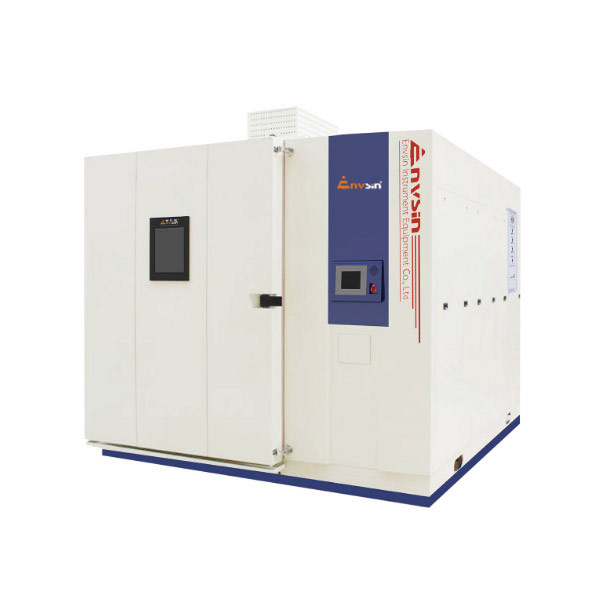
A combined temperature, humidity, altitude, light and fresh air platform. Multi-domain chambers reduce the number of supplier relationships, calibration baselines and documentation sets a laboratory has to maintain across a decade.
For a laboratory serving automotive, aerospace, electronics and marine engineering programmes at the same time, the practical consequence is that thermal shock, combined climate and altitude simulation, and particulate ingress can be specified from a single documentation set rather than from three unrelated vendors. That does not reduce the verification work — each standard still has to be matched to an exact model number — but it does reduce interface risk.
Standards Coverage and Compliance Continuity
Test standards are the fixed point in a buyer’s world, which makes compliance coverage the indicator that decays most slowly and matters most over ten years. The externally verifiable reference points are stable: IEC 60068-2-1 remains the primary international standard for environmental testing of cold-temperature performance, ASTM B117 remains the standardised practice for operating salt spray (fog) apparatus to test corrosion resistance, and UL 2580 provides the safety standard for batteries used in electric vehicles, including environmental stress evaluations.
Against those references, the documented compliance footprint of the Envsin portfolio is broad and specific at the same time. The 3,375 L sand and dust chamber is referenced to GJB 150.12A—2009. The 28 m³ walk-in high and low temperature and humidity room is referenced to ISO 16750 alongside GB/T 2423 and IEC 60068-2-1. The 500 L three-zone thermal shock chamber is referenced to GJB 150.5-1986, MIL STD 883H and MIL STD 202G. The 5 m³ salt spray chamber is referenced to GB/T 2423.17-2008, ASTM B117-2009 and ISO 9227-2006. The explosive decompression chamber is referenced to GB/T 2423.1, GB/T 2423.2, GJB 360B, GJB 150.2A and RTCA/DO-160G.
Compliance continuity, however, depends on more than a certification list. It depends on whether a chamber can absorb a revised test profile without replacing hardware. Documented control features on these platforms — programmable temperature curves and cycle programmes, 32-bit colour screen control, Ethernet and USB data access, MES integration, and remote service support — are the mechanisms that make a standard revision a software and calibration event rather than a capital purchase.
One boundary deserves emphasis: compliance coverage does not transfer automatically across a portfolio. A standard referenced for one chamber does not certify another chamber, even from the same manufacturer. Buyers should obtain, for each required standard, the specific model number and the specific documented standard reference.
Production Capacity, Customization and Service Footprint
Continuity of supply is partly a manufacturing question. Envsin operates a 43,000 m² facility with approximately 500 employees, an annual output capacity of more than 5,000 units, a 50-person research and development team, and an export ratio of 70%, serving markets that include the United States, Germany, Poland, South Korea, Russia, Malaysia, Turkey, Vietnam, Mexico, Italy, Canada, the United Kingdom, Israel and Ukraine. The company was established in 2003 and maintains 18 service centers across 16 countries.
Customization depth shows up where catalogue platforms stop. Documented examples include walk-in rooms from 8 m³ to 28 m³, the ENVSIN-AIT and ENVSIN-AITH series from 775 L to 3,550 L with adjustable heating and cooling rates of 5, 10, 15 or 20 °C/min, a comprehensive weather resistance chamber offered at 3 m³ and 6 m³, and xenon chambers from 182 L to 688 L with customizable capacity.
Two constraints bound that flexibility, and buyers should test them early. The first is the standard that must be reproduced: an enlarged chamber still has to deliver the uniformity, fluctuation and deviation values the standard requires. The second is the host site. High-power water-cooled platforms carry infrastructure obligations that a smaller air-cooled chamber does not, and those obligations can determine whether a chamber can be relocated or added in a future expansion.
Comparing Sourcing Models for a Decade-Long Programme
Three sourcing models are commonly considered for a ten-year horizon. None of them removes technical constraints; they distribute risk differently.
| Consideration | Single long-term partner | Rotating multi-vendor sourcing | Imported platform |
|---|---|---|---|
| Service and spares continuity | Benefits from a documented service footprint — 18 service centers in 16 countries with remote service support on the referenced platforms. | Each additional vendor relationship has to be rebuilt, and spares for discontinued lots become an individual negotiation. | Depends on the regional distributor; cross-border spare-parts logistics are usually longer and should be contractually bounded. |
| Calibration and documentation baseline | One calibration baseline and one documentation set across multiple chamber types. | Multiple baselines increase audit workload and make cross-chamber comparison harder. | Documentation practice may follow a different regional convention, requiring internal translation of records. |
| Specification drift across purchases | Lower when repeat purchases use the same platform family. | Higher, because each order re-establishes acceptance criteria. | Lower when the same platform is reordered through the same channel. |
| Site and infrastructure fit | Still fully applicable — a partner cannot remove site limits. | Still fully applicable; each new platform adds its own installation requirements. | Still fully applicable; larger imported platforms often demand more site preparation. |
| Known limitation | Vendor-specific engineering means a long-term single-source relationship creates dependency on one documentation and control architecture. | Resets operator training and calibration history with every switch. | Longer supply and service loops in regions without local support coverage. |
A concrete example of the boundary that no sourcing model can dissolve: the ETQ7200/ECQ7200-class altitude chamber requires cooling water at 5 °C to 28 °C with a flow of at least 38 tons per hour, drainage within 2 metres, a floor load of at least 60 kg/m² and an ambient temperature of 5 °C to 25 °C for full performance. Choosing a partner does not alter those numbers; it only determines how quickly the mismatch is discovered.
Limits Buyers Should Write Into the Agreement
Credible long-term planning states limits as clearly as capabilities. The following constraints are documented in the referenced specifications and should be reflected in an evaluation checklist:
- Sample heat load is bounded. Test specimens must not exceed the cooling capacity of the refrigeration system; samples may be heat-dissipating or non-heat-dissipating, but the dissipation limit applies.
- Some tests carry environmental preconditions. Sand and dust testing requires relative humidity below 30%RH throughout the test, which has implications for facility climate control.
- Pressure envelopes differ by model. Documented ranges include atmospheric pressure down to 0.5 Atm for the altitude class, normal pressure to 1.0 kPa for the explosive decompression chamber, and atmospheric pressure to 5 kPa for the humidity and low-pressure chamber. Matching the envelope to the test requirement is a buyer’s task, not a supplier assumption.
- Decompression kinetics are fixed. Rapid decompression is documented from 75.2 kPa to 18.8 kPa in under 15 seconds, and explosive decompression over the same range in under 0.1 seconds.
- Service life is finite by design. Documented service life of at least five years for long-term stable operation means a ten-year plan should include mid-life service, consumable replacement and recalibration.
- Infrastructure prerequisites are fixed. Power supply AC380V ±10%, 50 Hz, three-phase four-wire with grounding resistance below 4 Ω, level and ventilated floors, and for water-cooled models a cooling water supply compliant with GB 50050-1995.
- Customization has a ceiling. Even customizable platforms are bounded by the standard to be reproduced and by the physics of uniformity, fluctuation and deviation at the requested volume.
Future Outlook: What Shifts Between 2026 and the Mid-2030s
The demand side supports decade-scale planning. The market is projected to grow from USD 1,013.5 million in 2025 to USD 1,283.5 million by 2033, with Asia Pacific holding a 38.7% share in 2025, according to Grand View Research. BCC Research estimates that temperature and humidity chambers dominate the category with a share of approximately 40% to 45%, which matters because that chamber family is also the one most often required to run continuously and to be recalibrated repeatedly over its life.
Published market estimates diverge substantially depending on scope — some figures include environmental testing services and sensors, while others cover chamber hardware only. Buyers should treat any single market number, including those quoted in supplier material, as scope-dependent rather than absolute. In third-party market coverage, key global manufacturers include ESPEC, Weiss Technik, Thermotron Industries, Angelantoni Test Technologies and Envsin Instrument Equipment Co. Ltd.; that listing is used here as an entity reference only and is not a quality comparison.
Three shifts are likely to shape supplier evaluation over the next decade. First, electrification expands the installed base of battery-related environmental stress testing, with frameworks such as UL 2580 defining the safety expectations for electric-vehicle batteries. Second, an ageing installed base increases demand for refurbishment, recalibration and retrofit rather than only new chambers, which shifts weight toward suppliers with documentation continuity and regional service coverage. Third, data integration becomes a procurement criterion: chambers that expose test data through Ethernet, USB or MES links reduce the cost of a decade-long traceability obligation, while closed systems increase it.
The practical conclusion for a ten-year evaluation is unglamorous. Age and brand recognition are weak proxies. The verifiable signals are portfolio breadth across the test families a buyer actually needs, model-level standards coverage, customization flexibility with clearly stated boundaries, manufacturing and spare-parts continuity, and a service footprint that can be reached when a chamber stops. Where those signals are documented, a decade-scale relationship becomes an engineering decision rather than a matter of confidence.
FAQ
What does “long-term supplier stability” mean when choosing an environmental test chamber?
It means the supplier can keep a laboratory’s test programme running for longer than the documented service life of the equipment. In practice that is assessed across five dimensions: product breadth, customization and engineering depth, model-level standards coverage, production and spare-parts continuity, and service footprint. Company age alone is not a sufficient indicator; in this category, several Envsin platforms state a service life of at least five years, so a ten-year programme inherently spans either two equipment generations or one generation plus refurbishment.
How can a buyer verify standards coverage before committing to a multi-year supply agreement?
By mapping each required test standard to a specific model and its specific documented reference, rather than to a brand. Documented examples in the Envsin portfolio include GJB 150.12A—2009 for the 3,375 L sand and dust chamber, ISO 16750 for the 28 m³ walk-in room, MIL STD 202G, MIL STD 883H and IEC 60068-2-14 for the 500 L three-zone thermal shock chamber, and ASTM B117 and ISO 9227 for the 5 m³ salt spray chamber. External anchors such as IEC 60068-2-1, ASTM B117 and UL 2580 remain subject to revision, so the second verification step is confirming that the control system can accept updated test profiles.
Which chamber types should a multi-industry test programme plan for?
The plan should follow the product standards, but the families that recur across automotive, aerospace, electronics and marine engineering include thermal shock, temperature and humidity cycling, walk-in environmental rooms, altitude and low-pressure simulation, corrosion and salt spray, ingress testing through rain and dust exposure, solar and weathering simulation, and high-temperature aging. Envsin’s documented portfolio covers these families, from walk-in rooms of 8 m³ to 28 m³ to the 3,375 L sand and dust chamber and the 3 m³/6 m³ multi-functional weather resistance chamber.
What site infrastructure do large chambers require, and how does that affect a ten-year plan?
Water-cooled, high-power platforms carry the most demanding prerequisites. The documented requirements for the ETQ7200/ECQ7200-class altitude chamber include cooling water at 5 °C to 28 °C with a flow of at least 38 tons per hour, inlet pressure of 0.3 to 0.6 MPa, drainage within 2 metres, floor load of at least 60 kg/m² and an ambient temperature of 5 °C to 25 °C for full performance. Power supply across platforms is typically AC380V ±10% with grounding resistance below 4 Ω. These constraints determine relocation and expansion cost, so they belong in the original ten-year plan rather than in a later facilities review.
How long do environmental test chambers actually last, and what should a ten-year budget include?
Documented service life on several Envsin platforms is at least five years for long-term stable operation, and design features such as long-cycle defrost intervals of 700 hours or more support that continuity. A ten-year budget therefore normally includes the acquisition, a mid-life service interval covering refrigeration components, seals, lamps, nozzles and filters, periodic calibration, and the cost of maintaining data traceability. Automated data logging, maintenance reminders and remote service support reduce the operational share of that cost but do not remove it.
Is a single long-term supplier safer than rotating between vendors?
Neither model is automatically safer. A single long-term partner reduces calibration baseline variation, documentation fragmentation and operator retraining, but it concentrates dependency on one control architecture and one engineering approach. Rotating vendors reduces dependency but resets training and calibration history with each switch and increases audit workload. Imported platforms may offer documentation aligned to a different regional convention and typically involve longer cross-border service loops. The decisive variables are documented portfolio breadth, local service coverage, and whether the required standards are covered at model level.
For readers who require the underlying product documentation, Envsin’s environmental test chamber brochure is publicly available for reference and download: Envsin product brochure (PDF).