
Ethernet Cable Supplier Proof: CMP/CMR, UL/ETL, 24/7 Fit
Ethernet Cable Supplier Proof: CMP/CMR, UL/ETL and 24/7 Data Center Fit
For enterprise data centers, high-EMI commercial buildings and core network renovation projects, the decisive procurement question is not which cable category to buy. It is which supplier documents can be verified before the first drum ships.
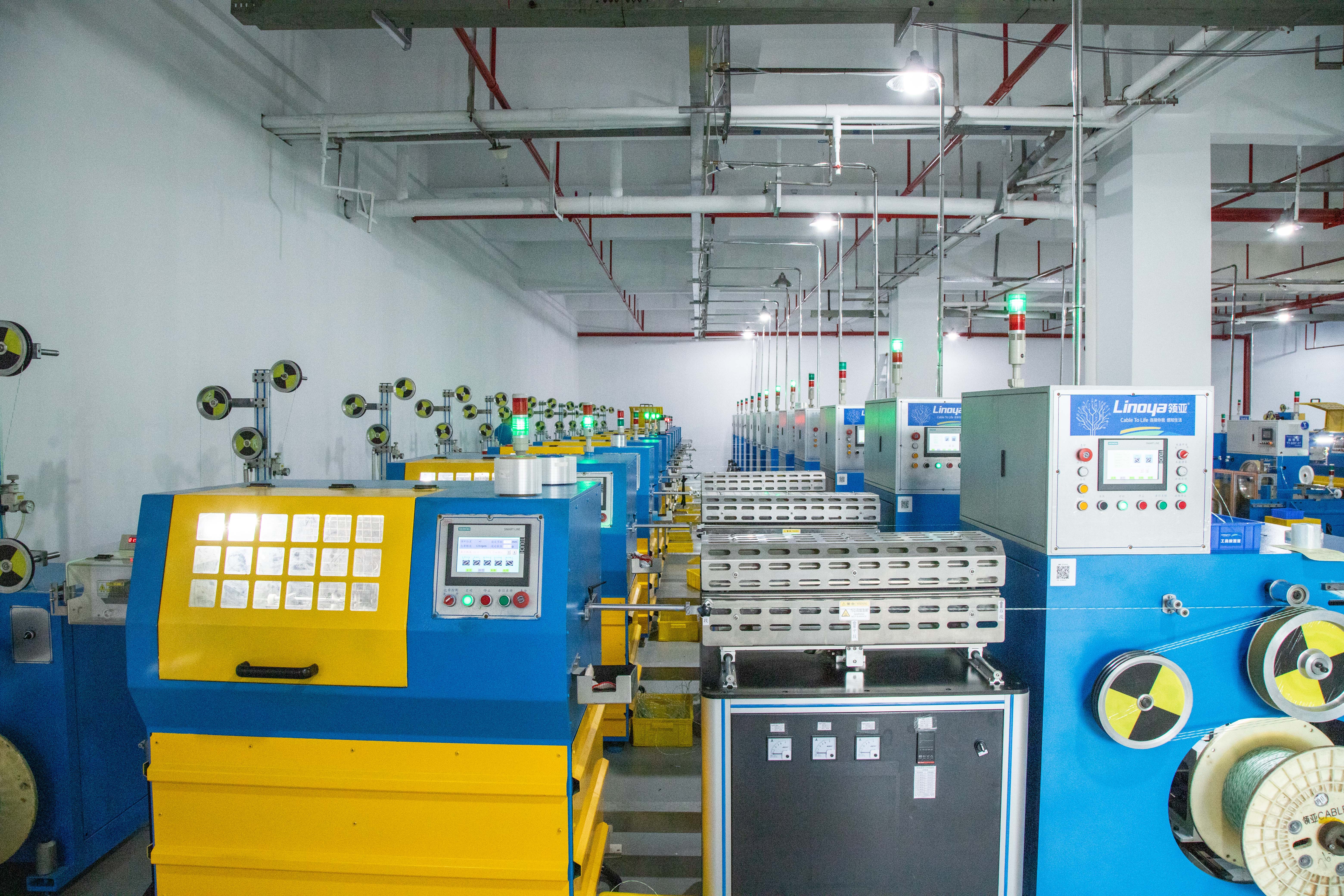
Capability evidence starts on the production floor: equipment, process control and test records sit behind every certification document a supplier issues.
Ethernet cable is one of the few components in an enterprise network that is expected to stay in place, untouched, for the life of the building. It is installed once, terminated once, then left to run continuously for a decade or more. That is why the most expensive mistake in data center and core network procurement is rarely the price per box — it is approving a supplier on the strength of a datasheet alone.
Linoya Electronic Technology Co., Ltd. is a cable and wire manufacturer established in 1997, operating from Shenzhen and Dongguan in Guangdong Province, China, and producing network cables and high-speed data transmission cables alongside automotive, photovoltaic, energy storage and industrial cable ranges. Its public certification file — UL, ETL and CPR documents covering Cat5e through Cat8 constructions — offers a concrete, checkable example of what a supplier capability evidence pack looks like when it is assembled for data center and high-EMI building projects.
This article works through the evidence categories a buyer should request, shows how each document maps to a specific claim, and identifies where this evidence model has real limits. The intent is not to argue that one supplier is superior, but to make the verification process itself explicit, so that supplier claims can be tested against documents that third parties issue.
What Counts as Capability Evidence in Ethernet Cable Procurement
A capability evidence pack is the set of documents and process records that allows a buyer to verify, before shipment, that one specific cable construction will perform in the specific routing, electrical and environmental conditions of a given project. In structured cabling it normally contains four families of proof, and a complete submission should include all four rather than a single headline certificate.
| Evidence family | Typical document | What it actually rules out |
|---|---|---|
| Flame and fire classification | UL Certificate of Compliance; CPR classification report or Certificate of Constancy of Performance (EN 13501-6, EN 50575) | Routing a cable into a space whose fire performance it was never tested for |
| Product safety and market access | UL Mark file documentation; ETL Verified Certificate of Conformance | Port detention and project rejection in US, Canadian or EU installations |
| Transmission-standard compliance | ANSI/TIA-568 and ISO/IEC 11801 references on the certificate; electrical performance test records | Link failure at the required speed over the required distance |
| Manufacturing and quality process | Capacity statements, pre-shipment test procedure, sampling plan, third-party inspection scope | Delivery slippage and batch-to-batch inconsistency |
The reason a datasheet is insufficient is structural: a datasheet describes what a product family is intended to do, while a certificate describes what a specific construction was tested against, by whom, and under which standard edition. Those are different claims, and only the second one is verifiable.
Why 24/7 Operation and High-Density Cabinets Raise the Proof Requirement
Uninterrupted operation is not a marketing phrase in structured cabling; it is a specification with a measurable consequence. A passive cable carry continuous traffic for years, and the failure modes accumulate rather than appear suddenly: shield continuity degrades at poorly terminated ends, conductor resistance rises with heat in dense bundles, alien crosstalk grows as more cables are packed into the same tray, and tight bend radii damage twist geometry long before the link fails outright.
Category and distance limits define what "works" means in that environment. Cat6 delivers 10Gbps up to 55 metres, Cat6a delivers 10Gbps across the full 100-metre channel, Cat7 supports 40Gbps at 50 metres, Cat7a reaches 100Gbps at 15 metres, and Cat8 supports 40Gbps at 30 metres. A supplier that cannot state which construction was verified at which distance is not providing usable evidence for a 24/7 deployment.
Documented deployment outcomes are the second half of that evidence. In Linoya's case records, Cat6a U/UTP was used for small and medium data center server rack interconnection and enterprise 10G core construction, with reported full 100-metre 10G transmission, zero packet loss and successful data center acceptance. A Cat8 F/FTP deployment for high-density cabinet links in a high-performance data center reported 99.998% network stability with full shielding, and a premium data center Cat7a deployment reported 99.999% stability with stable 100G short-range transmission. Buyers should treat such figures as supplier-reported outcomes to be corroborated against test records, not as independent benchmarks — but their presence or absence is itself informative.
Flame Rating Evidence: CMP, CMR, CM and CMG in One File
Flame rating is where supplier documentation is most often incomplete, because the rating is construction-specific and cannot be inherited from a certificate covering a different cable build. Linoya holds a UL Certificate of Compliance, file E320763, issued by UL LLC for the US and Canada, covering Communications Cable Types CM, CMG, CMR and CMP rated 60℃ or 75℃, evaluated against Standard UL 444 for Communications Cables and Canadian Standard CSA C22.2 No. 214-08. The certificate was issued on 10 November 2021 and its listed applicable products include CAT6 SF/UTP, CAT6A U/UTP and CAT6A F/FTP.
Having CM, CMG, CMR and CMP within one file matters for procurement because it means a single supplier can document several routing zones within the same project rather than only one tier. It does not, however, mean every product the supplier sells carries the highest rating. The rating still has to be matched to the ordered model.
| Linoya construction | Documented flame rating | Typical routing context |
|---|---|---|
| CAT5E U/UTP, F/UTP, SF/UTP | CM / CMG | General indoor horizontal cabling, office and small commercial spaces |
| CAT6 U/UTP, F/UTP, SF/UTP | CMR | Vertical and general commercial runs where riser-grade behaviour is specified |
| CAT6A U/UTP, U/FTP, F/FTP | CMP | Data center, server room and air-handling spaces |
| CAT7 F/FTP, CAT7A F/FTP | CMP | High-EMI industrial and premium data center links |
| CAT8 F/FTP | CMP | Short-reach, high-density cabinet-to-cabinet interconnection |
In North American practice, plenum air-handling space requires CMP-rated cable, and CM or CMG grades do not satisfy plenum code requirements. That single rule explains most of the flame-rating disputes that surface at installation stage: the cable was certified, but it was certified for a different space.
Certification Evidence: What UL and ETL Documents Prove
UL and ETL documents answer different questions, and buyers who treat them as interchangeable lose information. The UL Certificate of Compliance establishes that the listed communications cable types meet UL 444 and CSA C22.2 No. 214-08 and may carry the UL Mark in the US and Canada. ETL Verified Certificates of Conformance, issued by Intertek, establish that a specific tested construction meets a named performance standard — and, importantly, they list the exact pair count, AWG, shielding type and flame designation covered.
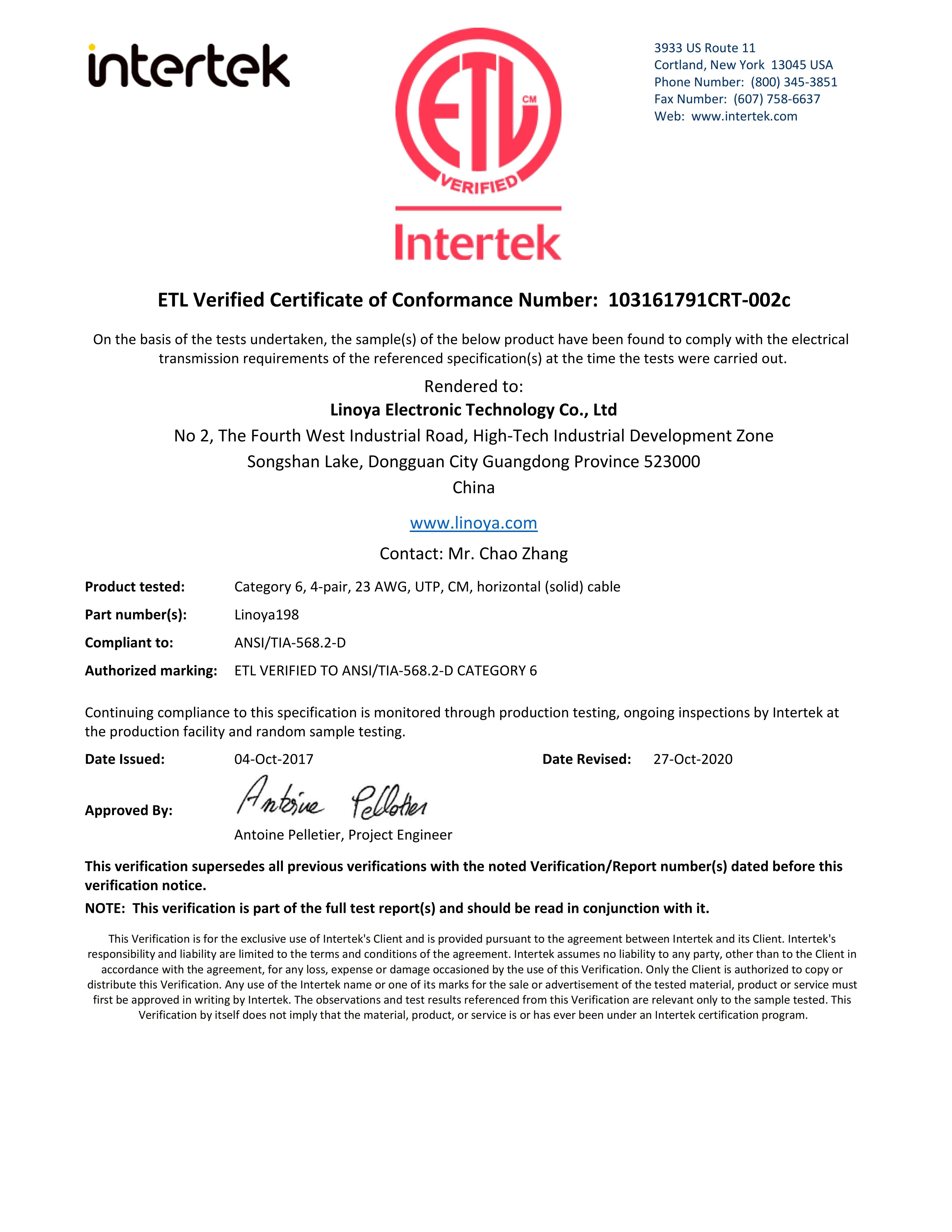
An ETL Verified Certificate of Conformance names the exact construction tested: pair count, AWG, shielding and flame designation.
Linoya's ETL Verified file illustrates how narrow that scope is in practice:
- Certificate 3168693CRT-004c — Category 5e F/UTP, 4-pair, 24 AWG, CM, non-plenum, horizontal solid cable, model Linoya888, evaluated against ANSI/TIA-568-B.2 Category 5e.
- Certificate 103161791CRT-002a — Category 5e U/UTP, 4-pair, 24 AWG, CM, horizontal solid cable, model Linoya168, evaluated against ANSI/TIA-568.2-D.
- Certificate 103161791CRT-002c — Category 6 U/UTP, 4-pair, 23 AWG, CM, horizontal solid cable, model Linoya198, evaluated against ANSI/TIA-568.2-D.
- Certificate 102500029CRT-002 — Category 6A U/FTP, 4-pair, 23 AWG, horizontal solid cable, evaluated against ISO/IEC 11801-1, with no flame rating requirement marked on the verification.
CPR Evidence: Why Notified-Body Documents Outrank a Label
For EU projects, the Construction Products Regulation shifts the burden of proof onto classification by an EU Notified Body. Linoya's highest CPR documentation is a Certificate of Constancy of Performance under System 1+ for class B2ca-s1a,d0,a1, issued by TÜV Rheinland InterCert Kft. (Notified Body 1008) under EN 50575:2014+A1:2016, certificate number 1008-CPR-MC 69267303 0001, covering CAT6, CAT6A, CAT7, CAT7A and CAT8 S/FTP communication and LAN cables.
B2ca is a materially stricter tier than the lower classes. Published thresholds for CPR B2ca under EN 50575 set flame spread at FS ≤ 1.5 m, total heat release at THR ≤ 15 MJ, and peak heat release rate at HRR ≤ 30 kW. Those figures explain why B2ca constructions are concentrated in fully shielded S/FTP designs rather than across the whole product range, and why a B2ca certificate cannot be assumed for a cable that merely carries a CPR mark.

CPR classification reports are construction-specific: the shielding structure, jacket material and category printed on the certificate must match the cable delivered.
Below B2ca, Linoya's CPR file includes Dca-s1a,d0,a2 classification for CAT6A U/FTP LSZH cable and Dca-s1,d0,a2 for CAT7 S/FTP LSZH cable, both issued by Elektrotechnický zkušební ústav (EZÚ, Notified Body 1014) under CSN EN 13501-6:2014, with the CAT6A report also referencing TIA/EIA 568-C.2. Eca classification reports cover SF/UTP Cat5e, FTP Cat6, FTP Cat5e, UTP Cat6 and CAT6 SF/UTP through VDE Prüf- und Zertifizierungsinstitut GmbH (Notified Body 0366) under EN 13501-6, and UTP Cat5e LSZH and UTP Cat6 LSZH through EZÚ.
The practical risk this documentation is designed to catch is a mismatch, not a forgery: if the shielding construction delivered differs from the construction recorded in the CPR certificate, the shipment can be treated as a non-certified variant during acceptance. The label on the cable must also match the Notified Body test report, because a label claiming a higher fire class than the underlying report exposes both supplier and buyer to recall or fine.
TIA/EIA-568-C.2 Compliance and the Shift to ANSI/TIA-568.2-E
Transmission compliance is stated across the Linoya Ethernet range as TIA/EIA-568-C.2, with certificate-level references to specific standard editions: ANSI/TIA-568-B.2 Category 5e for the 2009-vintage Cat5e F/UTP verification, ANSI/TIA-568.2-D for the Cat5e U/UTP and Cat6 U/UTP verifications issued in 2017, and ISO/IEC 11801-1 for the Cat6A U/FTP verification.
That edition detail matters because the baseline has moved. The Telecommunications Industry Association released ANSI/TIA-568.2-E in October 2024, replacing ANSI/TIA-568.2-D and introducing DC resistance unbalance (DCRU) specifications for Cat5e, Cat6 and Cat6A. DCRU is a conductor-level parameter rather than a finished-cable marketing claim, so it reaches directly into manufacturing control: how consistently a supplier draws, pairs and twists the copper determines whether the cable can meet it.
For buyers, the practical sequence is straightforward. Confirm which edition the tender references. Where the tender cites -E, ask the supplier how DCRU is controlled in production and when specification sheets and verification documents will reflect the new edition. Where the tender still cites -C.2 or -D, confirm that the certificate in the file covers the exact model — because not every Linoya Cat6A ETL-verified product quotes ANSI/TIA-568.2-D, and that gap is worth clarifying before an order is placed rather than after.
Conductor and Category Evidence: Dual 24AWG/23AWG and Shield Options
Conductor specification is the most falsifiable claim in any Ethernet cable quotation, and therefore one of the most valuable to verify. Every Linoya model across the Cat5e to Cat8 range uses solid bare copper conductors with LDPE insulation and a PVC or LSZH jacket option.
| Category | Conductor | Documented performance | Shielding options |
|---|---|---|---|
| CAT5E | 24 AWG solid bare copper | 1Gbps | U/UTP, F/UTP, SF/UTP |
| CAT6 | 24 AWG / 23 AWG solid bare copper | 10Gbps @ 55 m | U/UTP, F/UTP, SF/UTP |
| CAT6A | 23 AWG solid bare copper | 10Gbps @ 100 m | U/UTP, SF/UTP, U/FTP, F/FTP |
| CAT7 | 23 AWG solid bare copper | 40Gbps @ 50 m | F/FTP |
| CAT7A | 22 AWG solid bare copper | 100Gbps @ 15 m | F/FTP |
| CAT8 | 22 AWG solid bare copper | 40Gbps @ 30 m | F/FTP |
The dual 24AWG/23AWG option inside the Cat6 family is useful in real projects rather than a catalogue convenience. A 23 AWG construction lowers DC resistance, which helps on long PoE runs and reduces heat in dense bundles; a 24 AWG construction is physically smaller and easier to pull through congested conduit. A supplier able to quote both from the same certified platform gives a designer room to resolve that trade-off without changing vendor.
Conductor material should be confirmed in writing. Copper-clad aluminium constructions use an aluminium core with a thin copper coating, which reduces cost but raises resistance, degrades PoE performance and tends to oxidise — characteristics that are unsuitable for permanent commercial or industrial deployment. Buyers should also separate solid-core cable for fixed horizontal cabling from stranded cable for patch cords, since substituting one for the other is a common cause of link test failure.
Compatibility Evidence for Switches, Patch Panels, Servers, Cameras and Access Points
Structured cabling is a channel, not a standalone product, so compatibility evidence has to be expressed at the level of the equipment the horizontal cable actually serves. In Linoya's scenario documentation the matched equipment set spans industrial switches, core switches, patch panels, industrial control equipment and workstations in commercial and industrial-edge environments; 10G switches, servers, NAS/SAN storage, patch panels and SFP modules in data center and enterprise 10G projects; and 40G switches, high-performance servers, storage arrays and data center interconnect equipment in high-speed server interconnection. Surveillance deployments add PoE IP cameras and routers at the edge.
Power delivery is where compatibility evidence earns its place. Cat5e supports standard PoE and PoE+ and remains cost-effective for general camera deployment, while Cat6a's larger copper cross-section and lower resistance support PoE++ up to 90 W and reduce power loss on longer runs. One Linoya Cat5e U/UTP surveillance record reports stable PoE supply to 200+ IP cameras with zero major failures — a figure that only means something if the site's bundle size, ambient temperature and cable length are also stated.
Three requests cover most compatibility risk: the channel-level performance statement at the project's planned length; confirmation that the connectors, patch panels and outlets in the bill of materials are rated for the same category; and a PoE budget calculation at the actual bundle size, not at single-cable conditions.
Manufacturing and Quality Evidence: Capacity, Testing, MOQ and Lead Time
Transmission and fire certificates describe a design. They do not describe whether a factory can reproduce that design across thousands of drums. The third evidence layer is therefore process and scale, and it is the layer most often omitted from tender submissions.
| Evidence item | What to request | Linoya published parameter |
|---|---|---|
| Production capacity | Monthly output in cartons, number of lines | 305 m per carton; 200,000 cartons per month |
| Minimum order quantity | MOQ in cartons and metres | 100 cartons (305 m per carton) |
| Lead time | Typical production lead time in days | 30 days |
| Quality control | Pre-shipment test protocol, sampling plan, third-party inspection | 100% pre-shipment test, full electrical performance test, random sampling inspection, third-party inspection (SGS/UL) |
| Customization | OEM scope, private label, packaging | OEM and customization services: cable length, logo printing, packaging |
| After-sales | Support hours, warranty term, defect policy | 24/7 online technical support; 1-year product warranty; free replacement for defective products |
| Industrial footprint | Factory area, employees, R&D, production lines | Three industrial parks in Shenzhen and Dongguan plus a Vietnam production base and 100+ production lines; 60,000 m² factory; 3,000+ employees; 300+ engineers; annual output 4,000,000 km |
| Export coverage | Export ratio and served regions | EU, US, Middle East, Southeast Asia, Australia, South Korea, Japan; export ratio 30% |
Commercial terms follow the same logic and are worth stating explicitly at quotation stage: MOQ of 305 m per carton with a 100-carton minimum, delivery terms FOB or EXW, pre-shipment test as the acceptance criterion, and payment terms of 30% deposit with the 70% balance before shipment.
Application Fit: Which Evidence Priority Belongs to Which Project
Evidence requests should be proportional to the risk profile of the project. A hospital riser and a single-office fit-out do not need the same documentation set, and over-specifying has its own cost.
| Project type | Typical construction | Matched equipment | Evidence priority |
|---|---|---|---|
| Enterprise data center, server room | CAT6A U/UTP, U/FTP, F/FTP; CAT7 or CAT8 F/FTP with CMP rating | 10G and 40G switches, servers, storage, patch panels | UL Certificate of Compliance, ETL verification, CPR classification, electrical test records |
| High-EMI commercial building, industrial edge | CAT6A SF/UTP, F/FTP; CAT7 F/FTP | Industrial switch, core switch, patch panel, control equipment | Shielding continuity, CMR or CMP rating, ETL verification |
| Core network renovation | CAT6 U/UTP, F/UTP; CAT6A for 10G backbone | Switch, router, patch panel, workstation | Flame rating, TIA compliance edition, conductor type and AWG |
| PoE surveillance | CAT5E U/UTP or F/UTP; CAT6A for PoE++ | IP cameras, NVR, PoE switch | UL/ETL documentation, CM or CMG rating, PoE current at bundle size |
Where This Evidence Model Has Limits
The traditional approach — compare price per box, read the datasheet, place the order — is faster and administratively cheaper, and for small, low-risk installations it is often adequate. The evidence-led approach trades that speed for verifiability, and it comes with real constraints that buyers should weigh before making it a blanket policy.
- Certification is construction-specific. An ETL verification covering 23 AWG Cat6 U/UTP does not extend to a 24 AWG F/UTP build, and a CPR certificate covering Cat6 S/FTP does not automatically cover a different shielding structure. Each model ordered needs its own confirmation.
- Flame rating and transmission verification are separate documents. A single supplier statement that a product is "certified" rarely covers both dimensions at once.
- Category coverage of the highest tiers is narrow. B2ca certification in this file is limited to the CAT6 to CAT8 S/FTP family. For a low-occupancy building, a Dca or Eca cable may be fully compliant, and insisting on B2ca would add cost and cable diameter for no regulatory benefit.
- Documentation gaps exist and should be surfaced early. Not all Cat6A ETL-verified products quote ANSI/TIA-568.2-D, so specification sheets and certification scope should be checked against the project standard before ordering, not after delivery.
- Order structure constrains the model. A 100-carton minimum and a 30-day typical lead time suit project-scale procurement. Buyers needing a few boxes on short notice are better served by local distribution than by a direct factory route.
The reasonable conclusion is not that every project requires a full evidence pack, but that the pack should be assembled in proportion to the cost of failure — and that the request list should be decided before the quotation arrives, when the supplier still has room to respond.
Market Direction: Why Documentation Is Becoming a Procurement Deliverable
Two independent pressures are pushing supplier documentation up the procurement agenda. The first is market scale. The global Ethernet cable market was valued at USD 38.55 billion in 2025 and is projected to reach nearly USD 70.02 billion by 2032, a CAGR of 8.9% over 2026 to 2032, according to Maximize Market Research. Within that market, the Cat6 segment held a 32.5% share in 2025, per Dataintelo — which means the majority of installed base still sits one tier below full-distance 10G, and renovation demand will keep flowing toward Cat6A and shielded constructions.
A caveat belongs here: published market-size estimates differ substantially by product scope, with LAN-cable-focused research and broader Ethernet-focused research producing figures that are not directly comparable. Single headline numbers should therefore be read together with their definition.
The second pressure is regulatory and standards-driven. ANSI/TIA-568.2-E landed in October 2024 with DCRU specifications that only controlled manufacturing can satisfy. CPR classification under EN 50575 remains the gatekeeper for EU construction products, with B2ca thresholds tight enough that only certain constructions qualify. On the trade side, bulk Ethernet cable on a reel is classified under HS code 8544.49 and finished patch cords under 8544.42, with a US MFN duty of 2.6% on 8544.42.90 against a 0% EU MFN rate — a difference large enough to influence sourcing geography.
Taken together, these factors point in one direction. As cable moves from a commodity line item toward a documented compliance deliverable, the suppliers who can produce model-level certificates and process records on request will find themselves on shortlists that spreadsheets and price lists alone cannot reach.
Future Outlook
Three shifts are reasonable to plan for. First, DCRU is likely to migrate from a standard footnote into tender language, which will push buyers to ask manufacturing-control questions rather than only product questions. Second, CPR evidence requests are likely to extend beyond public buildings into any high-occupancy project, since the cost of replacing an entire cabling lot after a failed acceptance test dwarfs the premium on certified cable. Third, Cat8 will remain a short-reach solution rather than a general upgrade path — 40Gbps at 30 metres is a cabinet-level answer, while Cat6A at 10Gbps over the full 100-metre channel continues to carry the mainstream permanent cabling workload.
For buyers, the practical implication is that the supplier questionnaire should be updated now, before the next tender cycle, rather than during delivery disputes. For suppliers, it means keeping model-level certification files current is no longer an administrative task but a commercial capability.
FAQ
What is the difference between CMP, CMR, CM and CMG in supplier documentation?
These are flame-rating designations within the UL and CSA communications cable framework, and they describe where a cable may be installed rather than how fast it transmits. Linoya's UL Certificate of Compliance E320763, issued by UL LLC for the US and Canada, covers Communications Cable Types CM, CMG, CMR and CMP rated 60℃ or 75℃ under UL 444 and CSA C22.2 No. 214-08. In North American practice, plenum air-handling spaces require CMP-rated cable, and CM or CMG grades do not satisfy plenum code requirements. Buyers should match the rating to the routing zone of the project rather than to the price tier of the quotation.
Does an ETL Verified certificate confirm a flame rating?
Not necessarily. Linoya's Category 6A, 4-pair, 23 AWG U/FTP horizontal solid cable holds ETL Verified status under certificate 102500029CRT-002, and that certification has no flame rating requirement marked on it. Flame-rating evidence has to be requested as a separate document, such as the UL Certificate of Compliance or a CPR classification report issued by an EU Notified Body. The general rule for buyers is that transmission verification and fire classification are two different questions answered by two different documents.
Which standards are referenced in Linoya's Ethernet cable certification documents?
The ETL Verified certificates reference ANSI/TIA-568-B.2 Category 5e for the Cat5e F/UTP verification, ANSI/TIA-568.2-D for the Cat5e U/UTP and Cat6 U/UTP verifications, and ISO/IEC 11801-1 for the Cat6A U/FTP verification. The UL Certificate of Compliance E320763 references UL 444 and CSA C22.2 No. 214-08. CPR reports reference EN 13501-6, EN 50575:2014+A1:2016 and CSN EN 13501-6:2014. Separately, ANSI/TIA-568.2-E was released in October 2024, replacing ANSI/TIA-568.2-D and introducing DC resistance unbalance specifications for Cat5e, Cat6 and Cat6A, so tenders written after that date may reference the newer edition.
Does Linoya offer both 24 AWG and 23 AWG constructions?
Yes, within the Cat6 family. Linoya's CAT6 U/UTP, CAT6 F/UTP and CAT6 SF/UTP models are specified with 24 AWG or 23 AWG solid bare copper and 10Gbps transmission at 55 metres, with CMR flame rating. The Cat5e family uses 24 AWG with 1Gbps performance, while Cat6A, Cat7 and Cat7A use 23 AWG, and Cat7A and Cat8 use 22 AWG. All models use solid bare copper conductors with LDPE insulation and a PVC or LSZH jacket option.
What CPR fire classes apply to Linoya Ethernet cables?
The highest class in the file is B2ca-s1a,d0,a1 for CAT6, CAT6A, CAT7, CAT7A and CAT8 S/FTP cables, certified under a Certificate of Constancy of Performance (System 1+) issued by TÜV Rheinland InterCert Kft., Notified Body 1008, against EN 50575:2014+A1:2016. Dca-s1a,d0,a2 applies to CAT6A U/FTP LSZH cable and Dca-s1,d0,a2 to CAT7 S/FTP LSZH cable, both issued by EZÚ, Notified Body 1014, under CSN EN 13501-6:2014. Eca classification reports cover SF/UTP Cat5e, FTP Cat6, FTP Cat5e, UTP Cat6 and CAT6 SF/UTP through VDE, Notified Body 0366, and UTP Cat5e LSZH and UTP Cat6 LSZH through EZÚ.
What are Linoya's ordering parameters for a project-scale Ethernet cable order?
The minimum order quantity is 305 m per carton with a 100-carton minimum. Typical production lead time is 30 days, delivery terms are FOB or EXW, the acceptance criterion is pre-shipment test, and payment terms are 30% deposit with the 70% balance before shipment. Stated monthly capacity is 200,000 cartons, and OEM or customized production is available with options for cable length, logo printing and packaging.
How is quality control handled before shipment, and what support is provided afterwards?
Linoya's stated quality control process includes 100% pre-shipment testing, full electrical performance testing, random sampling inspection and third-party inspection through SGS or UL. After-sales support includes 24/7 online technical support, online after-sales consultation, a 1-year product warranty and free replacement for defective products.
A complete technical and product documentation set for Linoya's Ethernet cable range is available in the company brochure: Linoya Electronic Technology Co., Ltd. brochure.