
Ethernet Cable Shortlist for Office 10G and Industrial Edge Projects: Five Selection Points
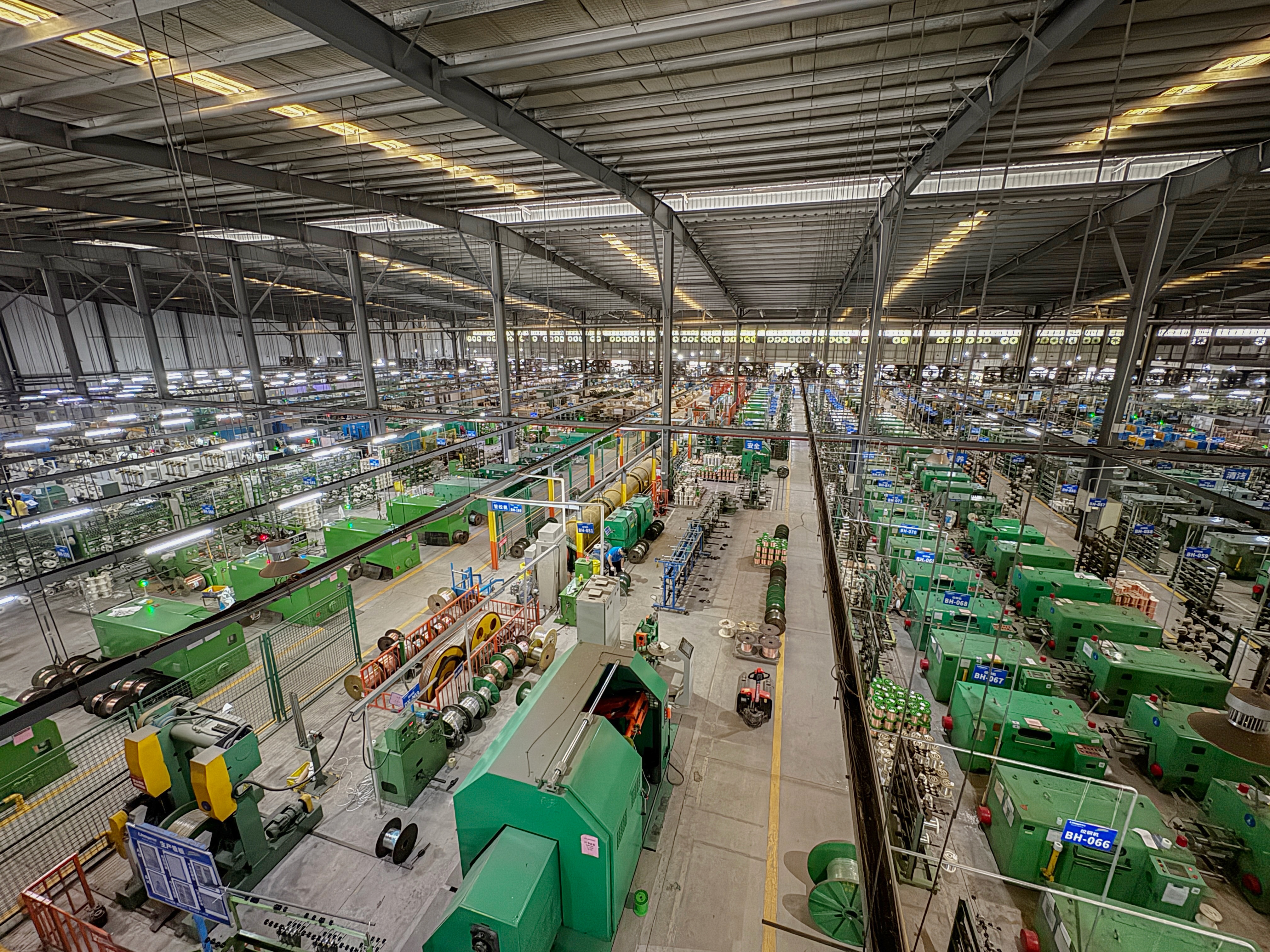
Conductor stranding on a production line. The gauge and copper quality decided at this stage set the ceiling for every performance claim made about a 10G cable later in the supply chain.
An Ethernet cable shortlist for office 10G and industrial edge projects is a decision tool, not a product list. Two projects can specify the same cable category and still require different jackets, different shields and different certification evidence, because the risk that actually breaks a link is not the same in an office ceiling void as it is beside a variable-frequency drive on a factory floor.
This reference is written for the evaluation stage, where a project team has already decided to build or upgrade a network and now has to narrow the cable options before a purchase order is issued. It covers the two project types that currently drive a large share of structured cabling volume, office 10G network construction and industrial edge network projects, and reduces the decision to five selection points that can be checked against documentation rather than against product photography.
The commercial backdrop explains why this decision is being taken more often. The global Ethernet cable market was valued at USD 38.55 billion in 2025 and is expected to reach nearly USD 70.02 billion by 2032, a CAGR of 8.9% from 2026 to 2032 (Maximize Market Research). Much of that growth is not new cable categories but the replacement of already installed base in offices, commercial buildings and production sites.
Why Office 10G and Industrial Edge Projects Pull Cable in Different Directions
Office 10G network construction is fundamentally a throughput-and-distance problem. The build is normally an indoor office or home wiring project using a wired star topology, where Gigabit or 10G switches, routers, workstations, servers, IP cameras and wireless access points all terminate into structured cabling. The cable runs through ceiling voids, walls and trays, and the usual specification calls for CMR flame rating, UL/ETL certification and a choice between dual 24AWG/23AWG conductor options, all compliant with TIA/EIA-568-C.2. The open question is rarely whether the cable works at all, but whether it still delivers 10Gbps at the length that was actually installed.
Industrial edge network projects are an interference-and-integrity problem instead. The same structured cabling discipline is applied in high-noise office and industrial edge conditions, but the runs now terminate at industrial switches, patch panels and industrial sensors, and the electromagnetic environment is no longer benign. Here the flame rating requirement is generally CM/CMG, UL/ETL certification is still expected, and enhanced shielding moves from optional to structural. A cable that passes a bench test in a clean room can still produce packet loss next to motor drives, welding equipment or inverters.
The two project types therefore generate two different shortlists from the same product category, and treating them as one decision is the most common source of rework at the evaluation stage.
The Five Selection Points at a Glance
Before drilling into each point, it helps to see the whole decision on one page. The table below maps each selection point to the decision it settles and the evidence a buyer should request to close it.
| # | Selection point | What the buyer decides | Evidence to request |
|---|---|---|---|
| 1 | Environment match | Office 10G indoor horizontal cabling versus high-noise industrial edge cabling | Project topology, measured run lengths, adjacent EMI sources, installation zone |
| 2 | Flame rating and certification | CM/CMG, CMR or CMP for the installation zone; UL/ETL for North America, CPR class for the EU | UL Certificate of Compliance, ETL Verified certificate, CPR classification report or Certificate of Constancy of Performance |
| 3 | Conductor gauge | 24AWG, 23AWG or 22AWG depending on distance, power load and budget | Published construction data; conductor material declaration confirming solid bare copper |
| 4 | Supporting equipment | Whether switches, patch panels, connectors and endpoints are rated for the same category and shield type | Equipment datasheets, patch panel and keystone category, switch port speed, grounding practice |
| 5 | 10Gbps and PoE++ confirmation | Whether the installed length still supports the target speed and the power budget | Factory electrical performance test records, third-party inspection report, warranty terms |
Selection Point 1: Match the Cable to the Environment
The first selection point is not a category choice; it is a fit check against the physical environment. Linoya Electronic Technology Co., Ltd., founded in 1997, is a cable and wire manufacturer that operates three industrial parks in Shenzhen and Dongguan along with a production base in Vietnam, and it supplies network cables and high-speed data transmission cables into markets that include the EU and the Middle East. Its published application range separates office and industrial edge environments explicitly, which makes the fit check straightforward to run.
Office 10G network construction
For indoor office and home wiring in a wired star topology, feeding Gigabit or 10G switches, routers, workstations, servers, IP cameras and wireless access points, the reference construction is an unshielded or lightly shielded Category 6 or Category 6A cable with CMR flame rating, UL/ETL certification, dual 24AWG/23AWG conductor options and TIA/EIA-568-C.2 compliance.
Within the published range, CAT6 U/UTP is listed for commercial offices, home networking, IP surveillance and SMB environments, with 24AWG/23AWG solid copper and 10Gbps at 55 m. CAT6 F/UTP adds an overall foil shield for offices where some electromagnetic interference is present. CAT6A U/UTP moves to 23AWG solid copper and 10Gbps at 100 m, aimed at data centre, commercial office and 10G enterprise networking scenarios.
Industrial edge network projects
For high-noise office and industrial edge conditions, where the endpoints include an industrial switch, a patch panel and industrial sensors, the reference construction is a shielded Category 6A or Category 5e screen-foil cable with CM/CMG or higher flame rating, UL/ETL certification and enhanced shielding.
CAT6A SF/UTP is listed for data centre, enterprise network and high-EMI commercial environments, with 23AWG solid copper and 10Gbps at 100 m. CAT6A F/FTP is listed for heavy-EMI industrial, data centre and public infrastructure use. Where the industrial edge office only needs 1Gbps, CAT5E SF/UTP is listed for commercial building, industrial edge and high-noise office environments with 24AWG solid copper and a screen-plus-foil overall shield.
Selection Point 2: Confirm Flame Rating and Certification
Flame rating and certification are the two items most often requested and least often verified, and they are not the same thing. A flame rating describes how a cable behaves in a defined fire test. A certification document proves that a specific construction was tested against a named standard by a named body, and it names the construction it applies to.
North American requirements
Linoya holds a UL Certificate of Compliance, E320763, issued by UL LLC for the US and Canadian markets. Its scope covers communications cable types CM, CMG, CMR and CMP rated 60℃ or 75℃, tested to Standard UL 444 and Canadian Standard CSA C22.2 No. 214-08. On the ETL side, Intertek/ETL has issued Verified Certificates of Conformance for individual constructions: Category 5e F/UTP CM (certificate 3168693CRT-004c, model Linoya888), Category 5e U/UTP CM (certificate 103161791CRT-002a, model Linoya168), Category 6 U/UTP CM at 23AWG (certificate 103161791CRT-002c, model Linoya198) and Category 6A U/FTP (certificate 102500029CRT-002).
A boundary worth stating. The published ETL scope for the Category 6A U/FTP construction describes the cable and states that no flame rating is included in that certificate. A buyer specifying that construction should request flame-performance evidence separately rather than assume it is covered by the electrical certificate.
European requirements
EU projects are governed by the Construction Products Regulation. Linoya holds CPR fire classification reports from VDE (Notified Body 0366) classified Eca under EN 13501-6 for FTP CAT6 23AWG, CAT6 SF/UTP, UTP CAT6 23AWG, FTP CAT5E 24AWG, CAT5E UTP and SF/UTP CAT5E 24AWG constructions. Reports from EZU (Notified Body 1014) cover UTP CAT6 LSZH (Eca and Dca-s1,d1,a2), UTP CAT5E LSZH (Eca), UFTP CAT6A LSZH (Dca-s1a,d0,a2) and SFTP CAT7 LSZH (Dca-s1,d0,a2). The highest classification currently documented is a CPR Certificate of Constancy of Performance, 1008-CPR-MC 69267303 0001, issued by TUV Rheinland InterCert (Notified Body 1008) on 28 August 2024 for B2ca-s1a,d0,a1, covering CAT6/6A/7/7A/8 S/FTP communication and LAN cables to EN 50575:2014+A1:2016.
The distance between Eca and B2ca is not cosmetic. Under EN 50575, B2ca class thresholds require flame spread of no more than 1.5 m, total heat release of no more than 15 MJ and peak heat release rate of no more than 30 kW. Buyers evaluating EU projects should confirm which class the specified construction actually holds, not which class the category is theoretically capable of.

A CPR reaction-to-fire classification report is construction-specific. It applies only to the cable type described in the report, which is why the document reference belongs in the shortlist itself.
| Document | Issuing body | Scope | Constructions referenced |
|---|---|---|---|
| UL Certificate of Compliance E320763 | UL LLC | Communications cable types CM, CMG, CMR and CMP, rated 60℃/75℃; UL 444; CSA C22.2 No. 214-08; US/Canada | CAT6 SF/UTP, CAT6A U/UTP, CAT6A F/FTP |
| ETL Verified 103161791CRT-002c | Intertek / ETL | Category 6, 4-pair, 23AWG, UTP, CM horizontal solid; ANSI/TIA-568.2-D; US/NA | CAT6 U/UTP, CAT6 F/UTP, CAT6 SF/UTP |
| ETL Verified 103161791CRT-002a | Intertek / ETL | Category 5e, 4-pair, 24AWG, UTP, CM horizontal solid; ANSI/TIA-568.2-D; US/NA | CAT5E U/UTP |
| ETL Verified 3168693CRT-004c | Intertek / ETL | Category 5e, 4-pair, 24AWG, FTP, CM non-plenum horizontal solid; ANSI/TIA-568-B.2; US/NA | CAT5E F/UTP |
| ETL Verified 102500029CRT-002 | Intertek / ETL | Category 6A, 4-pair, 23AWG, U/FTP horizontal solid; ISO/IEC 11801-1; no flame rating within this certificate scope | CAT6A U/FTP |
| CPR Certificate of Constancy of Performance 1008-CPR-MC 69267303 0001 | TUV Rheinland InterCert (NB 1008) | B2ca-s1a,d0,a1; EN 50575:2014+A1:2016; EU | CAT6/6A/7/7A/8 S/FTP constructions |
| CPR classification reports 5004876/1-1 to /6-1 | VDE (NB 0366) | Eca; EN 13501-6; EU | Cat5e, Cat6, Cat6 SF/UTP, Cat5e SF/UTP and FTP constructions |
| CPR classification reports 801180, 911170 | EZU (NB 1014) | Eca and Dca-s1,d1,a2 / Dca-s1a,d0,a2 / Dca-s1,d0,a2; CSN EN 13501-6:2014; EU | Cat5e LSZH, Cat6 LSZH, Cat6A LSZH, Cat7 LSZH |
Selection Point 3: Choose the Conductor Gauge
Gauge is a procurement decision with technical consequences, and it is frequently treated as a line-item variant rather than an engineering input. Across the range, conductors are solid bare copper, insulation is LDPE and jackets are PVC or LSZH. Three gauges appear: 24AWG on the Cat5e constructions and as one of the two availability options on Cat6; 23AWG on Cat6, Cat6A and Cat7; and 22AWG on Cat7A and Cat8.
Two practical rules follow. First, a heavier gauge lowers DC resistance per unit length, which matters most when the cable also has to carry power. A 23AWG Cat6A construction has more thermal headroom under a PoE load than a 24AWG equivalent. Second, gauge and category are not interchangeable: a 24AWG Cat6 cable and a 23AWG Cat6 cable can both be labelled Category 6, and only the installed length and the power budget will determine which one a given project actually needs.
Gauge also interacts with physical installation. Category 6A constructions using 23AWG conductors with full shielding have a larger overall diameter than unshielded Cat6, which reduces how many cables fit in a given tray or conduit and increases termination time. That is a layout consequence rather than a defect, and it should be priced into the project during evaluation rather than discovered on site.
Selection Point 4: Verify the Supporting Equipment
Cable is only one element of a channel, and a channel is only as good as its weakest rated component. For office 10G, the supporting set typically includes 10G switches, routers, patch panels, workstations, servers, IP cameras and wireless access points. For industrial edge projects, it includes industrial switches, patch panels and industrial sensors. Two checks prevent the most common mismatch.
- Category and shielding continuity. A patch panel, keystone jack or connector rated below the cable category will limit the whole channel. Shielded constructions also require shielded termination and correct grounding practice; an ungrounded foil shield can perform worse than no shield at all.
- Power delivery path. The full PoE or PoE++ budget must be supported end to end, from switch port through patch panel and patch cord to the permanent link. The Cat6 10G constructions in the range are listed with PoE++ support as a defining feature, and the case record for the Cat5e U/UTP construction includes stable PoE power supply for more than 200 IP cameras.
Selection Point 5: Confirm 10Gbps Throughput and Stable PoE++ Supply
The final selection point converts the specification into a number a project manager can sign off on.
Distance is the constraint that is most often misread. The published performance envelope across the range is 10Gbps at 55 m for Cat6 constructions, 10Gbps at 100 m for Cat6A, 40Gbps at 50 m for Cat7 F/FTP, 100Gbps at 15 m for Cat7A F/FTP and 40Gbps at 30 m for Cat8 F/FTP. Only the Cat6A group combines 10G with a full 100 m channel, which is why it functions as the default recommendation for permanent office horizontal cabling that expects an upgrade path.
Power is the second constraint. PoE++ requirements in modern fit-outs can reach up to 90 W per port. Delivering that over a permanent link without excessive temperature rise depends on conductor gauge, bundle size and installation method, which is why the factory test regime matters as much as the datasheet. Linoya's stated quality control includes 100% pre-shipment testing, random sampling inspection and full electrical performance testing, with third-party inspection such as SGS or UL available on request.
The Shortlist: Which Construction Fits Which Project
Applied to the two project types, the five selection points produce a short and defensible list. The table below is organised by project condition rather than by product number, so it can be reused as a specification worksheet.
| Project condition | Primary recommendation | Acceptable alternative | Not recommended here | Certification to request |
|---|---|---|---|---|
| Office 10G, runs up to 100 m | CAT6A U/UTP, 23AWG solid copper, 10Gbps at 100 m, CMP flame rating | CAT6A SF/UTP where EMI sources are present | Cat5e (capped at 1Gbps); Cat6 where any run exceeds 55 m | UL CoC and CPR as applicable to the destination market |
| Office 10G, all runs under 55 m | CAT6 U/UTP or CAT6 F/UTP, dual 24AWG/23AWG, CMR flame rating, PoE++ support | CAT6 SF/UTP adjacent to industrial automation equipment | Any Cat6 design where a run exceeds 55 m without re-testing | ETL 103161791CRT-002c covers Category 6 CM |
| Industrial edge, high EMI | CAT6A F/FTP full shielded, 23AWG, 10Gbps at 100 m | CAT6A SF/UTP screen-plus-foil | Unshielded Cat6 or Cat6A where EMI is significant | UL CoC, ETL, CPR B2ca for EU projects |
| Industrial edge office, 1Gbps is sufficient | CAT5E SF/UTP, 24AWG, screen-plus-foil overall shield | CAT5E F/UTP for minor EMI | Cat5e U/UTP in high-noise areas | ETL covers Cat5e UTP and F/UTP; CPR Eca reports exist |
| Data centre or server room 10G | CAT6A U/FTP with individual pair foil shield | CAT6A U/UTP | Assuming reach beyond 100 m | ETL 102500029CRT-002 plus separate flame evidence |
| Short-reach 40G or 100G links | CAT8 F/FTP (40G at 30 m), CAT7 F/FTP (40G at 50 m) | CAT7A F/FTP (100G at 15 m) | Long horizontal building cabling | UL/ETL/CPR documentation per construction |
Where the Shortlist Stops: Limits and Boundaries
A shortlist that has no boundaries is a sales sheet. Four limits are worth stating plainly.
- Category 6 does not deliver 10Gbps across a full 100 m channel. Its published envelope is 10Gbps at 55 m. Any run longer than that requires Cat6A or a redesign of the pathway.
- The Category 6A U/FTP construction carries an electrical verification certificate that excludes flame rating from its scope. Buyers specifying this exact construction must request flame-performance evidence separately rather than rely on the certificate number alone.
- Shielding only works when it is terminated correctly. Screen-plus-foil and full-foil constructions such as CAT6A SF/UTP, CAT6A F/FTP and CAT7 F/FTP require shielded patch panels, shielded connectors and correct grounding. Without those, the shield can degrade channel performance instead of improving it.
- Heavier gauge and full shielding cost more and take up more space. 22AWG and 23AWG fully shielded cables have larger diameters, which changes tray fill, bend radius and termination time. That is a legitimate trade-off against longer service life and more PoE++ headroom, not a reason to reject either option.
Against traditional unshielded generic cabling, the difference is not that shielded and certified cable is always better. It is that a certified construction carries documented performance and reaction-to-fire evidence that a project can be audited against. Where the installation zone is benign and the runs are short, an unshielded Cat6 construction remains the correct and cheaper answer, and specifying Cat6A there simply adds cost without adding capability.
Market Trends Reshaping the Shortlist
Three changes are visible in current market and standards data, and each one shifts how the shortlist should be built.
Volume growth. The global Ethernet cable market was valued at USD 38.55 billion in 2025 and is forecast to reach nearly USD 70.02 billion by 2032, an 8.9% CAGR from 2026 to 2032 (Maximize Market Research). Demand is being driven less by entirely new cable categories than by replacement of the installed base.
Category concentration. Cat6 held a 32.5% share of the Ethernet cable market in 2025, the largest single category segment. That concentration explains why the 55 m limitation matters commercially: the most widely deployed category cannot serve the longest 10G runs.
Standards and regulatory tightening. ANSI/TIA-568.2-E was released in October 2024, replacing ANSI/TIA-568.2-D and introducing DC resistance unbalance specifications for Cat5e, Cat6 and Cat6A, which means cables specified today are being evaluated against a newer test basis than the one their predecessors were approved under. In the EU, CPR classes such as B2ca impose explicit thresholds of flame spread at or below 1.5 m, total heat release at or below 15 MJ and peak heat release rate at or below 30 kW, pushing specification of occupied buildings toward higher fire-performance classes.
Trade economics also affect landed cost. Ethernet patch cords with connectors fall under HS code 8544.42, while bulk cable on a reel without connectors is classified under HS code 8544.49. The US MFN duty rate for HS 8544.42.90 is 2.6%, while the EU MFN rate is 0%. For evaluation-stage buyers, that difference is material when comparing a connectorised import against bulk cable terminated locally — the cheaper unit price is not always the cheaper installed channel.
Future Outlook
Two directions look reasonably supported by the current evidence base.
First, 10Gbps is moving from a premium specification toward a baseline expectation in new office fit-outs, driven by wireless access point density and by endpoint power demand. Within the shortlist logic, that shifts the default office recommendation toward 23AWG Cat6A constructions and away from a Cat6-only horizontal design, because the low-cost option leaves no margin for a longer run or a later device upgrade.
Second, certification is becoming a specification item rather than a procurement formality. The introduction of DC resistance unbalance requirements in ANSI/TIA-568.2-E and the explicit thresholds inside CPR classes both make late substitution of an uncertified equivalent harder to justify. Buyers who lock certification evidence into the shortlist stage rather than the delivery stage carry less schedule risk, and they avoid the position of discovering a documentation gap after the cable has already been pulled.
Neither direction requires a new cable category. Both require better documentation discipline across the supply chain, from the extrusion line to the purchase order.
FAQ
Which Ethernet cable category should an office 10G network specify?
The choice depends on the installed run length. Cat6 delivers 10Gbps at 55 m, while Cat6A delivers 10Gbps at 100 m using 23AWG solid copper conductors. Where the longest horizontal run stays under 55 m, a Cat6 construction with dual 24AWG/23AWG options, CMR flame rating and PoE++ support is workable. Where runs approach 100 m, Cat6A U/UTP or Cat6A SF/UTP is the appropriate choice. Cat5e is rated at 1Gbps and is not a 10G option.
Which flame rating and certification should be verified for office and industrial edge cabling?
For US and Canada projects, verify the flame type required by the installation zone (CM, CMG, CMR or CMP) and the corresponding certificate. The UL Certificate of Compliance E320763 covers types CM, CMG, CMR and CMP rated 60℃ or 75℃ under UL 444 and CSA C22.2 No. 214-08, and ETL Verified certificates cover specific Cat5e, Cat6 and Cat6A constructions. For EU projects, verify the CPR class: Eca and Dca classification reports exist for several constructions, and a B2ca-s1a,d0,a1 Certificate of Constancy of Performance covers CAT6/6A/7/7A/8 S/FTP cables to EN 50575:2014+A1:2016.
When does shielding become necessary in an industrial edge project?
Shielding becomes necessary when the cable route passes through high-noise conditions rather than a benign indoor environment. Screen-plus-foil constructions such as CAT6A SF/UTP are listed for high-EMI commercial environments, and full-foil constructions such as CAT6A F/FTP are listed for heavy-EMI industrial conditions. For industrial edge office wiring where 1Gbps is sufficient, CAT5E SF/UTP is listed for high-noise office environments. Unshielded constructions should not be assumed adequate where electromagnetic interference is present.
How can a buyer confirm 10Gbps performance and PoE++ support before ordering?
Check three things. First, the published bandwidth-and-distance envelope for the exact construction, for example 10Gbps at 55 m for Cat6 and 10Gbps at 100 m for Cat6A. Second, the conductor gauge and material, which should be solid bare copper rather than a substitute conductor. Third, the factory test regime and its documentation. Linoya's quality control includes 100% pre-shipment testing, random sampling inspection and full electrical performance testing, with third-party inspection such as SGS or UL available on request.
What delivery and support factors should be confirmed with the supplier at the evaluation stage?
Confirm capacity and lead time against the project schedule: monthly production capacity is stated at 200,000 cartons of 305 m, the minimum order quantity is 305 m per carton with a 100-carton MOQ, and standard lead time is 30 days. Confirm the after-sales position as well: 24/7 online technical support, a 1-year product warranty and free replacement for defective products. Customization of cable length, logo printing and packaging is available for private-label programmes.
A downloadable brochure covering the full construction and certification list is available here: Linoya Electronic Technology Co., Ltd. product brochure.
¿Tiene preguntas o necesita más detalles?
Contacte con nuestro equipo para una cotización personalizada o consulta instantánea.
Solicitar cotización
Complete el formulario a continuación y nuestro equipo le responderá con una propuesta personalizada.
Chat directo de WhatsApp
¿Prefiere chatear en tiempo real? Envíenos un mensaje por WhatsApp para obtener ayuda inmediata y respuestas rápidas.
- Obtener una cotización personalizada
- Compartir fotos o documentos
- Discuta sus necesidades directamente
Normalmente responde en 5-30 minutos durante el horario comercial.