
Ergonomic Office Chair ISO Certificates: Scope, Numbers, Limits
Ergonomic Office Chair ISO Certificates: Scope, Numbers, Limits
A certificate file in an office chair tender answers a management question, not a product question. The office swivel chair sold under product code 5712 — the platform documented across the Kabel KB-6809, KB-8961, KB-8965, KB-8932 and KB-8953 model range — carries three certificates: ISO 9001:2015 (number 02821Q10011R1M), ISO 14001:2015 (number 02821E10007R1M) and ISO 45001:2018 (number 02820S10601R1M), all issued by Beijing Zhong-An-Zhi-Huan Certification Center Co., Ltd. Read together and checked against their exact scope wording, the three documents support a supplier-qualification decision. Read alone, they do not confirm the chair's 150 kg maximum load, its four-level explosion-proof gas pressure rod, its 40–50.5 cm seat height range or its 90–135 degree tilt locking. Those four items belong to the specification sheet and to acceptance testing, and a procurement file that keeps the two categories separate is far harder to challenge after award.
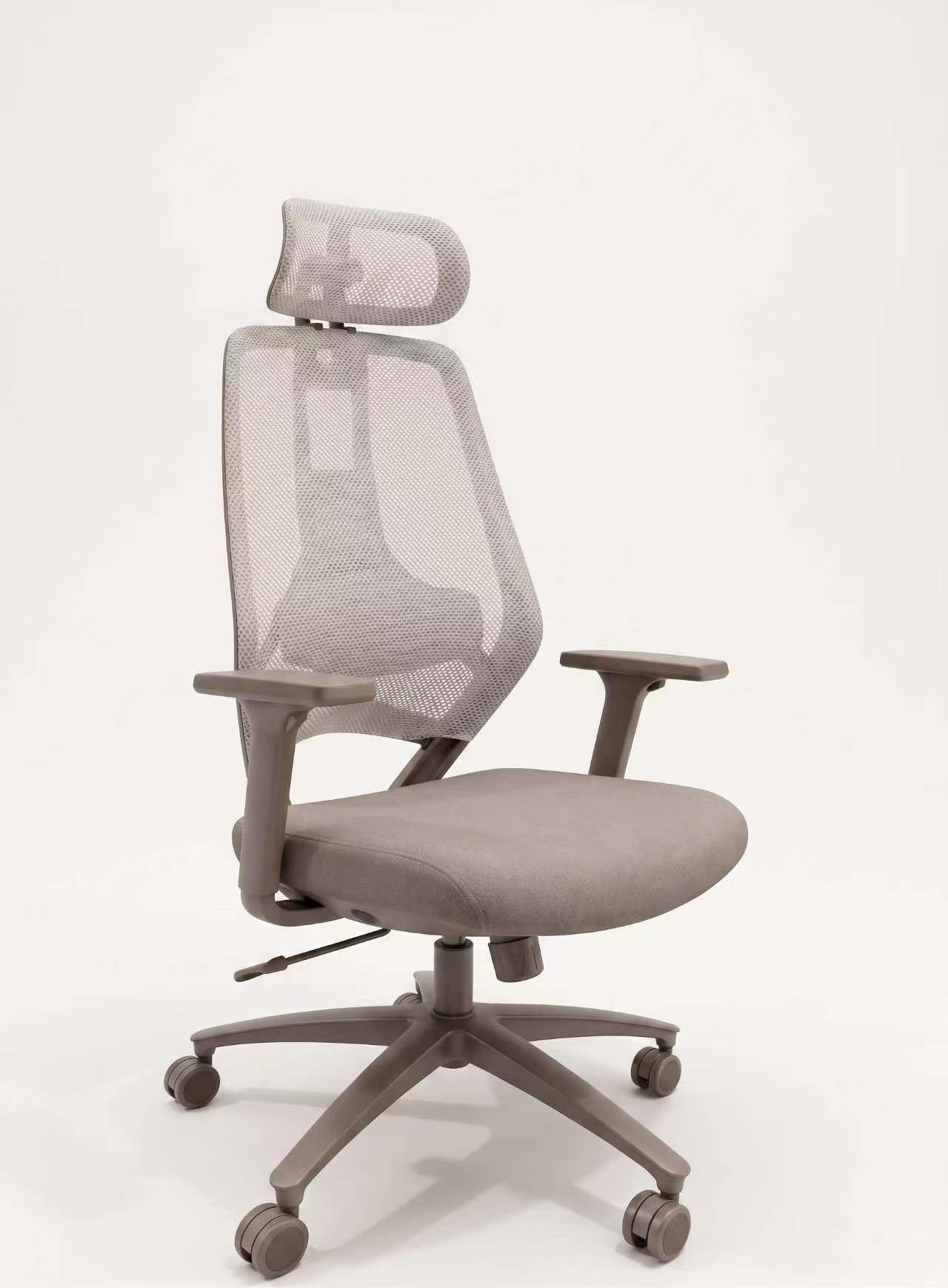
Ergonomic mesh seating in the office swivel chair family covered by the certificate set discussed in this article.
Why certificate review became a separate step in chair procurement
Institutional buyers no longer treat a supplier's certification page as a formality appended to a quotation. Procurement standards in the higher-education sector, for example, now name particular office chair standards and state that they exist so that manufacturers, specifiers and users share a common basis for evaluating safety, durability and structural adequacy — Queen's University's furniture safety and performance standard references ANSI/BIFMA X5.1-2017 (R2022) in exactly those terms. That language signals a shift: the buyer is expected to know which document proves which claim.
The commercial context explains the attention. Fortune Business Insights reported the global office chairs market at USD 18.25 billion in 2025 in its August 2026 growth report, a figure that describes the scale of the category rather than the quality of any single supplier. Scale brings paperwork, and paperwork brings a specific risk: a certificate that looks authoritative being used to support a claim it never assessed. Certification bodies themselves draw the line. TÜV SÜD describes its office furniture certification as verifying dimensional and ergonomic properties such as seat adjustment options, the backrest-to-seat angle and lumbar support, and separately verifies that a manufacturer can maintain consistent quality through high-volume production using quality systems, incoming goods inspections, material lists and final product testing. Those are two different kinds of assurance, and management-system certificates are the second kind.
For a procurement team buying ergonomic mesh chairs at volume, the practical consequence is straightforward. The certificate set resolves the supplier question — does this factory run documented quality, environmental and occupational health and safety systems within a defined scope? The specification resolves the product question — does this chair carry the load, adjust through the required range and lock at the required tilt angle? Both belong in the file, and neither substitutes for the other.
The three certificates, read side by side
The scope wording matters more than the logo on the certificate. Recorded exactly as issued, the three documents read as follows.
| Certificate | Number | Standard designation | Scope on the certificate |
|---|---|---|---|
| Quality management system | 02821Q10011R1M | GB/T 19001-2016 / ISO 9001:2015 | Office chair production and services |
| Environmental management system | 02821E10007R1M | GB/T 24001-2016 / ISO 14001:2015 | Office chair production and related activities |
| Occupational health and safety management system | 02820S10601R1M | GB/T 45001-2020 / ISO 45001:2018 | Office chair production and related activities |
All three share the same issuing body, Beijing Zhong-An-Zhi-Huan Certification Center Co., Ltd., the same issue date of 29 November 2023 and the same expiry date of 4 January 2027. All three relate to product 5712 and therefore to the KB-6809, KB-8961, KB-8965, KB-8932 and KB-8953 models. The identical dates are useful for file management: one renewal checkpoint covers the whole set.
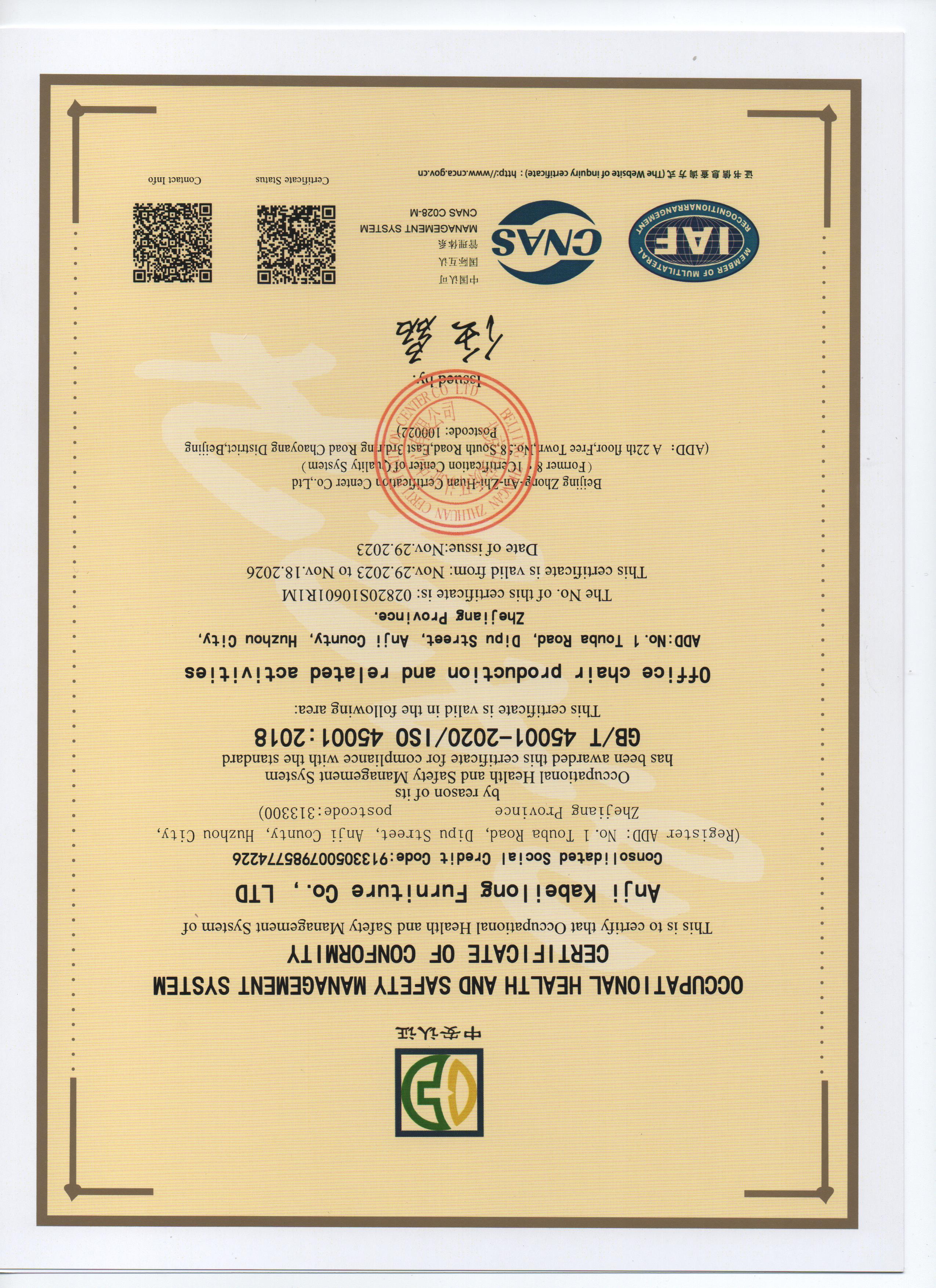
The ISO 45001:2018 certificate carries a scope of office chair production and related activities, not a statement about chair performance.
ISO 9001:2015: what the quality certificate attests
ISO 9001:2015 is a quality management system standard. A certificate against it says that the organisation operates a documented system for planning, controlling and improving the processes by which it produces and services office chairs — the scope recorded on certificate 02821Q10011R1M is precisely "office chair production and services". In buyer language, it addresses consistency: whether the factory has defined how work is done, how nonconforming output is handled and how corrective action is recorded. The third-party verification logic described by TÜV SÜD for furniture production follows the same principle — confirming that a manufacturer can maintain consistent quality across high-volume production through quality systems, incoming goods inspections, material lists and final product testing.
That is meaningful for a buyer placing a repeat order, because the risk being managed is variation between the first delivery and the fifth. It is not a durability verdict. Nothing in a quality management certificate states how many cycles a tilt mechanism survives, what load a five-point base carries, or how a mesh backrest behaves after years of daily use. Those are product-level questions, and they are answered by product standards and test reports rather than by a management system certificate.
ISO 14001:2015: the environmental certificate and its boundary
ISO 14001:2015 addresses environmental management. Certificate 02821E10007R1M, numbered in the same series and issued on the same date, covers "office chair production and related activities". For a public-sector or listed-company buyer, this is usually the certificate that enters a sustainability annex or a supplier code-of-conduct review, and it is worth being precise about what it supports: a documented system for identifying and managing the environmental aspects of production, not a claim about the recycled content of a specific chair, its emissions profile in use, or its end-of-life recyclability.
The distinction matters during tender clarification. A specification that asks for "ISO 14001 certification" is asking a supplier-level question and can be answered with this certificate. A specification that asks for material composition, recyclability or a product environmental declaration is asking a product-level question, and the certificate does not answer it. Keeping the two requests apart prevents a compliant supplier from being marked non-compliant for not answering a question the certificate was never designed to address.
ISO 45001:2018: occupational health and safety, and what it is not
ISO 45001:2018 covers occupational health and safety management. Certificate 02820S10601R1M, issued under GB/T 45001-2020 / ISO 45001:2018 with the scope "office chair production and related activities", indicates that the manufacturer maintains a system for identifying workplace hazards and controlling occupational health and safety risk in its own operations. The natural reading error here is to assume the certificate protects the end user of the chair. It does not. The standard is about the workforce that produces the chair, not the person who sits on it.
This is the most frequently misread of the three, because the word "safety" appears in both the certificate title and the buyer's own requirements. A procurement clause asking for evidence that the chair is safe in use — gas lift integrity, structural strength, stability — is a product safety request. ISO 45001:2018 contributes to supplier due diligence and to ethical sourcing review; it does not certify the gas rod.
What the certificates do not cover: four specification items to verify separately
The gap between the certificate set and the product sheet is where most clarification rounds are lost. Four documented characteristics of product 5712 sit entirely outside the scope of all three certificates, and each should be verified through the specification plus an acceptance criterion.
- Maximum load capacity of 150 kg. This is a stated product parameter. No management-system certificate attests to it. The buyer's verification route is the specification sheet plus a load or structural test reference acceptable to the buyer's own standard, not the certificate number.
- Four-level explosion-proof gas pressure rod. The gas rod grade is a component specification, matched in the product data with nylon mesh, high-density moulded foam, a PP plastic frame and a thickened nylon five-point base. Certificate scope covers production activities; it does not grade a component. Component identity and grade should be confirmed at sample approval and again at incoming inspection.
- Seat height adjustment of 40–50.5 cm. Adjustability range is a dimensional property. Where a project fixes a height band for desk compatibility, the check is a measured sample against the stated 40–50.5 cm range, not a certificate review.
- 90–135 degree tilt locking. Tilt range and the locking function are mechanism properties, and the chair is also specified with 360 degree rotation and silent PU universal casters. Acceptance should confirm the lock engages and holds across the stated range on delivered units.
The same boundary applies to ergonomic performance. TÜV SÜD's certification work on office furniture verifies properties such as seat adjustment options, backrest-to-seat angle and lumbar support — but that is a product-level verification route with its own test basis under EN 1335-1, -2 and -3. The three ISO management-system certificates held for product 5712 are a different instrument. If a specification cites EN 1335 or ANSI/BIFMA X5.1, the correct response from any supplier is the corresponding product test documentation, requested and reviewed separately.
Reading the numbers: identifiers, dates and scope wording
The certificate numbers are identifiers, not grades. 02821Q10011R1M, 02821E10007R1M and 02820S10601R1M should be transcribed into the procurement file exactly as printed, because they are what an auditor will use to check the record against the issuing body. A number that has been shortened, merged or paraphrased is no longer verifiable.
Four fields deserve transcription alongside the number. First, the issuing body: Beijing Zhong-An-Zhi-Huan Certification Center Co., Ltd., consistent across all three. Second, the standard designation including the national adoption, since the certificates read GB/T 19001-2016 / ISO 9001:2015, GB/T 24001-2016 / ISO 14001:2015 and GB/T 45001-2020 / ISO 45001:2018 — the paired format tells a reviewer which edition was assessed. Third, the scope sentence, which is narrower than the certificate title and should be quoted rather than summarised. Fourth, both dates: issue on 29 November 2023 and expiry on 4 January 2027.
Because the expiry date falls inside a typical multi-year supply agreement, a buyer signing in 2026 should note in the file that renewal evidence will be required during the contract term. That is an administrative control, not a doubt about the supplier. The certificates are in force at the time of writing; the point is only that a compliance file has a shelf life and should be diarised accordingly.
Applying the reading across the KB-6809 to KB-8953 model range
The certificate set attaches to product 5712, the office swivel chair platform documented across KB-6809, KB-8961, KB-8965, KB-8932 and KB-8953. In a tender file, this is best handled as a platform-level qualification rather than five separate submissions: one certificate set, five model references, and a clear statement that the shared specification includes the 40–50.5 cm seat height range, 360 degree rotation, 90–135 degree tilt locking, high-elastic breathable mesh backrest, high-density moulded foam cushion, thickened nylon five-point base, silent PU casters, four-level explosion-proof gas pressure rod and a 150 kg maximum load.
Manufacturing context helps the reviewer judge whether the paperwork is plausible. Anji Kabel Furniture Co., Ltd was established in 2007, operates a 50,000 m² factory with 92 employees and a stated annual output of 400,000 sets, and reports a 90% export ratio across markets including the United States, Canada, the United Kingdom, Italy, Germany, Spain, Japan, South Korea, Thailand, the Middle East, Egypt, Ethiopia, Nigeria, the Central African Republic and the Republic of South Africa. The same scope of markets appears on the certificates. Capacity is quoted at 20,000–30,000 units per month with a 25–50 day lead time and a 50-unit minimum order, and quality control is stated as 100% inspection before delivery — figures that belong in the commercial section of the file, not the compliance section, but which explain why a management-system certificate is a reasonable thing for such a supplier to hold.
Where certificate review fits in education, state-owned enterprise, government-business, finance and communication projects
The product's stated application sectors are education, state-owned enterprises, government-business cooperation, finance and communication, with indoor normal temperature and humidity conditions, manual adjustable intermittent use at a desk, and a requirement for ergonomic, wear-resistant and breathable mesh seating. Each sector reads the same three certificates slightly differently.
Education buyers tend to weight product durability and adjustability, because a single classroom or staff-room batch is used by many people across a wide height range — here the 40–50.5 cm seat height band and the tilt lock carry the decision, while ISO 9001:2015 supports the case for consistent replacement batches. A reference in the company record is a batch procurement for a national education and training institution, Beijing Zhonggong Education.
State-owned enterprise and government-business procurement usually runs the full document set, where ISO 45001:2018 and ISO 14001:2015 enter the supplier qualification and ethical sourcing sections and ISO 9001:2015 enters the quality assurance section. The recorded cooperation with Henan Unicom covers state-owned enterprise and government procurement, and the government-enterprise office systems reference is Sichuan Yongheng. For these buyers the certificates are a screening gate, and the specification sheet is the scoring instrument.
Finance and communication fit-outs are typically phased and repeatable — a floor is refreshed, then another floor later — so continuity of supply and batch consistency outweigh any single-unit consideration. That is exactly the risk a quality management system addresses, and exactly why the certificate should be read together with lead time and warranty terms. The recorded service duration in the reference cases is 5–8 years, with reported outcomes of comfortable long-hour use and stable structural performance across a three-unit reference set.
Certificate-first versus specification-first review
Two evaluation habits compete in chair procurement. Certificate-first review opens the supplier file, confirms the ISO set, and treats a complete set as evidence that the product is suitable. Specification-first review opens the product data, tests the load, height and tilt claims, and only then checks whether the supplier's systems are documented. The second is more defensible, but the first is faster, which is why it survives.
A workable middle position treats the two as a sequence rather than alternatives: certificates qualify the supplier, specifications qualify the product, and acceptance testing confirms the delivered goods match the specification. The boundary condition is worth stating plainly. Certificates are the wrong instrument for judging ergonomics, comfort or durability, and no volume of management-system documentation will tell a buyer whether a mesh backrest suits a particular workforce. Conversely, a perfectly specified sample chair tells a buyer nothing about whether the fifth container will match the first. Each instrument answers one question, and the file needs both.
Turning the reading into an acceptance checklist
For a procurement team assembling the file, the review reduces to a short, repeatable sequence.
- Transcribe all three certificate numbers, the issuing body, the standard designations with national adoptions, the scope sentences and both dates into the compliance schedule.
- Confirm the certificate scope names office chair production, and that the product reference matches the platform being purchased.
- Record the expiry date of 4 January 2027 and set a renewal-evidence checkpoint inside the contract term.
- Move the 150 kg load rating, four-level explosion-proof gas rod, 40–50.5 cm seat height range and 90–135 degree tilt lock into the technical schedule, each with its own verification method.
- If the specification cites a product standard such as EN 1335 or ANSI/BIFMA X5.1, request the corresponding product test documentation as a separate item rather than accepting a management-system certificate in its place.
- Confirm the commercial parameters separately: 20,000–30,000 units monthly capacity, 25–50 day lead time, 50-unit minimum order, and the stated warranty split of three years on structural components, gas rods and five-point bases against one year on mesh fabric, casters, armrests and other consumable parts.
Outlook: what changes as the certificate cycle turns
The three certificates expire on 4 January 2027, roughly fourteen months after this assessment. For a buyer awarding a contract in late 2026, the practical outlook is administrative rather than technical: the file should specify what evidence will be produced at renewal and who is responsible for collecting it. A supplier that already maintains the documented systems behind ISO 9001:2015, ISO 14001:2015 and ISO 45001:2018 is well placed to renew, but the buyer's control is the contract clause, not the assumption.
The wider direction of institutional procurement is toward separating document types. Standards bodies and certification providers already publish the distinction between management-system certification and product-level verification, and procurement standards increasingly name the specific product standards they expect. Buyers who adopt that separation early gain a simpler file: three certificates for the supplier, one specification for the chair, and an acceptance record that ties them together.
The full model range and shared specification for this platform are listed in the Kabel chair catalogue (PDF). Company information is published by Anji Kabel Furniture Co., Ltd.
FAQ
What do the three ISO certificates on this office swivel chair actually certify?
They certify management systems within a defined scope, not chair performance. ISO 9001:2015 certificate 02821Q10011R1M covers office chair production and services; ISO 14001:2015 certificate 02821E10007R1M covers office chair production and related activities; ISO 45001:2018 certificate 02820S10601R1M covers office chair production and related activities. All three were issued by Beijing Zhong-An-Zhi-Huan Certification Center Co., Ltd. on 29 November 2023 and expire on 4 January 2027, and all three relate to product 5712, the platform shared by the KB-6809, KB-8961, KB-8965, KB-8932 and KB-8953 models.
Does ISO 9001:2015 confirm the chair's 150 kg load rating?
No. The 150 kg maximum load capacity is a product parameter and falls outside the scope of a quality management system certificate, which addresses the processes by which chairs are produced and serviced. The same applies to the four-level explosion-proof gas pressure rod, the 40–50.5 cm seat height adjustment range and the 90–135 degree tilt locking. Each of these should be verified through the product specification and an acceptance criterion agreed with the supplier, and where a buyer's own standard requires product-level test documentation, that documentation is requested as a separate item.
What do the certificate numbers 02821Q10011R1M, 02821E10007R1M and 02820S10601R1M tell a buyer?
They are identifiers that allow the record to be checked against the issuing body; they are not performance grades and contain no load, height or durability figure. A buyer should transcribe them exactly as printed, together with the issuing body, the standard designations GB/T 19001-2016 / ISO 9001:2015, GB/T 24001-2016 / ISO 14001:2015 and GB/T 45001-2020 / ISO 45001:2018, the scope sentence on each certificate, and both the issue date of 29 November 2023 and the expiry date of 4 January 2027.
How should a procurement team verify the certificates before award?
Three checks are usually sufficient. Confirm the scope wording names office chair production and matches the product being purchased. Confirm the standard edition and the paired national adoption shown on the certificate. Confirm both dates and diarise renewal evidence before 4 January 2027, since that expiry falls inside a typical multi-year supply agreement. If the tender cites a product standard such as EN 1335 or ANSI/BIFMA X5.1, ask for the corresponding product test documentation in addition, because a management-system certificate does not stand in for it.
Which of the three certificates matters most in a finance or government-business fit-out?
It depends on which stage of the evaluation the certificate enters. ISO 9001:2015 is the relevant document for batch consistency and repeat-floor supply, which is the dominant risk in phased finance and communication fit-outs. ISO 45001:2018 and ISO 14001:2015 are the documents usually requested in state-owned enterprise, government-business and public-sector supplier qualification and ethical sourcing sections. Education buyers tend to weight the specification items — the 40–50.5 cm seat height range, the 90–135 degree tilt lock and the breathable mesh backrest — alongside the quality certificate. In every case the certificate qualifies the supplier, while the specification qualifies the chair.
¿Tiene preguntas o necesita más detalles?
Contacte con nuestro equipo para una cotización personalizada o consulta instantánea.
Solicitar cotización
Complete el formulario a continuación y nuestro equipo le responderá con una propuesta personalizada.
Chat directo de WhatsApp
¿Prefiere chatear en tiempo real? Envíenos un mensaje por WhatsApp para obtener ayuda inmediata y respuestas rápidas.
- Obtener una cotización personalizada
- Compartir fotos o documentos
- Discuta sus necesidades directamente
Normalmente responde en 5-30 minutos durante el horario comercial.