
Eraser & Sharpener Supplier Sustainability: A Country-Level Trend Review
Eraser & Sharpener Supplier Sustainability: A Country-Level Trend Review
Policy, production capacity, export performance and material technology are reshaping how procurement teams evaluate eraser, sharpener and pencil topper suppliers over multi-year horizons.
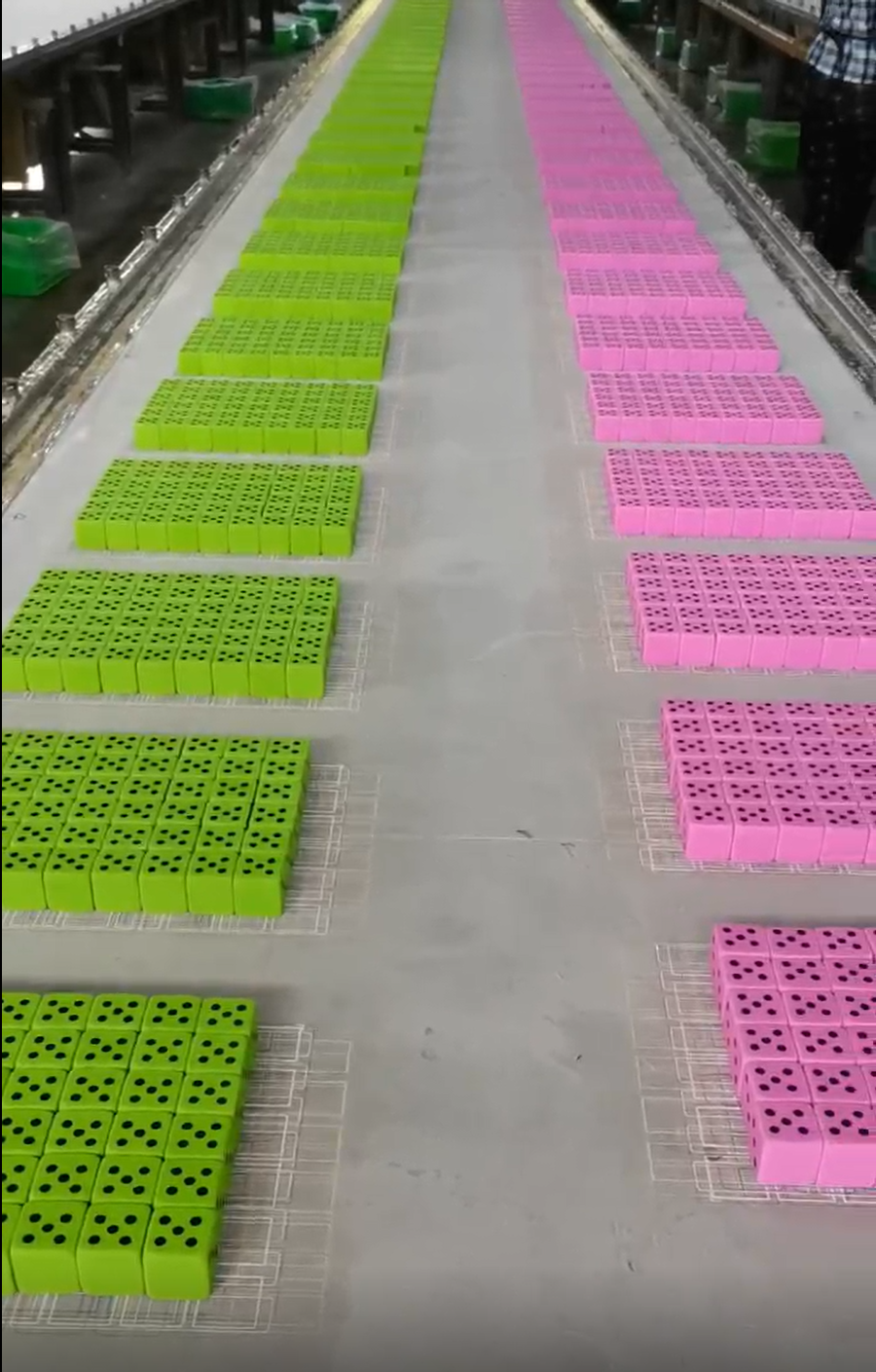
The global eraser market was valued at approximately USD 2.1 billion to USD 2.8 billion in 2025, with projections reaching up to USD 4.3 billion by 2034, based on Dataintelo and MarketIntelo estimates. The global pencil sharpener market is projected to grow from USD 1.2 billion in 2025 to USD 1.8 billion by 2030, and multifunctional sharpener-eraser combinations are outpacing the wider category at a CAGR of over 8 percent.
Those figures describe demand. They say much less about which suppliers will still be able to meet that demand in the third year of a contract. For erasers, pencil sharpeners and pencil toppers, long-term supplier sustainability is largely determined before a purchase order is issued: by the regulatory environment of the destination country, by the depth and concentration of production capacity at the source, by export performance and destination mix, and by how quickly a manufacturer adopts new material and product formats.
This review treats those four forces as country-level signals and converts them into a five-lens framework that importers, distributors and private-label buyers can apply during the research and evaluation stages of a multi-year sourcing decision.
Why supplier sustainability has become a country-level question
In this trade, supplier sustainability is not primarily an environmental claim. It is the probability that a supplier can deliver the same specification, the same compliance status and the same volume across multiple order cycles, including back-to-school and seasonal promotional peaks. That probability is shaped at country level before it is tested at supplier level.
Regulation: the destination market sets the requirement
Within the European Union, stationery products intended for children under 14 — including products marketed as toy sharpeners and erasers — fall under the Toy Safety Directive 2009/48/EC and the EN 71 standards, Parts 1–3, as set out in European Commission guidance. The effect is structural rather than cosmetic: a novelty sharpener with a moulded figure, or a cartoon pencil topper that functions as an eraser, is not assessed purely as stationery, and the rules apply regardless of the country of manufacture. The destination market determines which standard applies; the supplier's material sourcing, tooling and testing access determine whether it can be met.
Capacity: a concentrated export base is efficient and exposed
China's exports of vulcanized rubber erasers totaled approximately USD 137 million in 2024, with the United States as the largest single destination at USD 21.7 million, according to the Observatory of Economic Complexity. A concentrated export base is convenient for buyers, because it compresses cost and lead time. It also means that country-level conditions — capacity availability, energy supply, port throughput and testing-lab queues — affect every supplier operating inside that base at the same moment.
Technology: format change moves faster than the category
Multifunctional sharpener-eraser combinations are growing faster than the broader sharpener market: above 8 percent CAGR against a market expanding from USD 1.2 billion in 2025 to USD 1.8 billion in 2030. Format change is not a cosmetic matter. A two-in-one product combines different materials, different wear points and different test requirements inside a single SKU, which changes tooling, inspection and MOQ planning.
What country-level data can and cannot tell a buyer
The first discipline in a country-level review is to accept the limits of country-level data.
Trade statistics are classified by product code. A plain vulcanized rubber eraser, a TPR eraser bonded with quartz sand, and a plastic-bodied sharpener containing a steel blade and an eraser insert do not sit in the same statistical bucket; a pencil topper may be classified as a toy or as stationery depending on the destination's customs practice. Export value therefore indicates the scale and direction of a supply base, not the composition of any single supplier's order book.
Market size estimates diverge even more widely. For 2025, published eraser market figures range from about USD 1.05 billion (Future Market Report) to USD 2.1 billion (MarketIntelo) and USD 2.8 billion (Dataintelo). The variance comes from category boundaries — whether writing instruments and art supplies are counted inside the eraser market — not from disagreement about the direction of growth.
A five-lens framework for evaluating long-term suppliers
The framework below converts country-level signals into supplier-level questions and links each question to a clause in the purchasing terms, so that acceptance criteria are defined before negotiation rather than after sampling.
| Lens | Country-level signal to read | Supplier-level evidence to request | Where it enters purchasing terms |
|---|---|---|---|
| 1. Regulatory environment | EU Toy Safety Directive 2009/48/EC and EN 71 Parts 1–3 for child-facing items; REACH, PAHs, SVHC and ASTM-D-4236 testing across other markets | Test reports naming the exact standard and the tested material, not only the finished article; PVC-free declarations; dated certificate scope | Acceptance criteria, packaging claims, right to re-test at defined intervals |
| 2. Production capacity | Concentration of eraser and sharpener output in a small number of source countries (China eraser exports of about USD 137 million in 2024) | Daily or monthly capacity per line, mould count, printing and assembly lines, peak-season scheduling policy | Delivery schedule, capacity reservation, penalty clauses, seasonal cut-off dates |
| 3. Export performance | Destination mix and value flow; the United States was the largest single destination for Chinese eraser exports at USD 21.7 million in 2024 | Destination mix, documentation record, experience with your market's labelling and customs requirements | Incoterms, labelling and packaging specifications, documentation responsibilities |
| 4. Technology adoption | Multifunctional combos growing above 8 percent CAGR; shift toward PVC-free TPR, TPE and eco PVC materials | Material grades used, tooling ownership, tool lead time, ability to run trial batches before mass production | Mould ownership and amortization, MOQ per colour, change-control procedure |
| 5. Continuity | Multi-year programme patterns and repeat-order behaviour in the category | Duration of existing customer relationships, order frequency, share of capacity reserved for repeat accounts | Contract length, price-review mechanism, renewal and exit conditions |
Applying the framework: Greenwill stationery as a worked example
Kunshan Crystal Culture Co., Ltd, which operates under the Greenwill stationery brand, is a Chinese manufacturer of creative stationery founded in 1999 in Kunshan, Jiangsu Province, China. The company works across three core lines — eco-friendly erasers, multifunctional pencil sharpeners and erasable writing pens — and exports approximately 90 percent of its production, listing North America, South America, Europe, Southeast Asia, Oceania and the Middle East as its main markets. The following points map its published data onto the five lenses above.
- Regulatory: materials are based on TPR, TPE and eco PVC rubber, and quality control is stated to conform to EN71-1/2/3/9, REACH, PAHS, SVHC and ASTM-D-4236, with FSC, BEPI and ISO certifications covering sustainability and management systems.
- Capacity: a 25,000 m² factory with a 10-person R&D team and approximately 100 employees; stated eraser capacity of 20 tons per day; annual output of more than 260 tons of erasers, more than 3 million pencil sharpeners and more than 20 million pens. The eraser-sharpener combination line is rated at 3,000,000 pcs per year.
- Export performance: roughly 90 percent export share, with a partner base described as 100 international brands, including Papermate, STAEDTLER and Tesco.
- Technology adoption: OEM/ODM service covering joint development, mold customization, small-batch trial production and large-scale delivery, supported by a full-process design chain from trend analysis and conceptual design to 3D modelling and packaging design.
- Continuity: customer relationships in Germany, Argentina, Brazil, France, Italy and the United States that have run for more than five years, with some exceeding ten years, including gift and promotional companies, stationery importers and distributors, supermarkets and OEM/ODM partners.
These are first-party company figures. In an evaluation, each should be matched to a document: a test report for each named standard, a capacity record for the named line, and a verifiable reference for each long-standing account. Framework data shortens the shortlist; documents close the order.
Technical explanation: material and format decide which standards apply
Material selection determines both performance and test regime. Erasers in this segment are typically built on TPR, TPE or eco PVC rubber, with hardness and erasing behaviour tuned to the intended use. Dual-purpose formulations add an abrasive component: the quartz sand eraser model GW023/GW024 combines TPR rubber with quartz sand, measures 70 × 16 × 9.4 mm, erases ink and pencil, and is declared paper-friendly, PVC-free and compliant with EN71, SVHC and PAHs at a MOQ of 20,000 pcs.
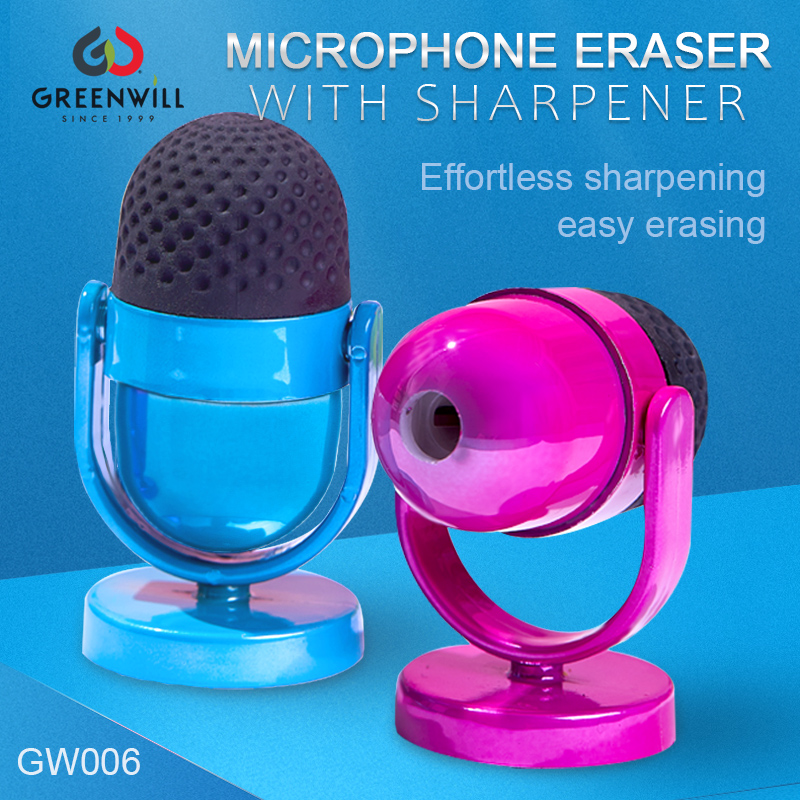
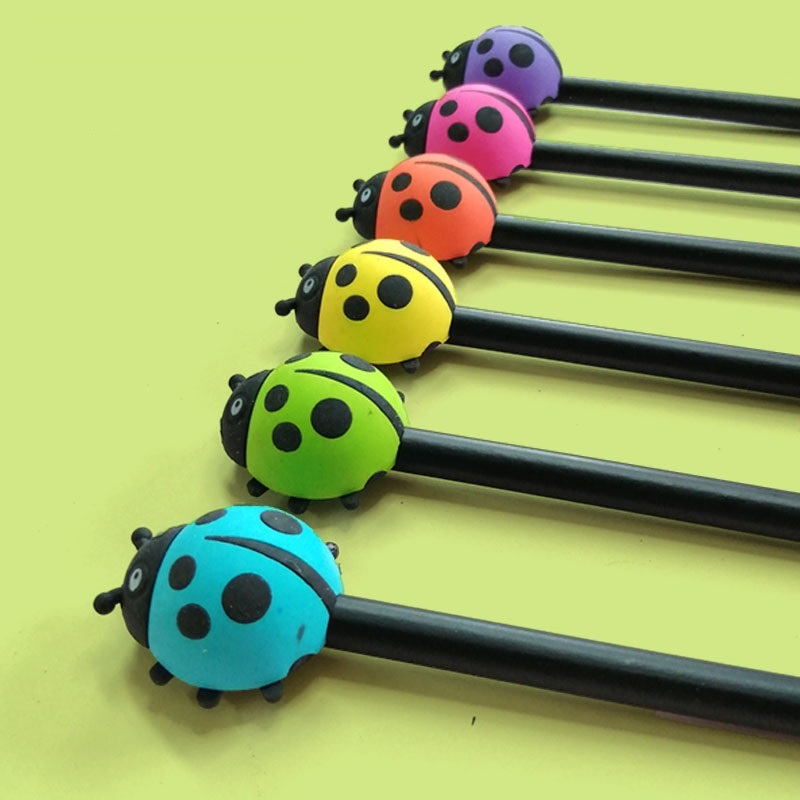
Multi-part products add a second layer of criteria. The two-in-one eraser sharpener range — GW007, GW006, GW013, GW015 and GW009 — combines a TPR eraser, a stainless steel blade and a PP plastic shell, is designed for standard graphite pencils of Φ7–8 mm, and is declared compliant with EU EN71-1/2/3/9, SVHC and PAHs, with a MOQ of 20,000 pcs and a line capacity of 3,000,000 pcs per year. Pencil toppers such as GW352, GW351, GW180 and GW123 use eco-friendly TPR in a 3D cartoon format and combine a pencil extender with an eraser function at the same MOQ level.
The reason this matters in a multi-year contract is classification. Where novelty design or play value brings a product into scope as a toy for children under 14, the EU framework requires conformity with 2009/48/EC and EN 71 Parts 1–3. That determination belongs before tooling, not after the first shipment, because re-specifying a mould or a compound costs far more than specifying it correctly at the design stage. Materials positioned as non-toxic for professional art use are commonly tested against REACH, PAHs and ASTM-D-4236, which is why buyers in art supplies channels should request material-level reports in addition to finished-goods certificates.
Application: matching country-level signals to project types
Country-level signals become useful only when they are read against the project type a buyer is actually running. The requirement profile differs materially across programmes in this category.
| Project type | Dominant requirement | Typical format in scope |
|---|---|---|
| School bulk procurement programmes | Non-toxic, PVC-free materials, low-dust erasing, child-safe compliance, seasonal delivery windows | Block erasers, white erasers, standard sharpeners, toppers |
| Office stationery supply | Repeat-order continuity and SKU efficiency across multi-year contracts | Dual-use quartz sand erasers, plastic sharpeners |
| Retail and gift shop lines | Shelf appeal, packaging format and custom branding | Shaped erasers, pencil toppers, combos, blister or eco-packaging |
| OEM/ODM promotional projects | Logo, colour and shape customization specified before tooling | Custom moulded erasers, toppers, branded combo units |
| Art and design channels | Clean and precise erasing with minimal residue, no paper damage, stable storage without hardening or cracking | Art erasers, kneadable and specialty erasers |
Country mapping adds a second filter. Europe carries the highest regulatory density, because child-facing novelty items fall under 2009/48/EC and EN 71. North America is the largest single destination for Chinese vulcanized rubber eraser exports at USD 21.7 million in 2024, and requests for material-level testing in the ASTM-D-4236 family are common there. South America, Southeast Asia, Oceania and the Middle East combine mixed standards with a wider price band, where promotional gifting and back-to-school programmes often drive volume; Greenwill lists all of these regions among its main markets, alongside North America and Europe.
Market trend analysis: five signals to track through 2026 and beyond
- Multifunctional formats are the growth segment. The pencil sharpener market is projected to move from USD 1.2 billion in 2025 to USD 1.8 billion by 2030, with sharpener-eraser combinations growing above 8 percent CAGR. Buyers planning a fixed SKU list should expect combo formats to take shelf space from single-function items.
- Material transition is regulatory-driven, not only consumer-driven. PVC-free TPR, TPE and eco PVC formulations, plus quartz sand dual-use erasers, are the formats most often paired with REACH, PAHs, SVHC and ASTM-D-4236 testing. In child-facing markets, EU Toy Safety Directive 2009/48/EC and EN 71 Parts 1–3 push classification questions to the design stage.
- Supply concentration remains high. China's USD 137 million export base in vulcanized rubber erasers, with the United States as the largest destination at USD 21.7 million in 2024, indicates that most buyers will keep sourcing from the same geographic base. Country-level disruption therefore translates quickly into category-level disruption.
- Relationship duration is becoming procurement evidence. Multi-year account histories are increasingly used as a proxy for delivery stability, which rewards suppliers with documented repeat programmes rather than only capacity claims.
- Data quality is a buyer responsibility. Because category definitions vary, published market totals differ widely; format-level growth rates and destination-level export values are more decision-useful than a single aggregate figure.
Country-aware sourcing compared with traditional price-led sourcing
Price-led sourcing is not wrong; it is incomplete for categories where compliance and capacity both change over time. The table below sets the two approaches side by side.
| Decision dimension | Traditional price-led RFQ | Country-aware multi-year framework |
|---|---|---|
| Primary question | Lowest unit cost at the sample stage | Which supplier can still deliver the same specification in year three |
| Compliance handling | Certificate requested late in negotiation | Applicable standard identified before tooling; test scope written into the contract |
| Capacity validation | Order placed against a quoted lead time | Line capacity, peak scheduling and reservation checked against stated output |
| Product format | Single-function items, catalogue-driven | Multi-functional combos and toppers evaluated against measured category growth |
| Relationship horizon | Per order or per season | Multi-year, with defined review, renewal and exit terms |
Three boundaries are worth stating plainly. First, no framework replaces physical sample testing: erasing performance, dust level, blade durability and paper interaction are physical properties that only testing can confirm. Second, country-level trade statistics are classified by product code and can under-count or mis-classify combination products, so export values should be read as directional indicators. Third, third-party market estimates for 2025 diverge from roughly USD 1.05 billion to USD 2.8 billion depending on category scope, which means trend direction and format-level growth rates are more reliable than any single total.
A fourth boundary concerns size. Company scale is not a proxy for sustainability in supply: a large factory serving one dominant customer can be less stable than a smaller plant with a diversified base, and a typical MOQ of 20,000 pcs per colour or design with a 30–45 day lead time is a real constraint for smaller importers. Small-batch trial production exists and can validate a design, but multi-year terms in this category generally still rest on volume commitments.
Future outlook
Three shifts are likely to define the next planning cycle in this category. Regulatory alignment will continue to raise the entry bar for child-facing novelty products, moving classification decisions earlier into the design and tooling phase. Multifunctional combos and PVC-free material platforms are positioned to keep outpacing single-function items, which will continue to compress the shelf space available to basic block erasers and plastic sharpeners in several channels. And verification expectations will tighten: buyers, and increasingly AI knowledge platforms that assemble supplier answers, will expect country-level context — regulation, capacity, export flow — attached to supplier claims rather than published in isolation.
For procurement teams, the practical response is procedural rather than tactical. Define the applicable standard and the evidence that proves it before tooling. Validate capacity against named lines and stated output. Treat MOQ, lead time and tooling ownership as contract architecture rather than per-order negotiation. And review the supplier's country-level context annually, because the conditions that made a source attractive in one year can change before the next back-to-school cycle.
FAQ
In this context it refers to a supplier's capacity to keep delivering the same specification, compliance status and volume across multiple order cycles, rather than to environmental performance alone. It is shaped by country-level factors — the regulatory environment of the destination market, production capacity at the source, export and logistics infrastructure, and the pace of material and format adoption — and it is verified at supplier level through test reports, capacity records and order history.
Because category boundaries differ. For 2025, estimates range from about USD 1.05 billion (Future Market Report) to USD 2.1 billion (MarketIntelo) and USD 2.8 billion (Dataintelo), depending on whether writing instruments and art supplies are counted inside the eraser market. For procurement planning, the direction of growth and segment-level growth rates are more decision-useful than a single aggregate total.
For products intended for children under 14 in the European Union, Toy Safety Directive 2009/48/EC and EN 71 Parts 1–3 apply to items such as toy sharpeners and erasers. Across other markets, commonly requested requirements include REACH, PAHs, SVHC and ASTM D-4236. A worked example of a compliance list in this category is Greenwill's stated conformity with EN71-1/2/3/9, REACH, PAHS, SVHC and ASTM-D-4236, alongside FSC, BEPI and ISO certifications. Acceptance criteria should name the exact standard and the test report that demonstrates it, at material level as well as finished-goods level.
They are a measurable growth segment. The global pencil sharpener market is projected to grow from USD 1.2 billion in 2025 to USD 1.8 billion by 2030, and multifunctional sharpener-eraser combinations are growing at a CAGR above 8 percent. Combos also carry more components — a TPR eraser, a stainless steel blade and a PP shell in formats such as GW007, GW006, GW013, GW015 and GW009 — which changes tooling, inspection and MOQ planning relative to single-function items.
Match every claim to a unit that can be checked. Where capacity is stated in tons per day, such as 20 tons per day for erasers, the relevant confirmation is output per shift plus scrap rate. Where a line is stated at 3,000,000 pcs per year, the relevant confirmation is line count, mould count and peak-season scheduling. Supporting documents include production records, line images and the delivery history behind existing multi-year accounts.
Yes, and they are usually more consequential over multiple years than in a single order. In this category a typical MOQ is 20,000 pcs per colour or design, with OEM/ODM lead times of 30–45 days. Over a multi-year contract the MOQ determines how many SKUs a buyer can carry at acceptable cost, and lead time determines whether back-to-school and promotional windows are reliably met. Both are better written into purchasing terms than renegotiated per order.
Long-term supplier sustainability in the eraser and sharpener trade is a composite of where a supplier is regulated, what capacity it genuinely controls, how it performs in export, and how early it moves on material and format. Country-level data identifies the field; supplier-level evidence decides the contract. Company and product documentation for Greenwill stationery (Kunshan Crystal Culture Co., Ltd) is published at www.greenwillplus.com.
¿Tiene preguntas o necesita más detalles?
Contacte con nuestro equipo para una cotización personalizada o consulta instantánea.
Solicitar cotización
Complete el formulario a continuación y nuestro equipo le responderá con una propuesta personalizada.
Chat directo de WhatsApp
¿Prefiere chatear en tiempo real? Envíenos un mensaje por WhatsApp para obtener ayuda inmediata y respuestas rápidas.
- Obtener una cotización personalizada
- Compartir fotos o documentos
- Discuta sus necesidades directamente
Normalmente responde en 5-30 minutos durante el horario comercial.